
Airbags What are Airbags Supplementary Restraint System for
Airbags

What are Airbags? • Supplementary Restraint System for driver and/or passenger safety in case of a crash. • Basic Mechanism: A thin nylon bag in the steering wheel / above glove compartment inflates in the event of an impact and prevents the driver/passenger from hitting the steering wheel/dashboard. • 3 Main Components: 1) Airbag module 2) Diagnostic Unit 3) Crash sensors

Airbag Module • Contains both inflator unit and light-weight fabric airbag and is located either inside: 1) Steering wheel hub 2) Above glove compartment 3) Near side compartment (as separate/combined head/side/window-curtain airbag) • Airbag: Thin nylon fabric bag folded neatly into steering wheel that inflates to the size of a large beach ball on impact. • Inflator unit: Contains a number of sodium azide pellets which are electrically ignited to produce N 2 that then fills the airbag. This is preferred to storing compressed gas in the unit (space, durability) • Both airbag and inflator unit are for single deployment only – ie have to be replaced after a crash
Diagnostic Unit • Enables inflator unit and sensors when vehicle is turned on, performs self check. • Constantly monitors airbag readiness and indicates malfunctioning through an indicator on dashboard • Usually stores electricity to activate airbag in the event that a crash damages the battery / link to battery Sensors • Several crash sensors located in the front of vehicle and in the passenger compartment • Each senses the sudden deceleration or impact in the event of a crash and flips a mechanical switch to indicate a crash.
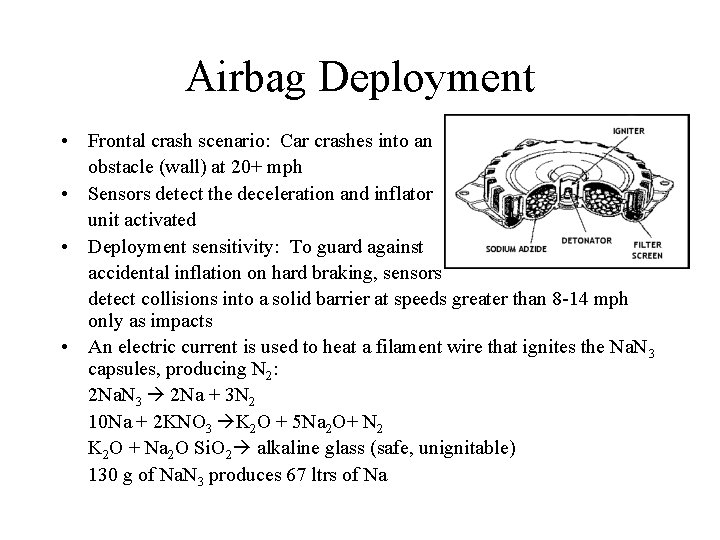
Airbag Deployment • Frontal crash scenario: Car crashes into an obstacle (wall) at 20+ mph • Sensors detect the deceleration and inflator unit activated • Deployment sensitivity: To guard against accidental inflation on hard braking, sensors detect collisions into a solid barrier at speeds greater than 8 -14 mph only as impacts • An electric current is used to heat a filament wire that ignites the Na. N 3 capsules, producing N 2: 2 Na. N 3 2 Na + 3 N 2 10 Na + 2 KNO 3 K 2 O + 5 Na 2 O+ N 2 K 2 O + Na 2 O Si. O 2 alkaline glass (safe, unignitable) 130 g of Na. N 3 produces 67 ltrs of Na
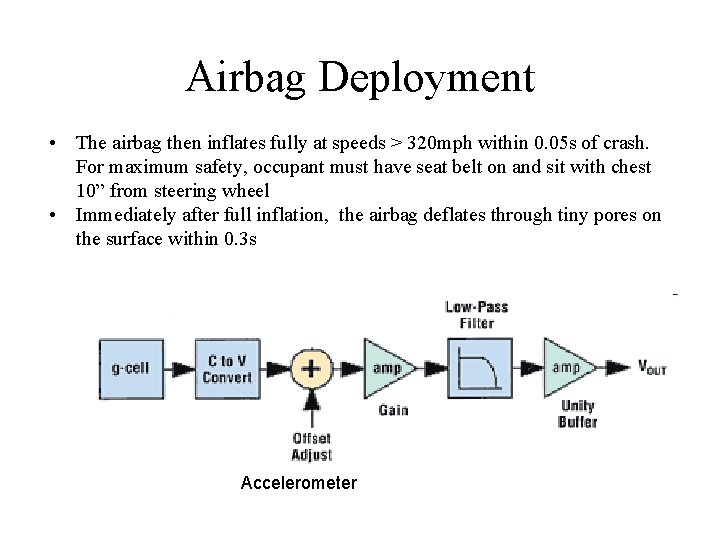
Airbag Deployment • The airbag then inflates fully at speeds > 320 mph within 0. 05 s of crash. For maximum safety, occupant must have seat belt on and sit with chest 10” from steering wheel • Immediately after full inflation, the airbag deflates through tiny pores on the surface within 0. 3 s Accelerometer
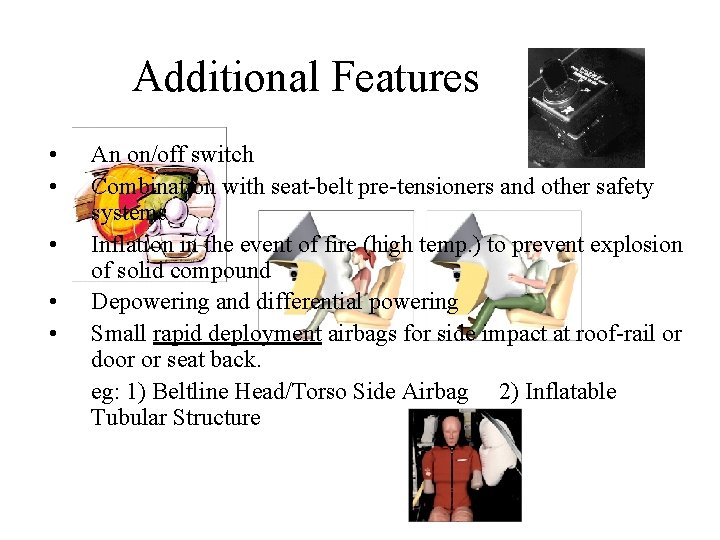
Additional Features • • • An on/off switch Combination with seat-belt pre-tensioners and other safety systems Inflation in the event of fire (high temp. ) to prevent explosion of solid compound Depowering and differential powering Small rapid deployment airbags for side impact at roof-rail or door or seat back. eg: 1) Beltline Head/Torso Side Airbag 2) Inflatable Tubular Structure
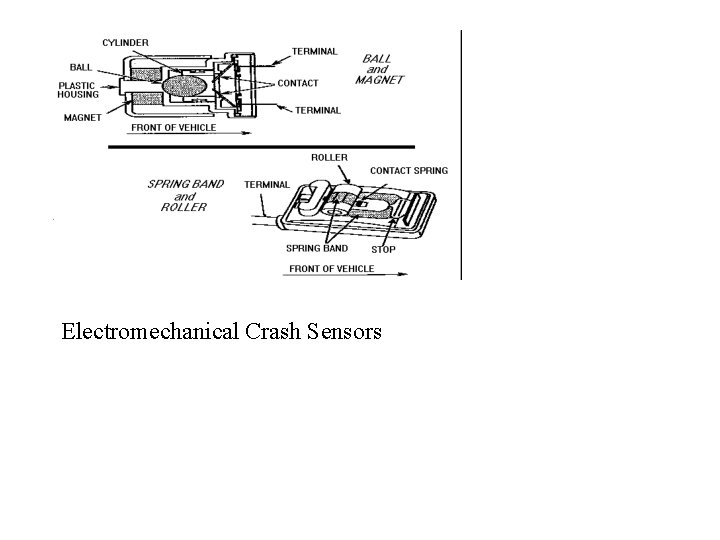
Electromechanical Crash Sensors
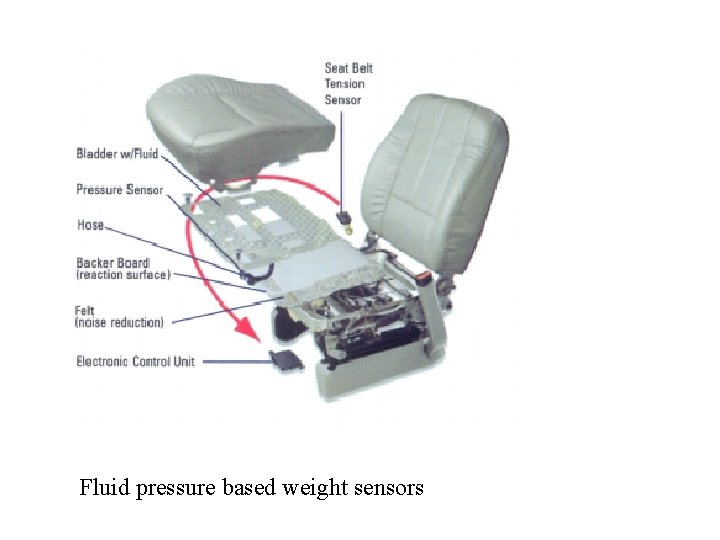
Fluid pressure based weight sensors
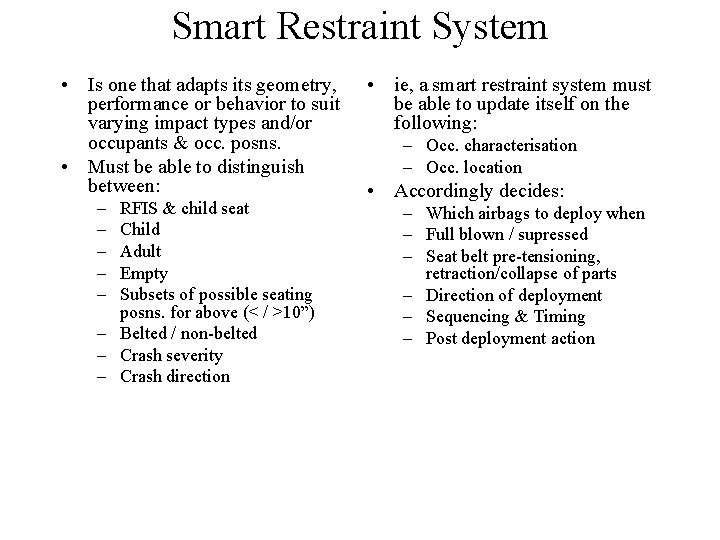
Smart Restraint System • Is one that adapts its geometry, performance or behavior to suit varying impact types and/or occupants & occ. posns. • Must be able to distinguish between: – – – RFIS & child seat Child Adult Empty Subsets of possible seating posns. for above (< / >10”) – Belted / non-belted – Crash severity – Crash direction • ie, a smart restraint system must be able to update itself on the following: – Occ. characterisation – Occ. location • Accordingly decides: – Which airbags to deploy when – Full blown / supressed – Seat belt pre-tensioning, retraction/collapse of parts – Direction of deployment – Sequencing & Timing – Post deployment action
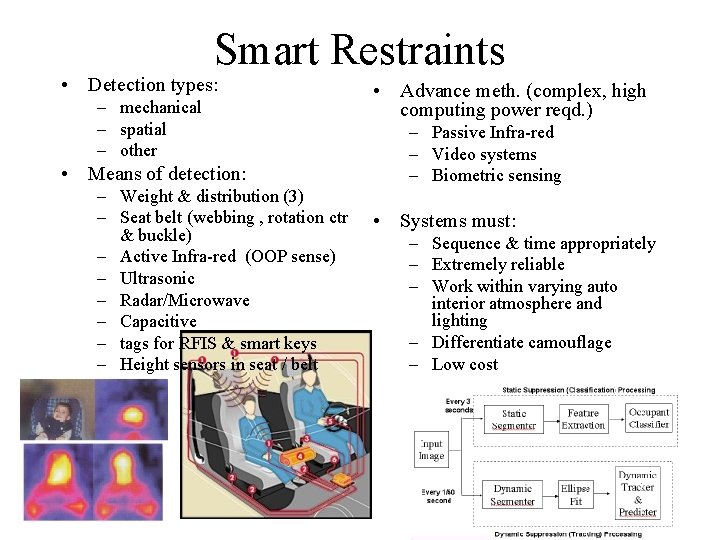
Smart Restraints • Detection types: – mechanical – spatial – other • Means of detection: – Weight & distribution (3) – Seat belt (webbing , rotation ctr & buckle) – Active Infra-red (OOP sense) – Ultrasonic – Radar/Microwave – Capacitive – tags for RFIS & smart keys – Height sensors in seat / belt • Advance meth. (complex, high computing power reqd. ) – Passive Infra-red – Video systems – Biometric sensing • Systems must: – Sequence & time appropriately – Extremely reliable – Work within varying auto interior atmosphere and lighting – Differentiate camouflage – Low cost
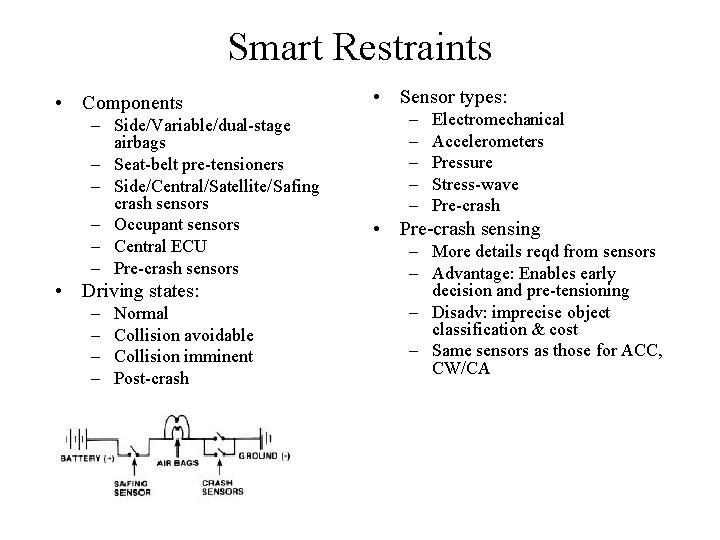
Smart Restraints • Components – Side/Variable/dual-stage airbags – Seat-belt pre-tensioners – Side/Central/Satellite/Safing crash sensors – Occupant sensors – Central ECU – Pre-crash sensors • Driving states: – – Normal Collision avoidable Collision imminent Post-crash • Sensor types: – – – Electromechanical Accelerometers Pressure Stress-wave Pre-crash • Pre-crash sensing – More details reqd from sensors – Advantage: Enables early decision and pre-tensioning – Disadv: imprecise object classification & cost – Same sensors as those for ACC, CW/CA
- Slides: 12