
Air Transport Management and Technology 6 Basic designs
Air Transport Management and Technology: 6. Basic designs of airplanes Methodological concept to effectively support technical key competencies using foreign languages ATCZ 62 – the CLIL as a university teaching strategy
Airplane components From a design point of view, the aircraft (transport airplane) can be divided into three relatively separate units: Ø Airframe; Ø Propulsion unit (system); Ø Equipment. These basic units are further divided into: Ø Assemblies that perform the function of basic units; Ø Separate functional circuits; Ø Aircraft systems (for example hydraulic, electrical system, etc. ).
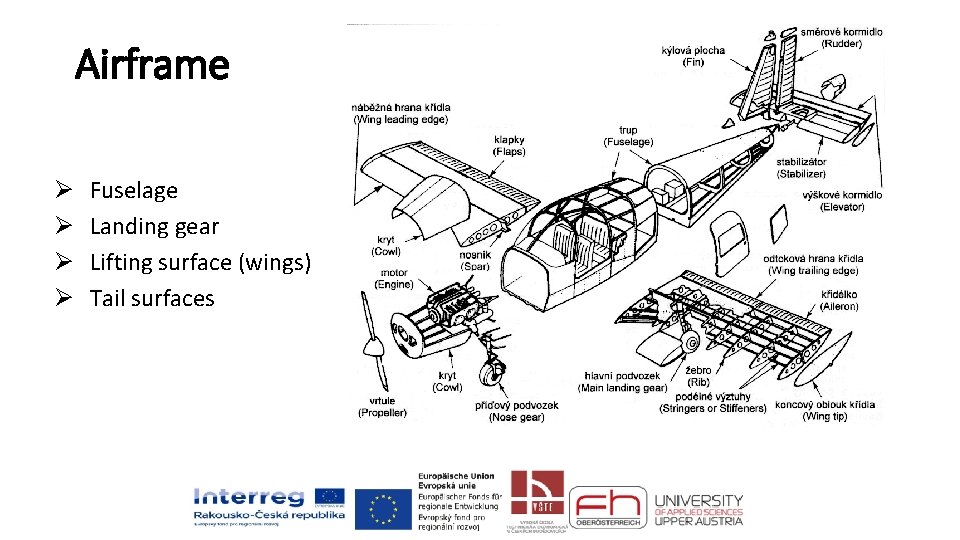
Airframe Ø Ø Fuselage Landing gear Lifting surface (wings) Tail surfaces
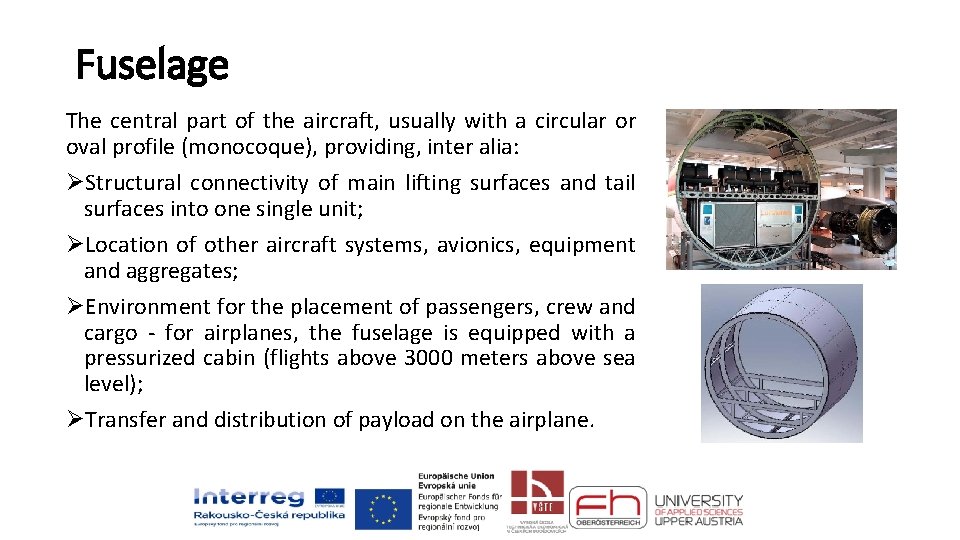
Fuselage The central part of the aircraft, usually with a circular or oval profile (monocoque), providing, inter alia: ØStructural connectivity of main lifting surfaces and tail surfaces into one single unit; ØLocation of other aircraft systems, avionics, equipment and aggregates; ØEnvironment for the placement of passengers, crew and cargo - for airplanes, the fuselage is equipped with a pressurized cabin (flights above 3000 meters above sea level); ØTransfer and distribution of payload on the airplane.
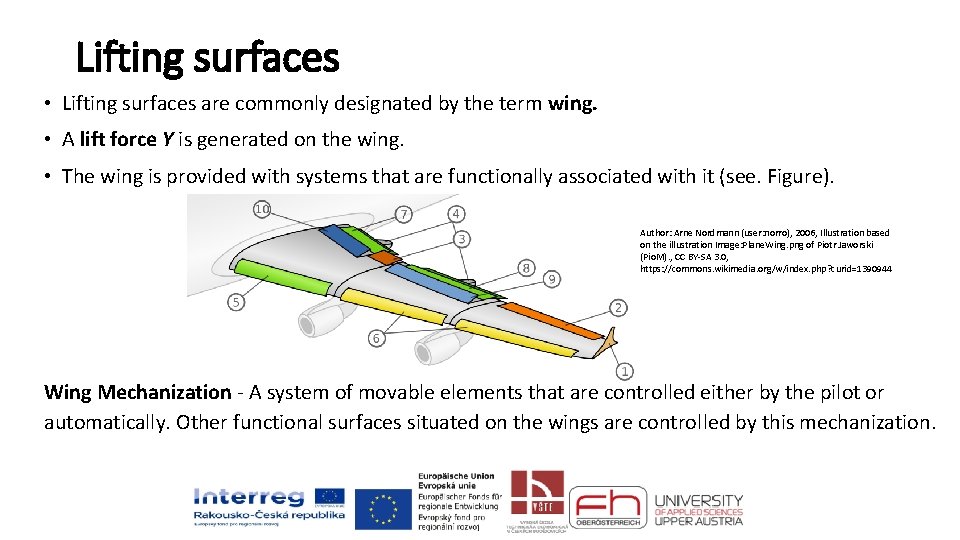
Lifting surfaces • Lifting surfaces are commonly designated by the term wing. • A lift force Y is generated on the wing. • The wing is provided with systems that are functionally associated with it (see. Figure). Author: Arne Nordmann (user: norro), 2006, Illustration based on the illustration Image: Plane. Wing. png of Piotr Jaworski (Pio. M). , CC BY-SA 3. 0, https: //commons. wikimedia. org/w/index. php? curid=1390944 Wing Mechanization - A system of movable elements that are controlled either by the pilot or automatically. Other functional surfaces situated on the wings are controlled by this mechanization.
Functional surfaces on wings • Winglets (1) - are extensions of fixed wing that encourage more efficient use of lift force exerted on the ends of the wings. • Ailerons (2, 3) - are a hinged flight control surfaces used in pairs to control the aircraft in roll (or movement around the aircraft's longitudinal axis). • Pods for flaps (4) - streamlining the flap track mechanisms. • Krueger flaps (5) - lift enhancement devices that may be fitted to the leading edge of an aircraft wing. • Slats (6) - aerodynamic surfaces on the leading edge of the wings of fixed-wing aircraft which, when deployed, allow the wing to operate at a higher angle of attack.
Functional surfaces on wings • Flaps (7, 8) - Sliding devices on the wing of the airplane to increase lift at low speeds, especially in the take-off and landing phase of flight. • Spoiler (9) - A hinged plate on the upper surface of the wings, which serves to reduce lift in a controlled way. By so doing, the spoiler creates a controlled stall over the portion of the wing behind it, greatly reducing the lift of that wing section. It is especially useful for landing when, due to reduced lift, the aircraft touches the runway more firmly and pushes the landing gear to surface. • Aerodynamic brake (10) - Increases the aerodynamic drag of the airplane (similar to the spoiler).
Tail surfaces consist of: Ø Horizontal tale surfaces; Ø Vertical tale surfaces. Horizontal tale surfaces consists of: Ø Fixed part = Stabilizer - provides stability and control of an airplane; Ø Hinged aft surface = Elevator - controls the aircraft's pitch, and therefore the angle of attack and the lift of the wing. Vertical tale surfaces consists of: Ø Fixed part = Fin (vertical stabilizer) - is intended to reduce aerodynamic side slip and provide direction stability; Ø Hinged aft surface = Rudder - allows the pilot to control yaw around the vertical axis.
Airplane movement in 3 D space Simply put, the transport airplane is controlled in three-dimensional space by a combination of three control surfaces: Ø Ailerons – Tilts the airplane around its longitudinal axis; Ø Rudder –deflects the airplane around its vertical axis; Ø Elevator – deflects the airplane around its horizontal axis. In practice, both aileron and rudder control input are used together to turn an aircraft, the ailerons imparting roll, the rudder imparting yaw, and also compensating for a phenomenon called adverse yaw. A rudder alone will turn a conventional fixed-wing aircraft, but much more slowly than if ailerons are also used in conjunction.
- Slides: 9