
AIR TRAFFIC ORGANIZATION Technology PreScreening Process and Evaluation
- Slides: 17
AIR TRAFFIC ORGANIZATION Technology Pre-Screening: Process and Evaluation Presented at ICAO ACP WGW Meeting, Montreal Canada June 27, 2005 Prepared by: FAA ATO/Brent Phillips, Eurocontrol/Jacky Pouzet NASA/James Budinger, ITT/Glen Dyer, Ron Bruno, Qineti. Q/Phil Platt
Briefing Outline • Context of the Study • Candidate Technologies Families • Technology Pre-screening Process • Evaluation Criteria Development Process and Criteria • Common Findings of Pre-screening • Action Request 2
Context of the Technology Pre-screening • Aeronautical air-to-ground VHF channel capacity for Air Traffic Management (ATM) is reaching saturation – Most severe in Europe and parts of the United States • Various proposals to address this problem have been offered and approved independently; none has achieved global endorsement • ICAO is seeking a common, global solution through the Aeronautical Communications Panel (ACP) • The FAA and Eurocontrol initiated a bi-lateral study of the problem with the support of NASA to provide major input to ICAO ACP in its search for a global solution – Action Plan 17 (AP-17) provides the study terms of reference and outlines a research plan – This Technology Pre-screening Study is Task 3. 1 as defined in AP-17 AIR TRAFFIC ORGANIZATION 3
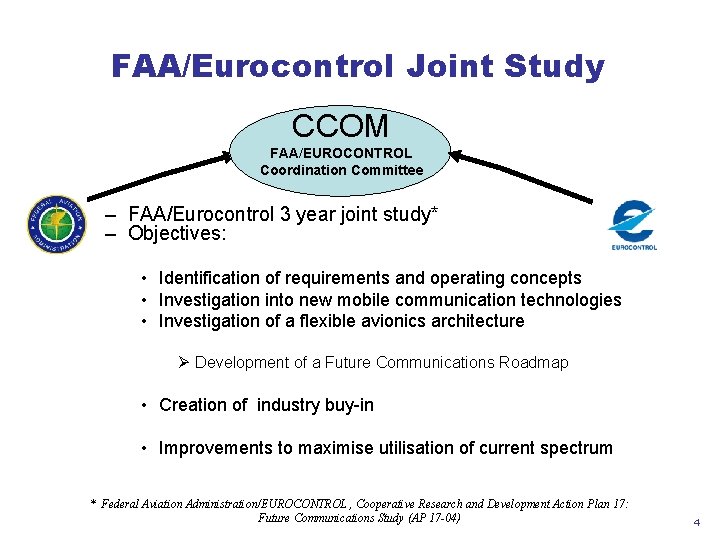
FAA/Eurocontrol Joint Study CCOM FAA/EUROCONTROL Coordination Committee – FAA/Eurocontrol 3 year joint study* – Objectives: • Identification of requirements and operating concepts • Investigation into new mobile communication technologies • Investigation of a flexible avionics architecture Ø Development of a Future Communications Roadmap • Creation of industry buy-in • Improvements to maximise utilisation of current spectrum * Federal Aviation Administration/EUROCONTROL , Cooperative Research and Development Action Plan 17: Future Communications Study (AP 17 -04) 4
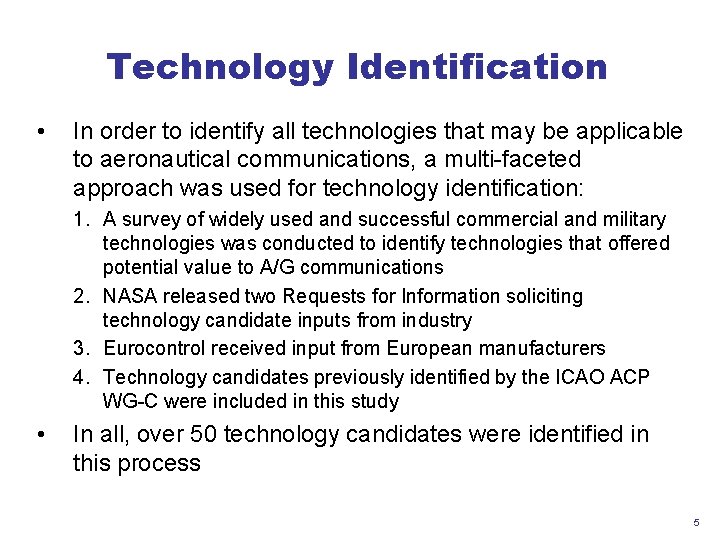
Technology Identification • In order to identify all technologies that may be applicable to aeronautical communications, a multi-faceted approach was used for technology identification: 1. A survey of widely used and successful commercial and military technologies was conducted to identify technologies that offered potential value to A/G communications 2. NASA released two Requests for Information soliciting technology candidate inputs from industry 3. Eurocontrol received input from European manufacturers 4. Technology candidates previously identified by the ICAO ACP WG-C were included in this study • In all, over 50 technology candidates were identified in this process 5
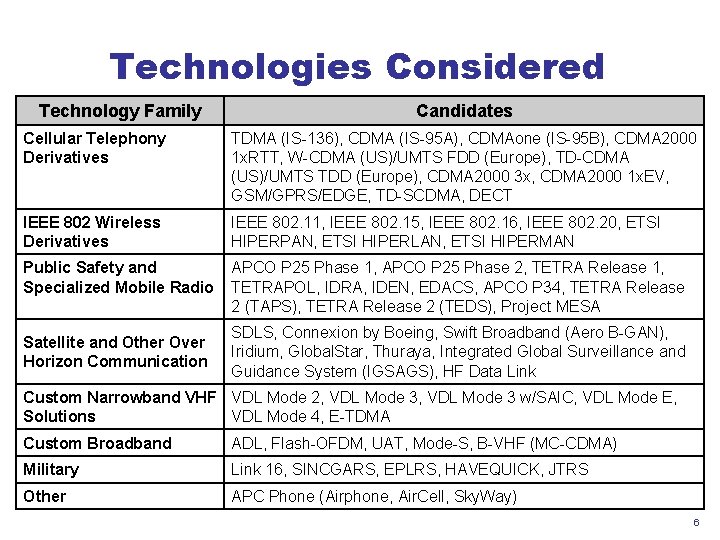
Technologies Considered Technology Family Candidates Cellular Telephony Derivatives TDMA (IS-136), CDMA (IS-95 A), CDMAone (IS-95 B), CDMA 2000 1 x. RTT, W-CDMA (US)/UMTS FDD (Europe), TD-CDMA (US)/UMTS TDD (Europe), CDMA 2000 3 x, CDMA 2000 1 x. EV, GSM/GPRS/EDGE, TD-SCDMA, DECT IEEE 802 Wireless Derivatives IEEE 802. 11, IEEE 802. 15, IEEE 802. 16, IEEE 802. 20, ETSI HIPERPAN, ETSI HIPERLAN, ETSI HIPERMAN Public Safety and Specialized Mobile Radio APCO P 25 Phase 1, APCO P 25 Phase 2, TETRA Release 1, TETRAPOL, IDRA, IDEN, EDACS, APCO P 34, TETRA Release 2 (TAPS), TETRA Release 2 (TEDS), Project MESA Satellite and Other Over Horizon Communication SDLS, Connexion by Boeing, Swift Broadband (Aero B-GAN), Iridium, Global. Star, Thuraya, Integrated Global Surveillance and Guidance System (IGSAGS), HF Data Link Custom Narrowband VHF VDL Mode 2, VDL Mode 3 w/SAIC, VDL Mode E, Solutions VDL Mode 4, E-TDMA Custom Broadband ADL, Flash-OFDM, UAT, Mode-S, B-VHF (MC-CDMA) Military Link 16, SINCGARS, EPLRS, HAVEQUICK, JTRS Other APC Phone (Airphone, Air. Cell, Sky. Way) 6
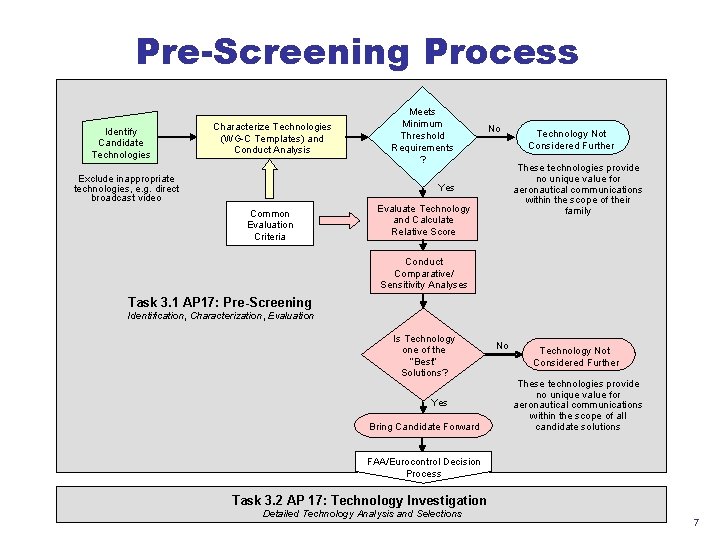
Pre-Screening Process Identify Candidate Technologies Characterize Technologies (WG-C Templates) and Conduct Analysis Exclude inappropriate technologies, e. g. direct broadcast video Meets Minimum Threshold Requirements ? No These technologies provide no unique value for aeronautical communications within the scope of their family Yes Common Evaluation Criteria Technology Not Considered Further Evaluate Technology and Calculate Relative Score Conduct Comparative/ Sensitivity Analyses Task 3. 1 AP 17: Pre-Screening Identification, Characterization, Evaluation Is Technology one of the “Best” Solutions? Yes Bring Candidate Forward No Technology Not Considered Further These technologies provide no unique value for aeronautical communications within the scope of all candidate solutions FAA/Eurocontrol Decision Process Task 3. 2 AP 17: Technology Investigation Detailed Technology Analysis and Selections 7
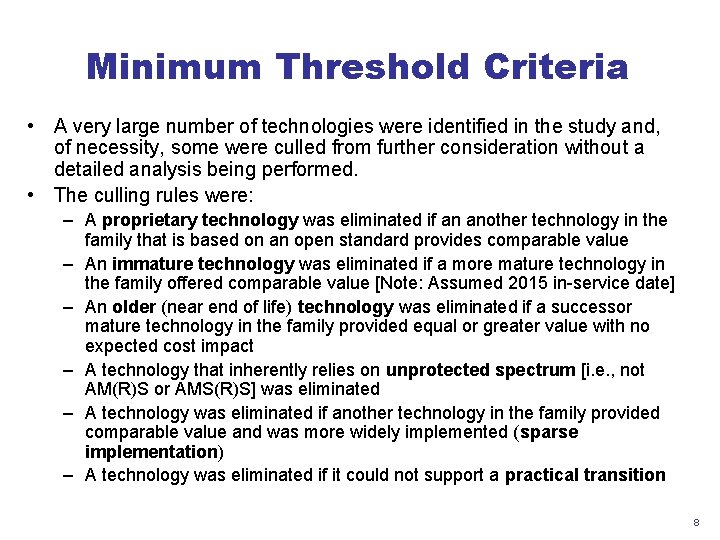
Minimum Threshold Criteria • A very large number of technologies were identified in the study and, of necessity, some were culled from further consideration without a detailed analysis being performed. • The culling rules were: – A proprietary technology was eliminated if an another technology in the family that is based on an open standard provides comparable value – An immature technology was eliminated if a more mature technology in the family offered comparable value [Note: Assumed 2015 in-service date] – An older (near end of life) technology was eliminated if a successor mature technology in the family provided equal or greater value with no expected cost impact – A technology that inherently relies on unprotected spectrum [i. e. , not AM(R)S or AMS(R)S] was eliminated – A technology was eliminated if another technology in the family provided comparable value and was more widely implemented (sparse implementation) – A technology was eliminated if it could not support a practical transition 8
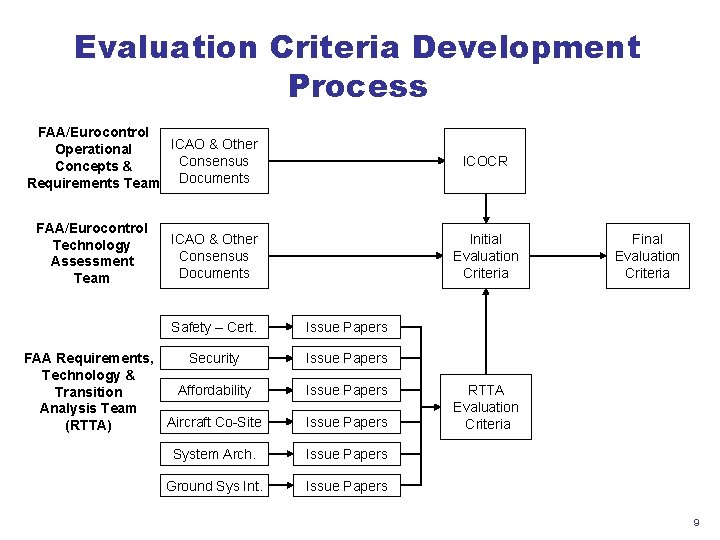
Evaluation Criteria Development Process FAA/Eurocontrol ICAO & Other Operational Consensus Concepts & Requirements Team Documents FAA/Eurocontrol Technology Assessment Team ICOCR ICAO & Other Consensus Documents Safety – Cert. FAA Requirements, Security Technology & Affordability Transition Analysis Team Aircraft Co-Site (RTTA) Initial Evaluation Criteria Final Evaluation Criteria Issue Papers System Arch. Issue Papers Ground Sys Int. Issue Papers RTTA Evaluation Criteria 9
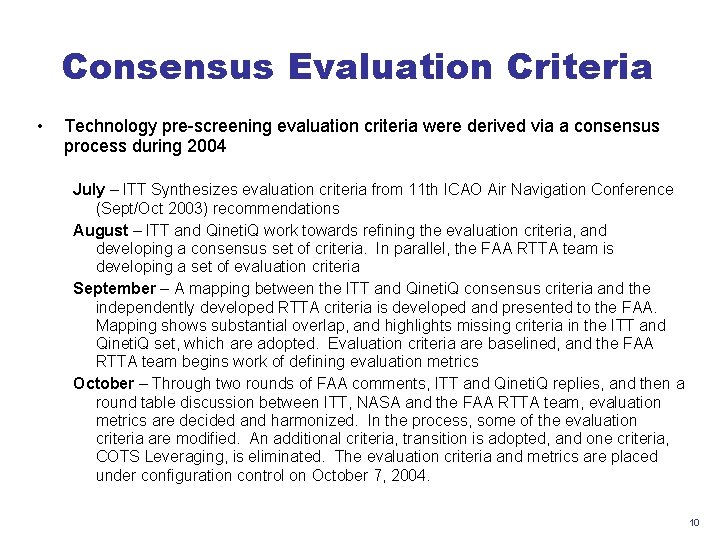
Consensus Evaluation Criteria • Technology pre-screening evaluation criteria were derived via a consensus process during 2004 July – ITT Synthesizes evaluation criteria from 11 th ICAO Air Navigation Conference (Sept/Oct 2003) recommendations August – ITT and Qineti. Q work towards refining the evaluation criteria, and developing a consensus set of criteria. In parallel, the FAA RTTA team is developing a set of evaluation criteria September – A mapping between the ITT and Qineti. Q consensus criteria and the independently developed RTTA criteria is developed and presented to the FAA. Mapping shows substantial overlap, and highlights missing criteria in the ITT and Qineti. Q set, which are adopted. Evaluation criteria are baselined, and the FAA RTTA team begins work of defining evaluation metrics October – Through two rounds of FAA comments, ITT and Qineti. Q replies, and then a round table discussion between ITT, NASA and the FAA RTTA team, evaluation metrics are decided and harmonized. In the process, some of the evaluation criteria are modified. An additional criteria, transition is adopted, and one criteria, COTS Leveraging, is eliminated. The evaluation criteria and metrics are placed under configuration control on October 7, 2004. 10
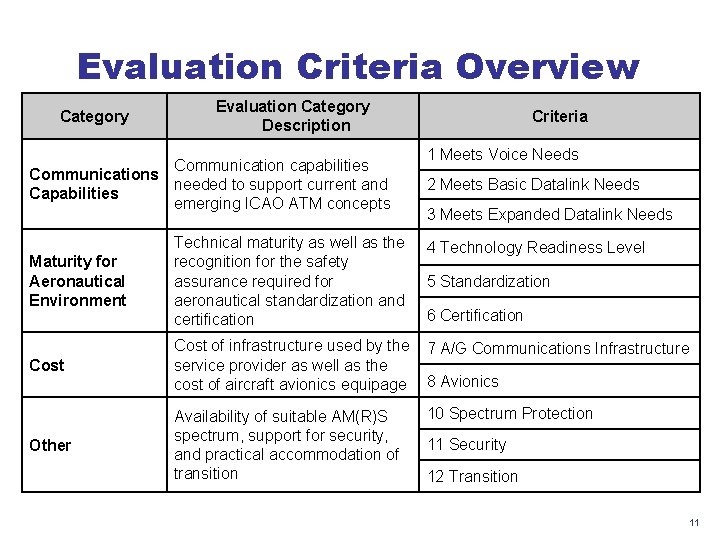
Evaluation Criteria Overview Category Evaluation Category Description Communication capabilities Communications needed to support current and Capabilities emerging ICAO ATM concepts Criteria 1 Meets Voice Needs 2 Meets Basic Datalink Needs 3 Meets Expanded Datalink Needs Maturity for Aeronautical Environment Technical maturity as well as the recognition for the safety assurance required for aeronautical standardization and certification 4 Technology Readiness Level Cost of infrastructure used by the service provider as well as the cost of aircraft avionics equipage 7 A/G Communications Infrastructure 10 Spectrum Protection Other Availability of suitable AM(R)S spectrum, support for security, and practical accommodation of transition 5 Standardization 6 Certification 8 Avionics 11 Security 12 Transition 11
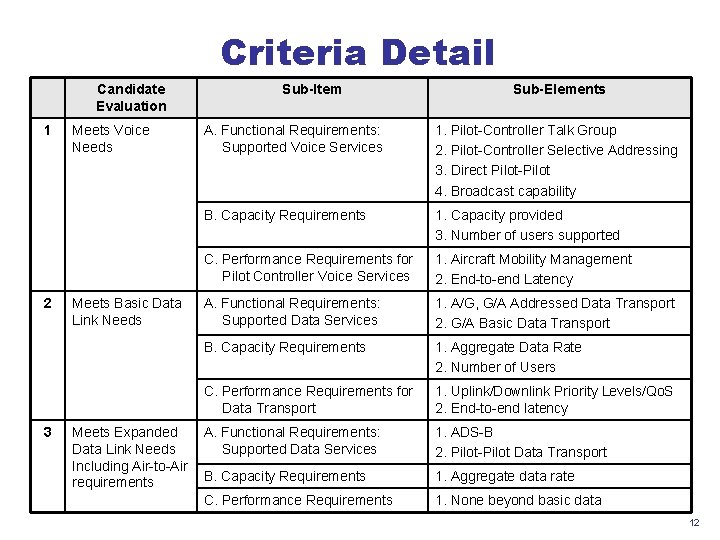
Criteria Detail Candidate Evaluation 1 2 3 Meets Voice Needs Meets Basic Data Link Needs Meets Expanded Data Link Needs Including Air-to-Air requirements Sub-Item Sub-Elements A. Functional Requirements: Supported Voice Services 1. Pilot-Controller Talk Group 2. Pilot-Controller Selective Addressing 3. Direct Pilot-Pilot 4. Broadcast capability B. Capacity Requirements 1. Capacity provided 3. Number of users supported C. Performance Requirements for Pilot Controller Voice Services 1. Aircraft Mobility Management 2. End-to-end Latency A. Functional Requirements: Supported Data Services 1. A/G, G/A Addressed Data Transport 2. G/A Basic Data Transport B. Capacity Requirements 1. Aggregate Data Rate 2. Number of Users C. Performance Requirements for Data Transport 1. Uplink/Downlink Priority Levels/Qo. S 2. End-to-end latency A. Functional Requirements: Supported Data Services 1. ADS-B 2. Pilot-Pilot Data Transport B. Capacity Requirements 1. Aggregate data rate C. Performance Requirements 1. None beyond basic data 12
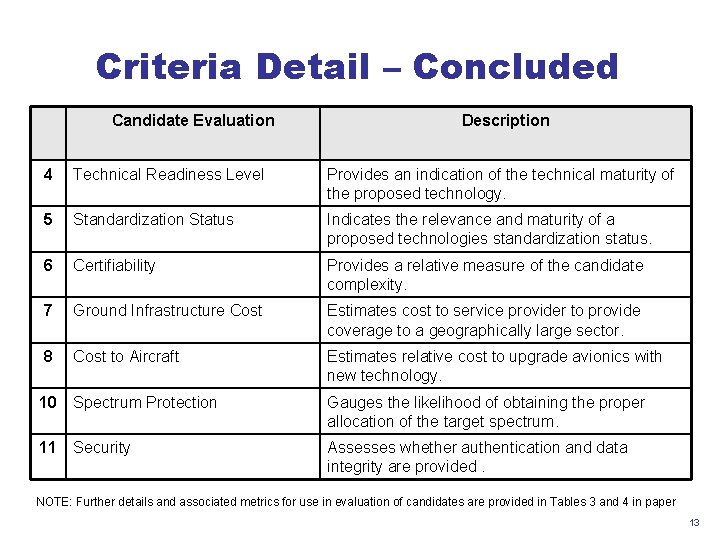
Criteria Detail – Concluded Candidate Evaluation Description 4 Technical Readiness Level Provides an indication of the technical maturity of the proposed technology. 5 Standardization Status Indicates the relevance and maturity of a proposed technologies standardization status. 6 Certifiability Provides a relative measure of the candidate complexity. 7 Ground Infrastructure Cost Estimates cost to service provider to provide coverage to a geographically large sector. 8 Cost to Aircraft Estimates relative cost to upgrade avionics with new technology. 10 Spectrum Protection Gauges the likelihood of obtaining the proper allocation of the target spectrum. 11 Security Assesses whether authentication and data integrity are provided. NOTE: Further details and associated metrics for use in evaluation of candidates are provided in Tables 3 and 4 in paper 13
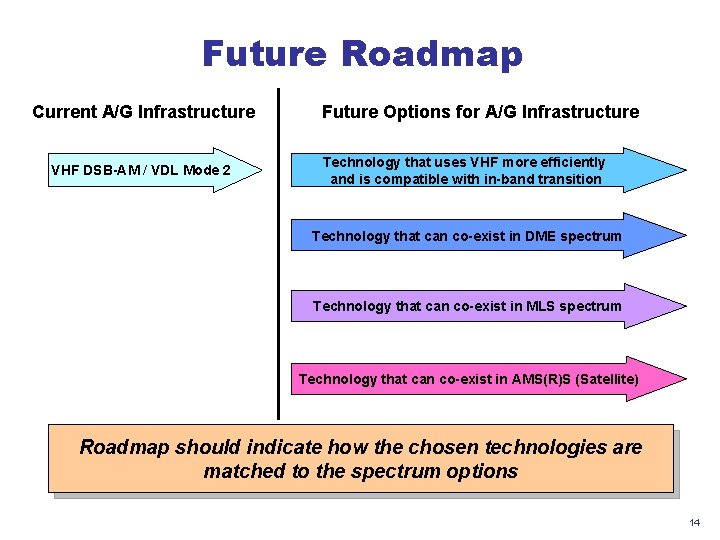
Future Roadmap Current A/G Infrastructure VHF DSB-AM / VDL Mode 2 Future Options for A/G Infrastructure Technology that uses VHF more efficiently and is compatible with in-band transition Technology that can co-exist in DME spectrum Technology that can co-exist in MLS spectrum Technology that can co-exist in AMS(R)S (Satellite) Roadmap should indicate how the chosen technologies are matched to the spectrum options 14
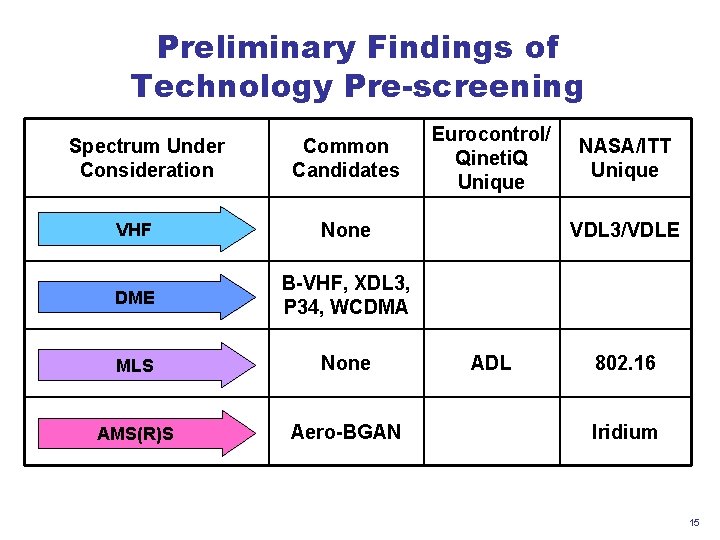
Preliminary Findings of Technology Pre-screening Spectrum Under Consideration Common Candidates VHF None DME B-VHF, XDL 3, P 34, WCDMA MLS None AMS(R)S Aero-BGAN Eurocontrol/ Qineti. Q Unique NASA/ITT Unique VDL 3/VDLE ADL 802. 16 Iridium 15
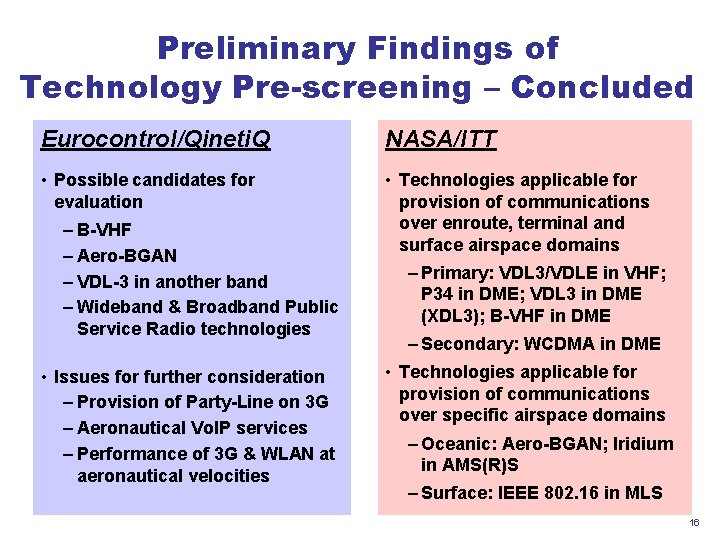
Preliminary Findings of Technology Pre-screening – Concluded Eurocontrol/Qineti. Q NASA/ITT • Possible candidates for evaluation • Technologies applicable for provision of communications over enroute, terminal and surface airspace domains – B-VHF – Aero-BGAN – VDL-3 in another band – Wideband & Broadband Public Service Radio technologies • Issues for further consideration – Provision of Party-Line on 3 G – Aeronautical Vo. IP services – Performance of 3 G & WLAN at aeronautical velocities – Primary: VDL 3/VDLE in VHF; P 34 in DME; VDL 3 in DME (XDL 3); B-VHF in DME – Secondary: WCDMA in DME • Technologies applicable for provision of communications over specific airspace domains – Oceanic: Aero-BGAN; Iridium in AMS(R)S – Surface: IEEE 802. 16 in MLS 16
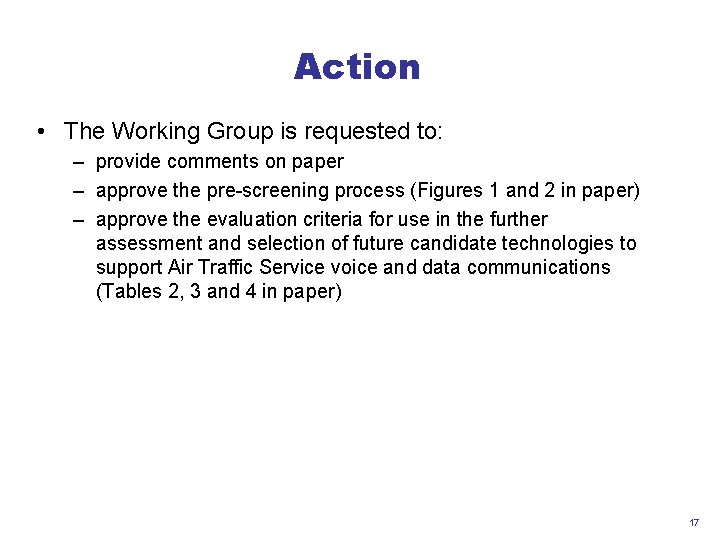
Action • The Working Group is requested to: – provide comments on paper – approve the pre-screening process (Figures 1 and 2 in paper) – approve the evaluation criteria for use in the further assessment and selection of future candidate technologies to support Air Traffic Service voice and data communications (Tables 2, 3 and 4 in paper) 17