
Air Thread Connections Presentation Discussion Materials For Additional
- Slides: 35
Air. Thread Connections Presentation Discussion Materials For Additional Coverage of the Topics Please See Me Or E-mail me at jheilprin@fas. harvard. edu Harvard University Extension School Joel L. Heilprin © 59 th Street Partners LLC
Air. Thread Connections Ø Ø Overview: Let’s begin by considering both American Cable and Air. Thread Then we can summarize the industry and competitive environment Decide if there might be a fit between American Cable and Air. Thread Finally conduct a valuation exercise on Air. Thread Harvard University Extension School Joel L. Heilprin © 59 th Street Partners LLC
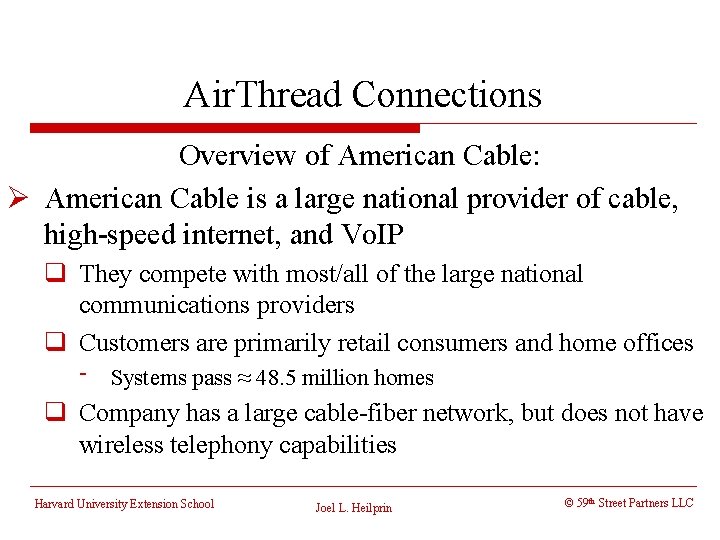
Air. Thread Connections Overview of American Cable: Ø American Cable is a large national provider of cable, high-speed internet, and Vo. IP q They compete with most/all of the large national communications providers q Customers are primarily retail consumers and home offices ־ Systems pass ≈ 48. 5 million homes q Company has a large cable-fiber network, but does not have wireless telephony capabilities Harvard University Extension School Joel L. Heilprin © 59 th Street Partners LLC
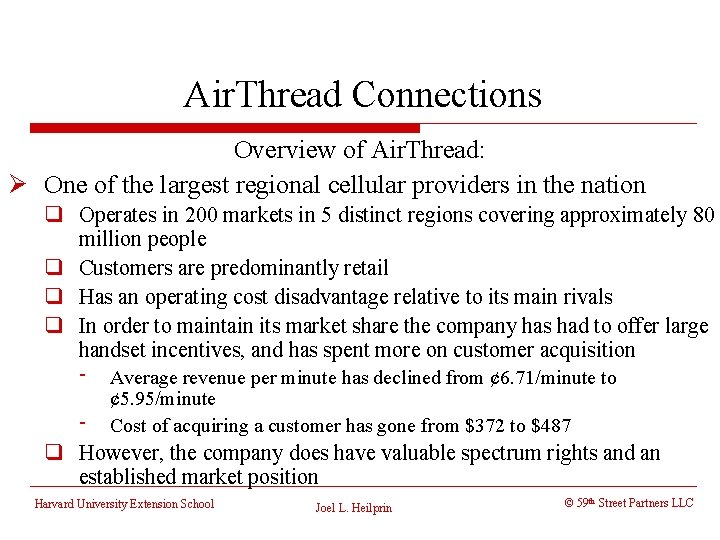
Air. Thread Connections Overview of Air. Thread: Ø One of the largest regional cellular providers in the nation q Operates in 200 markets in 5 distinct regions covering approximately 80 million people q Customers are predominantly retail q Has an operating cost disadvantage relative to its main rivals q In order to maintain its market share the company has had to offer large handset incentives, and has spent more on customer acquisition ־ ־ Average revenue per minute has declined from ¢ 6. 71/minute to ¢ 5. 95/minute Cost of acquiring a customer has gone from $372 to $487 q However, the company does have valuable spectrum rights and an established market position Harvard University Extension School Joel L. Heilprin © 59 th Street Partners LLC
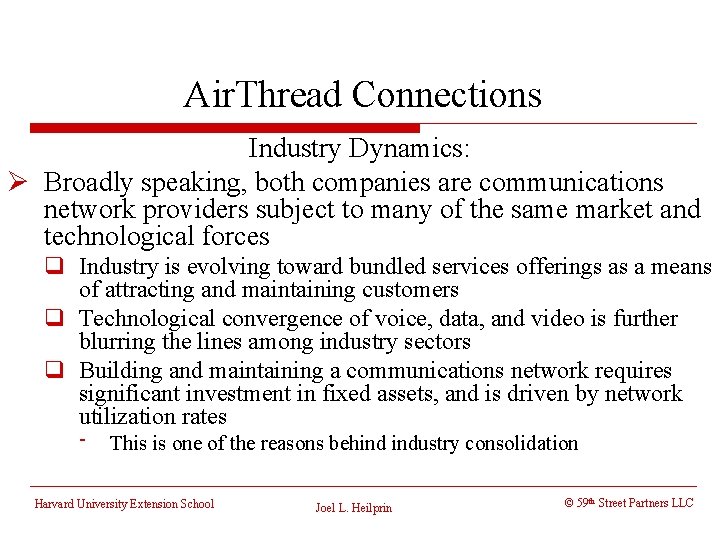
Air. Thread Connections Industry Dynamics: Ø Broadly speaking, both companies are communications network providers subject to many of the same market and technological forces q Industry is evolving toward bundled services offerings as a means of attracting and maintaining customers q Technological convergence of voice, data, and video is further blurring the lines among industry sectors q Building and maintaining a communications network requires significant investment in fixed assets, and is driven by network utilization rates ־ This is one of the reasons behind industry consolidation Harvard University Extension School Joel L. Heilprin © 59 th Street Partners LLC
Air. Thread Connections Acquisition Rationale: Ø For ACC, most of the rationale is based on cross-selling bundled services Harvard University Extension School Joel L. Heilprin © 59 th Street Partners LLC
Air. Thread Connections Acquisition Rationale: Ø For ACC, the biggest worry is getting sucked into paying to solve someone else’s problem Harvard University Extension School Joel L. Heilprin © 59 th Street Partners LLC
Air. Thread Connections Air. Thread Perspective: Ø Does Air. Thread need American Cable or some other suitor? Ø What are their options? Ø If they put themselves up for sale, are they likely to demand a high price? Harvard University Extension School Joel L. Heilprin © 59 th Street Partners LLC
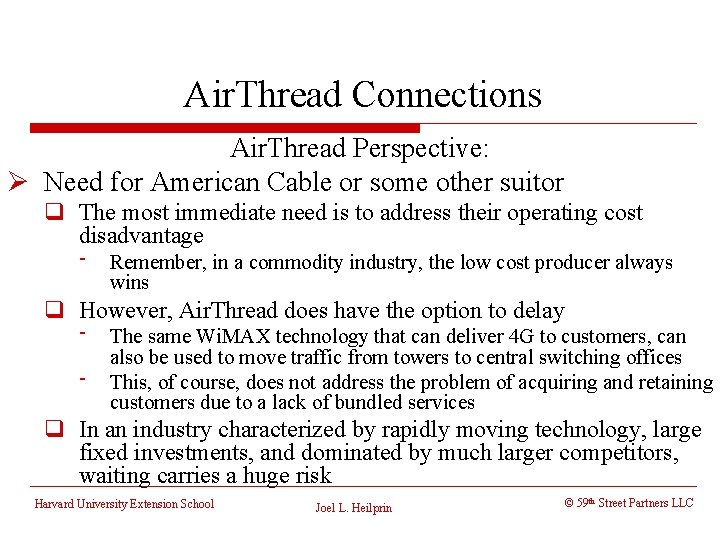
Air. Thread Connections Air. Thread Perspective: Ø Need for American Cable or some other suitor q The most immediate need is to address their operating cost disadvantage ־ Remember, in a commodity industry, the low cost producer always wins q However, Air. Thread does have the option to delay ־ ־ The same Wi. MAX technology that can deliver 4 G to customers, can also be used to move traffic from towers to central switching offices This, of course, does not address the problem of acquiring and retaining customers due to a lack of bundled services q In an industry characterized by rapidly moving technology, large fixed investments, and dominated by much larger competitors, waiting carries a huge risk Harvard University Extension School Joel L. Heilprin © 59 th Street Partners LLC
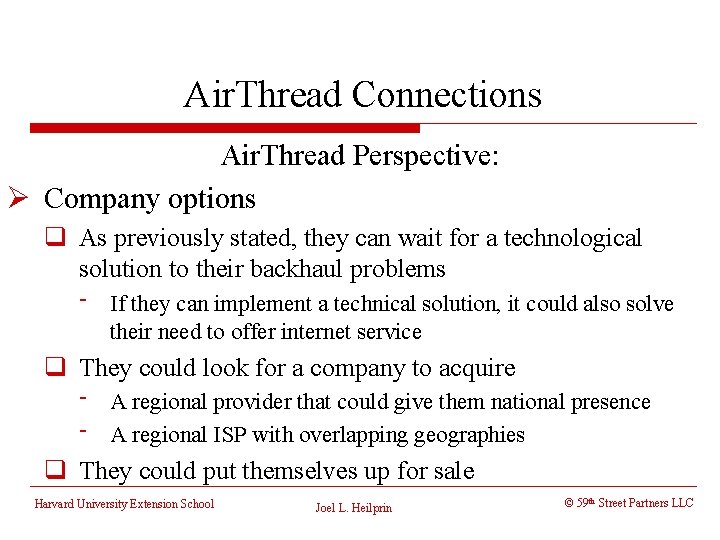
Air. Thread Connections Air. Thread Perspective: Ø Company options q As previously stated, they can wait for a technological solution to their backhaul problems ־ If they can implement a technical solution, it could also solve their need to offer internet service q They could look for a company to acquire ־ A regional provider that could give them national presence ־ A regional ISP with overlapping geographies q They could put themselves up for sale Harvard University Extension School Joel L. Heilprin © 59 th Street Partners LLC
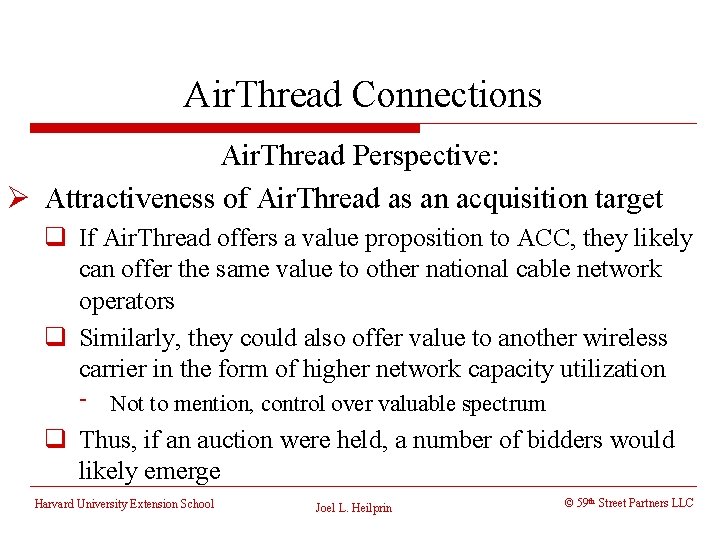
Air. Thread Connections Air. Thread Perspective: Ø Attractiveness of Air. Thread as an acquisition target q If Air. Thread offers a value proposition to ACC, they likely can offer the same value to other national cable network operators q Similarly, they could also offer value to another wireless carrier in the form of higher network capacity utilization ־ Not to mention, control over valuable spectrum q Thus, if an auction were held, a number of bidders would likely emerge Harvard University Extension School Joel L. Heilprin © 59 th Street Partners LLC
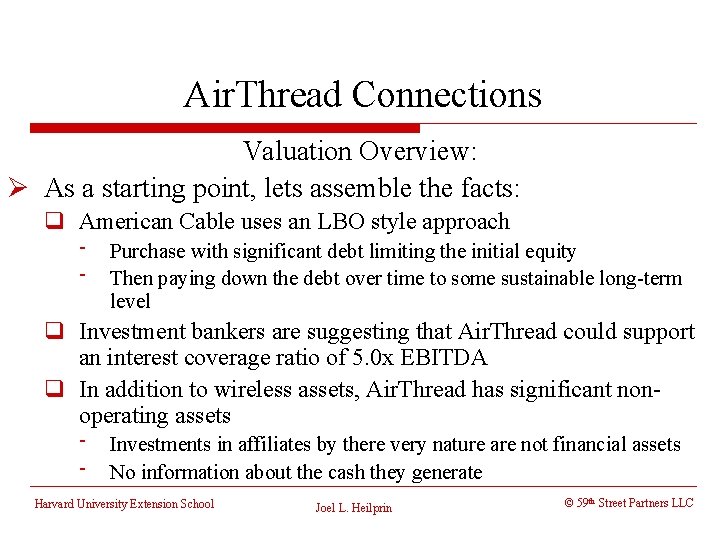
Air. Thread Connections Valuation Overview: Ø As a starting point, lets assemble the facts: q American Cable uses an LBO style approach ־ ־ Purchase with significant debt limiting the initial equity Then paying down the debt over time to some sustainable long-term level q Investment bankers are suggesting that Air. Thread could support an interest coverage ratio of 5. 0 x EBITDA q In addition to wireless assets, Air. Thread has significant nonoperating assets ־ ־ Investments in affiliates by there very nature are not financial assets No information about the cash they generate Harvard University Extension School Joel L. Heilprin © 59 th Street Partners LLC
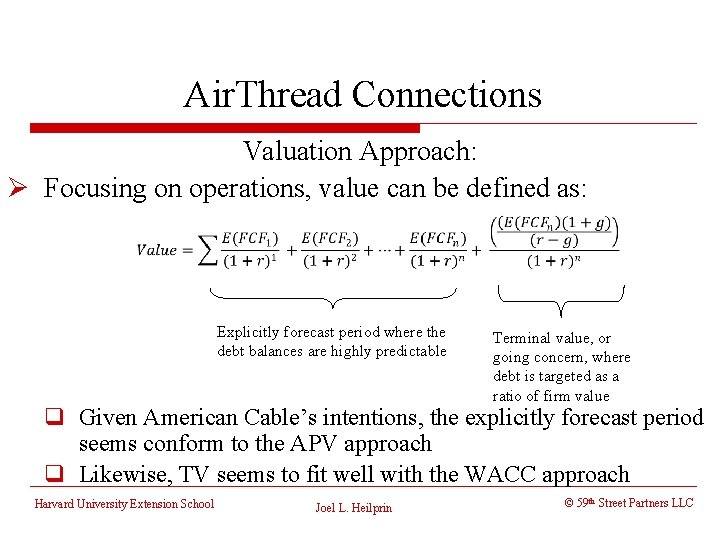
Air. Thread Connections Valuation Approach: Ø Focusing on operations, value can be defined as: Explicitly forecast period where the debt balances are highly predictable Terminal value, or going concern, where debt is targeted as a ratio of firm value q Given American Cable’s intentions, the explicitly forecast period seems conform to the APV approach q Likewise, TV seems to fit well with the WACC approach Harvard University Extension School Joel L. Heilprin © 59 th Street Partners LLC
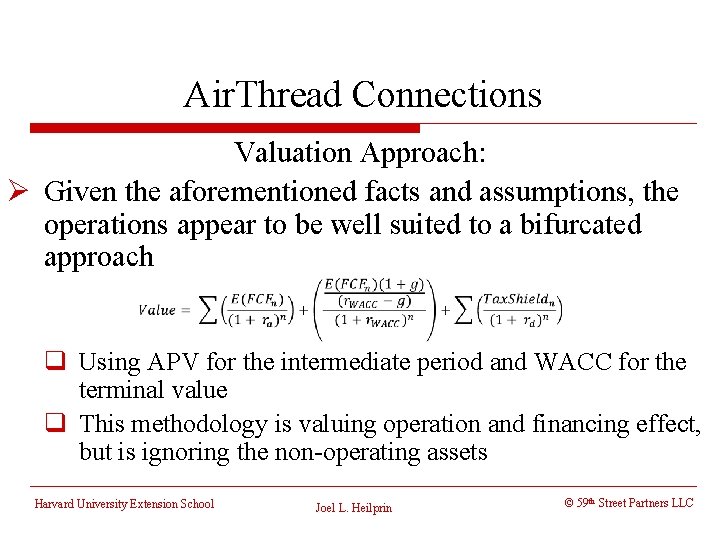
Air. Thread Connections Valuation Approach: Ø Given the aforementioned facts and assumptions, the operations appear to be well suited to a bifurcated approach q Using APV for the intermediate period and WACC for the terminal value q This methodology is valuing operation and financing effect, but is ignoring the non-operating assets Harvard University Extension School Joel L. Heilprin © 59 th Street Partners LLC
Air. Thread Connections Valuation Approach: Ø Taking into account non-operating assets and minority interest q With respect to the equity investments, we have no way of knowing the cash they generate, or whether they could be easily sold ־ The case, therefore, suggests using a market multiple approach q As for the minority interest, at this point, we are only interested in the enterprise value, so we don’t need to know which shareholders are claiming what ־ The underlying consideration is that the minority interest likely relates to specific assets, not the firm as a whole Harvard University Extension School Joel L. Heilprin © 59 th Street Partners LLC
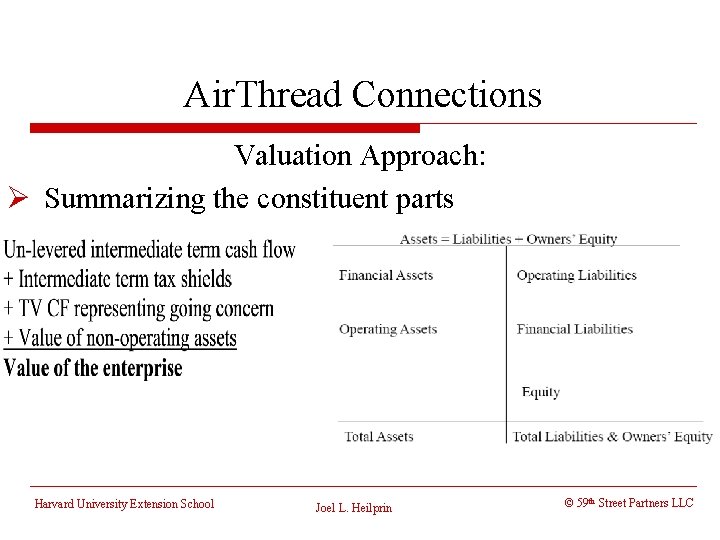
Air. Thread Connections Valuation Approach: Ø Summarizing the constituent parts Harvard University Extension School Joel L. Heilprin © 59 th Street Partners LLC
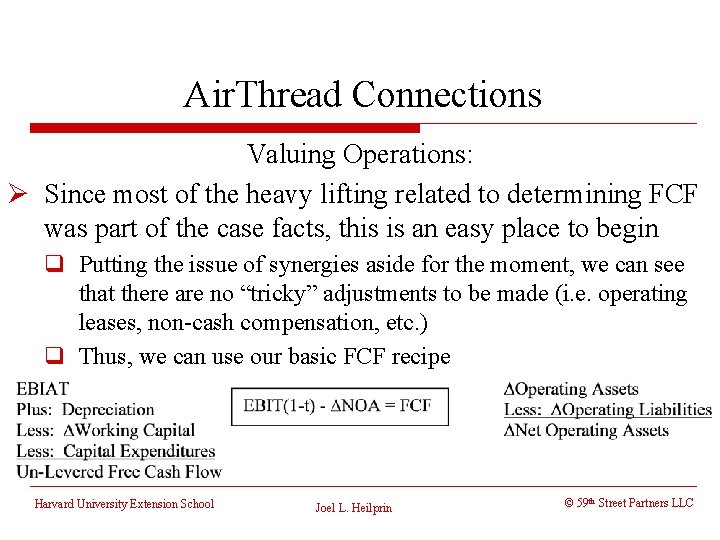
Air. Thread Connections Valuing Operations: Ø Since most of the heavy lifting related to determining FCF was part of the case facts, this is an easy place to begin q Putting the issue of synergies aside for the moment, we can see that there are no “tricky” adjustments to be made (i. e. operating leases, non-cash compensation, etc. ) q Thus, we can use our basic FCF recipe Harvard University Extension School Joel L. Heilprin © 59 th Street Partners LLC
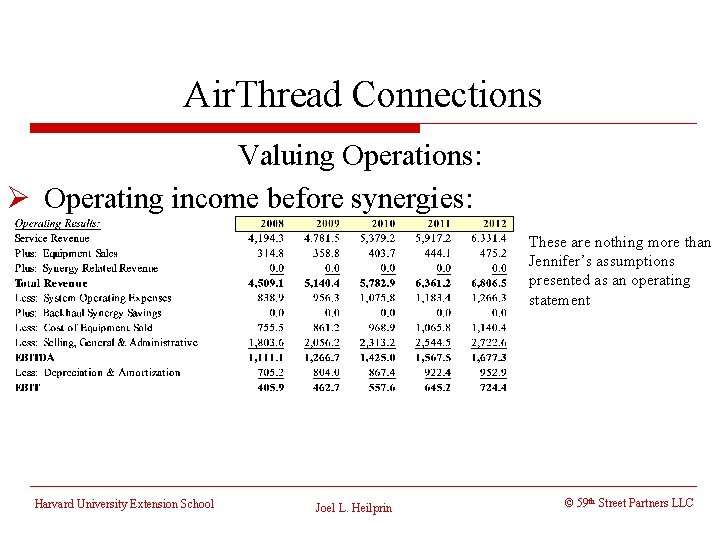
Air. Thread Connections Valuing Operations: Ø Operating income before synergies: These are nothing more than Jennifer’s assumptions presented as an operating statement Harvard University Extension School Joel L. Heilprin © 59 th Street Partners LLC
Air. Thread Connections Valuing Operations: Ø Moving from EBIT to FCF (pre-synergies) q Unlike Apollo, the case takes a straight forward approach to net reinvestment ־ There are no changes in net operating assets and liabilities other than cap-x, depreciation, and working capital q Since Zhang provided estimates of cap-x and depreciation, the only thing to compute are the working capital balances based on the ratios she provided Harvard University Extension School Joel L. Heilprin © 59 th Street Partners LLC
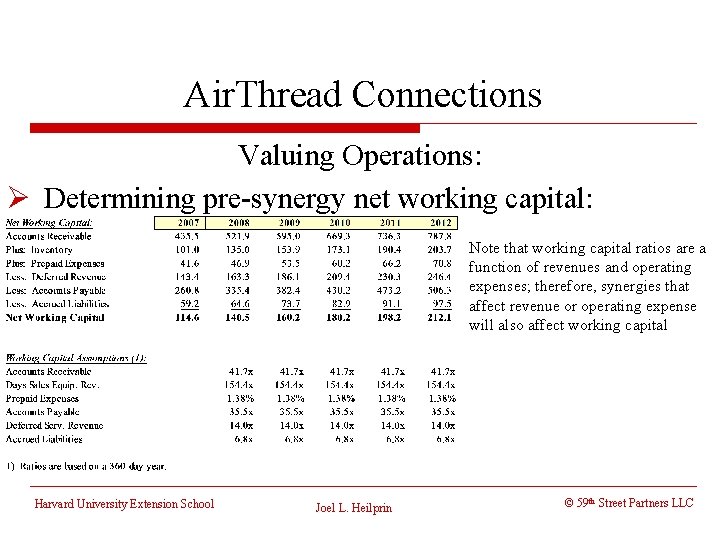
Air. Thread Connections Valuing Operations: Ø Determining pre-synergy net working capital: Note that working capital ratios are a function of revenues and operating expenses; therefore, synergies that affect revenue or operating expense will also affect working capital Harvard University Extension School Joel L. Heilprin © 59 th Street Partners LLC
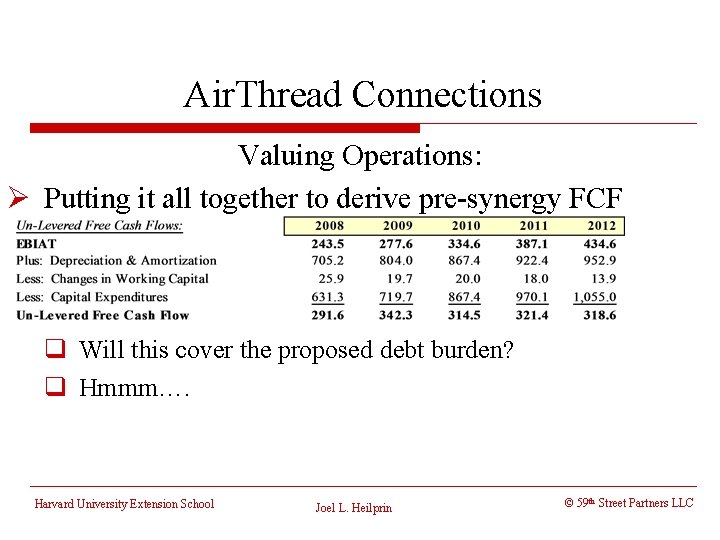
Air. Thread Connections Valuing Operations: Ø Putting it all together to derive pre-synergy FCF q Will this cover the proposed debt burden? q Hmmm…. Harvard University Extension School Joel L. Heilprin © 59 th Street Partners LLC
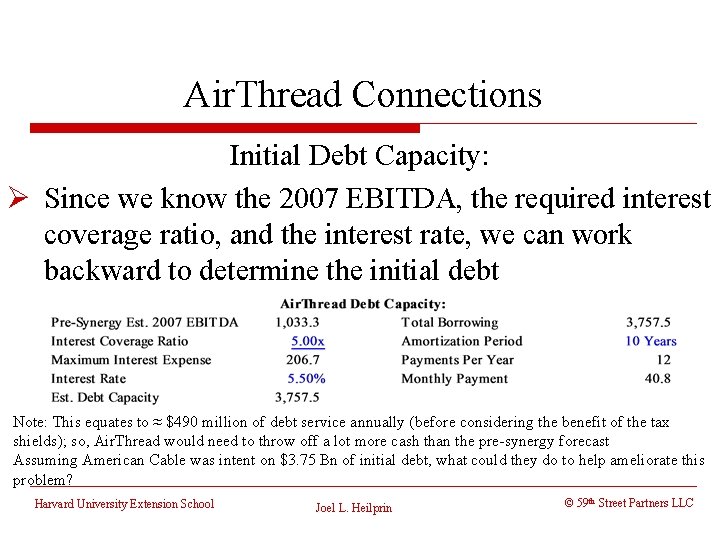
Air. Thread Connections Initial Debt Capacity: Ø Since we know the 2007 EBITDA, the required interest coverage ratio, and the interest rate, we can work backward to determine the initial debt Note: This equates to ≈ $490 million of debt service annually (before considering the benefit of the tax shields); so, Air. Thread would need to throw off a lot more cash than the pre-synergy forecast Assuming American Cable was intent on $3. 75 Bn of initial debt, what could they do to help ameliorate this problem? Harvard University Extension School Joel L. Heilprin © 59 th Street Partners LLC
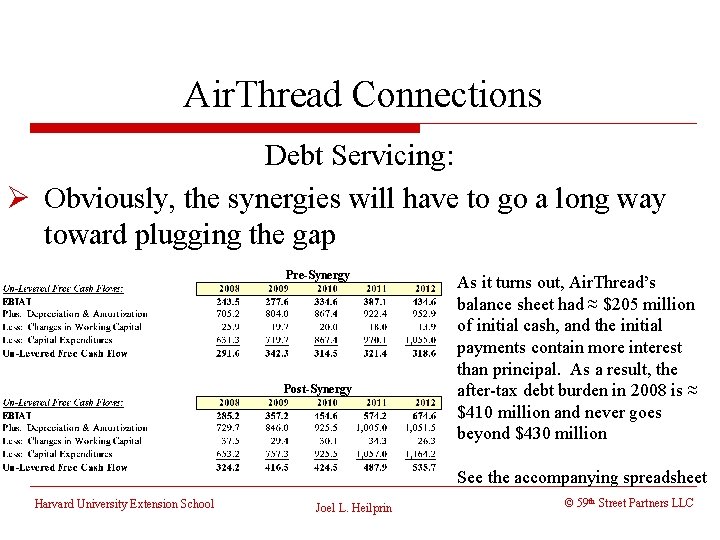
Air. Thread Connections Debt Servicing: Ø Obviously, the synergies will have to go a long way toward plugging the gap Pre-Synergy Post-Synergy As it turns out, Air. Thread’s balance sheet had ≈ $205 million of initial cash, and the initial payments contain more interest than principal. As a result, the after-tax debt burden in 2008 is ≈ $410 million and never goes beyond $430 million See the accompanying spreadsheet Harvard University Extension School Joel L. Heilprin © 59 th Street Partners LLC
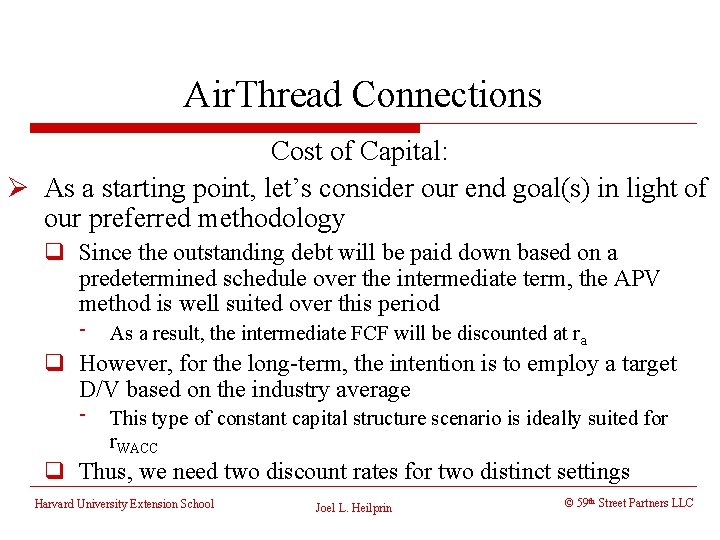
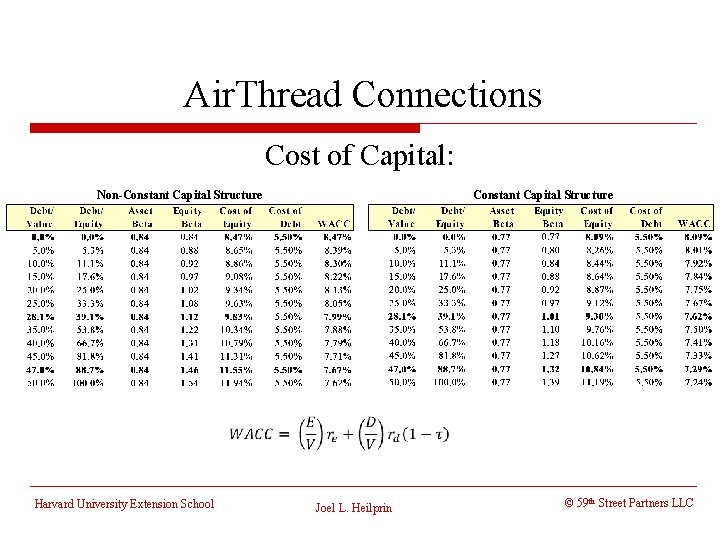
Air. Thread Connections Cost of Capital: Ø As a starting point, let’s consider our end goal(s) in light of our preferred methodology q Since the outstanding debt will be paid down based on a predetermined schedule over the intermediate term, the APV method is well suited over this period ־ As a result, the intermediate FCF will be discounted at ra q However, for the long-term, the intention is to employ a target D/V based on the industry average ־ This type of constant capital structure scenario is ideally suited for r. WACC q Thus, we need two discount rates for two distinct settings Harvard University Extension School Joel L. Heilprin © 59 th Street Partners LLC
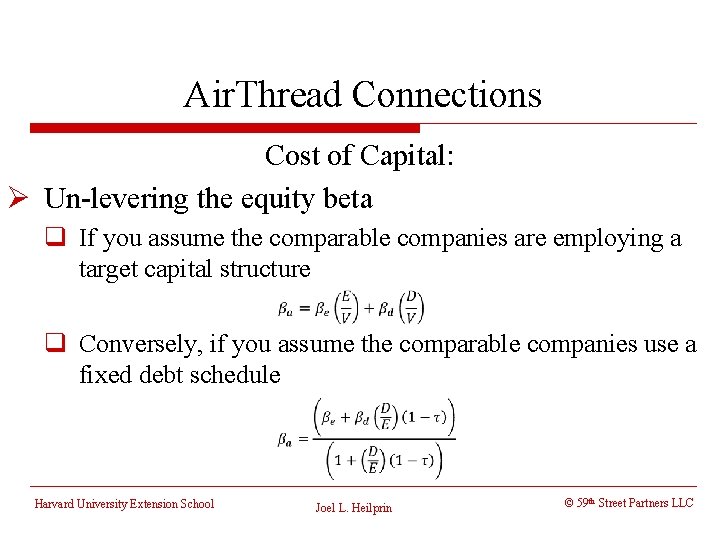
Air. Thread Connections Cost of Capital: Ø Un-levering the equity beta q If you assume the comparable companies are employing a target capital structure q Conversely, if you assume the comparable companies use a fixed debt schedule Harvard University Extension School Joel L. Heilprin © 59 th Street Partners LLC
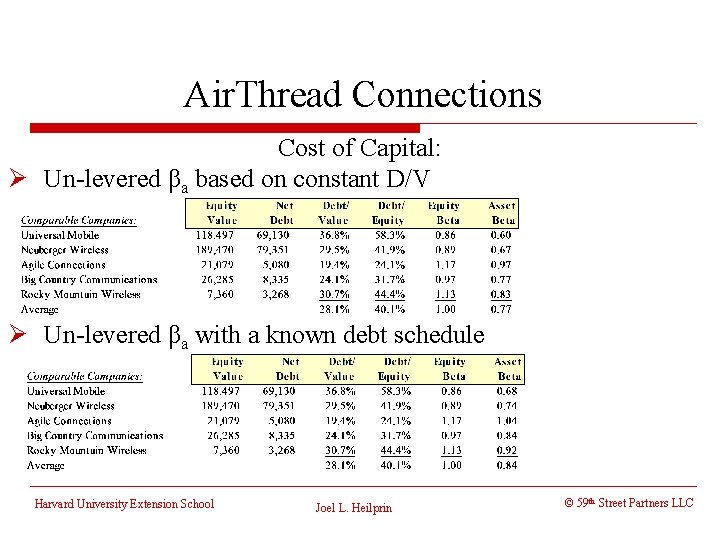
Air. Thread Connections Cost of Capital: Ø Un-levered βa based on constant D/V Ø Un-levered βa with a known debt schedule Harvard University Extension School Joel L. Heilprin © 59 th Street Partners LLC
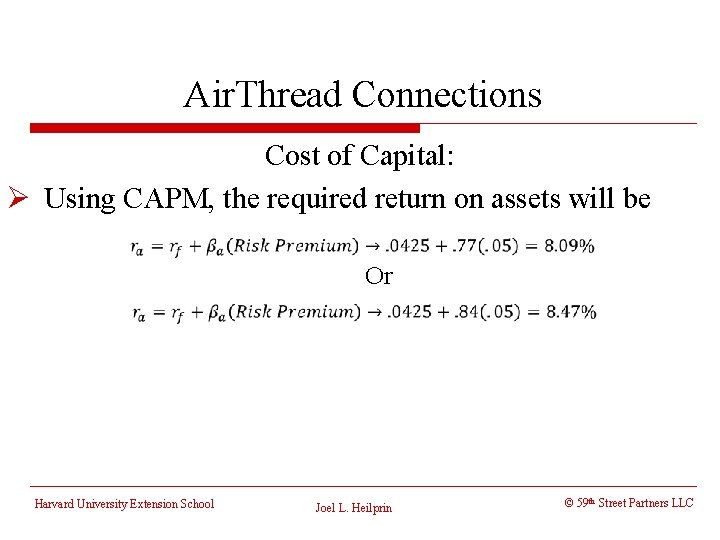
Air. Thread Connections Cost of Capital: Ø Using CAPM, the required return on assets will be Or Harvard University Extension School Joel L. Heilprin © 59 th Street Partners LLC
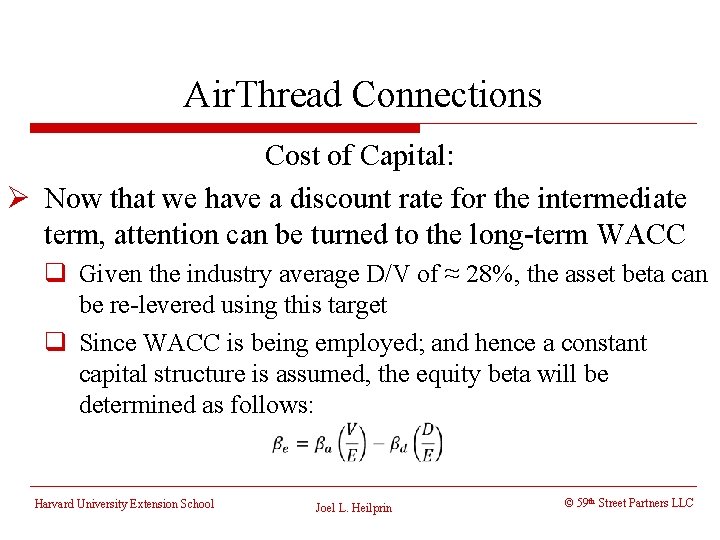
Air. Thread Connections Cost of Capital: Ø Now that we have a discount rate for the intermediate term, attention can be turned to the long-term WACC q Given the industry average D/V of ≈ 28%, the asset beta can be re-levered using this target q Since WACC is being employed; and hence a constant capital structure is assumed, the equity beta will be determined as follows: Harvard University Extension School Joel L. Heilprin © 59 th Street Partners LLC
Air. Thread Connections Cost of Capital: Non-Constant Capital Structure Harvard University Extension School Constant Capital Structure Joel L. Heilprin © 59 th Street Partners LLC
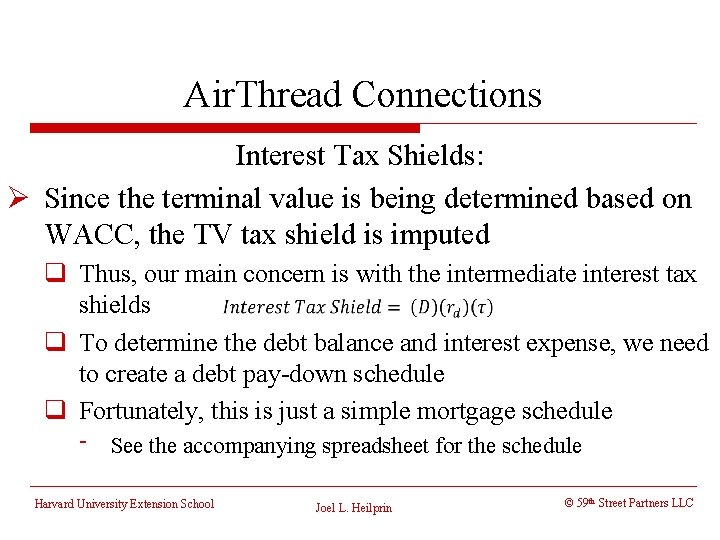
Air. Thread Connections Interest Tax Shields: Ø Since the terminal value is being determined based on WACC, the TV tax shield is imputed q Thus, our main concern is with the intermediate interest tax shields q To determine the debt balance and interest expense, we need to create a debt pay-down schedule q Fortunately, this is just a simple mortgage schedule ־ See the accompanying spreadsheet for the schedule Harvard University Extension School Joel L. Heilprin © 59 th Street Partners LLC
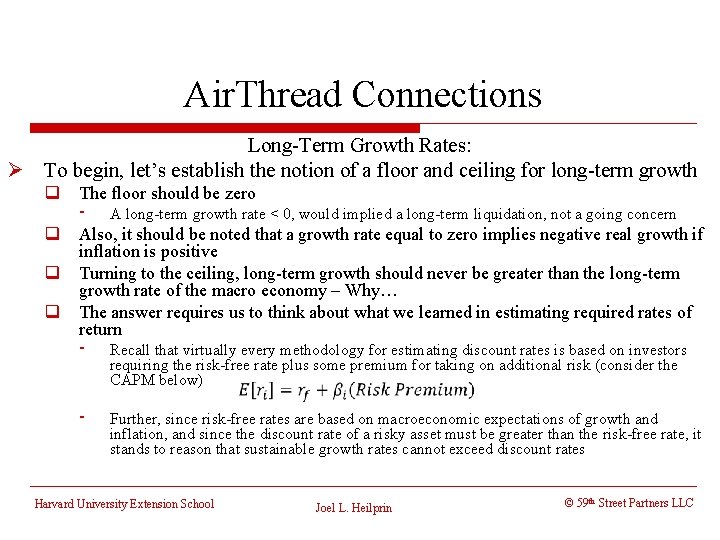
Air. Thread Connections Long-Term Growth Rates: Ø To begin, let’s establish the notion of a floor and ceiling for long-term growth q The floor should be zero ־ A long-term growth rate < 0, would implied a long-term liquidation, not a going concern q Also, it should be noted that a growth rate equal to zero implies negative real growth if inflation is positive q Turning to the ceiling, long-term growth should never be greater than the long-term growth rate of the macro economy – Why… q The answer requires us to think about what we learned in estimating required rates of return ־ Recall that virtually every methodology for estimating discount rates is based on investors requiring the risk-free rate plus some premium for taking on additional risk (consider the CAPM below) ־ Further, since risk-free rates are based on macroeconomic expectations of growth and inflation, and since the discount rate of a risky asset must be greater than the risk-free rate, it stands to reason that sustainable growth rates cannot exceed discount rates Harvard University Extension School Joel L. Heilprin © 59 th Street Partners LLC
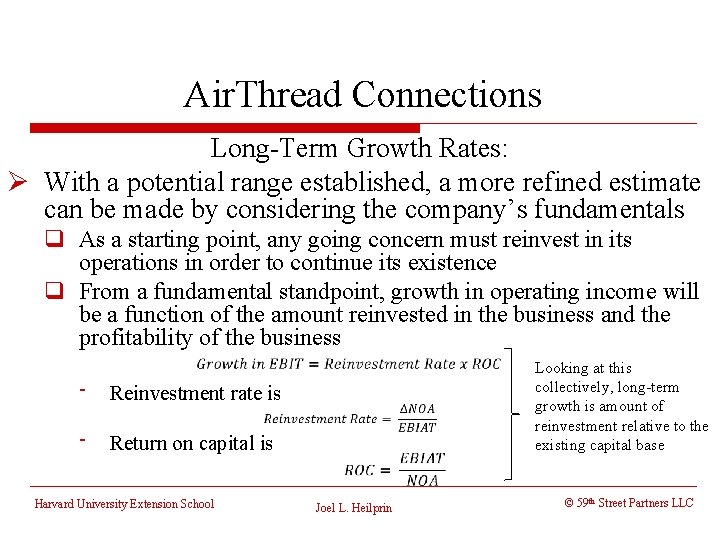
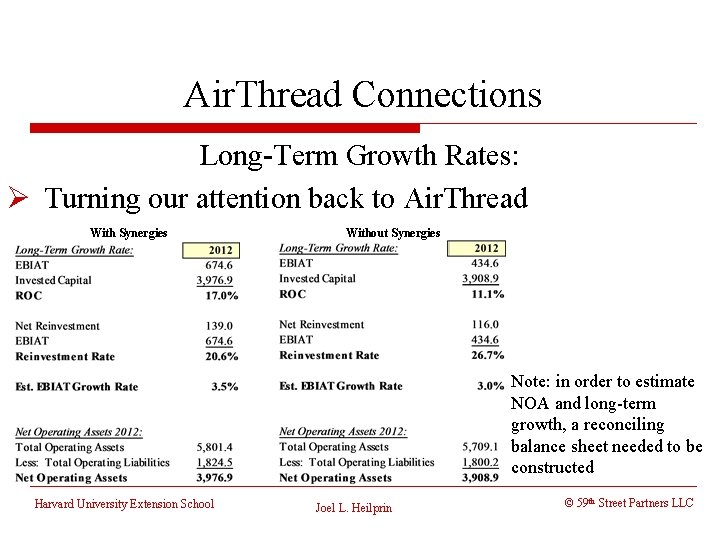
Air. Thread Connections Long-Term Growth Rates: Ø With a potential range established, a more refined estimate can be made by considering the company’s fundamentals q As a starting point, any going concern must reinvest in its operations in order to continue its existence q From a fundamental standpoint, growth in operating income will be a function of the amount reinvested in the business and the profitability of the business ־ Reinvestment rate is ־ Return on capital is Harvard University Extension School Looking at this collectively, long-term growth is amount of reinvestment relative to the existing capital base Joel L. Heilprin © 59 th Street Partners LLC
Air. Thread Connections Long-Term Growth Rates: Ø Turning our attention back to Air. Thread With Synergies Without Synergies Note: in order to estimate NOA and long-term growth, a reconciling balance sheet needed to be constructed Harvard University Extension School Joel L. Heilprin © 59 th Street Partners LLC
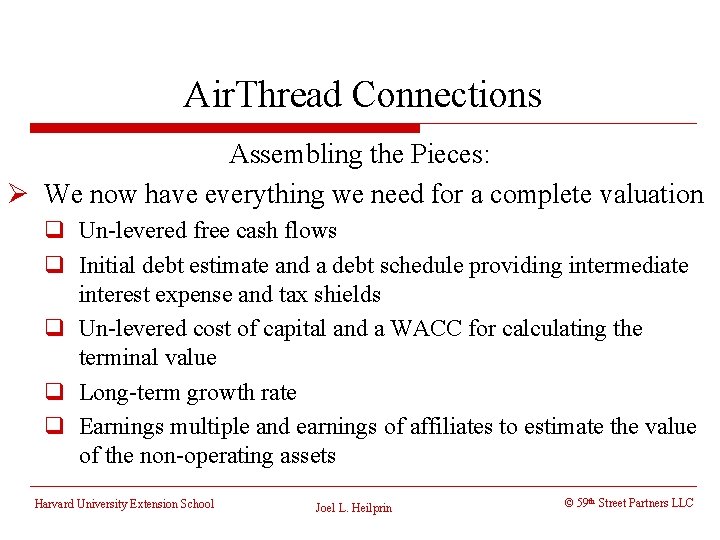
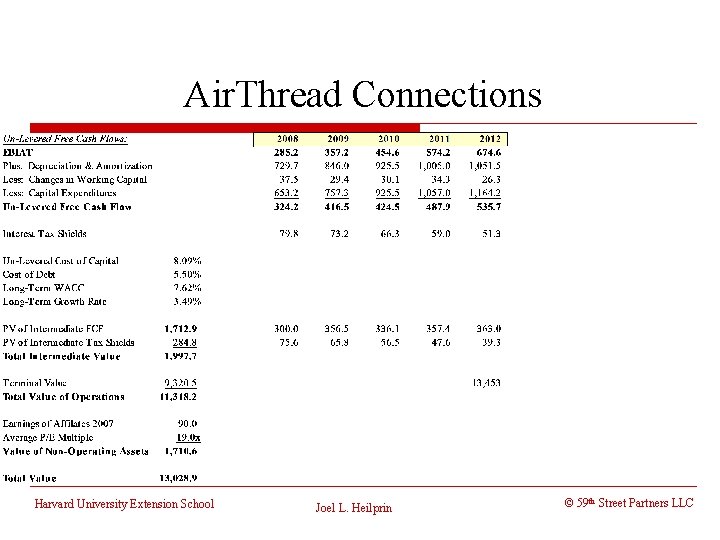
Air. Thread Connections Assembling the Pieces: Ø We now have everything we need for a complete valuation q Un-levered free cash flows q Initial debt estimate and a debt schedule providing intermediate interest expense and tax shields q Un-levered cost of capital and a WACC for calculating the terminal value q Long-term growth rate q Earnings multiple and earnings of affiliates to estimate the value of the non-operating assets Harvard University Extension School Joel L. Heilprin © 59 th Street Partners LLC
Air. Thread Connections Harvard University Extension School Joel L. Heilprin © 59 th Street Partners LLC