
AIR RIFLE SAFETY RANGE PROCEDURES JROTC Marksmanship Training

- Slides: 29
AIR RIFLE SAFETY & RANGE PROCEDURES JROTC Marksmanship Training, Section V
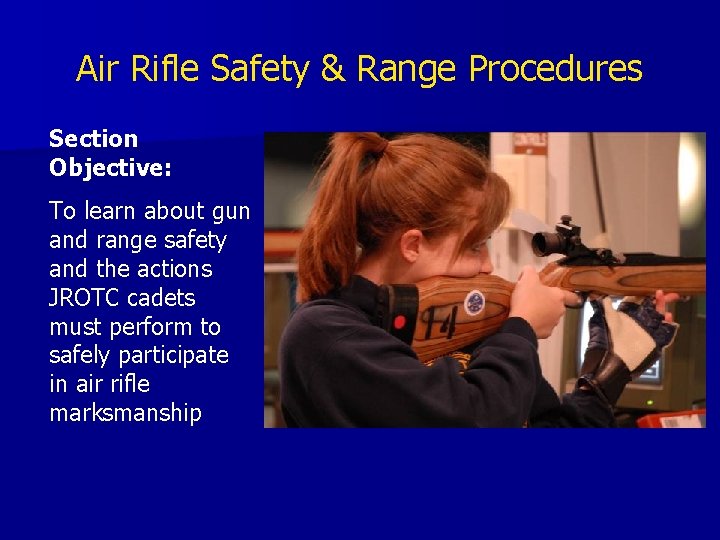
Air Rifle Safety & Range Procedures Section Objective: To learn about gun and range safety and the actions JROTC cadets must perform to safely participate in air rifle marksmanship
Air Rifle Safety Training Safe Gun Handling Rules Shooting Range Basics Range Commands Protecting Your Health Everyone is a Safety Officer Range Firing Procedures Self-Discipline & Focus Becoming “Marksmanship Qualified”
Safety Performance Objectives Properly Trained Cadets Will: Be aware of the gun muzzle and maintain proper muzzle control at all times Check for and maintain an open action, with CBI properly inserted, on every gun they handle Keep fingers off of the trigger at all times until actually aiming at a target Respond properly to range commands and special range situations Be aware of the gun handling of those around them to assist others in following safe gun handling rules
Learning To Handle Guns Safely The goal—eliminate all gun accidents! Know primary gun parts that affect safety: M-A-T Apply M-A-T performance standards Practice handling air rifles--safety comes from practice, not knowledge Safe gun handling rules apply to all guns and firearms
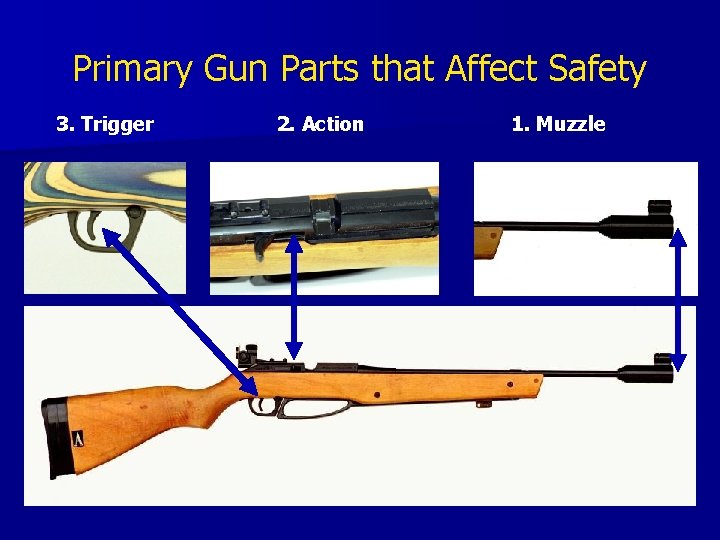
Primary Gun Parts that Affect Safety 3. Trigger 2. Action 1. Muzzle
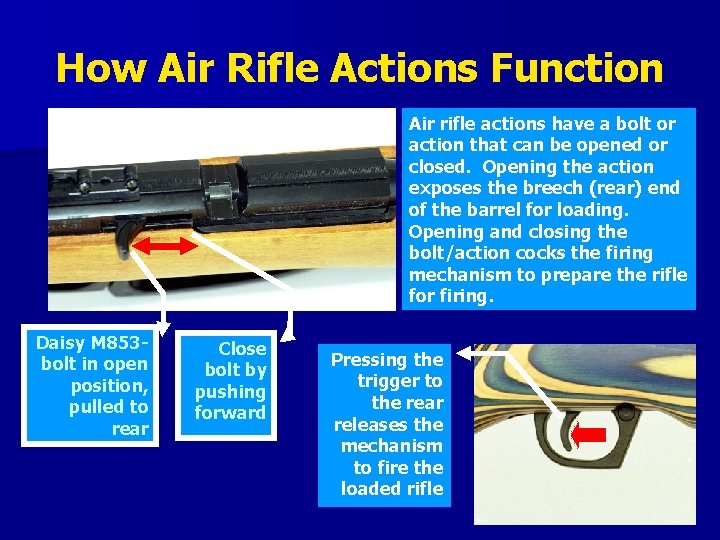
How Air Rifle Actions Function Air rifle actions have a bolt or action that can be opened or closed. Opening the action exposes the breech (rear) end of the barrel for loading. Opening and closing the bolt/action cocks the firing mechanism to prepare the rifle for firing. Daisy M 853 bolt in open position, pulled to rear Close bolt by pushing forward Pressing the trigger to the rear releases the mechanism to fire the loaded rifle
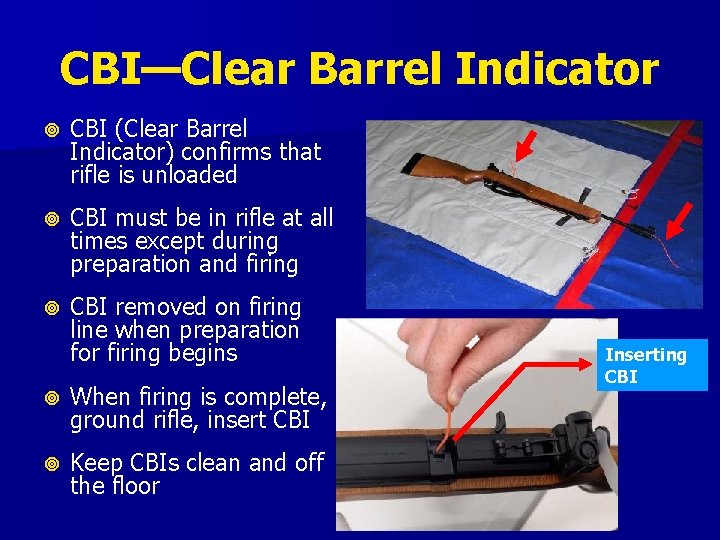
CBI—Clear Barrel Indicator CBI (Clear Barrel Indicator) confirms that rifle is unloaded CBI must be in rifle at all times except during preparation and firing CBI removed on firing line when preparation for firing begins When firing is complete, ground rifle, insert CBI Keep CBIs clean and off the floor Inserting CBI
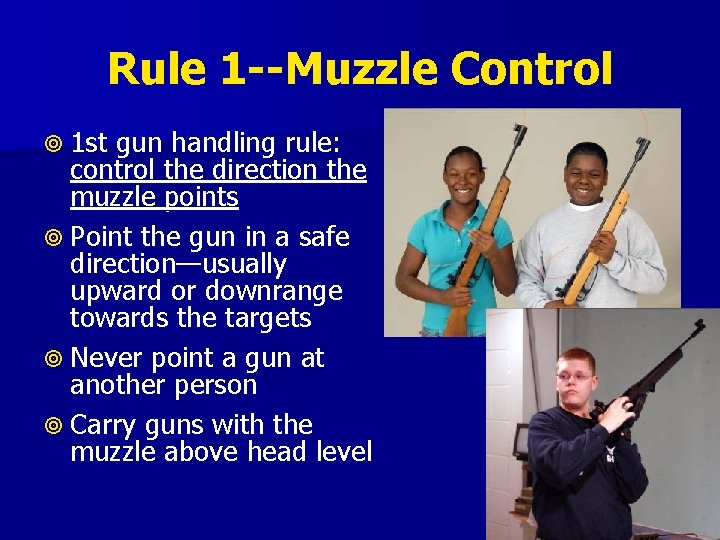
Rule 1 --Muzzle Control 1 st gun handling rule: control the direction the muzzle points Point the gun in a safe direction—usually upward or downrange towards the targets Never point a gun at another person Carry guns with the muzzle above head level
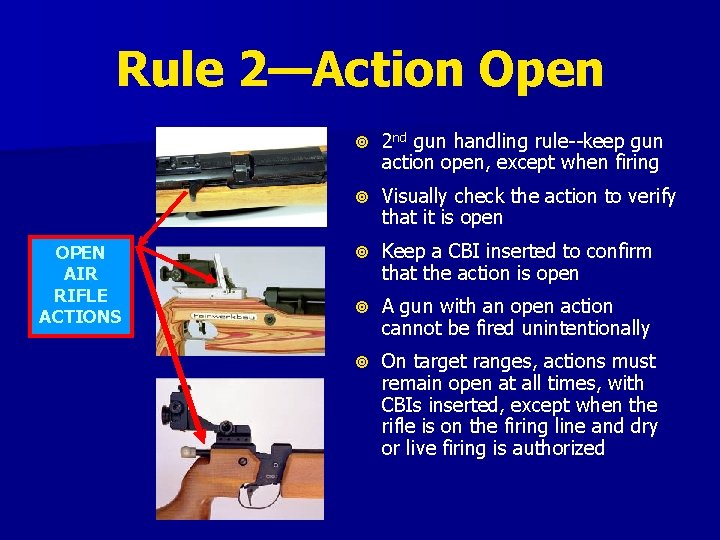
Rule 2—Action Open OPEN AIR RIFLE ACTIONS 2 nd gun handling rule--keep gun action open, except when firing Visually check the action to verify that it is open Keep a CBI inserted to confirm that the action is open A gun with an open action cannot be fired unintentionally On target ranges, actions must remain open at all times, with CBIs inserted, except when the rifle is on the firing line and dry or live firing is authorized
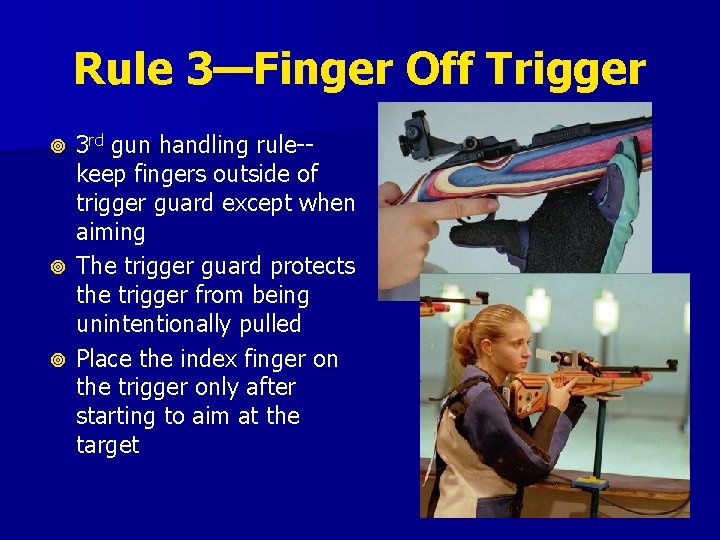
Rule 3—Finger Off Trigger 3 rd gun handling rule-keep fingers outside of trigger guard except when aiming The trigger guard protects the trigger from being unintentionally pulled Place the index finger on the trigger only after starting to aim at the target
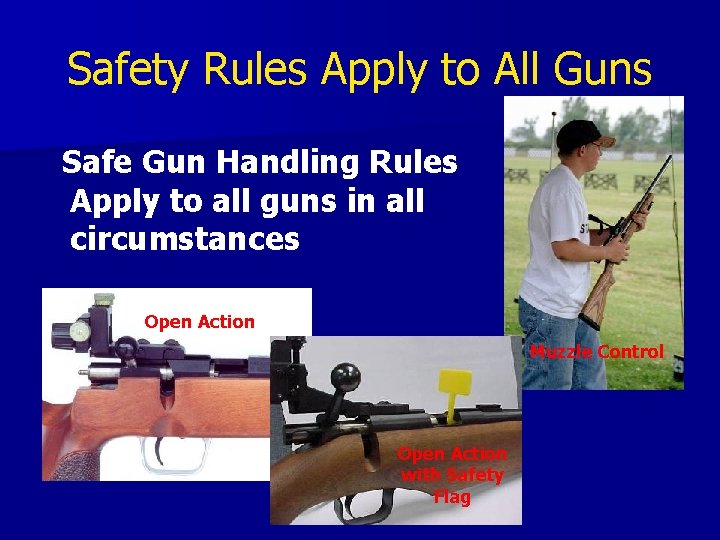
Safety Rules Apply to All Guns Safe Gun Handling Rules Apply to all guns in all circumstances Open Action Muzzle Control Open Action with Safety Flag
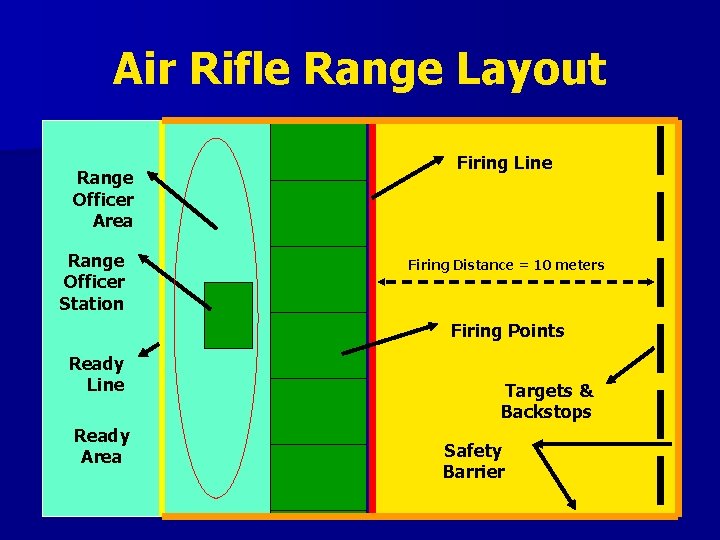
Air Rifle Range Layout Range Officer Area Range Officer Station Firing Line Firing Distance = 10 meters Firing Points Ready Line Ready Area Targets & Backstops Safety Barrier
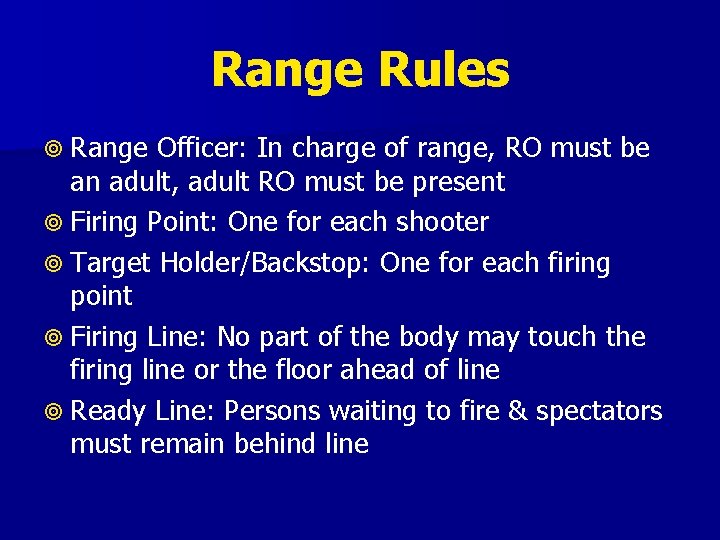
Range Rules Range Officer: In charge of range, RO must be an adult, adult RO must be present Firing Point: One for each shooter Target Holder/Backstop: One for each firing point Firing Line: No part of the body may touch the firing line or the floor ahead of line Ready Line: Persons waiting to fire & spectators must remain behind line
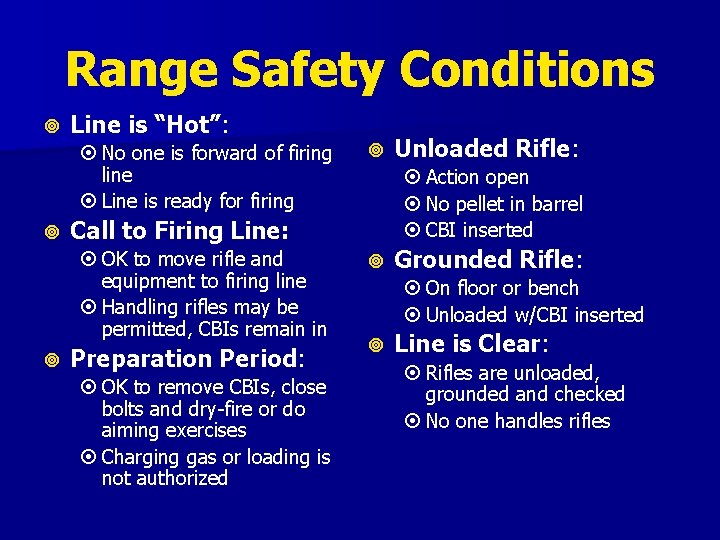
Range Safety Conditions Line is “Hot”: No one is forward of firing line Line is ready for firing Preparation Period: OK to remove CBIs, close bolts and dry-fire or do aiming exercises Charging gas or loading is not authorized Unloaded Rifle: Action open No pellet in barrel CBI inserted Call to Firing Line: OK to move rifle and equipment to firing line Handling rifles may be permitted, CBIs remain in Grounded Rifle: On floor or bench Unloaded w/CBI inserted Line is Clear: Rifles are unloaded, grounded and checked No one handles rifles
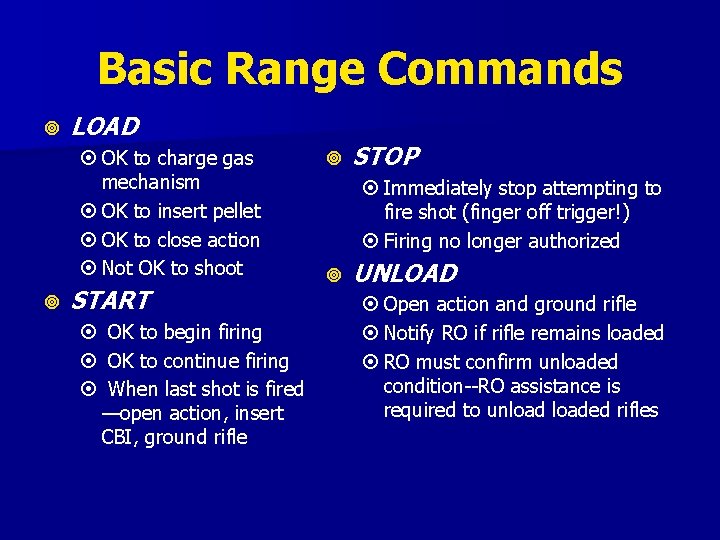
Basic Range Commands LOAD OK to charge gas mechanism OK to insert pellet OK to close action Not OK to shoot START OK to begin firing OK to continue firing When last shot is fired —open action, insert CBI, ground rifle STOP Immediately stop attempting to fire shot (finger off trigger!) Firing no longer authorized UNLOAD Open action and ground rifle Notify RO if rifle remains loaded RO must confirm unloaded condition--RO assistance is required to unloaded rifles
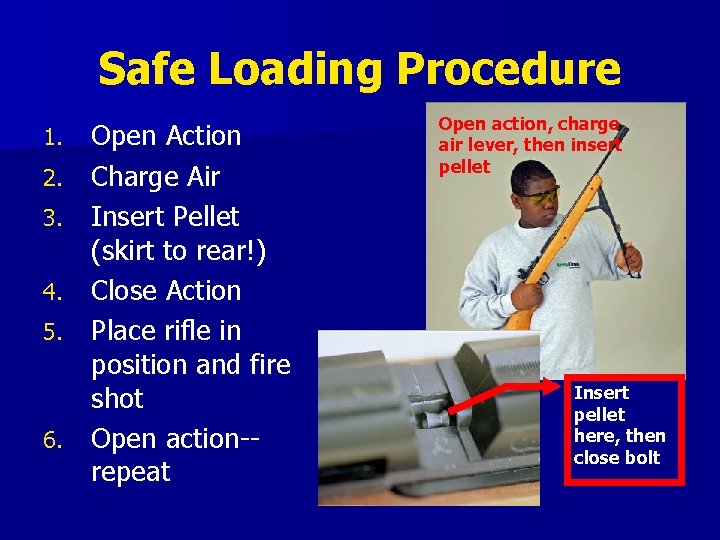
Safe Loading Procedure 1. 2. 3. 4. 5. 6. Open Action Charge Air Insert Pellet (skirt to rear!) Close Action Place rifle in position and fire shot Open action-repeat Open action, charge air lever, then insert pellet Insert pellet here, then close bolt
Dry Firing Dry Firing: Cocking and releasing trigger mechanism, without charging gas system, to simulate firing Will not damage air rifles Some air rifles cannot be dry fired (Daisy M 887/888); aiming exercises can be done in lieu of dry firing An especially effective way to practice Where: Only on designated firing point When: When authorized by RO (e. g. practice or preparation periods) Do not charge air during dry firing--just open and close action to cock trigger mechanism
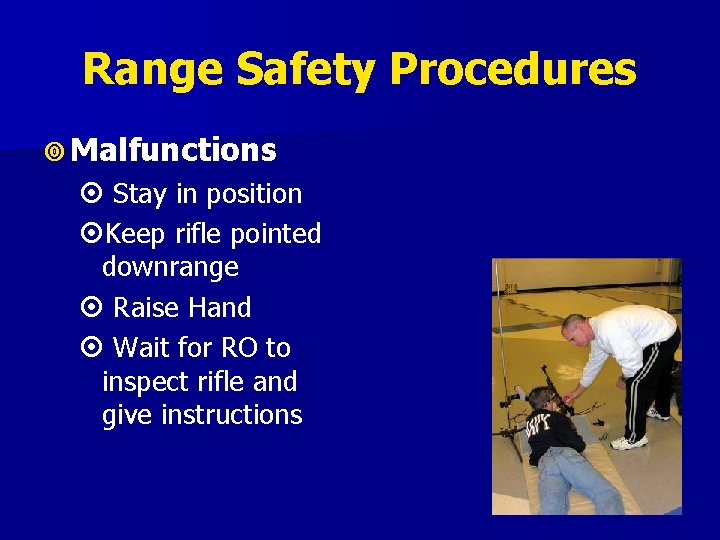
Range Safety Procedures Malfunctions Stay in position Keep rifle pointed downrange Raise Hand Wait for RO to inspect rifle and give instructions
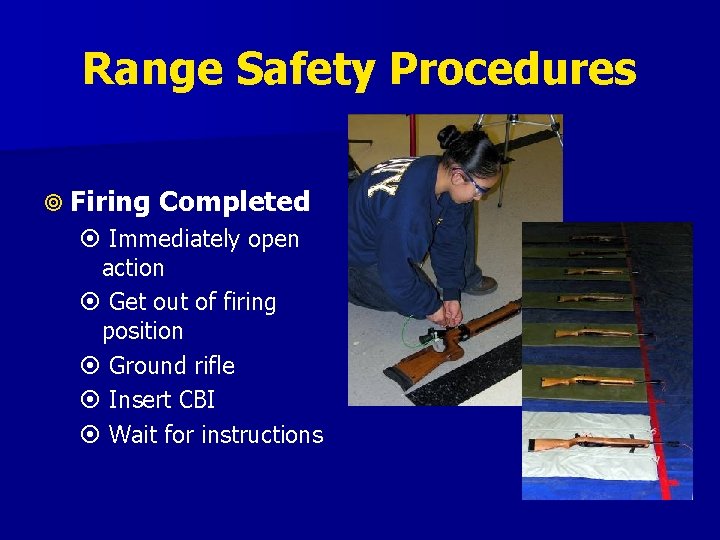
Range Safety Procedures Firing Completed Immediately open action Get out of firing position Ground rifle Insert CBI Wait for instructions
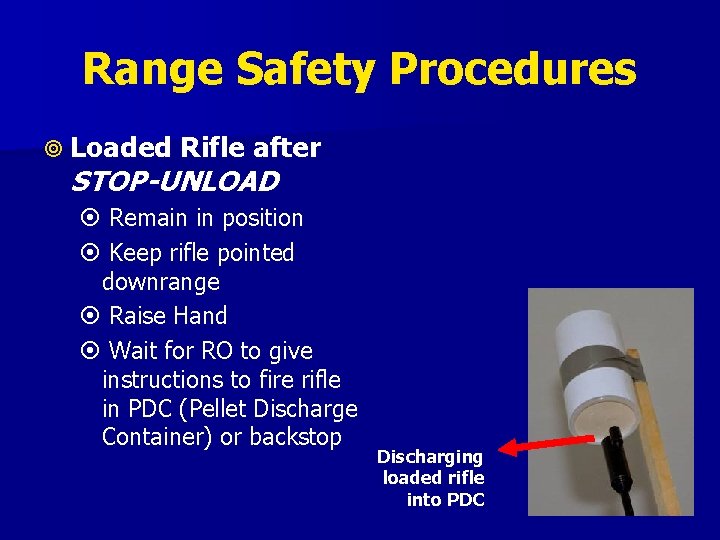
Range Safety Procedures Loaded Rifle after STOP-UNLOAD Remain in position Keep rifle pointed downrange Raise Hand Wait for RO to give instructions to fire rifle in PDC (Pellet Discharge Container) or backstop Discharging loaded rifle into PDC
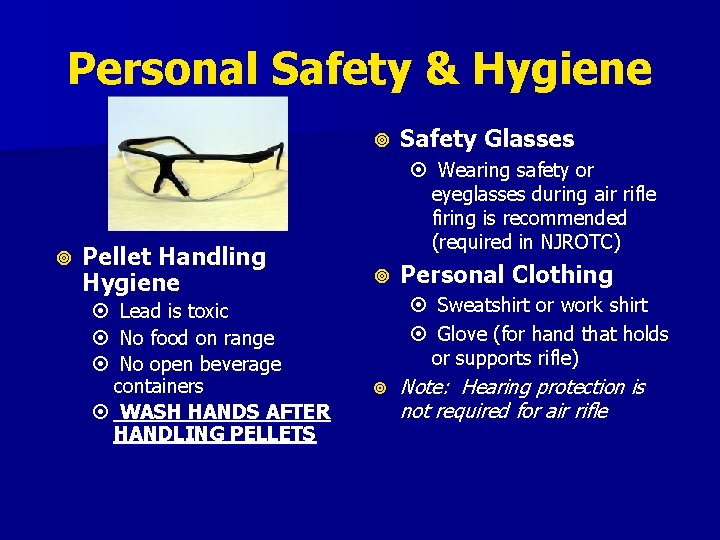
Personal Safety & Hygiene Pellet Handling Hygiene Lead is toxic No food on range No open beverage containers WASH HANDS AFTER HANDLING PELLETS Safety Glasses Wearing safety or eyeglasses during air rifle firing is recommended (required in NJROTC) Personal Clothing Sweatshirt or work shirt Glove (for hand that holds or supports rifle) Note: Hearing protection is not required for air rifle
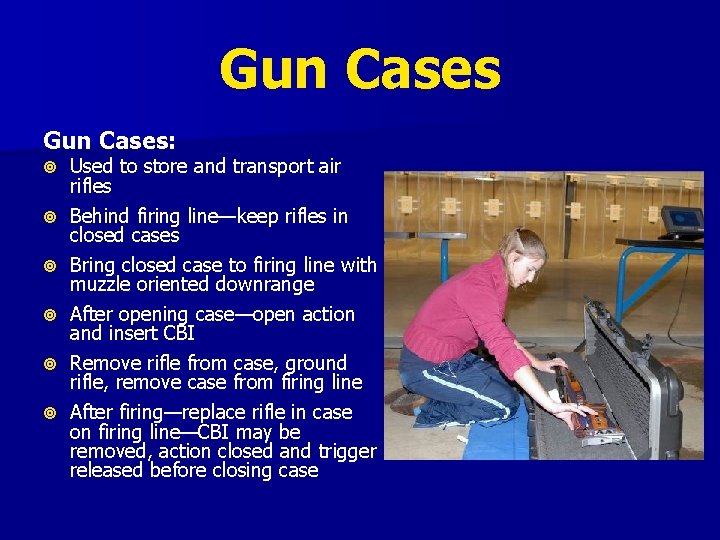
Gun Cases: Used to store and transport air rifles Behind firing line—keep rifles in closed cases Bring closed case to firing line with muzzle oriented downrange After opening case—open action and insert CBI Remove rifle from case, ground rifle, remove case from firing line After firing—replace rifle in case on firing line—CBI may be removed, action closed and trigger released before closing case
Special Conditions Safeties Mechanical devices to facilitate carrying loaded guns On target ranges, the safety is the open action and CBI Most target air rifles do not have mechanical safeties The use of the mechanical safety is not required in air rifle target shooting Safe Air Rifles for Target Ranges Taking a Break Use only 4. 5 mm/. 177 cal. air rifles Use only air rifles with pellet velocities of 600 fps or less Never lay a loaded rifle down Rifle must be cleared with a CBI inserted before laying it down
Special Conditions Other considerations Some ranges may have special safety rules— they must be followed too Other Range Commands Targets DO NOT Over tighten CO 2 Cylinders. Some ROs may use “commence/cease fire” Follow RO instructions and commands Shoot only at your designated target!
Becoming Marksmanship Qualified Cadets must attend safety training class Cadets must pass a standard safety exam Exam based on safety training class and Cadets Guide to Air Rifle Safety Cadets Enjoy must sign Cadet Safety Pledge your rifle marksmanship experience!
Achieving a Perfect Safety Record Safety requires self-discipline and focus— we must always pay attention to safety Everyone is a Safety Officer Never tolerate unsafe gun handling by others Act immediately to correct unsafe situations Anyone can call STOP in a safety emergency Remember the Goal—No Gun Accidents! Who ever is holding the air-rifle is the most important safety component.
Training Sessions F Monthly Calendars will be published F Times and locations subject to change F Right now - Tuesday and Thursday morning before school 0700 -0830 hrs F One or more Saturdays a month 08001100 hrs. F You are expected to be present 30 min early to set-up gym. F Compete for Competition Line-Up.
Questions?