
Air Pollution Exposure Model for Individuals EMI in
- Slides: 1
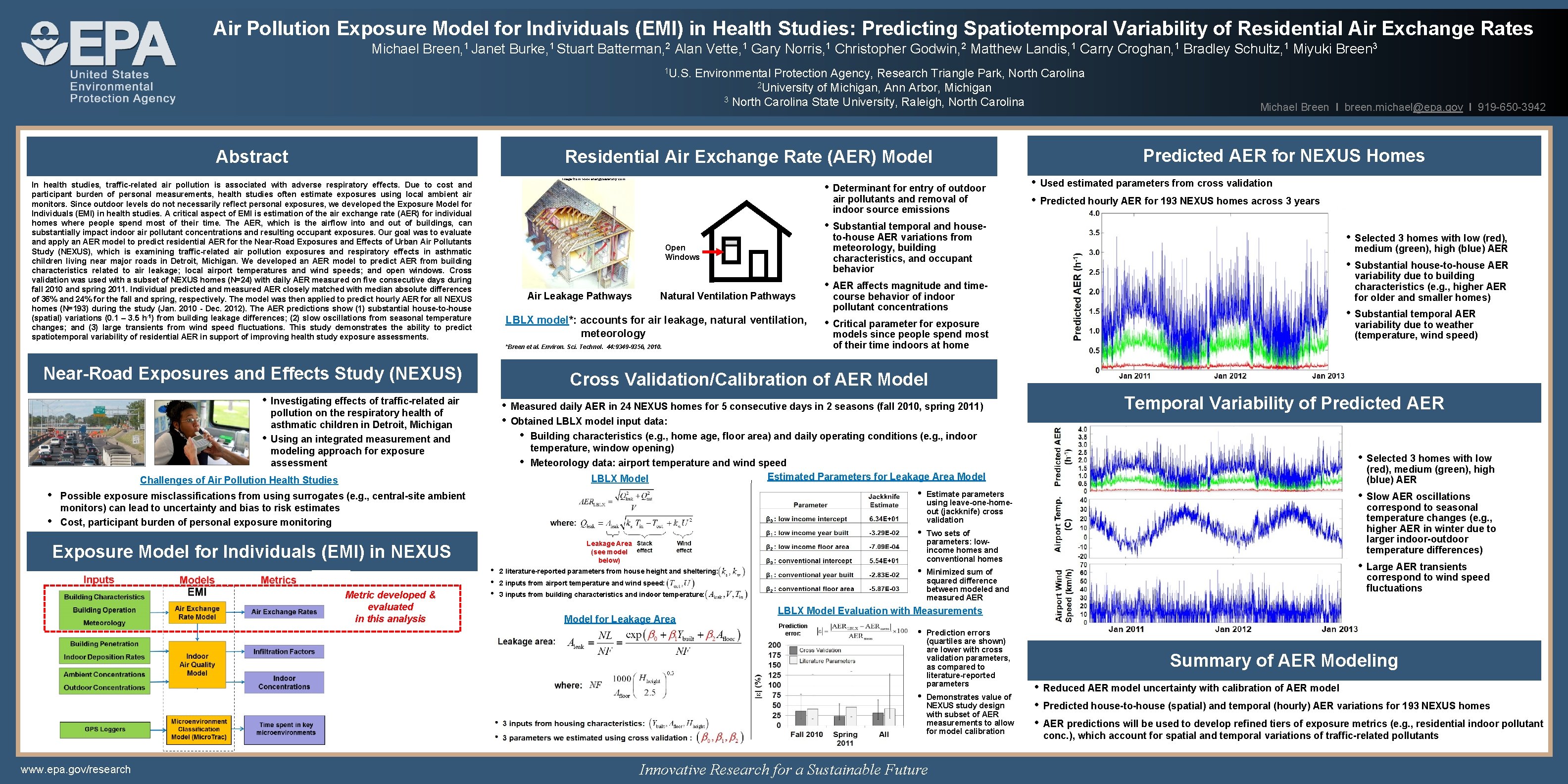
Air Pollution Exposure Model for Individuals (EMI) in Health Studies: Predicting Spatiotemporal Variability of Residential Air Exchange Rates Michael Breen, 1 Janet Burke, 1 Stuart Batterman, 2 Alan Vette, 1 Gary Norris, 1 Christopher Godwin, 2 Matthew Landis, 1 Carry Croghan, 1 Bradley Schultz, 1 Miyuki Breen 3 1 U. S. Abstract Environmental Protection Agency, Research Triangle Park, North Carolina 2 University of Michigan, Ann Arbor, Michigan 3 North Carolina State University, Raleigh, North Carolina Image from www. energysaversny. com • Determinant for entry of outdoor air pollutants and removal of indoor source emissions Air Leakage Pathways Natural Ventilation Pathways LBLX model*: accounts for air leakage, natural ventilation, meteorology • • pollution on the respiratory health of asthmatic children in Detroit, Michigan Using an integrated measurement and modeling approach for exposure assessment • medium (green), high (blue) AER • Substantial house-to-house AER variability due to building characteristics (e. g. , higher AER for older and smaller homes) • AER affects magnitude and timecourse behavior of indoor pollutant concentrations • Substantial temporal AER • Critical parameter for exposure variability due to weather (temperature, wind speed) models since people spend most of their time indoors at home • • 2 literature-reported parameters from house height and sheltering: Two sets of parameters: lowincome homes and conventional homes • Minimized sum of squared difference between modeled and measured AER 2 inputs from airport temperature and wind speed: 3 inputs from building characteristics and indoor temperature: Model for Leakage Area • Selected 3 homes with low (red), medium (green), high (blue) AER • Slow AER oscillations Estimate parameters using leave-one-homeout (jackknife) cross validation • Leakage Area (see model below) Exposure Model for Individuals (EMI) in NEXUS Temporal Variability of Predicted AER Building characteristics (e. g. , home age, floor area) and daily operating conditions (e. g. , indoor temperature, window opening) Meteorology data: airport temperature and wind speed Estimated Parameters for Leakage Area Model LBLX Model Possible exposure misclassifications from using surrogates (e. g. , central-site ambient monitors) can lead to uncertainty and bias to risk estimates Cost, participant burden of personal exposure monitoring correspond to seasonal temperature changes (e. g. , higher AER in winter due to larger indoor-outdoor temperature differences) • Large AER transients correspond to wind speed fluctuations LBLX Model Evaluation with Measurements Prediction error: • • www. epa. gov/research • Selected 3 homes with low (red), Measured daily AER in 24 NEXUS homes for 5 consecutive days in 2 seasons (fall 2010, spring 2011) Obtained LBLX model input data: • Challenges of Air Pollution Health Studies Metric developed & evaluated in this analysis Predicted hourly AER for 193 NEXUS homes across 3 years Cross Validation/Calibration of AER Model • Investigating effects of traffic-related air • Used estimated parameters from cross validation to-house AER variations from meteorology, building characteristics, and occupant behavior Open Windows Near-Road Exposures and Effects Study (NEXUS) • • Substantial temporal and house- *Breen et al. Environ. Sci. Technol. 44: 9349 -9356, 2010. • Predicted AER for NEXUS Homes Residential Air Exchange Rate (AER) Model In health studies, traffic-related air pollution is associated with adverse respiratory effects. Due to cost and participant burden of personal measurements, health studies often estimate exposures using local ambient air monitors. Since outdoor levels do not necessarily reflect personal exposures, we developed the Exposure Model for Individuals (EMI) in health studies. A critical aspect of EMI is estimation of the air exchange rate (AER) for individual homes where people spend most of their time. The AER, which is the airflow into and out of buildings, can substantially impact indoor air pollutant concentrations and resulting occupant exposures. Our goal was to evaluate and apply an AER model to predict residential AER for the Near-Road Exposures and Effects of Urban Air Pollutants Study (NEXUS), which is examining traffic-related air pollution exposures and respiratory effects in asthmatic children living near major roads in Detroit, Michigan. We developed an AER model to predict AER from building characteristics related to air leakage; local airport temperatures and wind speeds; and open windows. Cross validation was used with a subset of NEXUS homes (N=24) with daily AER measured on five consecutive days during fall 2010 and spring 2011. Individual predicted and measured AER closely matched with median absolute differences of 36% and 24% for the fall and spring, respectively. The model was then applied to predict hourly AER for all NEXUS homes (N=193) during the study (Jan. 2010 - Dec. 2012). The AER predictions show (1) substantial house-to-house (spatial) variations (0. 1 – 3. 5 h-1) from building leakage differences; (2) slow oscillations from seasonal temperature changes; and (3) large transients from wind speed fluctuations. This study demonstrates the ability to predict spatiotemporal variability of residential AER in support of improving health study exposure assessments. Michael Breen l breen. michael@epa. gov l 919 -650 -3942 Prediction errors (quartiles are shown) are lower with cross validation parameters, as compared to literature-reported parameters Demonstrates value of NEXUS study design with subset of AER measurements to allow for model calibration Innovative Research for a Sustainable Future Summary of AER Modeling • • • Reduced AER model uncertainty with calibration of AER model Predicted house-to-house (spatial) and temporal (hourly) AER variations for 193 NEXUS homes AER predictions will be used to develop refined tiers of exposure metrics (e. g. , residential indoor pollutant conc. ), which account for spatial and temporal variations of traffic-related pollutants