
AIR POLLUTION CONTROL MECHANISM AND TECHNOLOGIES PRESENTED BY
AIR POLLUTION CONTROL (MECHANISM AND TECHNOLOGIES) PRESENTED BY : SHABEER AHMAD DAR GOVT. DEGREE COLLEGE PATTAN, BARAMULLAH
q. INTRODUCTION q. TYPES CONTROL DEVICES OF PARTICULATE MATTER GRAVITY SETTLING CHAMBER SPRAY TOROWER DYNAMIC PRECIPITATOR CONTROL DEVICES FOR GASEOUS POLLUTANTS ADSORPTION ABSORPTION CONDENSATION COMBUSTION VOLATILE ORGANIC COMPOUNDS BIOFILTER BIOSCRUBBER q. CONCLUSION q. REFERENCES

In the nature itself there are certain devices , commonly referred to as atmospheric self–cleansing process for the removal of air pollutants. These natural process are very slow and limited, and cannot cope up with the present increased demands of pollution control. The artificially devised pollution control measures are based on the same principles of atmosphere self cleansing processes.
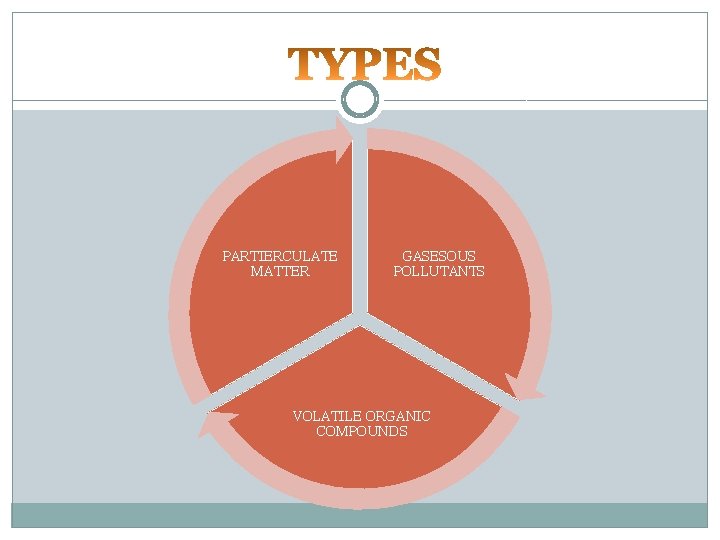
PARTIERCULATE MATTER GASESOUS POLLUTANTS VOLATILE ORGANIC COMPOUNDS
ØGRAVITY SETTLING CHAMBER ØSPRAY TOWER ØDYNAMIC PRECIPITATOR
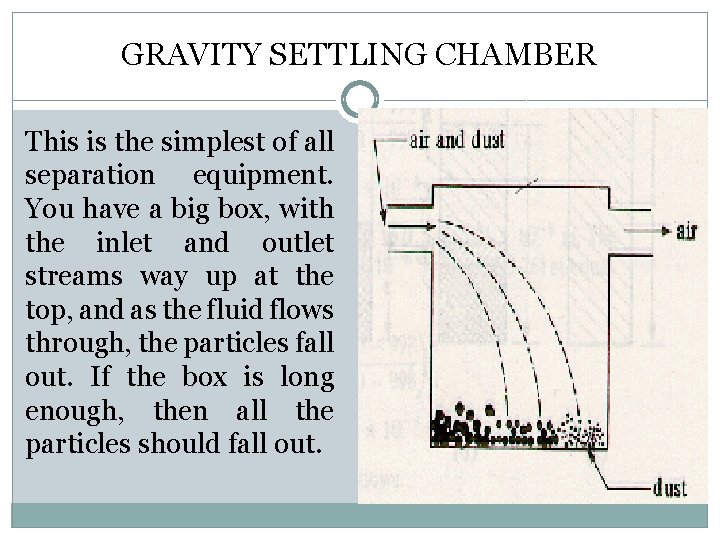
GRAVITY SETTLING CHAMBER This is the simplest of all separation equipment. You have a big box, with the inlet and outlet streams way up at the top, and as the fluid flows through, the particles fall out. If the box is long enough, then all the particles should fall out.
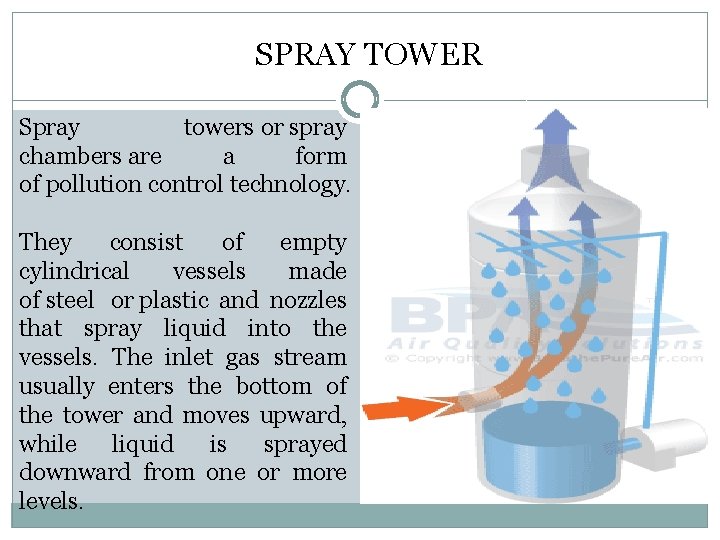
SPRAY TOWER Spray towers or spray chambers are a form of pollution control technology. They consist of empty cylindrical vessels made of steel or plastic and nozzles that spray liquid into the vessels. The inlet gas stream usually enters the bottom of the tower and moves upward, while liquid is sprayed downward from one or more levels.
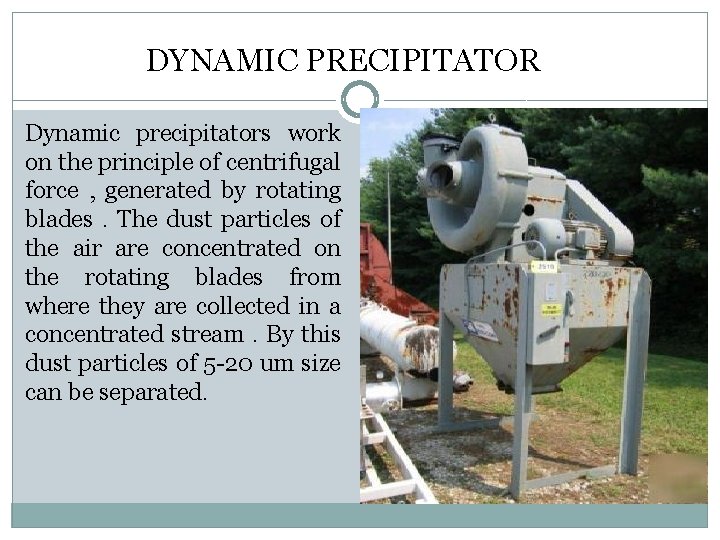
DYNAMIC PRECIPITATOR Dynamic precipitators work on the principle of centrifugal force , generated by rotating blades. The dust particles of the air are concentrated on the rotating blades from where they are collected in a concentrated stream. By this dust particles of 5 -20 um size can be separated.
CONTROL DEVICES FOR GASEOUS POLLUTANTS ØADSORPTION ØABSORPTION ØCONDENSATION ØCOMBUSTION
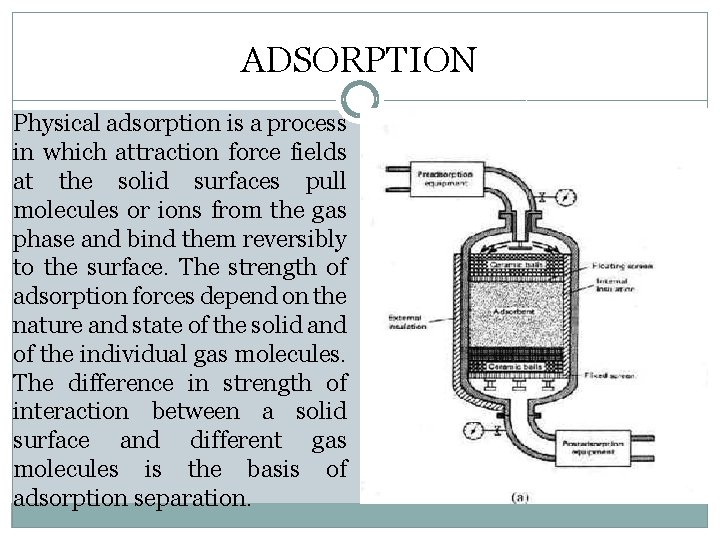
ADSORPTION Physical adsorption is a process in which attraction force fields at the solid surfaces pull molecules or ions from the gas phase and bind them reversibly to the surface. The strength of adsorption forces depend on the nature and state of the solid and of the individual gas molecules. The difference in strength of interaction between a solid surface and different gas molecules is the basis of adsorption separation.
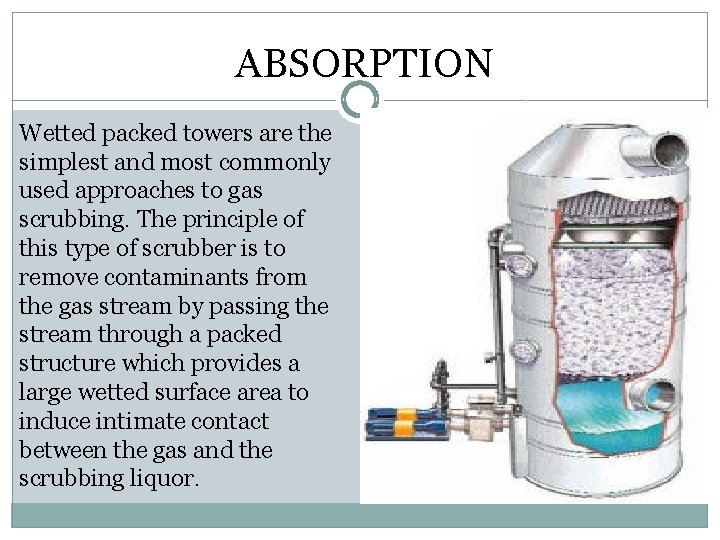
ABSORPTION Wetted packed towers are the simplest and most commonly used approaches to gas scrubbing. The principle of this type of scrubber is to remove contaminants from the gas stream by passing the stream through a packed structure which provides a large wetted surface area to induce intimate contact between the gas and the scrubbing liquor.
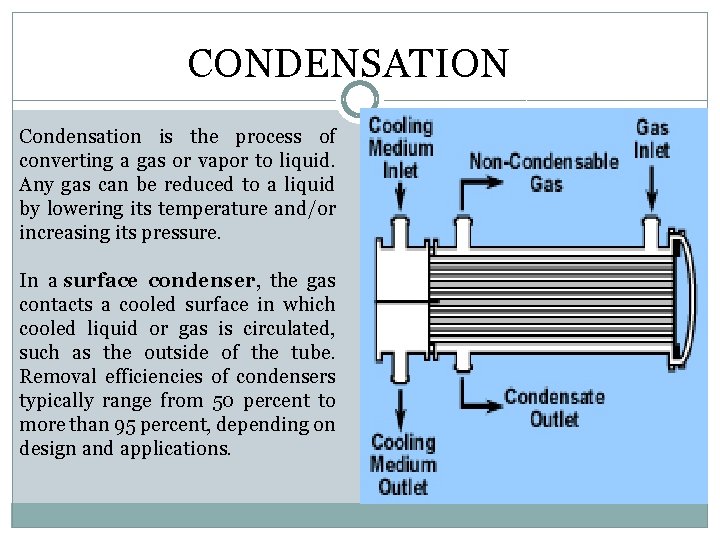
CONDENSATION Condensation is the process of converting a gas or vapor to liquid. Any gas can be reduced to a liquid by lowering its temperature and/or increasing its pressure. In a surface condenser, the gas contacts a cooled surface in which cooled liquid or gas is circulated, such as the outside of the tube. Removal efficiencies of condensers typically range from 50 percent to more than 95 percent, depending on design and applications.
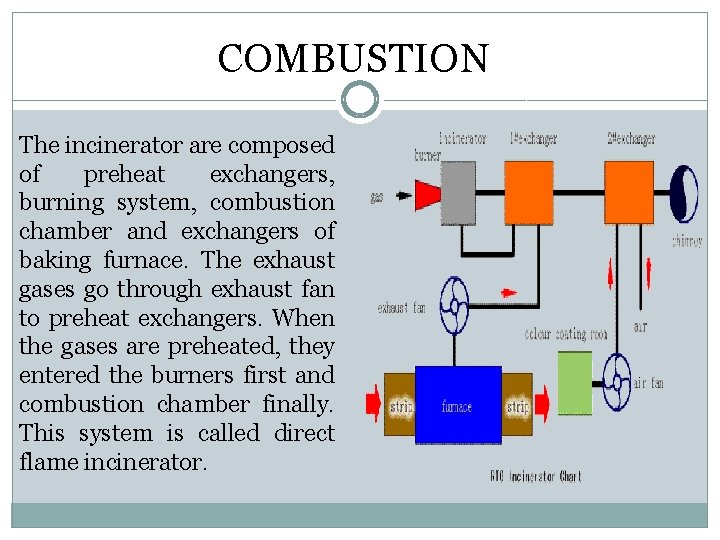
COMBUSTION The incinerator are composed of preheat exchangers, burning system, combustion chamber and exchangers of baking furnace. The exhaust gases go through exhaust fan to preheat exchangers. When the gases are preheated, they entered the burners first and combustion chamber finally. This system is called direct flame incinerator.
ØBIOFILTER ØBIOSCRUBBER
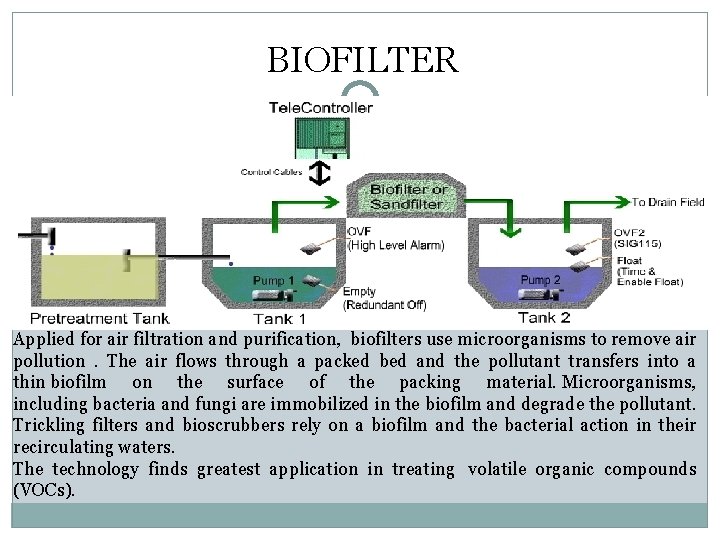
BIOFILTER Applied for air filtration and purification, biofilters use microorganisms to remove air pollution. The air flows through a packed bed and the pollutant transfers into a thin biofilm on the surface of the packing material. Microorganisms, including bacteria and fungi are immobilized in the biofilm and degrade the pollutant. Trickling filters and bioscrubbers rely on a biofilm and the bacterial action in their recirculating waters. The technology finds greatest application in treating volatile organic compounds (VOCs).
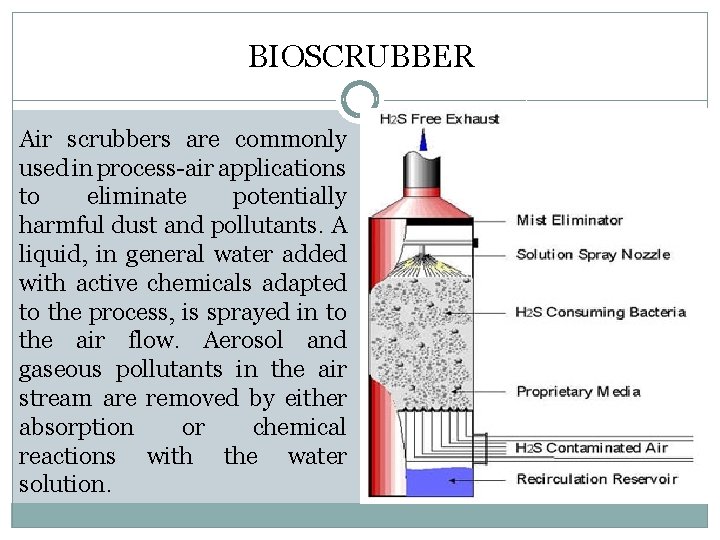
BIOSCRUBBER Air scrubbers are commonly used in process-air applications to eliminate potentially harmful dust and pollutants. A liquid, in general water added with active chemicals adapted to the process, is sprayed in to the air flow. Aerosol and gaseous pollutants in the air stream are removed by either absorption or chemical reactions with the water solution.
Air pollution is the introduction of chemicals, particulate matter, or biological materials that cause harm or discomfort to humans or other living organisms, or cause damage to the natural environment or built environment , into the atmosphere. So, pollution control devices are used by industry or transportation devices. They can either destroy contaminants or remove them from an exhaust stream before it is emitted into the atmosphere.

THANK YOU
- Slides: 18