
Air Force SBIRSTTR 101 Briefing Pacific Northwest Road
Air Force SBIR/STTR 101 Briefing Pacific Northwest Road Tour Integrity Service Excellence James Sweeney Air Force CRP Manager Acting Air Force SBIR PM AFRL/SB DISTRIBUTION STATEMENT A – Unclassified, Unlimited Distribution 1
What is SBIR/STTR? A congressionally mandated program… SBIR STTR 2. 9%-3. 2% of RDT&E Budget 0. 4%-0. 45% of RDT&E Budget Goals: • Stimulate technological innovation • Use small business to meet Federal R&D needs • Increase private-sector commercialization innovations derived from federal R&D • Foster and encourage participation by minorities and disadvantaged persons Goals: • Fund cooperative R&D between small businesses and research Institutions • Enable researchers to pursue commercial application of technologies • Bridge funding gap between basic research and commercial product Eligibility: • Applicant is for-profit SB based in U. S. • 500 or fewer employees • Principal Investigator’s primary employment must be with the SB Eligibility: • Applicant is for-profit SB based in U. S. partnering with U. S. research institution • SB performs 40% of work, U. S. research institution performs 30% Did you know? 25% of awardees are first-time winners DISTRIBUTION STATEMENT A – Unclassified, Unlimited Distribution 2
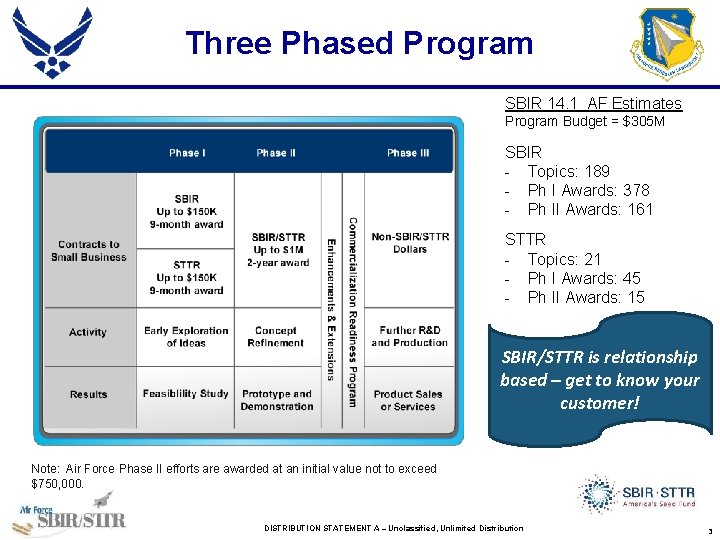
Three Phased Program SBIR 14. 1 AF Estimates Program Budget = $305 M SBIR - Topics: 189 - Ph I Awards: 378 - Ph II Awards: 161 STTR - Topics: 21 - Ph I Awards: 45 - Ph II Awards: 15 SBIR/STTR is relationship based – get to know your customer! Note: Air Force Phase II efforts are awarded at an initial value not to exceed $750, 000. DISTRIBUTION STATEMENT A – Unclassified, Unlimited Distribution 3
PHASE III - Commercialization • PURPOSE: Transition a company’s SBIR/STTR effort into hardware or software products, processes or services that benefit the Air Force acquisition community. • SBIR/STTR Phase III refers to work that derives from, extends, or completes an effort made under prior SBIR funding agreements • • It is funded with “Non-SBIR” sources Funding can come from: o • Either Government and/or the private sector! NOTE: Once a company has successfully been awarded a SBIR Phase I or Phase II, Phase III awards can be made using a “Non-Competitive” process since competition requirements were satisfied using the previous Phase(s). This is the “Holy Grail” for the SBIR Program! DISTRIBUTION STATEMENT A – Unclassified, Unlimited Distribution 4

Air Force Program Management • • Air Force has centralized program execution AFRL Commander executes program as Air Force TEO Do. D Air Force Contracting Technology Transfer TEO (AFRL) SBIR/STTR Technology Focus Areas Small Business Office IR&D Air Force-level programs AFRL–Air Force Research Laboratory TEO–Technology Executive Officer DISTRIBUTION STATEMENT A – Unclassified, Unlimited Distribution 5
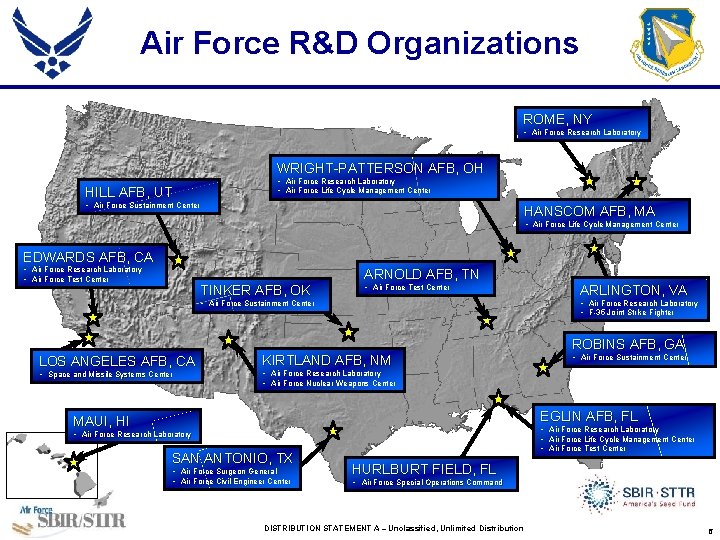
Air Force R&D Organizations ROME, NY • Air Force Research Laboratory WRIGHT-PATTERSON AFB, OH HILL AFB, UT • Air Force Research Laboratory • Air Force Life Cycle Management Center • Air Force Sustainment Center HANSCOM AFB, MA • Air Force Life Cycle Management Center EDWARDS AFB, CA • Air Force Research Laboratory • Air Force Test Center ARNOLD AFB, TN TINKER AFB, OK • Air Force Test Center LOS ANGELES AFB, CA • Space and Missile Systems Center ARLINGTON, VA • Air Force Research Laboratory • F-35 Joint Strike Fighter • Air Force Sustainment Center KIRTLAND AFB, NM ROBINS AFB, GA • Air Force Sustainment Center • Air Force Research Laboratory • Air Force Nuclear Weapons Center EGLIN AFB, FL MAUI, HI • Air Force Research Laboratory • Air Force Life Cycle Management Center • Air Force Test Center • Air Force Research Laboratory SAN ANTONIO, TX • Air Force Surgeon General • Air Force Civil Engineer Center HURLBURT FIELD, FL • Air Force Special Operations Command DISTRIBUTION STATEMENT A – Unclassified, Unlimited Distribution 6
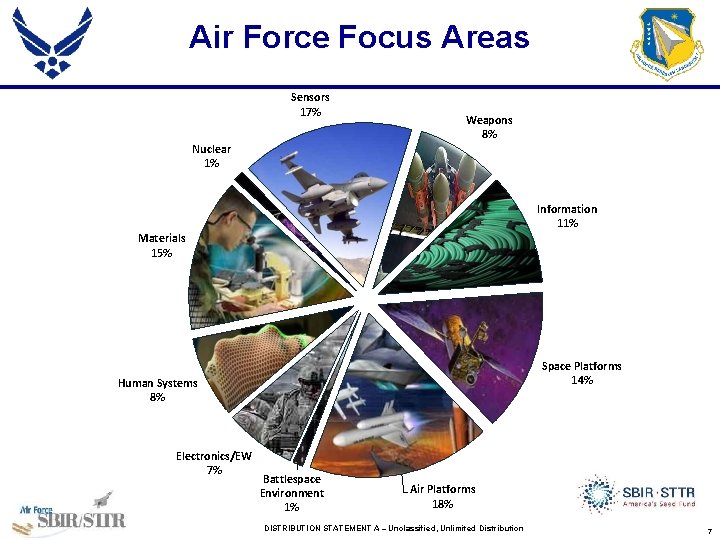
Air Force Focus Areas Sensors 17% Nuclear 1% Weapons 8% Information 11% Materials 15% Space Platforms 14% Human Systems 8% Electronics/EW 7% Battlespace Environment 1% Air Platforms 18% DISTRIBUTION STATEMENT A – Unclassified, Unlimited Distribution 7
Commercialization • Commercialization Readiness Program (CRP) authorized by amendment in Sec 5122 of the FY 12 National Defense Authorization Act – Identify and accelerate transition of SBIR developed technology – Allow for 1% of SBIR budget to administer CRP • Integral to the success of accelerating SBIR transition – Air Force provides valuable assistance in transitioning technology to military and commercial sectors – Successful Air Force SBIR/STTR contracts may help small businesses get additional non-SBIR funding to transition technology to commercial sector Did you know? 58% of AF Phase II contracts resulted in sales of new products and services based on the innovations developed DISTRIBUTION STATEMENT A – Unclassified, Unlimited Distribution 8
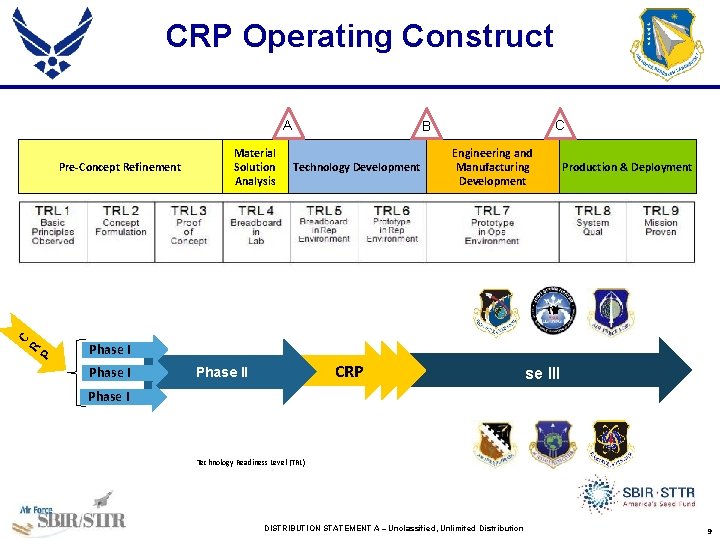
CRP Operating Construct A P R C Pre-Concept Refinement Material Solution Analysis C B Technology Development Engineering and Manufacturing Development Production & Deployment Phase I CRP Phase III Phase I Technology Readiness Level (TRL) DISTRIBUTION STATEMENT A – Unclassified, Unlimited Distribution 9
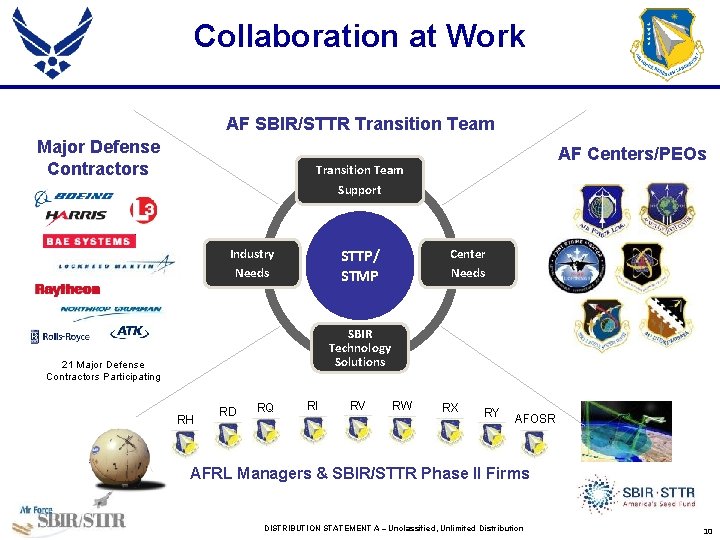
Collaboration at Work AF SBIR/STTR Transition Team Major Defense Contractors AF Centers/PEOs Transition Team Support Industry Center STTP/ STMP Needs SBIR Technology Solutions 21 Major Defense Contractors Participating RH RD RQ RI RV RW RX RY AFOSR AFRL Managers & SBIR/STTR Phase II Firms DISTRIBUTION STATEMENT A – Unclassified, Unlimited Distribution 10
Approach to CRP “Boots on the ground”: Transition Agents (TAs) located at Air Force Centers and Technology Directorates • Identify and Verify Customer, Need, & Technology – Support Technology Interchange Meetings – – Focused Industry and PEO meetings Targeted Do. D SBIR/STTR data mining and due diligence – Continuous Phase II portfolio transitioning – – Participation in various technology requirements discussions Liaison for adhoc PEO and industry technology needs – Facilitate topic alignment with PEOs – Collaborate with other agencies • Assist in development of Transition Plans (STTP/STMP) DISTRIBUTION STATEMENT A – Unclassified, Unlimited Distribution 11
STTP/STMP: The Basics Transition planning requires relationship building and collaboration! The STTP/STMP is a roadmap to transition, where stakeholders work together to plan and identify: ü All critical stakeholder roles & responsibilities ü Current and required transition TRL/MRL of SBIR Phase II technology ü Financial strategy - unfunded requirements ü Intellectual Property (IP) protection ü Risk mitigation STTP is NOT a contractual document or an application for funds DISTRIBUTION STATEMENT A – Unclassified, Unlimited Distribution 12
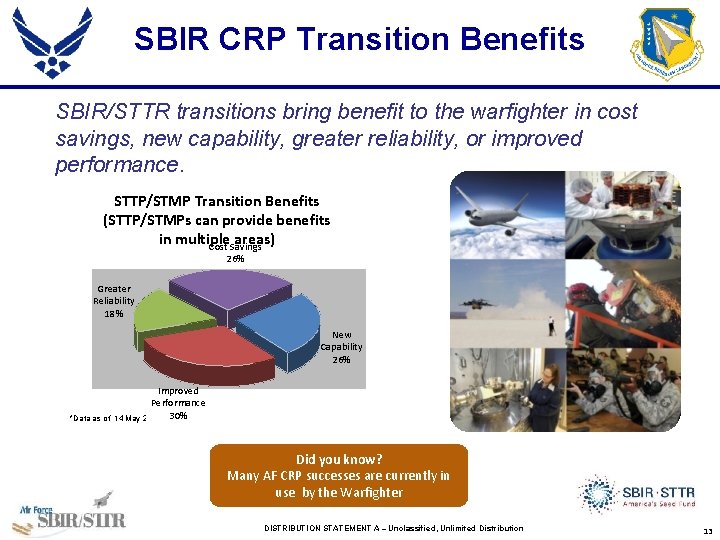
SBIR CRP Transition Benefits SBIR/STTR transitions bring benefit to the warfighter in cost savings, new capability, greater reliability, or improved performance. STTP/STMP Transition Benefits (STTP/STMPs can provide benefits in multiple areas) Cost Savings 26% Greater Reliability 18% New Capability 26% *Data as of Improved Performance 14 May 2015 30% E Did you know? Many AF CRP successes are currently in use by the Warfighter DISTRIBUTION STATEMENT A – Unclassified, Unlimited Distribution 13
Did You Know!! • Last year the federal government awarded 24. 9 percent of all prime contracts to small businesses, or about $91. 7 billion. And defense contracts accounted for more than half, at $54. 3 billion. . “This is the highest percentage of contracting dollars ever awarded to small businesses since the 23 percent goal was established in 1997” “Small businesses now are filing more patents than ever, ” she said. “So they're also driving innovation. ” • The Defense Department’s “better buying power” procurement guidelines specifically promote the use of small businesses, “both for innovation, efficiency, and cost control” • “Small businesses, tend to be leaner and more aggressive to get work, and thus tend to be more economic in many cases for the department. ” DISTRIBUTION STATEMENT A – Unclassified, Unlimited Distribution 14
Innovation – Why! • Air Force and Business leaders at all levels need to find, encourage, mentor, and defend airmen the people willing to take risks to build our future force because innovation cannot be trained… – "You can't institutionalize innovation, there's no instruction manual, there's no regulation—either you are, or you are not" innovative” – "He saw these broken toys. . . and he realized that we had this certain knack and talent if you just nurtured and grew that" – "You need to find those characters out there, you need to give them top cover" instead of putting people in a room and asking for "five brilliant ideas by close of business“. DISTRIBUTION STATEMENT A – Unclassified, Unlimited Distribution 15
What You Can Do • • Understand the Mission • Search technology areas and identify opportunities where your firm is a good fit • Submit proposals aligned with your core business strategy or area of expertise • • Take advantage of all available assistance Be a technology problem-solver & innovator, not just a manufacturer Build a network of contacts in the Air Force and programs of record Persevere! It could take years to make it into a system DISTRIBUTION STATEMENT A – Unclassified, Unlimited Distribution 16
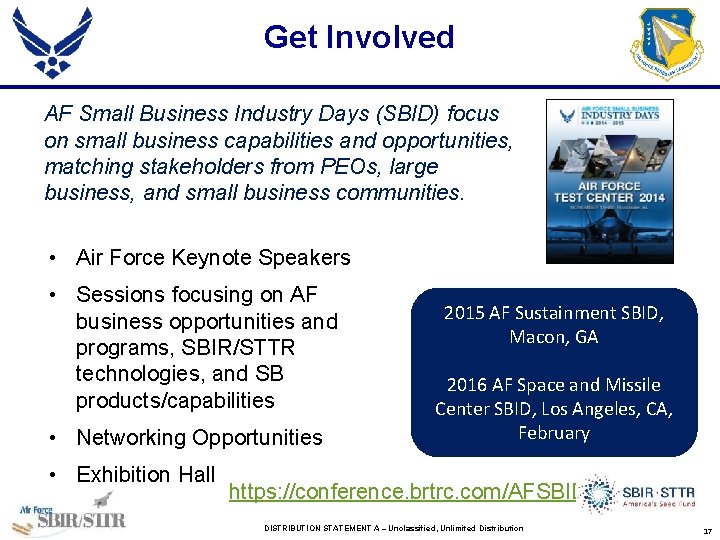
Get Involved AF Small Business Industry Days (SBID) focus on small business capabilities and opportunities, matching stakeholders from PEOs, large business, and small business communities. • Air Force Keynote Speakers • Sessions focusing on AF business opportunities and programs, SBIR/STTR technologies, and SB products/capabilities • Networking Opportunities • Exhibition Hall 2015 AF Sustainment SBID, Macon, GA 2016 AF Space and Missile Center SBID, Los Angeles, CA, February https: //conference. brtrc. com/AFSBID/ DISTRIBUTION STATEMENT A – Unclassified, Unlimited Distribution 17
Stay Connected • Stay up-to-date with the Air Force SBIR/STTR Program www. afsbirsttr. com • Check out SBIR/STTR Current Solicitations www. acq. osd. mil/osbp/sbir/solicitations – Air Force’s annual solicitation pre-release is in December • Get to know the Air Force Small Business Office www. airforcesmallbiz. org • Visit these additional resources www. sbir. gov https: //sbir. defensebusiness. org/ DISTRIBUTION STATEMENT A – Unclassified, Unlimited Distribution 18
AF CRP PEO Transition Agents Joint Strike Fighter (JSF) Don Williams donald. williams. 28. ctr@us. af. mil AF Nuclear Weapons Center (AFNWC) & AF Test Center (AFTC) Anthony Androsky anthony. androsky. ctr@us. af. mil Air Force Sustainment Center (AFSC) & AF Life Cycle Management Center (AFLCMC) Lance Chenault (Robins AFB) lance. chenault@abdainc. com Seth Turnipseed (Tinker AFB) seth. turnipseed. ctr@us. af. mil AF Life Cycle Management Center (AFLCMC) Walt Fenstermacher (Wright-Patterson) a. fenstermacher. 1. ctr@us. af. mil Gavin Tovrea (Eglin) gavin. tovrea. 1. ctr@us. af. mil Joe Minior (Hanscom) joseph. minior. 1. ctr@us. af. mil Space & Missile Systems Center (SMC) Ray Wells raymond. wells. 1. ctr@us. af. mil Monique Hill monique. hill. 1. ctr@us. af. mil Mario Rios (Hill AFB) mario. rios. 7. ctr@us. af. mil DISTRIBUTION STATEMENT A – Unclassified, Unlimited Distribution 19
AF CRP TD Transition Agents AFRL – RD & RV Michael Williams michael. williams. 241. ctr@us. af. mil AFRL – RQ & RY Rex Marshall rex. marshall. ctr@us. af. mil AFRL – RH & RX Donna Mc. Broom donna. mcbroom. ctr@us. af. mil AFRL – RW Marsha Palmer marsha. palmer. ctr@us. af. mil AFRL – RI & AFOSR Christopher Bock christopher. bock. ctr@us. af. mil Air Force SBIR Program Office: 1800 -222 -0336 Email: info@afsbirsttr. com DISTRIBUTION STATEMENT A – Unclassified, Unlimited Distribution 20
Back up DISTRIBUTION STATEMENT A – Unclassified, Unlimited Distribution 21
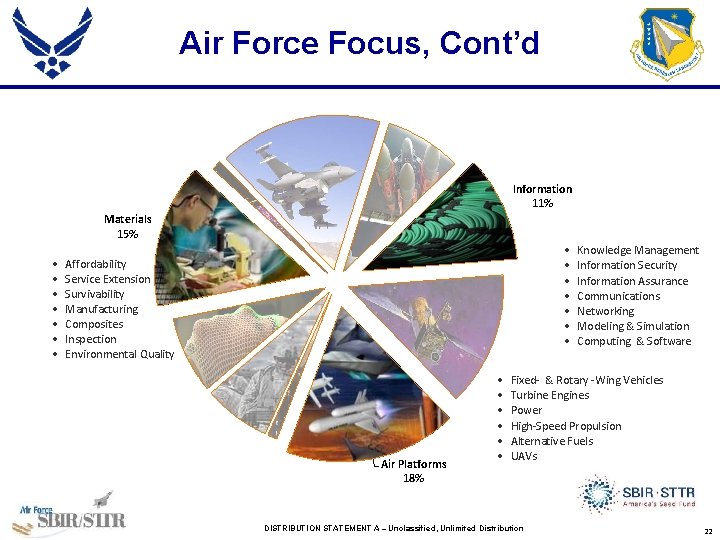
Air Force Focus, Cont’d Information 11% Materials 15% • • • • Affordability Service Extension Survivability Manufacturing Composites Inspection Environmental Quality Air Platforms 18% • • • Knowledge Management Information Security Information Assurance Communications Networking Modeling & Simulation Computing & Software Fixed- & Rotary -Wing Vehicles Turbine Engines Power High-Speed Propulsion Alternative Fuels UAVs DISTRIBUTION STATEMENT A – Unclassified, Unlimited Distribution 22
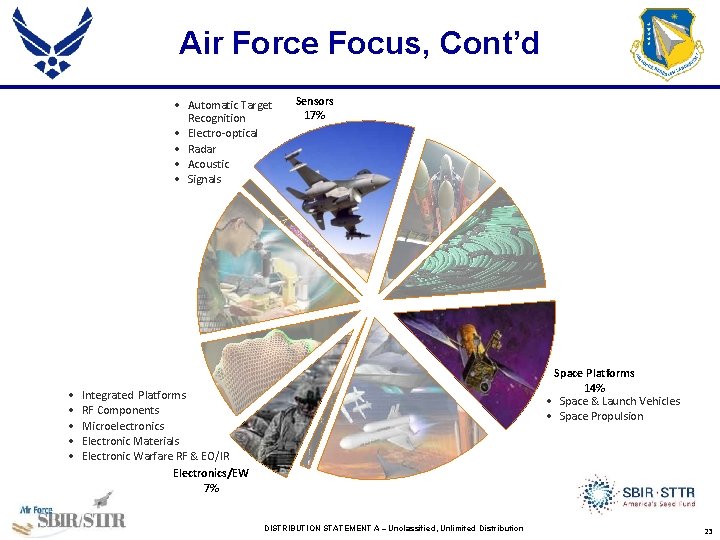
Air Force Focus, Cont’d • Automatic Target Recognition • Electro-optical • Radar • Acoustic • Signals • • • Sensors 17% Space Platforms 14% • Space & Launch Vehicles • Space Propulsion Integrated Platforms RF Components Microelectronics Electronic Materials Electronic Warfare RF & EO/IR Electronics/EW 7% DISTRIBUTION STATEMENT A – Unclassified, Unlimited Distribution 23
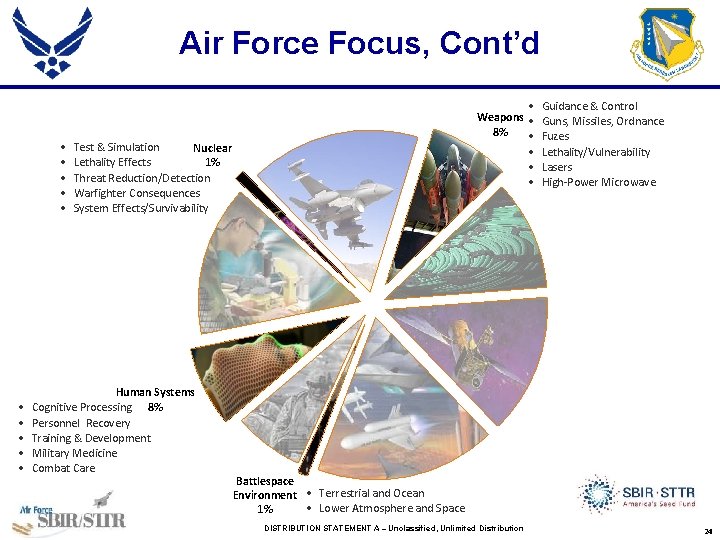
Air Force Focus, Cont’d • • • Guidance & Control Weapons • Guns, Missiles, Ordnance 8% • Fuzes • Lethality/Vulnerability • Lasers • High-Power Microwave Test & Simulation Nuclear 1% Lethality Effects Threat Reduction/Detection Warfighter Consequences System Effects/Survivability Human Systems Cognitive Processing 8% Personnel Recovery Training & Development Military Medicine Combat Care Battlespace Environment • Terrestrial and Ocean • Lower Atmosphere and Space 1% DISTRIBUTION STATEMENT A – Unclassified, Unlimited Distribution 24
Additional charts DISTRIBUTION STATEMENT A – Unclassified, Unlimited Distribution 25
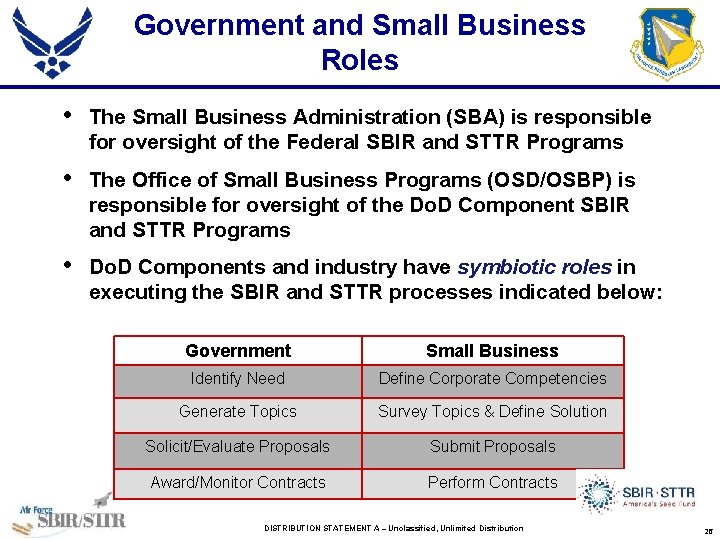
Government and Small Business Roles • The Small Business Administration (SBA) is responsible for oversight of the Federal SBIR and STTR Programs • The Office of Small Business Programs (OSD/OSBP) is responsible for oversight of the Do. D Component SBIR and STTR Programs • Do. D Components and industry have symbiotic roles in executing the SBIR and STTR processes indicated below: Government Small Business Identify Need Define Corporate Competencies Generate Topics Survey Topics & Define Solution Solicit/Evaluate Proposals Submit Proposals Award/Monitor Contracts Perform Contracts DISTRIBUTION STATEMENT A – Unclassified, Unlimited Distribution 26
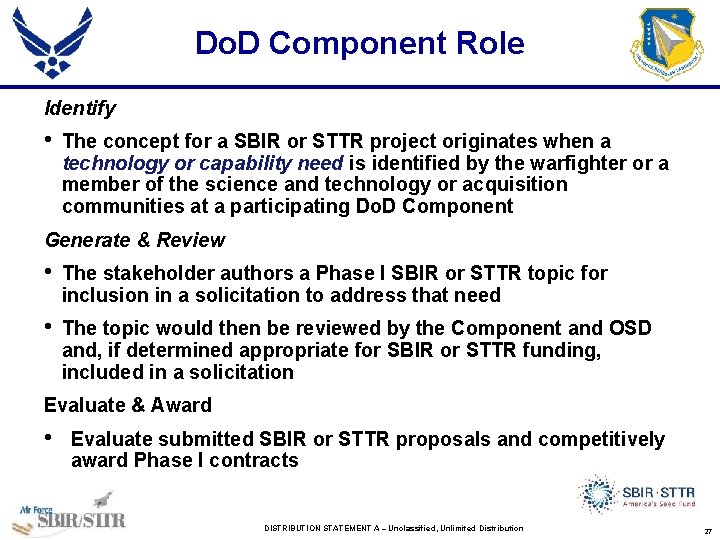
Do. D Component Role Identify • The concept for a SBIR or STTR project originates when a technology or capability need is identified by the warfighter or a member of the science and technology or acquisition communities at a participating Do. D Component Generate & Review • The stakeholder authors a Phase I SBIR or STTR topic for inclusion in a solicitation to address that need • The topic would then be reviewed by the Component and OSD and, if determined appropriate for SBIR or STTR funding, included in a solicitation Evaluate & Award • Evaluate submitted SBIR or STTR proposals and competitively award Phase I contracts DISTRIBUTION STATEMENT A – Unclassified, Unlimited Distribution 27
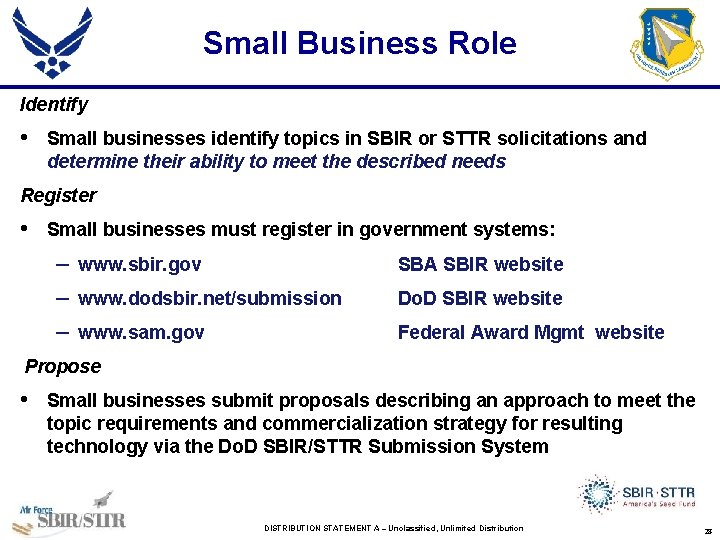
Small Business Role Identify • Small businesses identify topics in SBIR or STTR solicitations and determine their ability to meet the described needs Register • Small businesses must register in government systems: – – – www. sbir. gov SBA SBIR website www. dodsbir. net/submission Do. D SBIR website www. sam. gov Federal Award Mgmt website Propose • Small businesses submit proposals describing an approach to meet the topic requirements and commercialization strategy for resulting technology via the Do. D SBIR/STTR Submission System DISTRIBUTION STATEMENT A – Unclassified, Unlimited Distribution 28
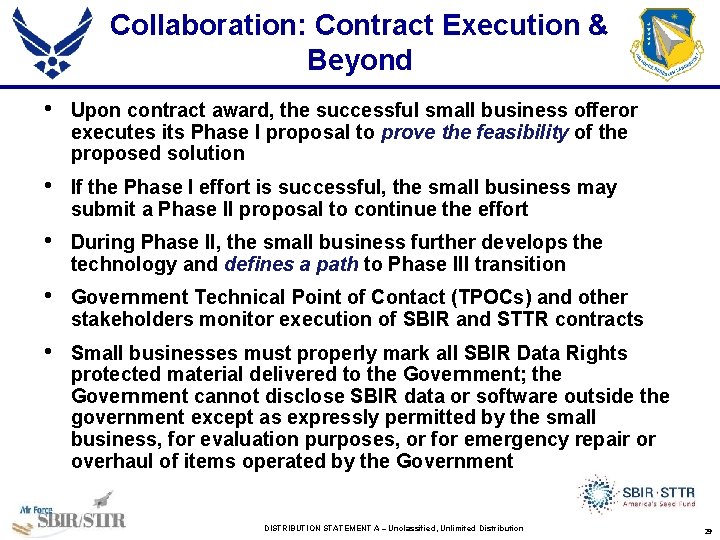
Collaboration: Contract Execution & Beyond • Upon contract award, the successful small business offeror executes its Phase I proposal to prove the feasibility of the proposed solution • If the Phase I effort is successful, the small business may submit a Phase II proposal to continue the effort • During Phase II, the small business further develops the technology and defines a path to Phase III transition • Government Technical Point of Contact (TPOCs) and other stakeholders monitor execution of SBIR and STTR contracts • Small businesses must properly mark all SBIR Data Rights protected material delivered to the Government; the Government cannot disclose SBIR data or software outside the government except as expressly permitted by the small business, for evaluation purposes, or for emergency repair or overhaul of items operated by the Government DISTRIBUTION STATEMENT A – Unclassified, Unlimited Distribution 29
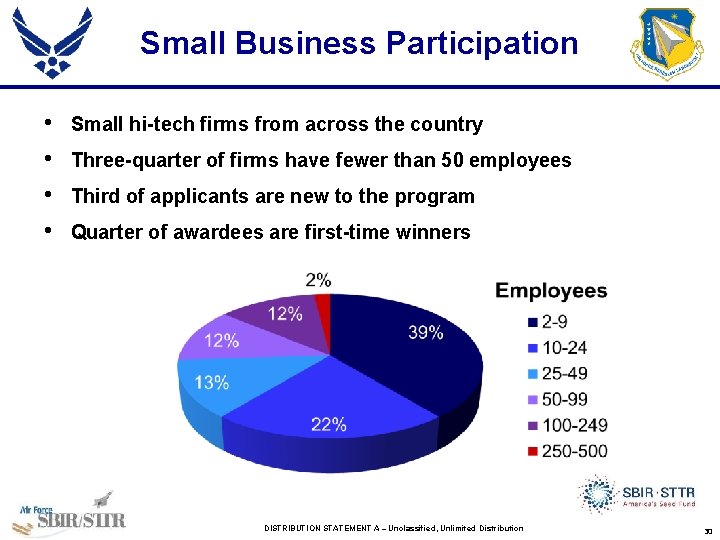
Small Business Participation • • Small hi-tech firms from across the country Three-quarter of firms have fewer than 50 employees Third of applicants are new to the program Quarter of awardees are first-time winners DISTRIBUTION STATEMENT A – Unclassified, Unlimited Distribution 30
Planning for Transition • The SBIR Program supports project funding through Phase II, however, at the completion of this phase, the small business must identify non-SBIR funding for technology maturity and validation efforts • Do. D SBIR Community should collaborate with acquisition stakeholders to incorporate SBIR projects into overall program planning to enable timely transition into acquisition programs • As such, acquisition program managers should plan for the transition of SBIR technologies from set aside funding in Phases I and II to non-SBIR funding in Phase III DISTRIBUTION STATEMENT A – Unclassified, Unlimited Distribution 31
Transition Tools • Some approaches for accomplishing the important task of transitioning SBIR technologies include: – Establishing a Technology Transition Plan, which documents the commitment and responsibilities of key stakeholders in the technology transition process -- such as the acquisition program sponsor, major defense contractors, component SBIR manager, and SBIR firm -- to develop, deliver and integrate a technology into an acquisition program – Addressing SBIR projects in program documentation including the Technology Development and Acquisition Strategies DISTRIBUTION STATEMENT A – Unclassified, Unlimited Distribution 32
SBIR Data Rights • Technical data and software generated under a SBIR/STTR award are covered under SBIR Data Rights (DFARS 252. 227 -7018): – – Limited Rights in SBIR/STTR technical data, and Restricted Rights in SBIR/STTR computer software • SBIR Data Rights apply to all SBIR funding agreements (Phase I, II & III) • For Do. D, SBIR Data Rights period is 5 years after receipt of the last contract deliverable, BUT follow-on SBIR/STTR projects could extend SBIR Data Rights • The Government is granted a royalty-free, world-wide, nonexclusive, irrevocable license DISTRIBUTION STATEMENT A – Unclassified, Unlimited Distribution 33
- Slides: 33