
AIR FORCE PAMPHLET 10 100 Instructional Plan Keith
- Slides: 18
AIR FORCE PAMPHLET 10 -100 Instructional Plan Keith Miller CUR/516 February 2, 2015 Kathryn Wyatt
Phase I – Instructional Plan Target Audience All active duty, guard, and reserve, emergency essential and contacted civilian personnel assigned to the organization are subject to deploy will require training. Delivery will be through paper and computer based training consisting of a game format. Course is 2 Hours) or until the game is completed.
Phase I – Instructional Plan Goal 1: Students will identify the differences between home station and deployment requirements prior to deployment. Goal 2: Students will identify war skill tactics, techniques, and procedures while deployed.
Phase I – Instructional Plan The training will be delivered using a combination of Paper-based material and computer generated Powerpoint game template.
Phase II – Instructional Plan Defined Goals Goal 1: Students will identify the differences between home station and deployment requirements prior to deployment. Goal 2: Students will identify war skill tactics, techniques, and procedures while deployed.
Phase II – Instructional Plan AFPAM 10 -100 Airman’s Manual Training Objective 1 Audience – Assigned Personnel Behavior – Identify home station requirements Condition – Using the AFPAM 10 -100 and Jeopardy Degree – 100% accuracy
Phase II – Instructional Plan AFPAM 10 -100 Airman’s Manual Training Objective 2 Audience – Assigned Personnel Behavior – Identify war skill tactics, technics, and procedures while at a deployed location Condition – Using the AFPAM 10 -100 and Jeopardy Degree – 100% accuracy
Phase II – Instructional Plan AFPAM 10 -100 Airman’s Manual Training Objective 1: Given an AFPAM 10 -100, “Airman’s Manual” and using the Powerpoint game Jeopardy, all identified organization personnel who are subject to deploy will identify home station requirements prior to deploying with at least 100% accuracy. Objective 2: Given an AFPAM 10 -100, “Airman’s Manual”, and using the Powerpoint game Jeopardy, all identified organization personnel who are subject to deploy will identify war skill tactics, technics, and procedures while at a deployed location with at least a 100% accuracy.
Phase II – Instructional Plan Project-Based Learning - builds on learners ’ curiosity and interest. Collaborative Learning - is an effective and motivating strategy for working adults. (used in groups) Critical Thinking – Making clear reasonable decisions
Phase III – Instructional Plan Implementation Phase Training will be completed annually on one of two Commander directed training days. Total Time – 2 hours Individuals – UDM, Team Captain, Learners (Team members). Pilot Test – A pilot test of the training will be conducted on one of the two training days. Any training deficiencies will be completed before the next training day.
Phase III – Instructional Plan Implementation Phase Cont. Training will be conducted in one of the installation’s classrooms in Building 2441 (Professional Development Center) One copy of the Airman’s Manual AFPAM 10 -100 will be provided to each elected team captain which will comprise of the highest ranking military member
Phase III – Instructional Plan Implementation Phase Cont. Training will be announced using email by the Commander Using a game format to build interest in training Participants will be selected using the first number of their social security number for team assignments.
Phase III – Instructional Plan Formative Assessment Used to improve learning and instruction that is essential to course goals. Each question’s answer will be revealed and we will use this as a means to conduct a formative assessment as a group.
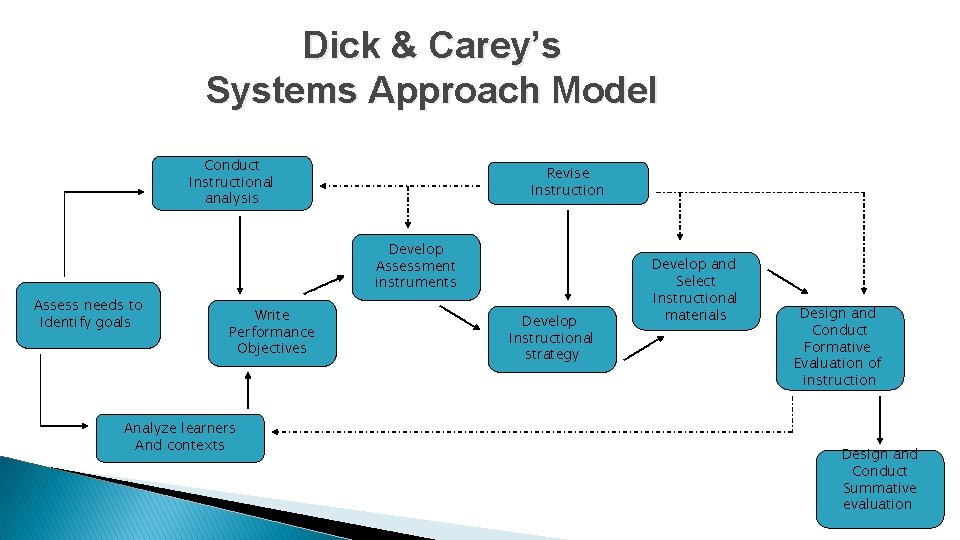
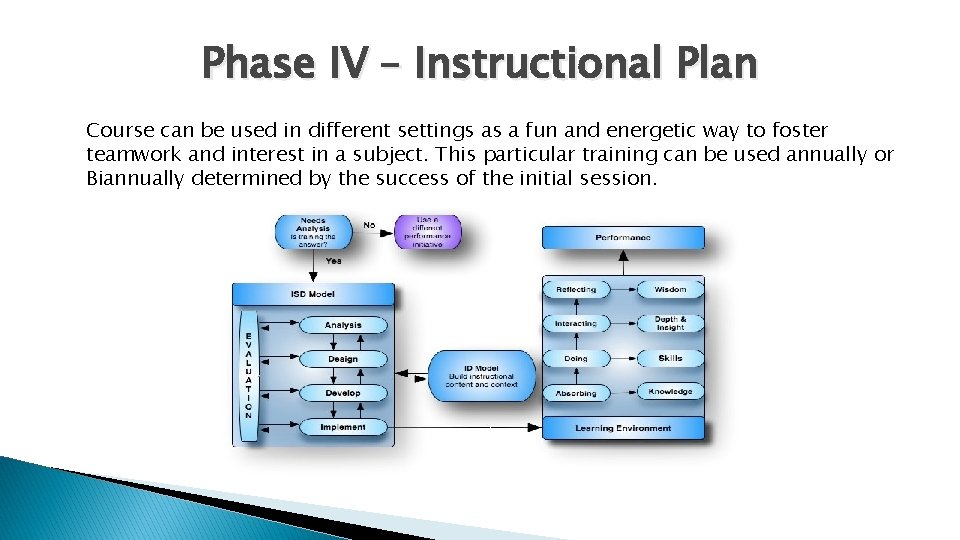
Phase IV – Instructional Plan ADDIE One of the most commonly used descriptions of design/development Analyze Design Develop Implement Evaluate System’s Approach Model (Dick & Carey)
Dick & Carey’s Systems Approach Model Conduct Instructional analysis Revise Instruction Develop Assessment instruments Assess needs to Identify goals Write Performance Objectives Analyze learners And contexts Develop Instructional strategy Develop and Select Instructional materials Design and Conduct Formative Evaluation of instruction Design and Conduct Summative evaluation
Phase IV – Instructional Plan Jeopardy will be the game used as the instrument. There will no Double or Final Jeopardy played only a single round.
Phase IV – Instructional Plan Course can be used in different settings as a fun and energetic way to foster teamwork and interest in a subject. This particular training can be used annually or Biannually determined by the success of the initial session.
References Brown, A. , & Green, T. D. (2011). The essentials of instructional design, Connecting fundamental principles with process and practice [University of Phoenix Custom Edition e. Book]. Allyn and Bacon. Retrieved from University of Phoenix, CUR 516 website. Wlodkowski, R. J. , & Ginsberg, M. B. (2010). Teaching intensive and accelerated courses, Instruction that motivates learning [University of Phoenix Custom Edition e. Book]. San Francisco, CA: Jossey-Bass. Retrieved from University of Phoenix, CUR 516 website