
Air Diving Decompression Sources Joiner J T ed

- Slides: 97
Air Diving & Decompression
Sources • Joiner, J. T. (ed. ). 2001. NOAA Diving Manual - Diving for Science and Technology, Fourth Edition. Best Publishing Company, Flagstaff, AZ. • Reference Materials: – In conjunction with this presentation, refer to: • NOAA Diving Manual Chapter 4 • NOAA Diving Manual Appendix IV • NOAA Diving Manual Appendix III
Objectives • After completing this training module you will be able to: – Differentiate between “safe” and “reliable” with regard to dive tables – Differentiate between a single, repetitive and contingency decompression dive, and plan these dives using US Navy, and NOAA Dive Tables – Explain the significance of Group Designation Letters
Objectives • After completing this training module you will be able to: – Differentiate between “safety stops” and “decompression stops” – List two options for dealing with omitted decompression – List three advantages of using a dive computer rather than dive tables
Objectives • After completing this training module you will be able to: – List three basic rules for diving a dive computer – Differentiate between Dive Tables, Dive Computers, and PC Based Decompression Software
General • Body tissues absorb additional nitrogen from air breathed during dives and release this excess nitrogen during ascent • By keeping the amount of nitrogen absorbed and released within acceptable limits, the risk of decompression sickness is reduced
Decompression Table Development • Physiologist J. S. Haldane developed a hypothetical model for nitrogen uptake and elimination around 1908 • Another notable in dive table development is Swiss cardiologist Prof. AA Buhlmann
Decompression Table Development • ALL DIVE TABLES ARE HYPOTHETICAL • All decompression modeling are based on theory • Dive tables do not reflect the actual workings of the human body
Are Dive Tables Safe? • “Safe” is not a good choice of words when discussing dive tables • Virtually any hyperbaric exposure imposes an obligation for decompression • “Safe” implies no risk of DCS - THERE IS ALWAYS A RISK OF DCS, even when diving well within table limits • A better word to use when describing dive tables is “Reliable”
Acceptable Risk. . . • Reliable dive tables are used to define “acceptable risk” • Individual susceptibility to decompression disorders, environmental and other factors influence your risk of DCS • You can do “everything right” and can still suffer “a hit”
Dive Planning Software • The algorithms of Prof. A. A. Buhlmann are the fundamental basis for most dive planning software and many dive computers • The different programs based on these algorithms manage the decompression models in slightly different ways
Decompression Planning • Reliable decompression profiles have been produced using dive tables, dive computers, and dive planning software • But again, no current method of calculating your decompression obligation can guarantee a zero risk of DCS
US Navy Dive Tables
Basics • A single dive is any dive made more than 12 hours following a previous dive • A repetitive dive is any dive made less than 12 hours after surfacing from a prior dive
Basics • US Navy Dive Table abbreviations / acronyms: – NDL (No Decompression Limit) – ABT (Actual Bottom Time) – SIT (Surface Interval Time) – RNT (Residual Nitrogen Time) – ESDT (Equivalent Single Dive Time)
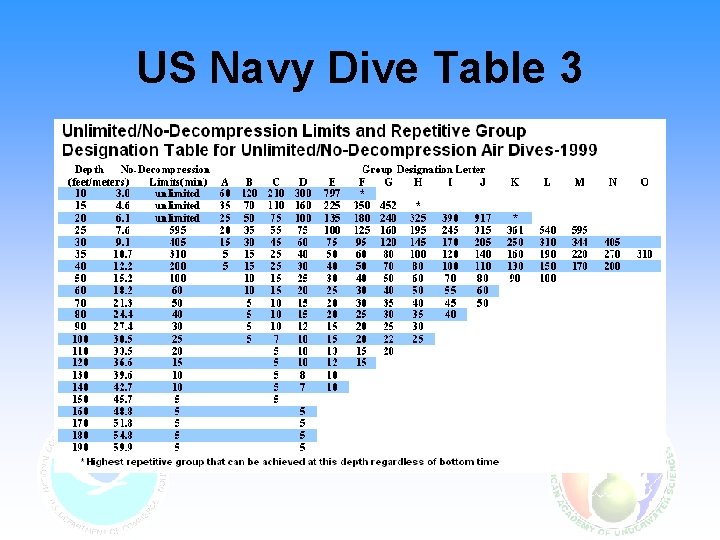
US Navy Dive Table 3
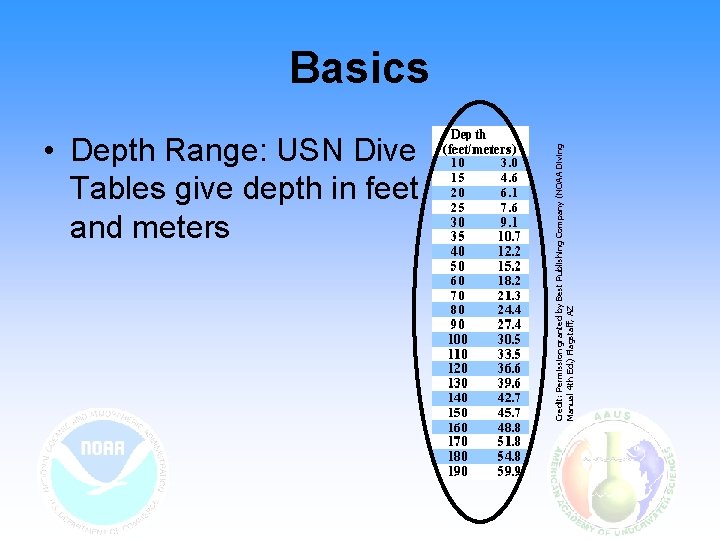
• Depth Range: USN Dive Tables give depth in feet and meters Credit: Permission granted by Best Publishing Company (NOAA Diving Manual 4 th Ed. ) Flagstaff, AZ Basics
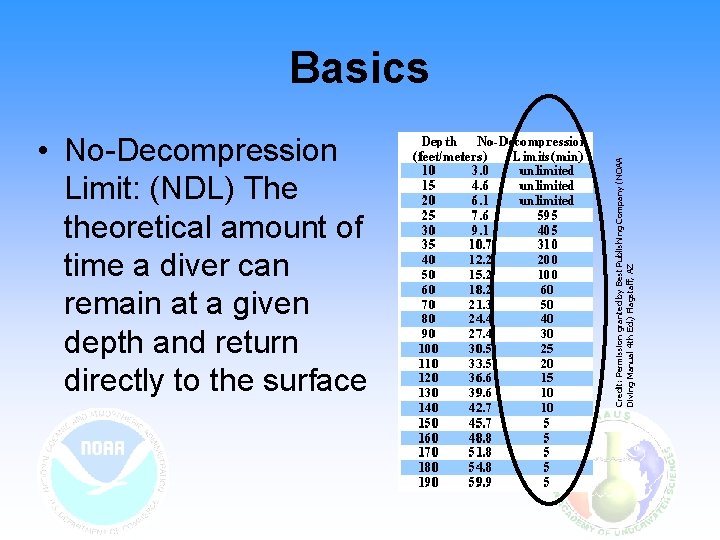
• No-Decompression Limit: (NDL) The theoretical amount of time a diver can remain at a given depth and return directly to the surface Credit: Permission granted by Best Publishing Company (NOAA Diving Manual 4 th Ed. ) Flagstaff, AZ Basics
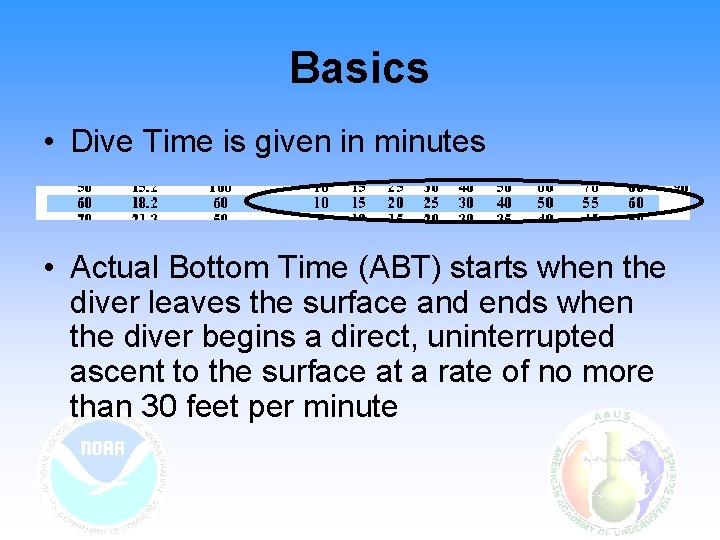
Basics • Dive Time is given in minutes • Actual Bottom Time (ABT) starts when the diver leaves the surface and ends when the diver begins a direct, uninterrupted ascent to the surface at a rate of no more than 30 feet per minute
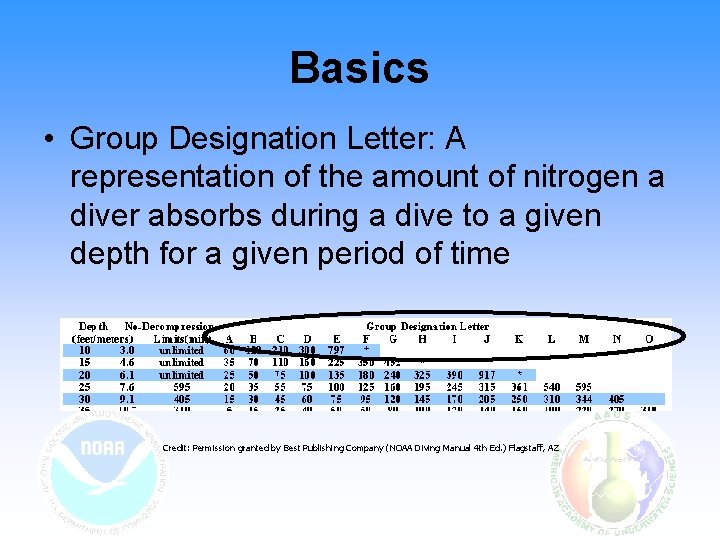
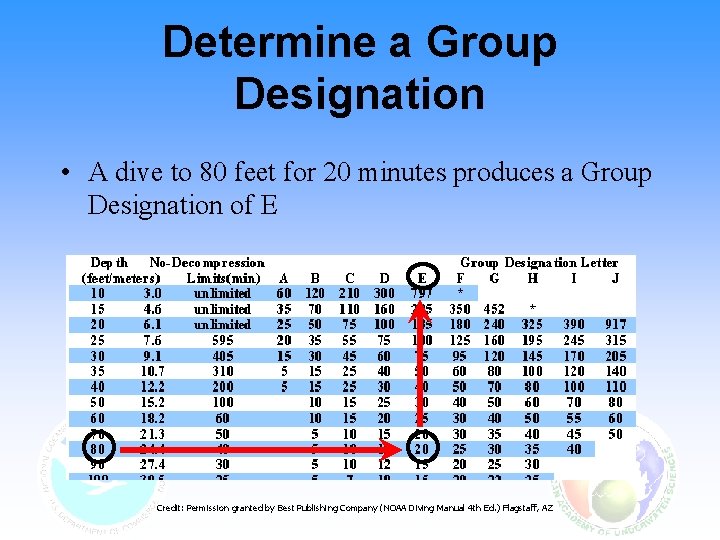
Basics • Group Designation Letter: A representation of the amount of nitrogen a diver absorbs during a dive to a given depth for a given period of time Credit: Permission granted by Best Publishing Company (NOAA Diving Manual 4 th Ed. ) Flagstaff, AZ
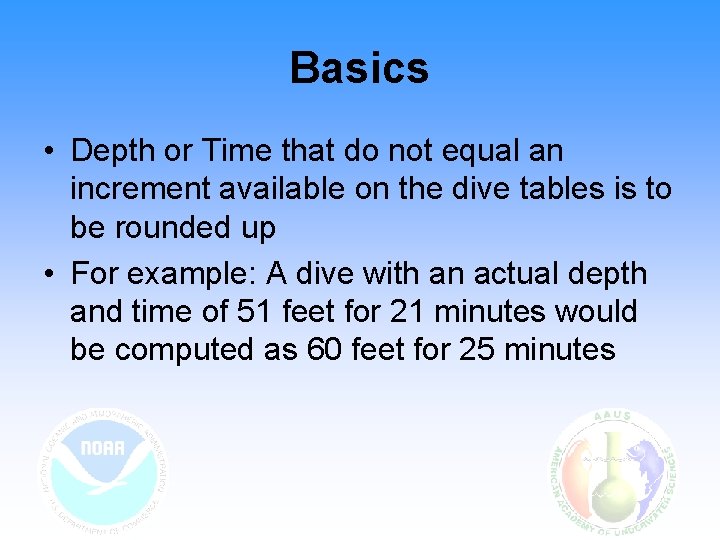
Basics • Depth or Time that do not equal an increment available on the dive tables is to be rounded up • For example: A dive with an actual depth and time of 51 feet for 21 minutes would be computed as 60 feet for 25 minutes
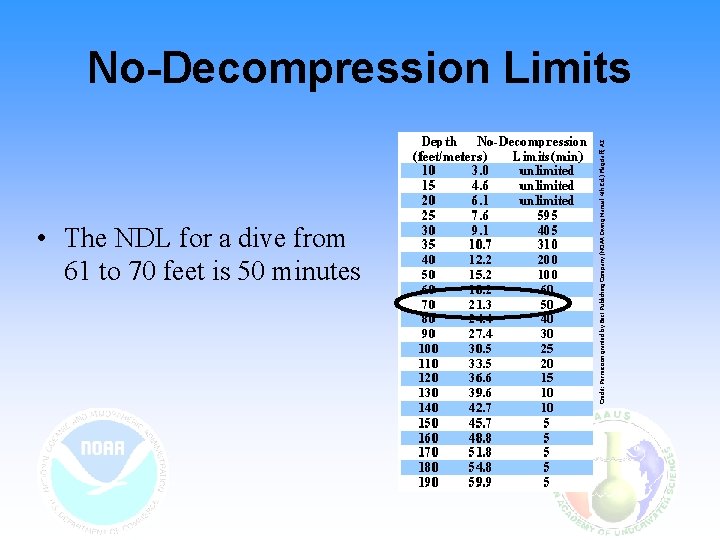
• The NDL for a dive from 61 to 70 feet is 50 minutes Credit: Permission granted by Best Publishing Company (NOAA Diving Manual 4 th Ed. ) Flagstaff, AZ No-Decompression Limits
Repetitive Dives • A repetitive dive is any dive made less than 12 hours after surfacing from a prior dive • To compute a repetitive dive schedule, you must determine the Group Designation Letter and take into account the Residual Nitrogen from the previous dive(s)
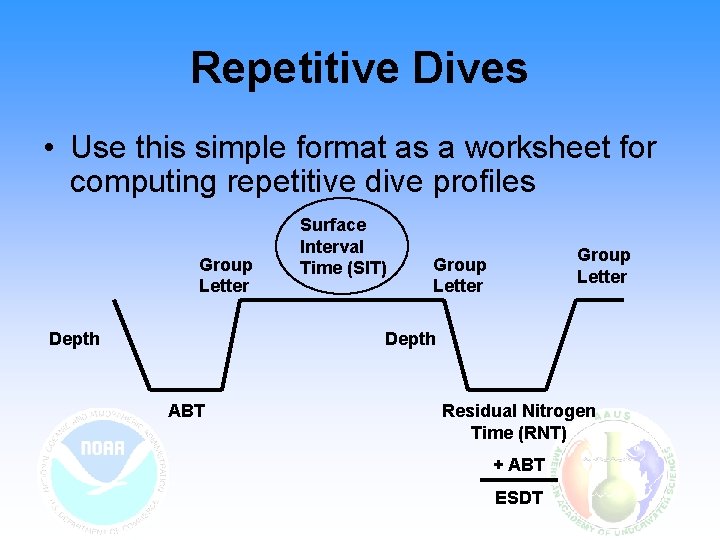
Repetitive Dives • Use this simple format as a worksheet for computing repetitive dive profiles Group Letter Depth Surface Interval Time (SIT) Group Letter Depth ABT Residual Nitrogen Time (RNT) + ABT ESDT
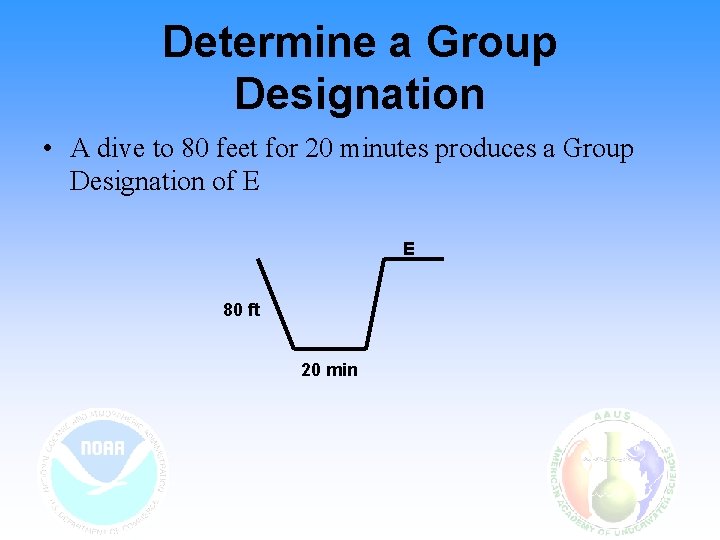
Determine a Group Designation • A dive to 80 feet for 20 minutes produces a Group Designation of E Credit: Permission granted by Best Publishing Company (NOAA Diving Manual 4 th Ed. ) Flagstaff, AZ
Determine a Group Designation • A dive to 80 feet for 20 minutes produces a Group Designation of E E 80 ft 20 min
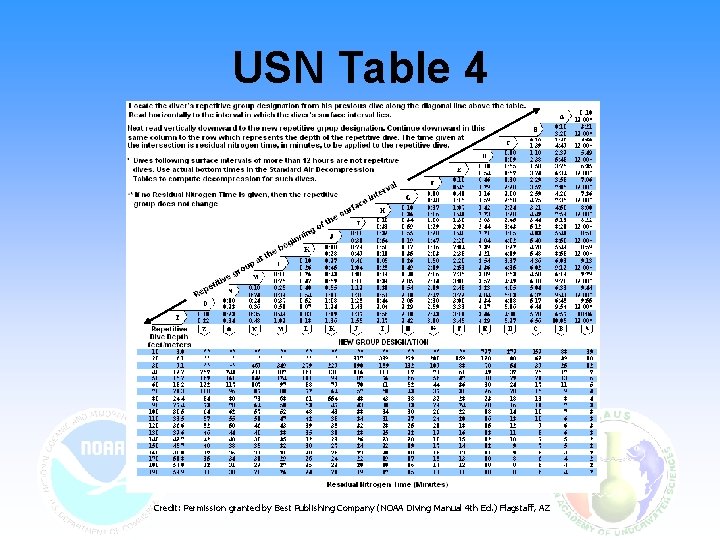
USN Table 4 Credit: Permission granted by Best Publishing Company (NOAA Diving Manual 4 th Ed. ) Flagstaff, AZ
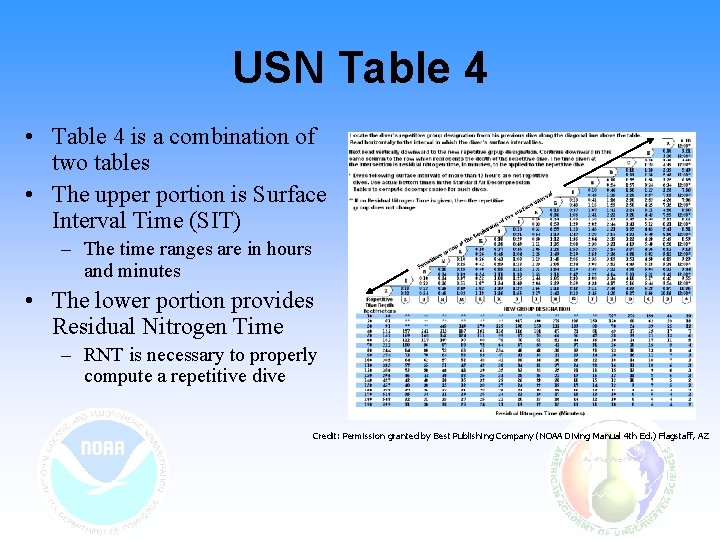
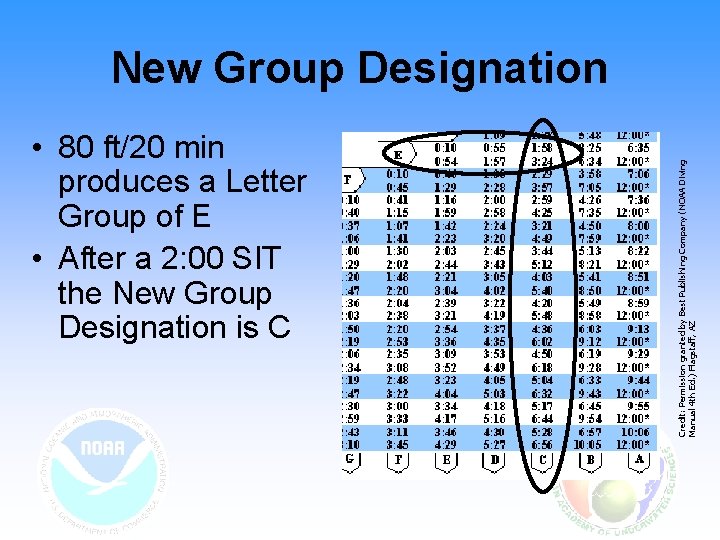
USN Table 4 • Table 4 is a combination of two tables • The upper portion is Surface Interval Time (SIT) – The time ranges are in hours and minutes • The lower portion provides Residual Nitrogen Time – RNT is necessary to properly compute a repetitive dive Credit: Permission granted by Best Publishing Company (NOAA Diving Manual 4 th Ed. ) Flagstaff, AZ
• 80 ft/20 min produces a Letter Group of E • After a 2: 00 SIT the New Group Designation is C Credit: Permission granted by Best Publishing Company (NOAA Diving Manual 4 th Ed. ) Flagstaff, AZ New Group Designation
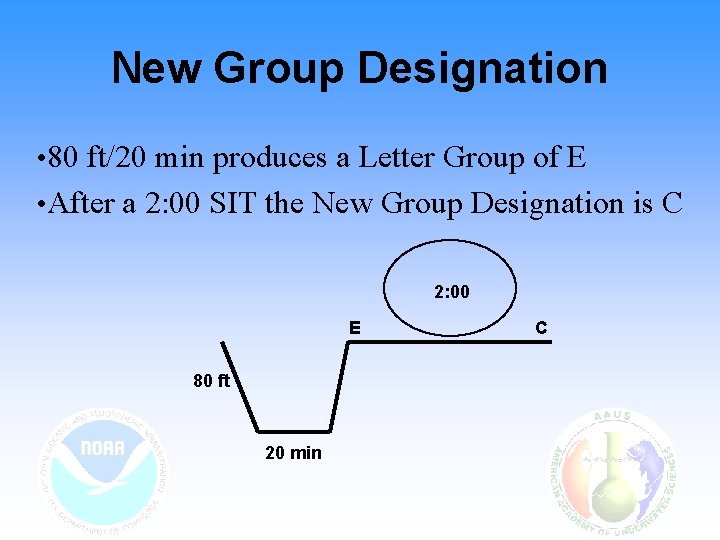
New Group Designation • 80 ft/20 min produces a Letter Group of E • After a 2: 00 SIT the New Group Designation is C 2: 00 E 80 ft 20 min C
Repetitive Dive • As a “C” diver, you want to plan a no-stop repetitive dive back to 80 ft for 20 minutes • To determine the Residual Nitrogen from the first dive use the lower portion of USN Table 4 • You will also need to know the NDL for 80 ft (Refer to the No-decompression Limit column of Table 3)
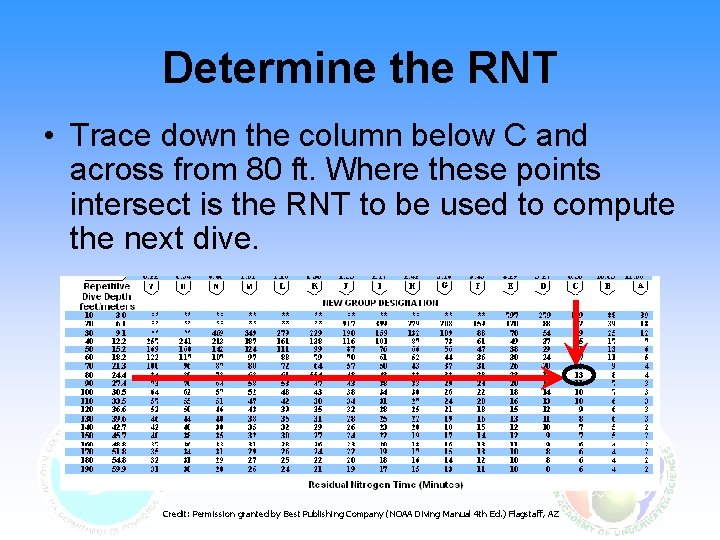
Determine the RNT • Trace down the column below C and across from 80 ft. Where these points intersect is the RNT to be used to compute the next dive. Credit: Permission granted by Best Publishing Company (NOAA Diving Manual 4 th Ed. ) Flagstaff, AZ
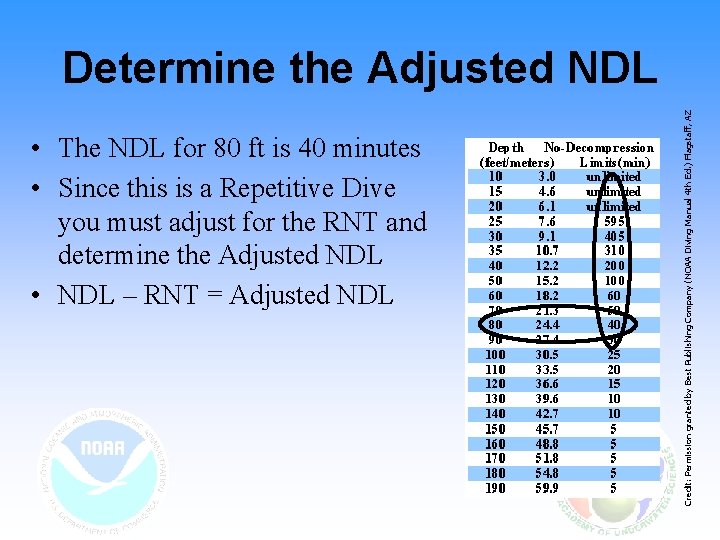
• The NDL for 80 ft is 40 minutes • Since this is a Repetitive Dive you must adjust for the RNT and determine the Adjusted NDL • NDL – RNT = Adjusted NDL Credit: Permission granted by Best Publishing Company (NOAA Diving Manual 4 th Ed. ) Flagstaff, AZ Determine the Adjusted NDL
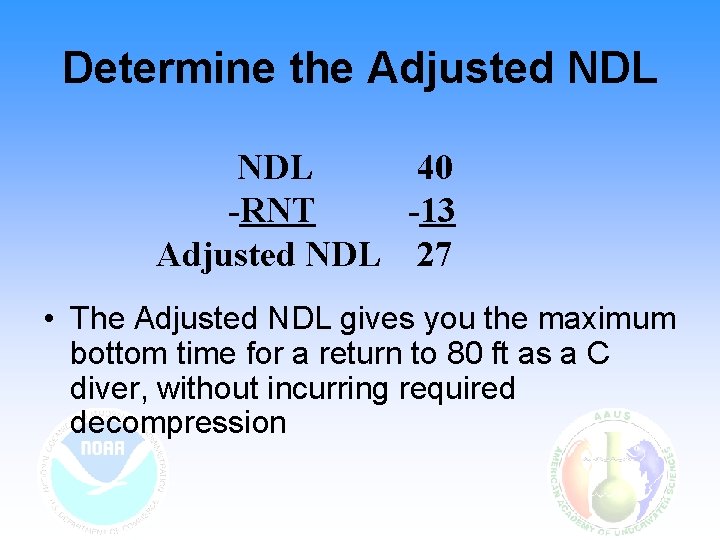
Determine the Adjusted NDL 40 -RNT -13 Adjusted NDL 27 • The Adjusted NDL gives you the maximum bottom time for a return to 80 ft as a C diver, without incurring required decompression
Repetitive Dive • You now know a repetitive dive to 80 ft for 20 minutes can be conducted within the No-Decompression Limits of the Navy Dive Tables • To complete the Repetitive Dive planning process, determine the Equivalent Single Dive Time (ESDT)
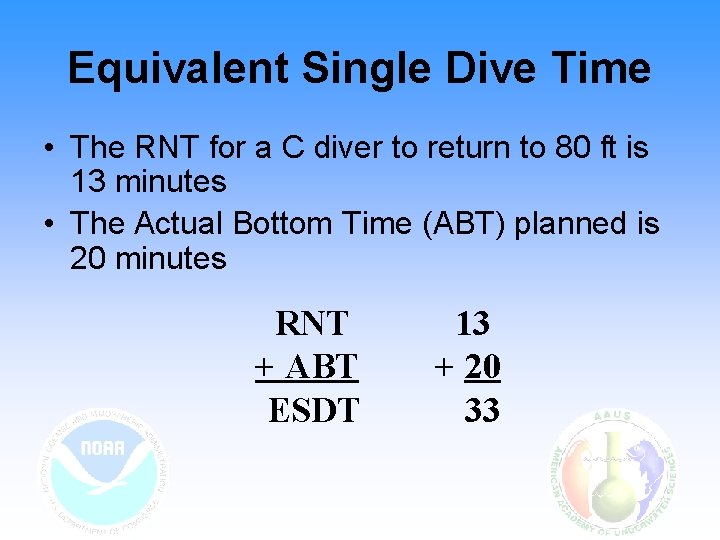
Equivalent Single Dive Time • The RNT for a C diver to return to 80 ft is 13 minutes • The Actual Bottom Time (ABT) planned is 20 minutes RNT + ABT ESDT 13 + 20 33
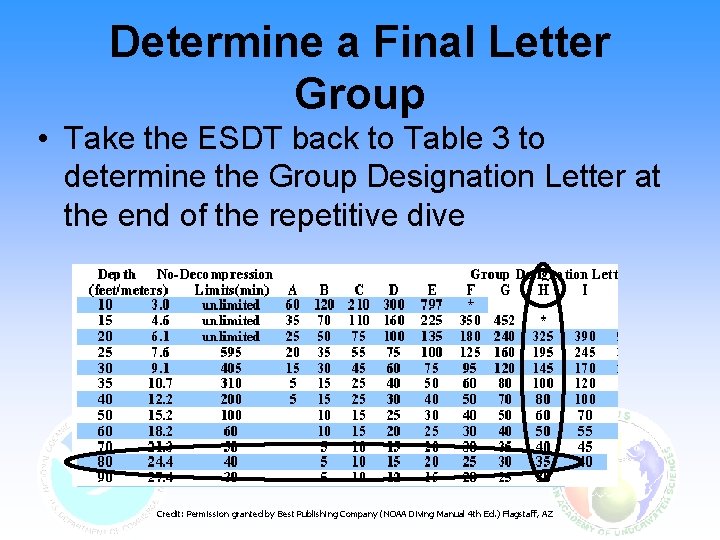
Determine a Final Letter Group • Take the ESDT back to Table 3 to determine the Group Designation Letter at the end of the repetitive dive Credit: Permission granted by Best Publishing Company (NOAA Diving Manual 4 th Ed. ) Flagstaff, AZ
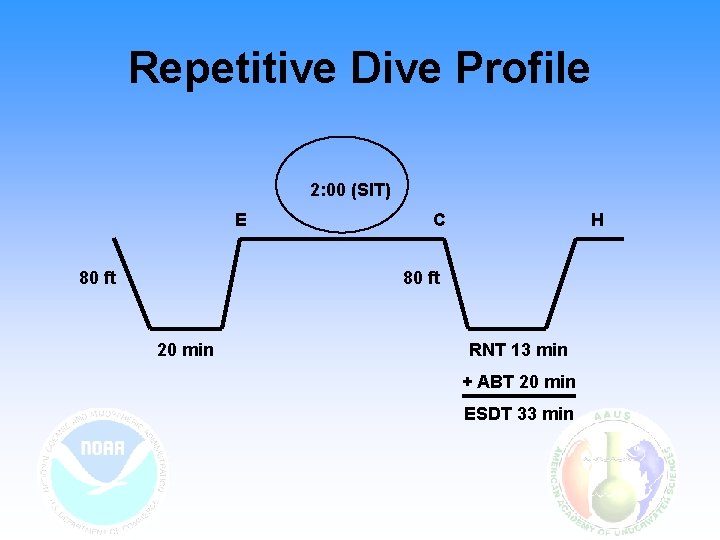
Repetitive Dive Profile 2: 00 (SIT) E 80 ft C H 80 ft 20 min RNT 13 min + ABT 20 min ESDT 33 min
Exceptions to Normal Repetitive Dive Planning • Computing a dive to 60 ft for 30 minutes with a 30 minute SIT followed a dive to 60 ft indicates an RNT of 36 • How can this be? The NDL for 60 ft is 60 minutes. The diver should have 30 minutes of unused NDL prior to the SIT • This seems to show the diver on-gassing nitrogen during the surface interval
Exceptions to Normal Repetitive Dive Planning • This is an exception to the tables • The diver can be conservative and use the indicated RNT to compute the dive profile • OR: The diver can ignore the indicated RNT and use the remaining NDL from dive one to compute the dive profile
Surface Intervals Less Than Ten Minutes • Table 4 does not allow for a SIT of less than ten minutes • Dives with a surface interval of less than ten minutes are considered ONE DIVE • Add the bottom times together and use the deepest depth reached to calculate the dive profile
Decompression • Technically, decompression is something that happens on every dive • However, for the purposes of this discussion decompression means the diver is required to follow a specific time, depth, and breathing gas profile
Decompression • A decompression profile, or table, is designed to allow the diver to ascend to the surface without DCS symptoms • A decompression profile may involve stops, or only require a specific ascent rate without stops
Precautionary Decompression Stops • Commonly know as “safety stops” • While not required by US Navy Dive Tables, safety stops are recommended for all “no-stop” dives conducted 60 fsw or deeper, plus all repetitive dives • Safety stops should be performed for three to five minutes in the 10 to 20 fsw depth range
Decompression Dives • Unlike a safety stop, a mandatory decompression stop is required by the dive tables • Decompression dives have substantially greater logistical requirements, and are generally believed to increase the risk DCS
Decompression Dives • For the purpose of this presentation decompression dive calculation is presented for contingency planning purposes only • Additional training is necessary prior to engaging in dives involving required or mandatory decompression stops
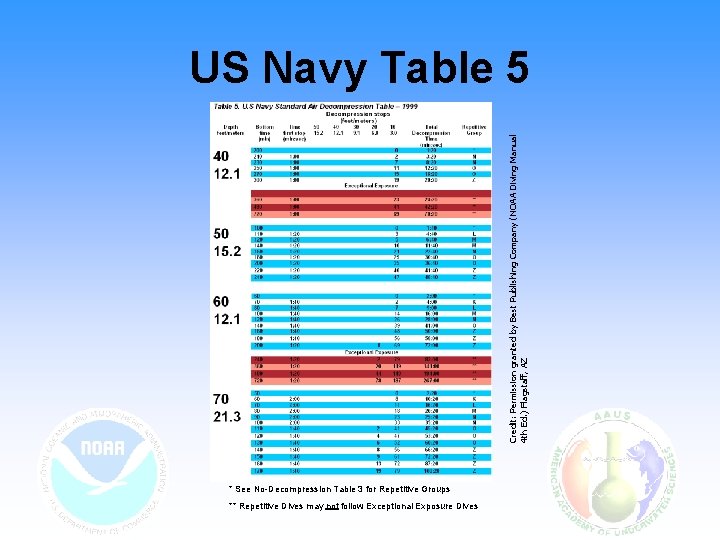
Credit: Permission granted by Best Publishing Company (NOAA Diving Manual 4 th Ed. ) Flagstaff, AZ US Navy Table 5 * See No-Decompression Table 3 for Repetitive Groups ** Repetitive Dives may not follow Exceptional Exposure Dives
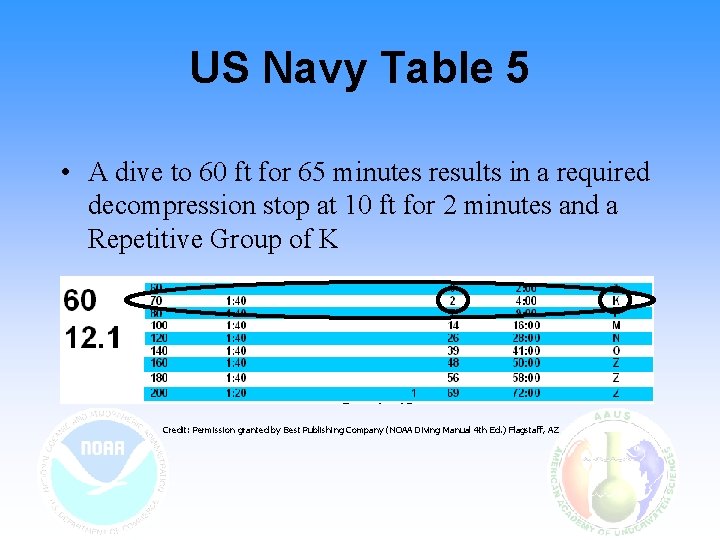
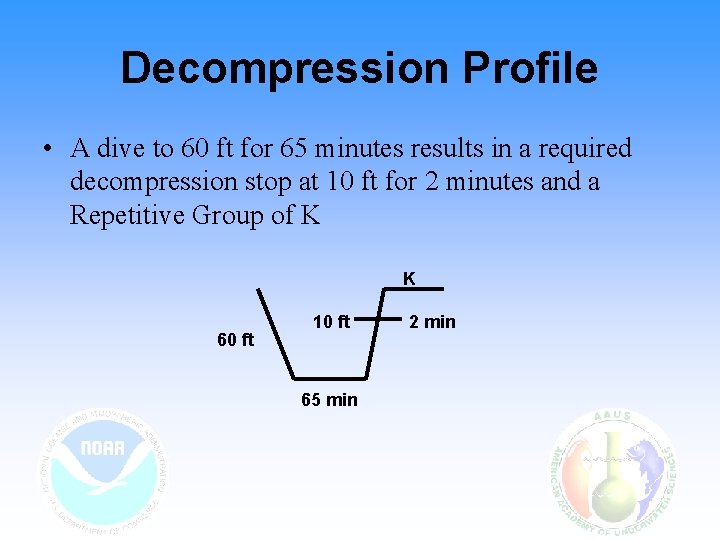
US Navy Table 5 • A dive to 60 ft for 65 minutes results in a required decompression stop at 10 ft for 2 minutes and a Repetitive Group of K Credit: Permission granted by Best Publishing Company (NOAA Diving Manual 4 th Ed. ) Flagstaff, AZ
Decompression Profile • A dive to 60 ft for 65 minutes results in a required decompression stop at 10 ft for 2 minutes and a Repetitive Group of K K 60 ft 10 ft 65 min 2 min
Omitted Decompression 1 • A diver realizes he has exceeded his planned dive schedule and does not have contingency tables • He should ascend at a proper rate and stop at 10 to 15 fsw for a minimum of 15 minutes or until cylinder pressure reaches 300 psi, whichever comes first
Omitted Decompression 1 • Consult USN Decompression tables upon surfacing • If the time spent at 10 to 15 feet did not equal or exceed the required time, the diver should be placed on oxygen for a minimum of 30 minutes, observed and restricted from diving for 12 hours
Omitted Decompression 2 • A diver does not have sufficient breathing gas to complete his required decompression and is forced to surface • If asymptomatic, and he can safely return to the water within five minutes, he and a buddy should return to the depth of the missed decompression and remain for 1 ½ times the required stop time
Omitted Decompression 2 • If he cannot be returned to the water within five minutes, he should be placed on oxygen for a minimum of 60 minutes • If asymptomatic after breathing oxygen for 60 minutes, the diver should observed for signs and symptoms of DCS and be restricted from diving for a minimum of 12 hours
USN Dive Table Altitude Assumptions • The altitude at the surface of the water in which a dive is made is no more than 1, 000 feet above sea level • For at least 12 hours following any dive, the divers will remain at an altitude no higher than 1, 000 feet above sea level
Reverse Profile Dives • A reverse profile can refer to a series of repetitive dives during which the deepest dive is not the first in the series, or to a single multi-level dive during which the diver goes deeper after completing a shallower phase
Reverse Profile Dives • There is no convincing evidence that reverse profile dives within the nodecompression limits subject a diver to an increased risk of DCS • Reverse Profile Dives should be conducted in water depths less than 130 fsw, within no -decompression limits, and with depth differentials of less than 40 fsw
Cold and Arduous Dives • Compute the dive profile for a dive that is cold or arduous by using the next greater time increment appearing on the tables • For example a dive with an ABT of 40 minutes should be computed using a dive time of 45 minutes, to compensate for cold or arduous conditions
Credit: Permission granted by Best Publishing Company (NOAA Diving Manual 4 th Ed. ) Flagstaff, AZ NOAA Air Dive Tables
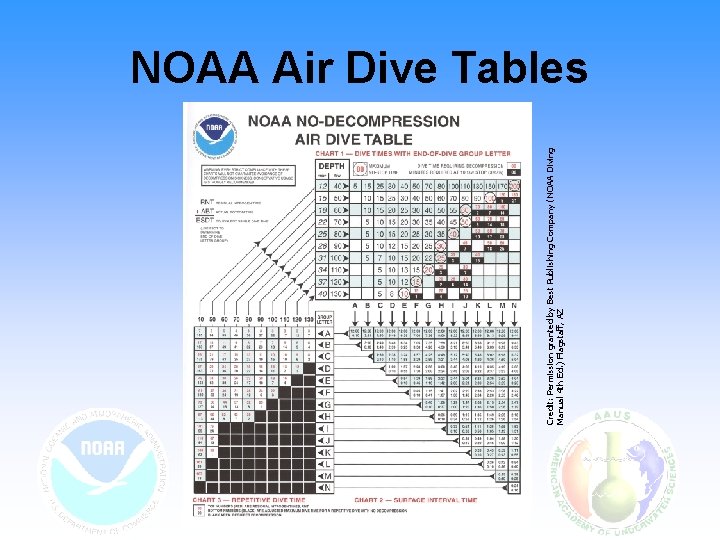
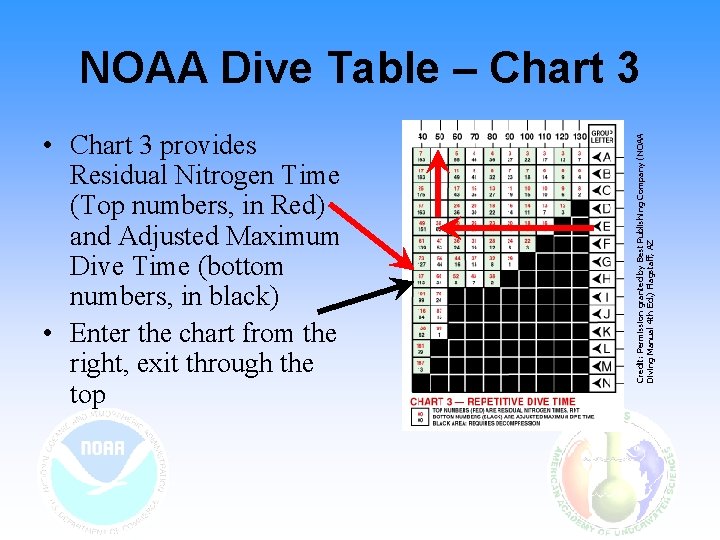
NOAA Air Dive Tables • NOAA Air Dive tables are based on US Navy Tables • They combine portions of US Navy Tables 3, 4, and 5 • The maximum depth available using NOAA Dive Tables is 130 fsw • To assist with dive profile calculation, the NOAA Tables also provide Adjusted Maximum Dive Times as part of Chart 3
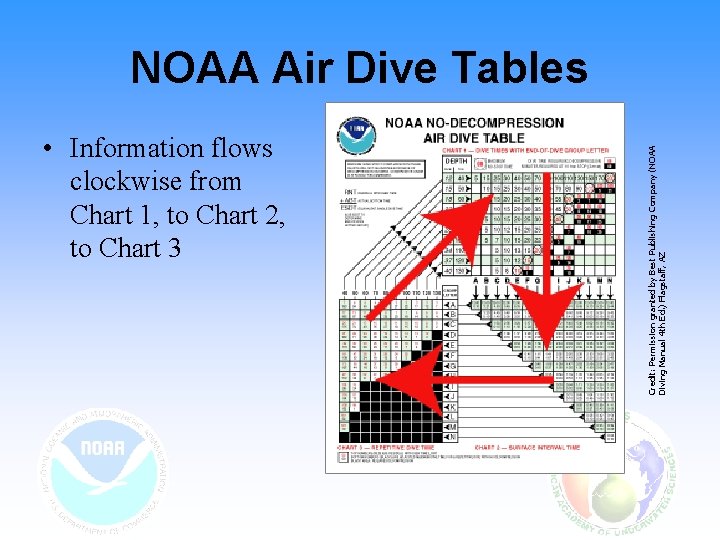
• Information flows clockwise from Chart 1, to Chart 2, to Chart 3 Credit: Permission granted by Best Publishing Company (NOAA Diving Manual 4 th Ed. ) Flagstaff, AZ NOAA Air Dive Tables
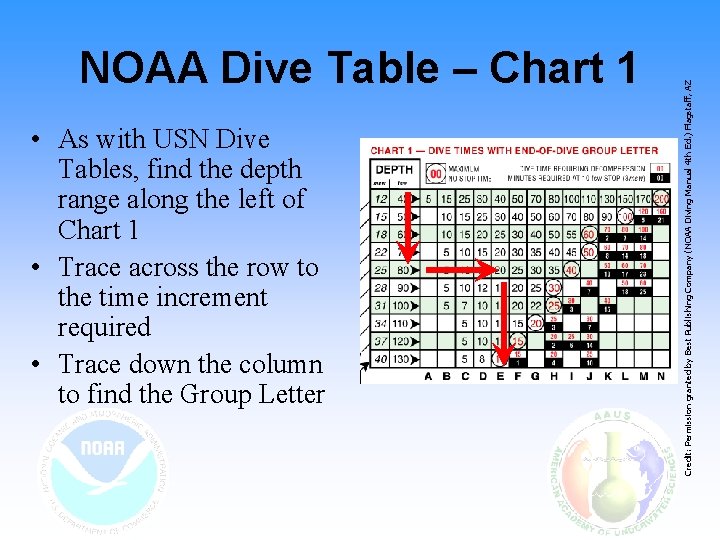
• As with USN Dive Tables, find the depth range along the left of Chart 1 • Trace across the row to the time increment required • Trace down the column to find the Group Letter Credit: Permission granted by Best Publishing Company (NOAA Diving Manual 4 th Ed. ) Flagstaff, AZ NOAA Dive Table – Chart 1
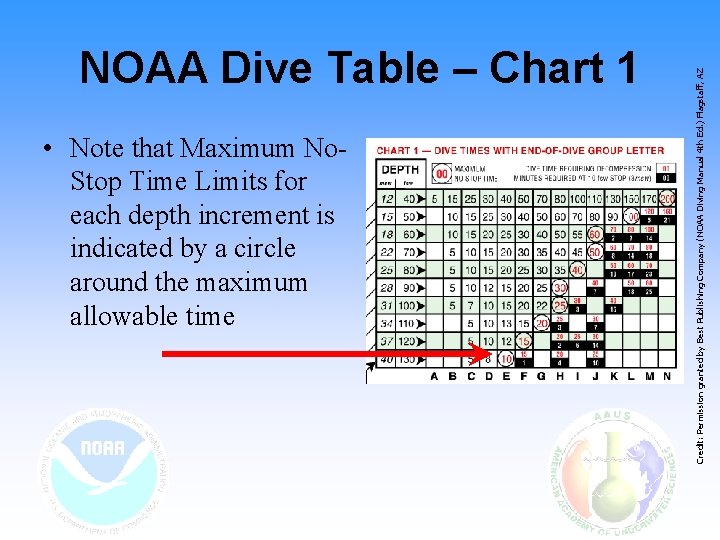
• Note that Maximum No. Stop Time Limits for each depth increment is indicated by a circle around the maximum allowable time Credit: Permission granted by Best Publishing Company (NOAA Diving Manual 4 th Ed. ) Flagstaff, AZ NOAA Dive Table – Chart 1
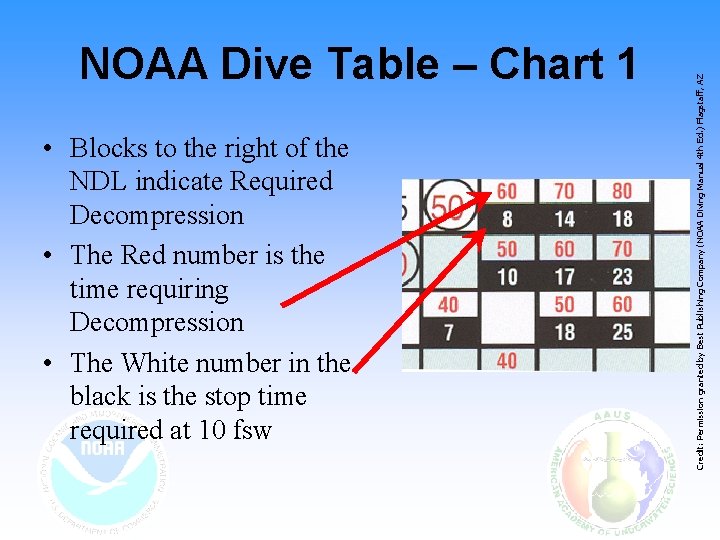
• Blocks to the right of the NDL indicate Required Decompression • The Red number is the time requiring Decompression • The White number in the black is the stop time required at 10 fsw Credit: Permission granted by Best Publishing Company (NOAA Diving Manual 4 th Ed. ) Flagstaff, AZ NOAA Dive Table – Chart 1
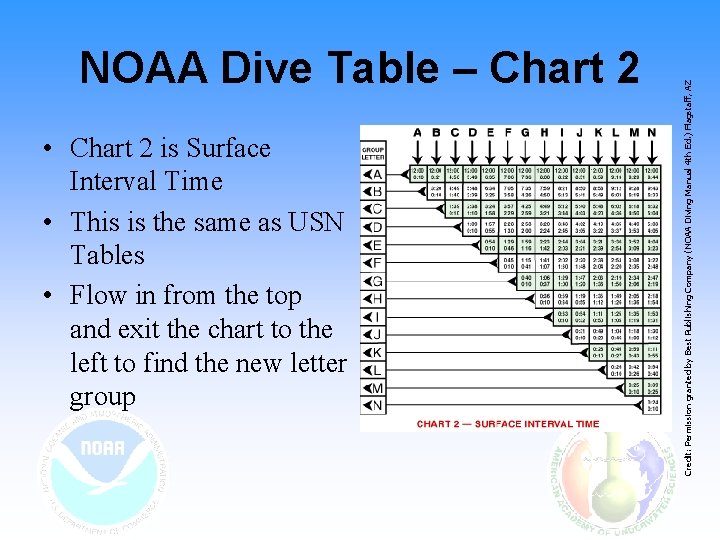
• Chart 2 is Surface Interval Time • This is the same as USN Tables • Flow in from the top and exit the chart to the left to find the new letter group Credit: Permission granted by Best Publishing Company (NOAA Diving Manual 4 th Ed. ) Flagstaff, AZ NOAA Dive Table – Chart 2
• Chart 3 provides Residual Nitrogen Time (Top numbers, in Red) and Adjusted Maximum Dive Time (bottom numbers, in black) • Enter the chart from the right, exit through the top Credit: Permission granted by Best Publishing Company (NOAA Diving Manual 4 th Ed. ) Flagstaff, AZ NOAA Dive Table – Chart 3
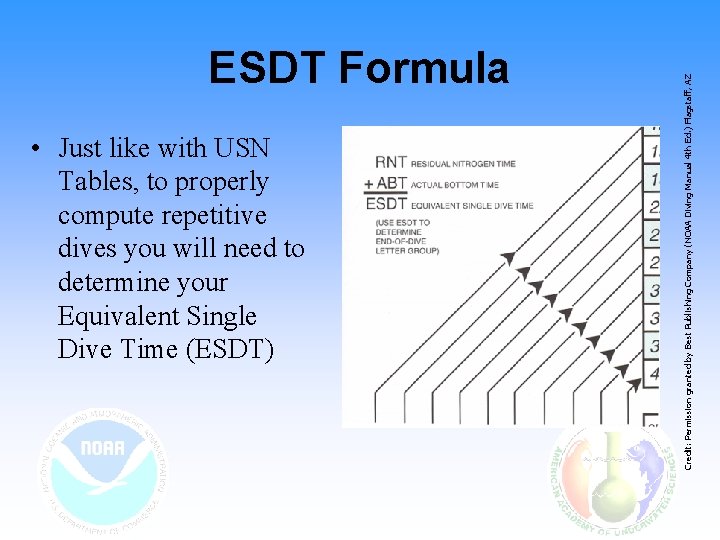
• Just like with USN Tables, to properly compute repetitive dives you will need to determine your Equivalent Single Dive Time (ESDT) Credit: Permission granted by Best Publishing Company (NOAA Diving Manual 4 th Ed. ) Flagstaff, AZ ESDT Formula
Practice Problems • Refer to the US Navy Dive Tables (Appendix IV of the NOAA Diving Manual) to answer the following practice problems
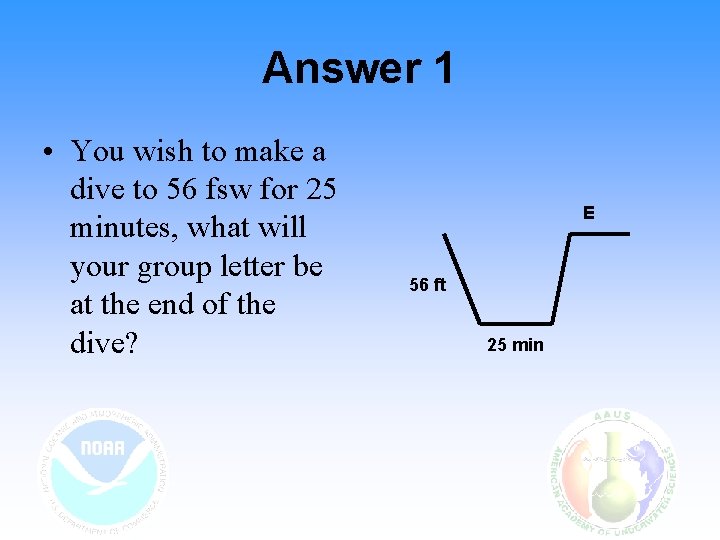
Practice Problem 1 • You wish to make a dive to 56 fsw for 25 minutes, what will your group letter be at the end of the dive?
Answer 1 • You wish to make a dive to 56 fsw for 25 minutes, what will your group letter be at the end of the dive? E 56 ft 25 min
Practice Problem 2 • As an E diver, you take a 1: 00 surface interval, what is your new group designation?
Answer 2 • As an E diver, you take a 1: 00 surface interval, what is your new group designation? • D • Use USN Table 4, find E, trace across the row to the SIT range that includes 1: 00, trace down the column to find the new group designation
Practice Problem 3 • A dive team makes a dive to 80 fsw for 10 minutes followed by a 2: 00 SIT, what is their RNT for a dive to 60 fsw?
Answer 3 • A dive team makes a dive to 80 fsw for 10 minutes followed by a 2: 00 SIT, what is their RNT for a dive to 60 fsw? • 11 minutes • Computing the dive and SIT results in a Group Letter of B • Trace down the B column of Table 4 and across the row for 60 fsw. Where these points meet is the RNT
Practice Problem 4 • A “B” diver wants to dive to 60 fsw, what is her Adjusted No-Decompression Limit?
Answer 4 • A “B” diver wants to dive to 60 fsw, what is her Adjusted No-Decompression Limit? • 49 minutes • Determine the RNT for a B diver returning to 60 ft. Look up the NDL for 60 ft • NDL – RNT = Adjusted NDL
Practice Problem 5 • A ‘C’ diver wants to dive to 90 fsw for 15 minutes, what is his ESDT?
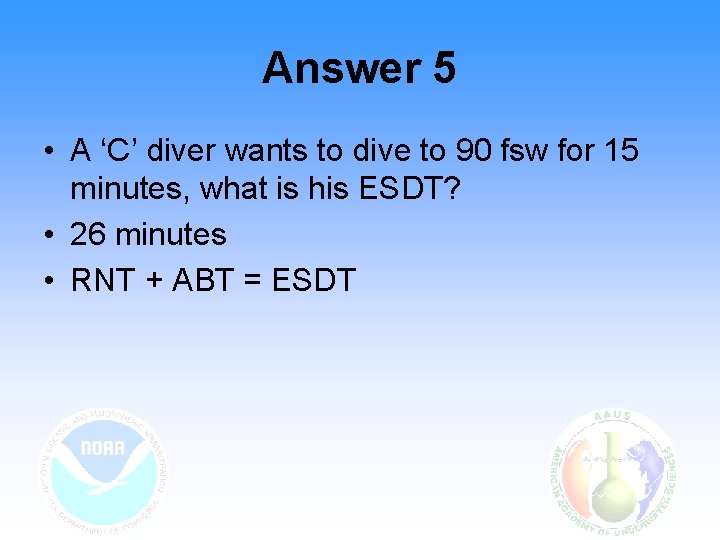
Answer 5 • A ‘C’ diver wants to dive to 90 fsw for 15 minutes, what is his ESDT? • 26 minutes • RNT + ABT = ESDT
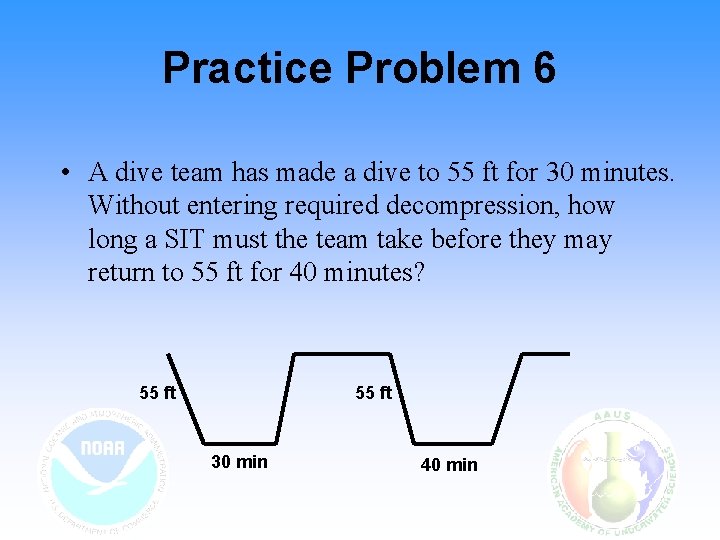
Practice Problem 6 • A dive team has made a dive to 55 ft for 30 minutes. Without entering required decompression, how long a SIT must the team take before they may return to 55 ft for 40 minutes? 55 ft 30 min 40 min
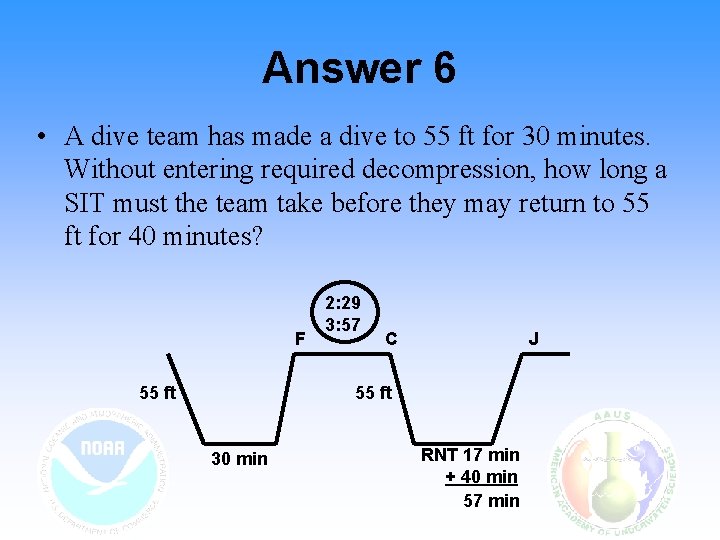
Answer 6 • A dive team has made a dive to 55 ft for 30 minutes. Without entering required decompression, how long a SIT must the team take before they may return to 55 ft for 40 minutes? F 55 ft 2: 29 3: 57 C J 55 ft 30 min RNT 17 min + 40 min 57 min
Practice Problem 7 • After your surface interval your Letter Group is D. What is the deepest you could dive for 30 minutes and not enter required decompression?
Answer 7 • After your surface interval your Letter Group is D. What is the deepest you could dive for 30 minutes and not enter required decompression? • 70 fsw • NDL – RNT = Adjusted NDL • 30 + RNT = ESDT
Practice Problem 8 • You have an RNT of 76 minutes for a repetitive dive to 50 ft. What was your Group Designation Letter at the end of your SIT?
Answer 8 • You have an RNT of 76 minutes for a repetitive dive to 50 ft. What was your Group Designation Letter at the end of your SIT? • I • Using Table 4 find 50 ft, trace along the 50 ft row until you locate the RNT, trace up to identify the Group Designation.
Practice Problem 9 • You have an NDL of 20 minutes. To what depth would you be diving? This is not a repetitive dive.
Answer 9 • You have an NDL of 20 minutes. To what depth would you be diving? This is not a repetitive dive. • 110 fsw • Using Table 3, trace down the NDL column until you locate the desired NDL, trace left to find the depth.
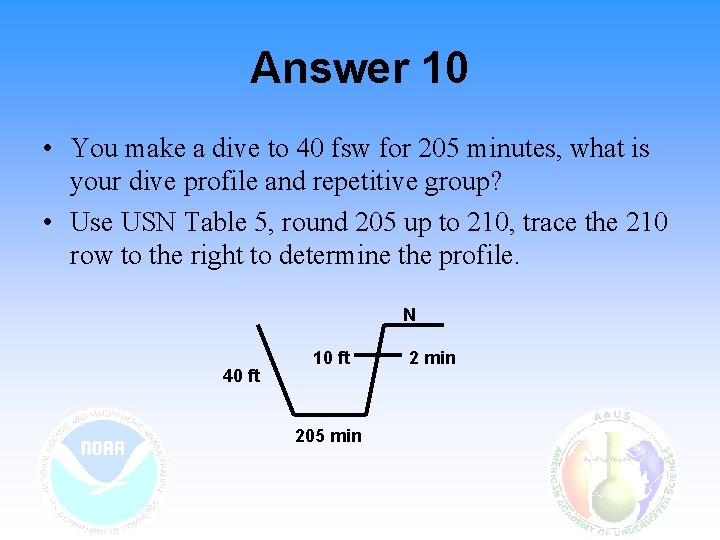
Practice Problem 10 • You make a dive to 40 fsw for 205 minutes, what is your dive profile and repetitive group?
Answer 10 • You make a dive to 40 fsw for 205 minutes, what is your dive profile and repetitive group? • Use USN Table 5, round 205 up to 210, trace the 210 row to the right to determine the profile. N 40 ft 10 ft 205 min 2 min
Practice Problem 11 • You have a required decompression stop for 1 minute at 20 ft and 69 minutes at 10 ft. How long was the dive and to what depth?
Answer 11 • You have a required decompression stop for 1 minute at 20 ft and 69 minutes at 10 ft. How long was the dive and to what depth? • 200 minutes at 60 fsw • Using Table 5, trace down the 20 ft and 10 ft Decompression Stop column until you find the required stop times, trace left to find the bottom time and depth.
Dive Computers
Dive Computers • Dive computers are electronic devices that monitor the diver’s depth and time and give a running calculation of the diver’s decompression status • Dive computers are based on mathematical models which attempt to describe the absorption and elimination of nitrogen within the human body
Dive Computers • Unlike Dive Tables, Dive Computers: – Compute a dive profile in “real time” – Compute “multilevel dives” – Have automatic dive log functions • Some dive computers can provide information on gas consumption, and/or be used with breathing gases other than air
Dive Computers • To dive a dive computer: – Each member of the dive team must have their own unit – On any given dive, the most conservative unit controls the dive; i. e. , call the dive on the most conservative information – It is the diver’s responsibility to understand the information being displayed by the computer and to adhere to the unit’s operational requirements
PC Based Decompression Software • There a variety of PC based decompression software currently available • This software allows a diver to cut “custom dive tables” • These programs are another way of managing your decompression obligation • They are not necessarily better than another method, but an additional tool for consideration
A Note On Decompression Software • Many PC based decompression software programs and some dive computers allow the user to customize settings such as gradient factors, gas percentages, conservatism, etc.
A Note On Decompression Software • Modification of these settings can produce widely varying dive schedules for a given dive, and may produce an overly aggressive decompression profile for a given diver, increasing the risk of DCS
A Note On Decompression Software • Research and understand the features and functions of the decompression profiling method you plan to use, use it as designed, and remember decompression schedules are tools for managing risk, not eliminating it