
AIR AND SEA INTERACTION Chapter 8 Ocean Circulation
- Slides: 16
AIR AND SEA INTERACTION Chapter 8
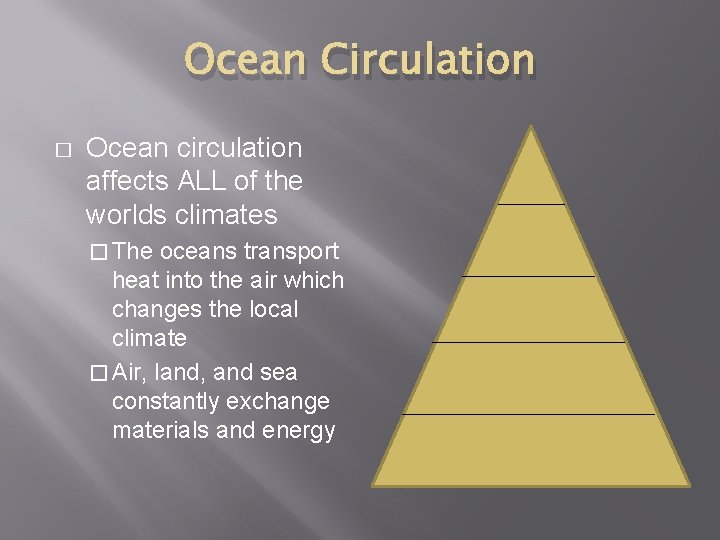
Ocean Circulation � Ocean circulation affects ALL of the worlds climates � The oceans transport heat into the air which changes the local climate � Air, land, and sea constantly exchange materials and energy
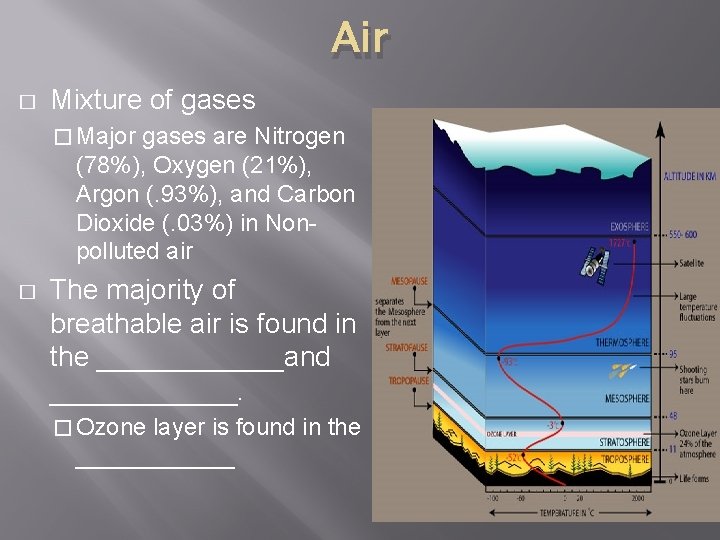
Air � Mixture of gases � Major gases are Nitrogen (78%), Oxygen (21%), Argon (. 93%), and Carbon Dioxide (. 03%) in Nonpolluted air � The majority of breathable air is found in the ______and ______. � Ozone layer is found in the ______
� _____% of the volume of air is aerosols (small particulates) and water vapor � The particulates are responsible for creating acid rain and the hole in the ozone layer � Water vapor is invisible. Clouds are condensed water around the aerosols � The amount of water the air can hold depends on 3 factors: Temperature (the ______ the temp, the more water) 2. Pressure (pressure ______, so does water) 3. Density of air (_____ causes increase in water) 1. � Warm moist air is _____dense than cool
Weather results � 2 air masses of the same temperature can have different densities � Can lead to rain when the 2 fronts meet � ______ and ______ rates are in a dynamic equilibrium Temperature changes causes saturation levels to change �adhesion and cohesion causes droplets to drop This is what is reported on the news
Earth Heat Balance � Greenhouse effect is NOT ____________. It is necessary. � It is how the earth absorbs and reflects solar radiation � _______% is absorbed or reflected in atmosphere Without it average temperature would be ____o C colder The concern is increasing the effect
Why does the Earth heat unevenly � Temperatures vary by location and time of year � ______ shape causes heat to arrive at different times � The ______ axis causes different parts to heat at different rates Reason why the northern is in winter while the southern hemisphere is in summer � The ____________ causes the earth to be closer to the sun at different times of the year. The winters of the northern hemisphere is warmer than the winters of the southern hemisphere �The earth is closer to the sun in January than in July
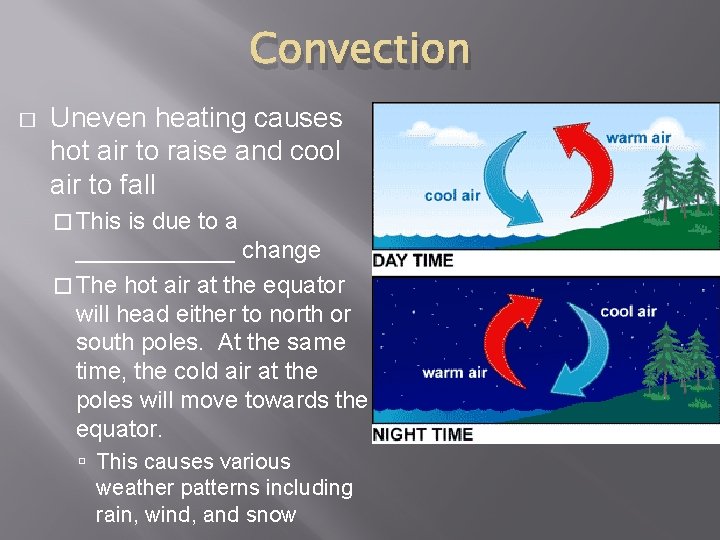
Convection � Uneven heating causes hot air to raise and cool air to fall � This is due to a ______ change � The hot air at the equator will head either to north or south poles. At the same time, the cold air at the poles will move towards the equator. This causes various weather patterns including rain, wind, and snow
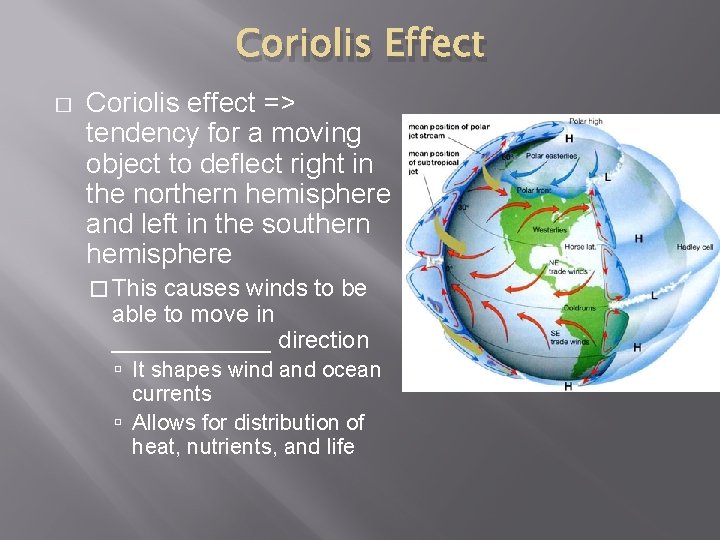
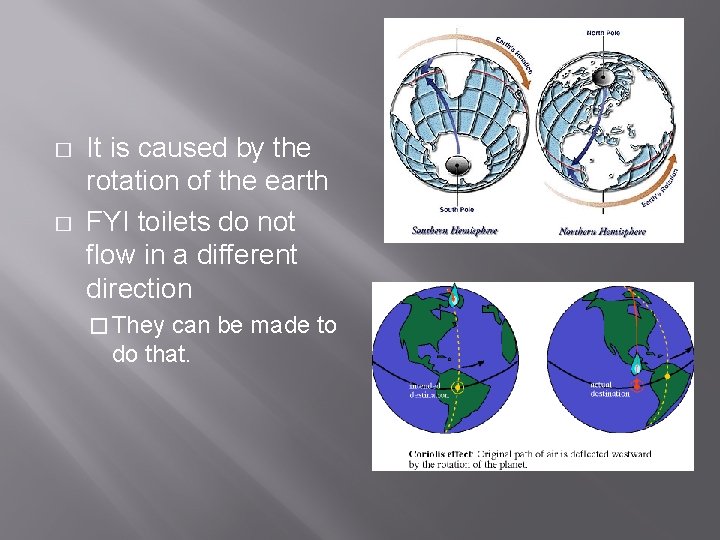
Coriolis Effect � Coriolis effect => tendency for a moving object to deflect right in the northern hemisphere and left in the southern hemisphere � This causes winds to be able to move in ______ direction It shapes wind and ocean currents Allows for distribution of heat, nutrients, and life
� � It is caused by the rotation of the earth FYI toilets do not flow in a different direction � They can be made to do that.
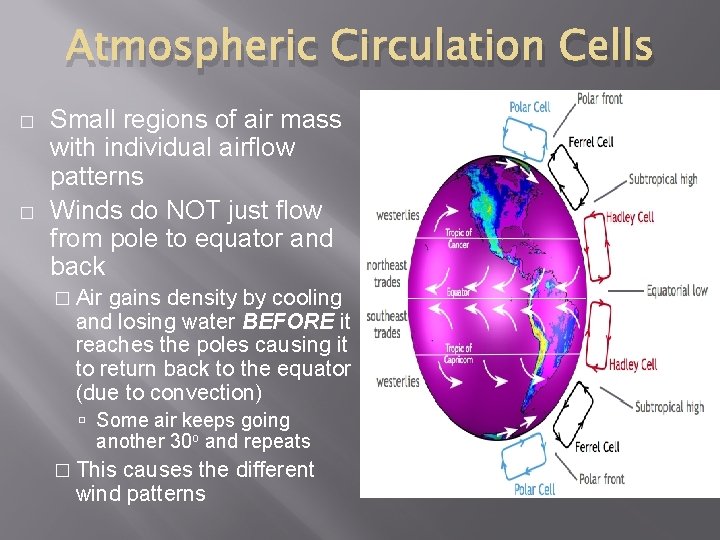
Atmospheric Circulation Cells � � Small regions of air mass with individual airflow patterns Winds do NOT just flow from pole to equator and back � Air gains density by cooling and losing water BEFORE it reaches the poles causing it to return back to the equator (due to convection) Some air keeps going another 30 o and repeats � This causes the different wind patterns
3 types of Atmospheric Circulation cells � 1. Each type has a northern and southern hemisphere version of it ______ = (a. k. a. trade winds) in the North it flows from NE to SW. In the South, it flows SE to NW
2. ______ = known as the Westerlies in the northern hemisphere because it flows from W to E and Easterlies in the southern hemisphere because its E to W. a) 3. This is opposite than expected because the other 2 types have an effect on it ______ = they follow the same flow pattern as the ____________.
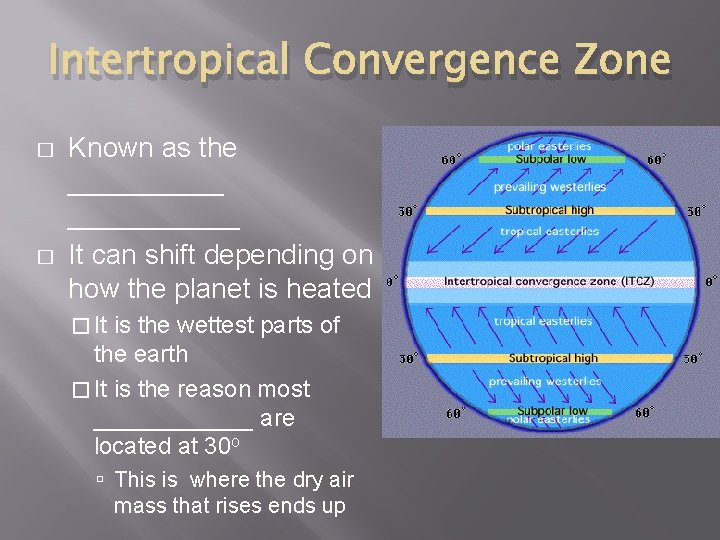
Intertropical Convergence Zone � � Known as the ___________ It can shift depending on how the planet is heated � It is the wettest parts of the earth � It is the reason most ______ are located at 30 o This is where the dry air mass that rises ends up
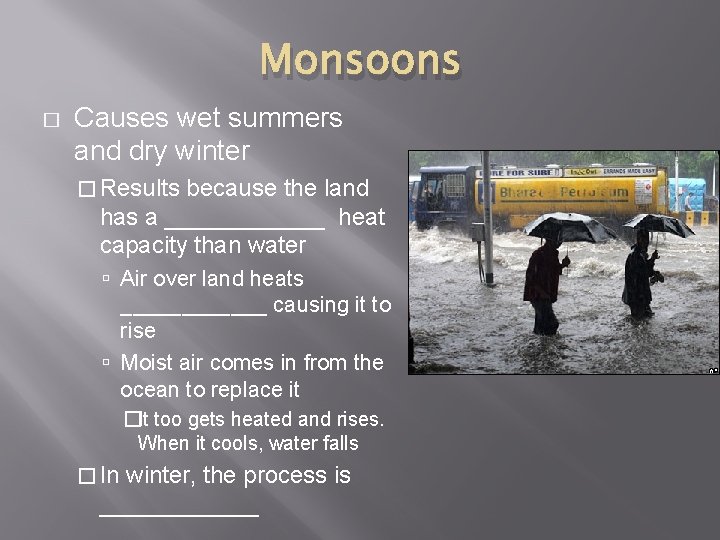
Monsoons � Causes wet summers and dry winter � Results because the land has a ______ heat capacity than water Air over land heats ______ causing it to rise Moist air comes in from the ocean to replace it �It too gets heated and rises. When it cools, water falls � In winter, the process is ______
Cyclones � ____________ storm systems of low pressure with converging winds at the ______ � Forms when the coriolis effect causes moist winds to spiral into a ____________ area It can become a ______ or ______ �Their energy source is a rapid movement of ______ and ______ into a system from warm, tropical ocean �This is why they weaken over land cold water They rotate ______ in the north and ______ in the south � There is a purpose for them: distribute heat in the planet as fast as possible.