
Ainsworths strange situation Here I was with my
- Slides: 20
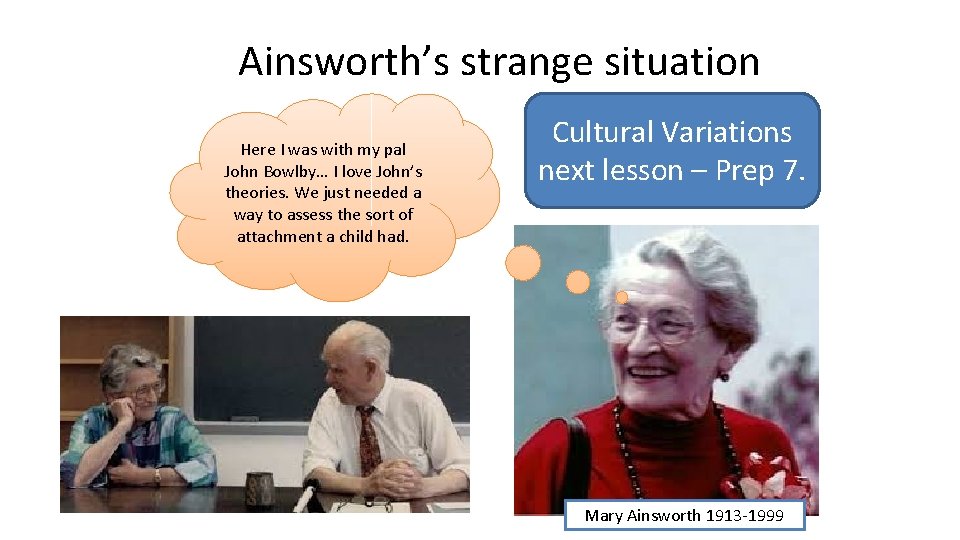
Ainsworth’s strange situation Here I was with my pal John Bowlby… I love John’s theories. We just needed a way to assess the sort of attachment a child had. Cultural Variations next lesson – Prep 7. Mary Ainsworth 1913 -1999
Quick starter. This item is on page 15 in your purple packs. Feel free to annotate as we discuss it Two mothers at the toddler and parent group are chatting. “I always felt sorry for my husband when Millie was a baby. He used to say his bond with Millie was not as strong as mine because I was breastfeeding. ” “I’m not sure”, replies the other mother. “I think there’s something important about a mother’s love that makes it more special anyway- and so important for future development. ” Discuss the learning theory of attachment and Bowlby’s monotropic theory of attachment. Refer to the conversation above in your answer. (16 marks) How would you link theories to the item?
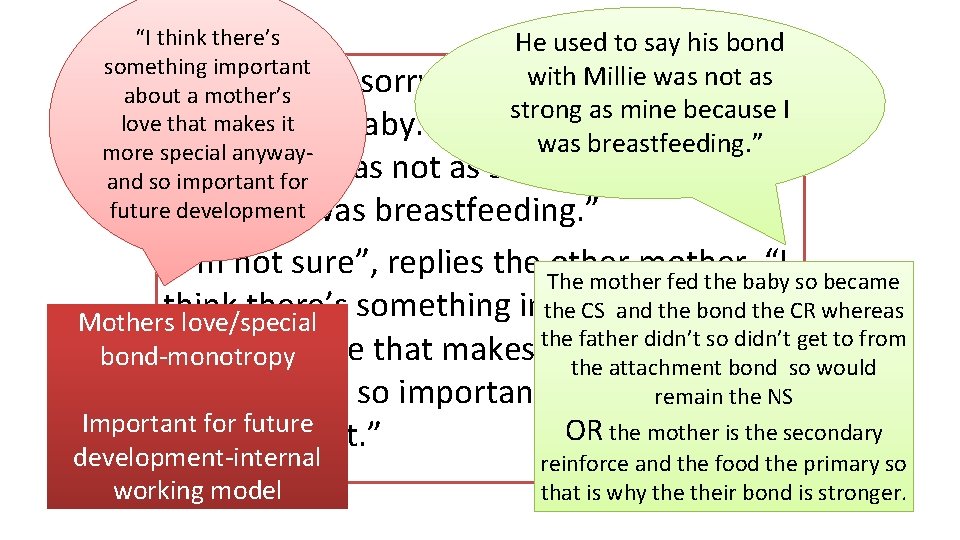
“I think there’s He used to say his bond something important with Millie was not as “I always felt sorry for my husband when about a mother’s strong as mine because I love Millie that makes it was a baby. He usedwas tobreastfeeding. ” say his bond more special anyway. Millie and sowith important for was not as strong as mine futurebecause development I was breastfeeding. ” “I’m not sure”, replies the The other mother. “I mother fed the baby so became think there’s something important about a CR whereas the CS and the bond the Mothers love/special the father didn’t so didn’t get to from mother’s love that makes it the more special bond-monotropy attachment bond so would anyway- and so important for future remain the NS Important for future OR the mother is the secondary development. ” development-internal working model reinforce and the food the primary so that is why their bond is stronger.
This is a scenario essay so is assessed in a different way Ao 1 -6 Ao 2 -4 Ao 3 -6 What do you remember about how to answer questions like this? • Marks available? • Recommended order of points– as per AQA examiner • Most effective evaluation?
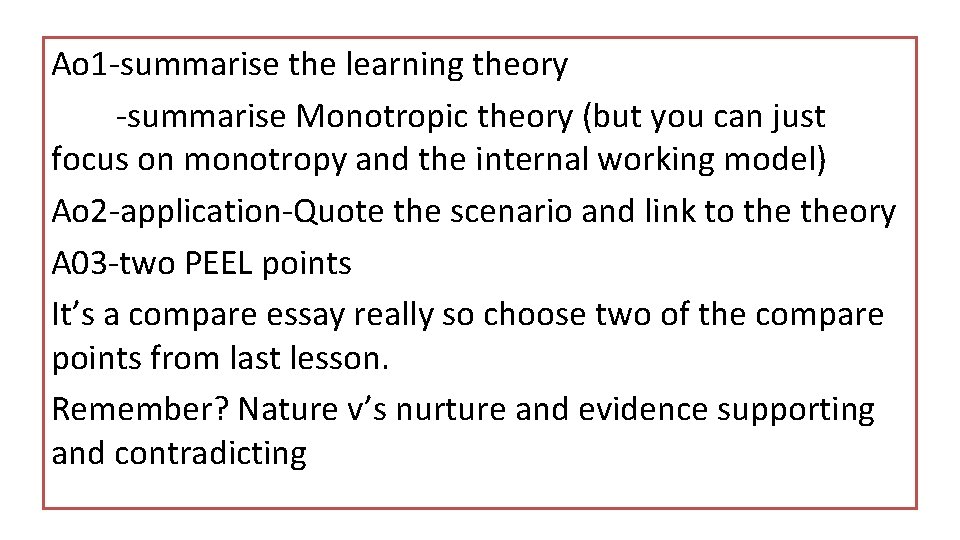
Ao 1 -summarise the learning theory -summarise Monotropic theory (but you can just focus on monotropy and the internal working model) Ao 2 -application-Quote the scenario and link to theory A 03 -two PEEL points It’s a compare essay really so choose two of the compare points from last lesson. Remember? Nature v’s nurture and evidence supporting and contradicting
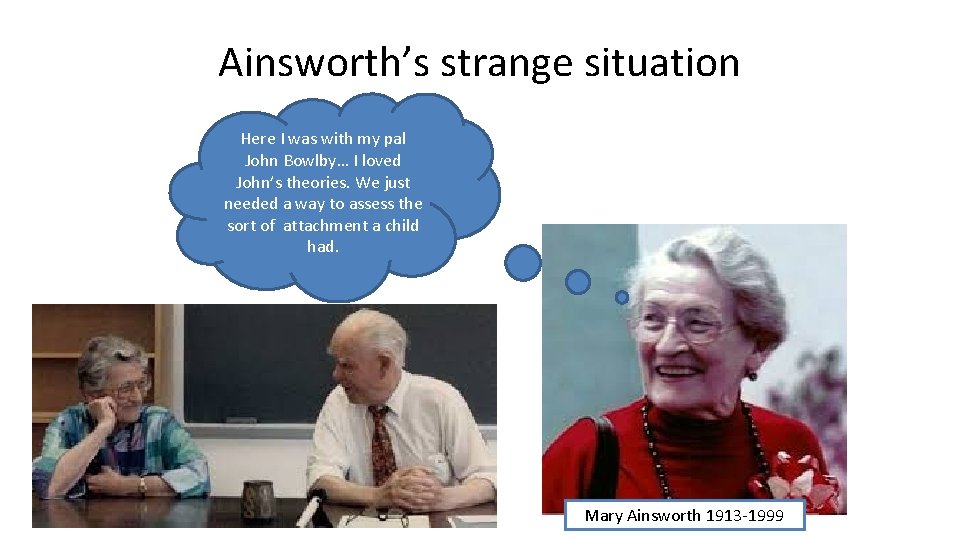
Ainsworth’s strange situation Here I was with my pal John Bowlby… I loved John’s theories. We just needed a way to assess the sort of attachment a child had. Mary Ainsworth 1913 -1999
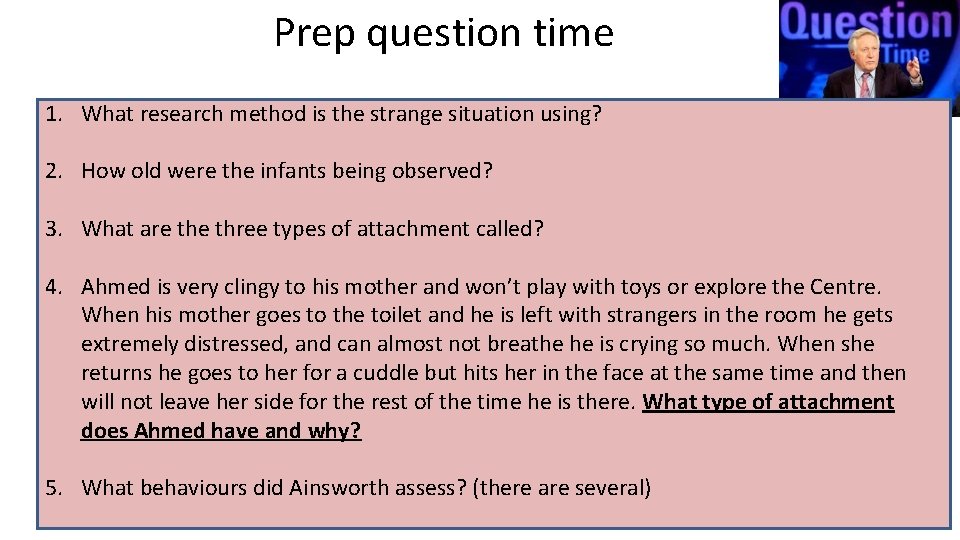
Prep question time 1. What research method is the strange situation using? 2. How old were the infants being observed? 3. What are three types of attachment called? 4. Ahmed is very clingy to his mother and won’t play with toys or explore the Centre. When his mother goes to the toilet and he is left with strangers in the room he gets extremely distressed, and can almost not breathe he is crying so much. When she returns he goes to her for a cuddle but hits her in the face at the same time and then will not leave her side for the rest of the time he is there. What type of attachment does Ahmed have and why? 5. What behaviours did Ainsworth assess? (there are several)
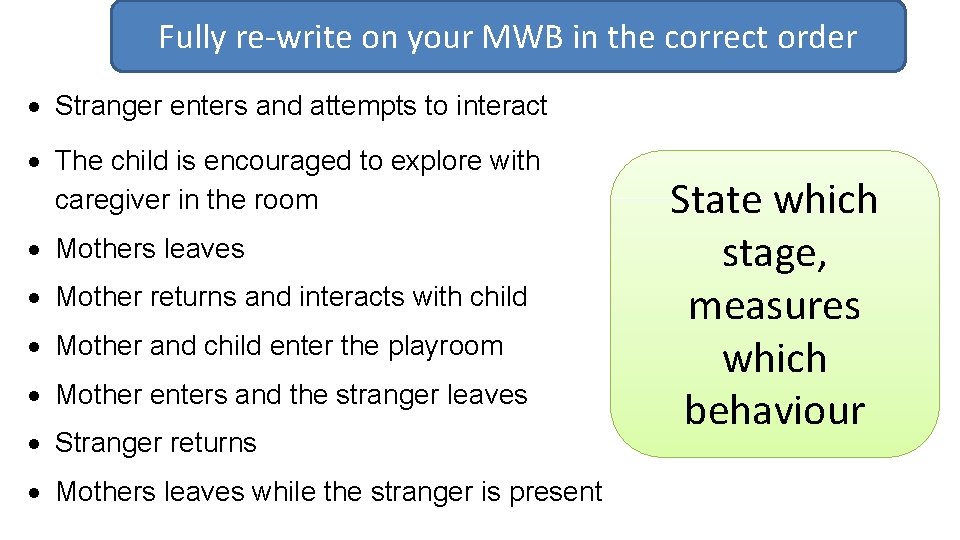
Fully re-write on your MWB in the correct order Stranger enters and attempts to interact The child is encouraged to explore with caregiver in the room Mothers leaves Mother returns and interacts with child Mother and child enter the playroom Mother enters and the stranger leaves Stranger returns Mothers leaves while the stranger is present State which stage, measures which behaviour
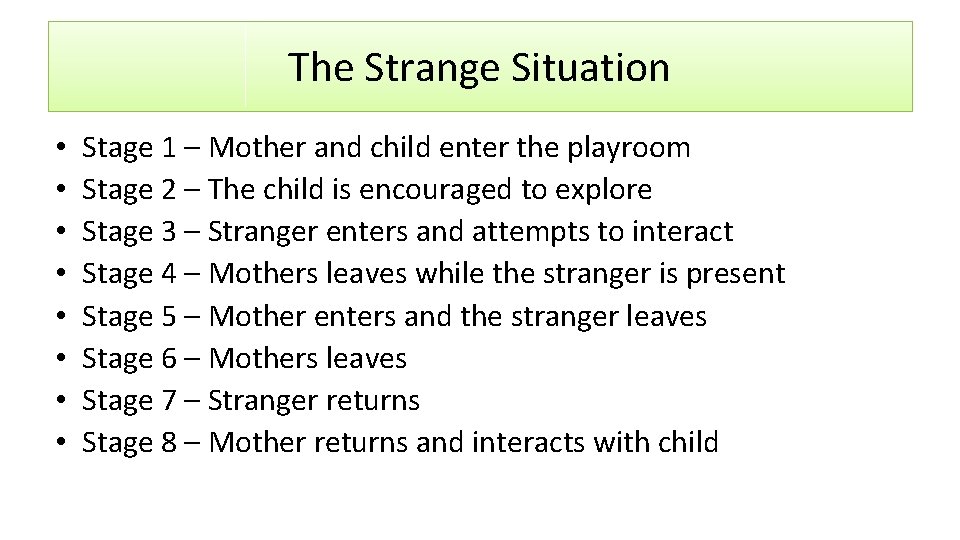
The Strange Situation • • Stage 1 – Mother and child enter the playroom Stage 2 – The child is encouraged to explore Stage 3 – Stranger enters and attempts to interact Stage 4 – Mothers leaves while the stranger is present Stage 5 – Mother enters and the stranger leaves Stage 6 – Mothers leaves Stage 7 – Stranger returns Stage 8 – Mother returns and interacts with child
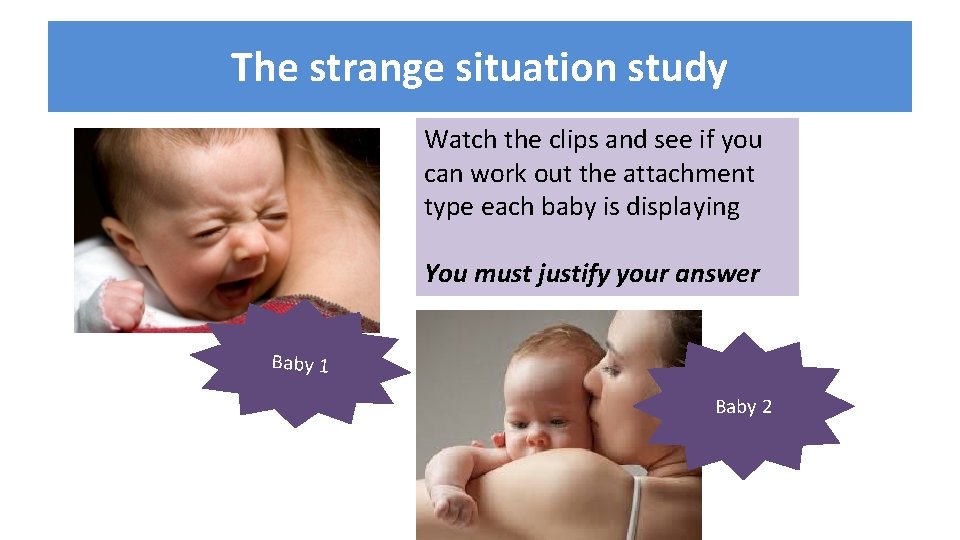
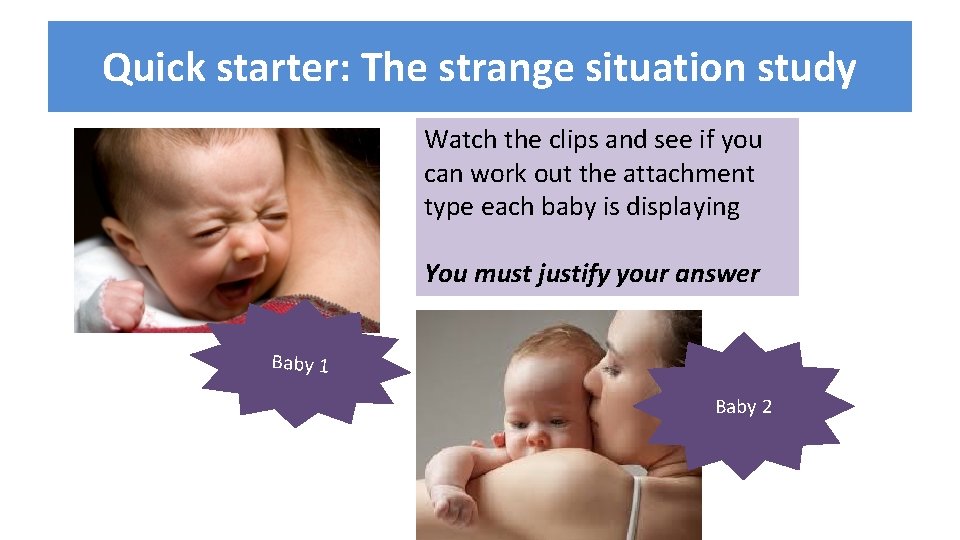
The strange situation study Watch the clips and see if you can work out the attachment type each baby is displaying You must justify your answer Baby 1 Baby 2
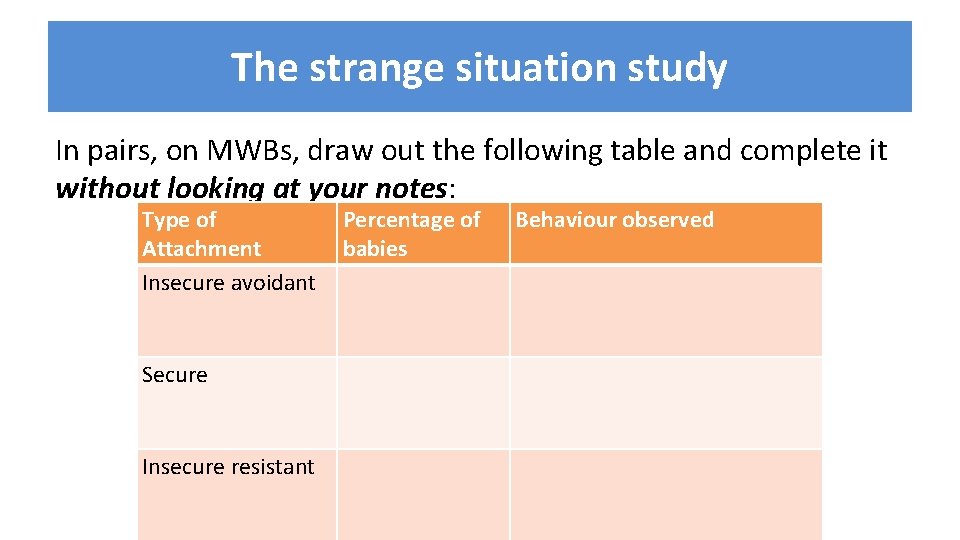
The strange situation study In pairs, on MWBs, draw out the following table and complete it without looking at your notes: Type of Attachment Insecure avoidant Secure Insecure resistant Percentage of babies Behaviour observed
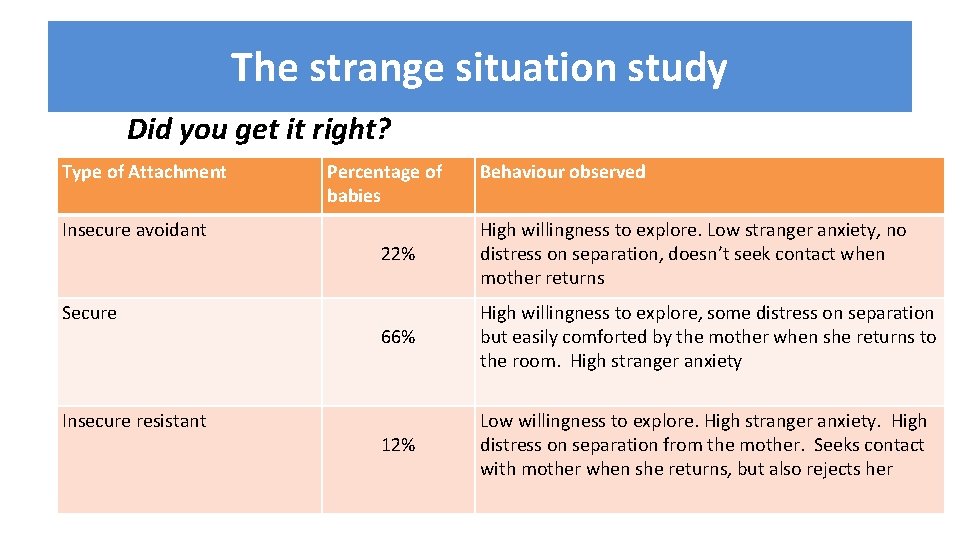
The strange situation study Did you get it right? Type of Attachment Insecure avoidant Secure Insecure resistant Percentage of babies Behaviour observed 22% High willingness to explore. Low stranger anxiety, no distress on separation, doesn’t seek contact when mother returns 66% High willingness to explore, some distress on separation but easily comforted by the mother when she returns to the room. High stranger anxiety 12% Low willingness to explore. High stranger anxiety. High distress on separation from the mother. Seeks contact with mother when she returns, but also rejects her
Quick starter: The strange situation study Watch the clips and see if you can work out the attachment type each baby is displaying You must justify your answer Baby 1 Baby 2
Evaluating Ainsworth’s strange situation Here I was with my pal John Bowlby… I love John’s theories. We just needed a way to assess the sort of attachment a child had. Cultural Variations next lesson – still Prep 7. Mary Ainsworth 1913 -1999
Evaluation of the strange situation Read the following findings and, discuss what that finding suggests about the Strange Situation study. You will need to use your knowledge of research methods terminology to be able to do this e r u s e b n a c e w t a h t s n a e m s • Different observers watching on what Thi the same children tendtytopagree ch a e t a h t e tfound the similarity n e attachment type to classify infants a as. Bick (2012) m h c a t t e th ot that classifications n between different observers was as high as 94% s i g n i v a h s da e s s a s i d l i f ch o n o i t a t e r p r e int of 1 year olds in the e • Vaughn and waters (1990) compared the behaviour h t o t n w o d just and found that children lso strange situation and at home who had been a t I. r e v r e s b o l a u d assessed as securely attached in Ainsworth’s procedure, also displayed e i v i d n i e h t ar e w r u secure attachment behaviour in the home o i v a h e b e h t t a h t s e r u sugg o i v a h e b t n e ist s n o c s i The first finding suggests that the research has high inter-rater reliability g n i v r obse ld i h c e h t f o t c du o r p a t o n d n n o i t The second finding suggests thatathe study has high external (ecological) a u t i s r a i l i am f n u n validity as the findings generalise to a real life situation a n i g n i be Now see if you can complete evaluation point 1 on your sheet.
Evaluation of the strange situation What did Ainsworth believe was responsible for a baby’s attachment type? SO …what might lead to a child developing a secure attachment, and what might lead to a child developing an insecure attachment? She believed that the way the mother responded to the child influenced its attachment type A mother who responses sensitively to the child’s needs (secure), or a mother who does not respond sensitively to the child’s needs (insecure) Now read the case study on the next slide and think about what it might suggest about a baby’s attachment type
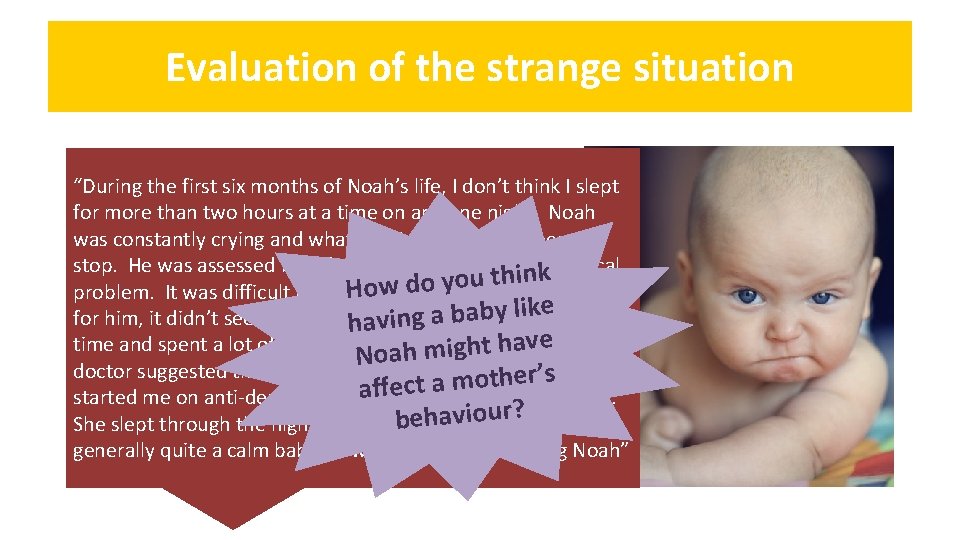
Evaluation of the strange situation “During the first six months of Noah’s life, I don’t think I slept for more than two hours at a time on any one night. Noah was constantly crying and whatever I did he didn’t seem to stop. He was assessed by a doctor, but there wasino physical k n h t u doasyoif whatever I did Hoasw. I felt problem. It was difficult for me, e k i l y b a for him, it didn’t seem to have h any effect. I was tired all the g n avi ave my time and spent a lot of time crying. a After aigfew months, h t h m h o N doctor suggested that I may be suffering fromodepression and s ’ r e h t m a ect child was really easy. afffirst started me on anti-depessants. My ur? was vioand behaold, She slept through the night from 8 weeks generally quite a calm baby. It was such a shock having Noah”
Evaluation of the strange situation Kagan proposed the temperament hypothesis, which suggests that babies may be born with an innate temperament that possible influences the way the mother reacts to the baby. Although there is limited evidence to support the temperament hypothesis, it does highlight a problem with Ainsworth’s conclusion Now Use this and the discussion about Noah to complete point 2. Try to be specific to the study, not generic. Use terms like… Cause effect e Why might w consider the research to be ve? i t i s n e s y l l a i c so
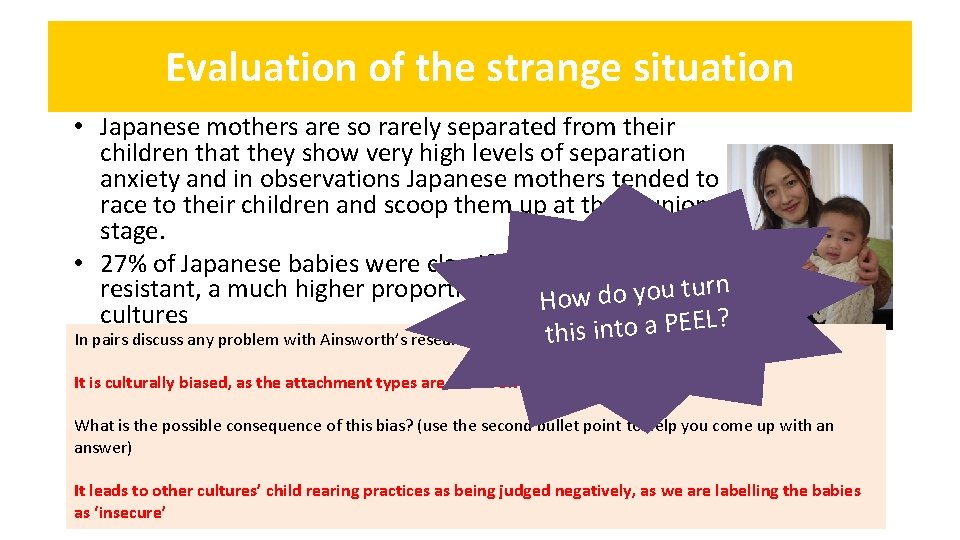
Evaluation of the strange situation • Japanese mothers are so rarely separated from their children that they show very high levels of separation anxiety and in observations Japanese mothers tended to race to their children and scoop them up at the reunion stage. • 27% of Japanese babies were classified as insecure n r u t resistant, a much higher proportion than. Hin western u o y o d w o cultures ? L E E P a o t n i thiofs this? In pairs discuss any problem with Ainsworth’s research on the basis It is culturally biased, as the attachment types are based on Western ideals What is the possible consequence of this bias? (use the second bullet point to help you come up with an answer) It leads to other cultures’ child rearing practices as being judged negatively, as we are labelling the babies as ‘insecure’
Evaluation of the strange situation Point: An example of culture bias in psychology is in Ainsworth’s Strange situation methodology used to investigate attachment Evidence/explain: The Strange Situation test assumes that behavior has the same meaning in all cultures, when in fact cultural perception and understanding of behavior differ greatly. The Strange Situation was created and tested in the USA. Many researchers assumed that the strange situation had the same meaning for infants in other cultures resulting in potentially invalid conclusions. Evidence/explain: For example that Japanese mothers are overly sensitive to the needs of the children as Japanese children showed a higher rate of insecure-resistant behavior at 27%. However extremely close mother-child relationships are a cultural norm in Japan which explains why the children behaved differently to those in the US. Link: Ainsworth’s research methodology is therefore an inappropriate and ineffective way to accurately measure attachment due to its ethnocentrism as it was assumed that the US model of classifying attachment was the norm