
Aims and objectives of SIA are to F
Aims and objectives of SIA are to: F analyse how proposals affect people F identify and mitigate adverse impacts F enhance benefits F help manage social change UNEP Training Resource Manual 1
Scope of SIA F SIA conducted under EIA legislation and procedure F scope of SIA differs with jurisdictional arrangements F initially limited to environmentallyrelated changes F larger range of social impacts now considered F comprehensive SIA often a separate process F focuses on social issues of sustainable development, poverty alleviation and justice UNEP Training Resource Manual 2
Causes of social impacts F demographic change, e. g. population size and composition F economic change, e. g. employment and income F environmental change, e. g. air and water quality F institutional change, e. g. law and administration UNEP Training Resource Manual 3
Types of social impact F lifestyle – behaviour and relationships F cultural – customs, values and religious beliefs F community – infrastructure, services and networks F amenity/ quality of life – sense of security, livability and futurity F health – mental and physical well being UNEP Training Resource Manual 4
SIA benefits can include: : F reduced impact on people F enhanced benefits for those affected F avoiding delays and obstruction F lowering costs by timely actions F better community and stakeholder relationships F improved future proposals UNEP Training Resource Manual 5
Steps in the SIA process F public involvement plan F identification of alternatives F profiling of baseline conditions F scoping of key issues F projection of estimated effects F prediction and evaluation of responses to impacts UNEP Training Resource Manual 6

Steps in the SIA process (continued) F estimate indirect and cumulative impacts F recommend changes to alternatives F develop and implement a mitigation plan F develop and implement a monitoring programme UNEP Training Resource Manual 7
Principles of SIA good practice F involve the diverse public F analyse impact equity F focus the assessment F identify methods and assumptions and define significance F provide feedback on social impacts to project planners UNEP Training Resource Manual 8
Principles of SIA good practice (continued) F use experienced SIA practitioners F establish monitoring and mitigation programmes F identify data sources F plan for gaps in data UNEP Training Resource Manual 9
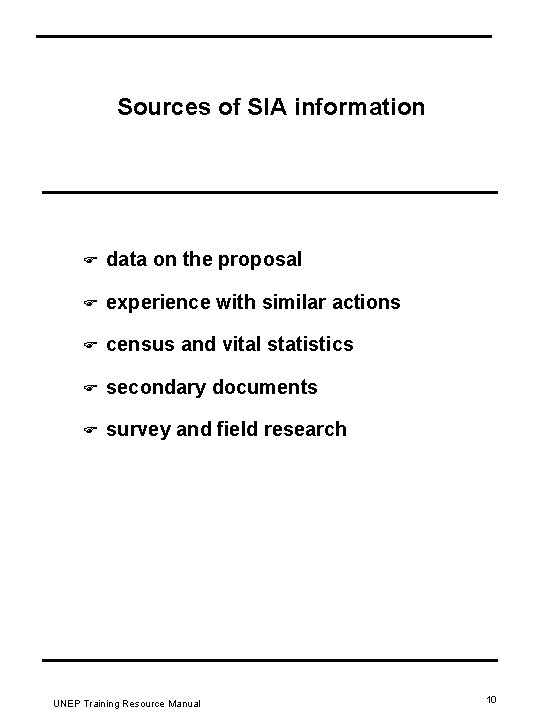
Sources of SIA information F data on the proposal F experience with similar actions F census and vital statistics F secondary documents F survey and field research UNEP Training Resource Manual 10
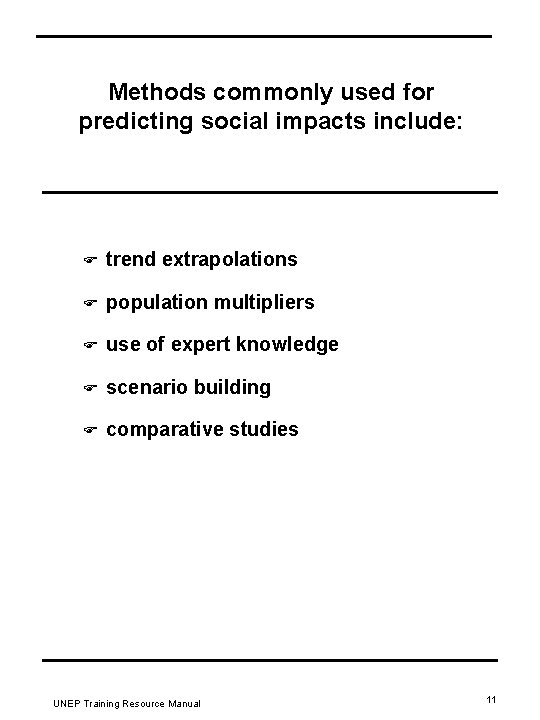
Methods commonly used for predicting social impacts include: F trend extrapolations F population multipliers F use of expert knowledge F scenario building F comparative studies UNEP Training Resource Manual 11
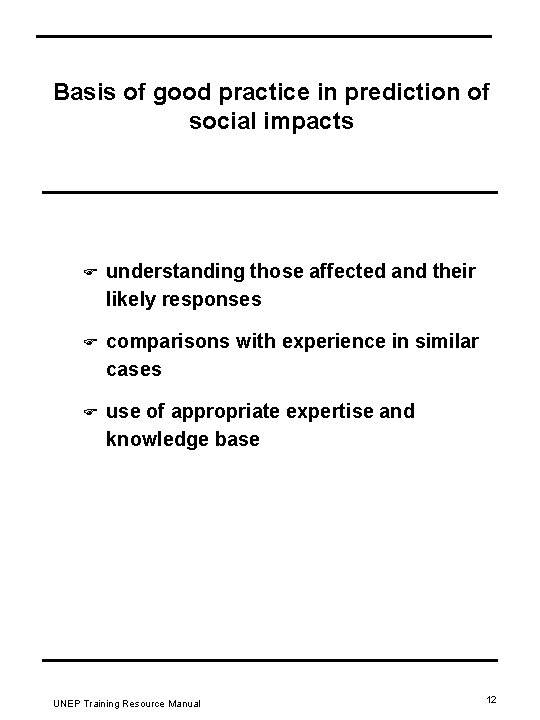
Basis of good practice in prediction of social impacts F understanding those affected and their likely responses F comparisons with experience in similar cases F use of appropriate expertise and knowledge base UNEP Training Resource Manual 12
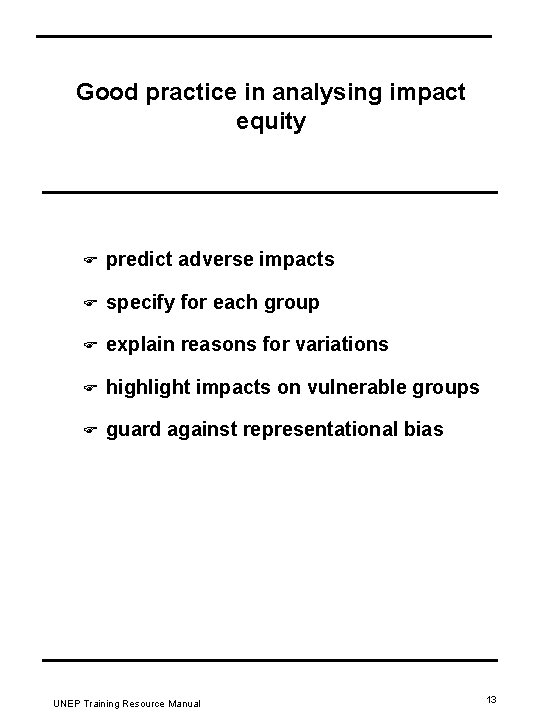
Good practice in analysing impact equity F predict adverse impacts F specify for each group F explain reasons for variations F highlight impacts on vulnerable groups F guard against representational bias UNEP Training Resource Manual 13
Good practice in impact mitigation and management F identify mitigation measures for each impact F customise them to the different groups affected F give priority to avoiding social impacts F then minimise them as far as practicable F use compensation as a last resort F ensure impacts are not borne disproportionately by one group UNEP Training Resource Manual 14
Good practice in impact mitigation and management (continued) F no one should be worse off than before F treat relocation/resettlement as a special case F livelihoods of those displaced should be improved F enhance benefits for local people through job training and development packages UNEP Training Resource Manual 15
- Slides: 15