
AIMING HIGH FOR DISABLED CHILDREN AHDC Report to

AIMING HIGH FOR DISABLED CHILDREN (AHDC) Report to the DCYP Overview and Scrutiny Committee 21 July 2008 Sally Riley – Head of Strategy and Inclusion 1
Purpose DCSF/HM Treasury Aiming High for Disabled Children: Better Support for Families programme seeks to: n n n transform social care, health, education and voluntary services for children with disabilities; provide the support needed to permit the best life outcomes for children and young people with disabilities; and enable their families to live as close to normal everyday lives as possible. 2
Vision – 3 priority areas n Access and empowerment – Core Offer o o o Information – Good clear information about what services children and families can have access to. Transparency – Consistent eligibility criteria that all can understand. Participation – The opportunity for children and families to have a say in the design and delivery of services. Assessment – A Common Assessment Framework that properly identifies a child’s needs and indicates the services they should get. Feedback – Clear procedures for families to be able to complain when things go wrong and get them put right quickly. 3
Vision – 3 priority areas n Responsive services and timely support ¡ All professionals responsible for planning services for children, both locally and nationally, will focus on the services disabled children and young people need, particularly at key life stages such as the early years and in transition to adulthood 4
Vision – 3 priority areas n Improving quality and capacity ¡ new funding has been allocated for the services families want and need, in particular short break services for children and young people with the most complex needs which families have described as their key priority 5
Views of children and their families “one key worker managing professionals and agencies” “clear entitlements with a core offer with local flexibility, financial support” “focussed, effective support early in life and at key transition points” “practical and emotional support through the child's life” “social inclusion, enjoying everyday life” “professionals who understand individual needs and work well together” “services that meet families' needs” “child care, short breaks and respite” “services that recognise children grow and move on” “continuity not crises” 6
AHDC - Context n Joined up services and working linked to Every Child Matters and Children’s National Service Framework n Provide personal and tailored response from both universal and specialist services to families with children with disabilities n Too many families with disabled children have struggled to get the support they need, rather than having ‘the system’ meeting their needs effectively 7
Making the system work better n A new national indicator on services for disabled children which will be used to measure the experience of families with disabled children to assess performance of LAs and PCTs n A Core Offer to disabled children and families with standards will help shape/review local services n Work to improve the quality and quantity of information held locally and centrally on disabled children, their families and the services they need 8
Expected outcomes n Disabled children will have the same opportunities to develop and fulfil their potential as all other children; n Families with disabled children will get the support they need, when they need it; n Universal children’s services will be more genuinely inclusive of disabled children, including those with complex needs; n Disabled children will be at the heart of the ongoing change programme for children’s services. 9
Defining ‘disability’ n "A person with a physical or mental impairment with a substantial long-term adverse effect on their ability to carry out normal day-to-day activities. ” Disability Discrimination Act (2005) 10
Defining the population n All children and young people (from early years through to 18 or 19) who have Special Educational Needs or Learning Difficulties and Disabilities (SEN/LDD) – [13, 628+799]; n Who are subject to the graduated stages of the SEN Code of Practice (School Action Plus [7, 169] and Early Years Action Plus [708] and those children and young people who are in receipt of a Statement of SEN) [6, 459+91]; n 14, 427 children and young people in Lancashire. 11
Implementing AHDC in Lancashire n Establish a AHDC Project Governance Board n Appoint an AHDC Programme Manager n Establish a AHDC Programme Management Board a AHDC Project Steering Group n Further develop the AHDC Programme Plan n Further develop the AHDC Communications Plan n Establish AHDC performance standards to measure progress. 12
National funding for AHDC n DCSF allocated £ 430 m nationally (includes £ 340 m announced previously + £ 90 m capital funding for short-term breaks) to cover CSR from 2008 -11 to LAs n Do. H allocated “significant additional funding” to PCTs to improve services to CYP with disabilities including palliative care n Funding streams cover: ¡ ¡ Short-term breaks (£ 1. 394 m + PCT funding) Childcare (£ 233 k in General Sure Start Grant) Transition Support Programme (£ 127 K) Parent Forums (£ 33 K) 13
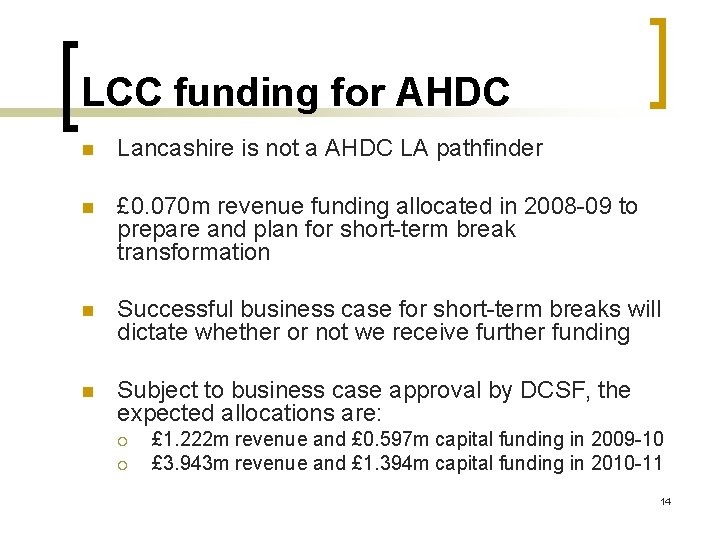
LCC funding for AHDC n Lancashire is not a AHDC LA pathfinder n £ 0. 070 m revenue funding allocated in 2008 -09 to prepare and plan for short-term break transformation n Successful business case for short-term breaks will dictate whether or not we receive further funding n Subject to business case approval by DCSF, the expected allocations are: ¡ ¡ £ 1. 222 m revenue and £ 0. 597 m capital funding in 2009 -10 £ 3. 943 m revenue and £ 1. 394 m capital funding in 2010 -11 14
Early priorities for AHDC n n n Redesigning short-term breaks offer; Joining up equipment provision and management; Making integrated working work in practice; Getting service users more engaged in service design; Providing relevant training to all staff who work with children with disabilities; Pooling budgets for AHDC 15
AHDC – some challenges n Revisiting Maplewood and other short-term breaks settings n Pooled budgeting n Effective partnership working providing ‘joined-up’ services around a vulnerable group of children and young people n Every Disabled Child Matters (EDCM) Campaign and the Local Authority Charter n EDCM Primary Care Trust Charter 16
EDCM LA Charter n n n 63 LAs have ‘signed up’ to the LA Charter 9 local MPs have committed Regular lobbying of the Cabinet Member for CYP to commit to the LA Charter Every Disabled Child Matters – Local Authority Charter 17
AHDC – the challenge n more than organisational adjustments and improved methods n culture change in how disabled children are perceived and catered for n more effective integration of universal, targeted and specialist services in order to realise not only the ‘team around the child’ approach but more importantly for DCYP and its partners to develop ‘services around vulnerable groups’ n a real opportunity to demonstrate that every child really does matter 19
- Slides: 18