
Aim What does it mean to be an
Aim: What does it mean to be an Animist?

I What is Animism? A) Animism is a belief that natural objects are animated by spirits. The term comes from the Latin word anima (spirit/soul/lifeforce). B) Animists believe spirits in nature can influence human affairs for better or worse. In turn, humans may influence them to some degree through appropriate rituals and offerings. C) Shamans are traditional animist healers/spiritual leaders. D) The oldest evidence of Animism goes back to the Neanderthals 70, 000 years ago as they buried their dead with offerings of red ochre and flowers (at Shanidar Cave, Iraq). https: //www. smithsonianmag. com/arts-culture/the-skeletonsof-shanidar-cave-7028477/

II Edward Burnett Tylor A) British anthropologist Sir Edward Burnett Tylor in his 1871 book Primitive Cultures described animism as the basis of all religions and the earliest stage in the evolution of religion. B) Tylor believed that the modern belief in spirits is due to elements of animism that survived into the present and is evidence that modern religion has not fully “evolved”. “Animism characterizes tribes very low in the scale of humanity, and thence ascends, deeply modified in its transmission, but from first to last preserving an unbroken continuity, into the midst of high modern culture. ” Sir Edward Burnett Tylor 1832 - 1917
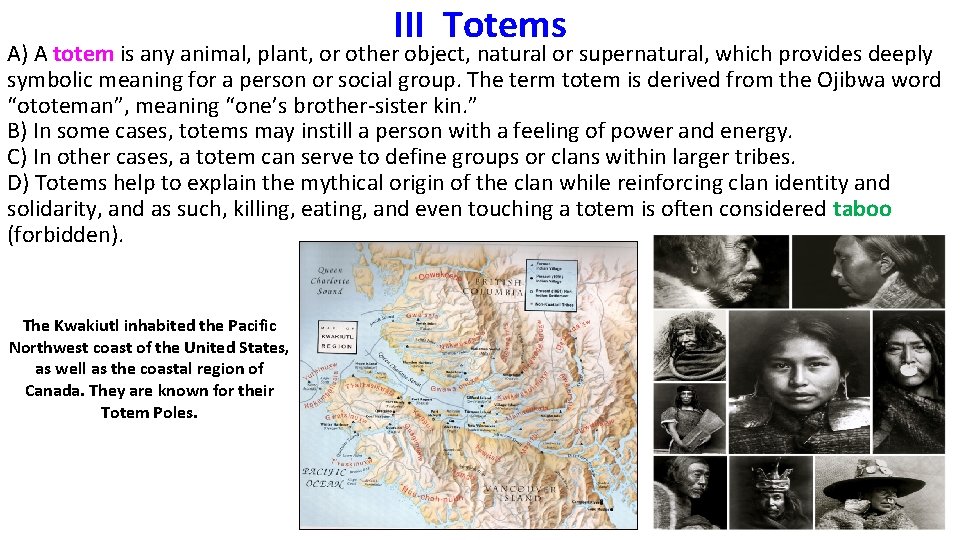
III Totems A) A totem is any animal, plant, or other object, natural or supernatural, which provides deeply symbolic meaning for a person or social group. The term totem is derived from the Ojibwa word “ototeman”, meaning “one’s brother-sister kin. ” B) In some cases, totems may instill a person with a feeling of power and energy. C) In other cases, a totem can serve to define groups or clans within larger tribes. D) Totems help to explain the mythical origin of the clan while reinforcing clan identity and solidarity, and as such, killing, eating, and even touching a totem is often considered taboo (forbidden). The Kwakiutl inhabited the Pacific Northwest coast of the United States, as well as the coastal region of Canada. They are known for their Totem Poles.
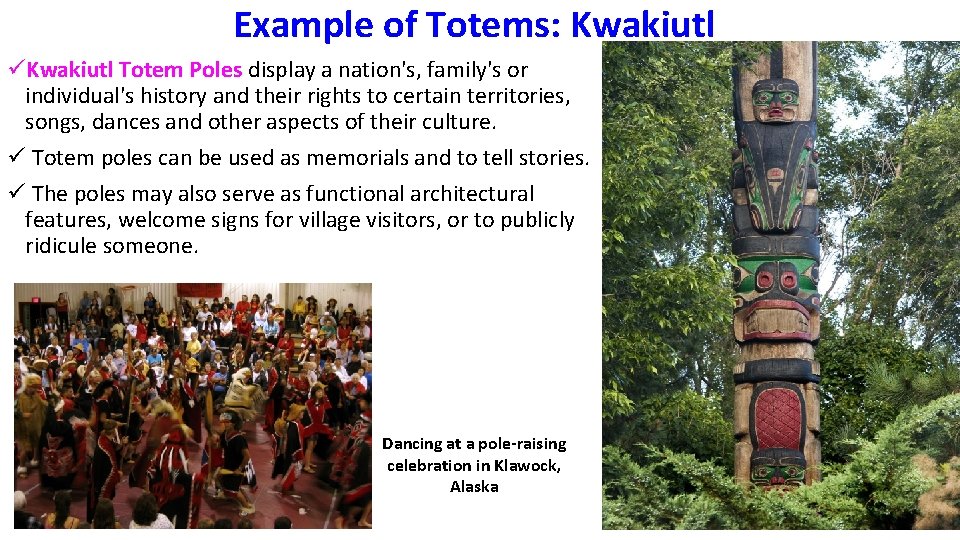
Example of Totems: Kwakiutl üKwakiutl Totem Poles display a nation's, family's or individual's history and their rights to certain territories, songs, dances and other aspects of their culture. ü Totem poles can be used as memorials and to tell stories. ü The poles may also serve as functional architectural features, welcome signs for village visitors, or to publicly ridicule someone. Dancing at a pole-raising celebration in Klawock, Alaska
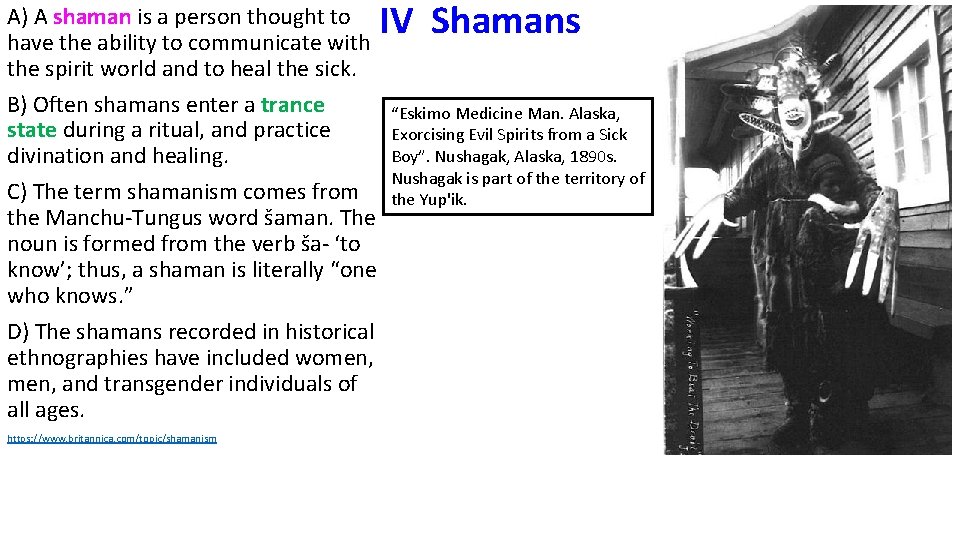
A) A shaman is a person thought to have the ability to communicate with the spirit world and to heal the sick. B) Often shamans enter a trance state during a ritual, and practice divination and healing. C) The term shamanism comes from the Manchu-Tungus word šaman. The noun is formed from the verb ša- ‘to know’; thus, a shaman is literally “one who knows. ” D) The shamans recorded in historical ethnographies have included women, and transgender individuals of all ages. https: //www. britannica. com/topic/shamanism IV Shamans “Eskimo Medicine Man. Alaska, Exorcising Evil Spirits from a Sick Boy”. Nushagak, Alaska, 1890 s. Nushagak is part of the territory of the Yup'ik.
Interview with an Inuit Shaman Aua, 19 th Century Greenland “…All our customs come from life and turn towards life. We explain nothing, we believe nothing… We fear the weather spirit of earth, that we must fight against to wrest our food from land sea. We fear hunger in the cold snow huts. We fear Takannakapsaaluk, the great woman down at the bottom of the sea, that rules over all the beasts of the sea. We fear the sickness that we meet with daily all around us; not death, but the suffering. We fear the evil spirits of life, those of the air, of the sea and the earth, that can help wicked shamans to harm their fellow men. We fear the souls of dead human beings and of the animals we have killed. Therefore, it is that our fathers have inherited from their fathers all the old rules of life which are based on the experience and wisdom of generations. We do not know how, we cannot say why, but we keep those rules in order that we may live untroubled. And so ignorant are we in spite of all our shamans, that we fear everything unfamiliar. We fear what we see about us, and we fear all the invisible things that are likewise about us, all that we have heard of in our forefathers’ stories and myths. Therefore, we have our customs, which are not the same as those of the white men, the white men who live in another land have need of other ways… What we have heard about the soul shows us that the life of men and beasts does not end with death. When at the end of life we draw our last breath, that is not the end. We awake to consciousness again, we come to life again, and all this is effected through the medium of the soul. Therefore it is that we regard the soul as the greatest and most incomprehensible of all. ” https: //www. canadiangeographic. ca/article/shamans-spirits-and-faith-inuit-north
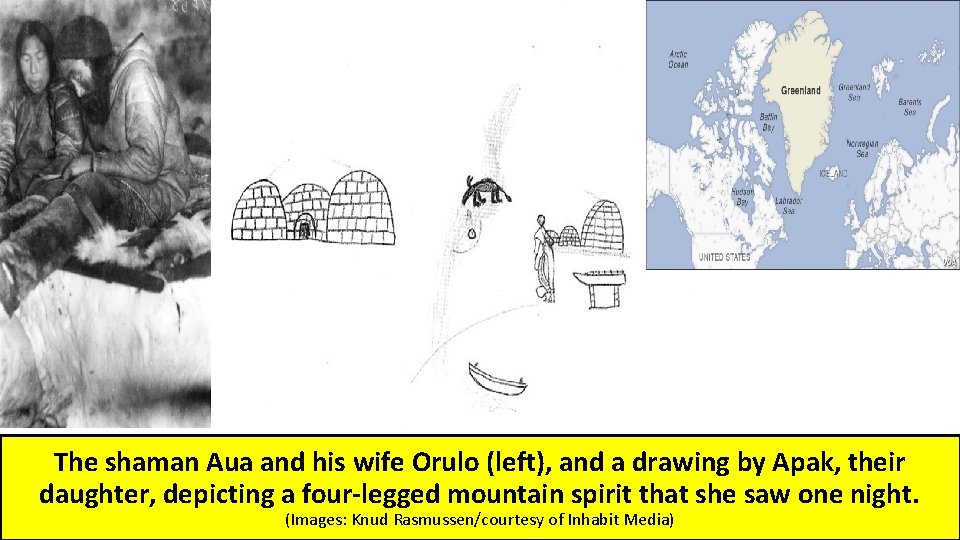
The shaman Aua and his wife Orulo (left), and a drawing by Apak, their daughter, depicting a four-legged mountain spirit that she saw one night. (Images: Knud Rasmussen/courtesy of Inhabit Media)
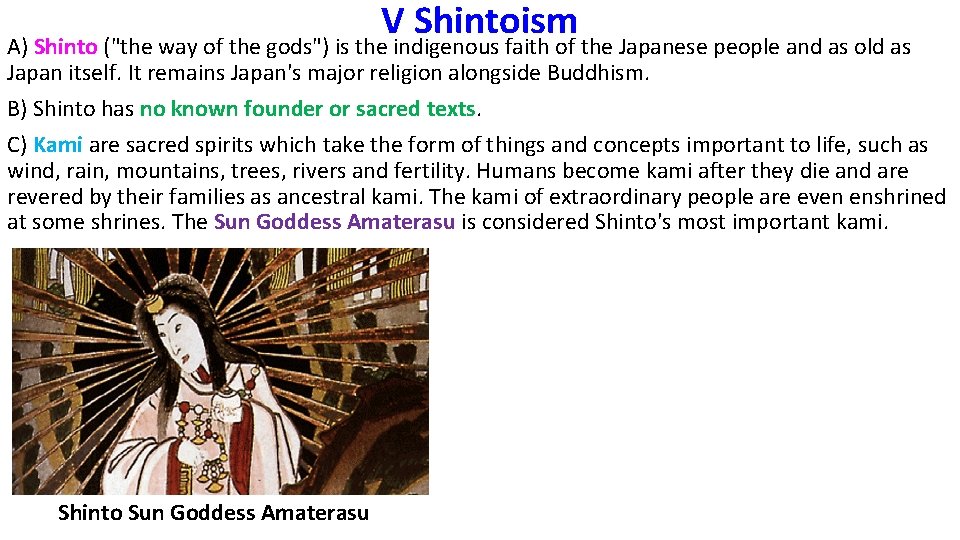
V Shintoism A) Shinto ("the way of the gods") is the indigenous faith of the Japanese people and as old as Japan itself. It remains Japan's major religion alongside Buddhism. B) Shinto has no known founder or sacred texts. C) Kami are sacred spirits which take the form of things and concepts important to life, such as wind, rain, mountains, trees, rivers and fertility. Humans become kami after they die and are revered by their families as ancestral kami. The kami of extraordinary people are even enshrined at some shrines. The Sun Goddess Amaterasu is considered Shinto's most important kami. Shinto Sun Goddess Amaterasu
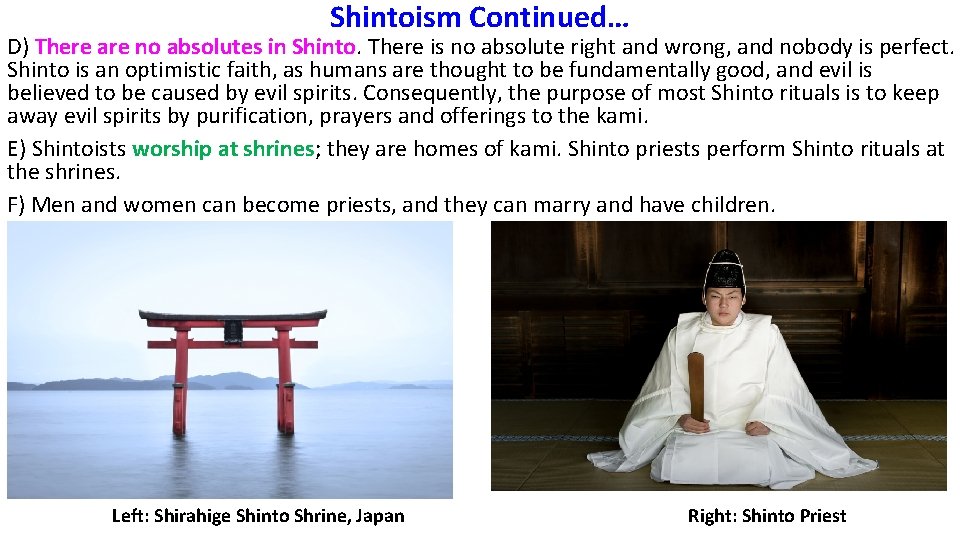
Shintoism Continued… D) There are no absolutes in Shinto. There is no absolute right and wrong, and nobody is perfect. Shinto is an optimistic faith, as humans are thought to be fundamentally good, and evil is believed to be caused by evil spirits. Consequently, the purpose of most Shinto rituals is to keep away evil spirits by purification, prayers and offerings to the kami. E) Shintoists worship at shrines; they are homes of kami. Shinto priests perform Shinto rituals at the shrines. F) Men and women can become priests, and they can marry and have children. Left: Shirahige Shinto Shrine, Japan Right: Shinto Priest
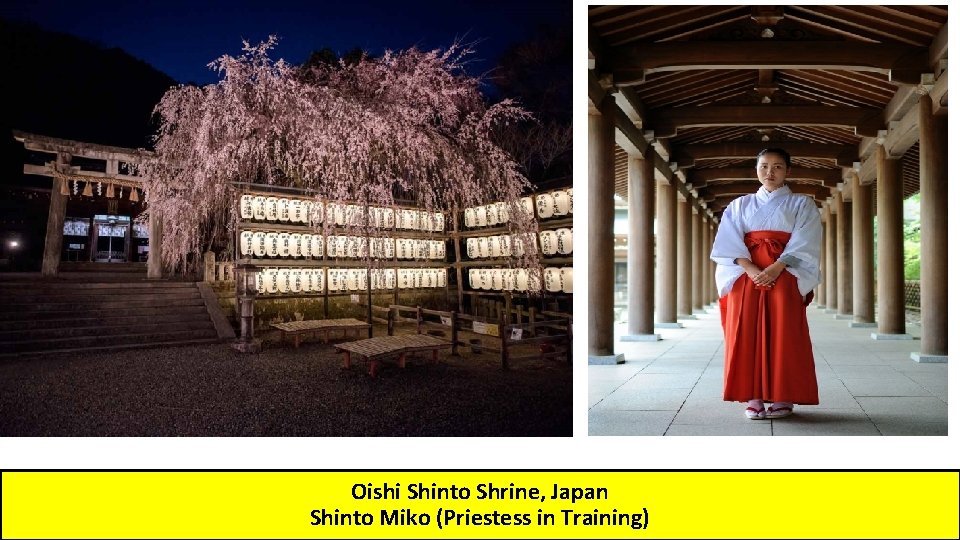
Oishi Shinto Shrine, Japan Shinto Miko (Priestess in Training)
Animism Edward Burnett Tylor Kami Kwakiutl Shaman Shintoism Totem Pole Key Vocabulary
- Slides: 12