
Aim To understand the origins of Aboriginal and
Aim • To understand the origins of Aboriginal and Torres Strait Islander Peoples artworks. Success Criteria • To list examples of Aboriginal and Torres Strait Islander Peoples art. • To describe the importance of Aboriginal and Torres Strait Islander Peoples art within our Australian culture. Curriculum link - ACHASSK 013 - Scootle
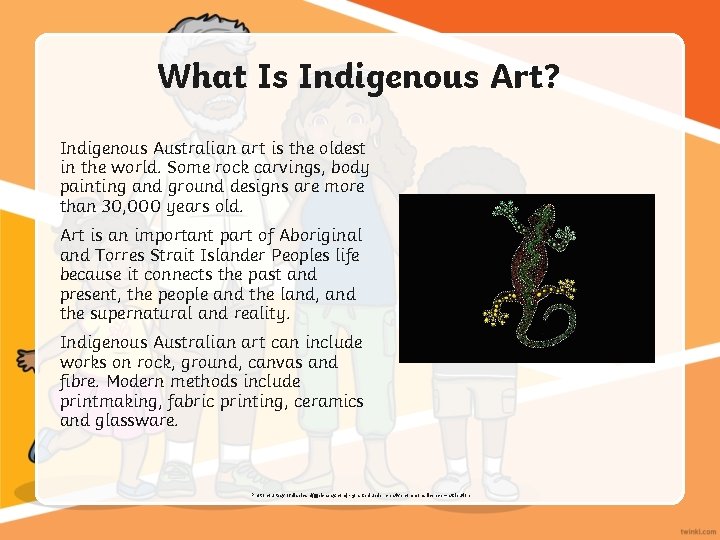
What Is Indigenous Art? Indigenous Australian art is the oldest in the world. Some rock carvings, body painting and ground designs are more than 30, 000 years old. Art is an important part of Aboriginal and Torres Strait Islander Peoples life because it connects the past and present, the people and the land, and the supernatural and reality. Indigenous Australian art can include works on rock, ground, canvas and fibre. Modern methods include printmaking, fabric printing, ceramics and glassware. Photo courtesy of diapicard(@pixabay. com) - granted under creative commons licence – attribution
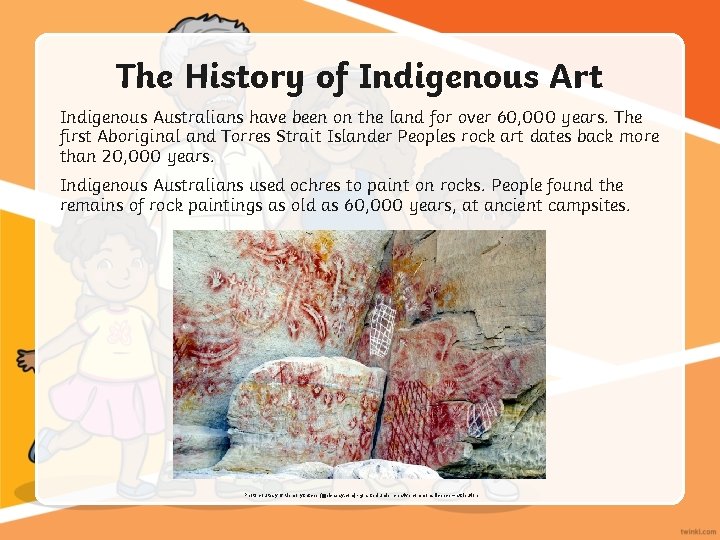
The History of Indigenous Art Indigenous Australians have been on the land for over 60, 000 years. The first Aboriginal and Torres Strait Islander Peoples rock art dates back more than 20, 000 years. Indigenous Australians used ochres to paint on rocks. People found the remains of rock paintings as old as 60, 000 years, at ancient campsites. Photo courtesy of Memory. Catcher(@pixabay. com) - granted under creative commons licence – attribution
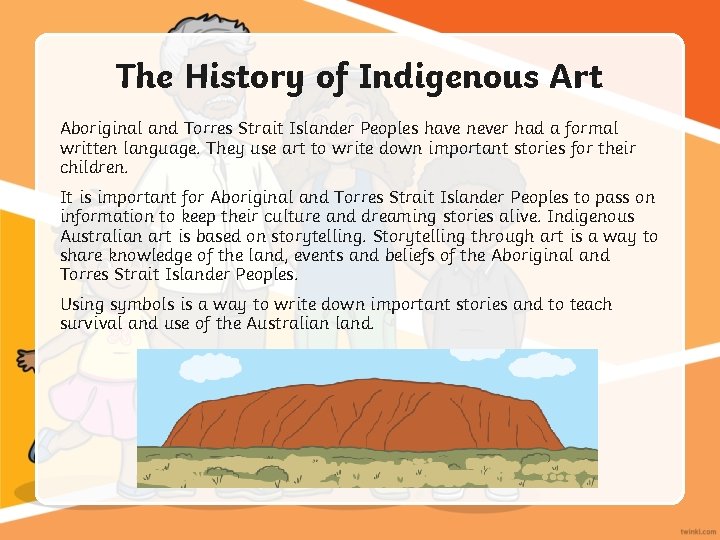
The History of Indigenous Art Aboriginal and Torres Strait Islander Peoples have never had a formal written language. They use art to write down important stories for their children. It is important for Aboriginal and Torres Strait Islander Peoples to pass on information to keep their culture and dreaming stories alive. Indigenous Australian art is based on storytelling. Storytelling through art is a way to share knowledge of the land, events and beliefs of the Aboriginal and Torres Strait Islander Peoples. Using symbols is a way to write down important stories and to teach survival and use of the Australian land.
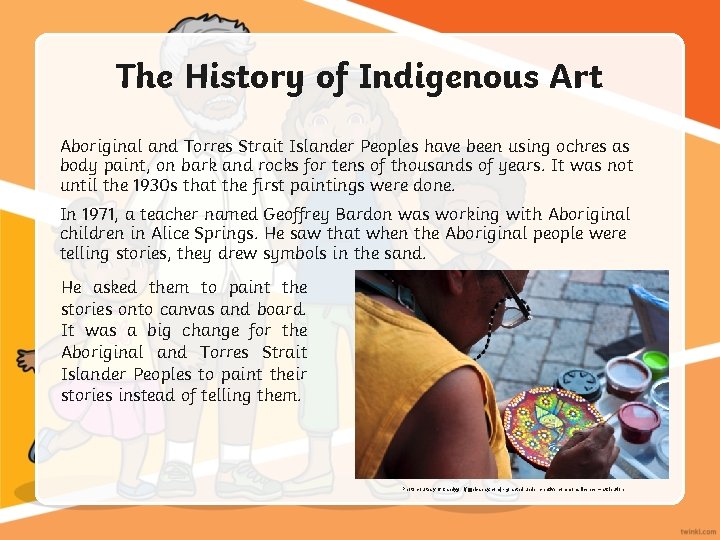
The History of Indigenous Art Aboriginal and Torres Strait Islander Peoples have been using ochres as body paint, on bark and rocks for tens of thousands of years. It was not until the 1930 s that the first paintings were done. In 1971, a teacher named Geoffrey Bardon was working with Aboriginal children in Alice Springs. He saw that when the Aboriginal people were telling stories, they drew symbols in the sand. He asked them to paint the stories onto canvas and board. It was a big change for the Aboriginal and Torres Strait Islander Peoples to paint their stories instead of telling them. Photo courtesy of Candygrrrl(@pixabay. com) - granted under creative commons licence – attribution

Examples of Indigenous Art Ochre Pigment Ochre was the most important painting material used by Aboriginal and Torres Strait Islander Peoples. It was dug from the earth and was a crumbly, hard rock. It came in a variety of natural earthy colours from pale yellow to dark red and brown. Ochre gave a rich, warm colour to Indigenous Australian art works. The surfaces it was used on varied from rock, wood and bark and even to the skin of participants in ceremonies. Red ochre was the most important colour because it symbolised the blood of ancestors. Photo courtesy of andyjh 07(@unsplash. com) - granted under creative commons licence – attribution
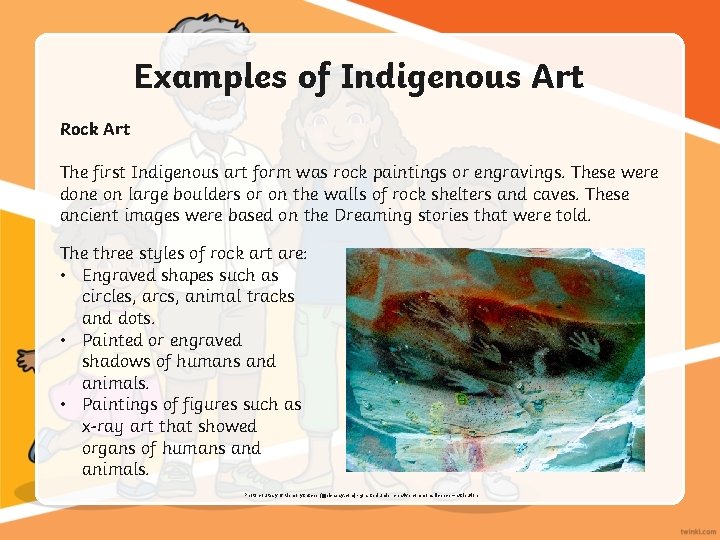
Examples of Indigenous Art Rock Art The first Indigenous art form was rock paintings or engravings. These were done on large boulders or on the walls of rock shelters and caves. These ancient images were based on the Dreaming stories that were told. The three styles of rock art are: • Engraved shapes such as circles, arcs, animal tracks and dots. • Painted or engraved shadows of humans and animals. • Paintings of figures such as x-ray art that showed organs of humans and animals. Photo courtesy of Memory. Catcher(@pixabay. com) - granted under creative commons licence – attribution
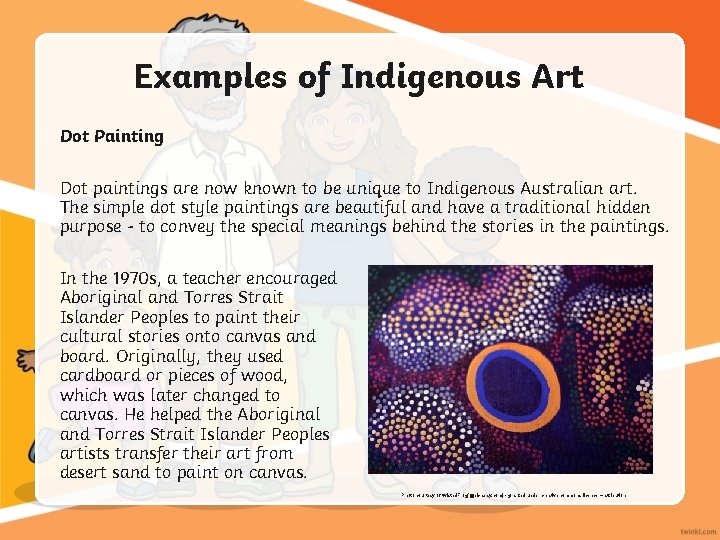
Examples of Indigenous Art Dot Painting Dot paintings are now known to be unique to Indigenous Australian art. The simple dot style paintings are beautiful and have a traditional hidden purpose - to convey the special meanings behind the stories in the paintings. In the 1970 s, a teacher encouraged Aboriginal and Torres Strait Islander Peoples to paint their cultural stories onto canvas and board. Originally, they used cardboard or pieces of wood, which was later changed to canvas. He helped the Aboriginal and Torres Strait Islander Peoples artists transfer their art from desert sand to paint on canvas. Photo courtesy of twisted. Frog(@pixabay. com) - granted under creative commons licence – attribution
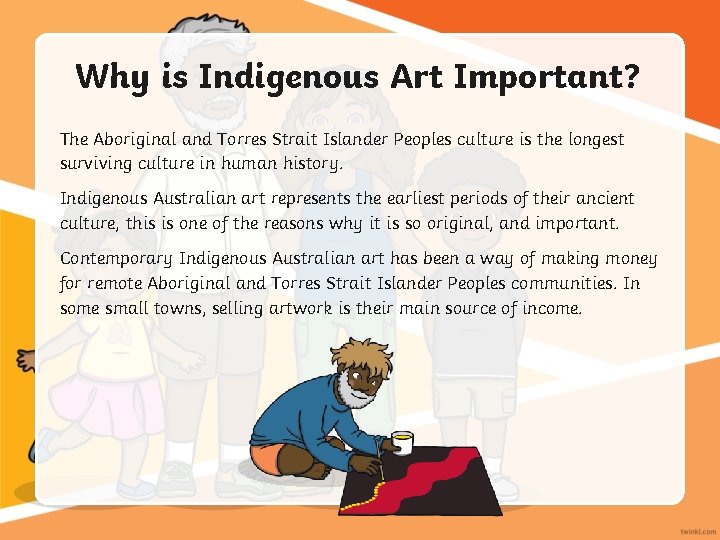
Why is Indigenous Art Important? The Aboriginal and Torres Strait Islander Peoples culture is the longest surviving culture in human history. Indigenous Australian art represents the earliest periods of their ancient culture, this is one of the reasons why it is so original, and important. Contemporary Indigenous Australian art has been a way of making money for remote Aboriginal and Torres Strait Islander Peoples communities. In some small towns, selling artwork is their main source of income.
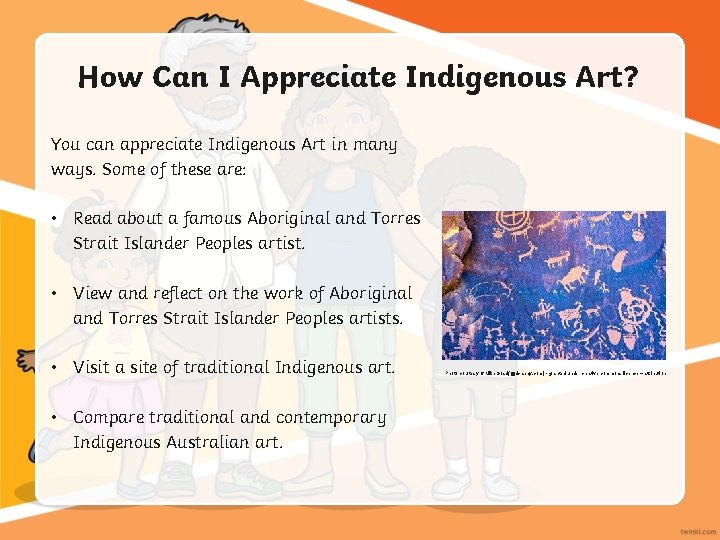
How Can I Appreciate Indigenous Art? You can appreciate Indigenous Art in many ways. Some of these are: • Read about a famous Aboriginal and Torres Strait Islander Peoples artist. • View and reflect on the work of Aboriginal and Torres Strait Islander Peoples artists. • Visit a site of traditional Indigenous art. • Compare traditional and contemporary Indigenous Australian art. Photo courtesy of Mike. Goad(@pixabay. com) - granted under creative commons licence – attribution
Post-Learning Discussion • How old is traditional Indigenous Australian art? • Why did Aboriginal and Torres Strait Islander Peoples originally create art? • How did Aboriginal and Torres Strait Islander Peoples produce art? • What effect does Indigenous Australian art have on remote communities today?

- Slides: 13