
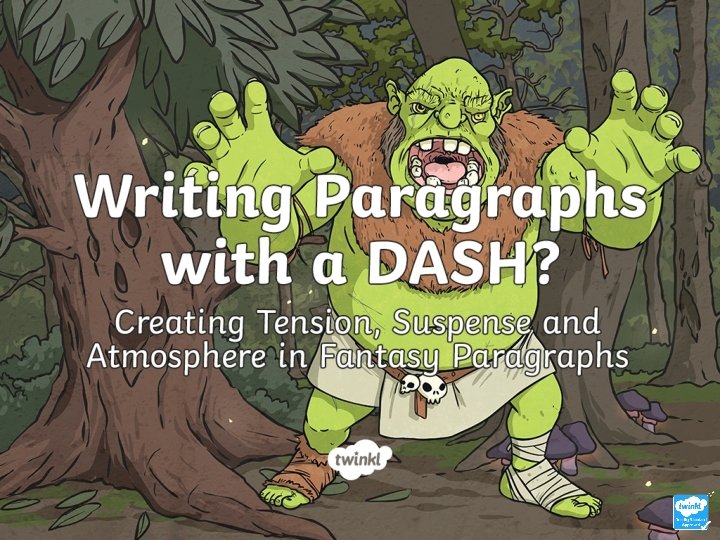
Aim To understand how to use different paragraphs
- Slides: 18
Aim • To understand how to use different paragraphs to describe a fantasy scene with suspense, tension and atmosphere. Success Criteria • IStatement can use ambitious 1 Lorem ipsum adjectives dolorinsitexpanded amet, consectetur noun phrases. adipiscing elit. • IStatement can punctuate 2 speech with inverted commas. • Sub statement • I can show a character is feeling through description of movements, feelings and body language. • I can use a cliffhanger or rhetorical question. • I can use the DASH? acronym to describe a scene.
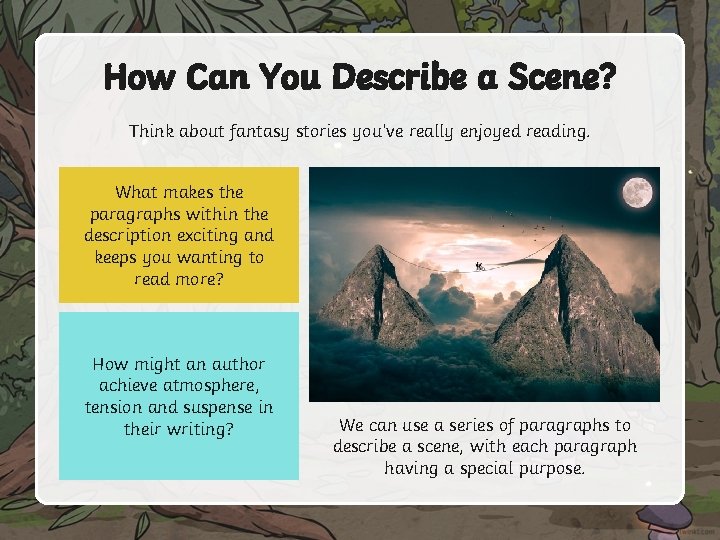
How Can You Describe a Scene? Think about fantasy stories you’ve really enjoyed reading. What makes the paragraphs within the description exciting and keeps you wanting to read more? How might an author achieve atmosphere, tension and suspense in their writing? We can use a series of paragraphs to describe a scene, with each paragraph having a special purpose.
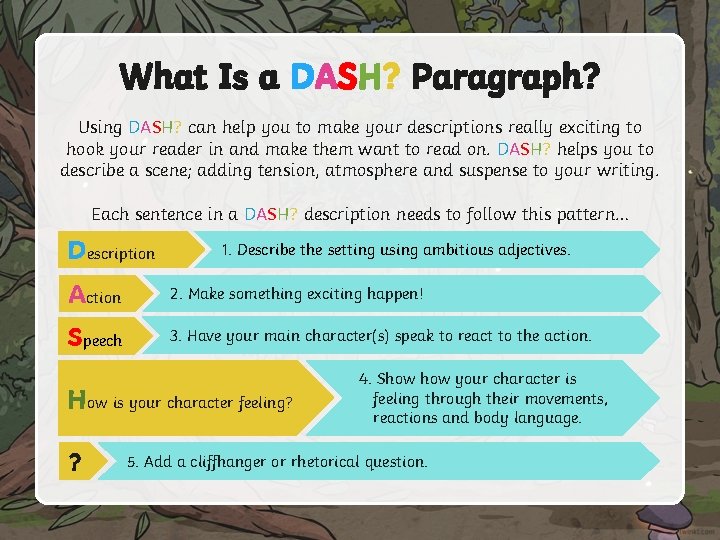
What Is a DASH? Paragraph? Using DASH? can help you to make your descriptions really exciting to hook your reader in and make them want to read on. DASH? helps you to describe a scene; adding tension, atmosphere and suspense to your writing. Each sentence in a DASH? description needs to follow this pattern… Description 1. Describe the setting using ambitious adjectives. Action 2. Make something exciting happen! Speech 3. Have your main character(s) speak to react to the action. How is your character feeling? ? 4. Show your character is feeling through their movements, reactions and body language. 5. Add a cliffhanger or rhetorical question.
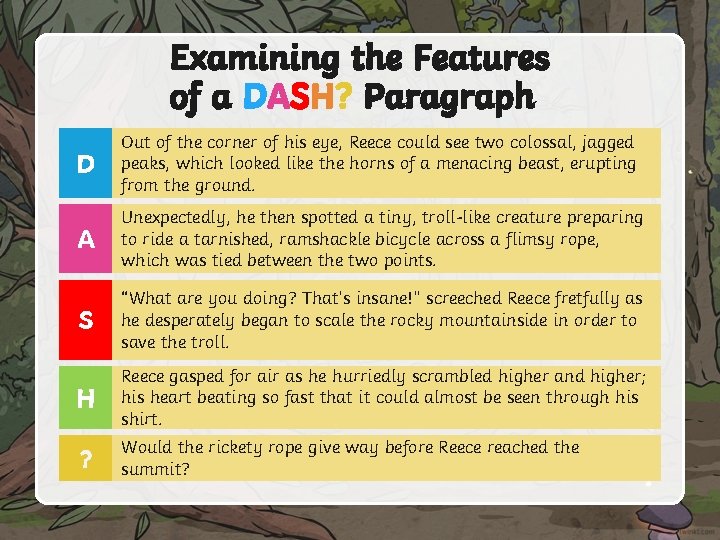
Examining the Features of a DASH? Paragraph D Out of the corner of his eye, Reece could see two colossal, jagged peaks, which looked like the horns of a menacing beast, erupting from the ground. A Unexpectedly, he then spotted a tiny, troll-like creature preparing to ride a tarnished, ramshackle bicycle across a flimsy rope, which was tied between the two points. S “What are you doing? That’s insane!” screeched Reece fretfully as he desperately began to scale the rocky mountainside in order to save the troll. H Reece gasped for air as he hurriedly scrambled higher and higher; his heart beating so fast that it could almost be seen through his shirt. ? Would the rickety rope give way before Reece reached the summit?
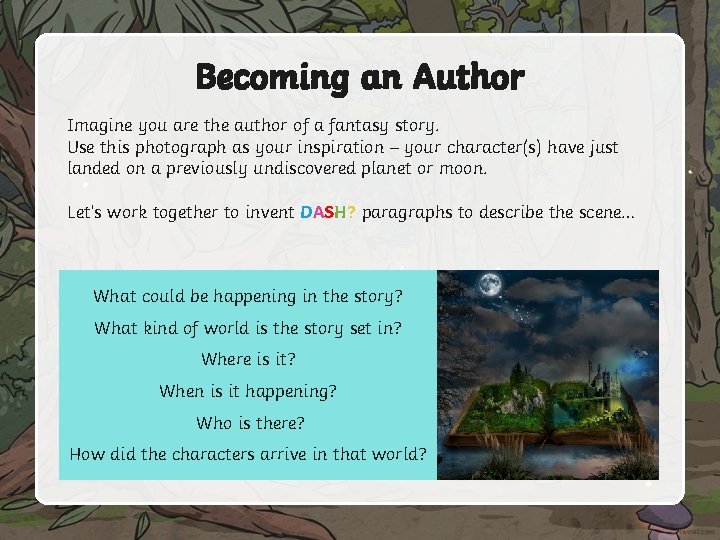
Becoming an Author Imagine you are the author of a fantasy story. Use this photograph as your inspiration – your character(s) have just landed on a previously undiscovered planet or moon. Let’s work together to invent DASH? paragraphs to describe the scene… What could be happening in the story? What kind of world is the story set in? Where is it? When is it happening? Who is there? How did the characters arrive in that world?
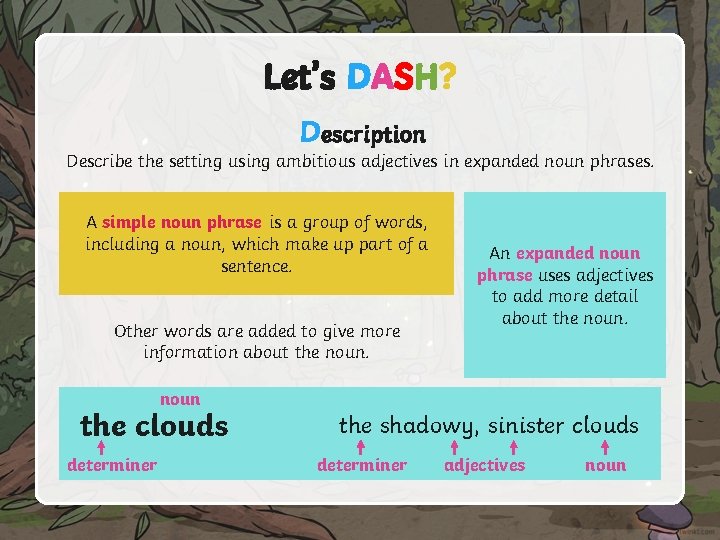
Let’s DASH? Description Describe the setting using ambitious adjectives in expanded noun phrases. A simple noun phrase is a group of words, including a noun, which make up part of a sentence. Other words are added to give more information about the noun. An expanded noun phrase uses adjectives to add more detail about the noun the clouds determiner the shadowy, sinister clouds determiner adjectives noun
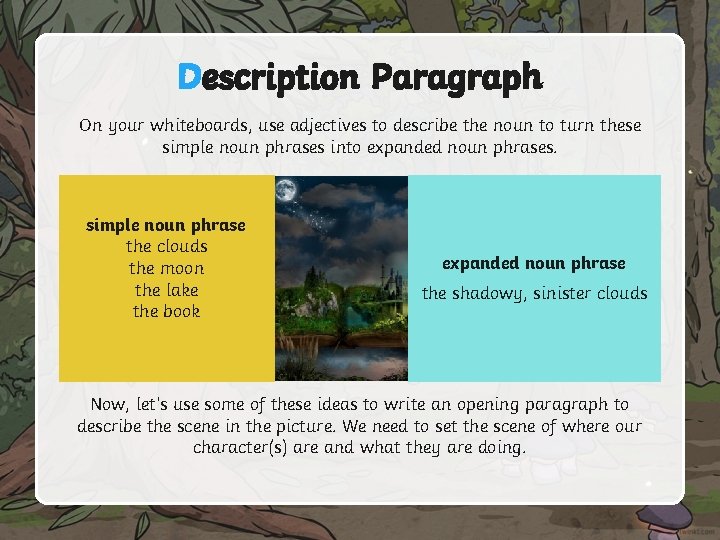
Description Paragraph On your whiteboards, use adjectives to describe the noun to turn these simple noun phrases into expanded noun phrases. simple noun phrase the clouds the moon the lake the book expanded noun phrase the shadowy, sinister clouds Now, let’s use some of these ideas to write an opening paragraph to describe the scene in the picture. We need to set the scene of where our character(s) are and what they are doing.
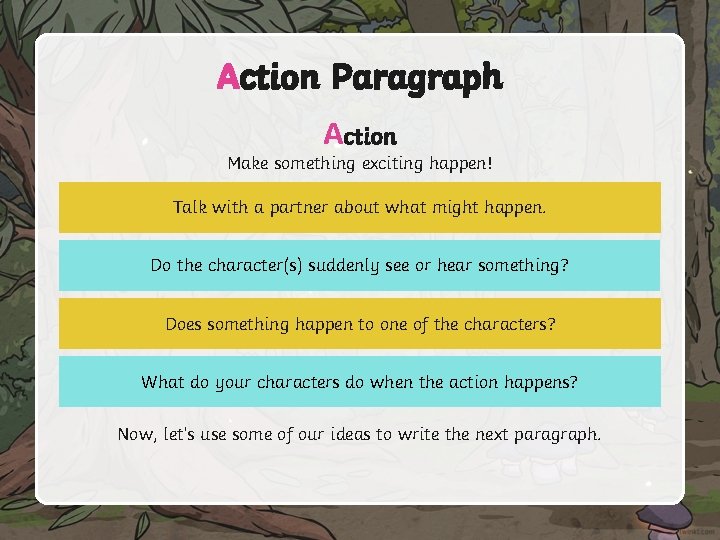
Action Paragraph Action Make something exciting happen! Talk with a partner about what might happen. Do the character(s) suddenly see or hear something? Does something happen to one of the characters? What do your characters do when the action happens? Now, let’s use some of our ideas to write the next paragraph.
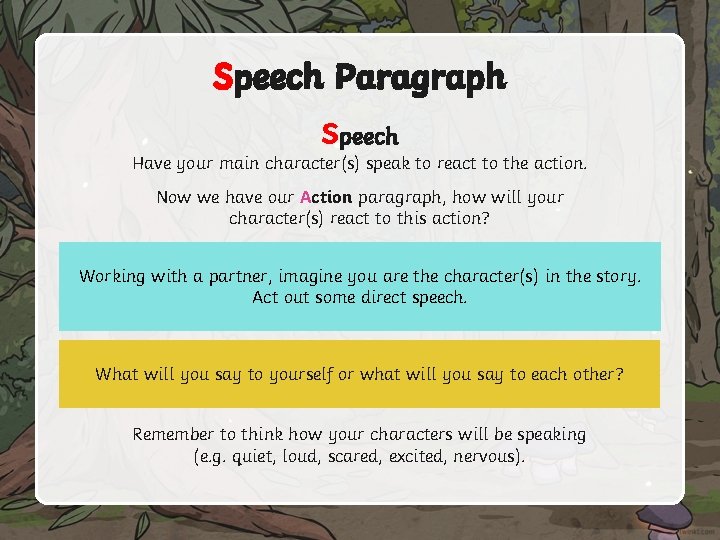
Speech Paragraph Speech Have your main character(s) speak to react to the action. Now we have our Action paragraph, how will your character(s) react to this action? Working with a partner, imagine you are the character(s) in the story. Act out some direct speech. What will you say to yourself or what will you say to each other? Remember to think how your characters will be speaking (e. g. quiet, loud, scared, excited, nervous).
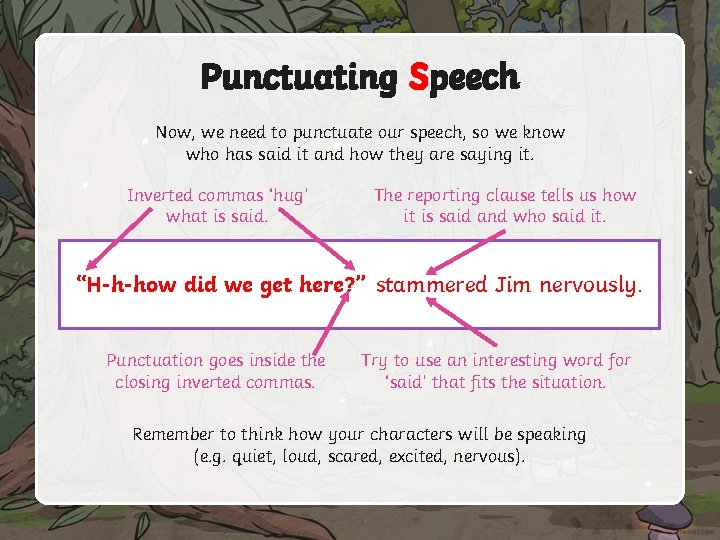
Punctuating Speech Now, we need to punctuate our speech, so we know who has said it and how they are saying it. Inverted commas ‘hug’ what is said. The reporting clause tells us how it is said and who said it. “H-h-how did we get here? ” stammered Jim nervously. Punctuation goes inside the closing inverted commas. Try to use an interesting word for ‘said’ that fits the situation. Remember to think how your characters will be speaking (e. g. quiet, loud, scared, excited, nervous).
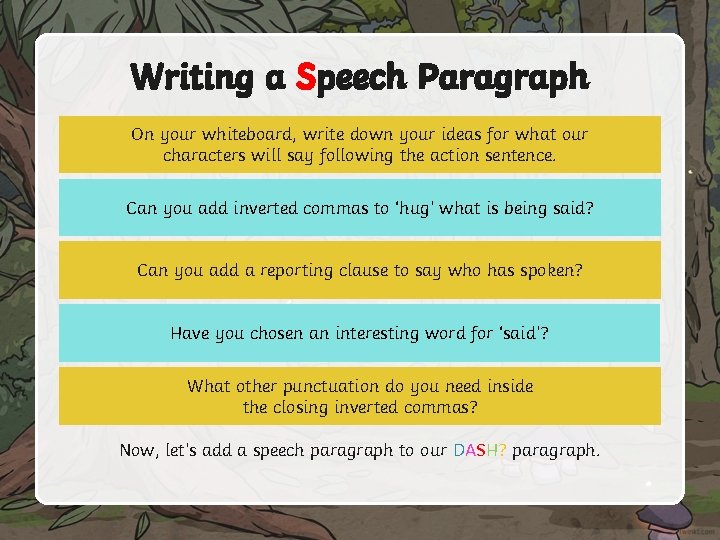
Writing a Speech Paragraph On your whiteboard, write down your ideas for what our characters will say following the action sentence. Can you add inverted commas to ‘hug’ what is being said? Can you add a reporting clause to say who has spoken? Have you chosen an interesting word for ‘said’? What other punctuation do you need inside the closing inverted commas? Now, let’s add a speech paragraph to our DASH? paragraph.
How Paragraph How is the character feeling? We can show our character is feeling through their movements, reactions and body language. What words or phrases could we use to describe how our character(s) might be feeling or moving? What facial expressions or body language might they be showing?
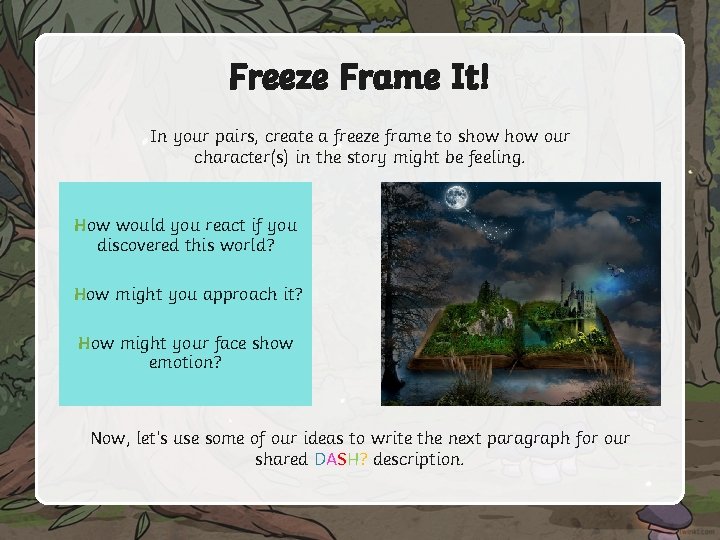
Freeze Frame It! In your pairs, create a freeze frame to show our character(s) in the story might be feeling. How would you react if you discovered this world? How might you approach it? How might your face show emotion? Now, let’s use some of our ideas to write the next paragraph for our shared DASH? description.
Adding a Cliffhanger or Rhetorical Question Add a question to leave your reader guessing, to create suspense and excitement. You could add this to the end of your ‘How paragraph’. A cliffhanger is a part of a story that is exciting or frightening, because you are left not knowing what will happen next. A rhetorical question is one that doesn’t require an answer. It can be used to create suspense. As they tentatively tiptoed towards the door of the castle, it unexpectedly swung open… Who could be lurking in the shadows? Can you think of a rhetorical question that we can use to end our DASH? description?
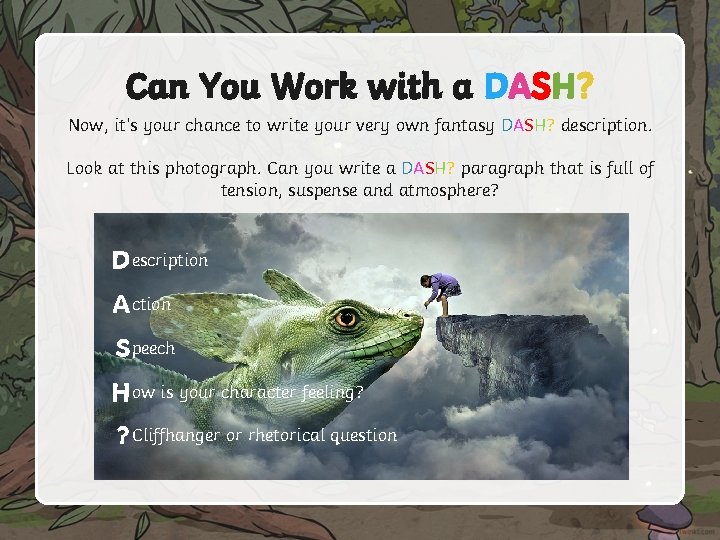
Can You Work with a DASH? Now, it’s your chance to write your very own fantasy DASH? description. Look at this photograph. Can you write a DASH? paragraph that is full of tension, suspense and atmosphere? D escription Action S peech H ow is your character feeling? ? Cliffhanger or rhetorical question
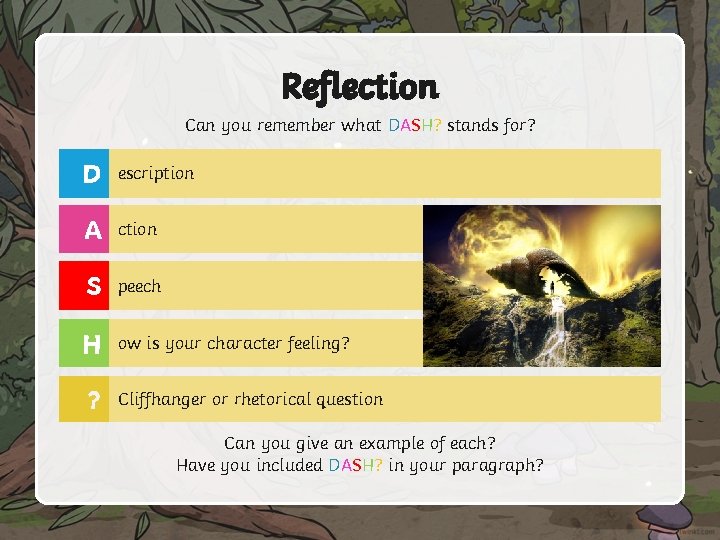
Reflection Can you remember what DASH? stands for? D escription A ction S peech H ow is your character feeling? ? Cliffhanger or rhetorical question Can you give an example of each? Have you included DASH? in your paragraph?