
Aim To identify and discuss different types of

- Slides: 15
Aim • To identify and discuss different types of quadrilaterals. Success Criteria • To Statement name different 1 Loremquadrilaterals. ipsum dolor sit amet, consectetur adipiscing elit. • To Statement describe 2 the properties of different types of quadrilaterals. Sub statement • To • work out the value of a missing angle inside a quadrilateral.
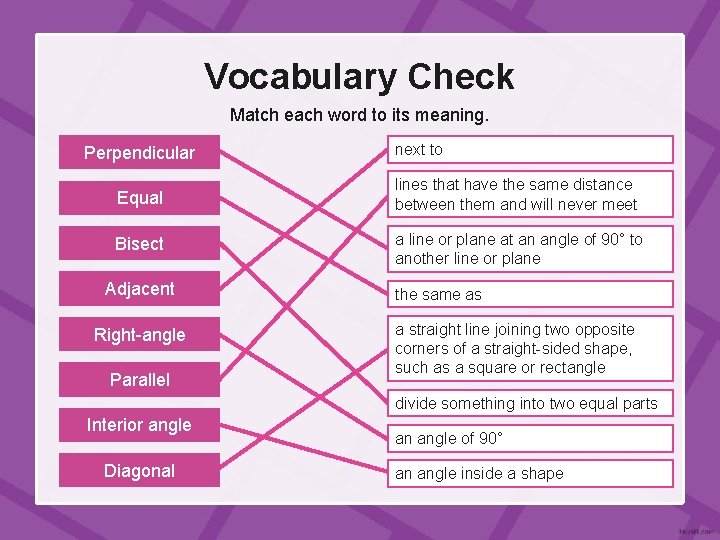
Vocabulary Check Match each word to its meaning. Perpendicular next to Equal lines that have the same distance between them and will never meet Bisect a line or plane at an angle of 90° to another line or plane Adjacent Right-angle Parallel the same as a straight line joining two opposite corners of a straight-sided shape, such as a square or rectangle divide something into two equal parts Interior angle Diagonal an angle of 90° an angle inside a shape
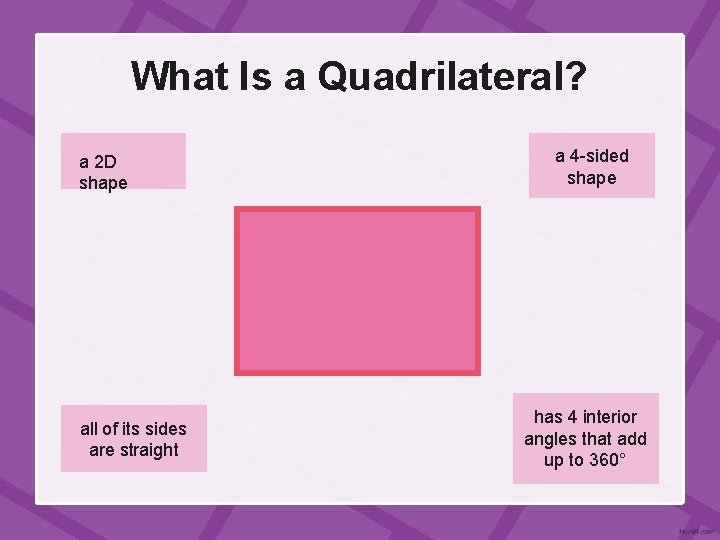
What Is a Quadrilateral? a 2 D shape all of its sides are straight a 4 -sided shape has 4 interior angles that add up to 360°
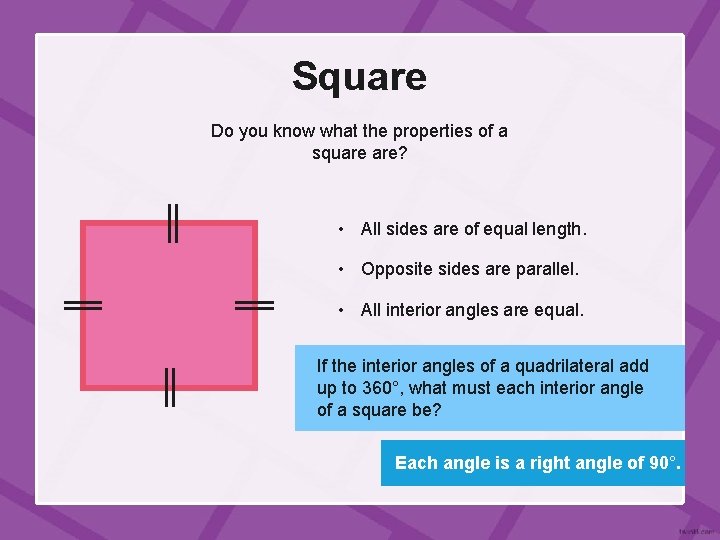
Square Do you know what the properties of a square are? • All sides are of equal length. • Opposite sides are parallel. • All interior angles are equal. If the interior angles of a quadrilateral add up to 360°, what must each interior angle of a square be? Each angle is a right angle of 90°.
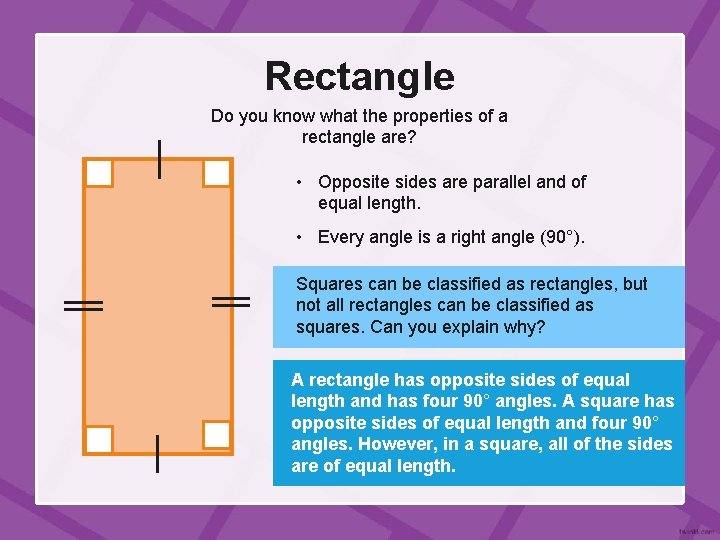
Rectangle Do you know what the properties of a rectangle are? • Opposite sides are parallel and of equal length. • Every angle is a right angle (90°). Squares can be classified as rectangles, but not all rectangles can be classified as squares. Can you explain why? A rectangle has opposite sides of equal length and has four 90° angles. A square has opposite sides of equal length and four 90° angles. However, in a square, all of the sides are of equal length.
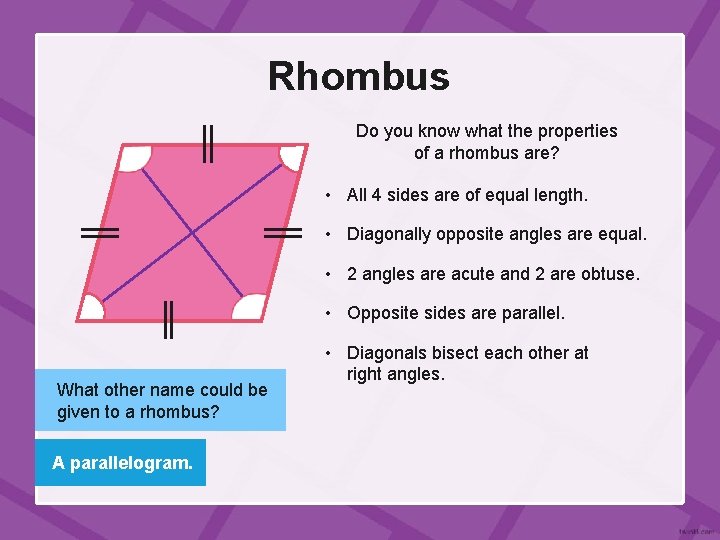
Rhombus Do you know what the properties of a rhombus are? • All 4 sides are of equal length. • Diagonally opposite angles are equal. • 2 angles are acute and 2 are obtuse. • Opposite sides are parallel. What other name could be given to a rhombus? A parallelogram. • Diagonals bisect each other at right angles.
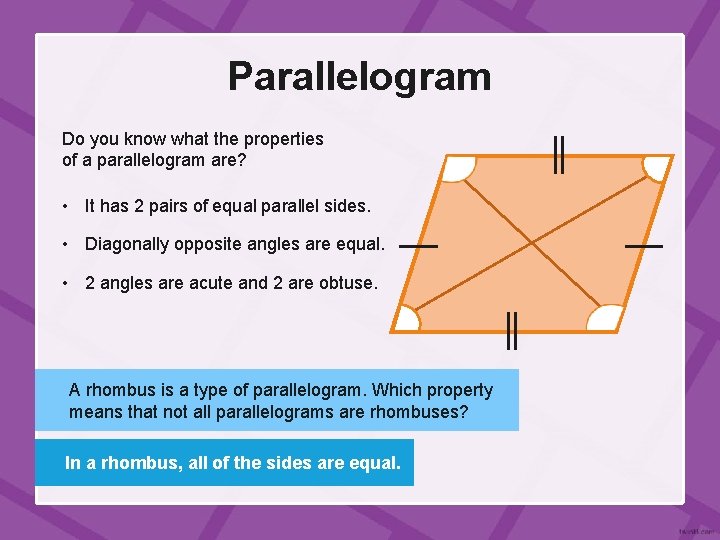
Parallelogram Do you know what the properties of a parallelogram are? • It has 2 pairs of equal parallel sides. • Diagonally opposite angles are equal. • 2 angles are acute and 2 are obtuse. A rhombus is a type of parallelogram. Which property means that not all parallelograms are rhombuses? In a rhombus, all of the sides are equal.
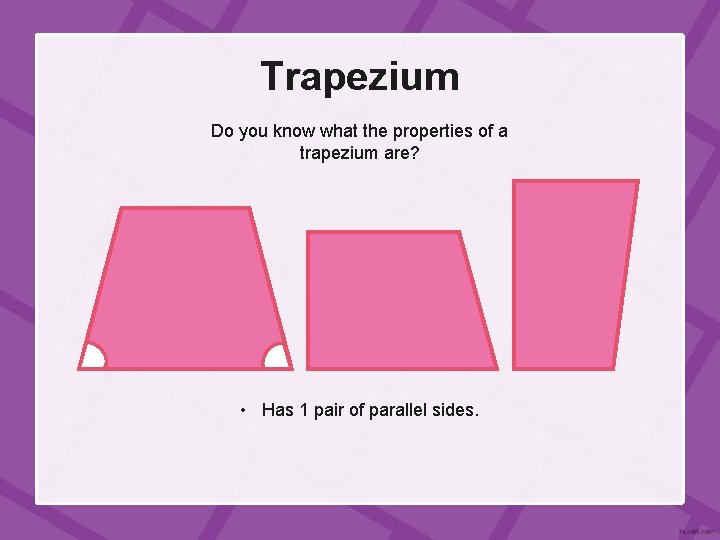
Trapezium Do you know what the properties of a trapezium are? • Has 1 pair of parallel sides.
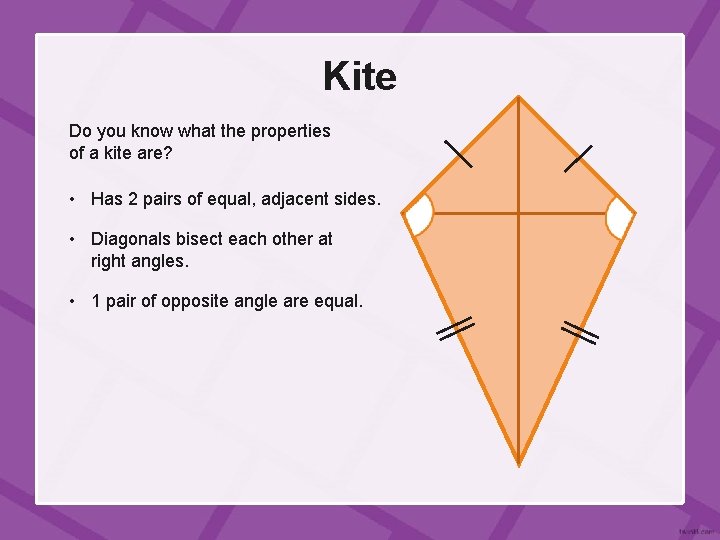
Kite Do you know what the properties of a kite are? • Has 2 pairs of equal, adjacent sides. • Diagonals bisect each other at right angles. • 1 pair of opposite angle are equal.
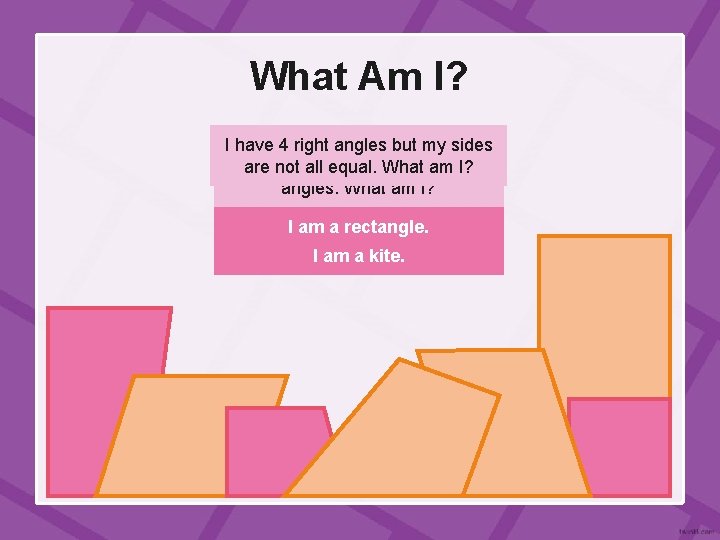
What Am I? My I have adjacent 1 sides pair sides ofare parallel are of lines. equal I have 4 my right angles but my sides All of equal and angles are. I length and What I equal. have am 1 What pair I? What equal are 2 not all am I? I? have acute angles. am equal. What am I? of angles. What am I? II amaaatrapezium. rhombus. square. am rectangle. I am a kite.
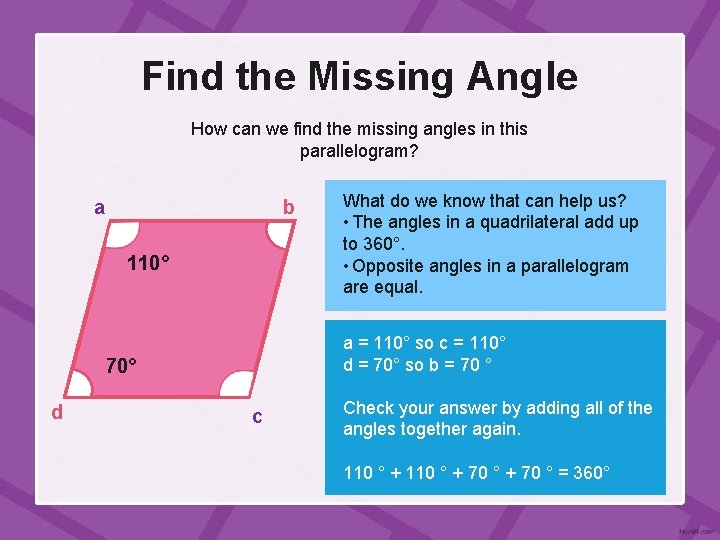
Find the Missing Angle How can we find the missing angles in this parallelogram? a b 110° a = 110° so c = 110° d = 70° so b = 70 ° 70° d What do we know that can help us? • The angles in a quadrilateral add up to 360°. • Opposite angles in a parallelogram are equal. c Check your answer by adding all of the angles together again. 110 ° + 70 ° = 360°
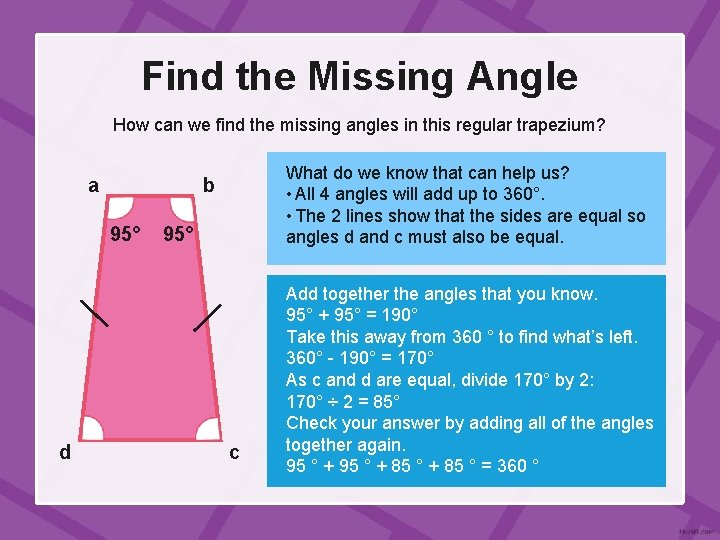
Find the Missing Angle How can we find the missing angles in this regular trapezium? a 95° d What do we know that can help us? • All 4 angles will add up to 360°. • The 2 lines show that the sides are equal so angles d and c must also be equal. b 95° c Add together the angles that you know. 95° + 95° = 190° Take this away from 360 ° to find what’s left. 360° - 190° = 170° As c and d are equal, divide 170° by 2: 170° ÷ 2 = 85° Check your answer by adding all of the angles together again. 95 ° + 85 ° = 360 °
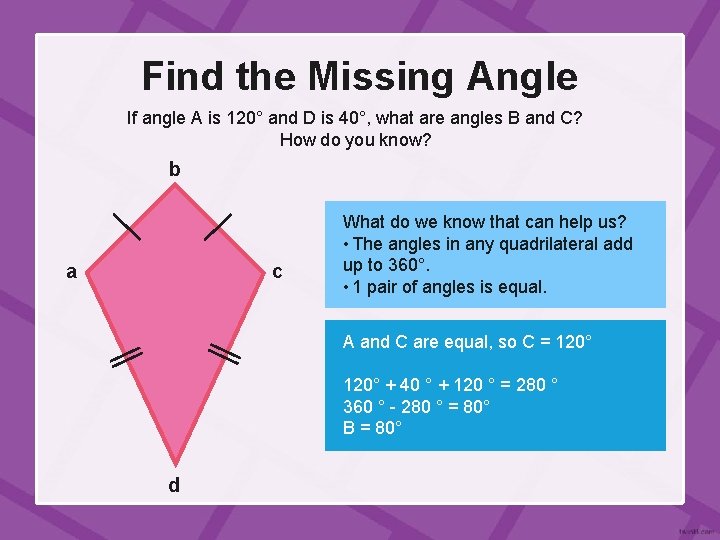
Find the Missing Angle If angle A is 120° and D is 40°, what are angles B and C? How do you know? b a c What do we know that can help us? • The angles in any quadrilateral add up to 360°. • 1 pair of angles is equal. A and C are equal, so C = 120° + 40 ° + 120 ° = 280 ° 360 ° - 280 ° = 80° B = 80° d