
Aim How to test a hypothesis and design
- Slides: 7
Aim: How to test a hypothesis and design an experiment Do Now: 1) What do you need to know in order to test your hypothesis? 2)Take out your homework. HOMEWORK: DO “SIMPSONS: IDENTIFY THE CONTROLS AND VARIABLES”. CHECK ON DAEDALUS.
The Design of Scientific Experiments An experiment is a set of procedures that scientists follow to gain knowledge about the world. It is a procedure used to test a hypothesis.
Questions to ask before designing experiment • Does my experiment answer the question I'm trying to solve? • Does it adequately test my hypothesis? • Can I make observations about the results of my experiment, and will I be able to analyze those results? • Finally, if I run this test, will it allow me to come up with some kind of conclusion?
What an Experiment Needs • Rule #1: The experiment must show that a hypothesis is either supported or not supported. • Rule #2: The results of an experiment must be measurable and objective. • Rule #3: The experiment must be repeatable by other scientists.
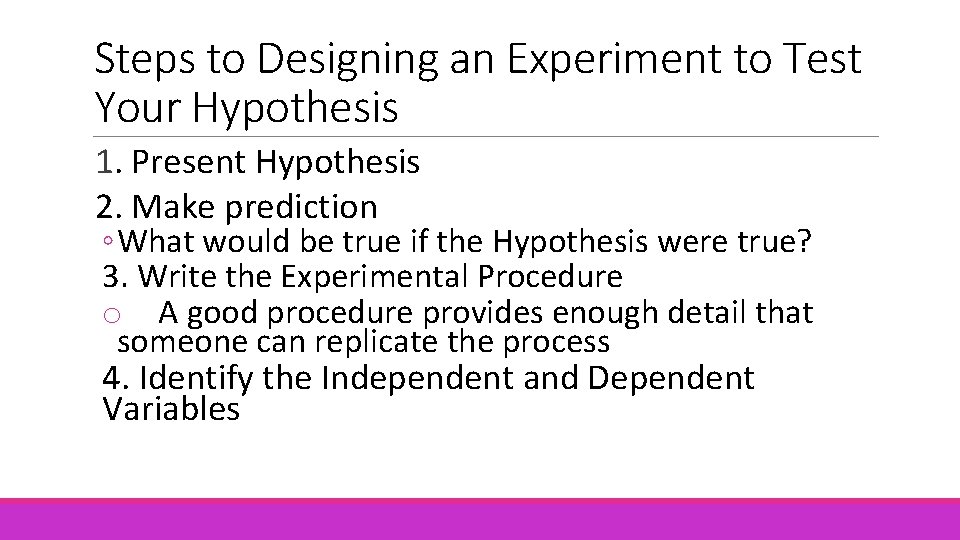
Steps to Designing an Experiment to Test Your Hypothesis 1. Present Hypothesis 2. Make prediction ◦ What would be true if the Hypothesis were true? 3. Write the Experimental Procedure o A good procedure provides enough detail that someone can replicate the process 4. Identify the Independent and Dependent Variables
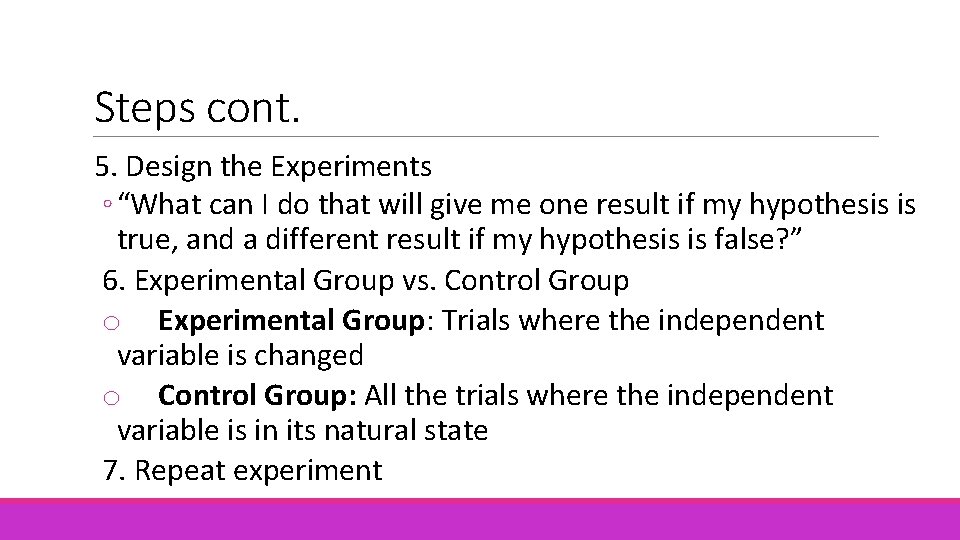
Steps cont. 5. Design the Experiments ◦ “What can I do that will give me one result if my hypothesis is true, and a different result if my hypothesis is false? ” 6. Experimental Group vs. Control Group o Experimental Group: Trials where the independent variable is changed o Control Group: All the trials where the independent variable is in its natural state 7. Repeat experiment
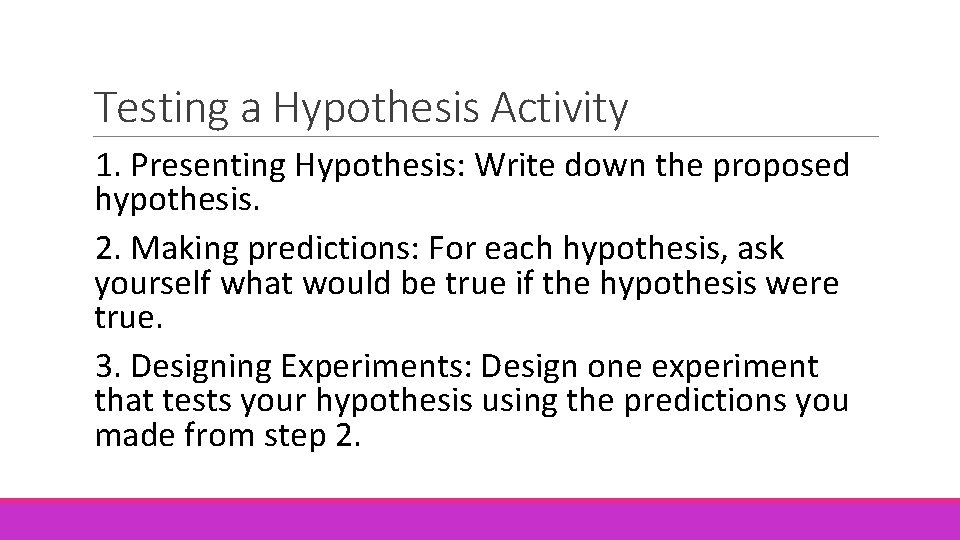
Testing a Hypothesis Activity 1. Presenting Hypothesis: Write down the proposed hypothesis. 2. Making predictions: For each hypothesis, ask yourself what would be true if the hypothesis were true. 3. Designing Experiments: Design one experiment that tests your hypothesis using the predictions you made from step 2.