
Aim How do we perceive color How do
- Slides: 24
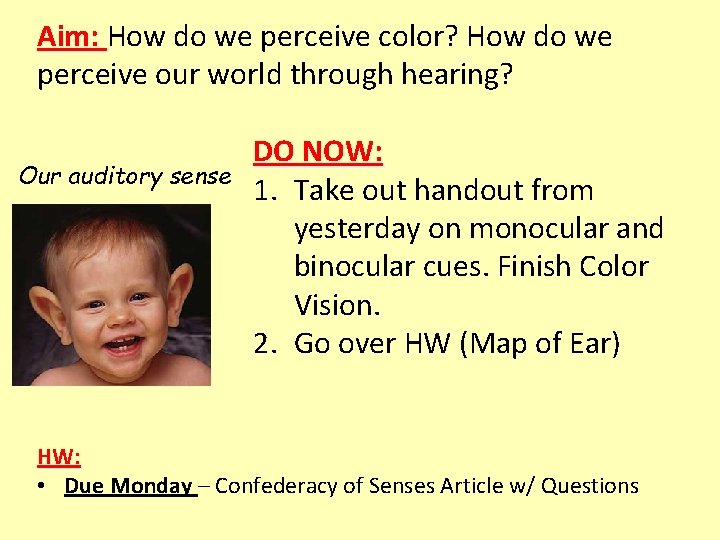
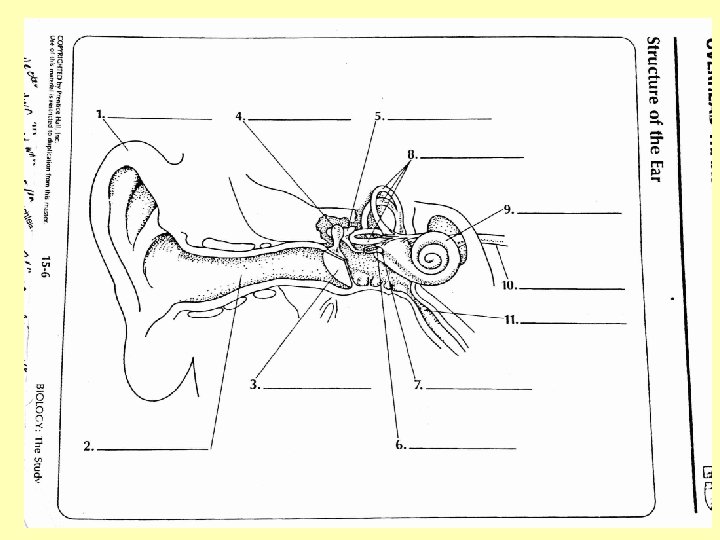
Aim: How do we perceive color? How do we perceive our world through hearing? Our auditory sense DO NOW: 1. Take out handout from yesterday on monocular and binocular cues. Finish Color Vision. 2. Go over HW (Map of Ear) HW: • Due Monday – Confederacy of Senses Article w/ Questions
So what are we detecting when we hear? • Stimulus for sound = vibrations in the air = sound waves • The waves determine the type of sound we hear. For example…
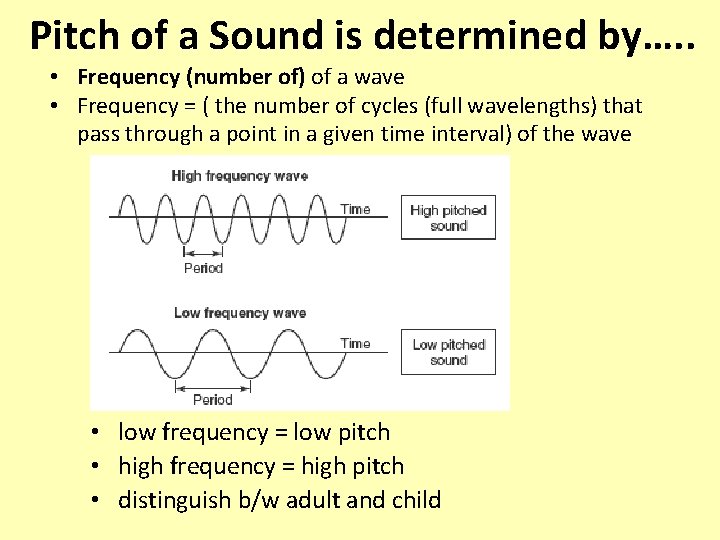
Pitch of a Sound is determined by…. . • Frequency (number of) of a wave • Frequency = ( the number of cycles (full wavelengths) that pass through a point in a given time interval) of the wave • low frequency = low pitch • high frequency = high pitch • distinguish b/w adult and child
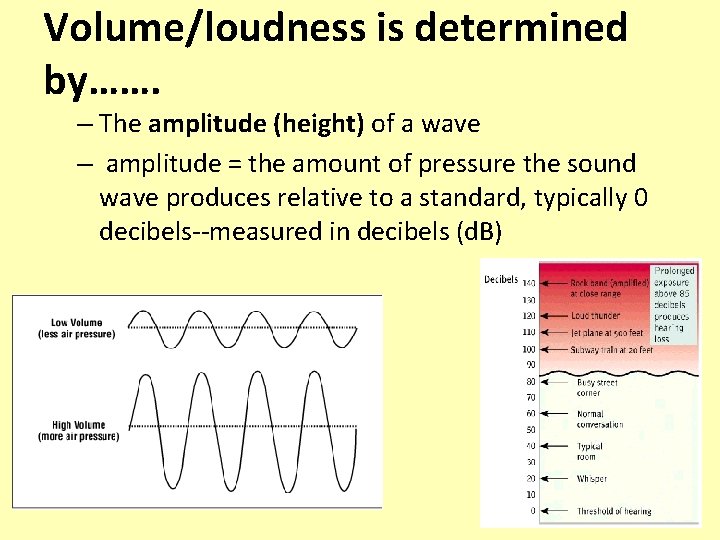
Volume/loudness is determined by……. – The amplitude (height) of a wave – amplitude = the amount of pressure the sound wave produces relative to a standard, typically 0 decibels--measured in decibels (d. B)
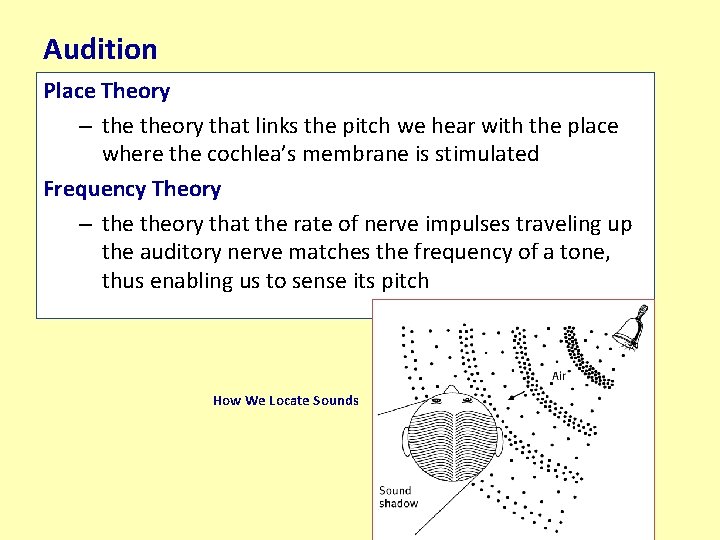
Audition Place Theory – theory that links the pitch we hear with the place where the cochlea’s membrane is stimulated Frequency Theory – theory that the rate of nerve impulses traveling up the auditory nerve matches the frequency of a tone, thus enabling us to sense its pitch How We Locate Sounds
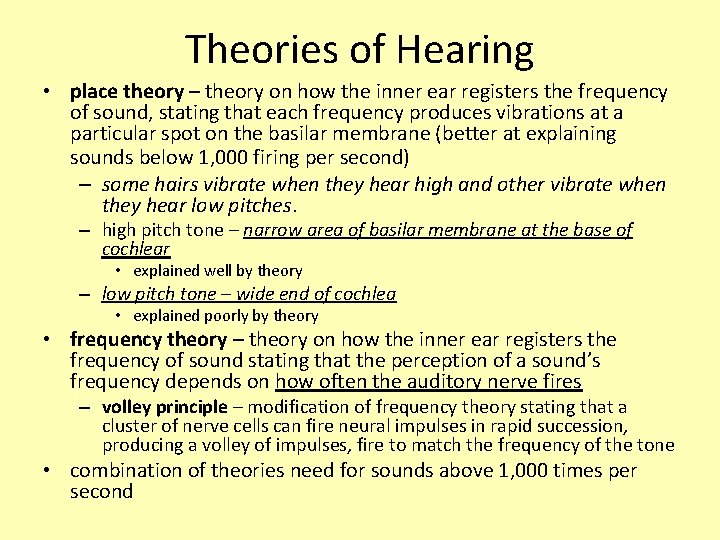
Theories of Hearing • place theory – theory on how the inner ear registers the frequency of sound, stating that each frequency produces vibrations at a particular spot on the basilar membrane (better at explaining sounds below 1, 000 firing per second) – some hairs vibrate when they hear high and other vibrate when they hear low pitches. – high pitch tone – narrow area of basilar membrane at the base of cochlear • explained well by theory – low pitch tone – wide end of cochlea • explained poorly by theory • frequency theory – theory on how the inner ear registers the frequency of sound stating that the perception of a sound’s frequency depends on how often the auditory nerve fires – volley principle – modification of frequency theory stating that a cluster of nerve cells can fire neural impulses in rapid succession, producing a volley of impulses, fire to match the frequency of the tone • combination of theories need for sounds above 1, 000 times per second
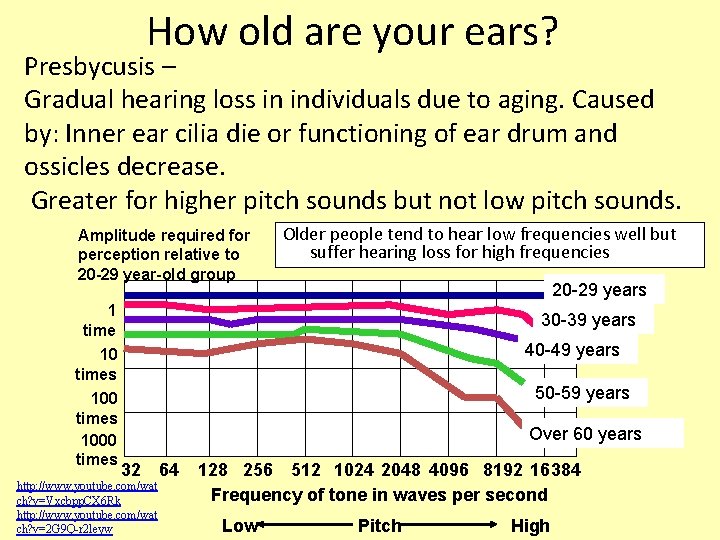
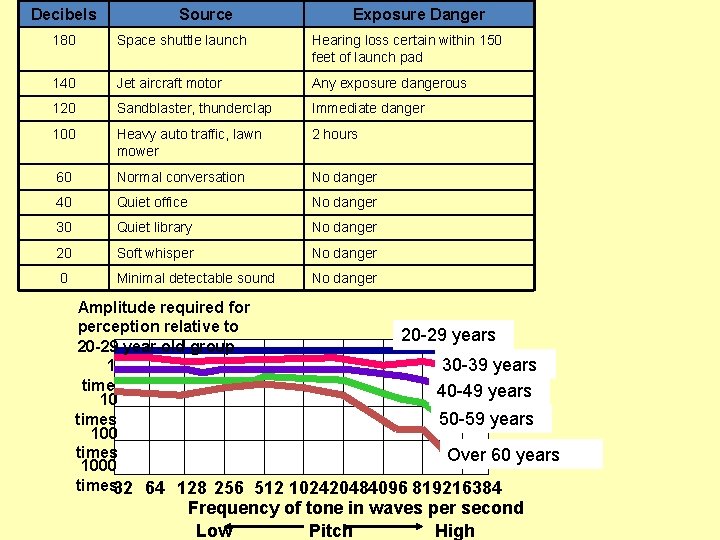
How old are your ears? Presbycusis – Gradual hearing loss in individuals due to aging. Caused by: Inner ear cilia die or functioning of ear drum and ossicles decrease. Greater for higher pitch sounds but not low pitch sounds. Amplitude required for perception relative to 20 -29 year-old group Older people tend to hear low frequencies well but suffer hearing loss for high frequencies 20 -29 years 1 time 30 -39 years 40 -49 years 10 times 1000 times 50 -59 years Over 60 years 32 http: //www. youtube. com/wat ch? v=Vxcbpp. CX 6 Rk http: //www. youtube. com/wat ch? v=2 G 9 Q-r 2 leyw 64 128 256 512 1024 2048 4096 8192 16384 Frequency of tone in waves per second Low Pitch High
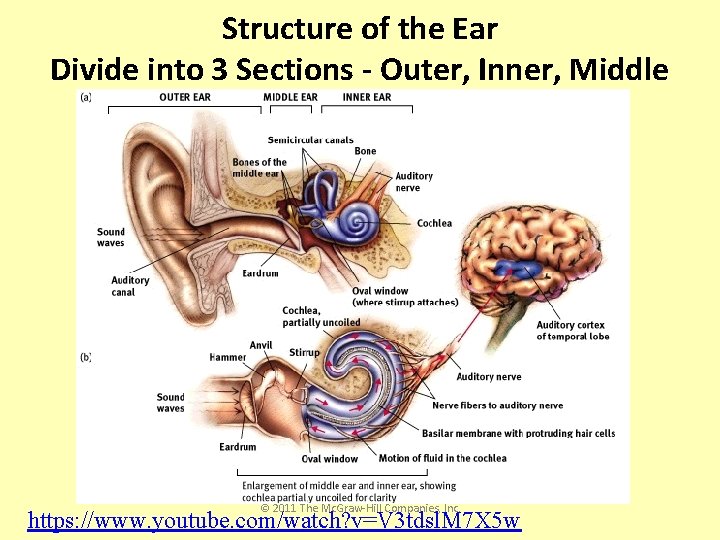
Structure of the Ear Divide into 3 Sections - Outer, Inner, Middle © 2011 The Mc. Graw-Hill Companies, Inc. https: //www. youtube. com/watch? v=V 3 tdsl. M 7 X 5 w
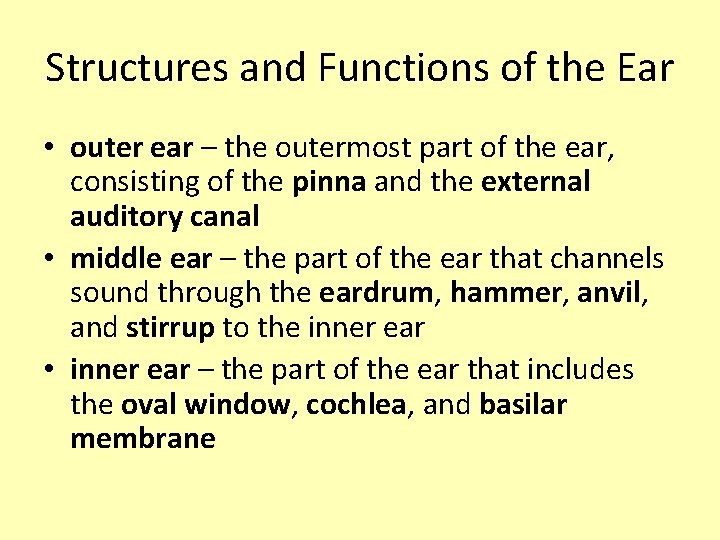
Structures and Functions of the Ear • outer ear – the outermost part of the ear, consisting of the pinna and the external auditory canal • middle ear – the part of the ear that channels sound through the eardrum, hammer, anvil, and stirrup to the inner ear • inner ear – the part of the ear that includes the oval window, cochlea, and basilar membrane
Outer Ear • pinna (plural, pinnae) – the outer, visible part of ear – collections sounds and channels them into the interior of the ear – moveable in some animals (localization) • external auditory canal
Middle Ear • eardrum (tympanic membrane) – separates the outer ear from the middle ear – vibrates in response to sound • hammer anvil stirrup – intricately connected chain of the three smallest bones in body – transmit sound waves to the fluid-filled inner ear (at oval window) by vibrating – can amplify sounds or decrease intensity to protect inner ear (muscles)
Inner Ear • inner ear – converts sound waves into neural impulses to send to brain • oval window – transmits sound waves to the cochlea (received from stirrup) • cochlea – tubular, fluid-filled structure, coiled – basilar membrane – lines the inner wall of the cochlea and runs its entire length • tells about frequency, pitch, complexity of sound • hair cells – ear’s sensory receptors (cilia sprout at top of hair cells) – delicate damage can lead to deafness or difficulty hearing – tectorial membrane – jellylike flap above hair cells • generates impulses that the brain interprets as sound
Auditory Processing in the Brain • auditory nerve – the nerve structure that receives information about sound from the hair cells of the inner ear and carries these neural impulses to the brain’s auditory areas (extends from the cochlea to brain • stem) – left ear right side of brain – right ear rights side of brain – temporal lobe
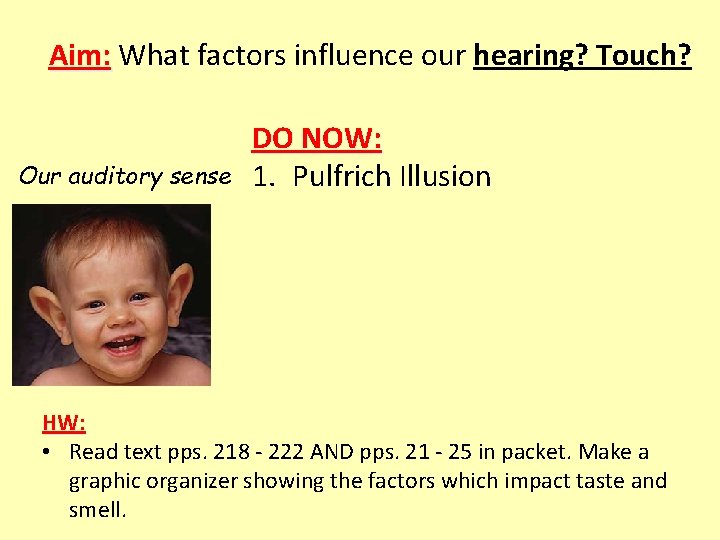
Aim: What factors influence our hearing? Touch? Our auditory sense DO NOW: 1. Pulfrich Illusion HW: • Read text pps. 218 - 222 AND pps. 21 - 25 in packet. Make a graphic organizer showing the factors which impact taste and smell.
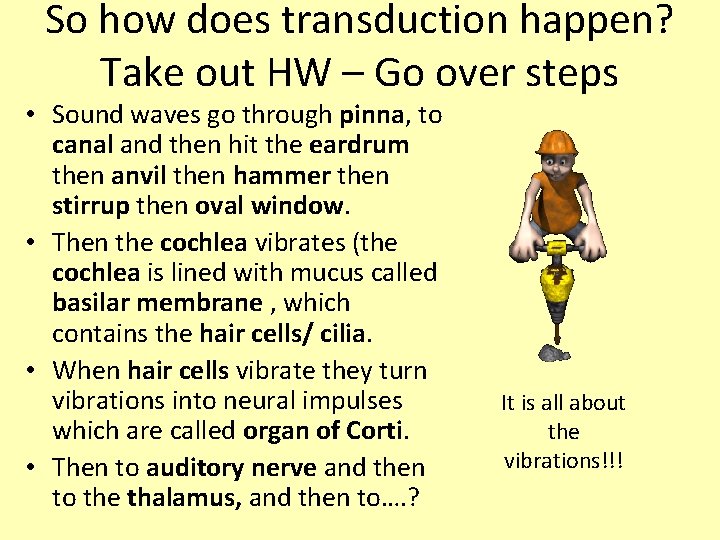
So how does transduction happen? Take out HW – Go over steps • Sound waves go through pinna, to canal and then hit the eardrum then anvil then hammer then stirrup then oval window. • Then the cochlea vibrates (the cochlea is lined with mucus called basilar membrane , which contains the hair cells/ cilia. • When hair cells vibrate they turn vibrations into neural impulses which are called organ of Corti. • Then to auditory nerve and then to the thalamus, and then to…. ? It is all about the vibrations!!!
Types of Hearing Loss SO HOW CAN WE LOSE OUR SENSE OF HEARING? WHAT CAN WE DO IF WE LOSE IT?
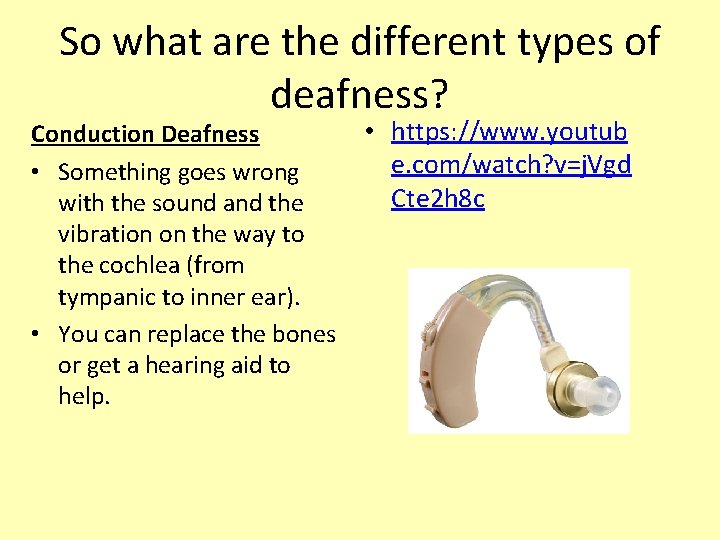
So what are the different types of deafness? Conduction Deafness • Something goes wrong with the sound and the vibration on the way to the cochlea (from tympanic to inner ear). • You can replace the bones or get a hearing aid to help. • https: //www. youtub e. com/watch? v=j. Vgd Cte 2 h 8 c
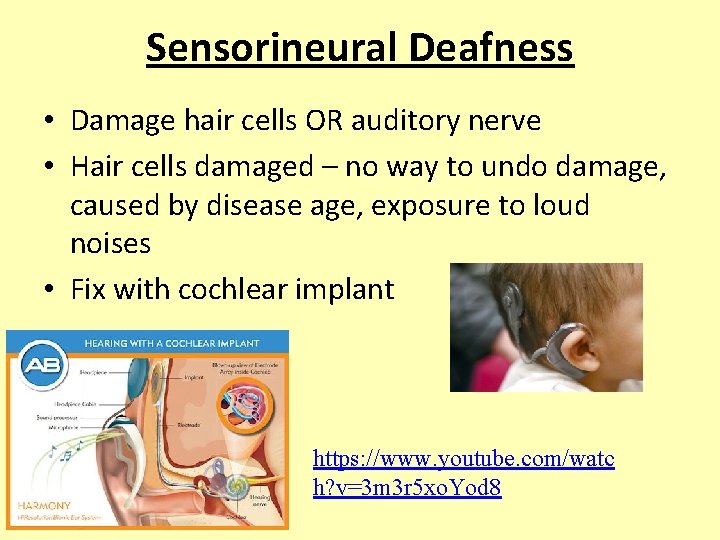
Sensorineural Deafness • Damage hair cells OR auditory nerve • Hair cells damaged – no way to undo damage, caused by disease age, exposure to loud noises • Fix with cochlear implant https: //www. youtube. com/watc h? v=3 m 3 r 5 xo. Yod 8
Decibels Source Exposure Danger 180 Space shuttle launch Hearing loss certain within 150 feet of launch pad 140 Jet aircraft motor Any exposure dangerous 120 Sandblaster, thunderclap Immediate danger 100 Heavy auto traffic, lawn mower 2 hours 60 Normal conversation No danger 40 Quiet office No danger 30 Quiet library No danger 20 Soft whisper No danger 0 Minimal detectable sound No danger Amplitude required for perception relative to 20 -29 years 20 -29 year-old group 30 -39 years 1 time 40 -49 years 10 times 50 -59 years 100 times Over 60 years 1000 times 32 64 128 256 512 102420484096 819216384 Frequency of tone in waves per second Low Pitch High
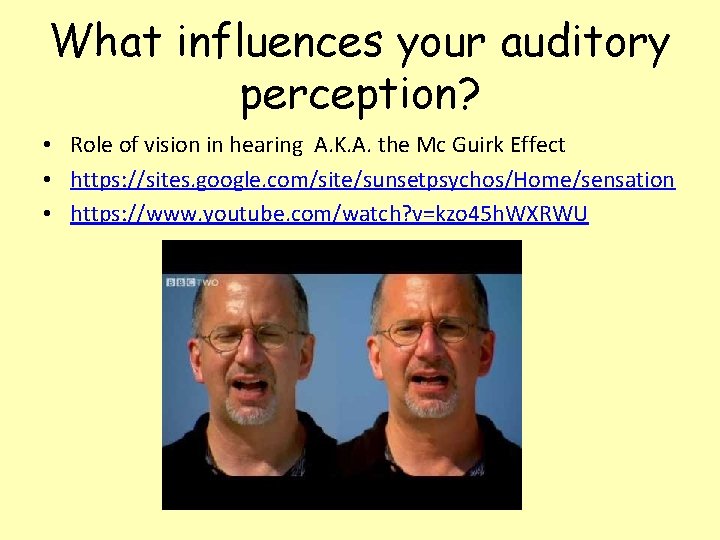
What influences your auditory perception? • Role of vision in hearing A. K. A. the Mc Guirk Effect • https: //sites. google. com/site/sunsetpsychos/Home/sensation • https: //www. youtube. com/watch? v=kzo 45 h. WXRWU
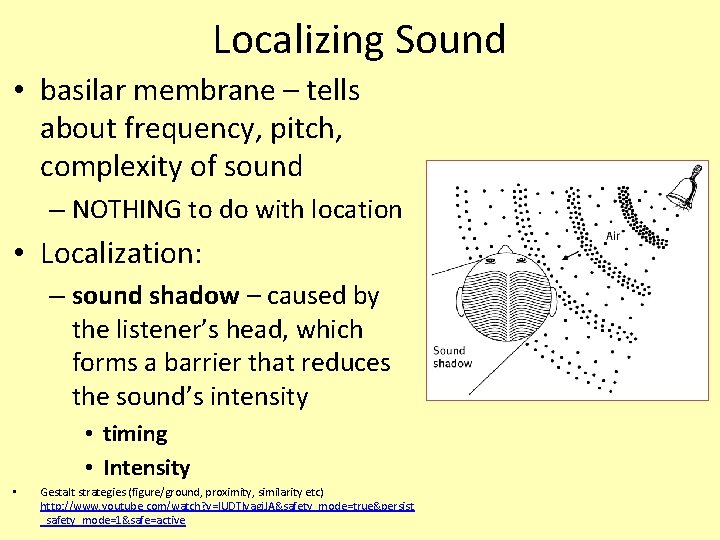
Localizing Sound • basilar membrane – tells about frequency, pitch, complexity of sound – NOTHING to do with location • Localization: – sound shadow – caused by the listener’s head, which forms a barrier that reduces the sound’s intensity • timing • Intensity • Gestalt strategies (figure/ground, proximity, similarity etc) http: //www. youtube. com/watch? v=IUDTlvagj. JA&safety_mode=true&persist _safety_mode=1&safe=active
Hearing Check for Understanding • Complete Part I and II
The Nature of Sound and How We Experience It – complex sounds – sounds with numerous frequencies of sound blending together • timbre – the tone saturation, or the perceptual quality, of a sound – Perceptual difference b/w different instruments playing the same note