
Aim Does Evolution Happen Today Evolution Review Evolution
- Slides: 10
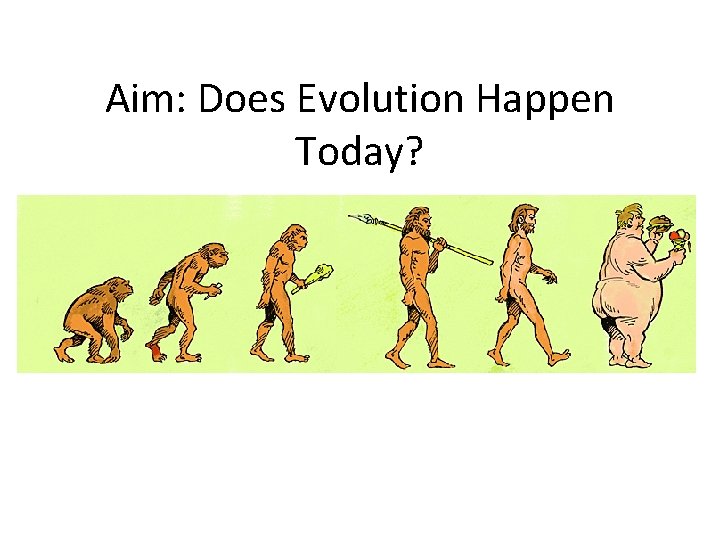
Aim: Does Evolution Happen Today?
Evolution - Review • Evolution is a change in a population of organisms over a period of time. • Within every population, there are individuals who are slightly different. • These differences are the results of mutations in the DNA. • These mutations lead to new traits that can help or hinder an individual chances to survive. • “Survival of the fittest” and “natural selection” means that individuals who have better traits will survive and pass on these traits to their offspring. • If the individual does not reproduce, then those traits become extinct.
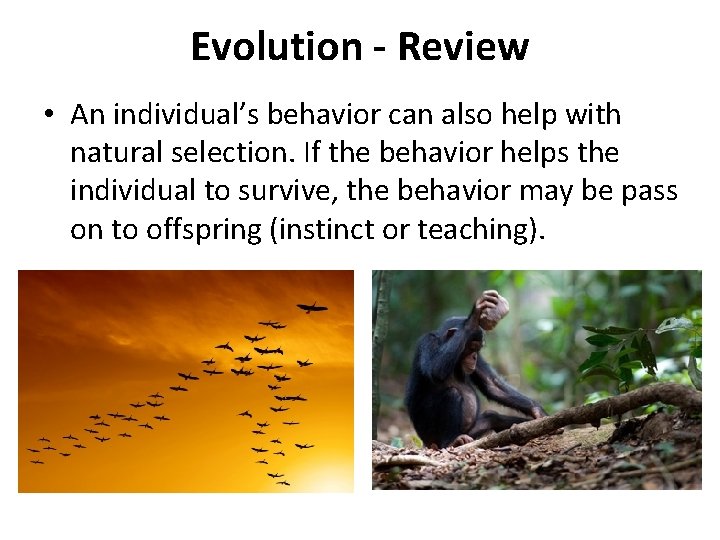
Evolution - Review • An individual’s behavior can also help with natural selection. If the behavior helps the individual to survive, the behavior may be pass on to offspring (instinct or teaching).
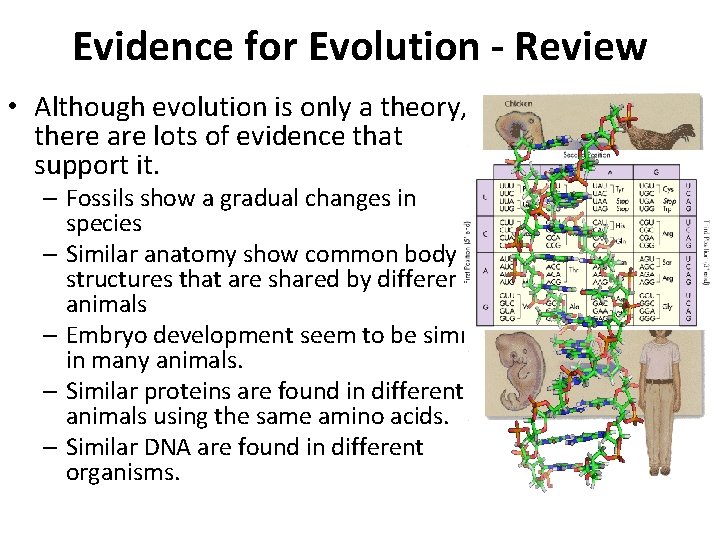
Evidence for Evolution - Review • Although evolution is only a theory, there are lots of evidence that support it. – Fossils show a gradual changes in species – Similar anatomy show common body structures that are shared by different animals – Embryo development seem to be similar in many animals. – Similar proteins are found in different animals using the same amino acids. – Similar DNA are found in different organisms.
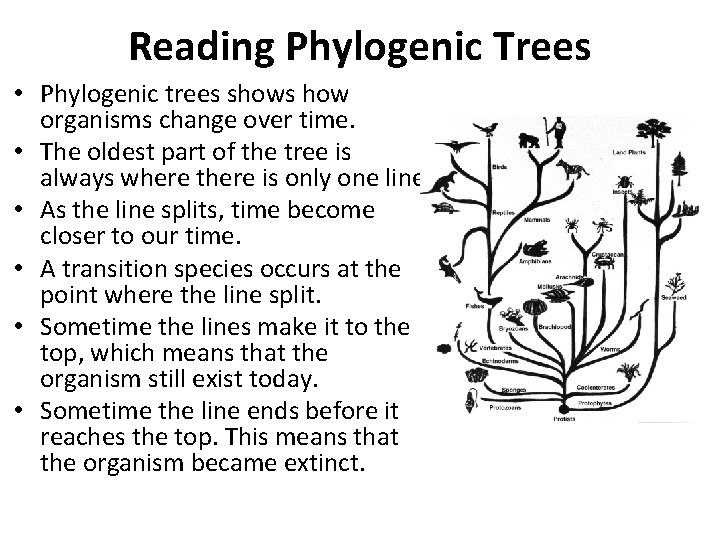
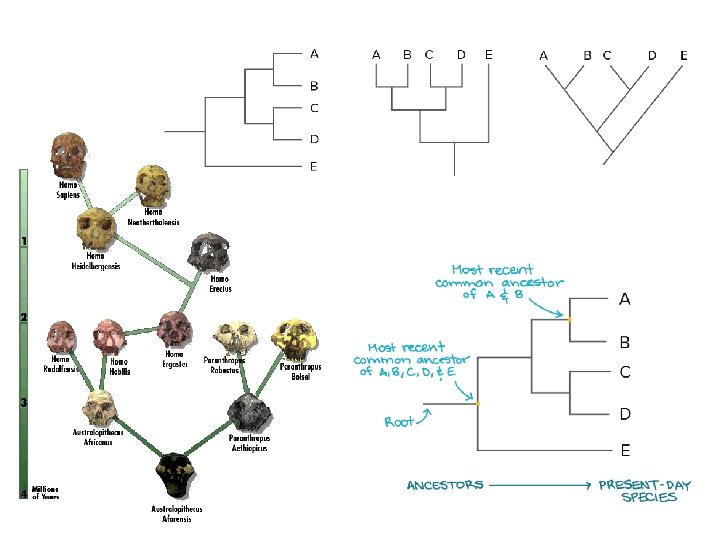
Reading Phylogenic Trees • Phylogenic trees shows how organisms change over time. • The oldest part of the tree is always where there is only one line. • As the line splits, time become closer to our time. • A transition species occurs at the point where the line split. • Sometime the lines make it to the top, which means that the organism still exist today. • Sometime the line ends before it reaches the top. This means that the organism became extinct.
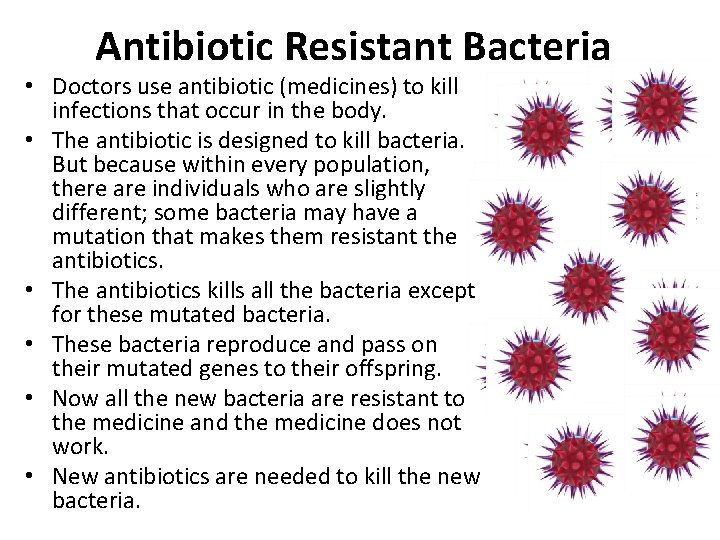
Antibiotic Resistant Bacteria • Doctors use antibiotic (medicines) to kill infections that occur in the body. • The antibiotic is designed to kill bacteria. But because within every population, there are individuals who are slightly different; some bacteria may have a mutation that makes them resistant the antibiotics. • The antibiotics kills all the bacteria except for these mutated bacteria. • These bacteria reproduce and pass on their mutated genes to their offspring. • Now all the new bacteria are resistant to the medicine and the medicine does not work. • New antibiotics are needed to kill the new bacteria.
Pesticide Resistant Insects. • Farmers use pesticides to kill unwanted insects that eat their crops. • The pesticides are designed to kill insects. But because within every population, there are individuals who are slightly different; some insects may have a mutation that makes them resistant to the pesticide. • The pesticide kills all the insects except for these mutated insects. • These insects reproduce and pass on their mutated genes to their offspring. • Now all the new insects are resistant to the pesticide and the pesticide does not work. • New pesticides are needed to kill the new insects.
The Key to a Species Chances to Survive • The environment is always changing. (climate, amount of resources) • Populations that have the most variety will have a better chance of some individuals surviving sudden environmental changes. These surviving individuals will reproduce and keep the species from becoming extinct. • Populations that have few or no variety will die out if the environment changes too quickly.
What is the best way to reproduce? • Asexual reproduction is fast. – Only one parent is needed. – Little variation (clones) – If a mutation occurs, the mutation will quickly move through the population. • Sexual reproduction is slow. – Needs two individuals – Lots of variations (Chromosome combinations) – Mutations move slow through a population. (mutation has to occur in the egg or sperm cells in order to be passed on to offspring).