
Aim Could WWI have been avoided Period 6
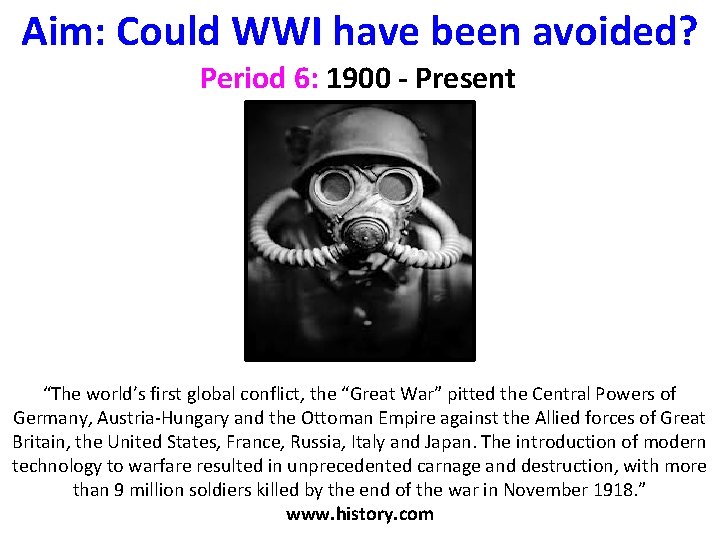
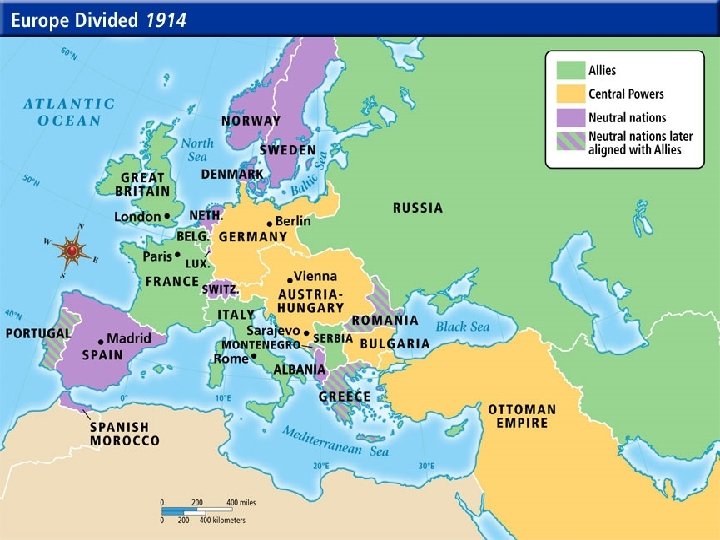
Aim: Could WWI have been avoided? Period 6: 1900 - Present “The world’s first global conflict, the “Great War” pitted the Central Powers of Germany, Austria-Hungary and the Ottoman Empire against the Allied forces of Great Britain, the United States, France, Russia, Italy and Japan. The introduction of modern technology to warfare resulted in unprecedented carnage and destruction, with more than 9 million soldiers killed by the end of the war in November 1918. ” www. history. com
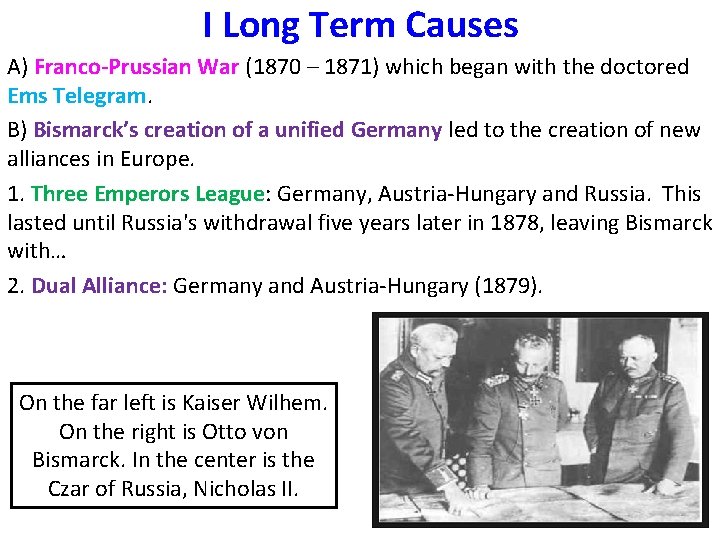
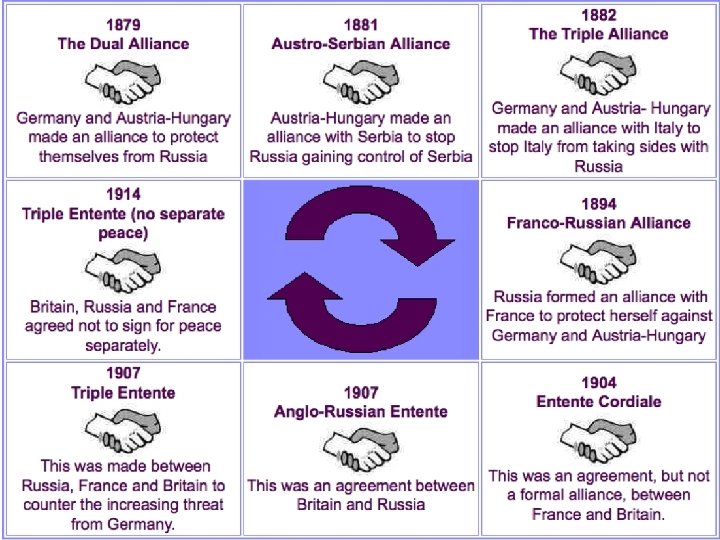
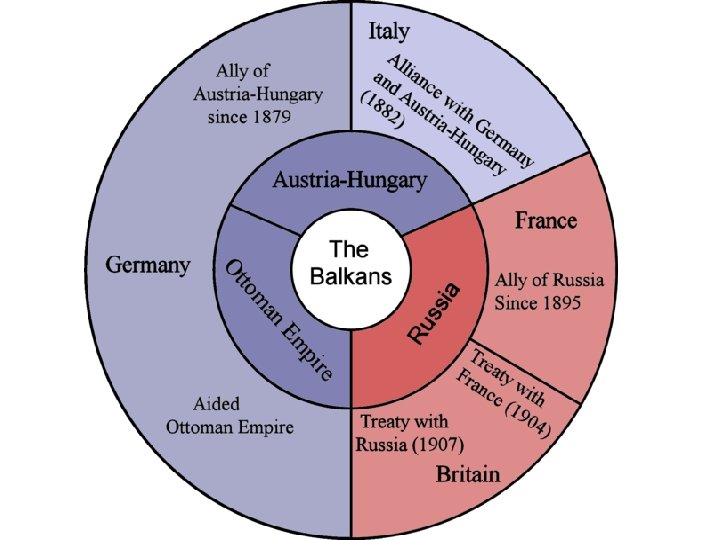
I Long Term Causes A) Franco-Prussian War (1870 – 1871) which began with the doctored Ems Telegram. B) Bismarck’s creation of a unified Germany led to the creation of new alliances in Europe. 1. Three Emperors League: Germany, Austria-Hungary and Russia. This lasted until Russia's withdrawal five years later in 1878, leaving Bismarck with… 2. Dual Alliance: Germany and Austria-Hungary (1879). On the far left is Kaiser Wilhem. On the right is Otto von Bismarck. In the center is the Czar of Russia, Nicholas II.
Long-Term Causes Continued… 3. The Triple Alliance (1881) Germany, Austria-Hungary, Italy. 4. The Secret Franco-Italian Alliance: As a “Plan B”, Italy negotiated a secret treaty with France, under which Italy would remain neutral should Germany attack France. 4. In 1887 Bismarck agreed to a Reinsurance Treaty with Russia. Both powers would remain neutral if either were involved in a war with a third. Exceptions for neutrality: war with France or Austria-Hungary. Bismarck's intention was to avoid the possibility of a two-front war against both France and Russia. Czar Nicholas II allowed the Reinsurance Treaty to lapse in 1890. 5. 1892 Franco-Russian Military Convention: France and Russia. This counteracted the threat by the Triple Alliance of Germany, Austria. Hungary and Italy.
Long-Term Causes Continued… 6. Kaiser Wilhelm built up the Germany naval fleet to rival Britain’s. In 1902 Britain agreed to a military alliance with Japan to limit German colonial gains in the east. Britain also built the enormous Dreadnought battleship (1906, completed in just 14 months!). By 1914 Germany had 29 battleships, Britain 49. 7. In 1907, Russia, Britain, France formed the Triple Entente. 8. In 1912 Britain and France formed an alliance at the Anglo-French Naval Convention; promised British protection of France's coastline from German naval attack, and French defense of the Suez Canal.
Long-Term Causes Continued… C) The Russo-Japanese War: (1904 – 1905) Following the Russian rejection of a Japanese plan to divide Manchuria and Korea into spheres of influence, Japan launched a naval attack against Port Arthur, a Russian naval base in China. The Russian fleet was decimated. During the subsequent Russo. Japanese War, Japan won three major victories over the Russians. In August 1905 U. S. President Theodore Roosevelt mediated a peace treaty at Portsmouth, New Hampshire. Japan emerged from the conflict as the first modern non. Western world power and set its sights on greater imperial expansion. Russia’s defeat was one of the immediate causes of the Russian Revolution of 1905.
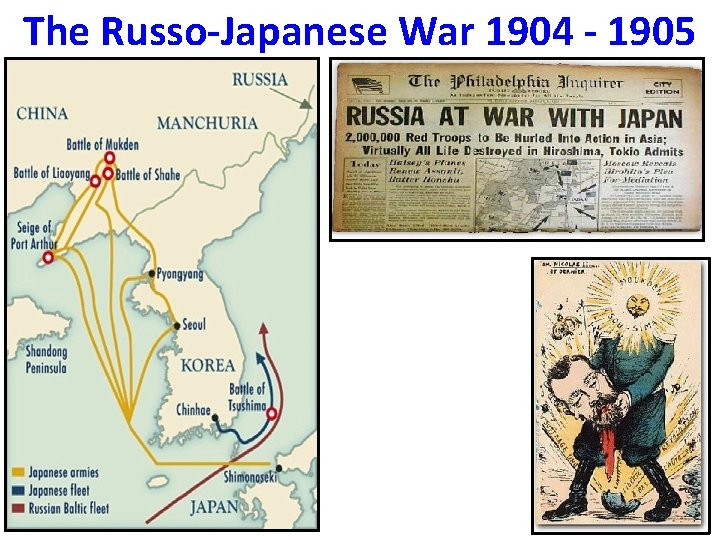
The Russo-Japanese War 1904 - 1905
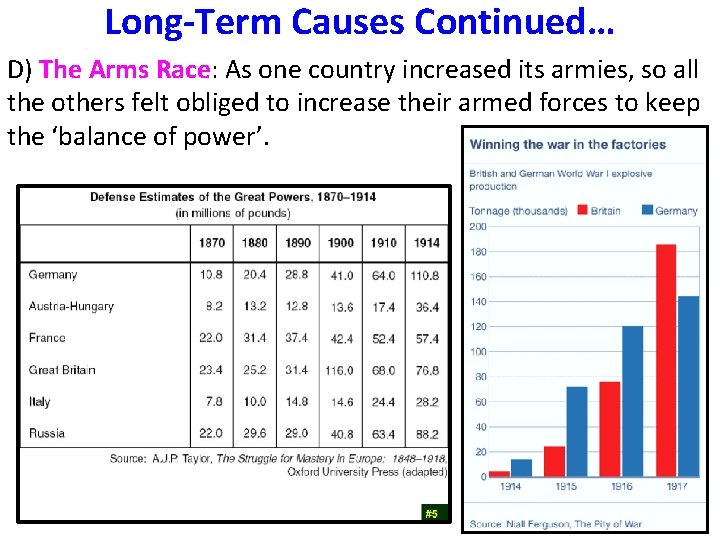
Long-Term Causes Continued… D) The Arms Race: As one country increased its armies, so all the others felt obliged to increase their armed forces to keep the ‘balance of power’.
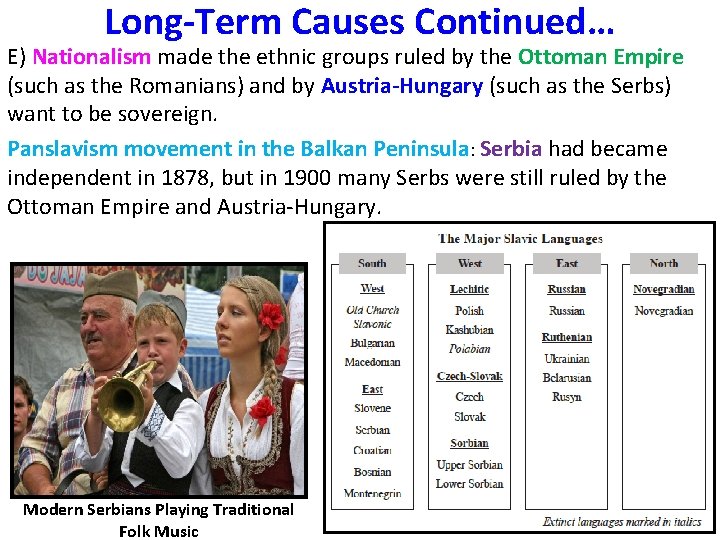
Long-Term Causes Continued… E) Nationalism made the ethnic groups ruled by the Ottoman Empire (such as the Romanians) and by Austria-Hungary (such as the Serbs) want to be sovereign. Panslavism movement in the Balkan Peninsula: Serbia had became independent in 1878, but in 1900 many Serbs were still ruled by the Ottoman Empire and Austria-Hungary. Modern Serbians Playing Traditional Folk Music
II The Keg Blows A) “The Archduke Francis Ferdinand traveled to Sarajevo in June 1914 to inspect the imperial armed forces in Bosnia and Herzegovina, former Ottoman territories in the Balkan region that were annexed by Austria. Hungary in 1908 to the indignation of Serbian nationalists, who believed they should become part of the newly independent and ambitious Serbian nation… On June 28, 1914, Franz Ferdinand Sophie were touring Sarajevo in an open car, with surprisingly little security, when Serbian nationalist Nedjelko Cabrinovic threw a bomb; it rolled off the back of the vehicle and wounded an officer and some bystanders. Later that day, 19 -year-old Gavrilo Princip fired into the car, shooting Franz Ferdinand Sophie at point-blank range. Princip then turned the gun on himself, but was prevented from shooting it by a bystander who threw himself upon the young assassin. A mob attacked Princip, who was taken by the police. Meanwhile, Franz Ferdinand Sophie both died within the hour. The assassination of Franz-Ferdinand Sophie set off a rapid chain of events…
The Keg Blows Continued… …Austria-Hungary blamed the Serbian government for the attack. As Russia supported Serbia, an Austro-Hungarian declaration of war was delayed until its leaders received assurances from Kaiser Wilhelm that Germany would support their cause in the event of a Russian intervention–which would likely involve Russia's ally, France, and possibly Britain as well. On July 28, Austria-Hungary declared war on Serbia. Within a week, Russia, Belgium, France, Great Britain and Serbia had lined up against Austria-Hungary and Germany, and World War I had begun. ” –www. history. com
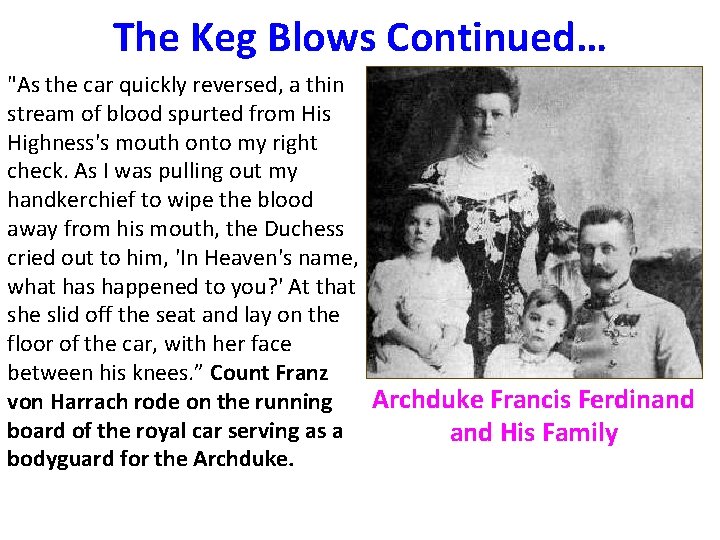
The Keg Blows Continued… "As the car quickly reversed, a thin stream of blood spurted from His Highness's mouth onto my right check. As I was pulling out my handkerchief to wipe the blood away from his mouth, the Duchess cried out to him, 'In Heaven's name, what has happened to you? ' At that she slid off the seat and lay on the floor of the car, with her face between his knees. ” Count Franz Archduke Francis Ferdinand von Harrach rode on the running board of the royal car serving as a and His Family bodyguard for the Archduke.
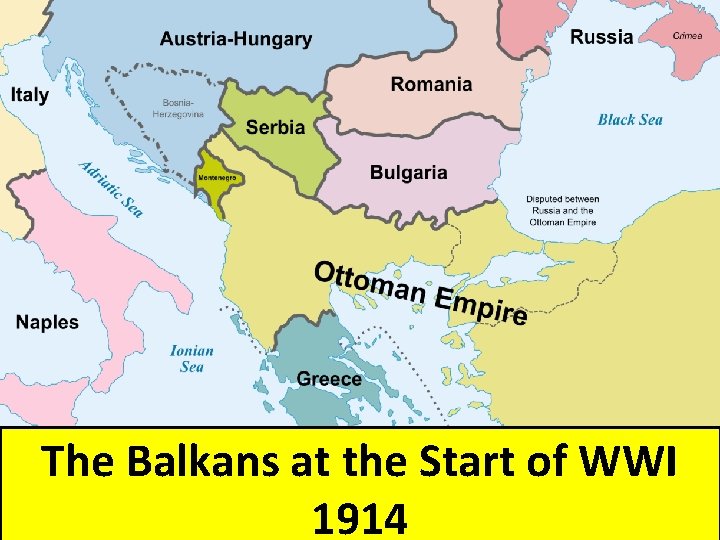
The Balkans at the Start of WWI 1914
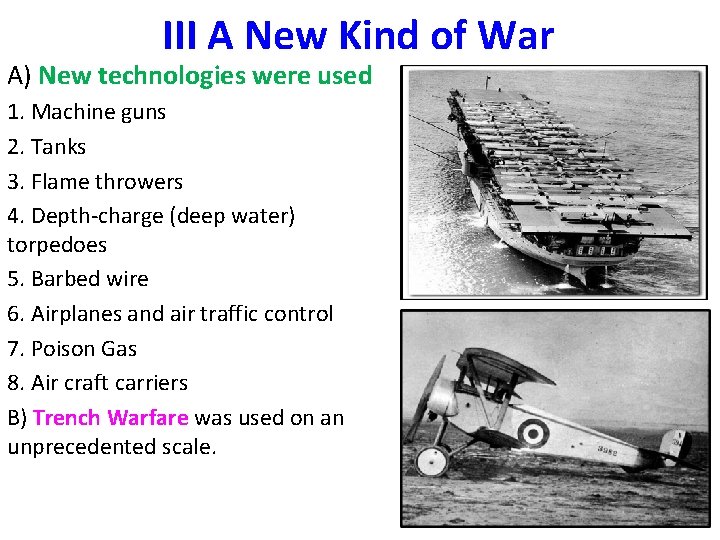
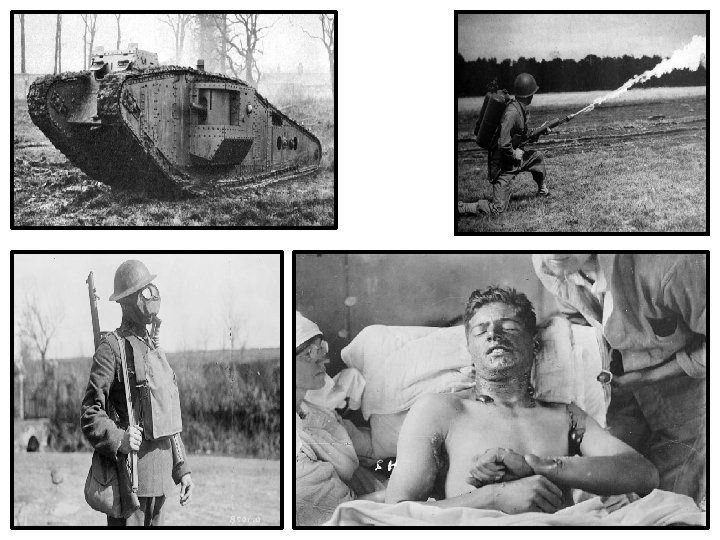
III A New Kind of War A) New technologies were used 1. Machine guns 2. Tanks 3. Flame throwers 4. Depth-charge (deep water) torpedoes 5. Barbed wire 6. Airplanes and air traffic control 7. Poison Gas 8. Air craft carriers B) Trench Warfare was used on an unprecedented scale.
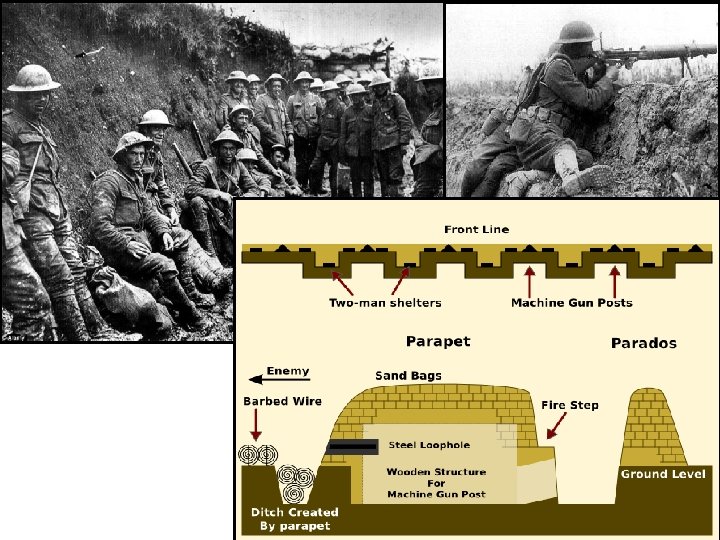
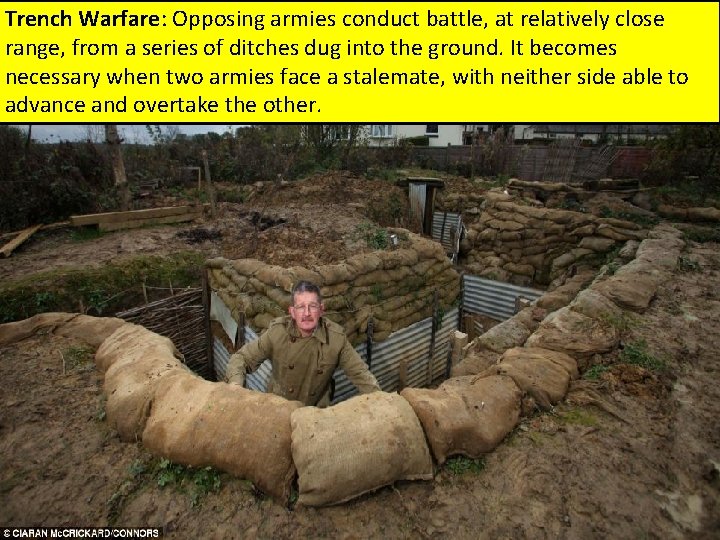
Trench Warfare: Opposing armies conduct battle, at relatively close range, from a series of ditches dug into the ground. It becomes necessary when two armies face a stalemate, with neither side able to advance and overtake the other.
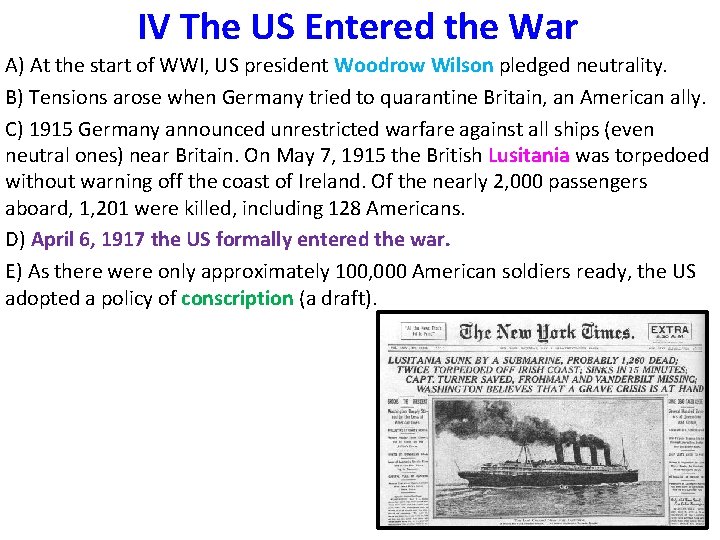
IV The US Entered the War A) At the start of WWI, US president Woodrow Wilson pledged neutrality. B) Tensions arose when Germany tried to quarantine Britain, an American ally. C) 1915 Germany announced unrestricted warfare against all ships (even neutral ones) near Britain. On May 7, 1915 the British Lusitania was torpedoed without warning off the coast of Ireland. Of the nearly 2, 000 passengers aboard, 1, 201 were killed, including 128 Americans. D) April 6, 1917 the US formally entered the war. E) As there were only approximately 100, 000 American soldiers ready, the US adopted a policy of conscription (a draft).
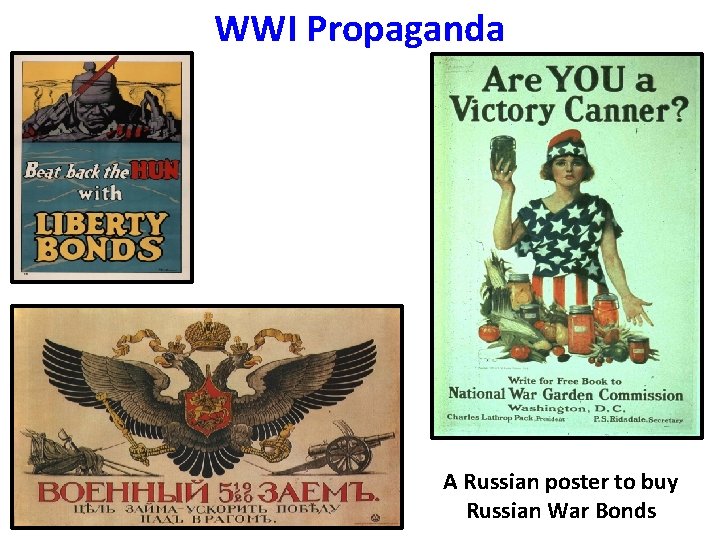
WWI Propaganda A Russian poster to buy Russian War Bonds
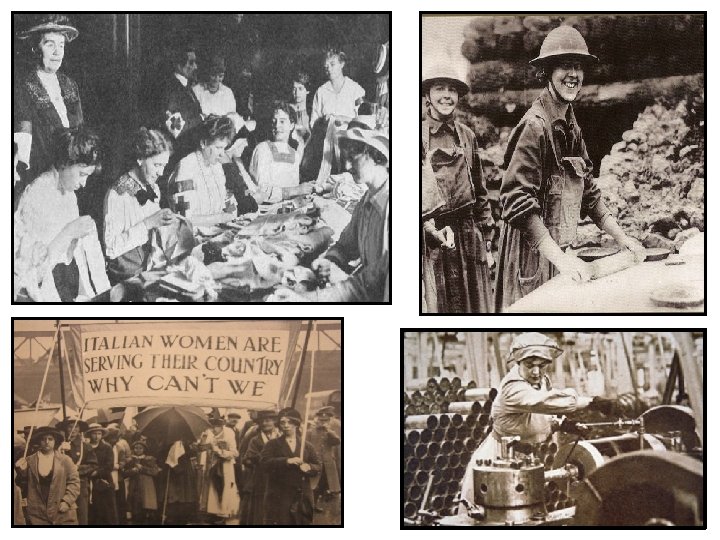
V Women and WWI A) After the US entered the war in 1917, women supported the war effort in numerous ways; such as by selling war bonds. B) During the war, women served in the navy and marines, and as nurses. On the home front, women worked in factories and in the government. C) WWI led to several important advances for women. It increased support for women’s suffrage (the right to vote) and contributed to the passage of the 19 th Amendment in 1920. In addition, during the war, the Department of Labor created the Women in Industry Service. After the war, the Women in Industry Service became The Women’s Bureau. http: //www. nwhm. org
VI The End of WWI? A) After the surrender of Austria-Hungary, Bulgaria and the Ottoman Empire, Germany was forced to seek an armistice with the Allies on November 11, 1918. B) The Paris Peace Conference began on January 18, 1919 to debate the terms of the Versailles Peace Treaty. Germany was not invited. The “Big Three” were Prime Minister David Lloyd George of the United Kingdom, Prime Minister Georges Clemenceau of France, and President Woodrow Wilson of the United States. The terms of the Versailles Treaty were so hostile to Germany that German Chancellor Philipp Scheidemann resigned rather than sign it. C) On June 28, 1919, Germany signed the Versailles Treaty. (Their military was so weakened Germany had no choice)
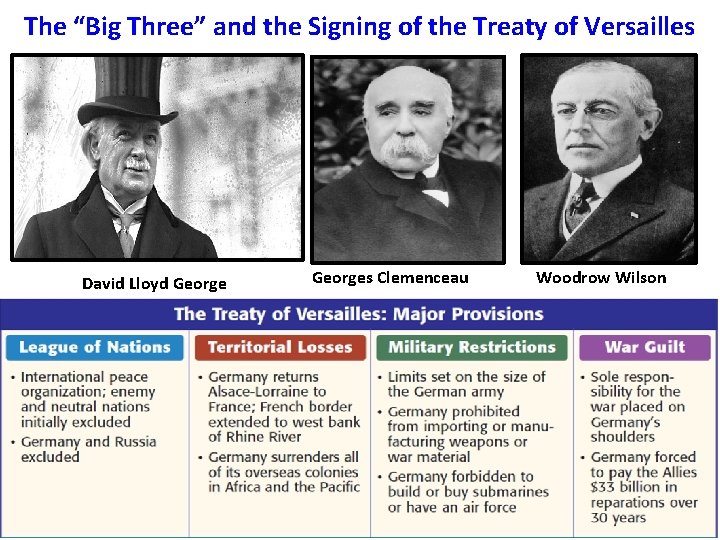
The “Big Three” and the Signing of the Treaty of Versailles David Lloyd Georges Clemenceau Woodrow Wilson
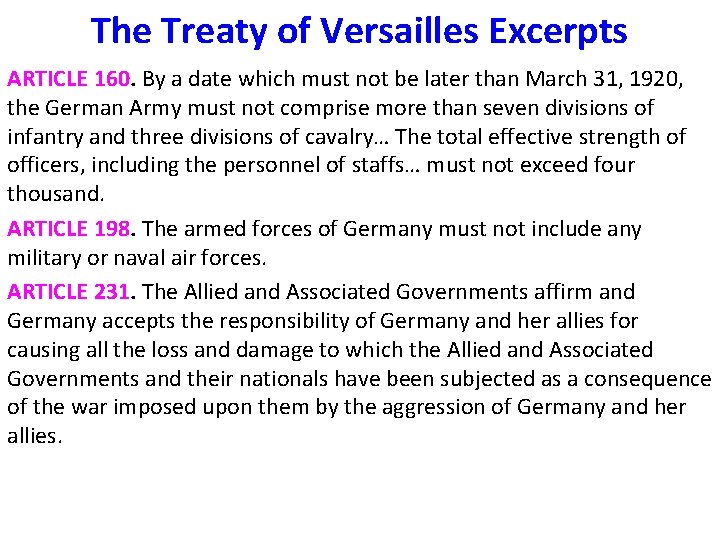
The Treaty of Versailles Excerpts ARTICLE 160. By a date which must not be later than March 31, 1920, the German Army must not comprise more than seven divisions of infantry and three divisions of cavalry… The total effective strength of officers, including the personnel of staffs… must not exceed four thousand. ARTICLE 198. The armed forces of Germany must not include any military or naval air forces. ARTICLE 231. The Allied and Associated Governments affirm and Germany accepts the responsibility of Germany and her allies for causing all the loss and damage to which the Allied and Associated Governments and their nationals have been subjected as a consequence of the war imposed upon them by the aggression of Germany and her allies.
VI The League of Nations A) In front of the U. S. Congress on January 8, 1918, President Woodrow Wilson, in the last of his Fourteen Points, called for a “general association of nations…formed on the basis of covenants designed to create mutual guarantees of the political independence and territorial integrity of States, large and small equally. ” B) Wilson used his influence to attach the charter of the League of Nations to the Treaty of Versailles. C) Due to concerns that the League would commit the United States to an organization that would reduce the United States’ ability to defend its own interests, the Senate voted to not join.
Wilson’s 14 Points Woodrow Wilson's Fourteen Points were first outlined in a speech Wilson gave to the American Congress in January 1918. 1. No more secret agreements 2. Free navigation of all seas 3. An end to all economic barriers between countries 4. Countries to reduce weapons 5. All decisions regarding the colonies should be impartial 8 - 13. Self-determination for those in France, Italy, Poland, the Balkans, the former Austro-Hungarian and Ottoman Empires 14. A League of Nations should be set up to guarantee the political and territorial independence of all states.
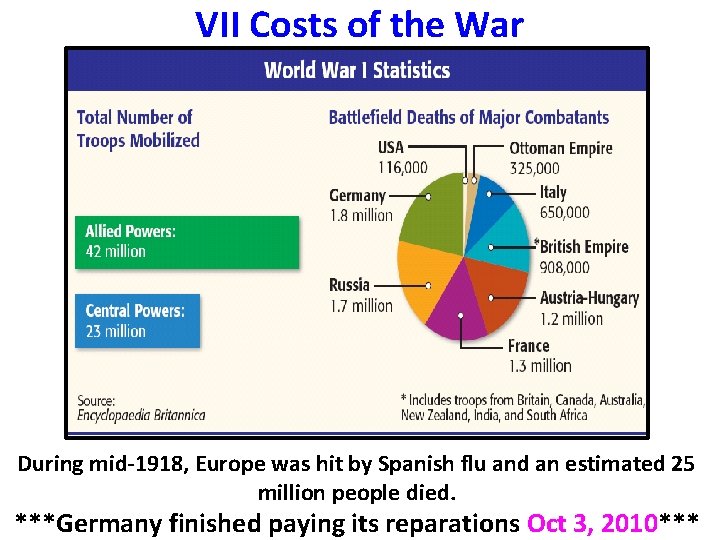
VII Costs of the War During mid-1918, Europe was hit by Spanish flu and an estimated 25 million people died. ***Germany finished paying its reparations Oct 3, 2010***
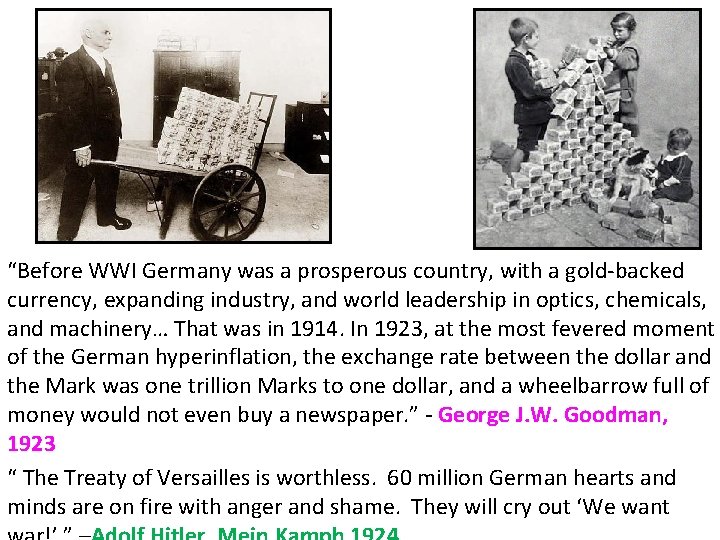
“Before WWI Germany was a prosperous country, with a gold-backed currency, expanding industry, and world leadership in optics, chemicals, and machinery… That was in 1914. In 1923, at the most fevered moment of the German hyperinflation, the exchange rate between the dollar and the Mark was one trillion Marks to one dollar, and a wheelbarrow full of money would not even buy a newspaper. ” - George J. W. Goodman, 1923 “ The Treaty of Versailles is worthless. 60 million German hearts and minds are on fire with anger and shame. They will cry out ‘We want
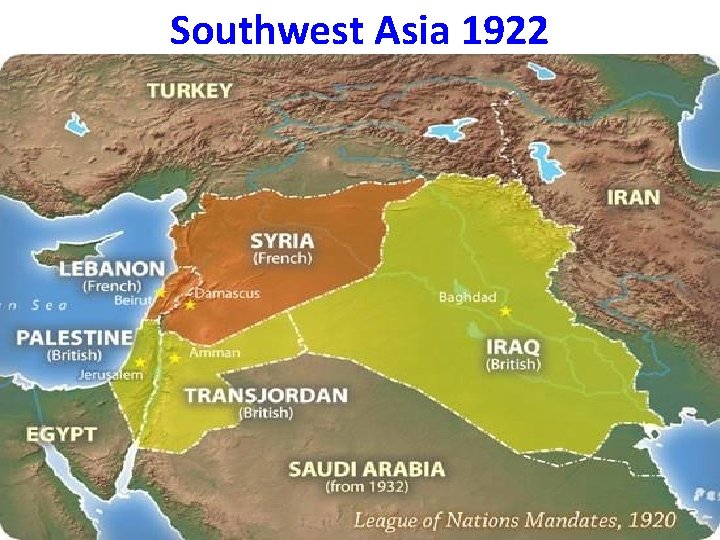
Southwest Asia 1922
HW Questions 1. Fill in your Period 6 Chart for WWI. 2. Could WWI have been avoided? 3. How was WWI different from previous wars? Does WWI deserve to be called the “Great War”? 4. If you were the leader of Germany, would you have signed the Treaty of Versailles as it was written? Why or why not? 5. Do you think that the Treaty of Versailles, Wilson’s 14 Points and the League of Nations were truly intended to prevent future world wars? Was it possible to predict WWII? *Justify your answers with historical evidence!
Key Vocabulary Anglo-Russian Entente 14 Points 19 th Amendment Anglo-French Naval Convention Archduke Francis Ferdinand Arms Race Balkans Big Three Conscription Czar Nicholas II David Lloyd George Dual Alliance Franco-Italian Alliance Franco-Prussian War Franco-Russian Military Convention Gavrilo Princip Georges Clemenceau League of Nations Lusitania Nedjelko Cabrinovic Pan-Slavicism Paris Peace Conference Russo-Japanese War Serbia Suez Canal Three Emperors League Treaty of Versailles Trench Warfare Triple Alliance Triple Entente Woodrow Wilson WWI
- Slides: 34