
AIM 2 as a Tier 2 Process for

- Slides: 37
AIM 2 as a Tier 2 Process for Behaviorally At-Risk Students Clayton R. Cook, Ph. D, LP Associate Professor School Psychology College of Education Associate Director School Mental Health Assessment, Research, and Training (SMART) Center University of Washington Yanchen Zhang, BA Doctoral Student School Psychology College of Education University of Washington
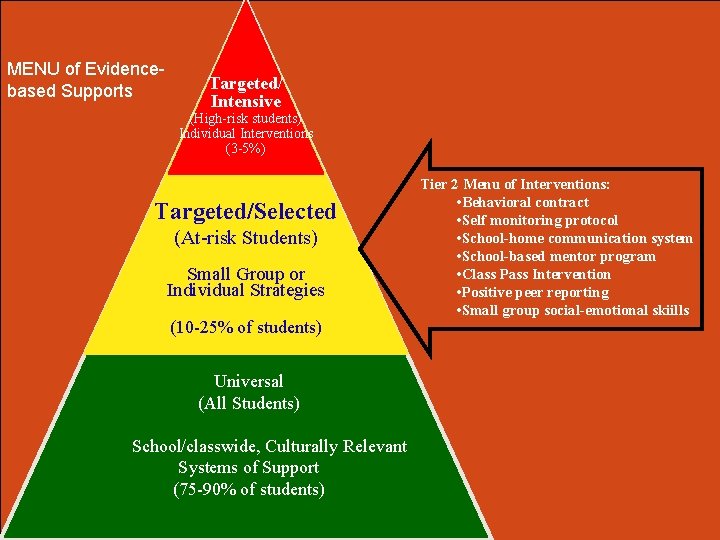
MENU of Evidencebased Supports Targeted/ Intensive (High-risk students) Individual Interventions (3 -5%) Targeted/Selected (At-risk Students) Small Group or Individual Strategies (10 -25% of students) Universal (All Students) School/classwide, Culturally Relevant Systems of Support (75 -90% of students) Tier 2 Menu of Interventions: • Behavioral contract • Self monitoring protocol • School-home communication system • School-based mentor program • Class Pass Intervention • Positive peer reporting • Small group social-emotional skiills
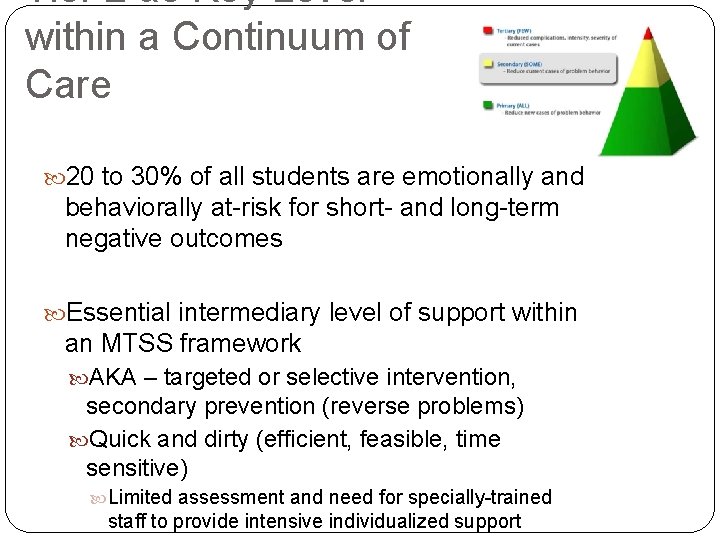
Tier 2 as Key Level within a Continuum of Care 20 to 30% of all students are emotionally and behaviorally at-risk for short- and long-term negative outcomes Essential intermediary level of support within an MTSS framework AKA – targeted or selective intervention, secondary prevention (reverse problems) Quick and dirty (efficient, feasible, time sensitive) Limited assessment and need for specially-trained staff to provide intensive individualized support
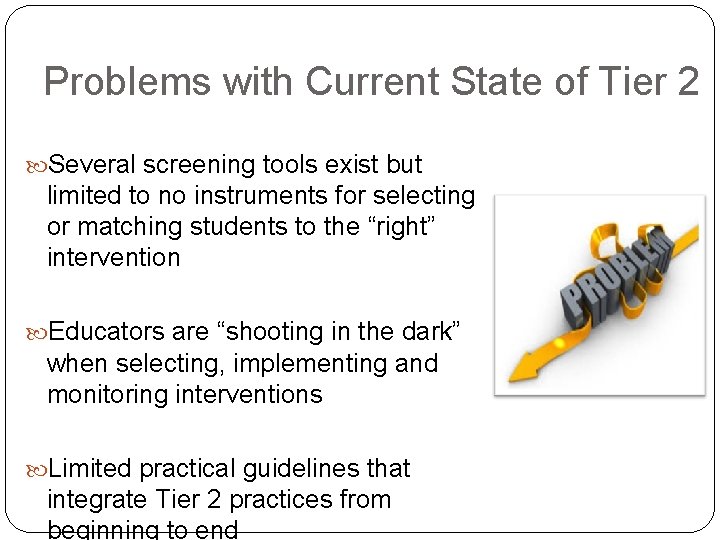
Problems with Current State of Tier 2 Several screening tools exist but limited to no instruments for selecting or matching students to the “right” intervention Educators are “shooting in the dark” when selecting, implementing and monitoring interventions Limited practical guidelines that integrate Tier 2 practices from beginning to end
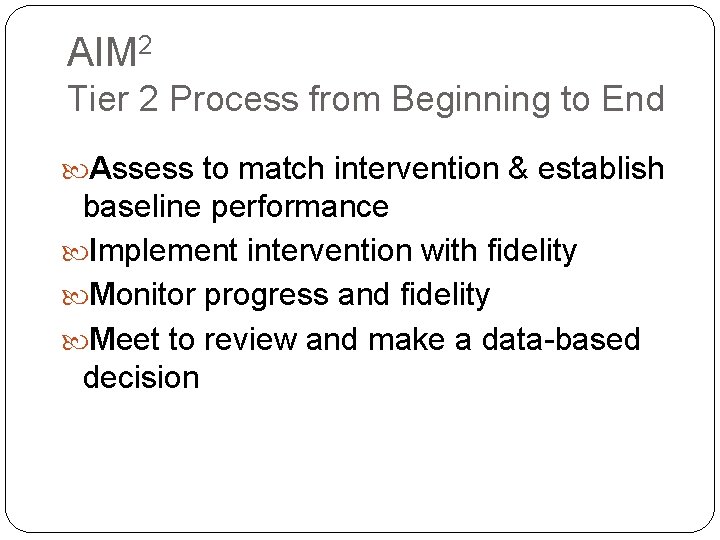
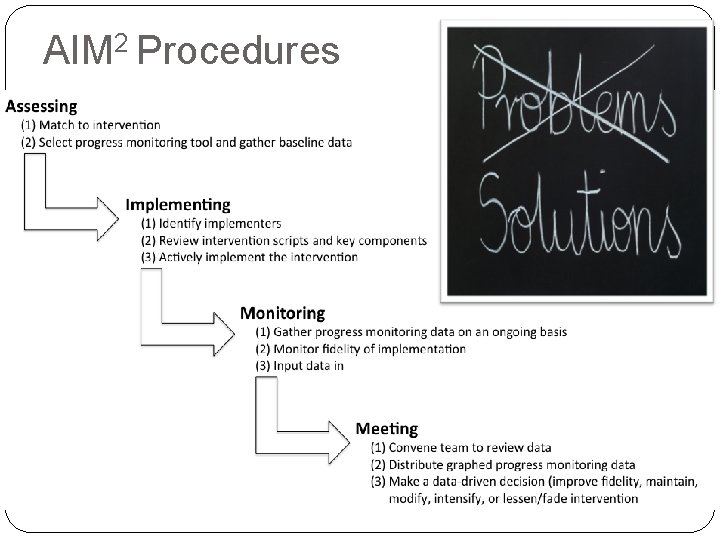
AIM 2 Tier 2 Process from Beginning to End Assess to match intervention & establish baseline performance Implement intervention with fidelity Monitor progress and fidelity Meet to review and make a data-based decision
AIM 2 Procedures
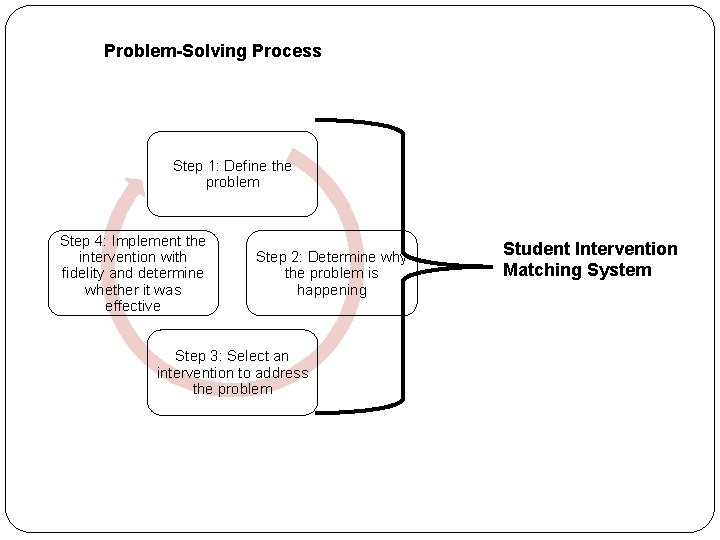
Problem-Solving Process Step 1: Define the problem Step 4: Implement the intervention with fidelity and determine whether it was effective Step 2: Determine why the problem is happening Step 3: Select an intervention to address the problem Student Intervention Matching System
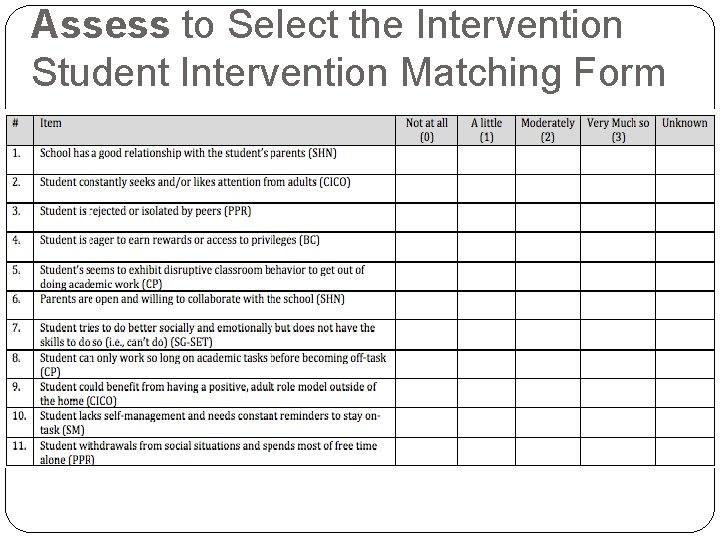
Assess to Select the Intervention Student Intervention Matching Form
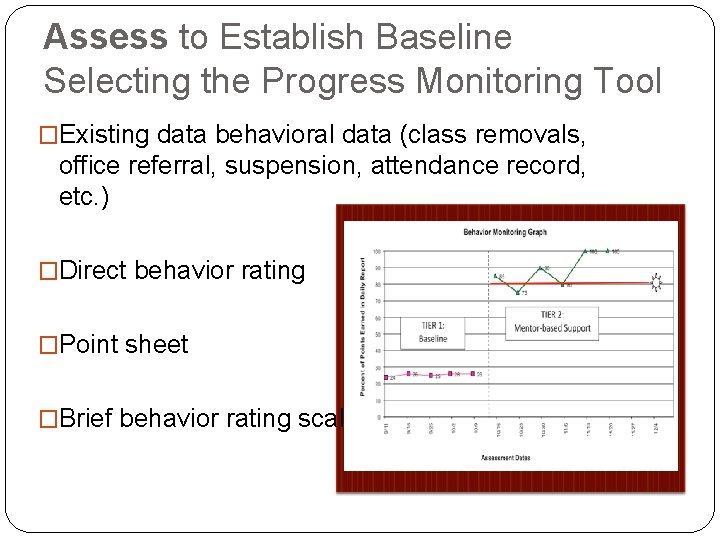
Assess to Establish Baseline Selecting the Progress Monitoring Tool �Existing data behavioral data (class removals, office referral, suspension, attendance record, etc. ) �Direct behavior rating �Point sheet �Brief behavior rating scale
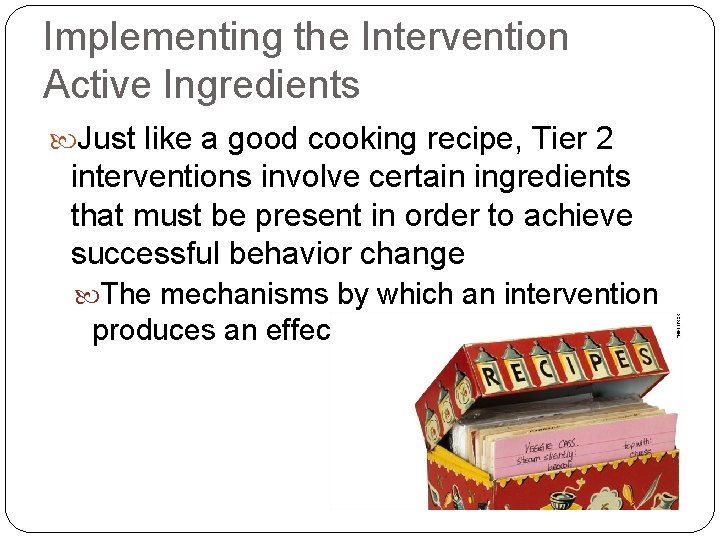
Implementing the Intervention Active Ingredients Just like a good cooking recipe, Tier 2 interventions involve certain ingredients that must be present in order to achieve successful behavior change The mechanisms by which an intervention produces an effect
Monitoring Progress and Fidelity Gather data on a weekly basis and input it into a data management system 2. Collect data for at-least 4 weeks and a minimum of 3 to 4 data points while the intervention was implemented 3. Prepare graph of the data for the next step to enable a data-based decision 1. 12
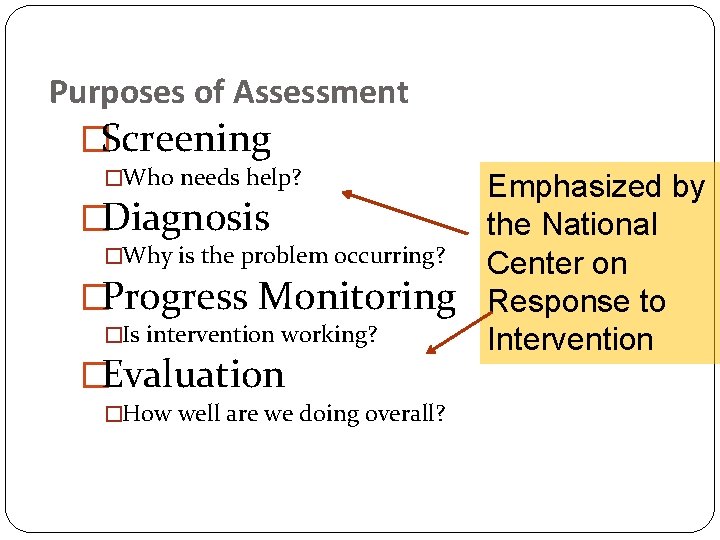
Purposes of Assessment �Screening �Who needs help? �Diagnosis �Why is the problem occurring? �Progress Monitoring �Is intervention working? �Evaluation �How well are we doing overall? Emphasized by the National Center on Response to Intervention
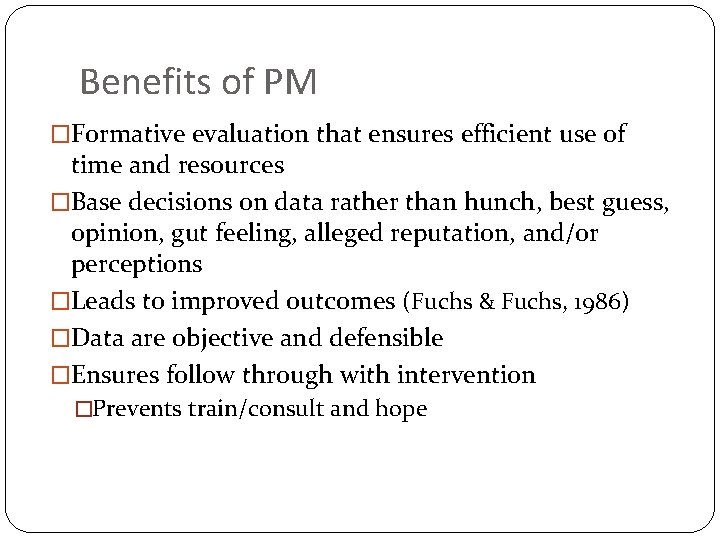
Benefits of PM �Formative evaluation that ensures efficient use of time and resources �Base decisions on data rather than hunch, best guess, opinion, gut feeling, alleged reputation, and/or perceptions �Leads to improved outcomes (Fuchs & Fuchs, 1986) �Data are objective and defensible �Ensures follow through with intervention �Prevents train/consult and hope
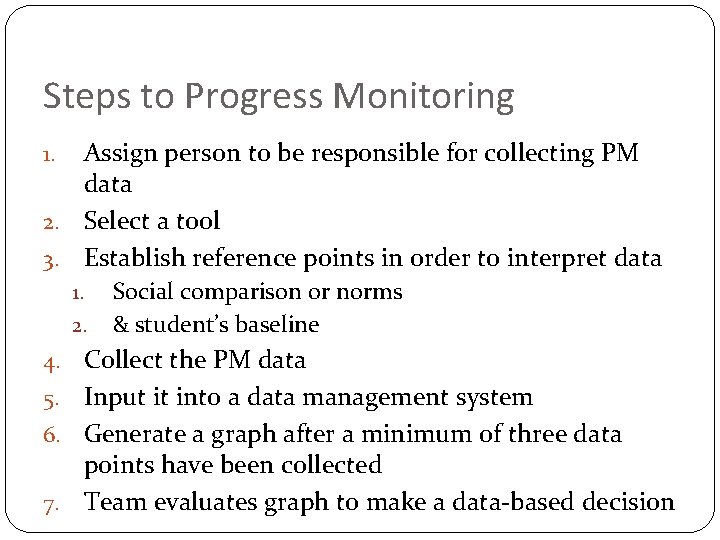
Steps to Progress Monitoring Assign person to be responsible for collecting PM data 2. Select a tool 3. Establish reference points in order to interpret data 1. 2. Social comparison or norms & student’s baseline Collect the PM data 5. Input it into a data management system 6. Generate a graph after a minimum of three data points have been collected 7. Team evaluates graph to make a data-based decision 4.
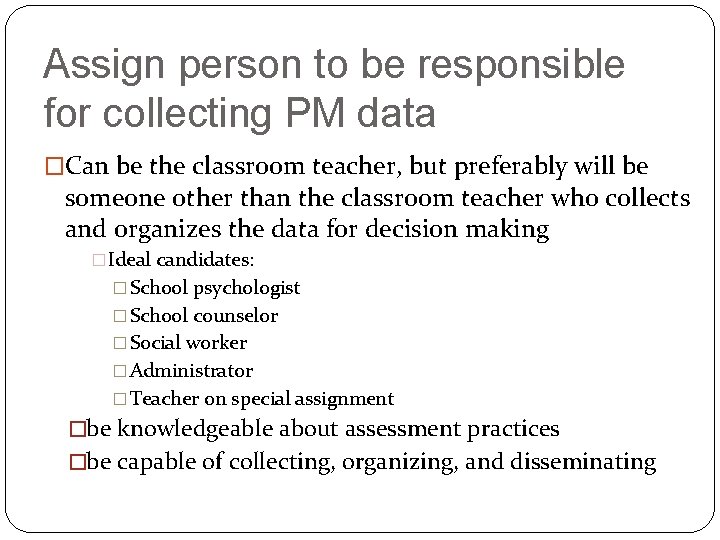
Assign person to be responsible for collecting PM data �Can be the classroom teacher, but preferably will be someone other than the classroom teacher who collects and organizes the data for decision making �Ideal candidates: � School psychologist � School counselor � Social worker � Administrator � Teacher on special assignment �be knowledgeable about assessment practices �be capable of collecting, organizing, and disseminating
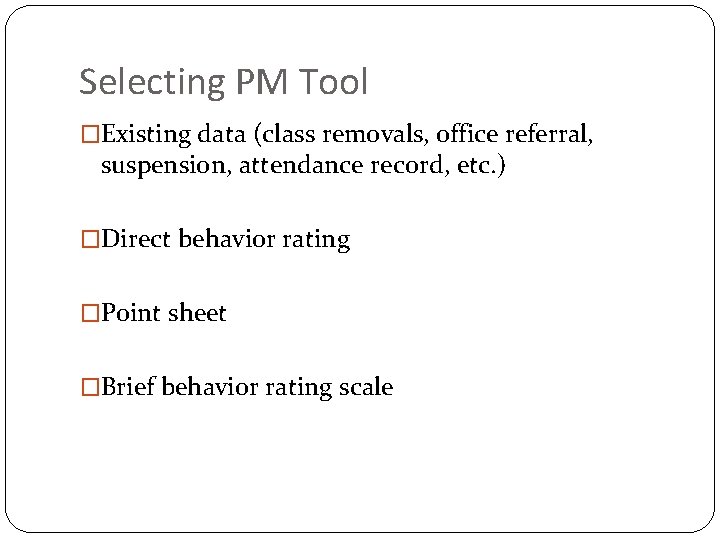
Selecting PM Tool �Existing data (class removals, office referral, suspension, attendance record, etc. ) �Direct behavior rating �Point sheet �Brief behavior rating scale
Selecting PM Tool. Existing Data Definition: �Data sources that already exist within the setting (“permanent products”) Advantages: �Already available �Highly contextually relevant �Natural occurrence can reduce/limit reactivity (Adapted from Chafouleas, Riley-Tillman, & Sugai, 2007)
Existing data �Examples: �Office discipline referrals (ODRs) �Attendance and tardy records �Suspension/expulsion data �Data from existing behavior management plans (e. g. token economy)
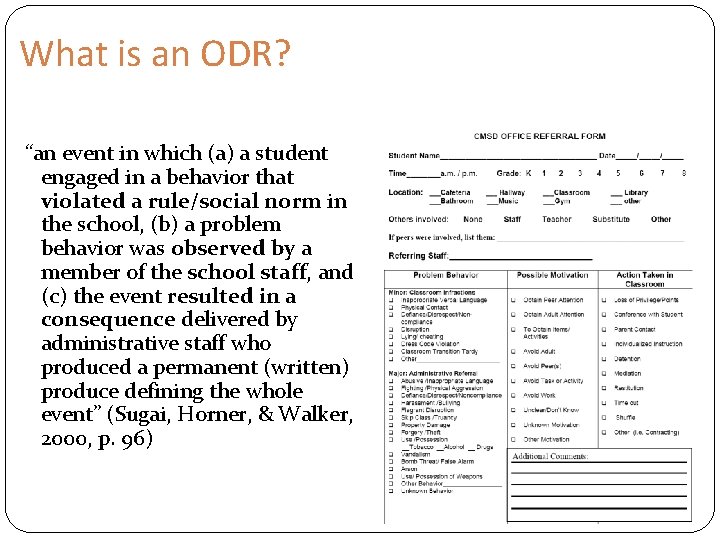
What is an ODR? “an event in which (a) a student engaged in a behavior that violated a rule/social norm in the school, (b) a problem behavior was observed by a member of the school staff, and (c) the event resulted in a consequence delivered by administrative staff who produced a permanent (written) produce defining the whole event” (Sugai, Horner, & Walker, 2000, p. 96)
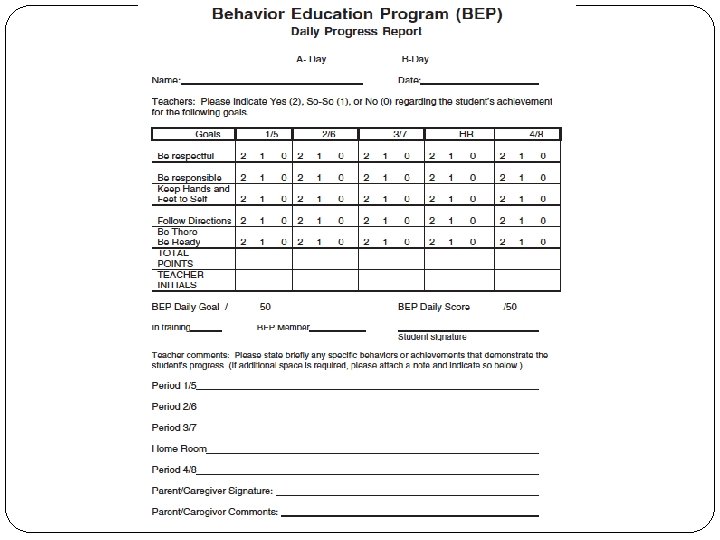
Selecting PM Tool: Direct Behavior Rating � Definition: A tool that involves a brief rating of a target behavior following a specified observation period (e. g. class activity) by those persons who are naturally occurring in the context of interest � Examples: �Behavior Report Card �Home-School Note �Daily Progress Report �Good Behavior Note
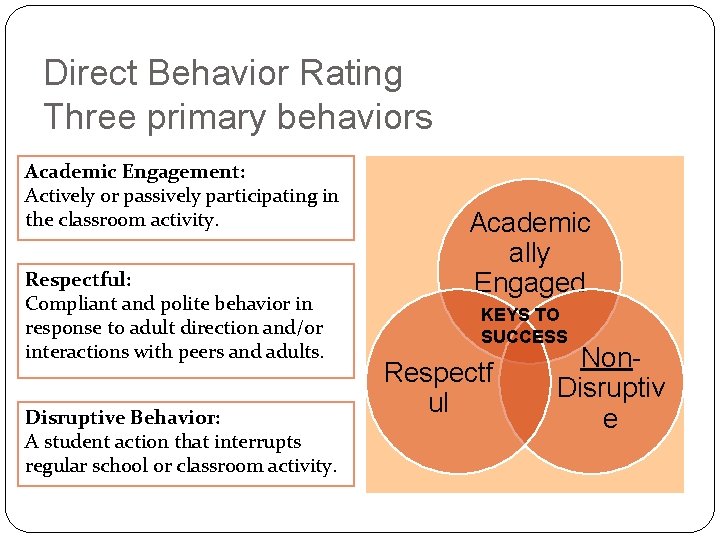
Direct Behavior Rating Three primary behaviors Academic Engagement: Actively or passively participating in the classroom activity. Respectful: Compliant and polite behavior in response to adult direction and/or interactions with peers and adults. Disruptive Behavior: A student action that interrupts regular school or classroom activity. Academic ally Engaged KEYS TO SUCCESS Respectf ul Non. Disruptiv e
Selecting PM Tool: Point Sheet �Point sheet is used to award points to the student for exhibiting particular target behaviors �Positively stated behaviors are identified and incorporated into the point sheet �e. g. , Safe, respectful and responsible �Specific time intervals to deliver points are selected (e. g. , every 30 minutes, every period, or two times daily) �Percent of total possible points is used as a basis to track student progress over time �Percent of total possible points is also used as a basis to develop a goal
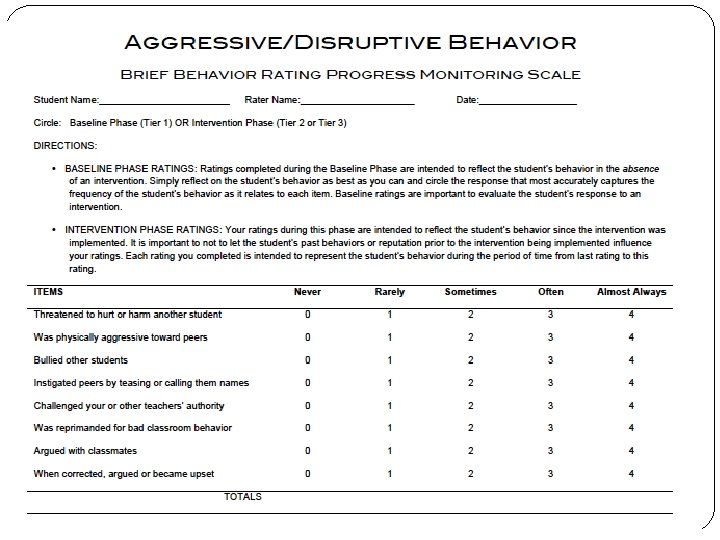
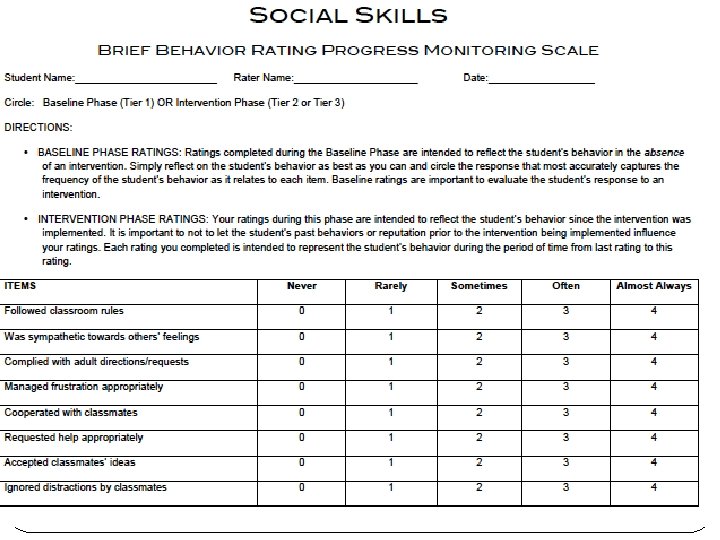
Selecting PM Tool. Brief Behavior Rating Scales �Abbreviated rating scales that contain change sensitive items and assess particular domains of a student’s emotional and behavioral functioning �Select the brief behavior rating scale(s) that represent the main areas of concern for the student �Social skills �Depressive behaviors �Anxious behaviors �Disruptive/inattentive behaviors �Aggressive behaviors
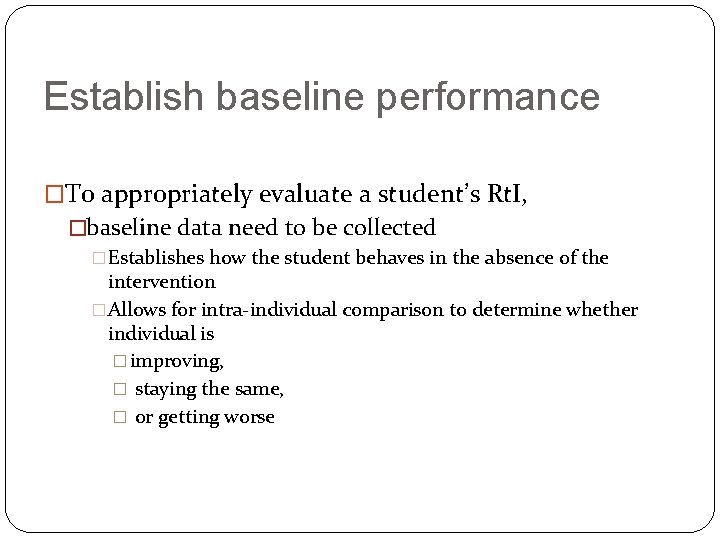
Establish baseline performance �To appropriately evaluate a student’s Rt. I, �baseline data need to be collected �Establishes how the student behaves in the absence of the intervention �Allows for intra-individual comparison to determine whether individual is � improving, � staying the same, � or getting worse
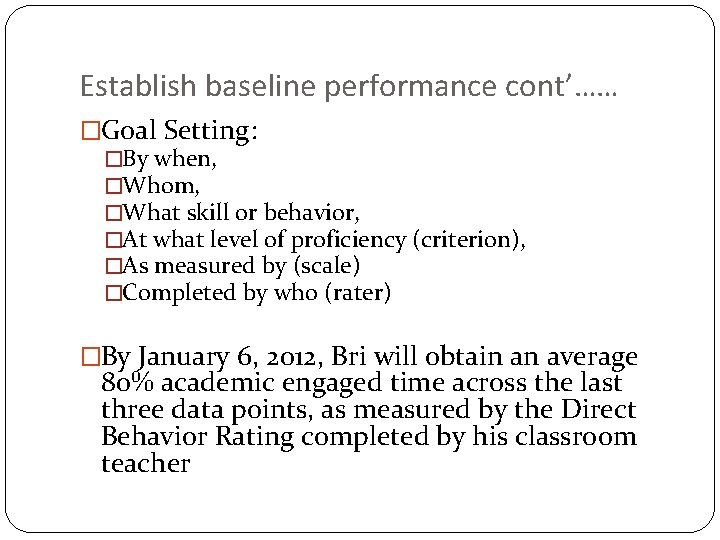
Establish baseline performance cont’…… �Goal Setting: �By when, �Whom, �What skill or behavior, �At what level of proficiency (criterion), �As measured by (scale) �Completed by who (rater) �By January 6, 2012, Bri will obtain an average 80% academic engaged time across the last three data points, as measured by the Direct Behavior Rating completed by his classroom teacher
Collect the progress monitoring data �PM data are collected at least one data point per week �A minimum of 4 data points across 4 -weeks of implementation are needed before making a databased decision �Allows for a reasonable amount of time for the student to response to the intervention �For secondary students, may need to collect PM data across multiple teachers
Input into a data management system �Input the data in Excel or another data management software program �This software should be able to generate progress monitoring graph
Generate PM graph �Generate PM graph for each student to facilitate team- based decision making �Graph should include: �Horizontal axis (weeks or PM data points) and Vertical axis (PM value) � Displays the data in a digestible manner �Baseline data are distinguished from Tier 2 and/or Tier 3 data � Allows for comparisons across phases �Behavioral Goal demarcated � Established by local norm or staff tolerance level � Allows for determination of whether behavioral goal has been reached
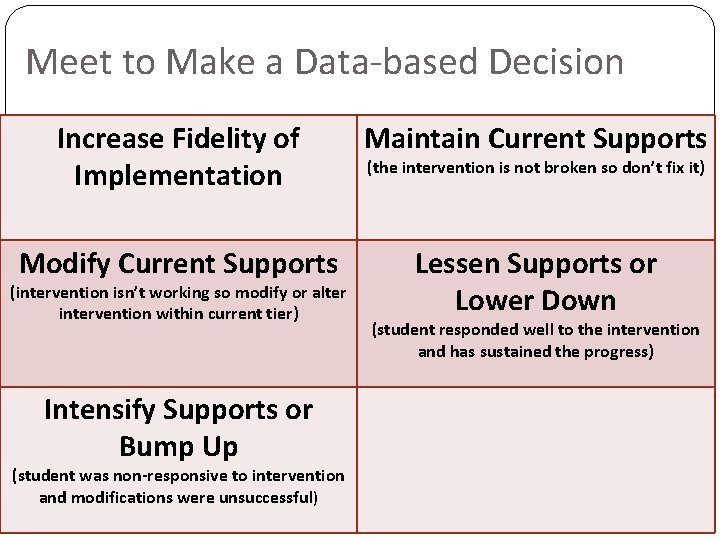
Meet to Make a Data-based Decision Increase Fidelity of Implementation Maintain Current Supports Modify Current Supports Lessen Supports or Lower Down (intervention isn’t working so modify or alter intervention within current tier) Intensify Supports or Bump Up (student was non-responsive to intervention and modifications were unsuccessful) (the intervention is not broken so don’t fix it) (student responded well to the intervention and has sustained the progress)
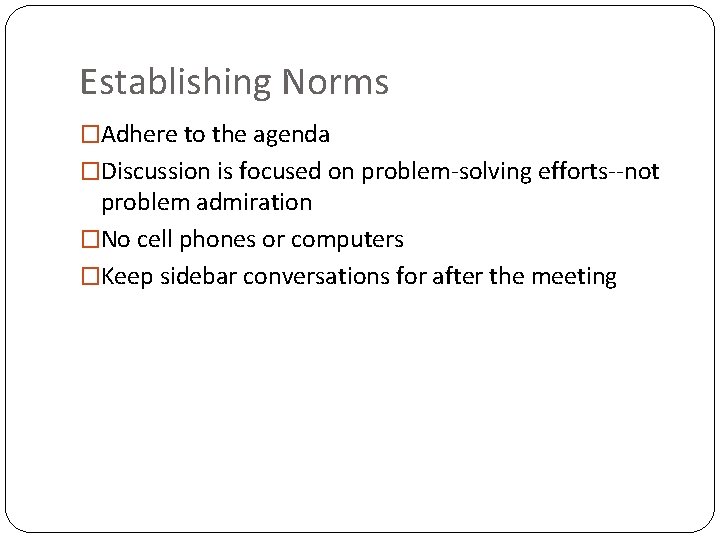
Establishing Norms �Adhere to the agenda �Discussion is focused on problem-solving efforts--not problem admiration �No cell phones or computers �Keep sidebar conversations for after the meeting
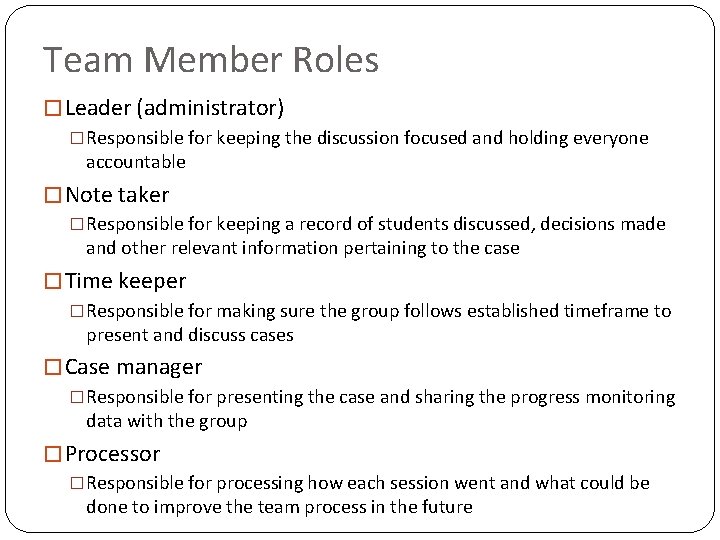
Team Member Roles �Leader (administrator) �Responsible for keeping the discussion focused and holding everyone accountable �Note taker �Responsible for keeping a record of students discussed, decisions made and other relevant information pertaining to the case �Time keeper �Responsible for making sure the group follows established timeframe to present and discuss cases �Case manager �Responsible for presenting the case and sharing the progress monitoring data with the group �Processor �Responsible for processing how each session went and what could be done to improve the team process in the future
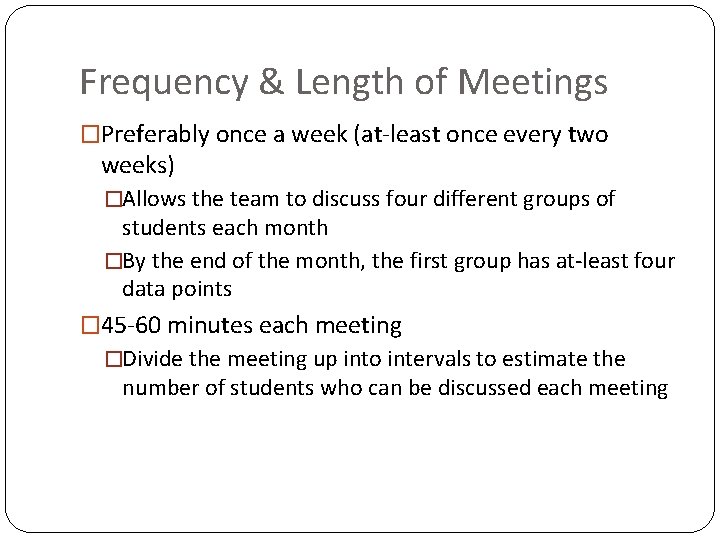
Frequency & Length of Meetings �Preferably once a week (at-least once every two weeks) �Allows the team to discuss four different groups of students each month �By the end of the month, the first group has at-least four data points � 45 -60 minutes each meeting �Divide the meeting up into intervals to estimate the number of students who can be discussed each meeting
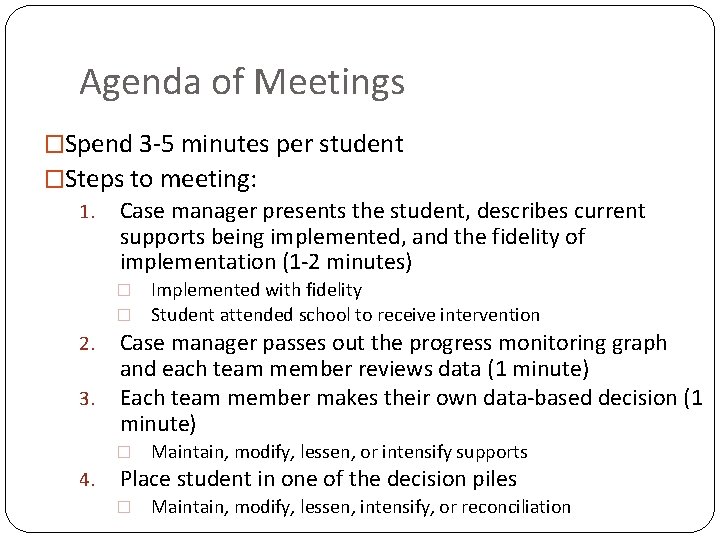
Agenda of Meetings �Spend 3 -5 minutes per student �Steps to meeting: 1. Case manager presents the student, describes current supports being implemented, and the fidelity of implementation (1 -2 minutes) � � 2. 3. Case manager passes out the progress monitoring graph and each team member reviews data (1 minute) Each team member makes their own data-based decision (1 minute) � 4. Implemented with fidelity Student attended school to receive intervention Maintain, modify, lessen, or intensify supports Place student in one of the decision piles � Maintain, modify, lessen, intensify, or reconciliation