
Aim 13 How can we use a base
Aim # 13: How can we use a base to determine the concentration of an acid? Study pp. 727 – 740 Ans. ques. p. 752 # 57, 59 Plot the titration curves of these problems Do Now: Zumdahl (8 th ed. ) 85, 109, 75 (28, 30)
I Neutralization – the reaction that occurs when an equivalent number of moles of H+ ions is added to OHions. One mole of hydrogen ions will react with one mole of hydroxide ions to produce one mole of water. Na+(aq) + OH-(aq) + H+(aq) + Cl-(aq) → H 2 O(ℓ) + Na+(aq) + Cl-(aq) Net Ionic Equation: H+(aq) + OH-(aq) → H 2 O(ℓ) II Acid-Base Titration – the molarity of an acid of unknown concentrtation can be determined by slowly adding a base of known molarity (a standard solution or titrant) with it until neutralization occurs. The endpoint may be determined by the use of an appropriate indicator. Note: The endpoint and the neutralization point are not the same.
III Titrating a strong acid (base) with a strong base (acid). A. Problem: A 50. 00 m. L solution of HNO 3 requires the addition of 25. 00 m. L of 0. 100 M Na. OH to neutralize it by turning added phenolphthalein indicator from clear to pink. What was the original concentration of the nitric acid? Ans: Ma. Va = Mb. Vb Ma = Mb. Vb = (. 100 mmol/m. L)(25. 00 m. L) Va 50. 00 m. L Ma =. 0500 mmol =. 0500 M m. L
B. Problem: From the above titration, calculate the p. H of the resulting solution after each of the following additions: a) 0 m. L Na. OH b) 20. 00 m. L Na. OH c) 24. 90 m. L Na. OH d) 25. 00 m. L Na. OH e) 25. 10 m. L Na. OH f) 26. 00 m. L Na. OH g) 35. 00 m. L Na. OH Ans: a) p. H = -log[H+] = -log(. 0500) = 1. 300 b) (. 0500 mmol/m. L H+)(50. 00 m. L) = 2. 50 mmol H+ (. 100 mmol/m. L OH-)(20. 00 m. L) = 2. 00 mmol OHmmoles H+ remaining: 2. 50 mmol H+ - 2. 00 mmol OH=. 50 mmole H + [H+] = 0. 50 mmol = 7. 14 x 10 -3 M 70. 00 m. L p. H = 2. 15
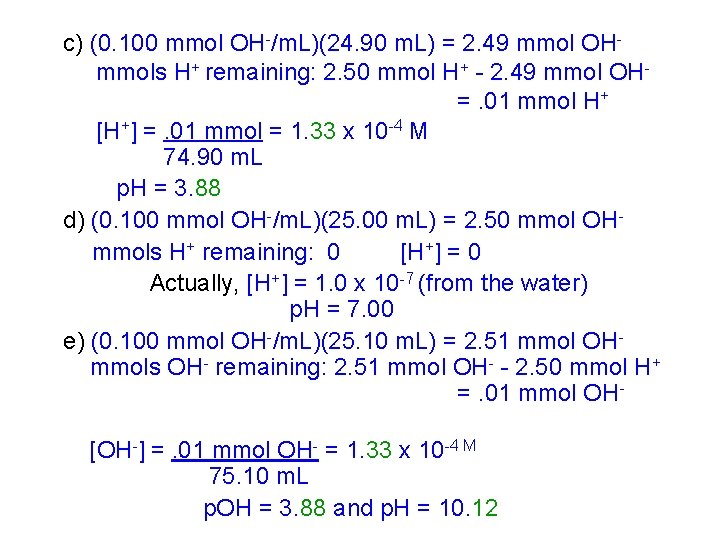
c) (0. 100 mmol OH-/m. L)(24. 90 m. L) = 2. 49 mmol OHmmols H+ remaining: 2. 50 mmol H+ - 2. 49 mmol OH=. 01 mmol H+ [H+] =. 01 mmol = 1. 33 x 10 -4 M 74. 90 m. L p. H = 3. 88 d) (0. 100 mmol OH-/m. L)(25. 00 m. L) = 2. 50 mmol OHmmols H+ remaining: 0 [H+] = 0 Actually, [H+] = 1. 0 x 10 -7 (from the water) p. H = 7. 00 e) (0. 100 mmol OH-/m. L)(25. 10 m. L) = 2. 51 mmol OHmmols OH- remaining: 2. 51 mmol OH- - 2. 50 mmol H+ =. 01 mmol OH[OH-] =. 01 mmol OH- = 1. 33 x 10 -4 M 75. 10 m. L p. OH = 3. 88 and p. H = 10. 12
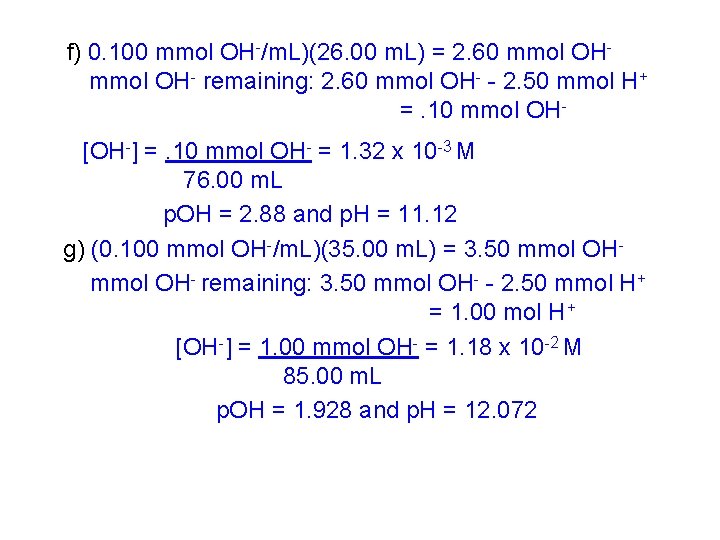
f) 0. 100 mmol OH-/m. L)(26. 00 m. L) = 2. 60 mmol OH- remaining: 2. 60 mmol OH- - 2. 50 mmol H+ =. 10 mmol OH[OH-] =. 10 mmol OH- = 1. 32 x 10 -3 M 76. 00 m. L p. OH = 2. 88 and p. H = 11. 12 g) (0. 100 mmol OH-/m. L)(35. 00 m. L) = 3. 50 mmol OH- remaining: 3. 50 mmol OH- - 2. 50 mmol H+ = 1. 00 mol H + [OH-] = 1. 00 mmol OH- = 1. 18 x 10 -2 M 85. 00 m. L p. OH = 1. 928 and p. H = 12. 072
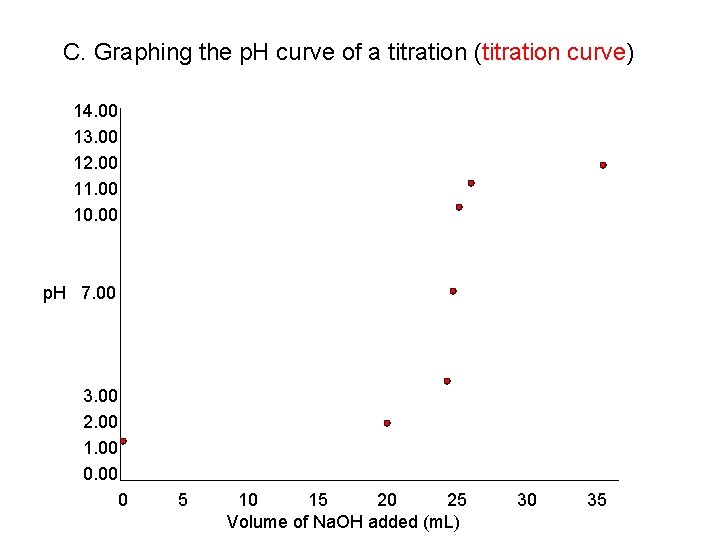
C. Graphing the p. H curve of a titration (titration curve) 14. 00 13. 00 12. 00 11. 00 10. 00 p. H 7. 00 3. 00 2. 00 1. 00 0 5 10 15 20 25 Volume of Na. OH added (m. L) 30 35
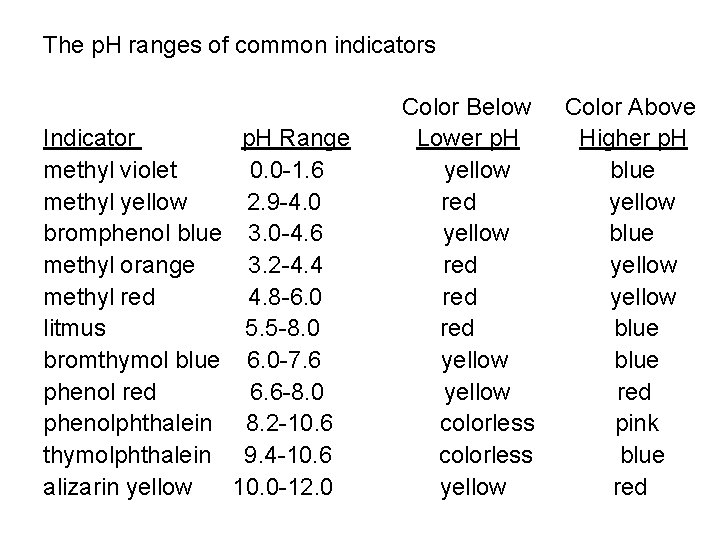
The p. H ranges of common indicators Indicator methyl violet methyl yellow bromphenol blue methyl orange methyl red litmus bromthymol blue phenol red phenolphthalein thymolphthalein alizarin yellow p. H Range 0. 0 -1. 6 2. 9 -4. 0 3. 0 -4. 6 3. 2 -4. 4 4. 8 -6. 0 5. 5 -8. 0 6. 0 -7. 6 6. 6 -8. 0 8. 2 -10. 6 9. 4 -10. 6 10. 0 -12. 0 Color Below Lower p. H yellow red red yellow colorless yellow Color Above Higher p. H blue yellow blue red pink blue red
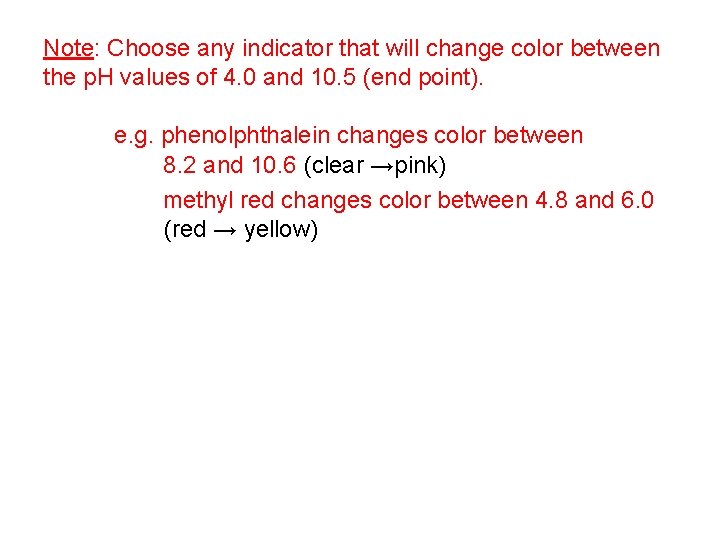
Note: Choose any indicator that will change color between the p. H values of 4. 0 and 10. 5 (end point). e. g. phenolphthalein changes color between 8. 2 and 10. 6 (clear →pink) methyl red changes color between 4. 8 and 6. 0 (red → yellow)
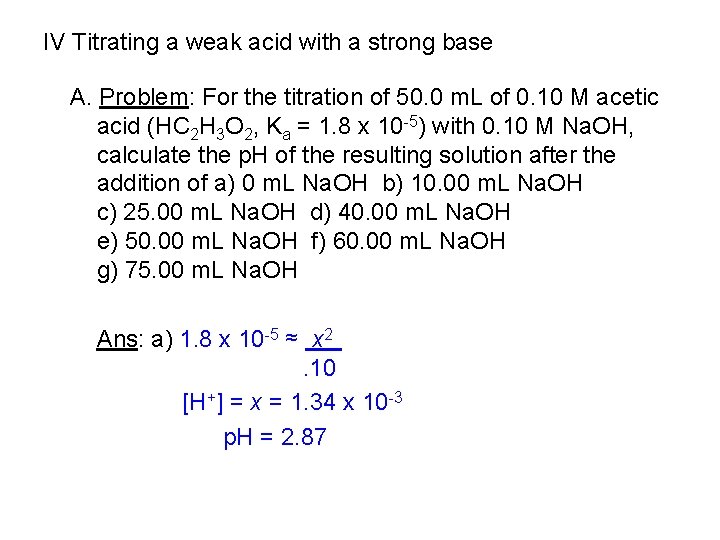
IV Titrating a weak acid with a strong base A. Problem: For the titration of 50. 0 m. L of 0. 10 M acetic acid (HC 2 H 3 O 2, Ka = 1. 8 x 10 -5) with 0. 10 M Na. OH, calculate the p. H of the resulting solution after the addition of a) 0 m. L Na. OH b) 10. 00 m. L Na. OH c) 25. 00 m. L Na. OH d) 40. 00 m. L Na. OH e) 50. 00 m. L Na. OH f) 60. 00 m. L Na. OH g) 75. 00 m. L Na. OH Ans: a) 1. 8 x 10 -5 ≈ x 2. 10 [H+] = x = 1. 34 x 10 -3 p. H = 2. 87
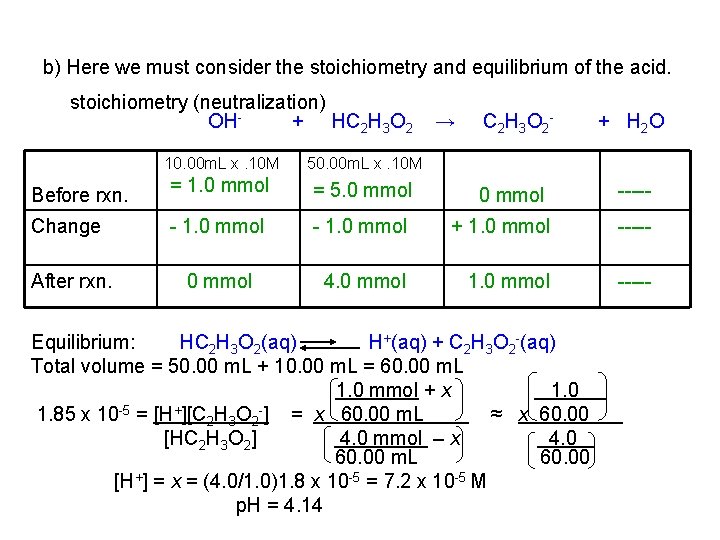
b) Here we must consider the stoichiometry and equilibrium of the acid. stoichiometry (neutralization) OH+ HC 2 H 3 O 2 → C 2 H 3 O 2 - + H 2 O 10. 00 m. L x. 10 M 50. 00 m. L x. 10 M Before rxn. = 1. 0 mmol = 5. 0 mmol Change - 1. 0 mmol + 1. 0 mmol ----- After rxn. 0 mmol 4. 0 mmol 1. 0 mmol ----- 0 mmol Equilibrium: HC 2 H 3 O 2(aq) H+(aq) + C 2 H 3 O 2 -(aq) Total volume = 50. 00 m. L + 10. 00 m. L = 60. 00 m. L 1. 0 mmol + x 1. 0 1. 85 x 10 -5 = [H+][C 2 H 3 O 2 -] = x 60. 00 m. L ≈ x 60. 00 [HC 2 H 3 O 2] 4. 0 mmol – x 4. 0 60. 00 m. L 60. 00 [H+] = x = (4. 0/1. 0)1. 8 x 10 -5 = 7. 2 x 10 -5 M p. H = 4. 14
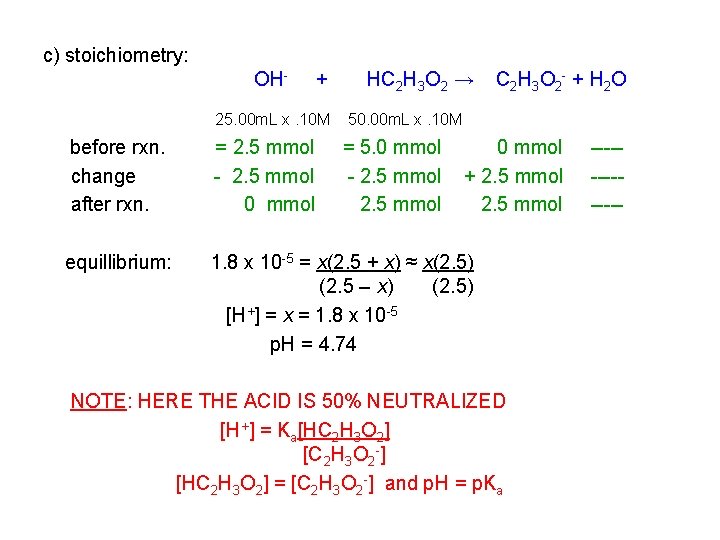
c) stoichiometry: OH- + 25. 00 m. L x. 10 M HC 2 H 3 O 2 → C 2 H 3 O 2 - + H 2 O 50. 00 m. L x. 10 M before rxn. change after rxn. = 2. 5 mmol - 2. 5 mmol 0 mmol = 5. 0 mmol - 2. 5 mmol 0 mmol + 2. 5 mmol equillibrium: 1. 8 x 10 -5 = x(2. 5 + x) ≈ x(2. 5) (2. 5 – x) (2. 5) [H+] = x = 1. 8 x 10 -5 p. H = 4. 74 NOTE: HERE THE ACID IS 50% NEUTRALIZED [H+] = Ka[HC 2 H 3 O 2] [C 2 H 3 O 2 -] [HC 2 H 3 O 2] = [C 2 H 3 O 2 -] and p. H = p. Ka -------
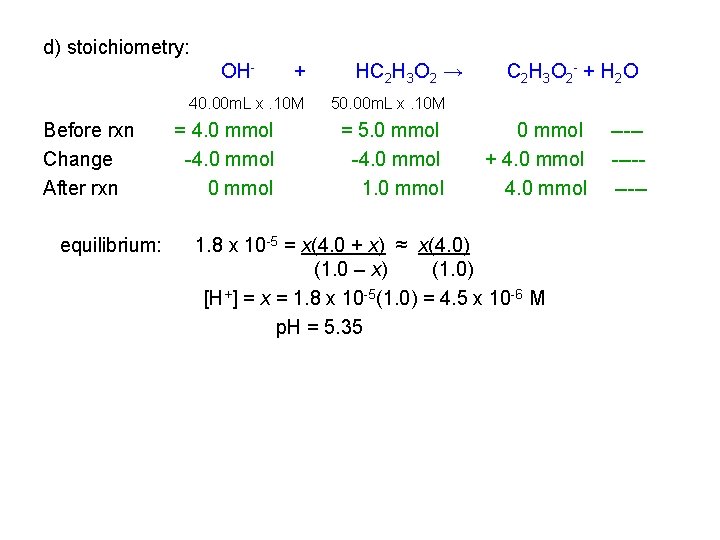
d) stoichiometry: OH- + 40. 00 m. L x. 10 M Before rxn Change After rxn equilibrium: = 4. 0 mmol -4. 0 mmol HC 2 H 3 O 2 → C 2 H 3 O 2 - + H 2 O 50. 00 m. L x. 10 M = 5. 0 mmol -4. 0 mmol 1. 0 mmol + 4. 0 mmol 1. 8 x 10 -5 = x(4. 0 + x) ≈ x(4. 0) (1. 0 – x) (1. 0) [H+] = x = 1. 8 x 10 -5(1. 0) = 4. 5 x 10 -6 M p. H = 5. 35 -------
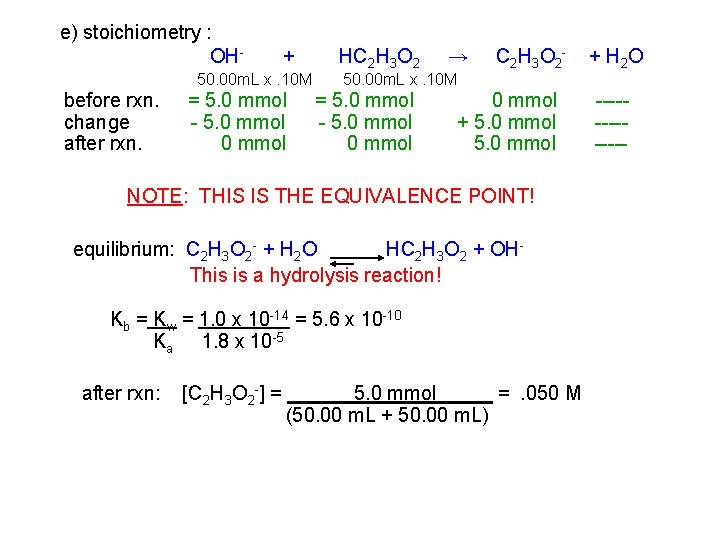
e) stoichiometry : OH- + 50. 00 m. L x. 10 M before rxn. change after rxn. = 5. 0 mmol - 5. 0 mmol HC 2 H 3 O 2 → 50. 00 m. L x. 10 M = 5. 0 mmol - 5. 0 mmol C 2 H 3 O 2 - 0 mmol + 5. 0 mmol NOTE: THIS IS THE EQUIVALENCE POINT! equilibrium: C 2 H 3 O 2 - + H 2 O HC 2 H 3 O 2 + OHThis is a hydrolysis reaction! Kb = Kw = 1. 0 x 10 -14 = 5. 6 x 10 -10 Ka 1. 8 x 10 -5 after rxn: [C 2 H 3 O 2 -] = 5. 0 mmol =. 050 M (50. 00 m. L + 50. 00 m. L) + H 2 O -------
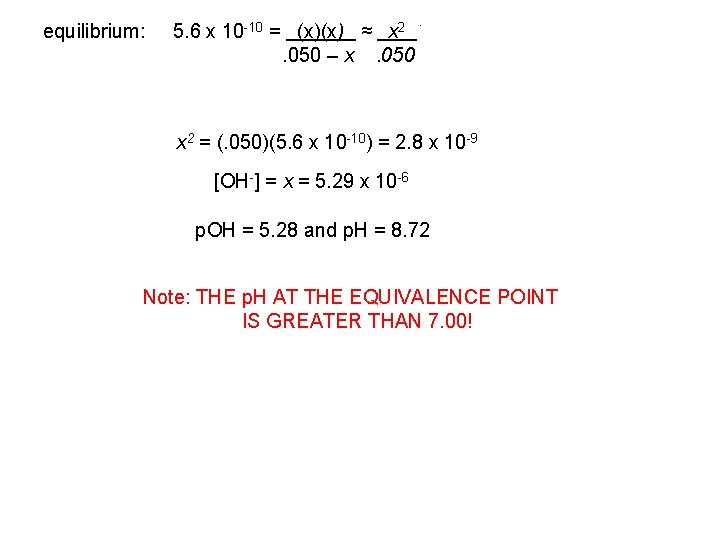
equilibrium: 5. 6 x 10 -10 = (x)(x) ≈ x 2 . 050 – x. 050 x 2 = (. 050)(5. 6 x 10 -10) = 2. 8 x 10 -9 [OH-] = x = 5. 29 x 10 -6 p. OH = 5. 28 and p. H = 8. 72 Note: THE p. H AT THE EQUIVALENCE POINT IS GREATER THAN 7. 00!
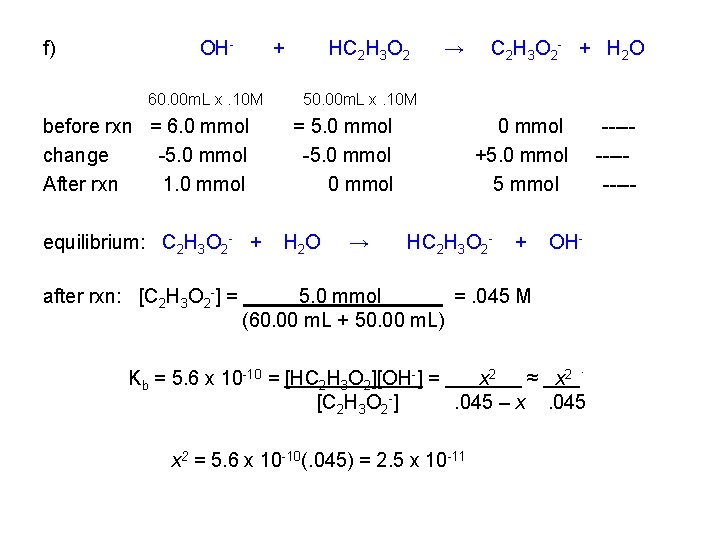
f) OH- + 60. 00 m. L x. 10 M before rxn = 6. 0 mmol change -5. 0 mmol After rxn 1. 0 mmol equilibrium: C 2 H 3 O 2 - + after rxn: [C 2 H 3 O 2 -] = HC 2 H 3 O 2 → C 2 H 3 O 2 - + H 2 O 50. 00 m. L x. 10 M = 5. 0 mmol -5. 0 mmol H 2 O → 0 mmol +5. 0 mmol 5 mmol HC 2 H 3 O 2 - + OH- 5. 0 mmol =. 045 M (60. 00 m. L + 50. 00 m. L) Kb = 5. 6 x 10 -10 = [HC 2 H 3 O 2][OH-] = x 2 ≈ x 2 [C 2 H 3 O 2 -]. 045 – x. 045 x 2 = 5. 6 x 10 -10(. 045) = 2. 5 x 10 -11 -------
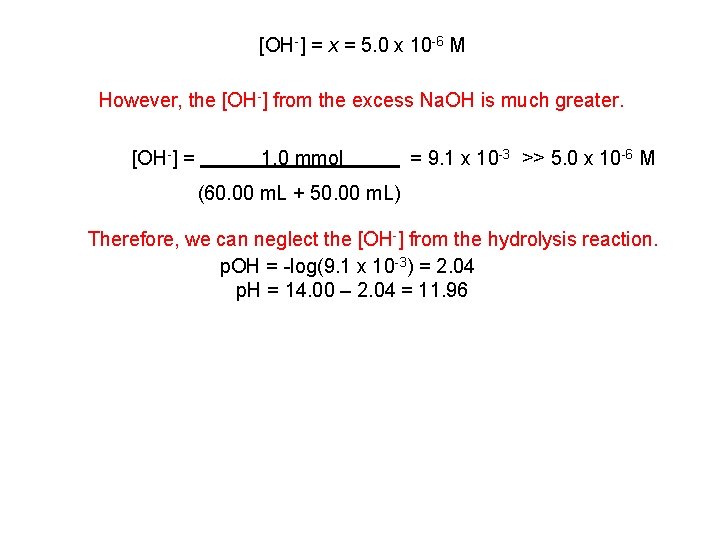
[OH -] = x = 5. 0 x 10 -6 M However, the [OH-] from the excess Na. OH is much greater. [OH-] = 1. 0 mmol = 9. 1 x 10 -3 >> 5. 0 x 10 -6 M (60. 00 m. L + 50. 00 m. L) Therefore, we can neglect the [OH-] from the hydrolysis reaction. p. OH = -log(9. 1 x 10 -3) = 2. 04 p. H = 14. 00 – 2. 04 = 11. 96
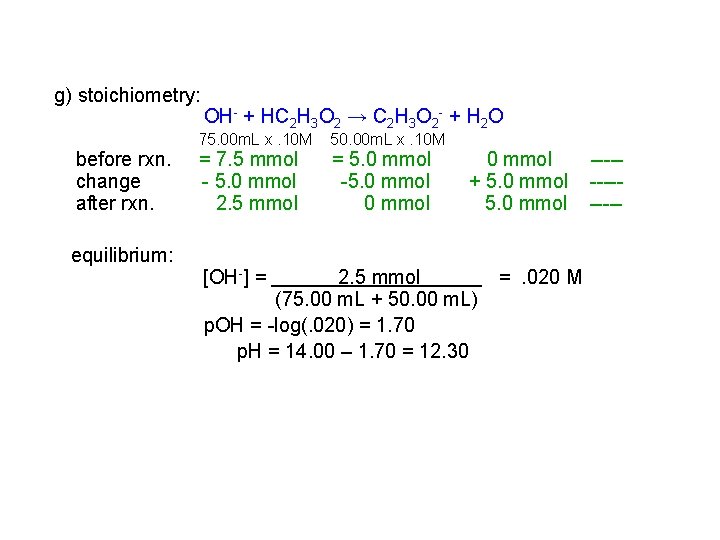
g) stoichiometry: before rxn. change after rxn. equilibrium: OH- + HC 2 H 3 O 2 → C 2 H 3 O 2 - + H 2 O 75. 00 m. L x. 10 M 50. 00 m. L x. 10 M = 7. 5 mmol - 5. 0 mmol 2. 5 mmol = 5. 0 mmol -5. 0 mmol [OH-] = 0 mmol + 5. 0 mmol 2. 5 mmol (75. 00 m. L + 50. 00 m. L) p. OH = -log(. 020) = 1. 70 p. H = 14. 00 – 1. 70 = 12. 30 =. 020 M -------
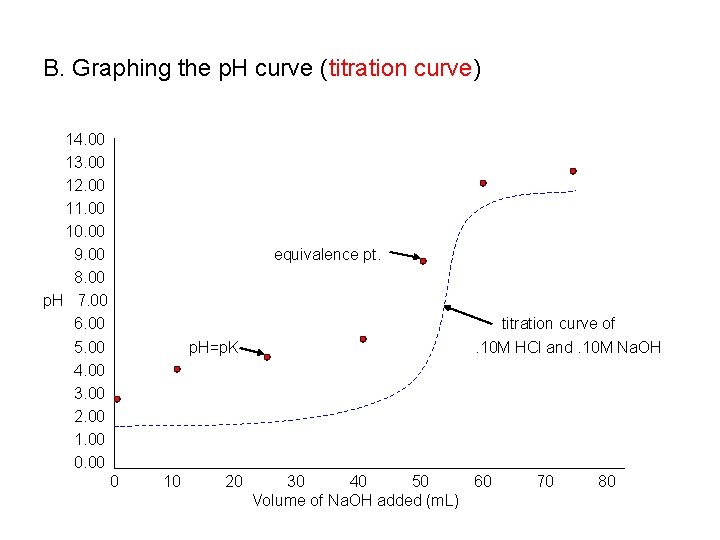
B. Graphing the p. H curve (titration curve) 14. 00 13. 00 12. 00 11. 00 10. 00 9. 00 8. 00 p. H 7. 00 6. 00 5. 00 4. 00 3. 00 2. 00 1. 00 0. 00 equivalence pt. p. H=p. K 0 10 20 titration curve of. 10 M HCl and. 10 M Na. OH 30 40 50 60 Volume of Na. OH added (m. L) 70 80
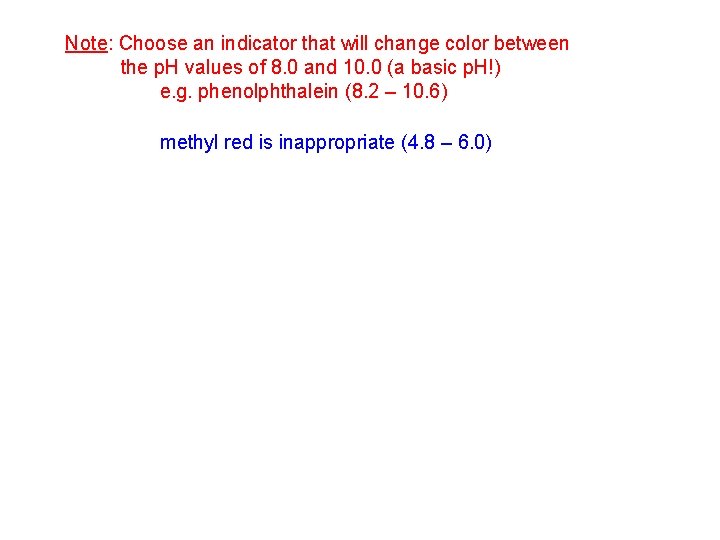
Note: Choose an indicator that will change color between the p. H values of 8. 0 and 10. 0 (a basic p. H!) e. g. phenolphthalein (8. 2 – 10. 6) methyl red is inappropriate (4. 8 – 6. 0)
- Slides: 20