
AIG Booster Shots Differentiating for AIG Learners Tiered
AIG Booster Shots Differentiating for AIG Learners: Tiered Assignments Session #3
What have you noticed about the questions you pose? • Are they challenging enough for AIGs? In what ways? • How have you adapted the questions you ask? 3 -Minute Reflection
Why use tiered assignments? • No class is homogeneous. • There is always a student who is working at the top of the class…and one working at the bottom. • We MUST ensure that ALL learners find challenge and success.
Think about something you’re currently teaching: • Which students already know it? • Which students are struggling with it? • How will a “one size fits all” approach impact their learning? 2 -Minute Reflection
Let’s agree… A “one size fits all” approach does NOT allow us to appropriately challenge our highest-ability learners.
An example: Compound words Objective: Students will be able to identify and spell compound words. Teacher observation: Some students are already familiar with compound words while others are not.
An example: Compound words Day 1: Informal pre-assessment Whole-group discussion and sharing of compound words
An example: Compound words Day 2: Tiered independent practice Tier 1: Create familiar compound words using simple words (for example, ball and foot) Tier 2: Create unknown compound words and use them to complete sentences
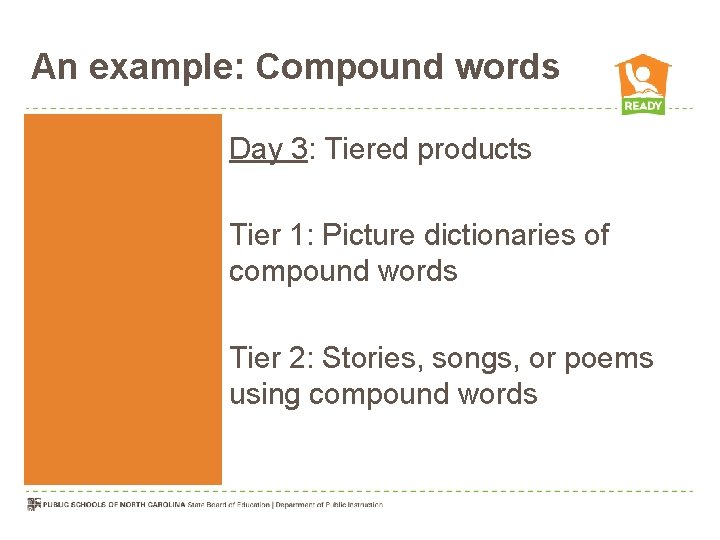
An example: Compound words Day 3: Tiered products Tier 1: Picture dictionaries of compound words Tier 2: Stories, songs, or poems using compound words
Tiered assignments… • Allow teachers to address readiness/ability differences. • Can occur in any class, even in ability-based classes. • Are assigned by teachers rather than chosen by students. • Focus on the same objective(s) for all learners. • Require proactive and purposeful planning.
Where should you use tiered assignments? Where do your students approach the curriculum with varying levels of readiness? 3 -Minute Task
Why tier in math? • Some students develop abstract thinking more quickly • Skills are lock step (from A to B, from B to C…) • Need to grow from different starting points
Creating tiered assignments Step 1 Identify/name the standards, objectives, goals: • What should students know, understand, and be able to do?
Creating tiered assignments Step 2 Assess: • What do they already know? • What can they already do? • Who has a solid grasp of the objective(s)?
Creating tiered assignments Step 3 Design/find a lesson/task that supports the stated objective(s): • Is the task engaging? • Is it aligned with the objective(s)?
Creating tiered assignments Step 4 Create additional tiered tasks • How can the initial task be modified to better meet students’ needs?
Creating tiered assignments Step 5 Assign students to tiers: • Which tasks are appropriate for which learners?
Maker’s Modifications for Gifted Learners • Addresses content, process, and product Examples • Content: abstract and complex ideas, texts • Process: importance of discovery, drawing conclusions • Product: real problems and audiences
Tomlinson’s Equalizer • Highlights a variety of ways to modify lessons /tasks Examples • Multiple steps • Varied resources • Streamlined pacing
AIG learners need to… • Make connections between seemingly unrelated ideas, events, and people. • Evaluate ideas, theories, and approaches. • Apply abstract concepts to the world around them. • Work with open-ended questions and problems. • Grapple with complex instructions and resources. • Use and transform their learning.
Create a Power. Point presentation to Comparing teach other 5 th graders about the tasks: amendments to the Constitution. Your presentation should be informative, engaging, and accurate. Task #1 Each slide should include both words and visuals that will help your audience to better understand Constitutional amendments.
You are a US senator representing NC. Your task is to propose a 28 th amendment to the US Constitution. To complete your task, you must identify a current problem or issue that has not been addressed previously in the Constitution OR that needs to be revisited. You will present your amendment to your fellow senators in a short speech and multimedia presentation that includes pictures, statistics, and individual stories designed to persuade your fellow senators of the necessity of your amendment. Comparing tasks: Task #2
• How do the 2 tasks differ? • Is one more appropriate for AIGs? WHY? • What is challenging about it? • What knowledge and skills does it require? 4 -Minute Task: Comparing tasks
The second task requires AIGs to… • Know previous amendments • Analyze and evaluate current issues • Provide supporting evidence • Grapple with complexity • Solve a real-world problem • Create something new
Upcoming AIG Booster Shots • Curriculum Compacting • Seminars • Concept-based teaching • Concept Development • Projects, independent studies, small-group investigations
- Slides: 25