
AICPA Ethics Codification Project As of January 24
- Slides: 24
AICPA Ethics Codification Project As of January 24, 2014
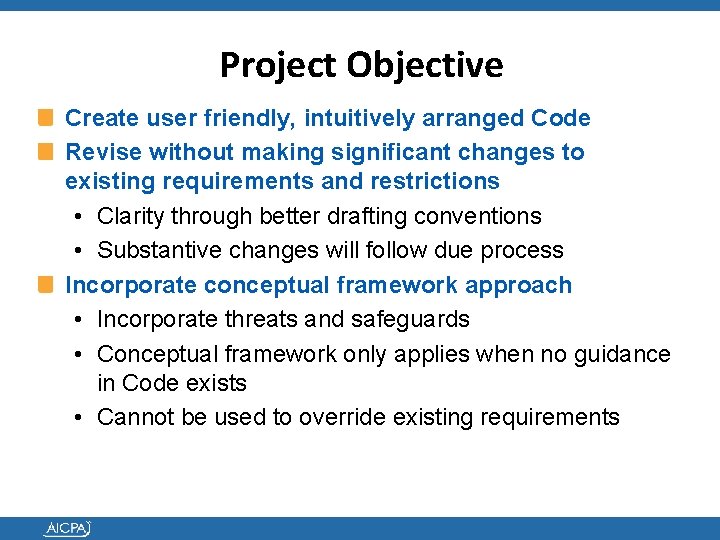
Project Objective Create user friendly, intuitively arranged Code Revise without making significant changes to existing requirements and restrictions • Clarity through better drafting conventions • Substantive changes will follow due process Incorporate conceptual framework approach • Incorporate threats and safeguards • Conceptual framework only applies when no guidance in Code exists • Cannot be used to override existing requirements
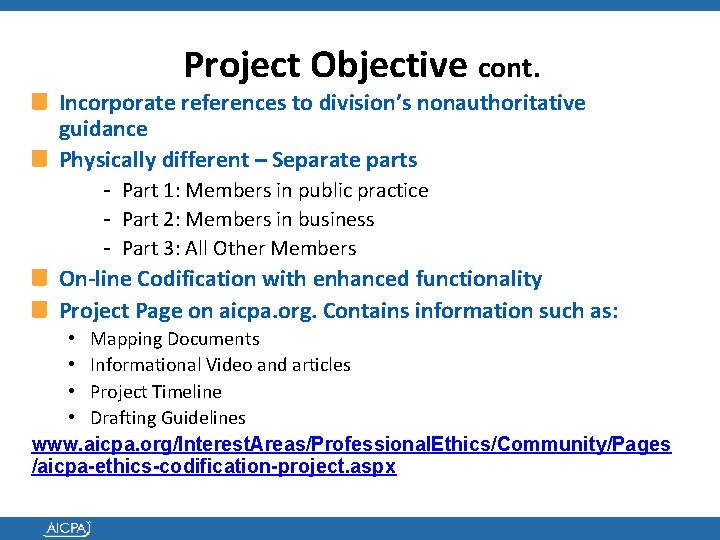
Project Objective cont. Incorporate references to division’s nonauthoritative guidance Physically different – Separate parts - Part 1: Members in public practice - Part 2: Members in business - Part 3: All Other Members On-line Codification with enhanced functionality Project Page on aicpa. org. Contains information such as: • Mapping Documents • Informational Video and articles • Project Timeline • Drafting Guidelines www. aicpa. org/Interest. Areas/Professional. Ethics/Community/Pages /aicpa-ethics-codification-project. aspx
Substantive Changes AICPA Ethics Codification
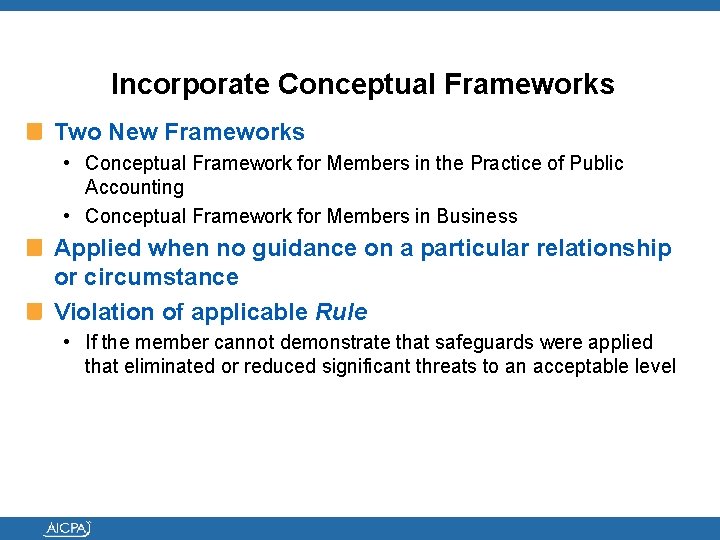
Incorporate Conceptual Frameworks Two New Frameworks • Conceptual Framework for Members in the Practice of Public Accounting • Conceptual Framework for Members in Business Applied when no guidance on a particular relationship or circumstance Violation of applicable Rule • If the member cannot demonstrate that safeguards were applied that eliminated or reduced significant threats to an acceptable level
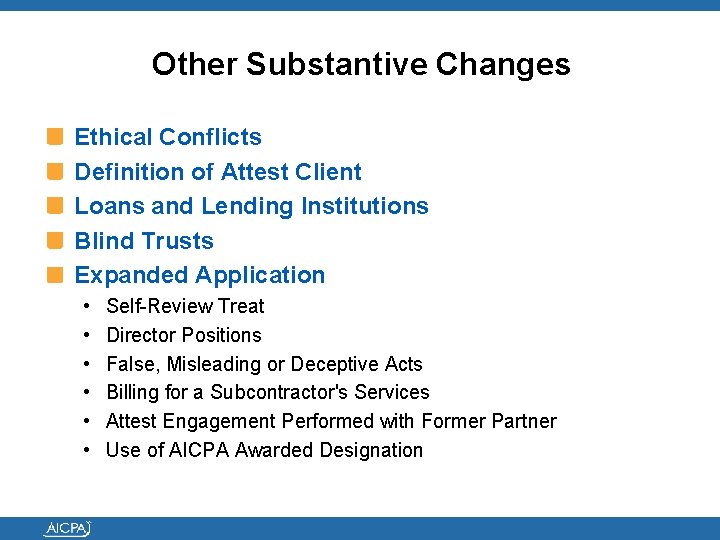
Other Substantive Changes Ethical Conflicts Definition of Attest Client Loans and Lending Institutions Blind Trusts Expanded Application • • • Self-Review Treat Director Positions False, Misleading or Deceptive Acts Billing for a Subcontractor's Services Attest Engagement Performed with Former Partner Use of AICPA Awarded Designation
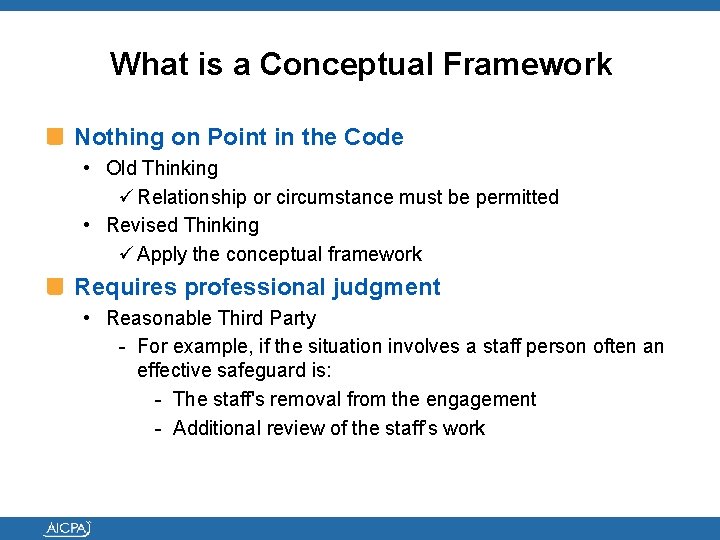
What is a Conceptual Framework Nothing on Point in the Code • Old Thinking ü Relationship or circumstance must be permitted • Revised Thinking ü Apply the conceptual framework Requires professional judgment • Reasonable Third Party - For example, if the situation involves a staff person often an effective safeguard is: - The staff's removal from the engagement - Additional review of the staff’s work
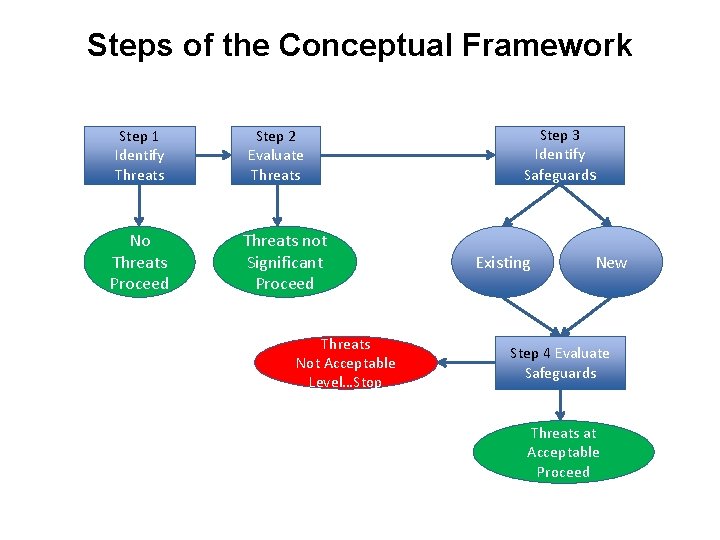
Steps of the Conceptual Framework Step 1 Identify Threats No Threats Proceed Step 2 Evaluate Threats not Significant Proceed Threats Not Acceptable Level…Stop Step 3 Identify Safeguards Existing New Step 4 Evaluate Safeguards Threats at Acceptable Proceed
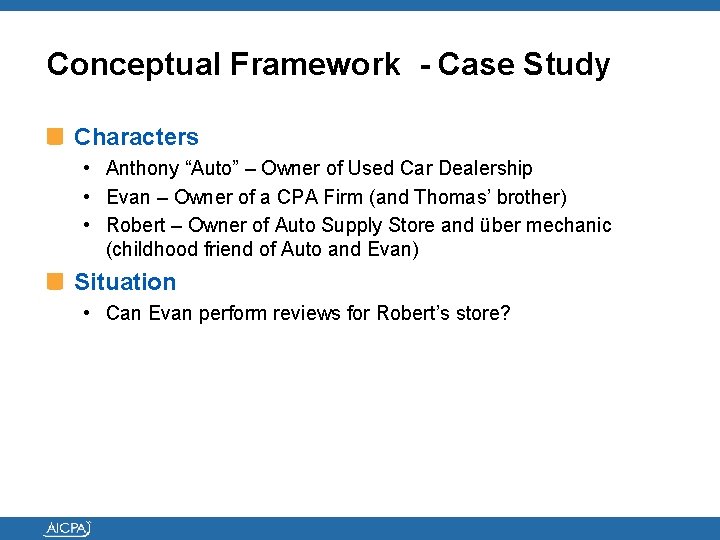
Conceptual Framework - Case Study Characters • Anthony “Auto” – Owner of Used Car Dealership • Evan – Owner of a CPA Firm (and Thomas’ brother) • Robert – Owner of Auto Supply Store and über mechanic (childhood friend of Auto and Evan) Situation • Can Evan perform reviews for Robert’s store?
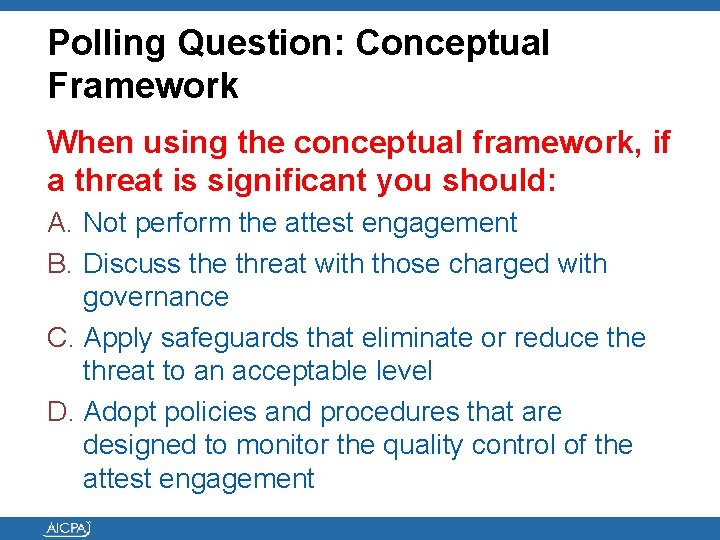
Polling Question: Conceptual Framework When using the conceptual framework, if a threat is significant you should: A. Not perform the attest engagement B. Discuss the threat with those charged with governance C. Apply safeguards that eliminate or reduce threat to an acceptable level D. Adopt policies and procedures that are designed to monitor the quality control of the attest engagement
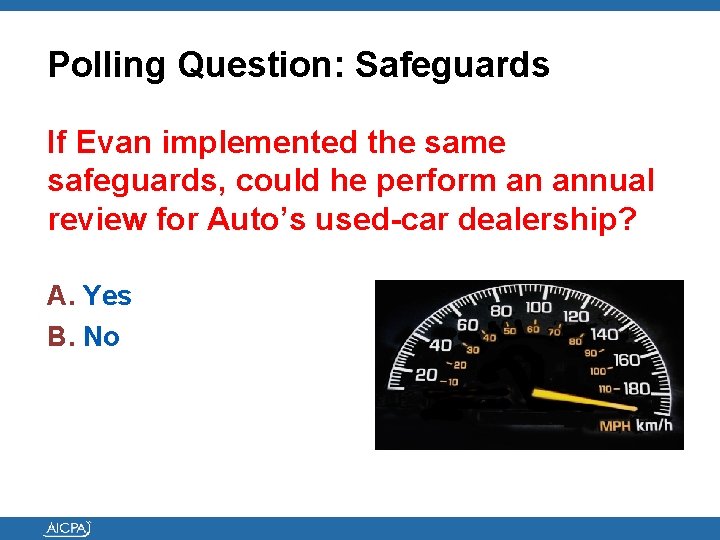
Polling Question: Safeguards If Evan implemented the same safeguards, could he perform an annual review for Auto’s used-car dealership? A. Yes B. No
Nonauthoritative Guidance AICPA Ethics Codification
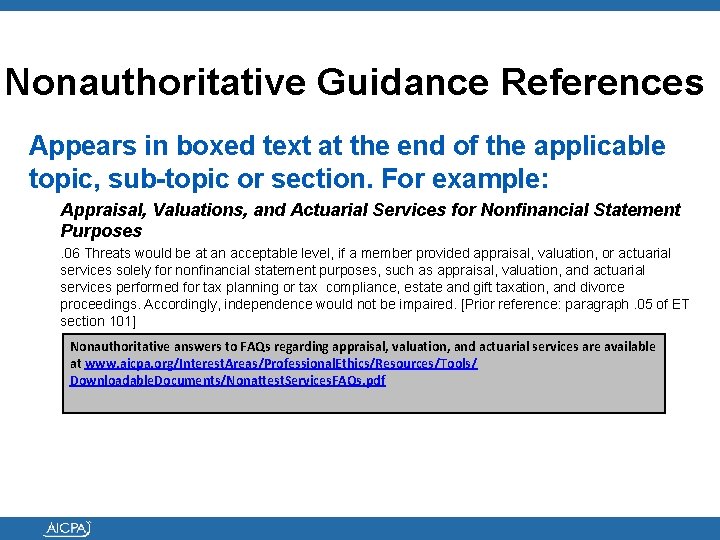
Nonauthoritative Guidance References Appears in boxed text at the end of the applicable topic, sub-topic or section. For example: Appraisal, Valuations, and Actuarial Services for Nonfinancial Statement Purposes. 06 Threats would be at an acceptable level, if a member provided appraisal, valuation, or actuarial services solely for nonfinancial statement purposes, such as appraisal, valuation, and actuarial services performed for tax planning or tax compliance, estate and gift taxation, and divorce proceedings. Accordingly, independence would not be impaired. [Prior reference: paragraph. 05 of ET section 101] Nonauthoritative answers to FAQs regarding appraisal, valuation, and actuarial services are available at www. aicpa. org/Interest. Areas/Professional. Ethics/Resources/Tools/ Downloadable. Documents/Nonattest. Services. FAQs. pdf
Visual Example AICPA Ethics Codification
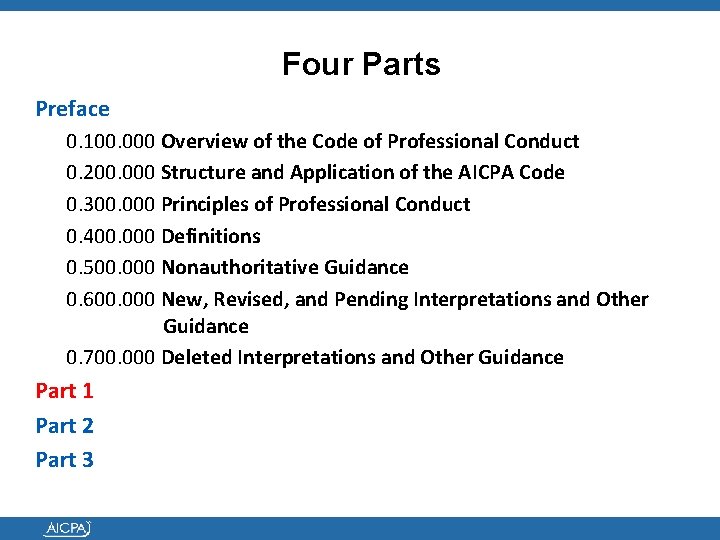
Four Parts Preface 0. 100. 000 Overview of the Code of Professional Conduct 0. 200. 000 Structure and Application of the AICPA Code 0. 300. 000 Principles of Professional Conduct 0. 400. 000 Definitions 0. 500. 000 Nonauthoritative Guidance 0. 600. 000 New, Revised, and Pending Interpretations and Other Guidance 0. 700. 000 Deleted Interpretations and Other Guidance Part 1 Part 2 Part 3
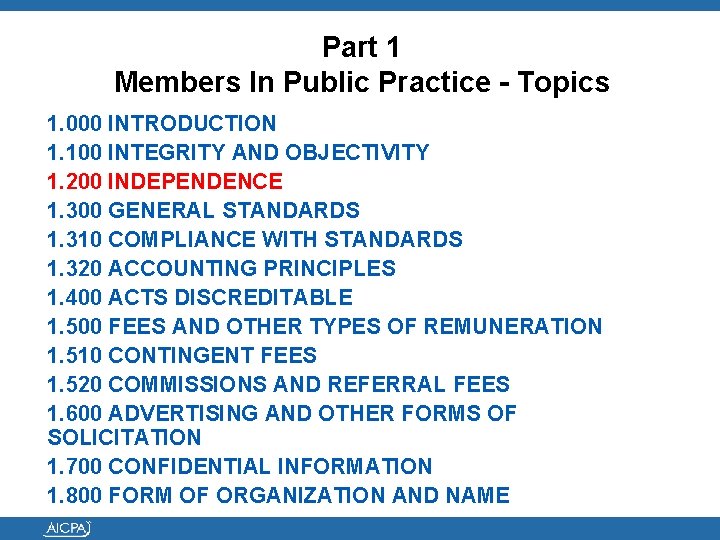
Part 1 Members In Public Practice - Topics 1. 000 INTRODUCTION 1. 100 INTEGRITY AND OBJECTIVITY 1. 200 INDEPENDENCE 1. 300 GENERAL STANDARDS 1. 310 COMPLIANCE WITH STANDARDS 1. 320 ACCOUNTING PRINCIPLES 1. 400 ACTS DISCREDITABLE 1. 500 FEES AND OTHER TYPES OF REMUNERATION 1. 510 CONTINGENT FEES 1. 520 COMMISSIONS AND REFERRAL FEES 1. 600 ADVERTISING AND OTHER FORMS OF SOLICITATION 1. 700 CONFIDENTIAL INFORMATION 1. 800 FORM OF ORGANIZATION AND NAME
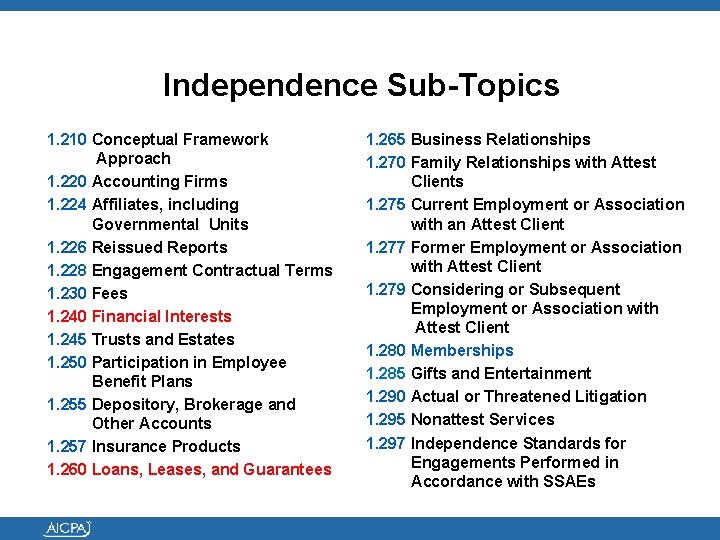
Independence Sub-Topics 1. 210 Conceptual Framework Approach 1. 220 Accounting Firms 1. 224 Affiliates, including Governmental Units 1. 226 Reissued Reports 1. 228 Engagement Contractual Terms 1. 230 Fees 1. 240 Financial Interests 1. 245 Trusts and Estates 1. 250 Participation in Employee Benefit Plans 1. 255 Depository, Brokerage and Other Accounts 1. 257 Insurance Products 1. 260 Loans, Leases, and Guarantees 1. 265 Business Relationships 1. 270 Family Relationships with Attest Clients 1. 275 Current Employment or Association with an Attest Client 1. 277 Former Employment or Association with Attest Client 1. 279 Considering or Subsequent Employment or Association with Attest Client 1. 280 Memberships 1. 285 Gifts and Entertainment 1. 290 Actual or Threatened Litigation 1. 295 Nonattest Services 1. 297 Independence Standards for Engagements Performed in Accordance with SSAEs
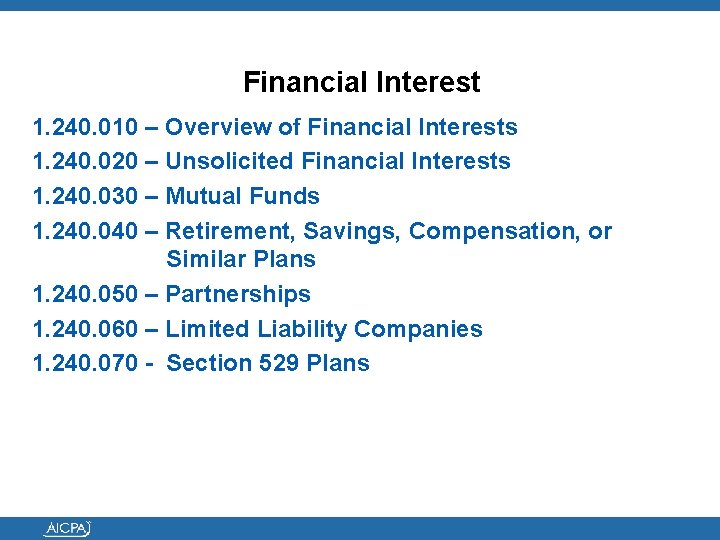
Financial Interest 1. 240. 010 – Overview of Financial Interests 1. 240. 020 – Unsolicited Financial Interests 1. 240. 030 – Mutual Funds 1. 240. 040 – Retirement, Savings, Compensation, or Similar Plans 1. 240. 050 – Partnerships 1. 240. 060 – Limited Liability Companies 1. 240. 070 - Section 529 Plans
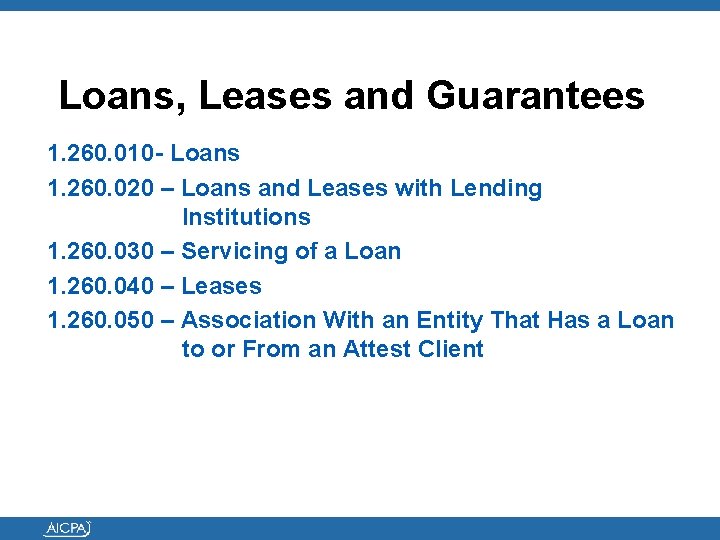
Loans, Leases and Guarantees 1. 260. 010 - Loans 1. 260. 020 – Loans and Leases with Lending Institutions 1. 260. 030 – Servicing of a Loan 1. 260. 040 – Leases 1. 260. 050 – Association With an Entity That Has a Loan to or From an Attest Client
Mapping Content and Citations AICPA Ethics Codification
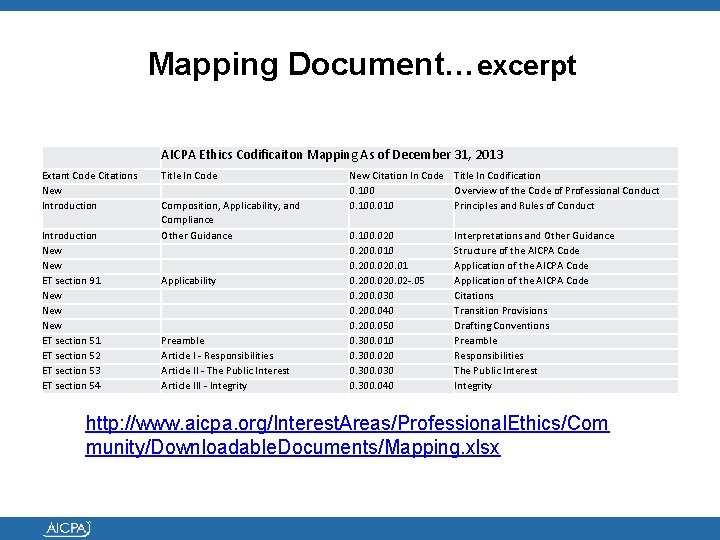
Mapping Document…excerpt AICPA Ethics Codificaiton Mapping As of December 31, 2013 Extant Code Citations New Introduction Title In Code Composition, Applicability, and Compliance New Citation In Code Title In Codification 0. 100 Overview of the Code of Professional Conduct 0. 100. 010 Principles and Rules of Conduct Introduction New ET section 91 New New ET section 51 ET section 52 ET section 53 ET section 54 Other Guidance Applicability Preamble Article I - Responsibilities Article II - The Public Interest Article III - Integrity 0. 100. 020 0. 200. 010 0. 200. 020. 01 0. 200. 02 -. 05 0. 200. 030 0. 200. 040 0. 200. 050 0. 300. 010 0. 300. 020 0. 300. 030 0. 300. 040 Interpretations and Other Guidance Structure of the AICPA Code Application of the AICPA Code Citations Transition Provisions Drafting Conventions Preamble Responsibilities The Public Interest Integrity http: //www. aicpa. org/Interest. Areas/Professional. Ethics/Com munity/Downloadable. Documents/Mapping. xlsx
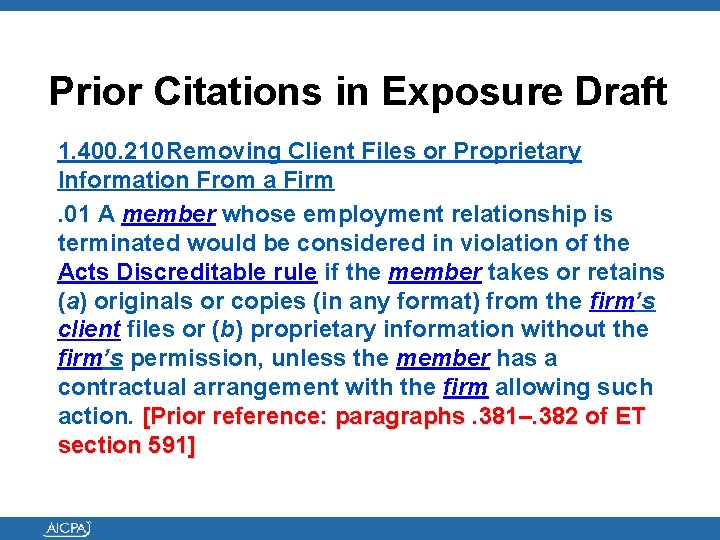
Prior Citations in Exposure Draft 1. 400. 210 Removing Client Files or Proprietary Information From a Firm. 01 A member whose employment relationship is terminated would be considered in violation of the Acts Discreditable rule if the member takes or retains (a) originals or copies (in any format) from the firm’s client files or (b) proprietary information without the firm’s permission, unless the member has a contractual arrangement with the firm allowing such action. [Prior reference: paragraphs. 381–. 382 of ET section 591]
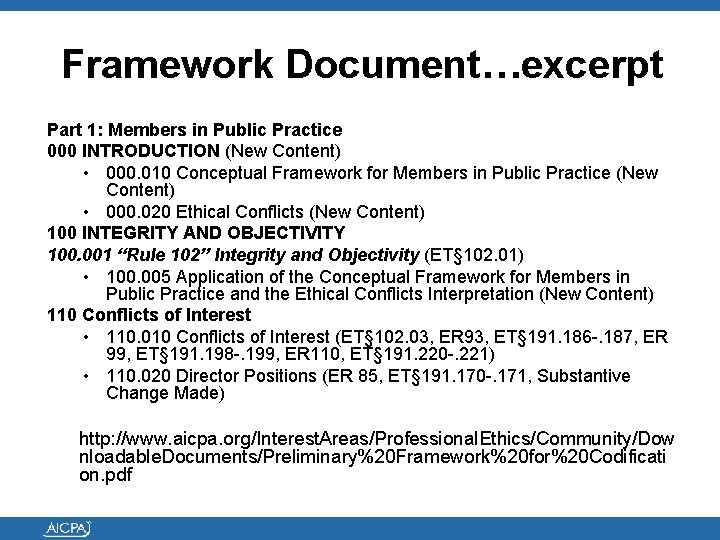
Framework Document…excerpt Part 1: Members in Public Practice 000 INTRODUCTION (New Content) • 000. 010 Conceptual Framework for Members in Public Practice (New Content) • 000. 020 Ethical Conflicts (New Content) 100 INTEGRITY AND OBJECTIVITY 100. 001 “Rule 102” Integrity and Objectivity (ET§ 102. 01) • 100. 005 Application of the Conceptual Framework for Members in Public Practice and the Ethical Conflicts Interpretation (New Content) 110 Conflicts of Interest • 110. 010 Conflicts of Interest (ET§ 102. 03, ER 93, ET§ 191. 186 -. 187, ER 99, ET§ 191. 198 -. 199, ER 110, ET§ 191. 220 -. 221) • 110. 020 Director Positions (ER 85, ET§ 191. 170 -. 171, Substantive Change Made) http: //www. aicpa. org/Interest. Areas/Professional. Ethics/Community/Dow nloadable. Documents/Preliminary%20 Framework%20 for%20 Codificati on. pdf
Questions Slide 24