
AICE Marine Science Objective 4 Nutrient cycles in
AICE Marine Science Objective #4 Nutrient cycles in marine ecosystems • Inputs & outputs to the reservoir of dissolved nutrients. • The biological uses of nutrients. • Nutrient availability & productivity
(a) Demonstrate an understanding that there is a reservoir of nutrients dissolved in the surface layer of the ocean. Algae require light for photosynthesis. Light intensity decreases as the depth of the ocean increases & therefore photosynthesis is restricted to a surface layer in which there is sufficient light. This layer (referred to as the ‘photic zone’) varies in depth from about 30 m to 150 m, although it is considerably less turbid water. The surface layer of the ocean contains many different ions, some of which are shown in Table 4. 1.
(a. ) Demonstrate an understanding that there is a reservoir of nutrients dissolved in the surface layer of the ocean. Table 4. 1 Concentrations of major ions in typical sea water Ion Mean concentration in seawater (parts per thousand) Chloride 19. 345 Sodium 10. 752 Sulphate 2. 701 Magnesium 1. 295 Calcium 0. 416 Hydrogencarbonate 0. 145 These ions, together with nitrate & phosphate ions, form a reservoir of nutrients for the growth of algae & other primary producers. Nitrate & phosphate ions occur at low concentrations in sea water; the mean concentration of nitrate is 0. 5 parts per million (ppm) & the mean concentration of phosphate in seawater is 0. 07 ppm.
(b) Explain the processes by which the reservoir of dissolved nutrients is replenished, including upwelling, runoff from the land & dissolving of atmospheric gases Upwelling is the movement of water from deep in the ocean to the surface layer, where the nutrients become available to primary producers. Upwelling is brought about by several processes including the deflection of deep water currents upwards & the movement of water away from a coast by the action of wind. Run-off from the land is part of the hydrological cycle & the water may leach nutrients, including nitrates & phosphates, from the soil. Carbon dioxide in the atmosphere dissolves in seawater forming hydrogencarbonate ions (HCO 3– ), making carbon dioxide available for fixation in the process of photosynthesis, by primary producers.
(b) cont. Explain the processes by which the reservoir of dissolved nutrients is replenished, including upwelling, runoff from the land & dissolving of atmospheric gases Atmospheric nitrogen gas is fixed by blue-green algae in intertidal zones, resulting in the formation of nitrogencontaining organic compounds. In this way, nitrogen can enter marine ecosystems. Some nutrients, including nitrates & phosphates are also recycled in the surface layer of the ocean as a result of excretion from zooplankton.
(c) Demonstrate an understanding that the reservoir of dissolved nutrients is depleted by uptake into organisms in food chains One of the ways in which nutrients are removed from the surface waters of an ocean is by their uptake by primary producers, such as phytoplankton, and their use for the synthesis of organic substances. As an example, nitrate ions are used in the synthesis of amino acids and proteins. If the phytoplankton is eaten by zooplankton, the proteins will pass to the next trophic level. Zooplankton may subsequently be eaten by small fish and, in this way, nutrients are passed along a food chain.
(d) Explain how productivity may be limited by the availability of dissolved nutrients. Inorganic nutrients, such as nitrate ions & phosphate ions are essential for the growth of primary producers. Since consumers depend on these primary producers for food, either directly on indirectly in food chains, the productivity of the primary producers will influence the productivity of higher trophic levels. In water where the nutrient levels are high, for example as a result of upwelling, the productivity is correspondingly high. One of the most productive ecosystems is the Benguela upwelling system, off the west coast of southern Africa.
(e) Demonstrate an understanding that the nutrients taken up by organisms in food chains may sink to the sea floor in feces or after death, may be incorporated into coral reefs, or may be removed by harvesting Detritus (decaying organic materials), faeces & dead organisms may gradually sink to the sea floor. This represents a loss of nutrients from the surface water. In deep water, these nutrients will tend to remain on the ocean floor, unless returned to surface waters by upwelling. The growth of corals involves the deposition of calcium carbonate; this represents another way in which nutrients may be removed from water. Finally, harvesting fish & other marine organisms, also results in the loss of nutrients from marine ecosystems.
(f) Show that each of the nutrient cycles listed below can be summarised as shown in figure on next page, & state the biological use of each nutrient • Nitrogen- which is used to make proteins • Carbon- which is used to make all organic materials • Magnesium- which is used to make chlorophyll • Calcium- which is used to make bones, corals & shells • Phosphorus- which is used to make DNA & bones
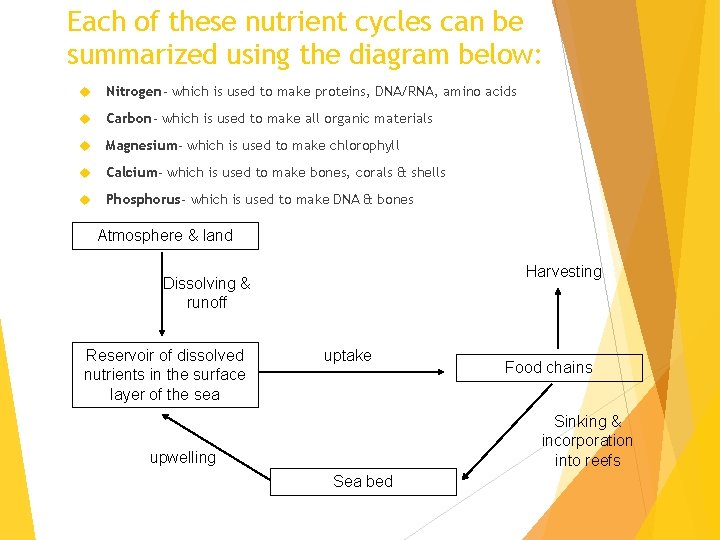
Each of these nutrient cycles can be summarized using the diagram below: Nitrogen- which is used to make proteins, DNA/RNA, amino acids Carbon- which is used to make all organic materials Magnesium- which is used to make chlorophyll Calcium- which is used to make bones, corals & shells Phosphorus- which is used to make DNA & bones Atmosphere & land Harvesting Dissolving & runoff Reservoir of dissolved nutrients in the surface layer of the sea uptake Food chains Sinking & incorporation into reefs upwelling Sea bed
(f) cont. Show that each of the nutrient cycles listed below can be summarised as shown in the figure, & state the biological use of each nutrient The figure summarises the ways in nutrients are cycled in marine ecosystems. Nutrients may be derived from both land & the atmosphere, forming a reservoir in the surface layer of the sea. From here, nutrients are taken up by living organisms & incorporated into food chains. Nutrients may be removed by harvesting, sinking to the sea bed, or incorporation into coral reefs. Nutrients from the sea bed may be returned to the surface layer of the sea by the process of upwelling.
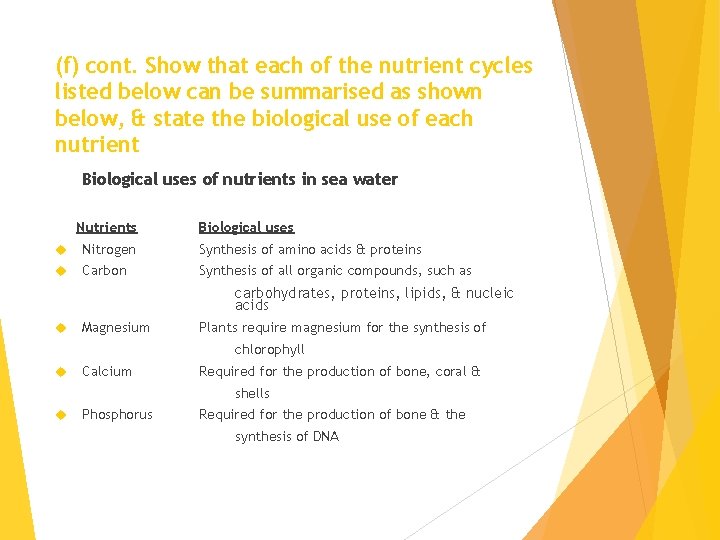
(f) cont. Show that each of the nutrient cycles listed below can be summarised as shown below, & state the biological use of each nutrient Biological uses of nutrients in sea water Nutrients Biological uses Nitrogen Synthesis of amino acids & proteins Carbon Synthesis of all organic compounds, such as carbohydrates, proteins, lipids, & nucleic acids Magnesium Plants require magnesium for the synthesis of chlorophyll Calcium Required for the production of bone, coral & shells Phosphorus Required for the production of bone & the synthesis of DNA
- Slides: 12