
AI in Knowledge Management Professor Robin Burke CSC
AI in Knowledge Management Professor Robin Burke CSC 594
Outline Introduction to the class ¢ Overview ¢ Knowledge management l AI l Case-based reasoning l
Objectives ¢ Content l Explore AI applications in knowledge management • specifically case-based reasoning ¢ Skills Reading research literature l Building an informal knowledge base l
Course design ¢ Seminar format student presentations l in-class exercises l Attendance VERY IMPORTANT! ¢ Reading VERY IMPORTANT! ¢
Reading ¢ Two main readings each week case study l research article l ¢ Admission ticket 1 -2 page reaction paper l what did you find interesting? l a discussion question l

Assessment ¢ Presentations – 40% l l l ¢ Participation – 50% l l ¢ two presentations / student 1 case study 1 research paper course librarian discussion Final Project – 10% l more later
Typical class session ¢ Case study 30 min. presentation l 15 min. discussion l ¢ Research paper 30 min. presentation l 15 min. questions l Librarian’s reports ¢ Group exercise ¢
Artificial intelligence ¢ ¢ The subfield of computer science concerned with the concepts and methods of symbolic inference by computer and symbolic knowledge representation for use in making inferences. AI can be seen as an attempt to model aspects of human thought on computers. It is also sometimes defined as trying to solve by computer any problem that a human can solve faster. -- FOLDOC
Knowledge management ¢ Knowledge management involves the acquisition, storage, retrieval, application, generation and review of the knowledge assets of an organization in a controlled way. -- I. Watson
Example: oil industry ¢ old model l ¢ own oil wells pump oil sell it problem l l how to grow when there’s no more wells to own? volatility of oil market low margins for commodity products high costs
Example: cont’d ¢ solution: reconceptualize business l ¢ oilfield expertise benefits everyone needs know-how l expertise is always valuable l
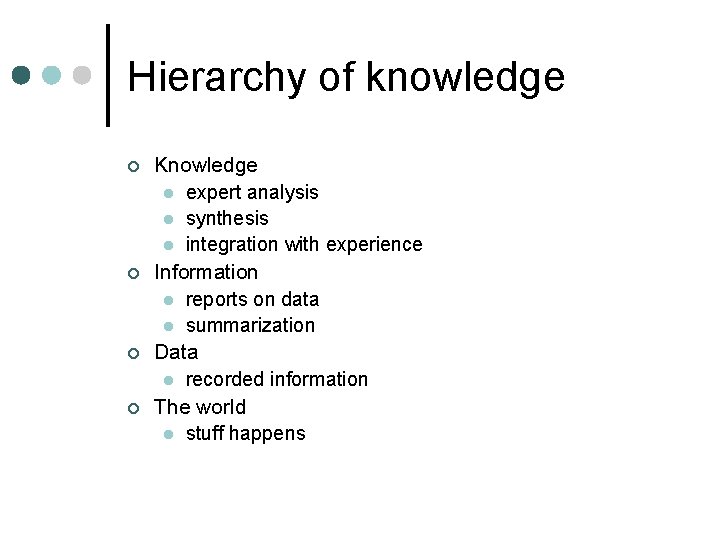
Hierarchy of knowledge ¢ ¢ Knowledge l expert analysis l synthesis l integration with experience Information l reports on data l summarization Data l recorded information The world l stuff happens

Knowledge assets ¢ Usually intangible l ¢ in worker’s heads How to make experience explicit? not just what? l but also why, how, and why not? l
AI + Knowledge Management Model aspects of human thought on computers ¢ Which aspects? ¢ l ¢ the storage and use of experience What sub-field of AI studies this? l case-based reasoning
Problem-solving ¢ One of the first two areas tackled by AI research l ¢ other is natural language How do we solve problems? l researchers looked at logic puzzles and problems of robot control

Rule-based reasoning ¢ What are the steps to the solution? l l ¢ Forward-chaining l ¢ reason forward from the problem Backward-chaining l ¢ problem situation desired result reason backward from the desired state Build up large rule bases l also control knowledge
Case-based reasoning An alternative to rule-based problemsolving ¢ “A case-based reasoner solves new problems by adapting solutions used to solve old problems” -- Riesbeck & Schank 1987 ¢
Paradox of the expert ¢ Experts should have more rules can solve more problems l can be much more precise l ¢ But experts are faster than novices l ¢ who presumably have fewer rules What does experience provide if it isn’t just “more rules”?
Problems we solve this way ¢ Medicine l ¢ Law l l ¢ English/US law depends on precedence case histories are consulted Management l ¢ doctor remembers previous patients especially for rare combinations of symptoms decisions are based on past experience Financial l performance is predicted by past results
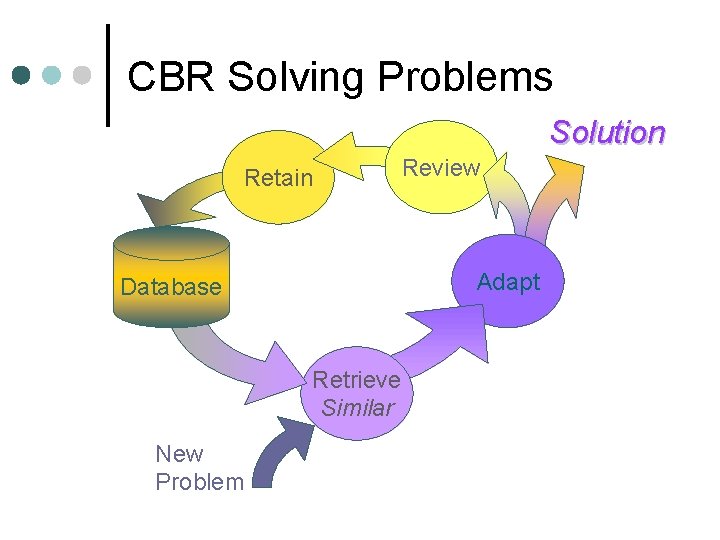
CBR Solving Problems Solution Retain Adapt Database Retrieve Similar New Problem Review
CBR System Components ¢ Case-base l l ¢ Retrieval of relevant cases l l l ¢ database of previous cases (experience) episodic memory index for cases in library matching most similar case(s) retrieving the solution(s) from these case(s) Adaptation of solution l alter the retrieved solution(s) to reflect differences between new case and retrieved case(s)
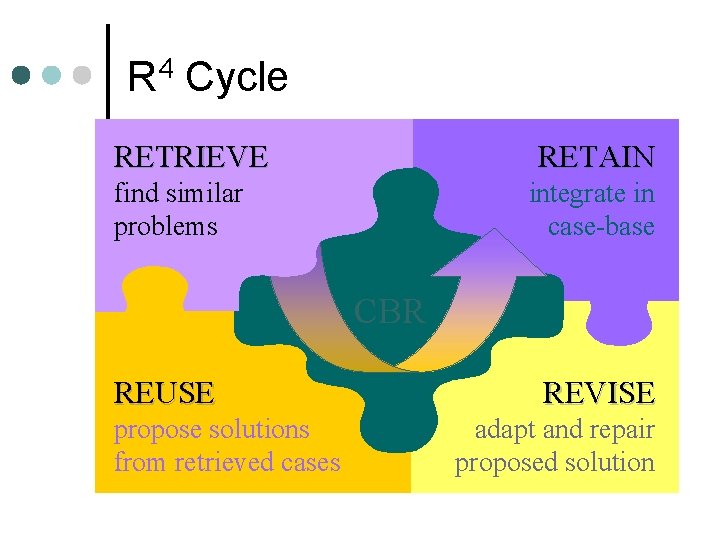
R 4 Cycle RETRIEVE RETAIN find similar problems integrate in case-base CBR REUSE propose solutions from retrieved cases REVISE adapt and repair proposed solution
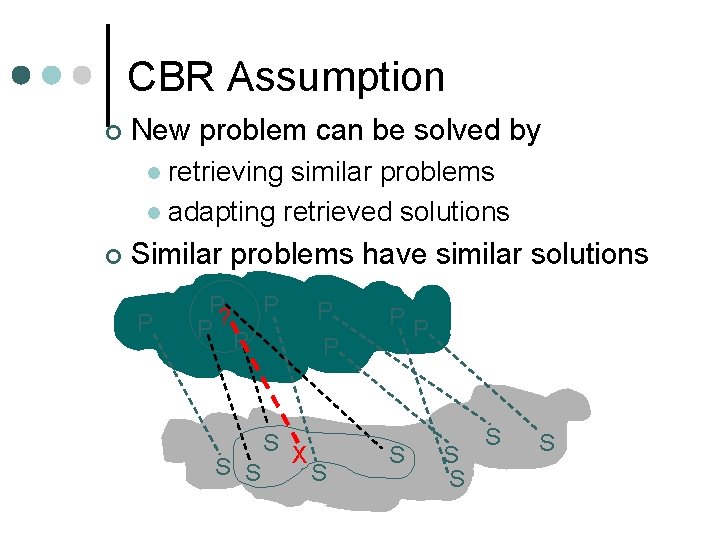
CBR Assumption ¢ New problem can be solved by retrieving similar problems l adapting retrieved solutions l ¢ Similar problems have similar solutions P P? P P P S S S X P P S PP S S S
AI in Knowledge Management ¢ Apply the CBR model to the organization rather than the individual Retain the experience of the firm l Apply it in new situations l Do this in a consistent, automated way l
How to do this? Very situation-specific ¢ What is a case? ¢ What counts as similar? ¢ What do you need to know to adapt old solutions? ¢ How do you find and remove obsolete cases? ¢
CBR Knowledge Containers ¢ ¢ Cases Case representation language Retrieval knowledge Adaptation knowledge
Cases ¢ Contents lesson to be learned l context in which lesson applies l ¢ Issues l case boundaries • time, space
Case representation language ¢ Contents l ¢ features and values of problem/solution Issues more detail / structure = flexible reuse l less detail / structure = ease of encoding new cases l
Retrieval knowledge ¢ Contents features used to index cases l relative importance of features l what counts as “similar” l ¢ Issues l “surface” vs “deep” similarity
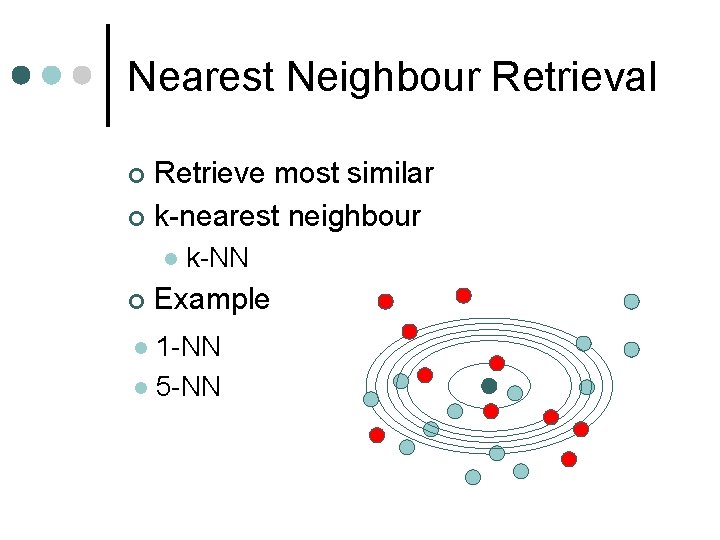
Nearest Neighbour Retrieval Retrieve most similar ¢ k-nearest neighbour ¢ l ¢ k-NN Example 1 -NN l 5 -NN l
How do we measure similarity? ¢ Can be strictly numeric weighted sum of similarities of features l “local similarities” l ¢ May involve inference l reasoning about the similarity of items
Adaptation knowledge ¢ Contents circumstances in which adaptation is needed l how to modify l ¢ Issues l role of causal knowledge • “why the case works”
Learning ¢ Case-base l l ¢ inserting new cases into case-base updating contents of case-base to avoid mistakes Retrieval Knowledge l indexing knowledge • features used • new indexing knowledge l similarity knowledge • weighting • new similarity knowledge ¢ Adaptation knowledge
What this class is about We will study examples of KM-related CBR applications ¢ We will study CBR technology and research ¢
Next week ¢ Case study l ¢ R. Burke & A. Kass (1994) "Tailoring Retrieval to Support Case-Based Teaching. " Proceedings of the 12 th Annual Conference on Artificial Intelligence. Research l A. Aamodt & E. Plaza (1994) "Case-based reasoning: Foundational issues, methodological variations, and system approaches. " AI Communications, 7: 39 -59
Administrativa Sign up for presentations ¢ Sign up for librarian slots ¢
- Slides: 36