
AI Ethical and Legal Challenges for Emerging Economies


- Slides: 17
+ AI: Ethical and Legal Challenges for Emerging Economies Babu Ram Aryal Executive Director, Forum for Digital Equality
+ n Presented at IGF Paris
+ IGF 2018 WS #231 AI: Ethical and Legal Challenges for Emerging Economies n Organized By: Forum for Digital Equality (FDE), Nepal n Co-organized by CCAOI, India n Onsite Moderator: Babu Ram Aryal, FDE n Online Moderator: Amrita Choudhari, CCOAI, India/Priyatosh Jana n Rapporteur: Forum for Digital Equality
+ Team n Speakers/Panelists: n n n Prof. Dr. Liu Chuang, Institute of Geographical Sciences and Natural Resources Research, Chinese Academy of Sciences, China Nnenna Nwakanma, Policy Director, joined in absence of Dr. Dhanraj Thakur, (Jamaica/Web Foundation) Bikash Gurung, Nepal (President, Robotics Association of Nepal/Nepal)/Last Minute Cancel/Remotely Joining Dinesh Kaushal, Specialist, Sapient, India/Last Minute Cancel Prof. Dr. Nii Quaynor (Chairman of GDC and a Professor of Computer Science at University of Cape-Coast, Ghana)/Canceled last minute. Moderators n n On Site: Babu Ram Aryal, Online: Amrita Choudhary
+ Sophia in Nepal n Sophia, developed by a Hong Kong based Company addressed a conference on theme ‘Public Services and Development’ organized by the UNDP in Nepal on 21 st March 2018. https: //www. youtube. com/watch? v=yxe. Qpzufk. TE n (A short Youtube video will be played, based on availability of time)
+ AI: meaning n AI is the simulation of human intelligence processes by machines, especially computer systems. n These processes include learning (the acquisition of information and rules for using the information), reasoning (using the rules to reach approximate or definite conclusions), and self-correction. n Artificial intelligence is intelligence demonstrated by machines, in contrast to the Natural Intelligence (NI) displayed by humans and other animals.
+ AI: Potential n According to Mc. Kinsey, corporations invested between $20 -$30 billion globally in 2016. n http: //www. unescap. org/sites/default/files/ESCAP_Artificial_Intellig ence. pdf n Globally, revenue generated from the direct and indirect application of AI software will grow from $1. 4 billion in 2016 to nearly $60 billion by 2025, as estimated by Tractica, n The International Data Corporation (IDC) estimates that the adoption of cognitive systems and AI across a broad range of industries will drive worldwide revenues to more than $47 billion in 2020. `
+ Challenge n AI may challenge social norms and laws in following area: n It may cause institutional conflicts within the legal framework in terms of civil subjects, obligations, intellectual property and road safety, n This might have a negative impact on economic security, and social management and stability.
+ Challenge… n Does this worsening unemployment, Increasing concentration of wealth and Bias baked into algorithms ? n Who is AI/Robotics-Man, Machine or Machine Man ? [EU has made law of electronic person] n Does AI will have the same legal rights, obligations and liability as a human being even after being legally considered a civil subject? n Will the AI "machine" bear the full legal responsibility alone? Or will its designer, developer, owner or user be held responsible for the physical injury or property loss? n Will the copyright law protect such products produced by AI, and if yes, who will own the copyright? What will be the duration of such patent protection? How will the humanoid robot exercise its rights?
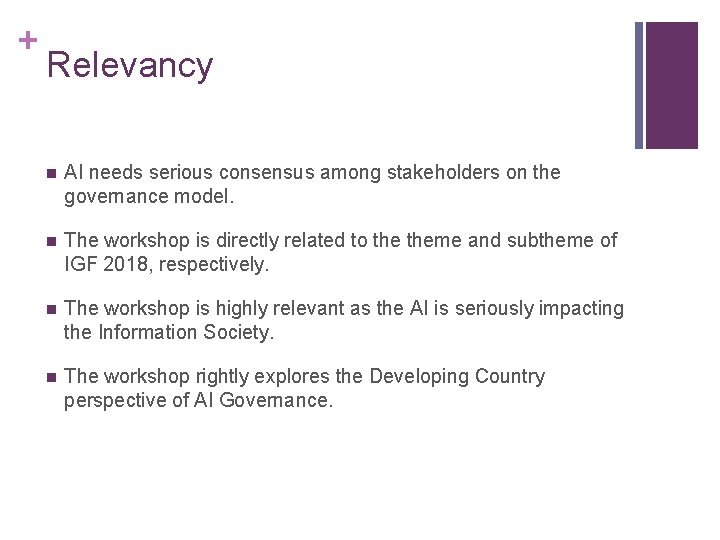
+ Relevancy n AI needs serious consensus among stakeholders on the governance model. n The workshop is directly related to theme and subtheme of IGF 2018, respectively. n The workshop is highly relevant as the AI is seriously impacting the Information Society. n The workshop rightly explores the Developing Country perspective of AI Governance.
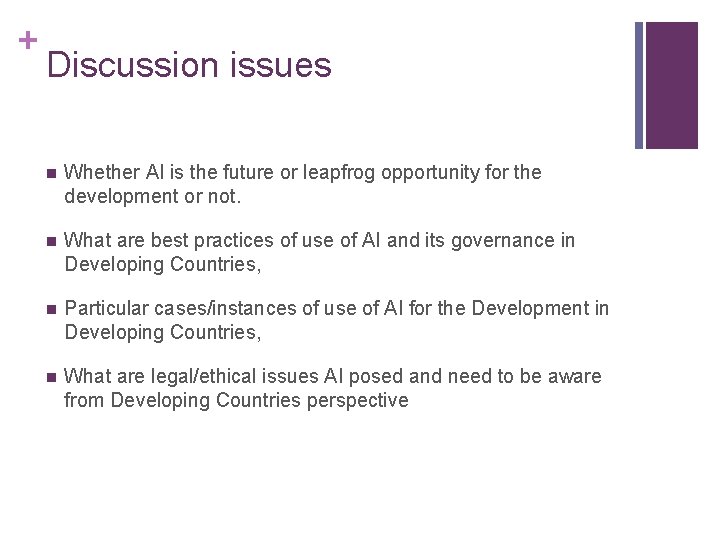
+ Discussion issues n Whether AI is the future or leapfrog opportunity for the development or not. n What are best practices of use of AI and its governance in Developing Countries, n Particular cases/instances of use of AI for the Development in Developing Countries, n What are legal/ethical issues AI posed and need to be aware from Developing Countries perspective
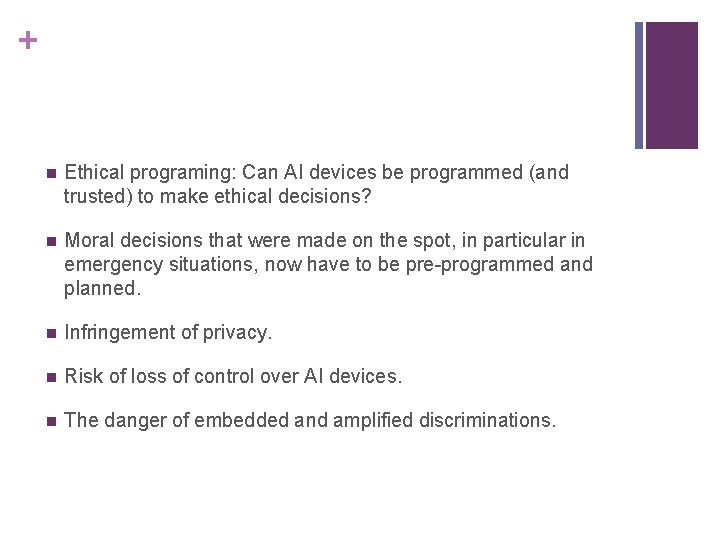
+ n Ethical programing: Can AI devices be programmed (and trusted) to make ethical decisions? n Moral decisions that were made on the spot, in particular in emergency situations, now have to be pre-programmed and planned. n Infringement of privacy. n Risk of loss of control over AI devices. n The danger of embedded and amplified discriminations.
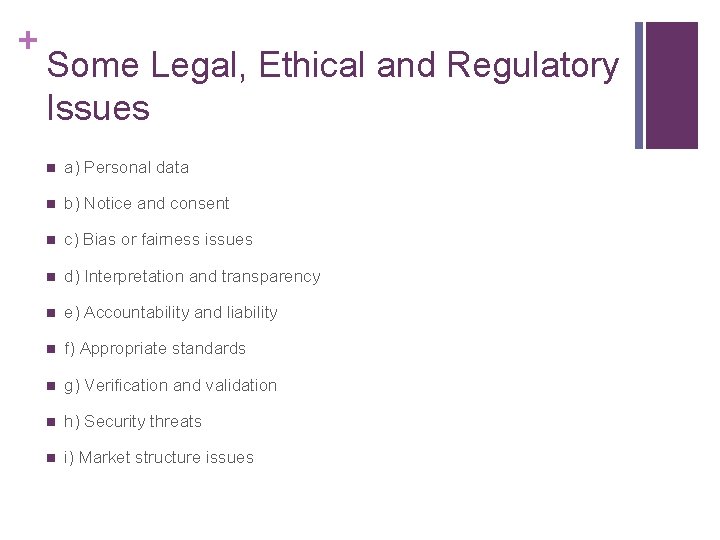
+ Some Legal, Ethical and Regulatory Issues n a) Personal data n b) Notice and consent n c) Bias or fairness issues n d) Interpretation and transparency n e) Accountability and liability n f) Appropriate standards n g) Verification and validation n h) Security threats n i) Market structure issues
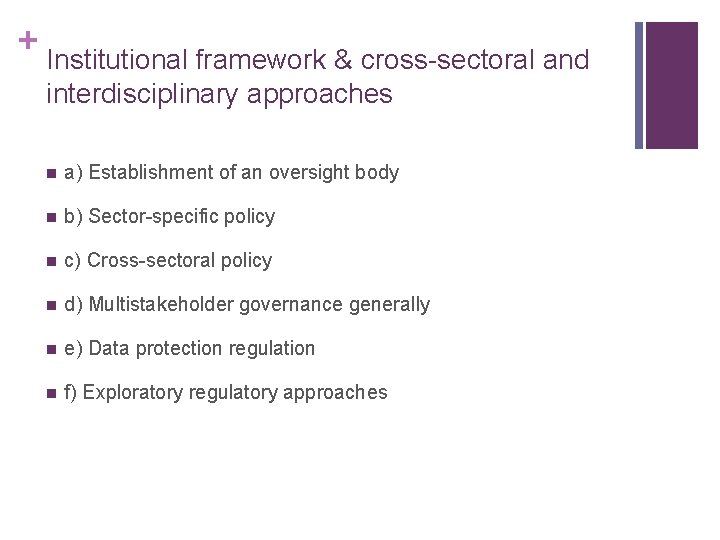
+ Institutional framework & cross-sectoral and interdisciplinary approaches n a) Establishment of an oversight body n b) Sector-specific policy n c) Cross-sectoral policy n d) Multistakeholder governance generally n e) Data protection regulation n f) Exploratory regulatory approaches
+ Interventions n Moderator Mr. Babu Ram Aryal, n Online Moderator: Amrita Choudhari/Priyatosh Jana n Nnenna Nwakanma will focus on the policy perspective of AI Governance and Developing Countries, n Prof. Dr. Liu Chuang will present emergence of AI in China, n Mr. Bikash Gurung will present both from youth perspective as well as the entrepreneur's perspective of least developed countries
+ Discussion n Floor Discussion
+ Thank you. n Babu Ram Aryal, n Executive Director, Forum for Digital Equality, n Kathmandu, Nepal n Email: baburam@thedeltalaw. com