
AI approaches to TC The REUL Lab and
AI approaches to TC The REUL Lab and NLP strategies for disseminating complex information David Young, Georgia Institute of Technology
Background on the REUL Lab Started in 2016 and sponsored through the Ivan Allan College (IAC) Digital Integrative Liberal Arts Center (DILAC) grant. Studies human engagement with complex contractual information Emphasizes machine-assisted translation/simplification
Projects in the REUL Lab Past Projects Project 1: Automated EULA Analysis Tool Project 2: Iconographic Presentation of EULAs Project 3: “Bite-Sized” EULA Tool Current Project Text classifier using machine learning algorithms

Typical workflow for NLTK projects
Approach to parsing meaning Machine learning requires structuring unstructured content then extracting features that a computer can identify in new texts Extracting features from a text requires human insight via coding, but we have also used topic modeling to assist feature identification and extraction Both human coding and topic modelling facilitate the text parsing/exploration of data and prepare our training set for the classifier
Topic modeling “Topic modeling is a type of statistical modeling for discovering the abstract “topics” that occur in a collection of documents. ” (Li, https: //towardsdatascience. com/topic-modeling-and-latent-dirichletallocation-in-python-9 bf 156893 c 24) Assumes that documents are made of topics and topics are made of co-occurring words Also assumes that word order does not matter in identifying topics Our approach uses Latent Dirichlet Allocation (LDA) to create topic models in Python

Topic modeling
Why use topic modeling? Our data set is large in human terms: 50+ EULAs (testing on User-Generated Content sections) Topic modeling provides an exploratory framework for processing large data sets Probabilistic statistics provide latent themes in minutes as opposed to hours (or even weeks)
Method Import 50 UGC sections from video game EULAs Pre-process text to remove stop words, punctuation, words that appear more than once, etc. Create combined corpus and dictionary Tune model parameters (e. g. iterations, passes, corpus, etc. ) For example, we removed adjectives and adverbs in favor of identifying relationships between nouns and verbs
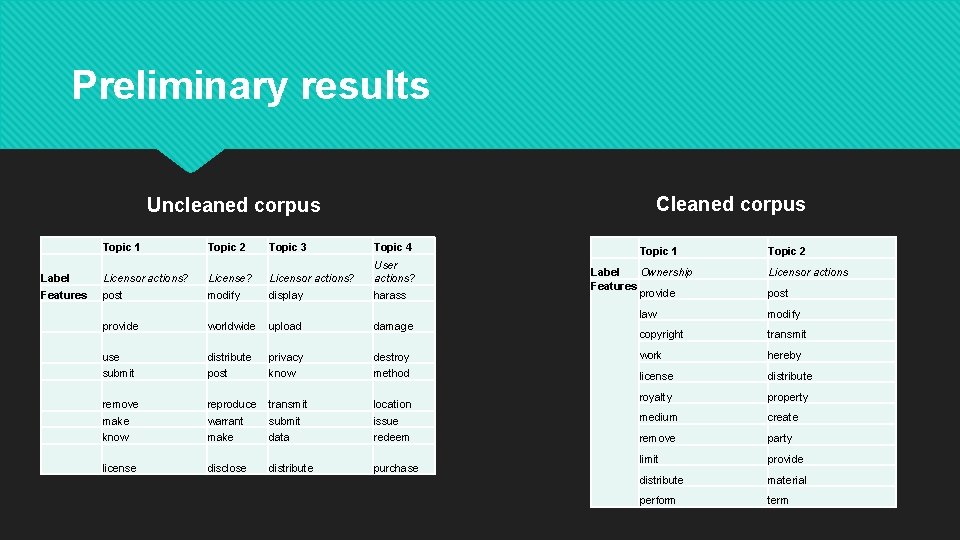
Preliminary results Cleaned corpus Uncleaned corpus Label Features Topic 1 Topic 2 Topic 3 Topic 4 Licensor actions? post License? modify Licensor actions? display User actions? harass provide worldwide upload damage use submit distribute post privacy know destroy method remove make know reproduce warrant make transmit submit data location issue redeem license disclose distribute purchase Topic 1 Label Ownership Features provide Topic 2 Licensor actions post law modify copyright transmit work hereby license distribute royalty property medium create remove party limit provide distribute material perform term
Reflection on ideation in a TC lab Machine learning approaches aren’t a substitute for human understanding Implementing effective algorithms requires deep rhetorical understanding of corpora Interdisciplinary collaboration requires breaking down boundaries in disciplinary knowledge Evidenced by Jay and Abigail working outside CS and LMC to solve complex problems. Also, includes my own introduction to CS approaches to solving language problems.
Paths forward Our next step is to translate the identification of these features to a feature extraction class and use a Naïve Bayes Classifier to start supervised machine learning of EULA corpora. We are also experimenting with methods for displaying this information visually once we can reliably classify documents.
Questions? We welcome any questions, suggestions, and comments!
- Slides: 13