
AI and Pathfinding CS 4730 Computer Game Design

- Slides: 43
AI and Pathfinding CS 4730 – Computer Game Design Some slides courtesy Tiffany Barnes, NCSU CS 4730
AI Strategies • Reaction vs. Deliberation • When having the NPC make a decision, how much thought goes into the next move? • How is the AI different in: – Frozen Synapse – Kingdom Hearts – Civilization – Halo 2 CS 4730
AI Strategies • Reaction-Based – Fast, but limited capabilities • Implementations – Finite-State Machines – Rule-Based Systems – Set Pattern 3 CS 4730
AI Strategies • Deliberation-Based – Much slower, but more adaptable • Implementations – A* / Dijkstra – Roadmaps – Genetic Algorithms 4 CS 4730
Deliberation • Goal is to emphasize making the best possible decision by searching across all possibilities • Thus, deliberation tends to use various search algorithms across data structures that contain the option space 5 CS 4730
“Sense – Plan – Act” • Sense (or perceive) a sufficiently complete model of the world • Plan by searching over possible future situations that would result from taking various actions • Act by executing the best course of action • Each possible outcome is effectively scored by a “metric of success” that indicates whether the choice should be taken or not 6 CS 4730
Deliberative vs. Reactive • These are NOT mutually exclusive! • You can have reactive policies for immediate threats – Incoming PC fire – Environmental destruction • And you can have deliberative policies for longterm planning – Build orders and positioning 7 CS 4730
Core Questions • How do you represent knowledge about the current task, environment, PC, etc? • How do you find actions that allow the goal to be met? 8 CS 4730
Knowledge Representation • A decision tree is a common way to represent knowledge • The root node is the current state of the game state WRT the NPC / AI • Thus, deliberative AI techniques are effectively versions of search and shortest-path algorithms! 9 CS 4730
Tic-Tac-Toe • What is the decision tree for Tic-Tac-Toe? 10 CS 4730
The Goal State • The objective of the decision tree model is to move from the initial game state (root of the tree) to the goal state of the NPC – What might a goal state be? • When searching through the decision tree space, which path do we take? 11 CS 4730
Cost and Reward • Every choice has a cost – Ammo – Movement – Time – Increase vulnerability to attack • Every choice has a reward – Opportunity to hit PC – Capture a strategic point – Gain new resources 12 CS 4730
Minimax Algorithm • Find the path through the decision tree that yields the best outcome for one player, assuming the other player always makes a decision that would lead to the best outcome for themselves 13 CS 4730
Naïve Search Algorithms • Breadth-First Search – At each depth, explore every option at the next depth • Depth-First Search – Fully explore one possible path to its “conclusion”, then backtrack to check other options • What are the problems with these techniques in gaming? 14 CS 4730
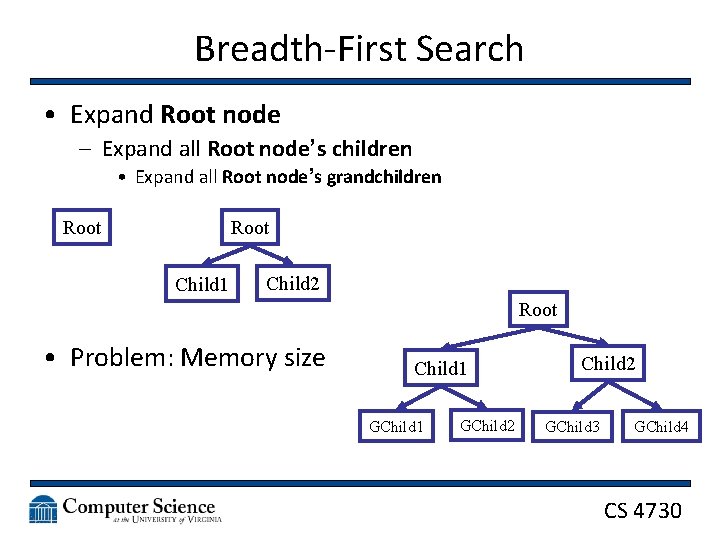
Breadth-First Search • Expand Root node – Expand all Root node’s children • Expand all Root node’s grandchildren Root Child 1 Child 2 Root • Problem: Memory size Child 1 GChild 2 GChild 3 GChild 4 CS 4730
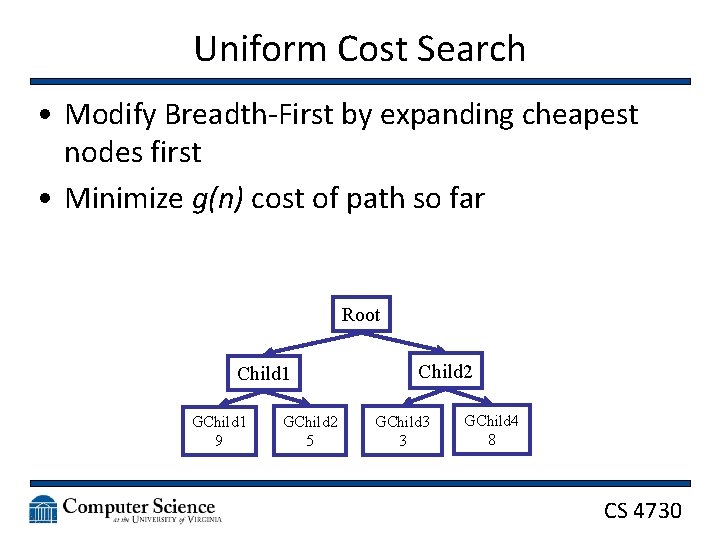
Uniform Cost Search • Modify Breadth-First by expanding cheapest nodes first • Minimize g(n) cost of path so far Root Child 1 GChild 1 9 GChild 2 5 Child 2 GChild 3 3 GChild 4 8 CS 4730
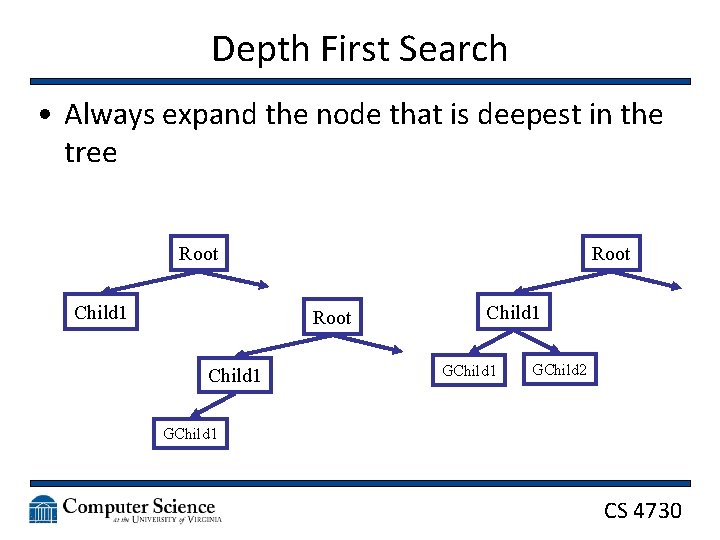
Depth First Search • Always expand the node that is deepest in the tree Root Child 1 GChild 1 GChild 2 GChild 1 CS 4730
Adding a Heuristic • Simple definition: a heuristic is a “mental shortcut” to ignore non-useful states to limit the search space and make the decision tree more reasonable • What metrics might we use to determine “the value” of a potential option? • What metrics might we use to determine “the cost” of a potential option? 18 CS 4730
Adding a Heuristic • Creating an AI heuristic forms the basis of how the NPCs will behave – Will they ignore enemies that are farther than X away? – Will they avoid water? – Will they always move in the straightest path to the PC? 19 CS 4730
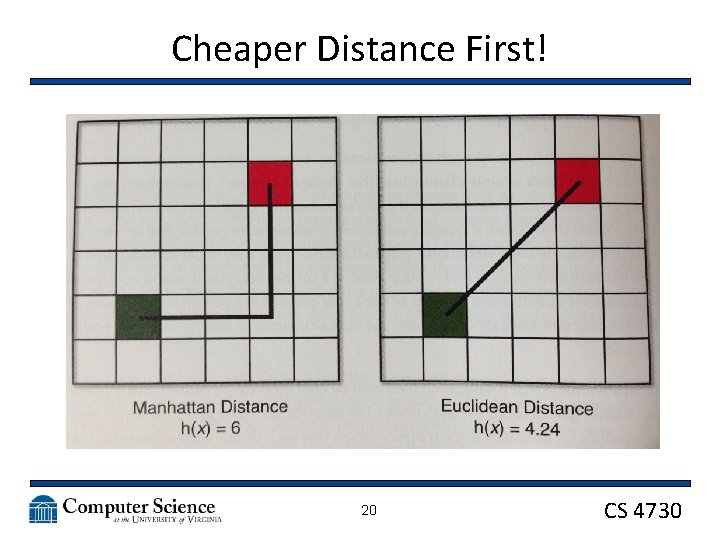
Cheaper Distance First! 20 CS 4730
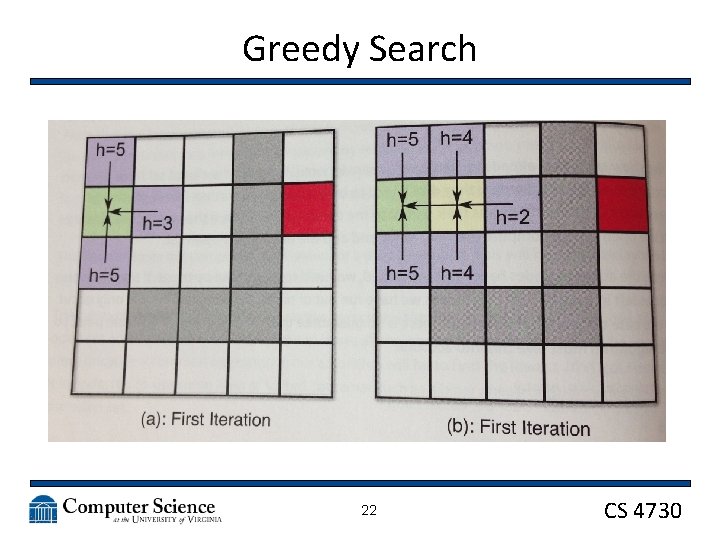
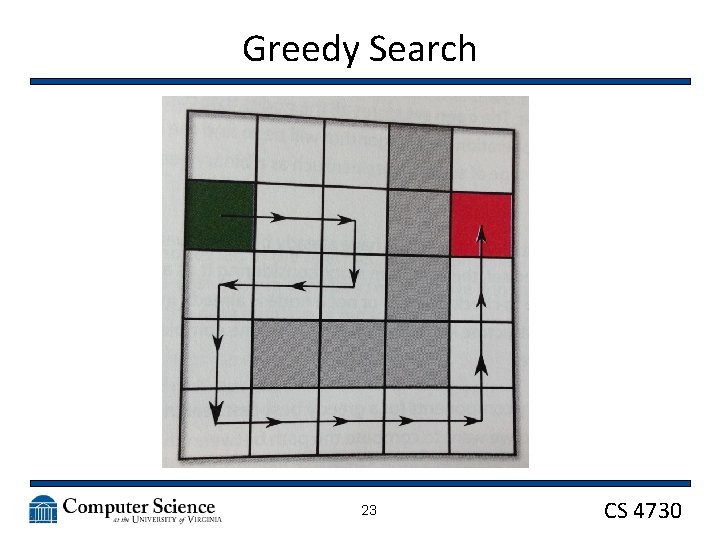
Greedy Search • Expand the node that yields the minimum cost – Expand the node that is closest to target – Depth first – Minimize the function h(n) the heuristic cost function CS 4730
Greedy Search 22 CS 4730
Greedy Search 23 CS 4730
Greedy Search • Greedy gives us (often) a sub-optimal path, but it’s really cheap to calculate! • How can we improve on this? • Add another aspect to the function – the cost of the node + the heuristic distance 24 CS 4730
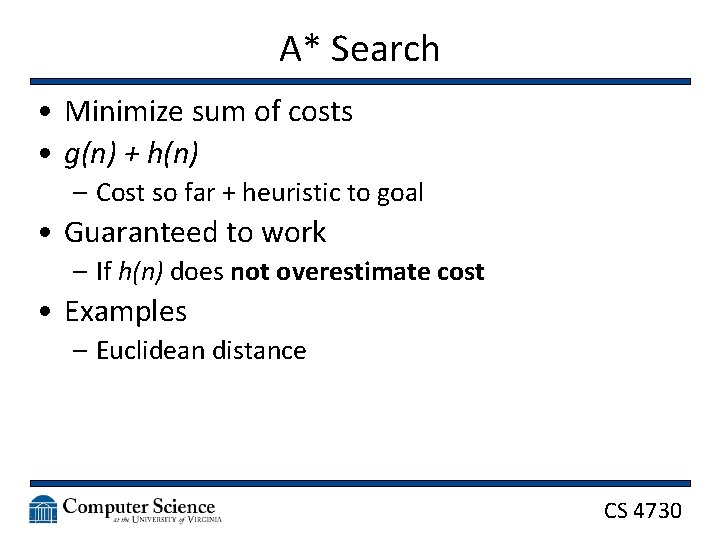
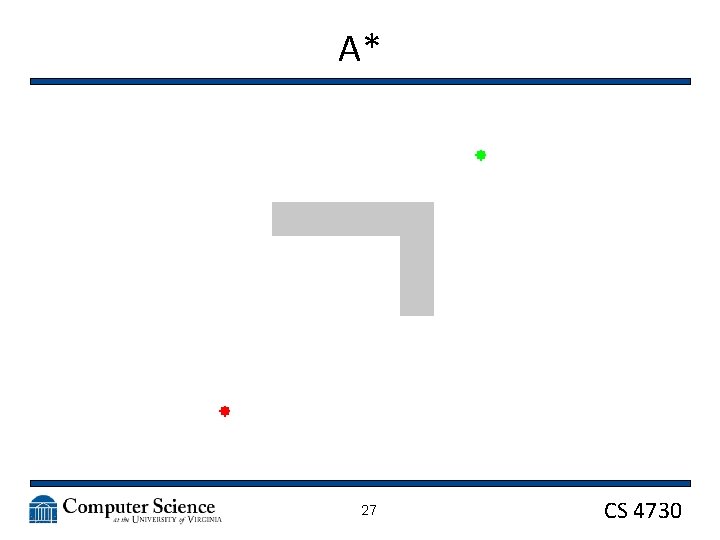
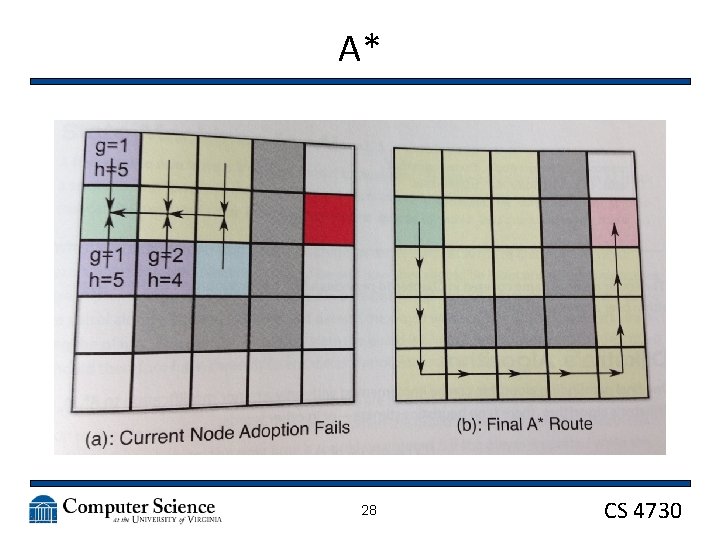
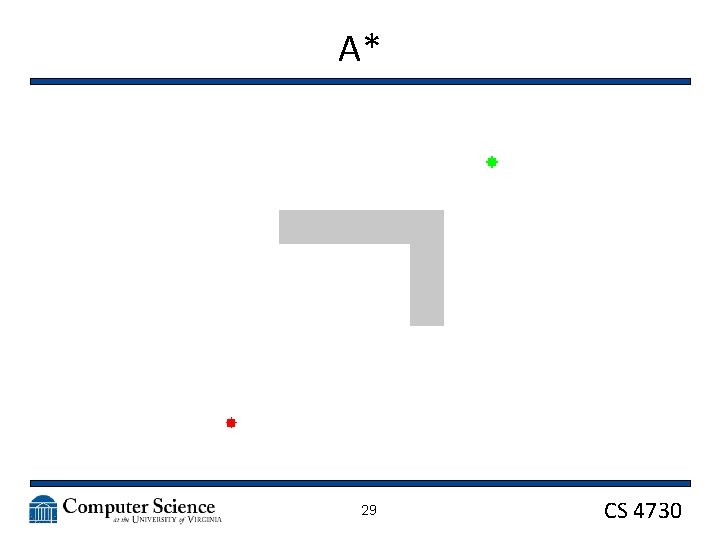
A* • A best-first search (using heuristics) to find the least-cost path from the initial state to the goal state • The algorithm follows the path of lowest expected cost, keeping a priority queue of alternate path segments along the way 25 CS 4730
A* Search • Minimize sum of costs • g(n) + h(n) – Cost so far + heuristic to goal • Guaranteed to work – If h(n) does not overestimate cost • Examples – Euclidean distance CS 4730
A* 27 CS 4730
A* 28 CS 4730
A* 29 CS 4730
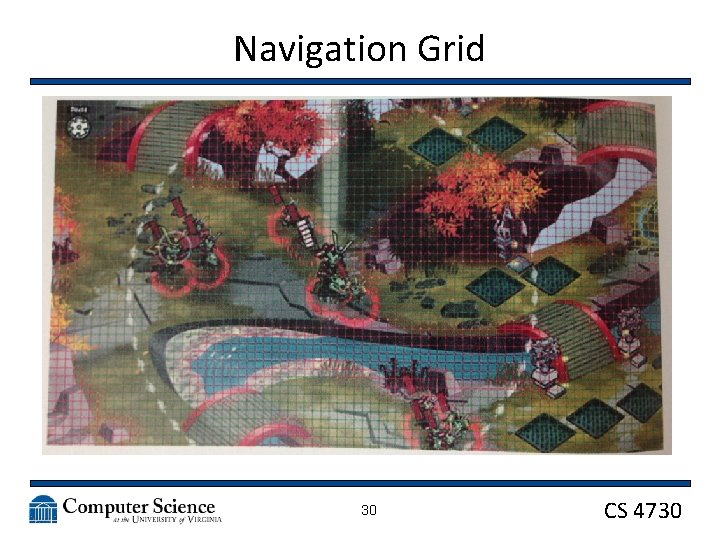
Navigation Grid 30 CS 4730
Pathfinding in “real life” • These algorithms work great when the game is grid based – Square grid – Hex grid • For more “open” games, like FPSs: – Path nodes are placed on the map that NPCs can reach – Navigation mesh layers are added over the terrain – Often done automatically in advanced engines 31 CS 4730
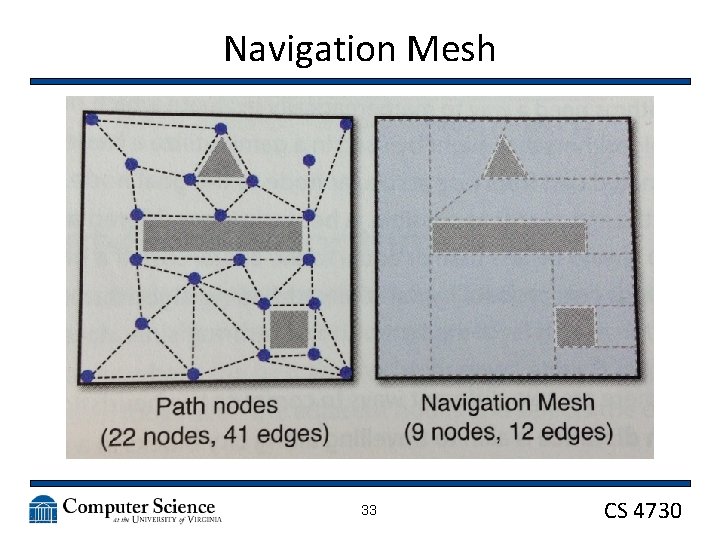
Navigation Mesh • Instead of using discrete node locations, a node in this instance is a convex polygon • Every point inside a valid polygon can be considered “fair game” to move into • Navigation meshes can be auto generated by the engine, so easier to manage than nodes • Can also handle different sized NPCs by checking collisions 32 CS 4730
Navigation Mesh 33 CS 4730
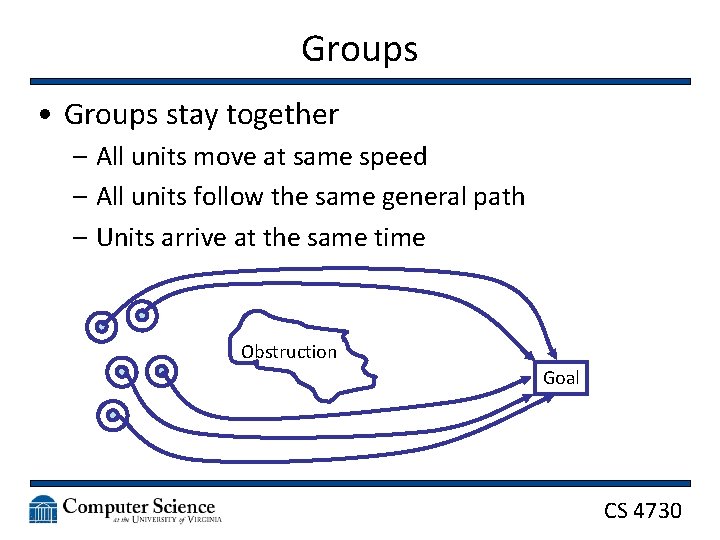
Groups • Groups stay together – All units move at same speed – All units follow the same general path – Units arrive at the same time Obstruction Goal CS 4730
Groups • Need a hierarchical movement system • Group structure – Manages its own priorities – Resolves its own collisions – Elects a commander that traces paths, etc • Commander can be an explicit game feature CS 4730
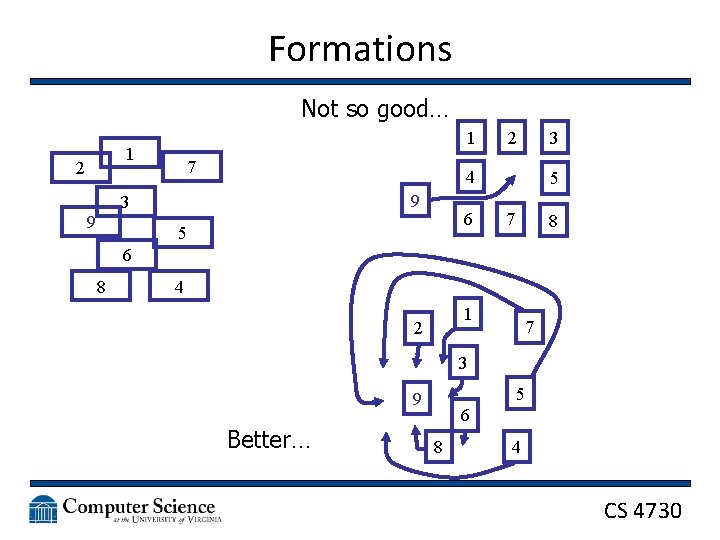
Formations • Groups with unit layouts – Layouts designed in advance • Additional States – Forming – Formed – Broken • Only formed formations can move CS 4730
Formations • Schedule arrival into position – Start at the middle and work outwards – Move one unit at a time into position – Pick the next unit with • Least collisions • Least distance – Formed units have highest priority • Forming units medium priority • Unformed units lowest CS 4730
Formations Not so good… 1 1 2 7 3 4 9 3 9 2 6 5 5 7 8 6 8 4 1 2 7 3 5 9 Better… 6 8 4 CS 4730
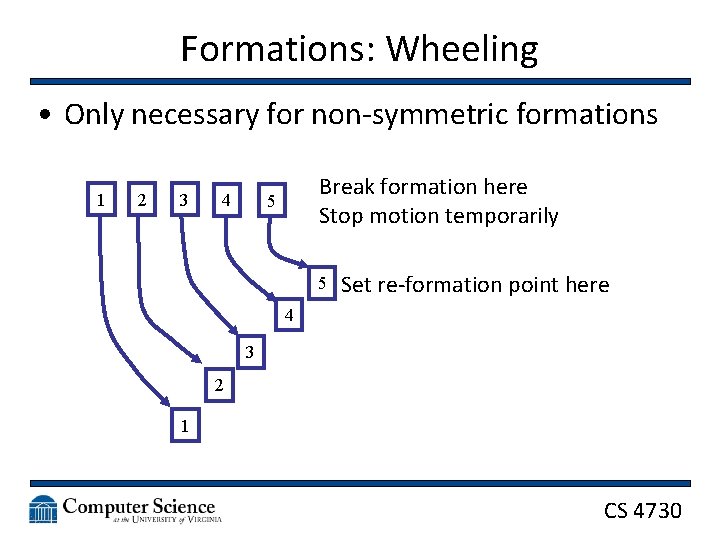
Formations: Wheeling • Only necessary for non-symmetric formations 1 2 3 4 Break formation here Stop motion temporarily 5 5 Set re-formation point here 4 3 2 1 CS 4730
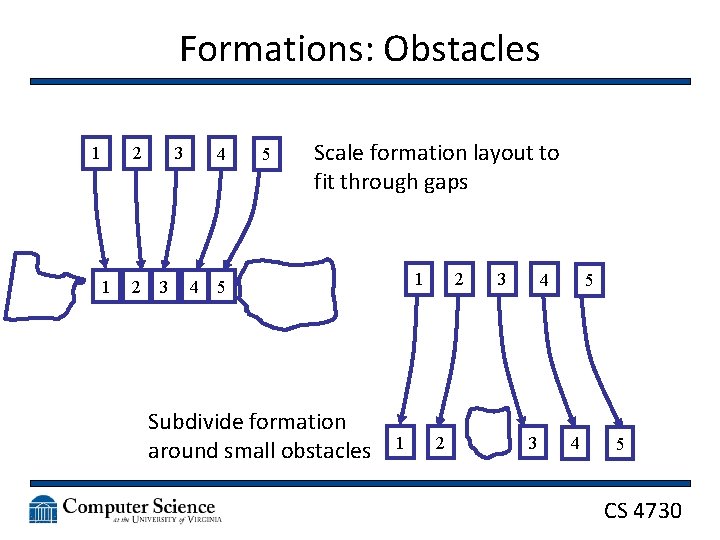
Formations: Obstacles 1 2 3 3 4 4 5 Scale formation layout to fit through gaps 1 5 Subdivide formation around small obstacles 1 2 2 3 4 3 5 4 5 CS 4730
Formations • Adopt a hierarchy of paths to simplify pathplanning problems • High-level path considers only large obstacles – Perhaps at lower resolution – Solves problem of gross formation movement – Paths around major terrain features CS 4730
AI That Learns • Imagine a player in Madden calls a particular play on offense over and over • The heuristic values for certain states should change to reflect a more optimal strategy • Now, the adjustment of heuristic values represents long-term strategy (to a degree) 42 CS 4730
AI That Evolves • Neural networks add in a mutation mechanic • Bayesian networks can also learn and add inferences • How much processing power can we use for this? • Is it better to truly have a “learning” AI, or should we just adjust some game parameters? 43 CS 4730