
Ahura First Defender Acquisition and Application in the

- Slides: 17
Ahura First Defender: Acquisition and Application in the Academic Environment 2013 College and University Hazardous Waste Conference Kyle Dagestad Sean Whalen Iowa State University
Introduction • • • The Money - Sean The Selection - Sean The Equipment - Kyle The Goods and The Bads- Kyle Safety and Maintenance – Kyle
The Money • Homeland Security Buffer Zone Program – Grant through ISU-Police • FTIR and RAMAN for unknowns • $82, 500 – Equipment only • Purchased the Ahura First Defender ($35, 000) and Tru Defender ($47, 500) • EH&S owns equipment • Tru Defender on loan to Ames Fire HAZMAT
The Selection • Two primary suppliers – Ahura Scientific – Smith’s Detection • • Disclaimer Representative Presentations Field Tests Matrix
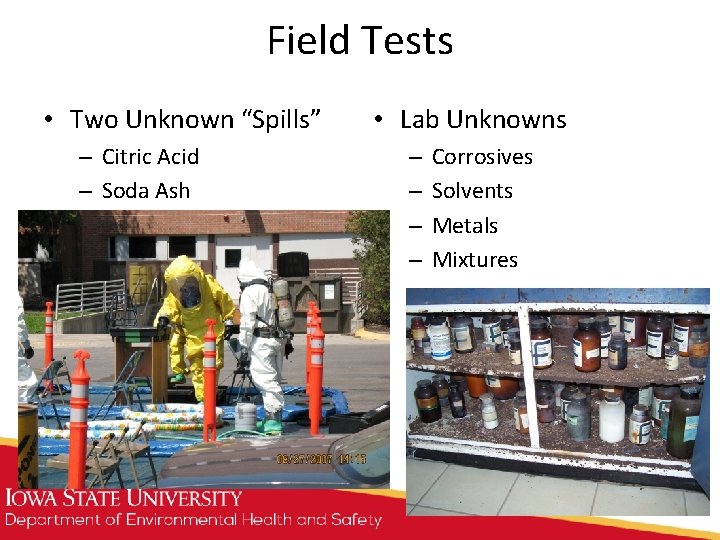
Field Tests • Two Unknown “Spills” – Citric Acid – Soda Ash • Lab Unknowns – – Corrosives Solvents Metals Mixtures
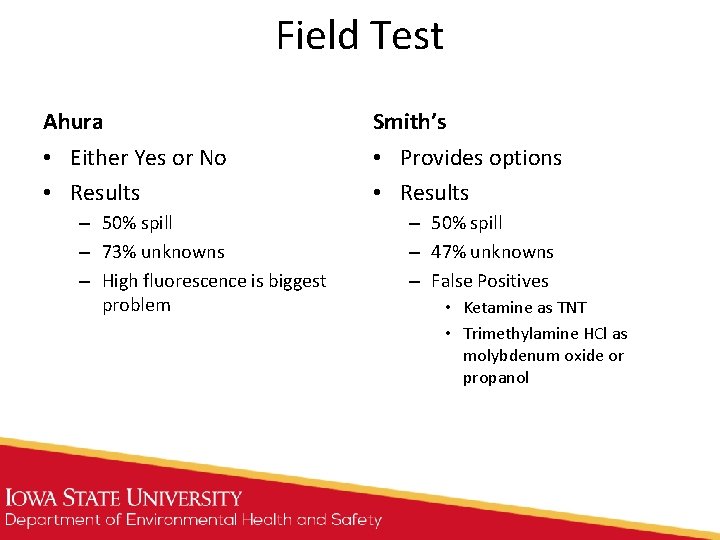
Field Test Ahura Smith’s • Either Yes or No • Results • Provides options • Results – 50% spill – 73% unknowns – High fluorescence is biggest problem – 50% spill – 47% unknowns – False Positives • Ketamine as TNT • Trimethylamine HCl as molybdenum oxide or propanol
Field Test Results
Matrix • Pointed out best unit • Ahura scored highest • Ahura more expensive • Had to write justification
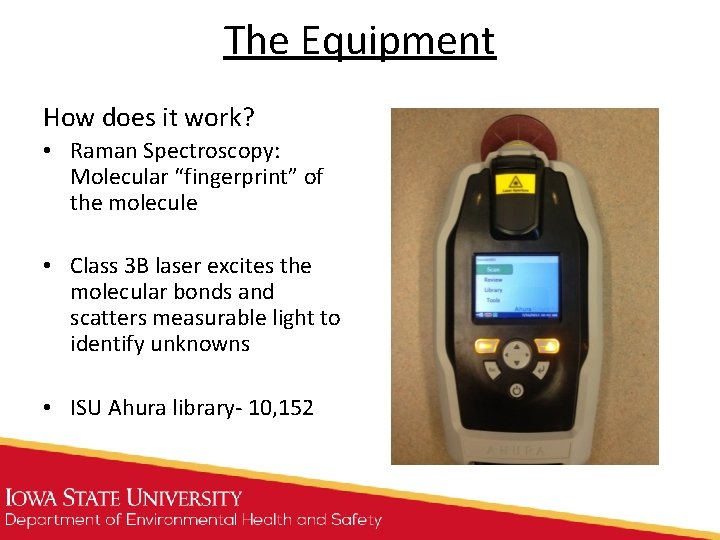
The Equipment How does it work? • Raman Spectroscopy: Molecular “fingerprint” of the molecule • Class 3 B laser excites the molecular bonds and scatters measurable light to identify unknowns • ISU Ahura library- 10, 152
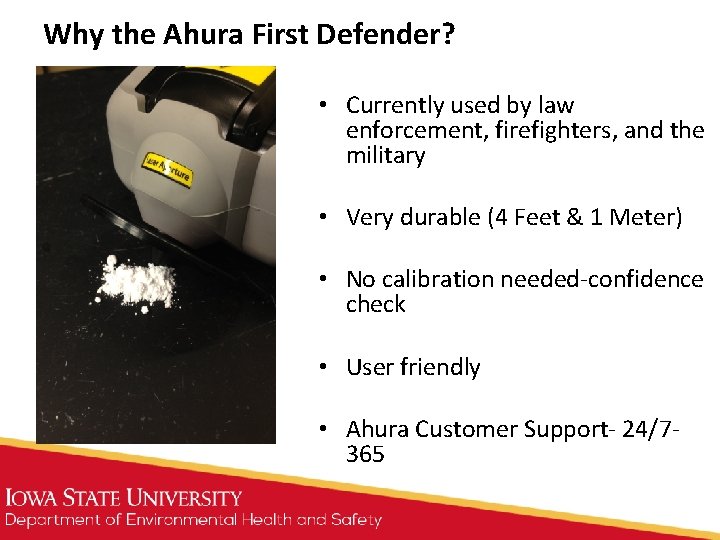
Why the Ahura First Defender? • Currently used by law enforcement, firefighters, and the military • Very durable (4 Feet & 1 Meter) • No calibration needed-confidence check • User friendly • Ahura Customer Support- 24/7365
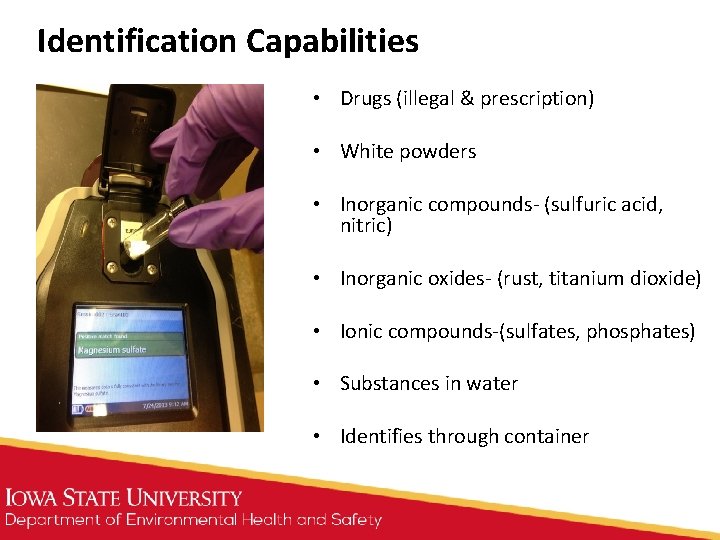
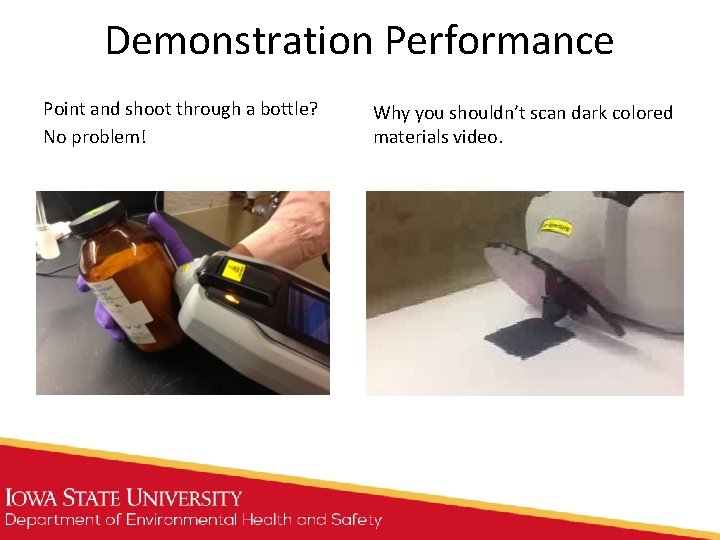
Identification Capabilities • Drugs (illegal & prescription) • White powders • Inorganic compounds- (sulfuric acid, nitric) • Inorganic oxides- (rust, titanium dioxide) • Ionic compounds-(sulfates, phosphates) • Substances in water • Identifies through container
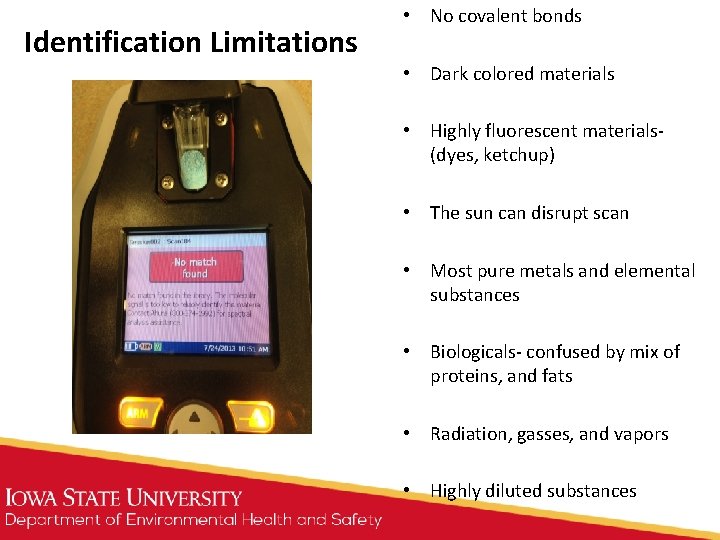
Identification Limitations • No covalent bonds • Dark colored materials • Highly fluorescent materials(dyes, ketchup) • The sun can disrupt scan • Most pure metals and elemental substances • Biologicals- confused by mix of proteins, and fats • Radiation, gasses, and vapors • Highly diluted substances
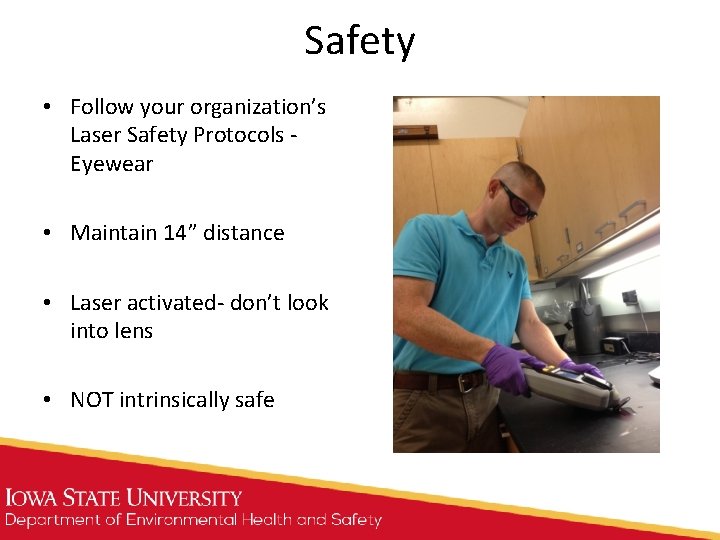
Safety • Follow your organization’s Laser Safety Protocols Eyewear • Maintain 14” distance • Laser activated- don’t look into lens • NOT intrinsically safe
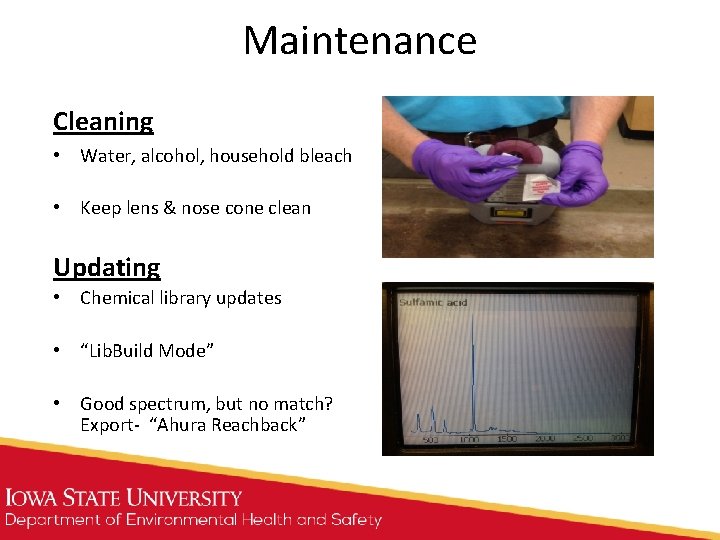
Maintenance Cleaning • Water, alcohol, household bleach • Keep lens & nose cone clean Updating • Chemical library updates • “Lib. Build Mode” • Good spectrum, but no match? Export- “Ahura Reachback”
Demonstration Performance Point and shoot through a bottle? No problem! Why you shouldn’t scan dark colored materials video.