
AHRQ Safety Program for Surgery Sustainability and the
AHRQ Safety Program for Surgery Sustainability and the Premortem Tool AHRQ Pub. No. 16(18)-0004 -15 -EF December 2017 AHRQ Safety Program for Surgery -- Sustainability
Learning Objectives After this session, you will be able to– • List benefits of a premortem exercise from the sustainability perspective • Use the Comprehensive Unit-based Safety Program (CUSP) Premortem Tool to identify risks to sustaining your efforts AHRQ Safety Program for Surgery -- Sustainability Premortem Tool 2
Problem Statement • Projects fail for many reasons • This safety project is no exception • Recognize potential barriers and complications to aid project implementation • Anticipate problems to help teams sustain improvements AHRQ Safety Program for Surgery -- Sustainability Premortem Tool 3
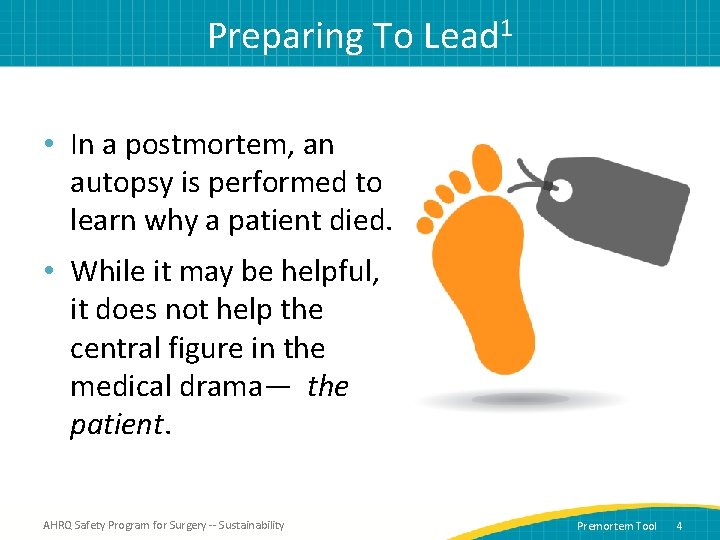
Preparing To Lead 1 • In a postmortem, an autopsy is performed to learn why a patient died. • While it may be helpful, it does not help the central figure in the medical drama— the patient. AHRQ Safety Program for Surgery -- Sustainability Premortem Tool 4
Preparing To Lead The Premortem Exercise helps you– • Imagine the project has failed • Brainstorm contributing factors that led to this failure • Develop plans to mitigate these barriers to sustaining success AHRQ Safety Program for Surgery -- Sustainability Premortem Tool 5
Preparing To Lead • Identify potential barriers and vulnerabilities • Build intuition and sensitivity to future problems • Encourage team members to speak up during planning stages • Prepare proactive approach to address concerns AHRQ Safety Program for Surgery -- Sustainability Premortem Tool 6
Premortem Exercise Step 1 • Imagine that you are 2 years into the future, and despite all of the team’s efforts, the surgical safety program has failed—catastrophically • Many things have gone completely wrong • Ask your team: – What does the worst-case scenario look like for you and your patients? AHRQ Safety Program for Surgery -- Sustainability Premortem Tool 7
Premortem Exercise Step 2 • Generate the reasons for this failure to sustain improvements • Spend 10 minutes recording the reasons that could cause this failure • Ask your team: – What could have caused our project to fail? AHRQ Safety Program for Surgery -- Sustainability Premortem Tool 8
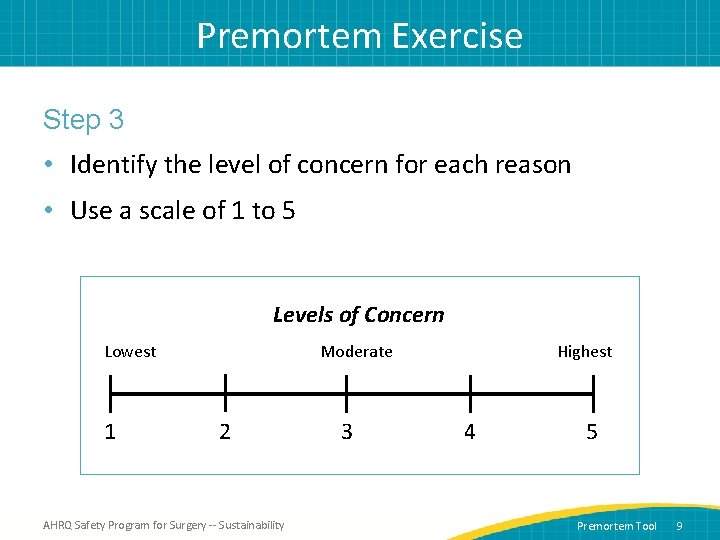
Premortem Exercise Step 3 • Identify the level of concern for each reason • Use a scale of 1 to 5 Levels of Concern Lowest 1 Moderate 2 AHRQ Safety Program for Surgery -- Sustainability 3 Highest 4 5 Premortem Tool 9
Premortem Exercise Step 4 • Prioritize your list of potential reasons for failure • Address the top two or three concerns • Ask your team: – What specific actions can you take to avoid or manage these concerns? AHRQ Safety Program for Surgery -- Sustainability Premortem Tool 10
CUSP Premortem Summary 1. Two years out, what does the worst-case scenario look like? 2. What could have caused your project to fail? 3. What specific actions can you take to avoid or manage these issues? AHRQ Safety Program for Surgery -- Sustainability Premortem Tool 11
Discussion • Set goals for sustainment – what do you want to maintain? • Target the potential risks for failure to achieve sustainment goals • Remember that sustainability is a process, not a project AHRQ Safety Program for Surgery -- Sustainability Premortem Tool 12
Discussion Questions 1. What aspects of the project are you planning on sustaining and how? 2. What challenges do you predict for sustaining progress? 3. How will you address these challenges? AHRQ Safety Program for Surgery -- Sustainability Premortem Tool 13
References 1. Klein G. Performing a Project Premortem. Harvard Business Review. Sept 2007. https: //hbr. org/2007/09/performing-aproject-premortem. Accessed Aug 22, 2015. AHRQ Safety Program for Surgery -- Sustainability Premortem Tool 14
- Slides: 14