
AHRQ Safety Program for Surgery Implementation Optimize Briefings
AHRQ Safety Program for Surgery Implementation Optimize Briefings and Debriefings AHRQ Pub. No. 16(18)-0004 -15 -EF December 2017 AHRQ Safety Program for Surgery – Implementation
Learning Objectives • Describe characteristics of effective briefings and debriefings • Present the evidence base for briefings and debriefings to your surgeons and surgical staff during a staff meeting • Prioritize and investigate defects identified by the team during operating room debriefings AHRQ Safety Program for Surgery – Implementation Briefings & Debriefings 2
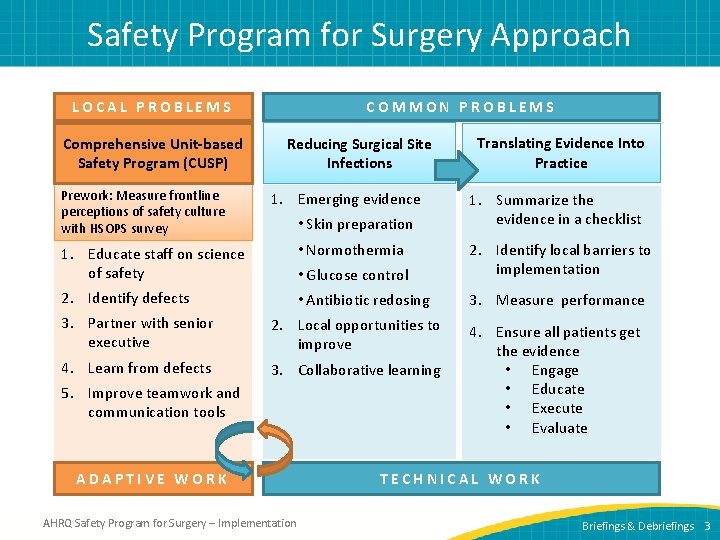
Safety Program for Surgery Approach COMMON PROBLEMS LOCAL PROBLEMS Comprehensive Unit-based Safety Program (CUSP) Prework: Measure frontline perceptions of safety culture with HSOPS survey Reducing Surgical Site Infections 1. Emerging evidence • Skin preparation Translating Evidence Into Practice 1. Summarize the evidence in a checklist 1. Educate staff on science of safety • Normothermia • Glucose control 2. Identify local barriers to implementation 2. Identify defects • Antibiotic redosing 3. Measure performance 3. Partner with senior executive 2. Local opportunities to improve 4. Learn from defects 3. Collaborative learning 5. Improve teamwork and communication tools ADAPTIVE WORK AHRQ Safety Program for Surgery – Implementation 4. Ensure all patients get the evidence • Engage • Educate • Execute • Evaluate TECHNICAL WORK Briefings & Debriefings 3

Comprehensive Unit-based Safety Program 1 CUSP SAFETY PROGRAM FOR SURGERY 1. Educate staff on the science of safety 2. Identify defects 3. Partner with a senior executive 4. Learn from defects 5. Improve teamwork and communication ADAPTIVE COMPONENTS AHRQ Safety Program for Surgery – Implementation Briefings & Debriefings 4
AHRQ Safety Program for Surgery Implementation BASICS OF BRIEFING AND DEBRIEFING AHRQ Safety Program for Surgery – Implementation
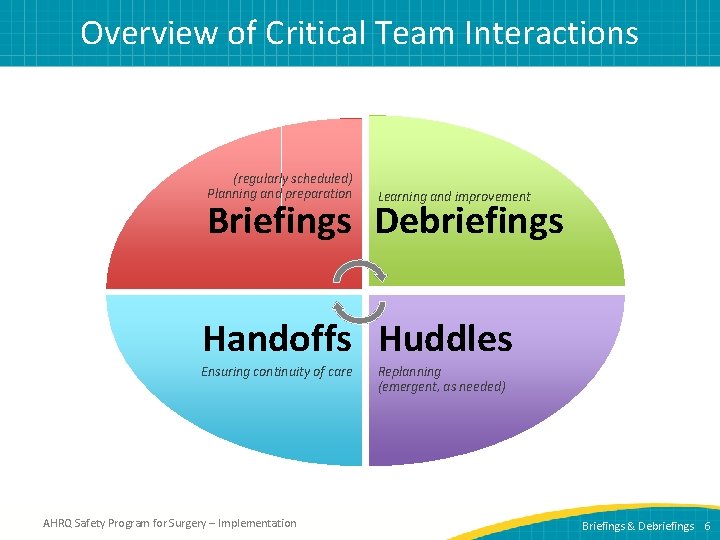
Overview of Critical Team Interactions (regularly scheduled) Planning and preparation Learning and improvement Briefings Debriefings Handoffs Huddles Ensuring continuity of care AHRQ Safety Program for Surgery – Implementation Replanning (emergent, as needed) Briefings & Debriefings 6
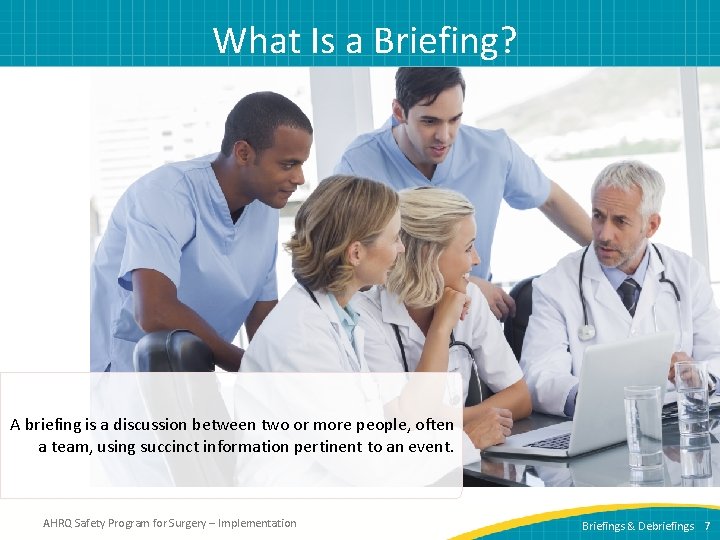
What Is a Briefing? A briefing is a discussion between two or more people, often a team, using succinct information pertinent to an event. AHRQ Safety Program for Surgery – Implementation Briefings & Debriefings 7
Purpose of a Briefing 1. Maps out the plan of care 2. Identifies roles and responsibilities for each team member 3. Heightens awareness of the situation 4. Allows the team to plan for the unexpected 5. Anticipates team members’ needs and expectations AHRQ Safety Program for Surgery – Implementation Briefings & Debriefings 8
Effective Briefings • Set the tone for the day – Chaotic and harried OR – Organized and efficient • Encourage participation and ownership by all team members – Organize based on procedure – Establish competencies • Anticipate events and plan for the unexpected – Equipment, medications, consultations – Intensive care unit bed AHRQ Safety Program for Surgery – Implementation Briefings & Debriefings 9

Briefing Checklist TOPIC Who is on core team? All members understand agree upon goals? Roles and responsibilities understood? Plan of care? Staff availability? Workload? Available resources? AHRQ Safety Program for Surgery – Implementation Briefings & Debriefings 10
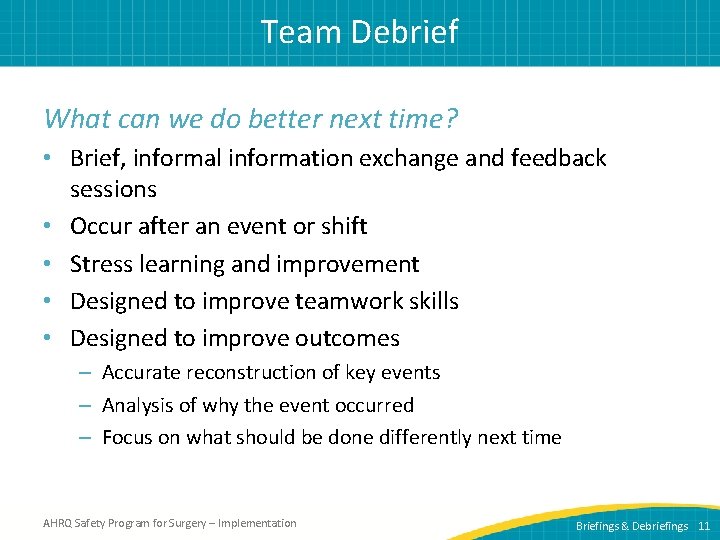
Team Debrief What can we do better next time? • Brief, informal information exchange and feedback sessions • Occur after an event or shift • Stress learning and improvement • Designed to improve teamwork skills • Designed to improve outcomes – Accurate reconstruction of key events – Analysis of why the event occurred – Focus on what should be done differently next time AHRQ Safety Program for Surgery – Implementation Briefings & Debriefings 11
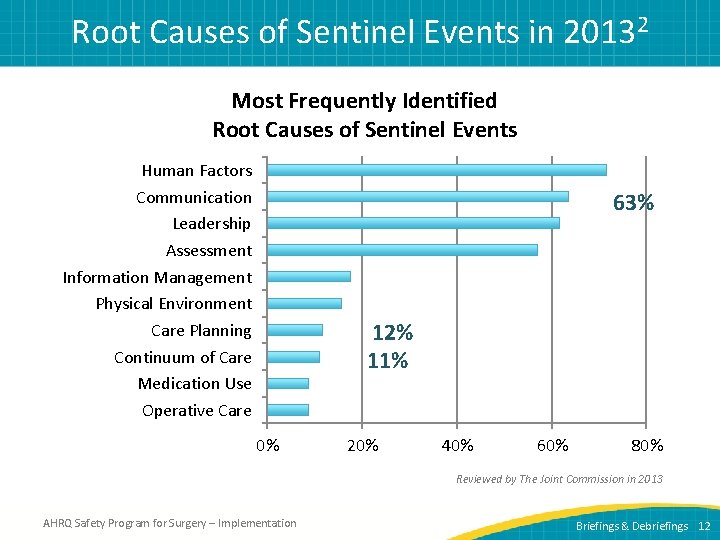
Root Causes of Sentinel Events in 20132 Most Frequently Identified Root Causes of Sentinel Events Human Factors Communication Leadership Assessment Information Management Physical Environment Care Planning Continuum of Care Medication Use Operative Care 63% 12% 11% 0% 20% 40% 60% 80% Reviewed by The Joint Commission in 2013 AHRQ Safety Program for Surgery – Implementation Briefings & Debriefings 12
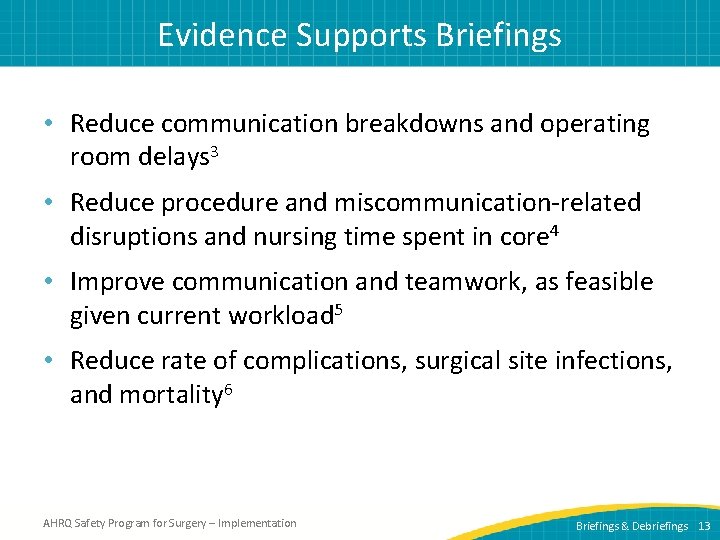
Evidence Supports Briefings • Reduce communication breakdowns and operating room delays 3 • Reduce procedure and miscommunication-related disruptions and nursing time spent in core 4 • Improve communication and teamwork, as feasible given current workload 5 • Reduce rate of complications, surgical site infections, and mortality 6 AHRQ Safety Program for Surgery – Implementation Briefings & Debriefings 13
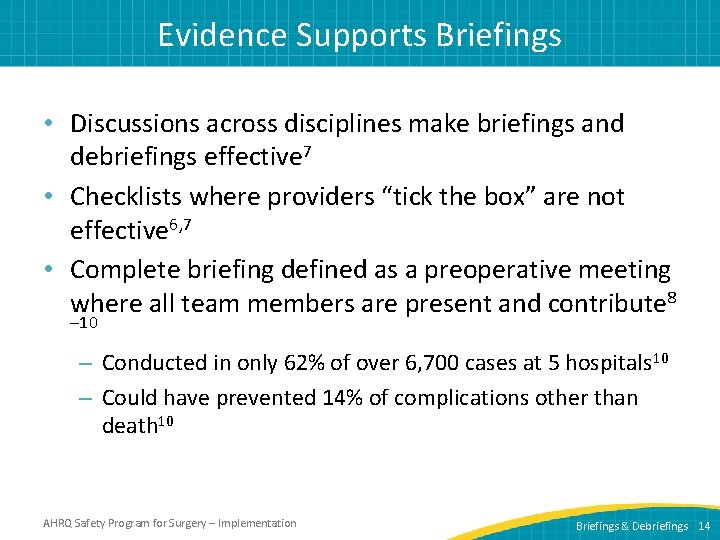
Evidence Supports Briefings • Discussions across disciplines make briefings and debriefings effective 7 • Checklists where providers “tick the box” are not effective 6, 7 • Complete briefing defined as a preoperative meeting where all team members are present and contribute 8 – 10 – Conducted in only 62% of over 6, 700 cases at 5 hospitals 10 – Could have prevented 14% of complications other than death 10 AHRQ Safety Program for Surgery – Implementation Briefings & Debriefings 14
Evidence Supports Briefings • Create shared mental model among team members 11 • Reduce task-related conflict in multi-disciplinary teams 12 • Clarify roles and responsibilities 8, 9, 12 • Anticipate changes and plan for emergent patient needs 11 AHRQ Safety Program for Surgery – Implementation Briefings & Debriefings 15
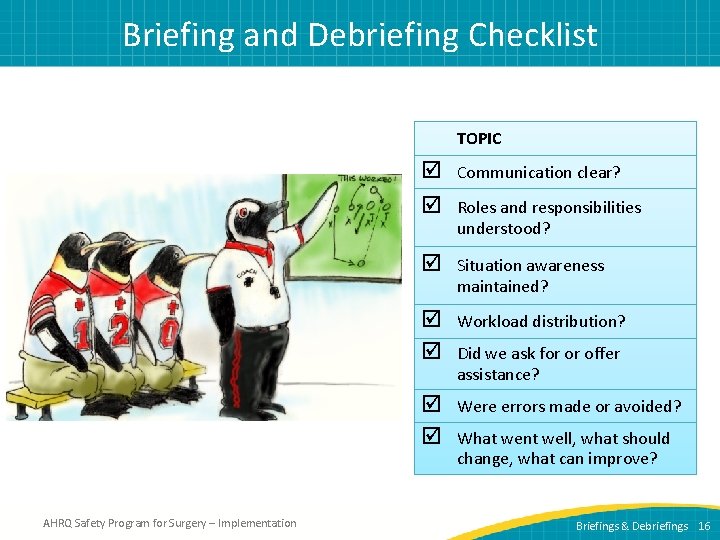
Briefing and Debriefing Checklist TOPIC AHRQ Safety Program for Surgery – Implementation Communication clear? Roles and responsibilities understood? Situation awareness maintained? Workload distribution? Were errors made or avoided? Did we ask for or offer assistance? What went well, what should change, what can improve? Briefings & Debriefings 16

Why Briefings and Debriefings? Teams perform better when they– 1. Have a high-quality plan 2. Share that plan 3. Learn and improve over time Briefings and debriefings can help, but they do not guarantee good planning. Checking the box AHRQ Safety Program for Surgery – Implementation ≠ Mindful engagement Briefings & Debriefings 17
Why Briefings and Debriefings? • Surgical safety checklists associated with significant reductions in mortality 6 • Later, 50% of reductions associated with preexisting safety culture rather than checklist alone 13 – Surgical units with strong safety culture yielded significant benefit with briefing checklist – Units with weaker safety culture saw minimal improvement • Staff that value teammates and tools are mindful of process and achieve results AHRQ Safety Program for Surgery – Implementation Briefings & Debriefings 18
How Do You Create a Mindful Process? • Coaching, role modeling, and feedback – Show that the organization values this process – Build effective communication behaviors • Briefing and debriefing process closes the loop with outcomes – Identifies defects and encourages correction – Validates the process AHRQ Safety Program for Surgery – Implementation Briefings & Debriefings 19
AHRQ Safety Program for Surgery Implementation OPERATING ROOM BRIEFINGS AND DEBRIEFINGS AHRQ Safety Program for Surgery – Implementation
Timeout: The Universal Protocol • Right patient • Right procedure • Right site AHRQ Safety Program for Surgery – Implementation Briefings & Debriefings 21
Briefings: Expanding the Timeout • Introduce all team members by first and last names • Write names and roles on white board • Facilitate timeouts • Share goal of the operation (surgeon) • Identify all issues or concerns (entire team) AHRQ Safety Program for Surgery – Implementation Briefings & Debriefings 22
What Is Most Likely To Go Wrong? Safety concerns • Identify critical steps of the procedure? • Is required equipment available? • Is someone trained on the equipment available? • Is instrumentation available? • Need implants? • Has attending physician reviewed latest results from lab and radiology? AHRQ Safety Program for Surgery – Implementation Briefings & Debriefings 23
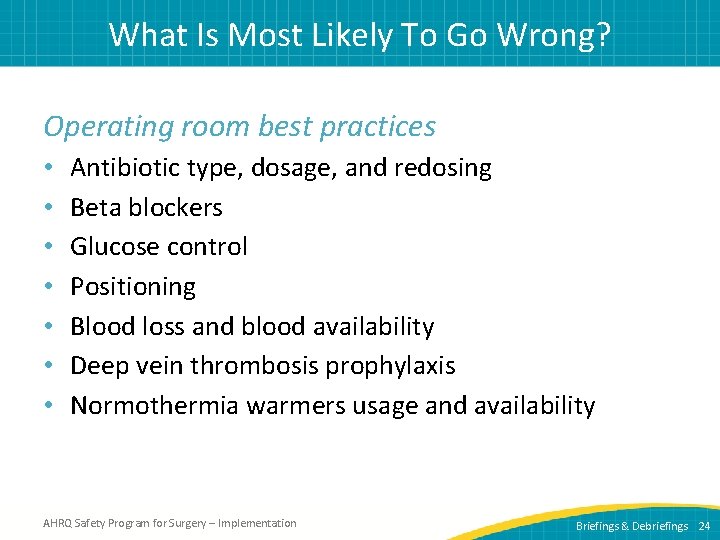
What Is Most Likely To Go Wrong? Operating room best practices • • Antibiotic type, dosage, and redosing Beta blockers Glucose control Positioning Blood loss and blood availability Deep vein thrombosis prophylaxis Normothermia warmers usage and availability AHRQ Safety Program for Surgery – Implementation Briefings & Debriefings 24
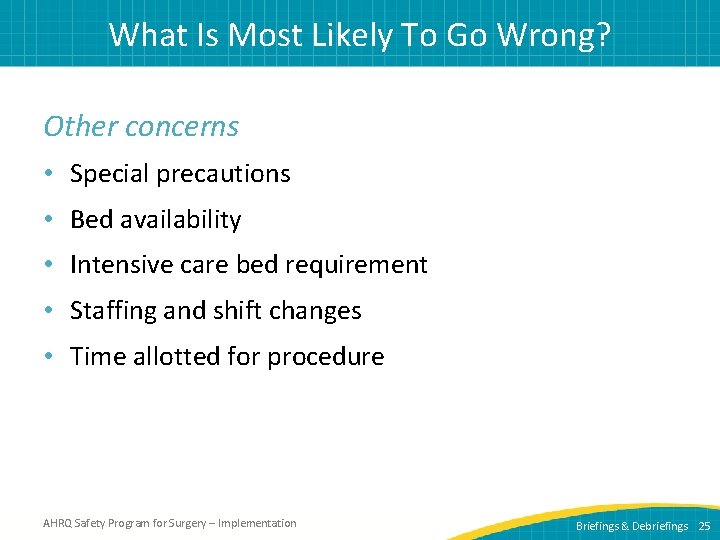
What Is Most Likely To Go Wrong? Other concerns • Special precautions • Bed availability • Intensive care bed requirement • Staffing and shift changes • Time allotted for procedure AHRQ Safety Program for Surgery – Implementation Briefings & Debriefings 25
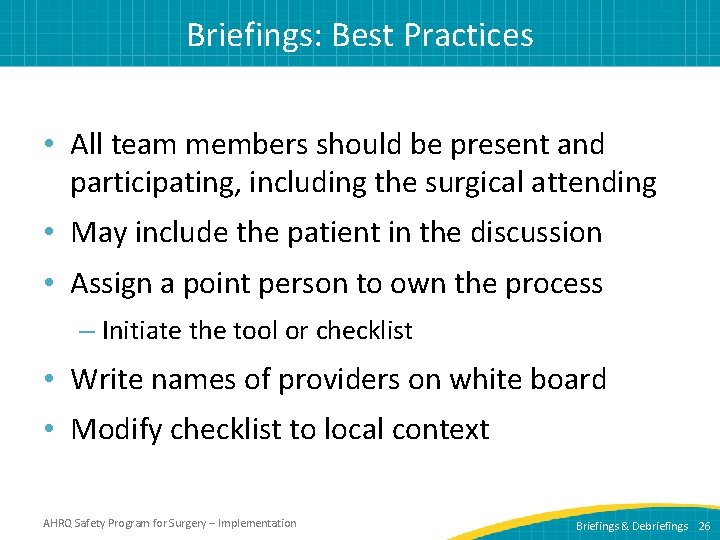
Briefings: Best Practices • All team members should be present and participating, including the surgical attending • May include the patient in the discussion • Assign a point person to own the process – Initiate the tool or checklist • Write names of providers on white board • Modify checklist to local context AHRQ Safety Program for Surgery – Implementation Briefings & Debriefings 26
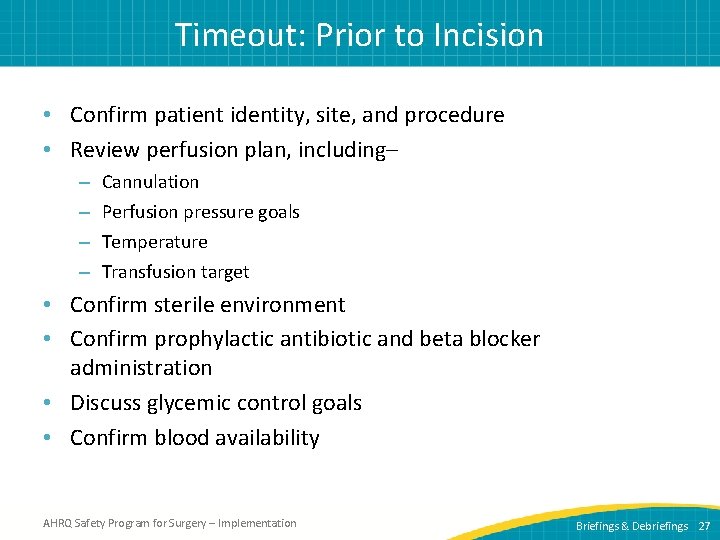
Timeout: Prior to Incision • Confirm patient identity, site, and procedure • Review perfusion plan, including– – – Cannulation Perfusion pressure goals Temperature Transfusion target • Confirm sterile environment • Confirm prophylactic antibiotic and beta blocker administration • Discuss glycemic control goals • Confirm blood availability AHRQ Safety Program for Surgery – Implementation Briefings & Debriefings 27
Timeout: Best Practices • All team members present • Use a checklist to serve as reminder • Encourage 100% participation AHRQ Safety Program for Surgery – Implementation Briefings & Debriefings 28
Debriefings in the Operating Room Before surgeon leaves the operating room– • How could the case have been safer or more efficient? • Were any issues encountered including good catches? • What went wrong? • Were patient identification, history number, specimen name, and laterality correctly listed on paperwork via independent verification? • Is plan for postoperative transition of care communicated? AHRQ Safety Program for Surgery – Implementation Briefings & Debriefings 29
Debriefings: Best Practices • Develop a system to review identified issues • Review issues with surgical site infection improvement team • Use the Learning From Defects tool – Identify all contributing factors – Develop plan to prevent defects from happening again AHRQ Safety Program for Surgery – Implementation Briefings & Debriefings 30
Real-Time Identification of Defects • Customize form based on needs in your surgical unit • Initiate candid discussions with surgeons about effective strategies for briefing and debriefing • Provide protected time for nurse to address defects and communicate solutions • Maintain logbook of defects AHRQ Safety Program for Surgery – Implementation Briefings & Debriefings 31
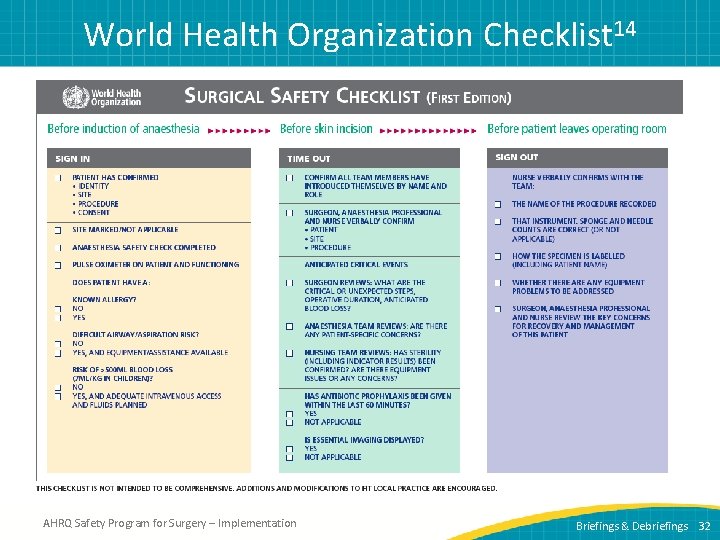
World Health Organization Checklist 14 AHRQ Safety Program for Surgery – Implementation Briefings & Debriefings 32

Colorectal Surgical Safety Checklist COLORECTAL SURGICAL SAFETY CHECKLIST • Sample checklist created for colorectal surgical unit • Model for Briefing and Debriefing tool AHRQ Safety Program for Surgery – Implementation Briefings & Debriefings 33
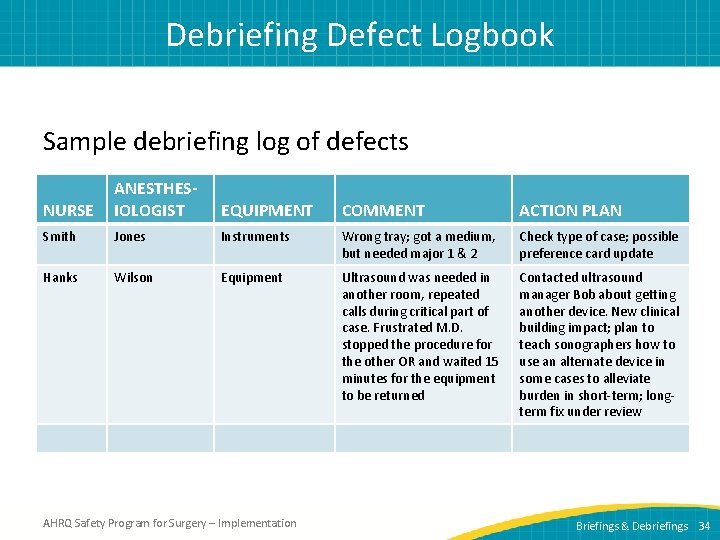
Debriefing Defect Logbook Sample debriefing log of defects NURSE ANESTHESIOLOGIST EQUIPMENT COMMENT ACTION PLAN Smith Jones Instruments Wrong tray; got a medium, but needed major 1 & 2 Check type of case; possible preference card update Hanks Wilson Equipment Ultrasound was needed in another room, repeated calls during critical part of case. Frustrated M. D. stopped the procedure for the other OR and waited 15 minutes for the equipment to be returned Contacted ultrasound manager Bob about getting another device. New clinical building impact; plan to teach sonographers how to use an alternate device in some cases to alleviate burden in short-term; longterm fix under review AHRQ Safety Program for Surgery – Implementation Briefings & Debriefings 34
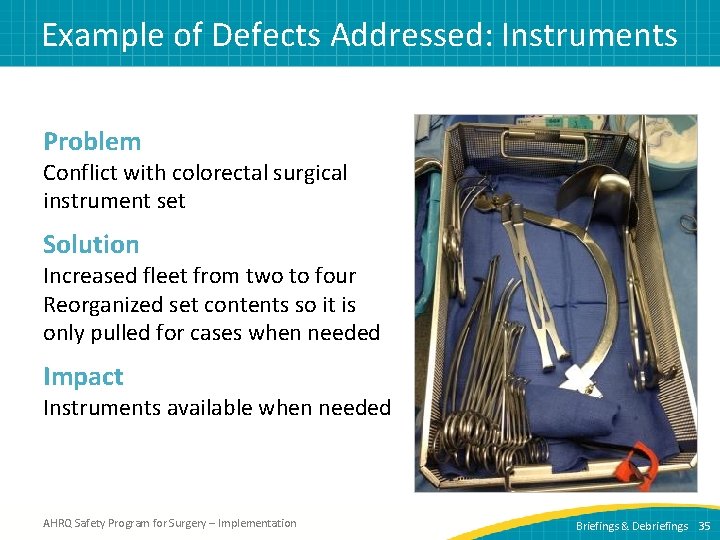
Example of Defects Addressed: Instruments Problem Conflict with colorectal surgical instrument set Solution Increased fleet from two to four Reorganized set contents so it is only pulled for cases when needed Impact Instruments available when needed AHRQ Safety Program for Surgery – Implementation Briefings & Debriefings 35
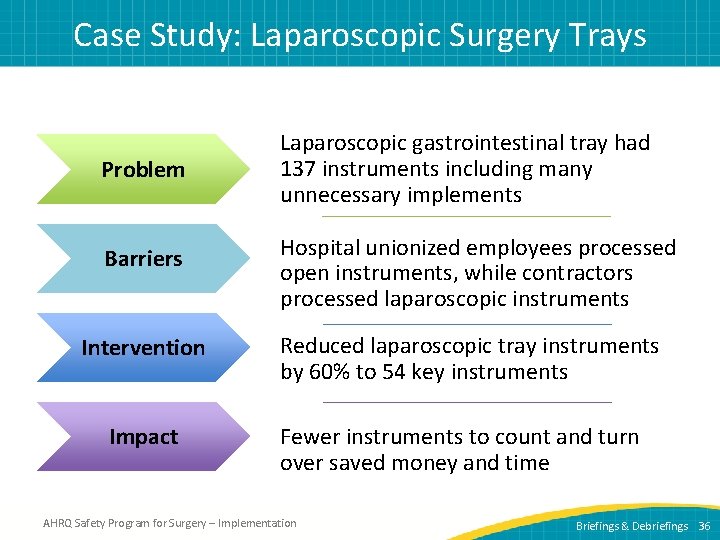
Case Study: Laparoscopic Surgery Trays Problem Barriers Intervention Impact Laparoscopic gastrointestinal tray had 137 instruments including many unnecessary implements Hospital unionized employees processed open instruments, while contractors processed laparoscopic instruments Reduced laparoscopic tray instruments by 60% to 54 key instruments Fewer instruments to count and turn over saved money and time AHRQ Safety Program for Surgery – Implementation Briefings & Debriefings 36
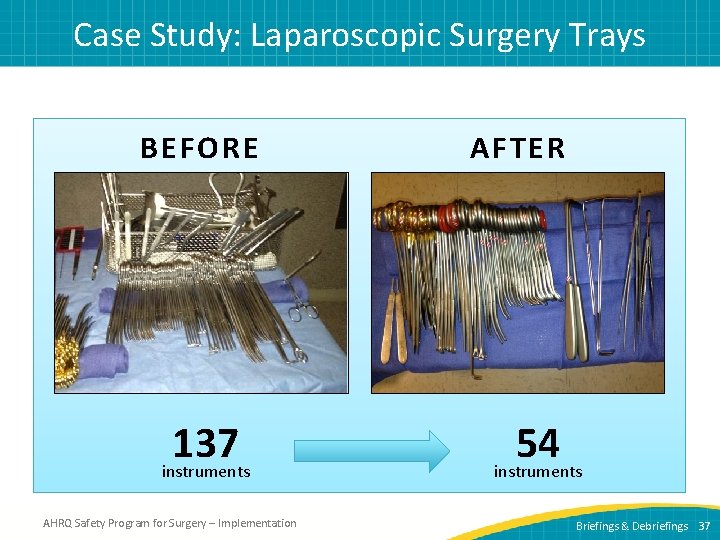
Case Study: Laparoscopic Surgery Trays BEFORE 137 instruments AHRQ Safety Program for Surgery – Implementation AFTER 54 instruments Briefings & Debriefings 37
Examples of Defects Addressed Postings Problem Circulating nurse and scrub technician could not tell from posting if an abdominal and perineal setup was needed Solution Worked with posting office • Add “second setup needed” to posting sheet • Add surgeon notes section in perioperative management system Impact • Set up before discussing case with surgeon • Incur fewer delays AHRQ Safety Program for Surgery – Implementation Briefings & Debriefings 38
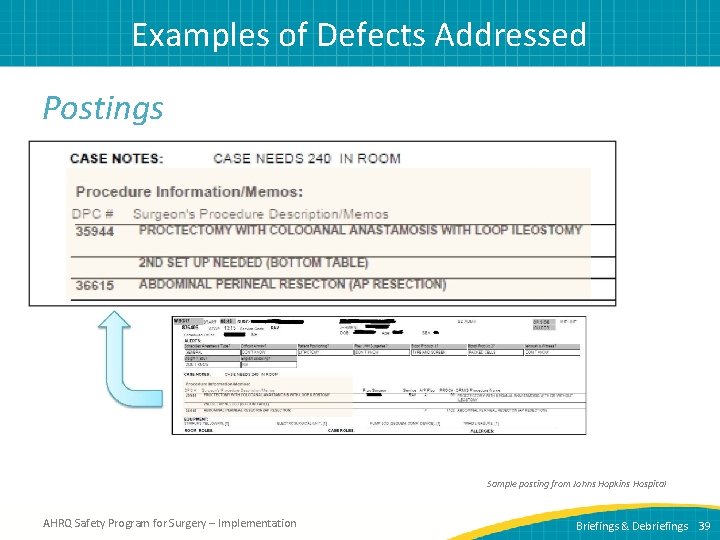
Examples of Defects Addressed Postings Sample posting from Johns Hopkins Hospital AHRQ Safety Program for Surgery – Implementation Briefings & Debriefings 39
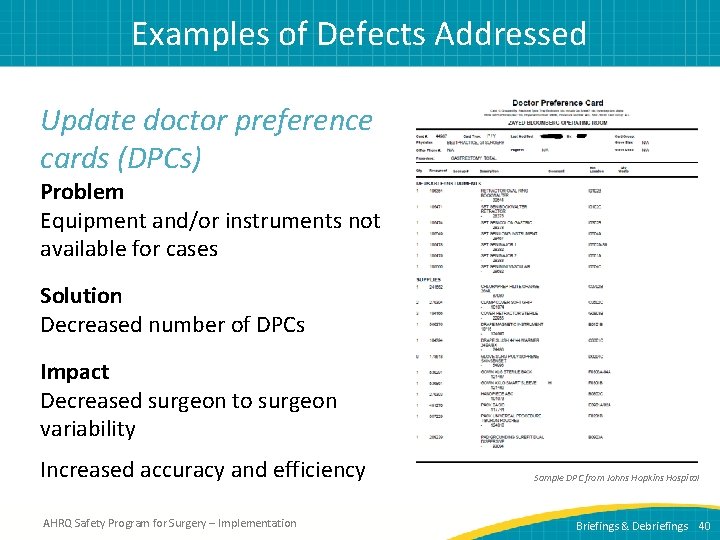
Examples of Defects Addressed Update doctor preference cards (DPCs) Problem Equipment and/or instruments not available for cases Solution Decreased number of DPCs Impact Decreased surgeon to surgeon variability Increased accuracy and efficiency AHRQ Safety Program for Surgery – Implementation Sample DPC from Johns Hopkins Hospital Briefings & Debriefings 40
What Can We Catch? • Wrong consents • Wrong patients • Incorrect equipment, implants, or instruments • Comorbidities that have a surgical impact • Incorrect specimen labels • Documentation issues • Unclear perioperative care instructions AHRQ Safety Program for Surgery – Implementation Briefings & Debriefings 41
What Can We Accomplish? • Create a shared mental model • Reduce missing equipment • Minimize team disruptions and reduce distractions – Contribute to more than 70% of sentinel events 5, 6 – Reduce hazards AHRQ Safety Program for Surgery – Implementation Briefings & Debriefings 42
Adapting to Local Context • Make interventions relevant and meaningful to staff – Ineffective and inefficient to use the same checklist for all procedure types – Adapt tools to needs of your clinical area • Allow frontline staff to drive improvement efforts – Perioperative Staff Safety Assessment (2 questions) – Surgical audits tools • Fixing local defects is a powerful (and visible) strategy to gain staff buy in and encourage participation AHRQ Safety Program for Surgery – Implementation Briefings & Debriefings 43
Lessons Learned Briefings and debriefings– • • Reshape safety culture with time and commitment Foster safety culture growth Practice and expect open communication Flatten the hierarchy Focus on the patient Adapt to local context so are meaningful to staff Identify defects proactively as they occur AHRQ Safety Program for Surgery – Implementation Briefings & Debriefings 44
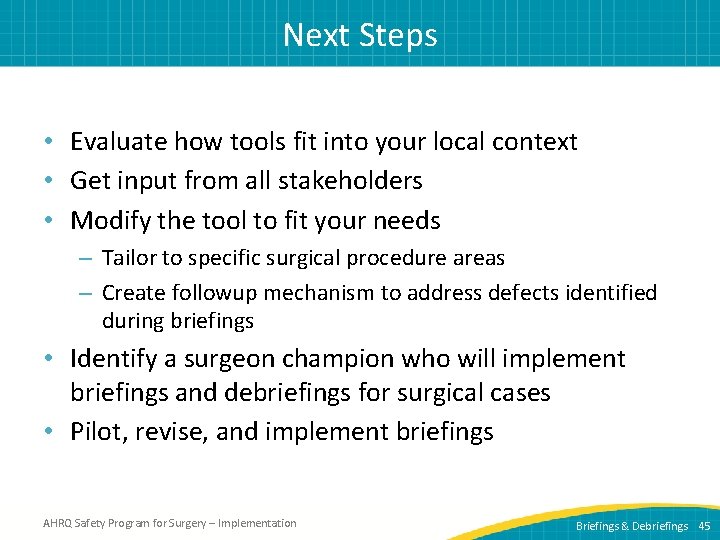
Next Steps • Evaluate how tools fit into your local context • Get input from all stakeholders • Modify the tool to fit your needs – Tailor to specific surgical procedure areas – Create followup mechanism to address defects identified during briefings • Identify a surgeon champion who will implement briefings and debriefings for surgical cases • Pilot, revise, and implement briefings AHRQ Safety Program for Surgery – Implementation Briefings & Debriefings 45
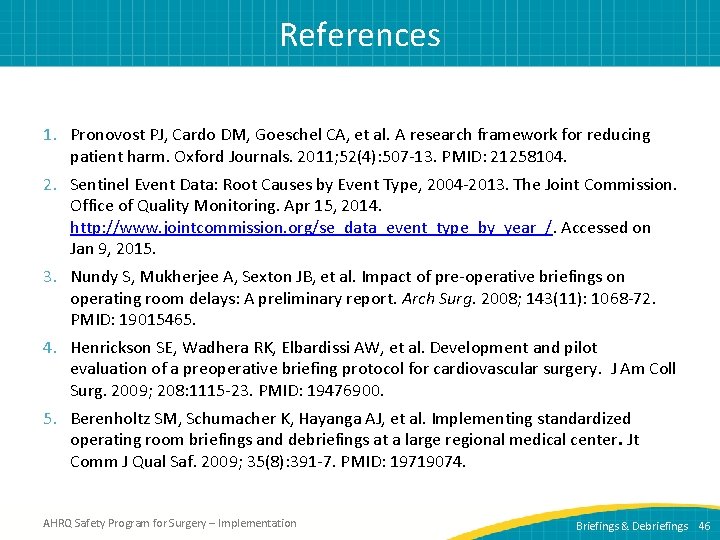
References 1. Pronovost PJ, Cardo DM, Goeschel CA, et al. A research framework for reducing patient harm. Oxford Journals. 2011; 52(4): 507 -13. PMID: 21258104. 2. Sentinel Event Data: Root Causes by Event Type, 2004 -2013. The Joint Commission. Office of Quality Monitoring. Apr 15, 2014. http: //www. jointcommission. org/se_data_event_type_by_year_/. Accessed on Jan 9, 2015. 3. Nundy S, Mukherjee A, Sexton JB, et al. Impact of pre-operative briefings on operating room delays: A preliminary report. Arch Surg. 2008; 143(11): 1068 -72. PMID: 19015465. 4. Henrickson SE, Wadhera RK, Elbardissi AW, et al. Development and pilot evaluation of a preoperative briefing protocol for cardiovascular surgery. J Am Coll Surg. 2009; 208: 1115 -23. PMID: 19476900. 5. Berenholtz SM, Schumacher K, Hayanga AJ, et al. Implementing standardized operating room briefings and debriefings at a large regional medical center. Jt Comm J Qual Saf. 2009; 35(8): 391 -7. PMID: 19719074. AHRQ Safety Program for Surgery – Implementation Briefings & Debriefings 46
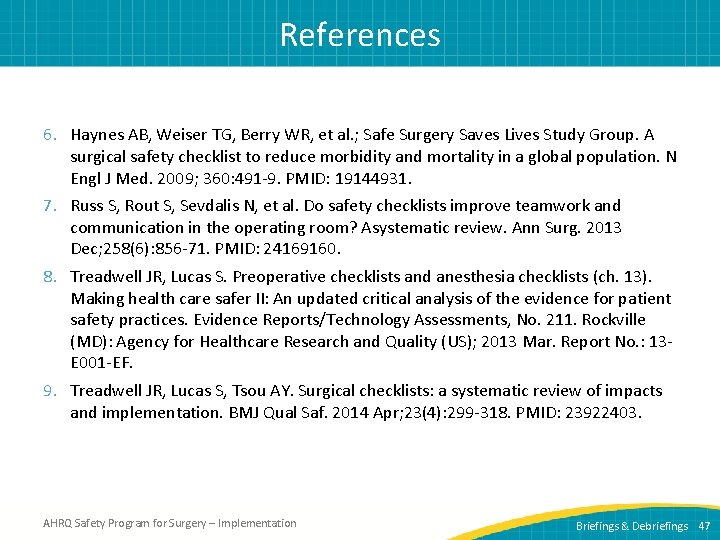
References 6. Haynes AB, Weiser TG, Berry WR, et al. ; Safe Surgery Saves Lives Study Group. A surgical safety checklist to reduce morbidity and mortality in a global population. N Engl J Med. 2009; 360: 491 -9. PMID: 19144931. 7. Russ S, Rout S, Sevdalis N, et al. Do safety checklists improve teamwork and communication in the operating room? Asystematic review. Ann Surg. 2013 Dec; 258(6): 856 -71. PMID: 24169160. 8. Treadwell JR, Lucas S. Preoperative checklists and anesthesia checklists (ch. 13). Making health care safer II: An updated critical analysis of the evidence for patient safety practices. Evidence Reports/Technology Assessments, No. 211. Rockville (MD): Agency for Healthcare Research and Quality (US); 2013 Mar. Report No. : 13 E 001 -EF. 9. Treadwell JR, Lucas S, Tsou AY. Surgical checklists: a systematic review of impacts and implementation. BMJ Qual Saf. 2014 Apr; 23(4): 299 -318. PMID: 23922403. AHRQ Safety Program for Surgery – Implementation Briefings & Debriefings 47
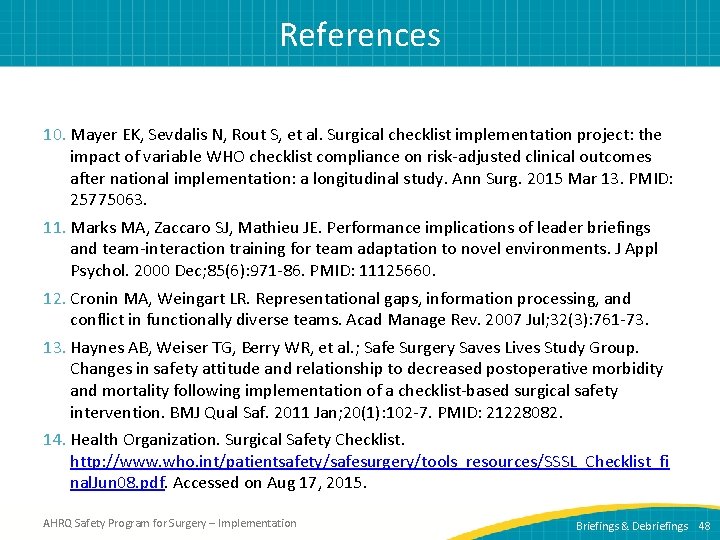
References 10. Mayer EK, Sevdalis N, Rout S, et al. Surgical checklist implementation project: the impact of variable WHO checklist compliance on risk-adjusted clinical outcomes after national implementation: a longitudinal study. Ann Surg. 2015 Mar 13. PMID: 25775063. 11. Marks MA, Zaccaro SJ, Mathieu JE. Performance implications of leader briefings and team-interaction training for team adaptation to novel environments. J Appl Psychol. 2000 Dec; 85(6): 971 -86. PMID: 11125660. 12. Cronin MA, Weingart LR. Representational gaps, information processing, and conflict in functionally diverse teams. Acad Manage Rev. 2007 Jul; 32(3): 761 -73. 13. Haynes AB, Weiser TG, Berry WR, et al. ; Safe Surgery Saves Lives Study Group. Changes in safety attitude and relationship to decreased postoperative morbidity and mortality following implementation of a checklist-based surgical safety intervention. BMJ Qual Saf. 2011 Jan; 20(1): 102 -7. PMID: 21228082. 14. Health Organization. Surgical Safety Checklist. http: //www. who. int/patientsafety/safesurgery/tools_resources/SSSL_Checklist_fi nal. Jun 08. pdf. Accessed on Aug 17, 2015. AHRQ Safety Program for Surgery – Implementation Briefings & Debriefings 48
AHRQ Safety Program for Surgery Implementation Briefings and Debriefings HOSPITAL TEAM EXPERIENCE AHRQ Safety Program for Surgery – Implementation
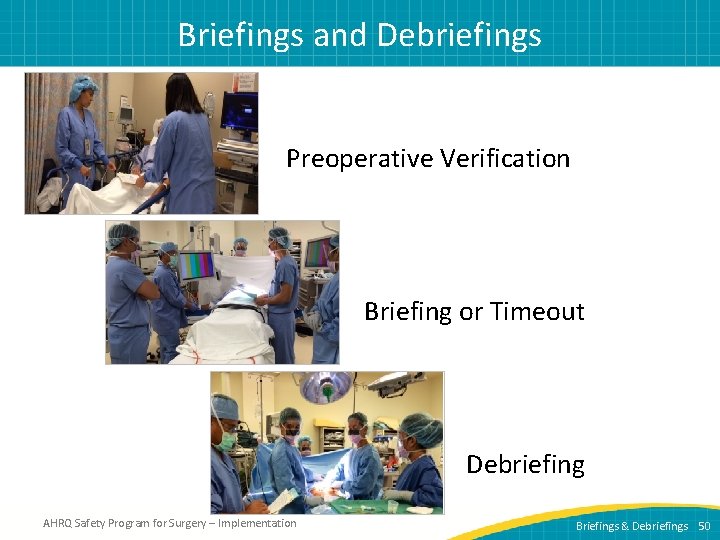
Briefings and Debriefings Preoperative Verification Briefing or Timeout Debriefing AHRQ Safety Program for Surgery – Implementation Briefings & Debriefings 50
Barriers to Debriefing • Team needed approval from the administration • Staff hesitant to incorporate another form • Team questioned if staff would comply with new form and process AHRQ Safety Program for Surgery – Implementation Briefings & Debriefings 51
Success With Debriefing • Championed by the surgical quality improvement team • Provides process to document concerns and issues • Reviews and shares followup opportunities • Improves morale as staff and surgeons see issues addressed • Reduces number of less-urgent issues escalated to management AHRQ Safety Program for Surgery – Implementation Briefings & Debriefings 52
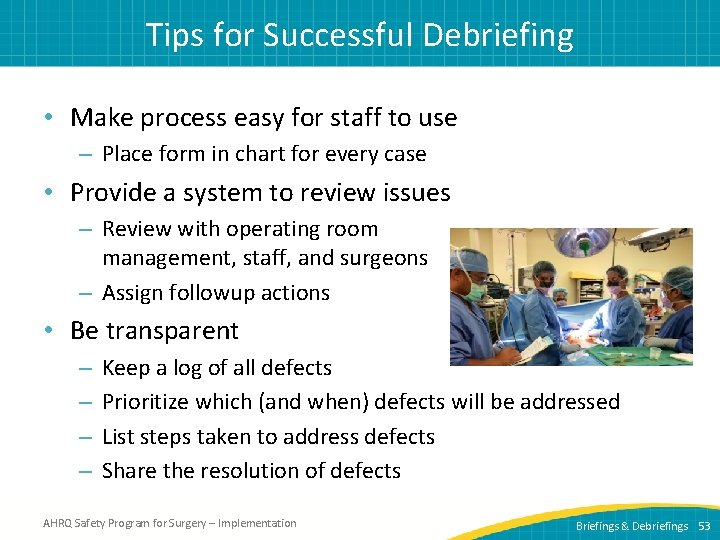
Tips for Successful Debriefing • Make process easy for staff to use – Place form in chart for every case • Provide a system to review issues – Review with operating room management, staff, and surgeons – Assign followup actions • Be transparent – – Keep a log of all defects Prioritize which (and when) defects will be addressed List steps taken to address defects Share the resolution of defects AHRQ Safety Program for Surgery – Implementation Briefings & Debriefings 53
Intraoperative Debriefing • Perform at case completion, usually after the first count and before surgeon leaves the operating room • Cover what went well, good catches, and room for improvement • Ask if instrument, sponge, and needle counts are correct • Record name of procedure and wound classification • If applicable, specify how specimen labeled or provide special instructions • Address equipment issues • Plan postoperative beta blockers, if applicable • Communicate key concerns for recovery and management of the patient AHRQ Safety Program for Surgery – Implementation Briefings & Debriefings 54
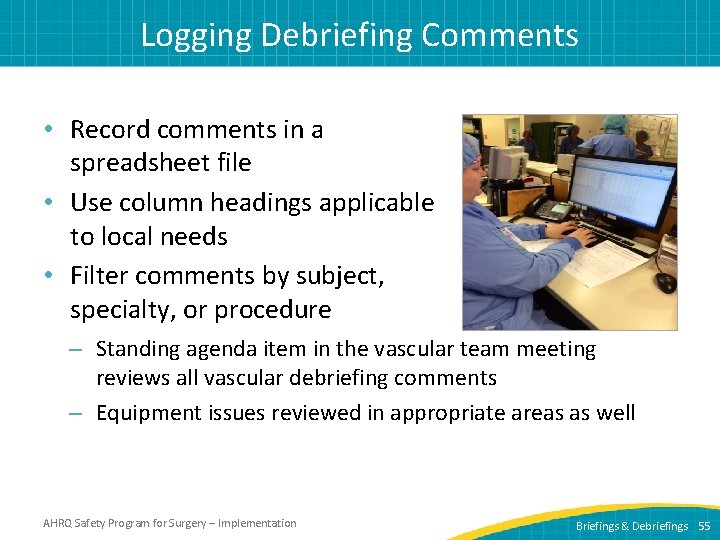
Logging Debriefing Comments • Record comments in a spreadsheet file • Use column headings applicable to local needs • Filter comments by subject, specialty, or procedure – Standing agenda item in the vascular team meeting reviews all vascular debriefing comments – Equipment issues reviewed in appropriate areas as well AHRQ Safety Program for Surgery – Implementation Briefings & Debriefings 55
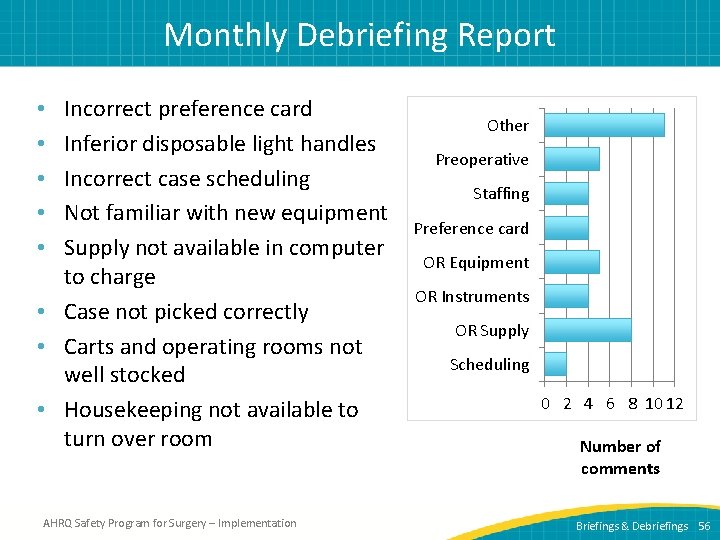
Monthly Debriefing Report Incorrect preference card Inferior disposable light handles Incorrect case scheduling Not familiar with new equipment Supply not available in computer to charge • Case not picked correctly • Carts and operating rooms not well stocked • Housekeeping not available to turn over room • • • AHRQ Safety Program for Surgery – Implementation Other Preoperative Staffing Preference card OR Equipment OR Instruments OR Supply Scheduling 0 2 4 6 8 10 12 Number of comments Briefings & Debriefings 56
- Slides: 56