
AHRQ Safety Program for Mechanically Ventilated Patients Learn
- Slides: 35
AHRQ Safety Program for Mechanically Ventilated Patients Learn From Defects in Care of Mechanically Ventilated Patients AHRQ Safety Program for Mechanically Ventilated Patients AHRQ Pub. No. 16(17)-0018 -34 -EF January 2017 Learn From Defects 1
Learning Objectives After this session, you will be able to— • Describe difference between first-order and second-order problem solving • List contributing factors that make defects in care more likely to occur • Use the Learning from Defects (LFD) tool to perform secondorder problem solving • Evaluate the effectiveness of your intervention by measuring baseline and post-intervention performance • Present your findings to department leadership AHRQ Safety Program for Mechanically Ventilated Patients Learn From Defects 2
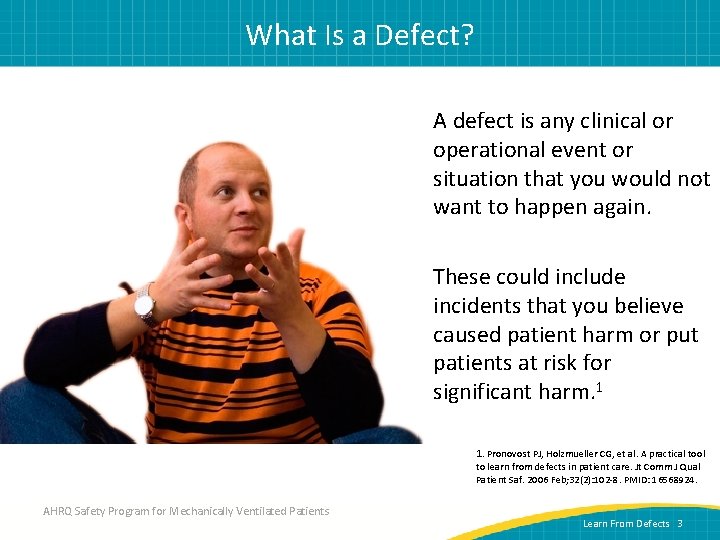
What Is a Defect? A defect is any clinical or operational event or situation that you would not want to happen again. These could include incidents that you believe caused patient harm or put patients at risk for significant harm. 1 1. Pronovost PJ, Holzmueller CG, et al. A practical tool to learn from defects in patient care. Jt Comm J Qual Patient Saf. 2006 Feb; 32(2): 102 -8. PMID: 16568924. AHRQ Safety Program for Mechanically Ventilated Patients Learn From Defects 3
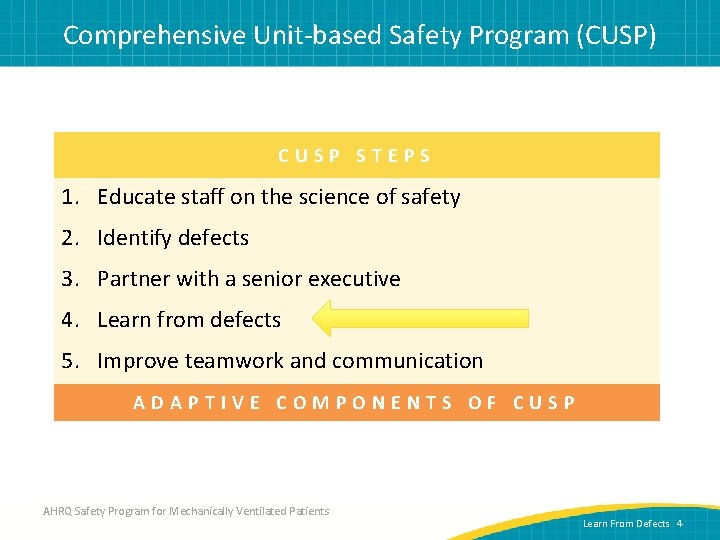
Comprehensive Unit-based Safety Program (CUSP) CUSP STEPS 1. Educate staff on the science of safety 2. Identify defects 3. Partner with a senior executive 4. Learn from defects 5. Improve teamwork and communication ADAPTIVE COMPONENTS OF CUSP AHRQ Safety Program for Mechanically Ventilated Patients Learn From Defects 4
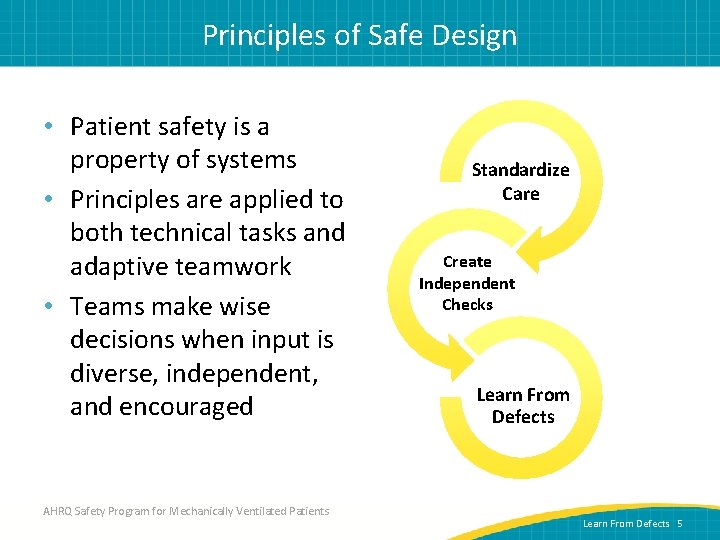
Principles of Safe Design • Patient safety is a property of systems • Principles are applied to both technical tasks and adaptive teamwork • Teams make wise decisions when input is diverse, independent, and encouraged AHRQ Safety Program for Mechanically Ventilated Patients Standardize Care Create Independent Checks Learn From Defects 5
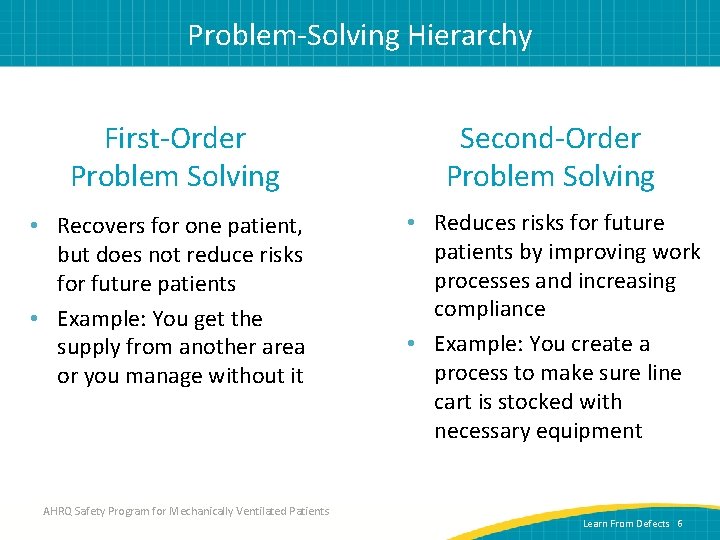
Problem-Solving Hierarchy First-Order Problem Solving Second-Order Problem Solving • Recovers for one patient, but does not reduce risks for future patients • Example: You get the supply from another area or you manage without it • Reduces risks for future patients by improving work processes and increasing compliance • Example: You create a process to make sure line cart is stocked with necessary equipment AHRQ Safety Program for Mechanically Ventilated Patients Learn From Defects 6
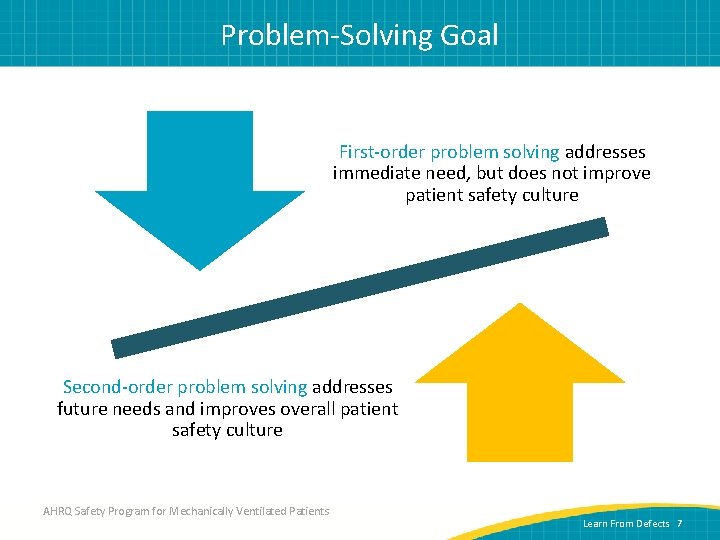
Problem-Solving Goal First-order problem solving addresses immediate need, but does not improve patient safety culture Second-order problem solving addresses future needs and improves overall patient safety culture AHRQ Safety Program for Mechanically Ventilated Patients Learn From Defects 7
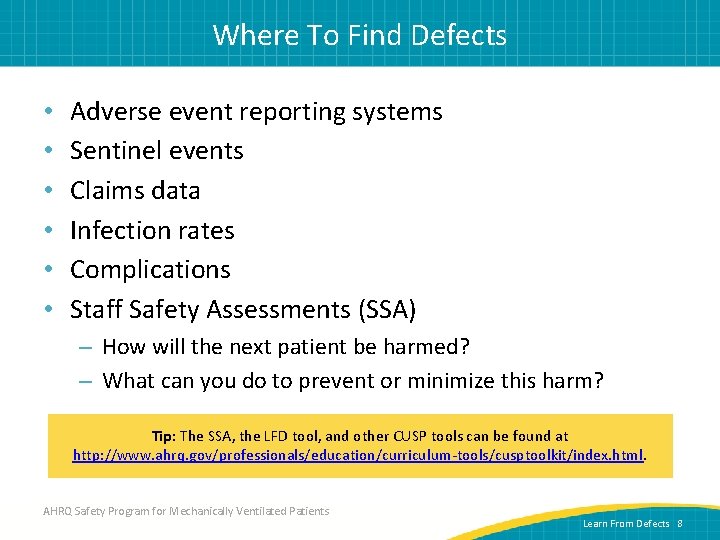
Where To Find Defects • • • Adverse event reporting systems Sentinel events Claims data Infection rates Complications Staff Safety Assessments (SSA) – How will the next patient be harmed? – What can you do to prevent or minimize this harm? Tip: The SSA, the LFD tool, and other CUSP tools can be found at http: //www. ahrq. gov/professionals/education/curriculum-tools/cusptoolkit/index. html. AHRQ Safety Program for Mechanically Ventilated Patients Learn From Defects 8
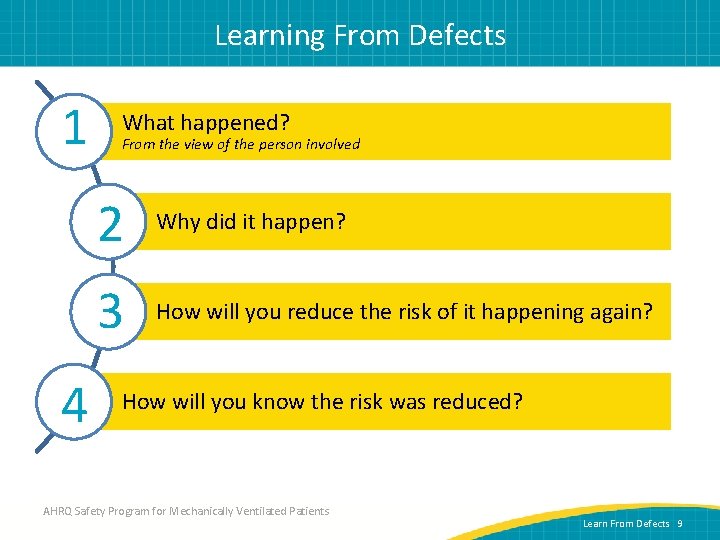
Learning From Defects 1 4 What happened? From the view of the person involved 2 Why did it happen? 3 How will you reduce the risk of it happening again? How will you know the risk was reduced? AHRQ Safety Program for Mechanically Ventilated Patients Learn From Defects 9
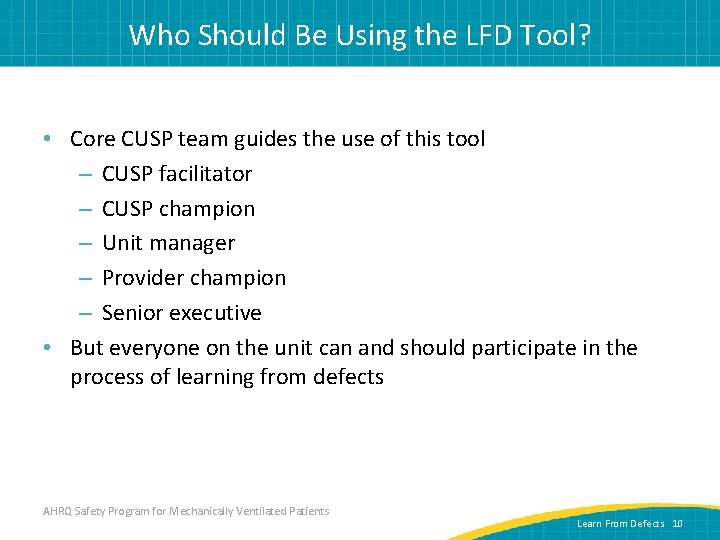
Who Should Be Using the LFD Tool? • Core CUSP team guides the use of this tool – CUSP facilitator – CUSP champion – Unit manager – Provider champion – Senior executive • But everyone on the unit can and should participate in the process of learning from defects AHRQ Safety Program for Mechanically Ventilated Patients Learn From Defects 10
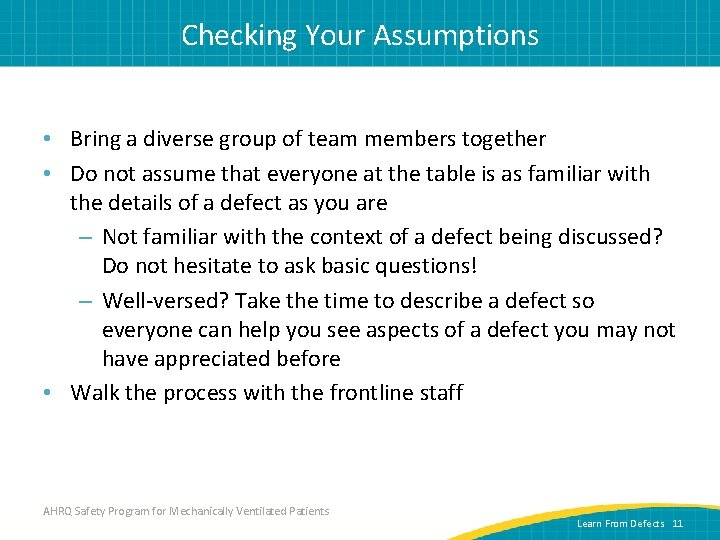
Checking Your Assumptions • Bring a diverse group of team members together • Do not assume that everyone at the table is as familiar with the details of a defect as you are – Not familiar with the context of a defect being discussed? Do not hesitate to ask basic questions! – Well-versed? Take the time to describe a defect so everyone can help you see aspects of a defect you may not have appreciated before • Walk the process with the frontline staff AHRQ Safety Program for Mechanically Ventilated Patients Learn From Defects 11
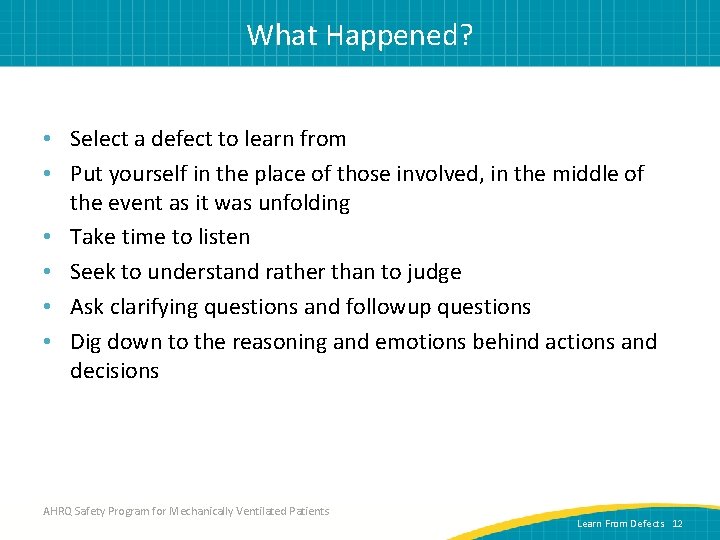
What Happened? • Select a defect to learn from • Put yourself in the place of those involved, in the middle of the event as it was unfolding • Take time to listen • Seek to understand rather than to judge • Ask clarifying questions and followup questions • Dig down to the reasoning and emotions behind actions and decisions AHRQ Safety Program for Mechanically Ventilated Patients Learn From Defects 12
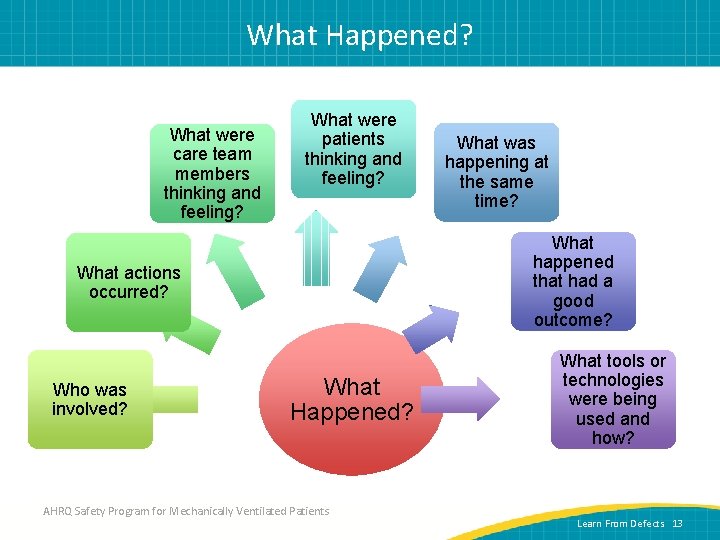
What Happened? What were care team members thinking and feeling? What were patients thinking and feeling? What happened that had a good outcome? What actions occurred? Who was involved? What was happening at the same time? What Happened? AHRQ Safety Program for Mechanically Ventilated Patients What tools or technologies were being used and how? Learn From Defects 13
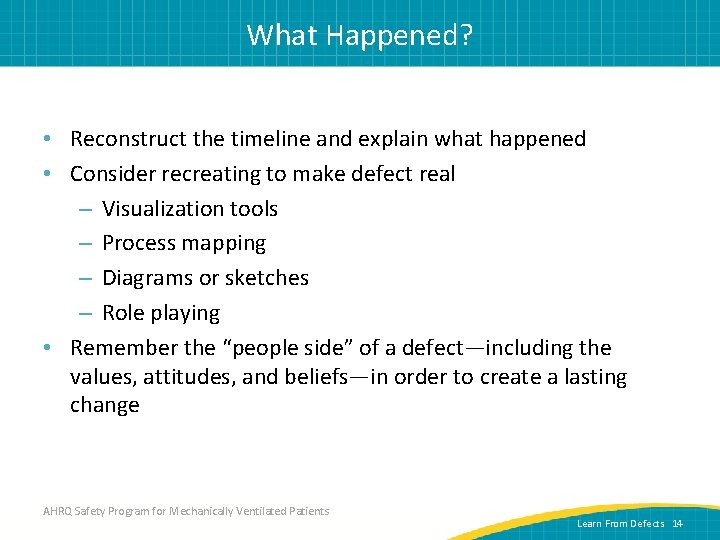
What Happened? • Reconstruct the timeline and explain what happened • Consider recreating to make defect real – Visualization tools – Process mapping – Diagrams or sketches – Role playing • Remember the “people side” of a defect—including the values, attitudes, and beliefs—in order to create a lasting change AHRQ Safety Program for Mechanically Ventilated Patients Learn From Defects 14
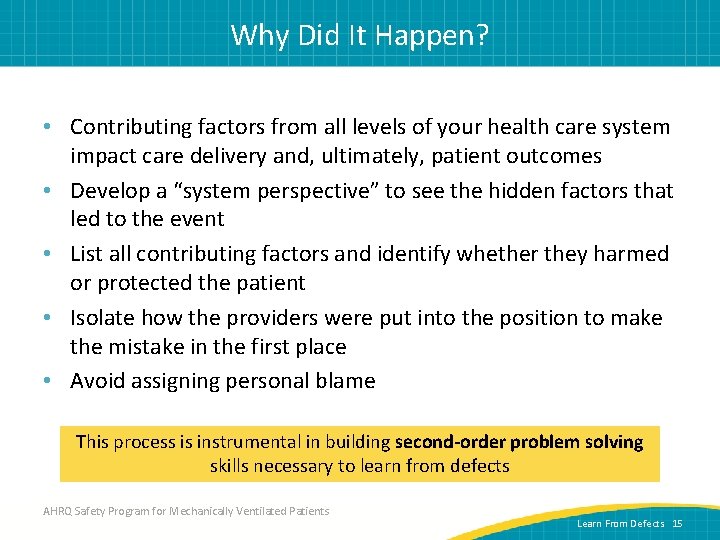
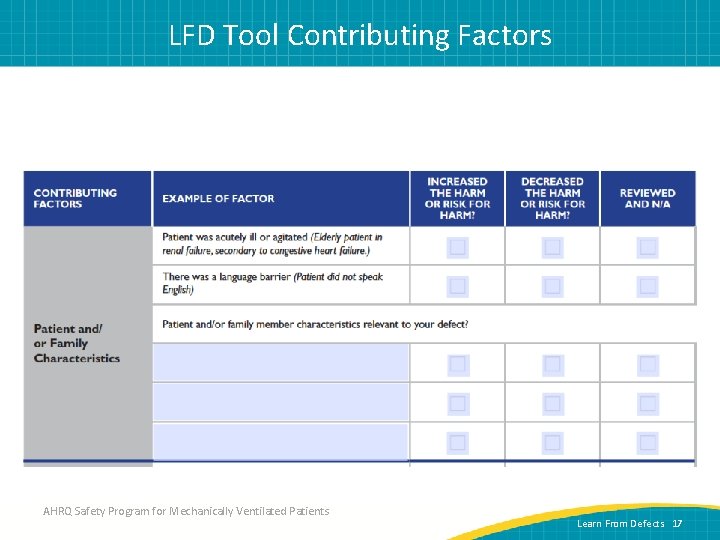
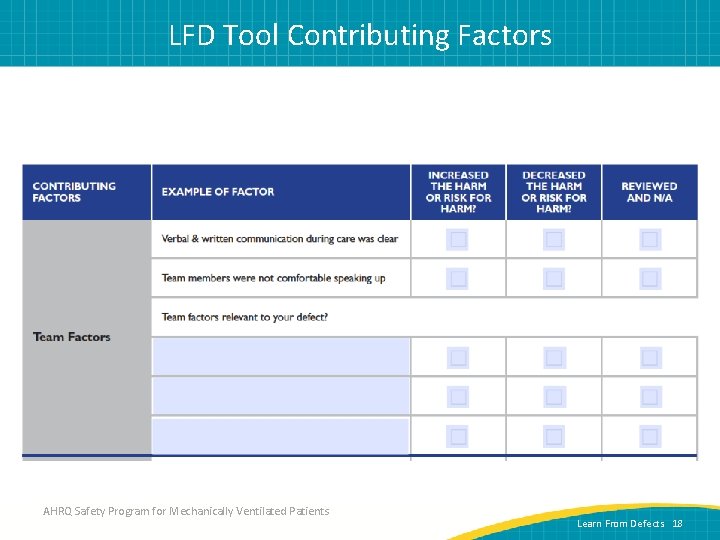
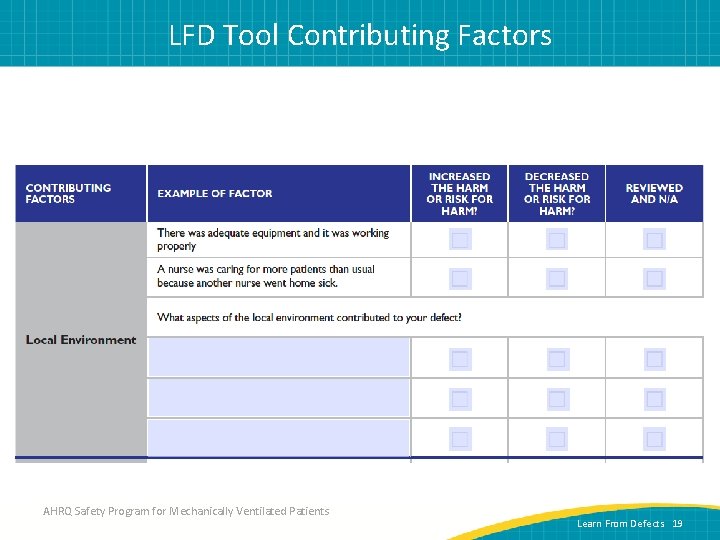
Why Did It Happen? • Contributing factors from all levels of your health care system impact care delivery and, ultimately, patient outcomes • Develop a “system perspective” to see the hidden factors that led to the event • List all contributing factors and identify whether they harmed or protected the patient • Isolate how the providers were put into the position to make the mistake in the first place • Avoid assigning personal blame This process is instrumental in building second-order problem solving skills necessary to learn from defects AHRQ Safety Program for Mechanically Ventilated Patients Learn From Defects 15
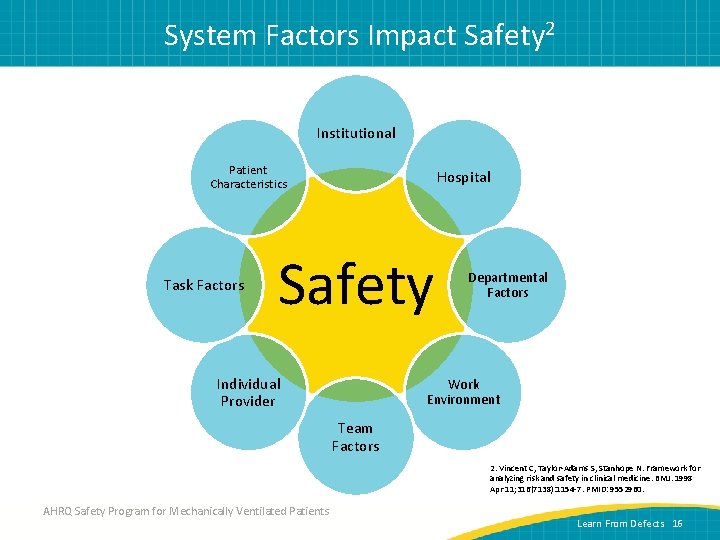
System Factors Impact Safety 2 Institutional Patient Characteristics Task Factors Hospital Safety Individual Provider Departmental Factors Work Environment Team Factors 2. Vincent C, Taylor-Adams S, Stanhope N. Framework for analyzing risk and safety in clinical medicine. BMJ. 1998 Apr 11; 316(7138): 1154 -7. PMID: 9552960. AHRQ Safety Program for Mechanically Ventilated Patients Learn From Defects 16
LFD Tool Contributing Factors AHRQ Safety Program for Mechanically Ventilated Patients Learn From Defects 17
LFD Tool Contributing Factors AHRQ Safety Program for Mechanically Ventilated Patients Learn From Defects 18
LFD Tool Contributing Factors AHRQ Safety Program for Mechanically Ventilated Patients Learn From Defects 19
Why Did It Happen? • Try to go deeper as you identify contributing factors • Use the “ 5 Whys” technique – Why 1—Why did this contributing factor occur? – Why 2—Why did “Why 1” occur? – Why 3—Why did “Why 2” occur? – Why 4—Why did “Why 3” occur? – Why 5—Why did “Why 4” occur? • Consider having more than one meeting or additional factfinding effort to find all contributing factors AHRQ Safety Program for Mechanically Ventilated Patients Learn From Defects 20
Why Did It Happen? • Refer back to any drawings your team used to illustrate what happened • Look for weaknesses in the processes – Are there redundant steps? – Are there variables that make care inconsistent among providers? • Evaluate the way your workspaces are designed – Is the workflow reasonable? – Is the workflow efficient? AHRQ Safety Program for Mechanically Ventilated Patients Learn From Defects 21
Why Did It Happen? • What about the people side of the defect? • Can you identify where the main points are? • Are there aspects of your patient safety culture that promote doing the wrong thing or engaging in a risky workaround? • What might your team do to build a stronger safety culture? AHRQ Safety Program for Mechanically Ventilated Patients Learn From Defects 22
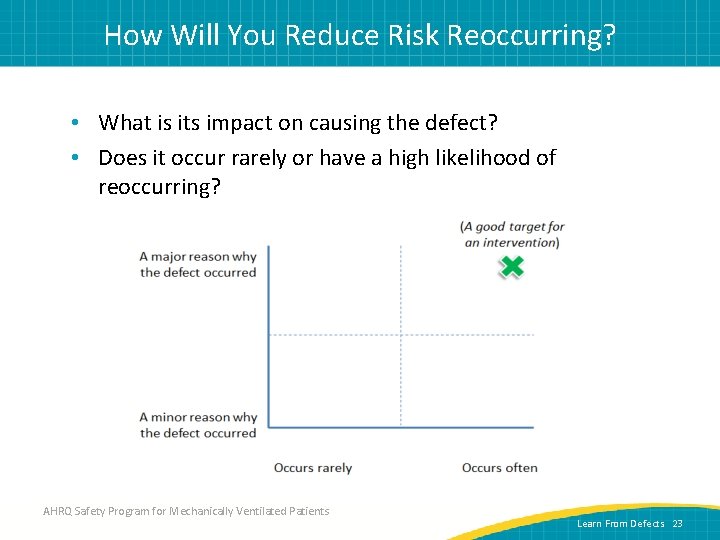
How Will You Reduce Risk Reoccurring? • What is its impact on causing the defect? • Does it occur rarely or have a high likelihood of reoccurring? AHRQ Safety Program for Mechanically Ventilated Patients Learn From Defects 23
How Will You Reduce Risk Reoccurring? Create choices by brainstorming possible interventions • Involve the entire team with flipcharts and Post-it notes • Prioritize most important contributing factors and most beneficial interventions • Take advantage of your diverse team! – Senior executive’s big-picture view of the organization and knowledge of resources – Team members’ connections throughout organization – Frontline staff with particular insight into the defect AHRQ Safety Program for Mechanically Ventilated Patients Learn From Defects 24
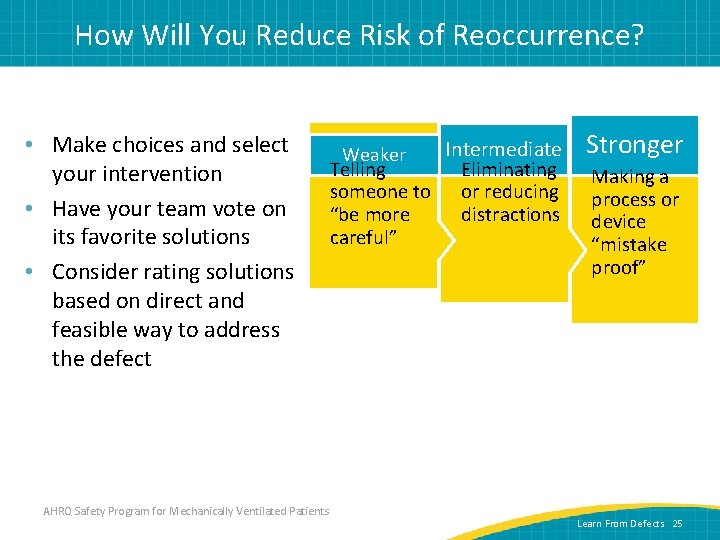
How Will You Reduce Risk of Reoccurrence? • Make choices and select your intervention • Have your team vote on its favorite solutions • Consider rating solutions based on direct and feasible way to address the defect AHRQ Safety Program for Mechanically Ventilated Patients Intermediate Eliminating Telling someone to or reducing distractions “be more careful” Weaker Stronger Making a process or device “mistake proof” Learn From Defects 25
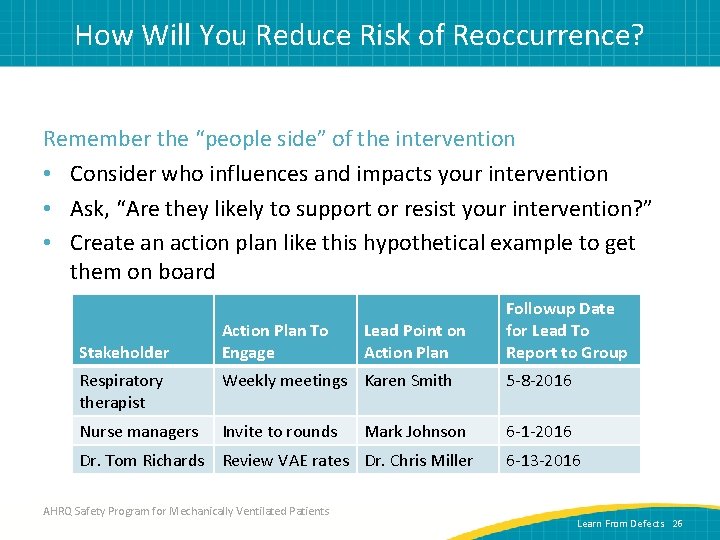
How Will You Reduce Risk of Reoccurrence? Remember the “people side” of the intervention • Consider who influences and impacts your intervention • Ask, “Are they likely to support or resist your intervention? ” • Create an action plan like this hypothetical example to get them on board Stakeholder Action Plan To Engage Lead Point on Action Plan Followup Date for Lead To Report to Group Respiratory therapist Weekly meetings Karen Smith 5 -8 -2016 Nurse managers Invite to rounds 6 -1 -2016 Mark Johnson Dr. Tom Richards Review VAE rates Dr. Chris Miller AHRQ Safety Program for Mechanically Ventilated Patients 6 -13 -2016 Learn From Defects 26
How Will You Reduce Risk of Reoccurrence? • Remember that engagement is hard! • Use the wisdom of your diverse team to overcome barriers and solve problems • Make sure the intervention details are spelled out and understood by everyone • Ensure the intervention is carried out consistently AHRQ Safety Program for Mechanically Ventilated Patients Learn From Defects 27
How Will You Know Risks Were Reduced? • Ask: – Do staff know about the interventions? – Are staff using the interventions as intended? – Do staff believe risks were reduced? • Make data-driven metrics the goal whenever possible • Incorporate subjective evaluations for valuable supplementary information AHRQ Safety Program for Mechanically Ventilated Patients Learn From Defects 28
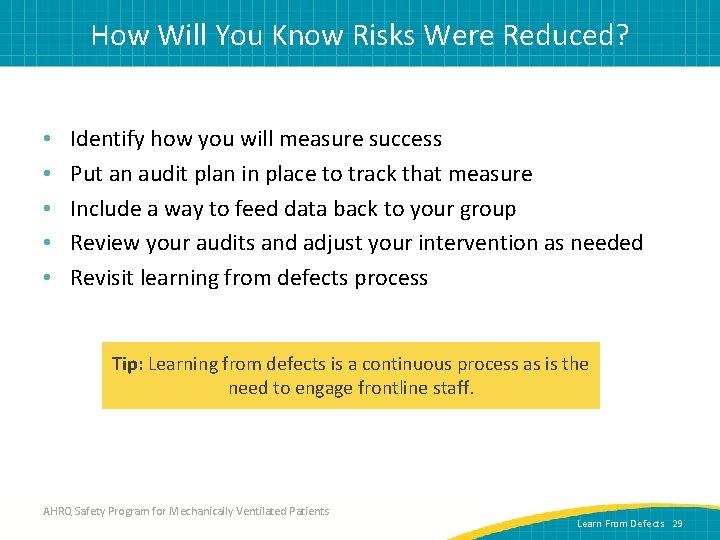
How Will You Know Risks Were Reduced? • • • Identify how you will measure success Put an audit plan in place to track that measure Include a way to feed data back to your group Review your audits and adjust your intervention as needed Revisit learning from defects process Tip: Learning from defects is a continuous process as is the need to engage frontline staff. AHRQ Safety Program for Mechanically Ventilated Patients Learn From Defects 29
How Will You Know Risks Were Reduced? • Evaluate the effectiveness of your intervention by measuring baseline and post-intervention performance • Present your findings to leadership and your frontline providers AHRQ Safety Program for Mechanically Ventilated Patients Learn From Defects 30
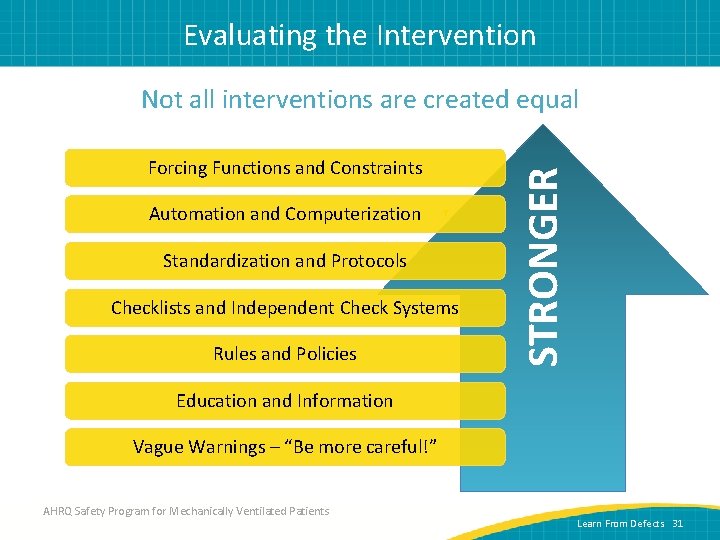
Evaluating the Intervention Forcing Functions and Constraints Automation and Computerization Standardization and Protocols Checklists and Independent Check Systems Rules and Policies STRONGER Not all interventions are created equal Education and Information Vague Warnings – “Be more careful!” AHRQ Safety Program for Mechanically Ventilated Patients Learn From Defects 31
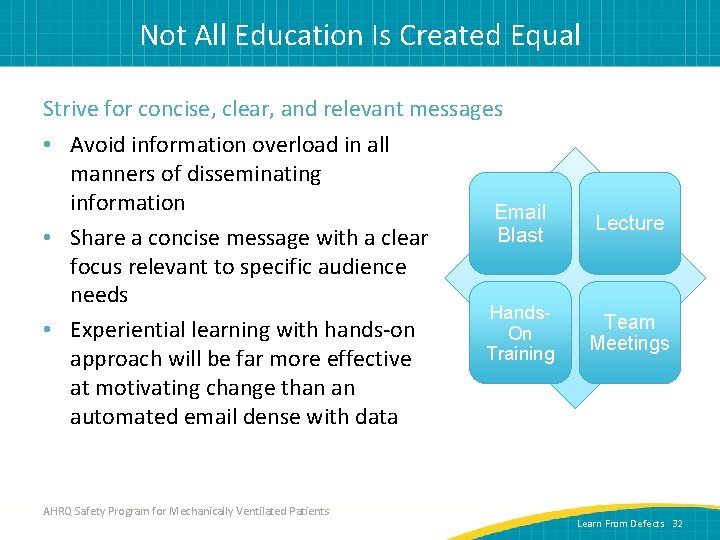
Not All Education Is Created Equal Strive for concise, clear, and relevant messages • Avoid information overload in all manners of disseminating information • Share a concise message with a clear focus relevant to specific audience needs • Experiential learning with hands-on approach will be far more effective at motivating change than an automated email dense with data AHRQ Safety Program for Mechanically Ventilated Patients Email Blast Lecture Hands. On Training Team Meetings Learn From Defects 32
Action Plan • • • Review the Learn From Defects tool with your team Review a defect in your intensive care unit Select one defect per month Identify the top three contributing factors Post stories of reduced risk—with data Share with others AHRQ Safety Program for Mechanically Ventilated Patients Learn From Defects 33
Questions? AHRQ Safety Program for Mechanically Ventilated Patients Learn From Defects 34
References 1. Pronovost PJ, Holzmueller CG, et al. A practical tool to learn from defects in patient care. Jt Comm J Qual Patient Saf. 2006 Feb; 32(2): 102 -8. PMID: 16568924. 2. Vincent C, Taylor-Adams S, Stanhope N. Framework for analyzing risk and safety in clinical medicine. BMJ. 1998 Apr 11; 316(7138): 1154 -7. PMID: 9552960. AHRQ Safety Program for Mechanically Ventilated Patients Learn From Defects 35