
AHRQ Safety Program for Mechanically Ventilated Patients Forming
- Slides: 29
AHRQ Safety Program for Mechanically Ventilated Patients Forming a Comprehensive Unit-based Safety Program Team AHRQ Safety Program for Mechanically Ventilated Patients AHRQ Pub. No 16(17)-0018 -28 -EF January 2017 Forming a CUSP Team 1
Learning Objectives After this session, you will be able to— • Differentiate technical and adaptive work • Describe steps of a Comprehensive Unit-based Safety Program (CUSP) • Highlight the importance of forming a multidisciplinary team • List top strategies of successful CUSP teams AHRQ Safety Program for Mechanically Ventilated Patients Forming a CUSP Team 2
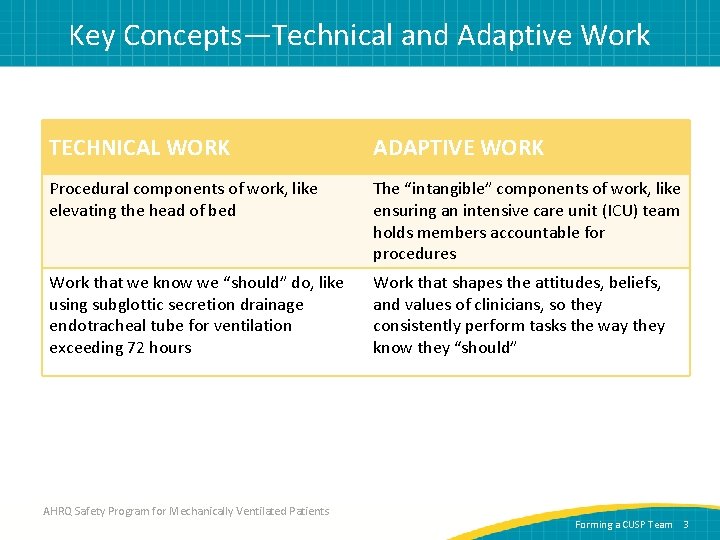
Key Concepts—Technical and Adaptive Work TECHNICAL WORK ADAPTIVE WORK Procedural components of work, like elevating the head of bed The “intangible” components of work, like ensuring an intensive care unit (ICU) team holds members accountable for procedures Work that we know we “should” do, like using subglottic secretion drainage endotracheal tube for ventilation exceeding 72 hours Work that shapes the attitudes, beliefs, and values of clinicians, so they consistently perform tasks the way they know they “should” AHRQ Safety Program for Mechanically Ventilated Patients Forming a CUSP Team 3
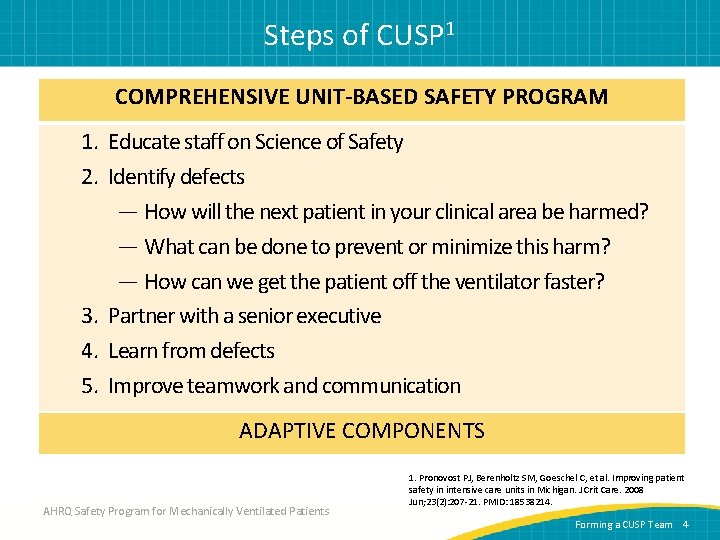
Steps of CUSP 1 COMPREHENSIVE UNIT-BASED SAFETY PROGRAM 1. Educate staff on Science of Safety 2. Identify defects — How will the next patient in your clinical area be harmed? — What can be done to prevent or minimize this harm? — How can we get the patient off the ventilator faster? 3. Partner with a senior executive 4. Learn from defects 5. Improve teamwork and communication ADAPTIVE COMPONENTS AHRQ Safety Program for Mechanically Ventilated Patients 1. Pronovost PJ, Berenholtz SM, Goeschel C, et al. Improving patient safety in intensive care units in Michigan. J Crit Care. 2008 Jun; 23(2): 207 -21. PMID: 18538214. Forming a CUSP Team 4
Successful CUSP Teams • Are composed of engaged frontline clinicians who take ownership of patient safety • Include staff members who have different levels of experience and perspectives • Represent all stakeholders by bringing multiple disciplines together AHRQ Safety Program for Mechanically Ventilated Patients Forming a CUSP Team 5
Why Engage Across Disciplines Successful efforts are— • Informed by science • Led by clinicians • Guided by measures • Informed by a systems view Respect the wisdom of frontline staff! AHRQ Safety Program for Mechanically Ventilated Patients Forming a CUSP Team 6
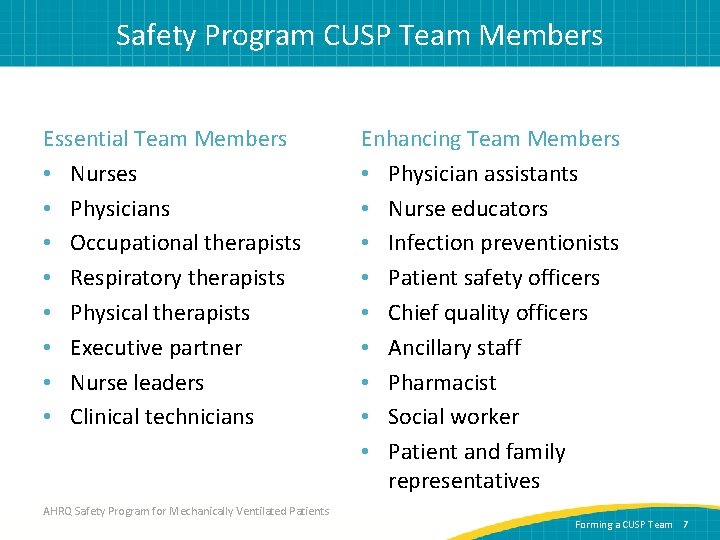
Safety Program CUSP Team Members Essential Team Members • Nurses • Physicians • Occupational therapists • Respiratory therapists • Physical therapists • Executive partner • Nurse leaders • Clinical technicians AHRQ Safety Program for Mechanically Ventilated Patients Enhancing Team Members • Physician assistants • Nurse educators • Infection preventionists • Patient safety officers • Chief quality officers • Ancillary staff • Pharmacist • Social worker • Patient and family representatives Forming a CUSP Team 7
Core CUSP Team Roles • • CUSP Facilitator CUSP Champion Unit Manager Provider Champion • • Nurse Champion Senior Executive CUSP Coordinator Others Tip: The CUSP Tool: CUSP Roles & Responsibilities provides a detailed list of expectations as well as reflection questions. Find this and other CUSP tools at http: //www. ahrq. gov/professionals/education/curriculumtools/cusptoolkit/index. html. AHRQ Safety Program for Mechanically Ventilated Patients Forming a CUSP Team 8
Team Roles—CUSP Facilitator • Supports the team to achieve exceptional performance • Serves as subject matter expert for CUSP • Provides safety culture survey support for teams • Gathers trending data for the unit • Shares lessons learned • Coordinates and leverages senior leadership, patient safety initiatives, and external resources AHRQ Safety Program for Mechanically Ventilated Patients Forming a CUSP Team 9
Team Roles—CUSP Champion • Works to ensure that the vision of CUSP is translated into action and that all staff members are engaged • Educates staff about CUSP; develops and implements a plan to educate staff on the Science of Safety • Sets agenda and invites team members to share relevant knowledge • Helps staff identify areas in need of improvement • Reviews project status, including resources needed and barriers encountered • Serves as the contact person for questions and gathers staff feedback AHRQ Safety Program for Mechanically Ventilated Patients Forming a CUSP Team 10
Team Roles—Unit Manager • Is often either a nurse manager or a unit manager • Plays an essential role supporting a unit’s CUSP work • Works with unit staff to implement new policies and procedures to achieve quality improvement goals and sustain patient safety efforts • Listens to concerns of staff in the clinical unit • Represents staff concerns in communications with hospital administration and senior management • Supports patient safety and quality improvement projects • Mentors the team to speak up and identify defects AHRQ Safety Program for Mechanically Ventilated Patients Forming a CUSP Team 11
Team Roles—Provider Champion • Is often a physician • Models leadership and active participation in safety work • Learns about CUSP and the Science of Safety, developing the lenses to lead change efforts • Galvanizes other providers to actively participate in safety initiatives • Respects contributions made by the frontline providers • Participates in defect investigation by articulating the provider processes involved and provides input regarding the patientlevel factors AHRQ Safety Program for Mechanically Ventilated Patients Forming a CUSP Team 12
Who To Engage—Provider and Nurse Champions • Select champions who— – – Garner respect of other clinicians Model solid leadership skills and values of organization Are approachable Are inclusive of input from diverse and multidisciplinary team members • Create a compact or an agreement – Identify clearly what is expected of champion – Review performance regularly AHRQ Safety Program for Mechanically Ventilated Patients Forming a CUSP Team 13
Team Roles—Senior Executive • Is an active member of the CUSP team, partnering with team to develop problem-solving and leadership skills • Meets monthly with the CUSP team, engaging all frontline staff and partnering with the team to foster team autonomy • Helps prioritize safety initiatives, identify resources, and reduce barriers that might hinder CUSP work • Helps the team to understand the organization’s strategic goals and to align their efforts with those goals • Connects team to necessary stakeholders AHRQ Safety Program for Mechanically Ventilated Patients Forming a CUSP Team 14
Engage the Senior Executive PLAY Engage the Senior Executive video available at http: //www. ahrq. gov/professionals/education/curriculum-tools/cusptoolkit/videos/03 a_engage_senior_exec/index. html. AHRQ Safety Program for Mechanically Ventilated Patients Forming a CUSP Team 15
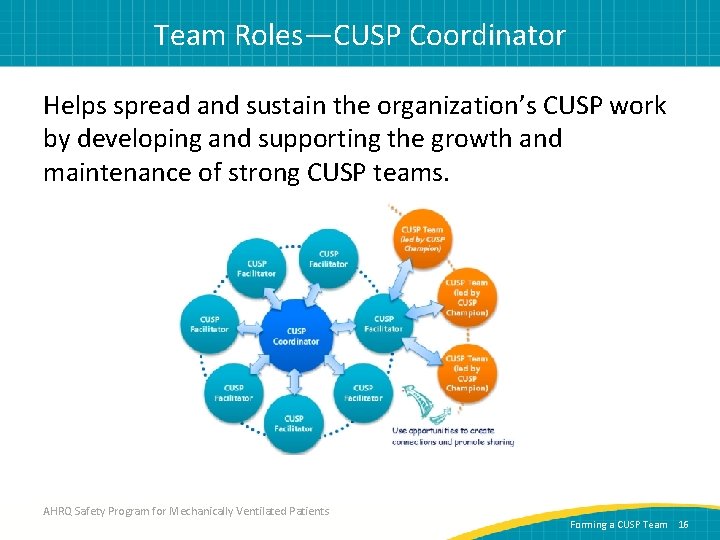
Team Roles—CUSP Coordinator Helps spread and sustain the organization’s CUSP work by developing and supporting the growth and maintenance of strong CUSP teams. AHRQ Safety Program for Mechanically Ventilated Patients Forming a CUSP Team 16
AHRQ Safety Program for Mechanically Ventilated Patients STRATEGIES FOR SUCCESS AHRQ Safety Program for Mechanically Ventilated Patients Forming a CUSP Team 17
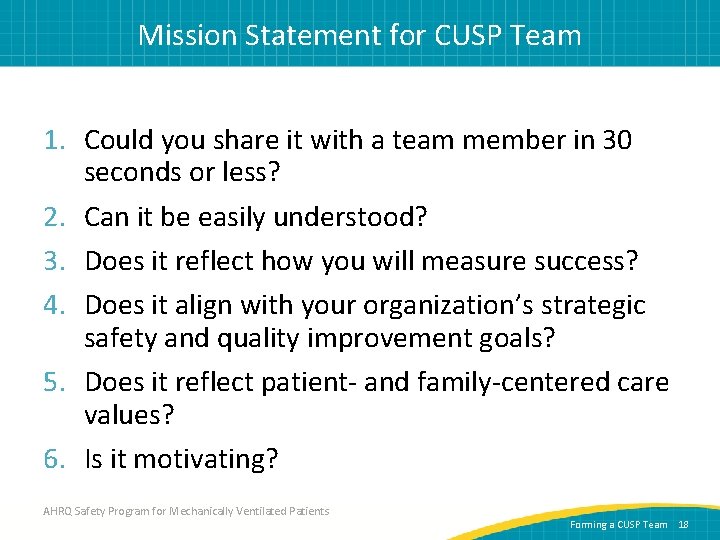
Mission Statement for CUSP Team 1. Could you share it with a team member in 30 seconds or less? 2. Can it be easily understood? 3. Does it reflect how you will measure success? 4. Does it align with your organization’s strategic safety and quality improvement goals? 5. Does it reflect patient- and family-centered care values? 6. Is it motivating? AHRQ Safety Program for Mechanically Ventilated Patients Forming a CUSP Team 18
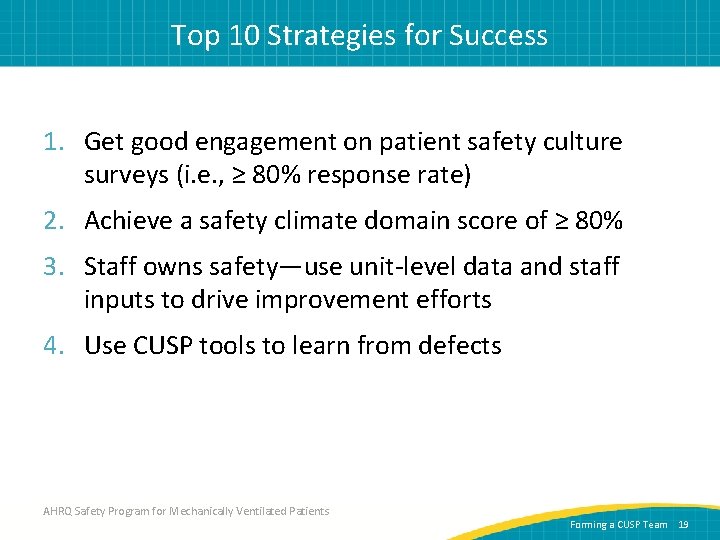
Top 10 Strategies for Success 1. Get good engagement on patient safety culture surveys (i. e. , ≥ 80% response rate) 2. Achieve a safety climate domain score of ≥ 80% 3. Staff owns safety—use unit-level data and staff inputs to drive improvement efforts 4. Use CUSP tools to learn from defects AHRQ Safety Program for Mechanically Ventilated Patients Forming a CUSP Team 19
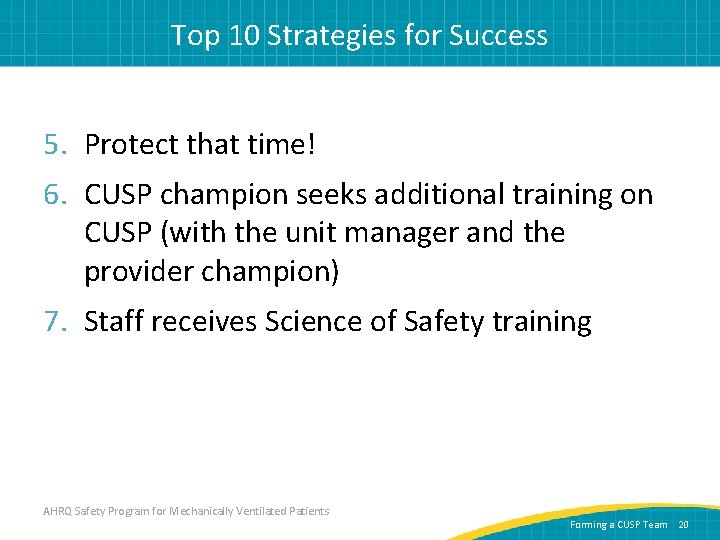
Top 10 Strategies for Success 5. Protect that time! 6. CUSP champion seeks additional training on CUSP (with the unit manager and the provider champion) 7. Staff receives Science of Safety training AHRQ Safety Program for Mechanically Ventilated Patients Forming a CUSP Team 20
Top 10 Strategies for Success 8. Provider champion is engaged and regularly contributes to CUSP work 9. Senior executive is engaged and regularly contributes to CUSP work, including regular participation in walking rounds 10. CUSP meetings are held regularly and rarely canceled AHRQ Safety Program for Mechanically Ventilated Patients Forming a CUSP Team 21
Strong CUSP Teams… • Share a strong team orientation • Understand the advantage a team approach offers • Share a mental model of the team’s mission • Work together to achieve the mission • Build frameworks for team behaviors and norms AHRQ Safety Program for Mechanically Ventilated Patients Forming a CUSP Team 22
Assembling a CUSP Team What’s our guiding framework? • Meeting logistics • Communication • Decisionmaking • Participation • Expectations Tip: You can find more information and other CUSP tools at http: //www. ahrq. gov/professionals/education/curriculumtools/cusptoolkit/index. html. AHRQ Safety Program for Mechanically Ventilated Patients Forming a CUSP Team 23
Meeting Resistance? Tune in to “What’s In It For Me? ” • People resist loss, not change • Identify and mitigate real and perceived loss (e. g. , time) • Perceived loss > real loss • Perceived loss is higher when communication is low AHRQ Safety Program for Mechanically Ventilated Patients Forming a CUSP Team 24
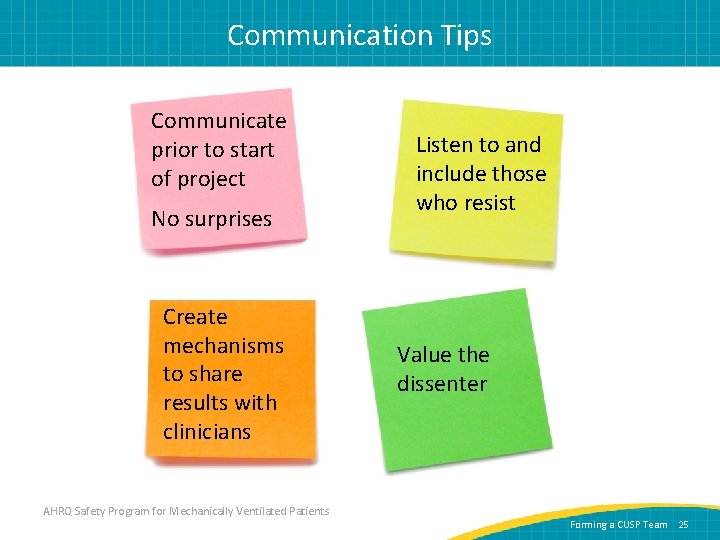
Communication Tips Communicate prior to start of project No surprises Create mechanisms to share results with clinicians AHRQ Safety Program for Mechanically Ventilated Patients Listen to and include those who resist Value the dissenter Forming a CUSP Team 25
Don’t Ignore the Elephants in the Room • Not enough time • Not enough resources Your champion can partner with your senior executive to help address barriers. Use early successes to build support and momentum for the program. AHRQ Safety Program for Mechanically Ventilated Patients Forming a CUSP Team 26
Discussion • What strategies have you used that have led to an engaged team? • What other disciplines have you successfully engaged? • Did your approach vary by discipline? How? • Did you leave out someone you later regretted not having on the team? AHRQ Safety Program for Mechanically Ventilated Patients Forming a CUSP Team 27
Questions AHRQ Safety Program for Mechanically Ventilated Patients Forming a CUSP Team 28
References 1. Pronovost PJ, Berenholtz SM, Goeschel C, et al. Improving patient safety in intensive care units in Michigan. J Crit Care. 2008 Jun; 23(2): 207 -21. PMID: 18538214. AHRQ Safety Program for Mechanically Ventilated Patients Forming a CUSP Team 29