
AHRQ Safety Program for LongTerm Care HAIsCAUTI Keeping


- Slides: 58
AHRQ Safety Program for Long-Term Care: HAIs/CAUTI Keeping Nursing Home Residents Safe: Catheter-Associated Urinary Tract Infections (CAUTI) Training Local and Volunteer Ombudsman Training (INSERT State LTC Ombudsman NAME) Dates/Times/Locations
Why Preventing Infections is Important • One to 3 million serious infections annually in nursing homes: as many as 380, 000 patients die of these infections. • Urinary Tract Infections (UTIs) are among the most common HAls in nursing homes. • Infections are among the most frequent causes of admission and readmission to hospitals from nursing homes. • Many residents are transferred to nursing homes from hospitals with urinary catheters. 2
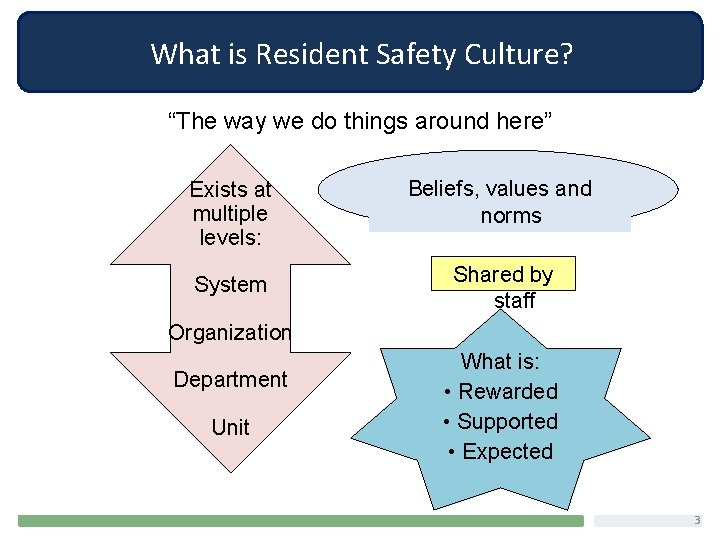
What is Resident Safety Culture? “The way we do things around here” Exists at multiple levels: Beliefs, values and norms System Shared by staff Organization Department Unit What is: • Rewarded • Supported • Expected 3
What Can An Ombudsman Do to Support a Culture of Safety? • Educate yourself about – CAUTI – Infection prevention – Federal requirements • Educate residents and families about CAUTI prevention. • Support resident and family engagement as part of the team. • Communicate: Share observations with staff. • Address residents’ concerns and issues. 4
Recognizing a Catheter-Associated Urinary Tract Infection 5
What is a CAUTI? • A CAUTI is a type of urinary tract infection (UTI) caused by a catheter. – A UTI is an infection of the bladder and/or kidneys. • Common symptoms include: • Burning or pain in the lower abdomen, below the stomach, • fever, and/or • burning sensations when urinating – A catheter is a tube inserted into the bladder to drain the bladder. • Usually attached to a bag that holds the urine
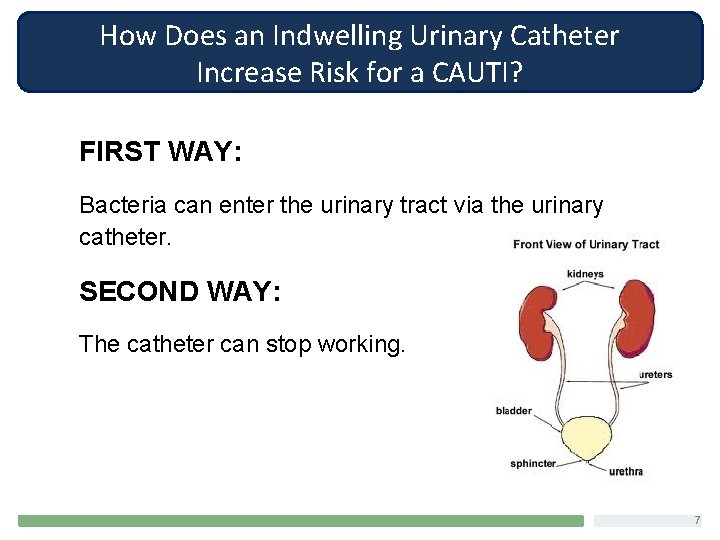
How Does an Indwelling Urinary Catheter Increase Risk for a CAUTI? FIRST WAY: Bacteria can enter the urinary tract via the urinary catheter. SECOND WAY: The catheter can stop working. 7
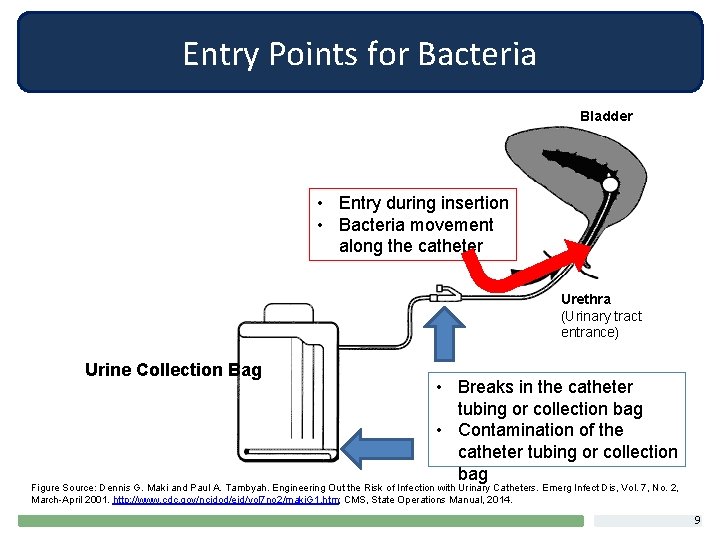
Entry Points for Bacteria can gain access to, and grow in, the bladder in several ways: • Contamination of the tube at the time of placement • Bacteria creeping up the catheter tube • Contamination of the urine collection bag or other breaks in the tubing 3 -10 percent of people develop bacteria in their urinary tract every day a catheter is in place 8
Entry Points for Bacteria Bladder • Entry during insertion • Bacteria movement along the catheter Urethra (Urinary tract entrance) Urine Collection Bag • Breaks in the catheter tubing or collection bag • Contamination of the catheter tubing or collection bag Figure Source: Dennis G. Maki and Paul A. Tambyah. Engineering Out the Risk of Infection with Urinary Catheters. Emerg Infect Dis, Vol. 7, No. 2, March-April 2001. http: //www. cdc. gov/ncidod/eid/vol 7 no 2/maki. G 1. htm; CMS, State Operations Manual, 2014. 9
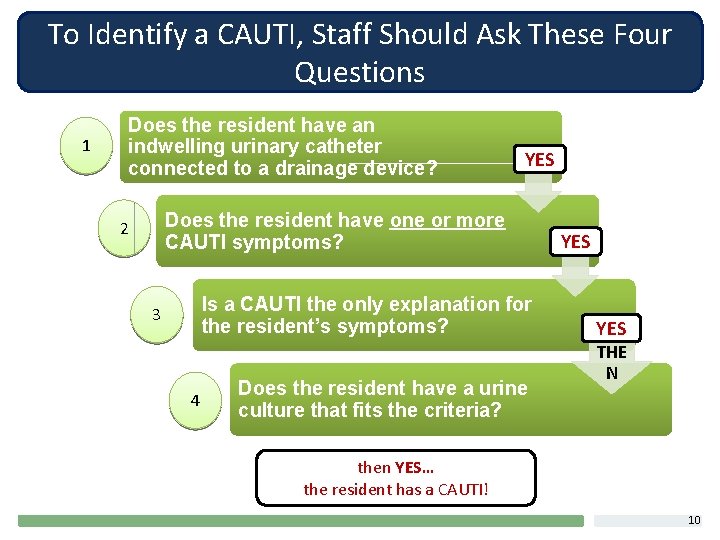
To Identify a CAUTI, Staff Should Ask These Four Questions 1 Does the resident have an indwelling urinary catheter connected to a drainage device? YES Does the resident have one or more CAUTI symptoms? 2 Is a CAUTI the only explanation for the resident’s symptoms? 3 4 Does the resident have a urine culture that fits the criteria? YES THE N then YES… the resident has a CAUTI! 10
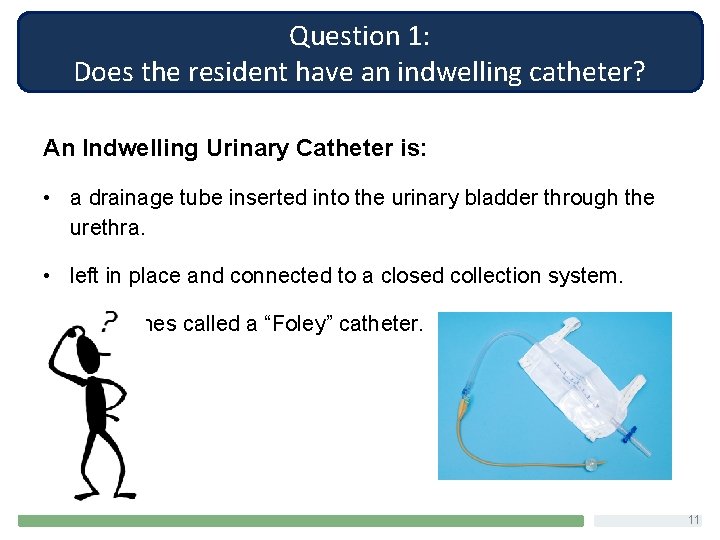
Question 1: Does the resident have an indwelling catheter? An Indwelling Urinary Catheter is: • a drainage tube inserted into the urinary bladder through the urethra. • left in place and connected to a closed collection system. • sometimes called a “Foley” catheter. 11
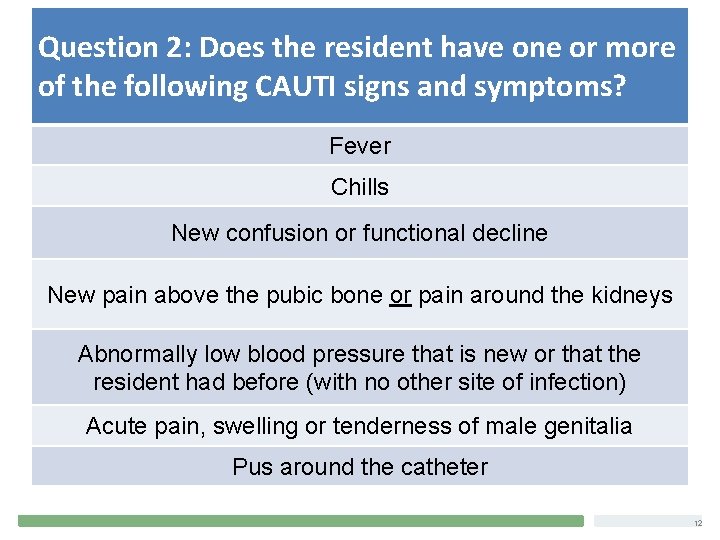
Question 2: Does the resident have one or more What are the Signs and Symptoms of CAUTI? of the following CAUTI signs and symptoms? Fever Chills New confusion or functional decline New pain above the pubic bone or pain around the kidneys Abnormally low blood pressure that is new or that the resident had before (with no other site of infection) Acute pain, swelling or tenderness of male genitalia Pus around the catheter 12
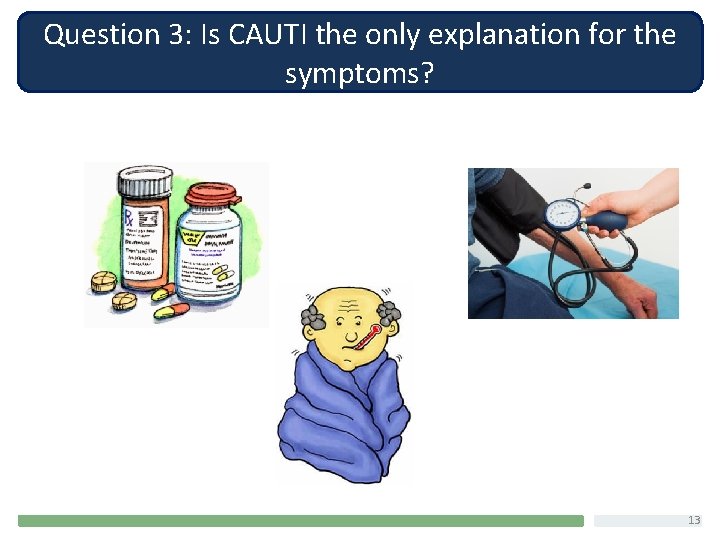
Question 3: Is CAUTI the only explanation for the symptoms? 13
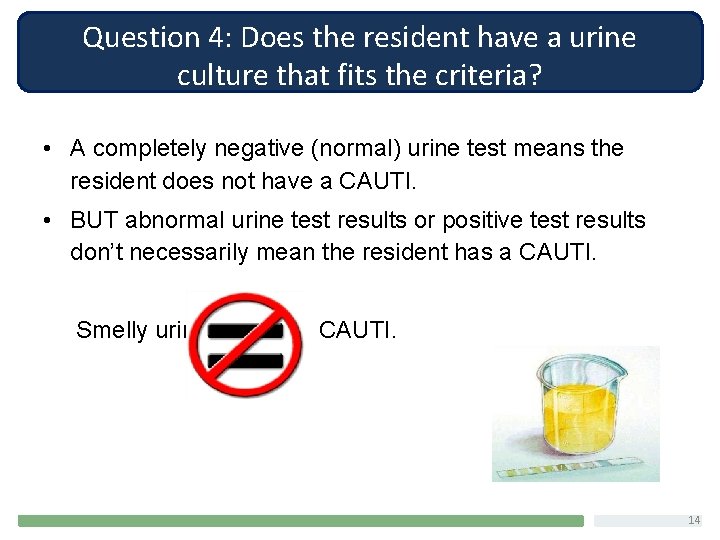
Question 4: Does the resident have a urine culture that fits the criteria? • A completely negative (normal) urine test means the resident does not have a CAUTI. • BUT abnormal urine test results or positive test results don’t necessarily mean the resident has a CAUTI. Smelly urine CAUTI. 14
When Should Urine Testing Be Done? • Urine testing should only be performed when a resident has signs and/or symptoms of CAUTI. • Odorous or cloudy urine are not indications for urine culture or analysis. These changes alone are not considered signs of CAUTI. Hooten et al. IDSA Guidelines, Clinical Infectious Diseases 2010; 50: 625 -663 15
Alternatives to Indwelling Catheters 16
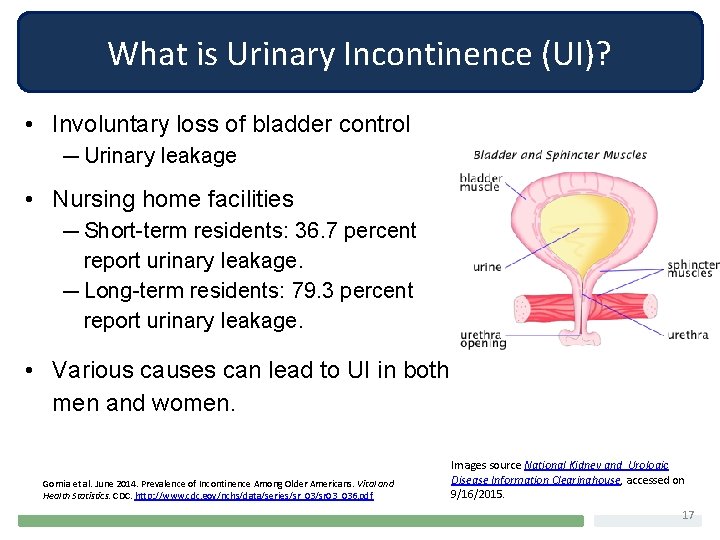
What is Urinary Incontinence (UI)? • Involuntary loss of bladder control — Urinary leakage • Nursing home facilities ― Short-term residents: 36. 7 percent report urinary leakage. ― Long-term residents: 79. 3 percent report urinary leakage. • Various causes can lead to UI in both men and women. Gornia et al. June 2014. Prevalence of Incontinence Among Older Americans. Vital and Health Statistics. CDC. http: //www. cdc. gov/nchs/data/series/sr_03/sr 03_036. pdf Images source National Kidney and Urologic Disease Information Clearinghouse, accessed on 9/16/2015. 17
How Does UI Impact Emotional Wellbeing? • Reduces social engagement • Lowers participation in other activities • Increases risk of reduced sensory stimulation • Lowers quality of life • Lowers levels of personal care 18
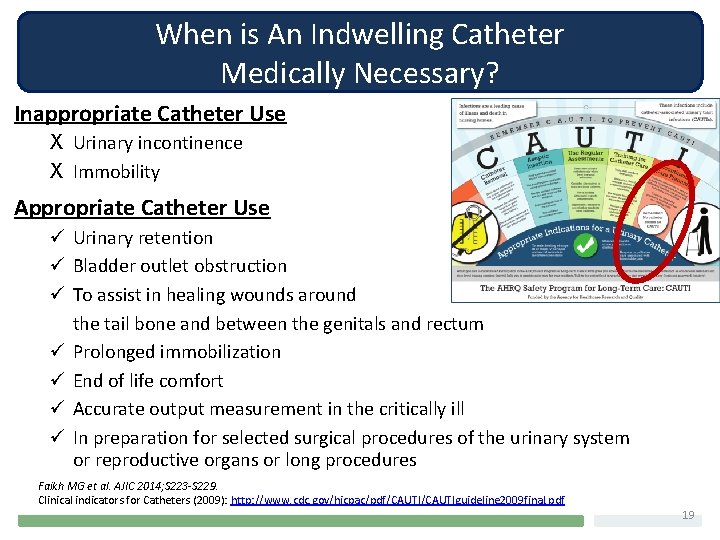
When is An Indwelling Catheter Medically Necessary? Inappropriate Catheter Use X Urinary incontinence X Immobility Appropriate Catheter Use ü Urinary retention ü Bladder outlet obstruction ü To assist in healing wounds around the tail bone and between the genitals and rectum ü Prolonged immobilization ü End of life comfort ü Accurate output measurement in the critically ill ü In preparation for selected surgical procedures of the urinary system or reproductive organs or long procedures Faikh MG et al. AJIC 2014; S 223 -S 229. Clinical indicators for Catheters (2009): http: //www. cdc. gov/hicpac/pdf/CAUTIguideline 2009 final. pdf 19
Managing UI Without an Indwelling Catheter • Other methods to drain urine: – External catheters in men – Temporary catheter • Absorbent pads – Mainstay for UI containment – Should be based on resident’s needs and preferences – Should only occur after an appropriate evaluation and after alternatives are considered (this is a federal regulation!) • Urinals and bedpans • Treatment medications 20
Managing UI Without an Indwelling Catheter Toileting Methods: • habit training • prompted voiding, timed voiding 21
Habit Training Catheter Alternatives for UI: Evidence-based Practice (EBP) Nursing Home Staff: • Identify resident’s natural voiding pattern. • Create an individualized toileting schedule. Comments: • Requires early planning, staff buy-in and consistent adherence Train staff to learn and honor a resident’s habits 22
Prompted vs. Timed Voiding Catheter Alternatives for UI: Evidence-based Practice (EBP) Prompted Voiding Target group • Cognitively and/or physically impaired Timed Voiding Target group • Procedure • Verbal prompt to ask the residents if they are wet or dry & if they need toilet assistance • Physical assistance to reach the bathroom • Positive reinforcement Outcome • Self-initiated requests • Number of incontinent episodes Comments Residents not capable of independent toileting; usually cognitively impaired Procedure • Fixed intervals between toileting assistance Outcome • • • Number of incontinent episodes Pad change due to incontinence in 24 hours Maintenance of skin integrity Comments • Consider passive toileting Labor intensive, requires staff assistance programs; requires CMS Manual System. June 2005. Department of Health and Human Services (DHHS), Centers for Medicare & Medicaid Services (CMS) buy-in and consistent adherence https: //www. cms. gov/Regulations-and-Guidance/Transmittals/downloads/r 8 som. pdf staff adherence • 23
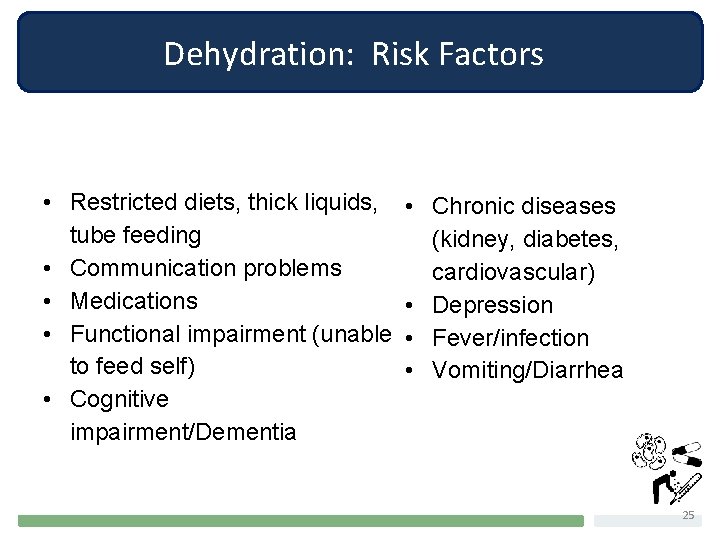
Dehydration: Definition & Causes Dehydration = Abnormal depletion of body fluids Causes: – Increased fluid loss due to acute illness, medication, environment – Decreased fluid intake as a result of decreased sense of thirst, difficulty swallowing, intentional decrease in intake to prevent incontinence 24
Dehydration: Risk Factors • Restricted diets, thick liquids, • tube feeding • Communication problems • Medications • • Functional impairment (unable • to feed self) • • Cognitive impairment/Dementia Chronic diseases (kidney, diabetes, cardiovascular) Depression Fever/infection Vomiting/Diarrhea 25
Why Dehydration is a Problem Dehydration cause Urinary Tract Infections 26
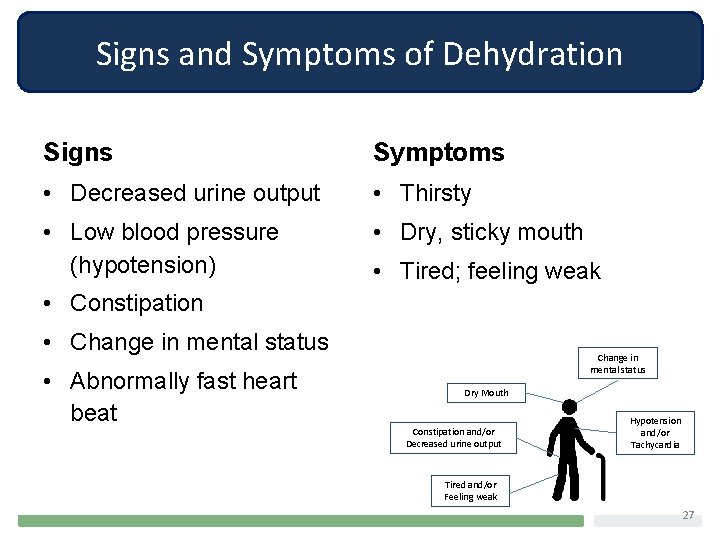
Signs and Symptoms of Dehydration Signs Symptoms • Decreased urine output • Thirsty • Low blood pressure (hypotension) • Dry, sticky mouth • Tired; feeling weak • Constipation • Change in mental status • Abnormally fast heart beat Change in mental status Dry Mouth Constipation and/or Decreased urine output Hypotension and/or Tachycardia Tired and/or Feeling weak 27
Ways to Help Prevent Dehydration: Staff • Involve the dietary and nutrition teams. • Encourage foods high in water content. • Encourage liquids before and with meals. • Celebrate often, and serve refreshments! • Develop targeted care plans to prevent dehydration/re-hydrate. • Engage residents, families and volunteers to support hydration and incontinence care planning and activities. • Maintain hydration station/snack carts. • Keep fresh water at bedside. • Ensure residents who cannot get out of bed are offered fluids on a regular basis. • Include hydration as a topic in safety discussions. • Track and review fluid intake. 28
Ways to Prevent Dehydration: Ombudsmen, Residents, Families Ombudsmen Residents and Families • Educate residents and families about dehydration • Encourage residents and families to tell staff the resident’s favorite beverages/foods that are high in water • Support residents and families in developing care plans that reflect resident’s preferences • Tell staff about resident’s favorite beverages/foods that are high in water content • Ask that offering beverages/foods be included in care plan • Families: Bring in the resident’s favorite beverages • Families: Encourage resident to drink; offer beverage frequently while 29
Preventing CAUTI
Preventing CAUTI You can’t get a CAUTI if you don’t have a catheter! 31
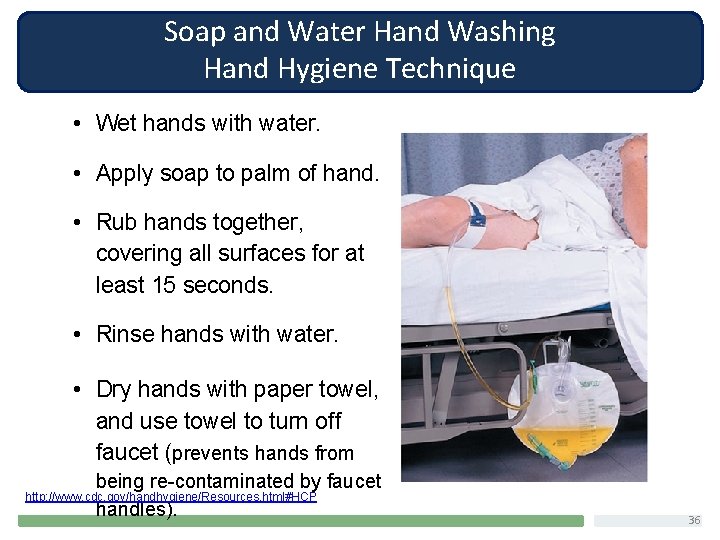
Preventing CAUTI If a resident DOES have a catheter, make sure: • The urine bag is kept below the level of the resident’s bladder to prevent urine from back flowing to the bladder. • The urine bag is kept off the floor. • The catheter is secured to the leg to prevent pulling on the catheter. • The catheter tube is not pulled, twisted or kinked. • The catheter and the drain tube do not become disconnected to prevent germs from getting into the catheter tube. • The collection bag is emptied regularly and the drainage 32
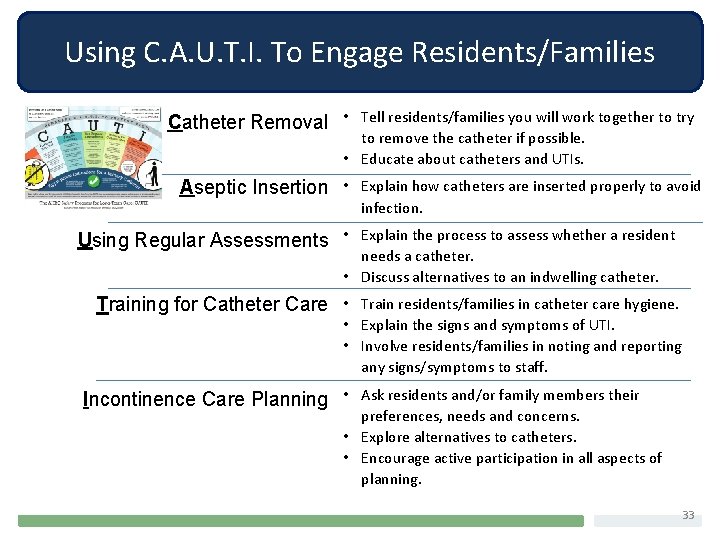
Using C. A. U. T. I. To Engage Residents/Families Tell residents/families you will work together to try to remove the catheter if possible. • Educate about catheters and UTIs. Catheter Removal • Aseptic Insertion • Explain how catheters are inserted properly to avoid infection. Explain the process to assess whether a resident needs a catheter. • Discuss alternatives to an indwelling catheter. Using Regular Assessments • Training for Catheter Care • Train residents/families in catheter care hygiene. • Explain the signs and symptoms of UTI. • Involve residents/families in noting and reporting any signs/symptoms to staff. Ask residents and/or family members their preferences, needs and concerns. • Explore alternatives to catheters. • Encourage active participation in all aspects of planning. Incontinence Care Planning • . 33
Prevention of CAUTI: Hand Hygiene One of the most effective ways to prevent infections is good hand hygiene. 34
Alcohol-based Hand Rub (ABHR) Hand Hygiene Technique • Apply hand rub to palm of hand. • Rub hands together, covering all surfaces. • Focus on thumbs, tips of fingers and under fingernails. • Hands are clean when dry (Usually takes about 15 -20 seconds). http: //www. cdc. gov/handhygiene/Resources. html#HCP 35
Soap and Water Hand Washing Hand Hygiene Technique • Wet hands with water. • Apply soap to palm of hand. • Rub hands together, covering all surfaces for at least 15 seconds. • Rinse hands with water. • Dry hands with paper towel, and use towel to turn off faucet (prevents hands from being re-contaminated by faucet handles). http: //www. cdc. gov/handhygiene/Resources. html#HCP 36
Notes About Hand Hygiene Products • Alcohol-based hand rubs/gels are preferred for hand hygiene almost all the time and are the most effective EXCEPT: • When hands are visibly dirty, contaminated or soiled • After care with residents with infectious diarrhea (Clostridium difficile: “C-diff”) In these instances: hands should be washed with soap (non-antimicrobial or antimicrobial) and water Centers for Disease Control and Prevention. Guideline for Hand Hygiene in Health-care Settings. MMWR 2002; vol. 51, no. RR-16. 37
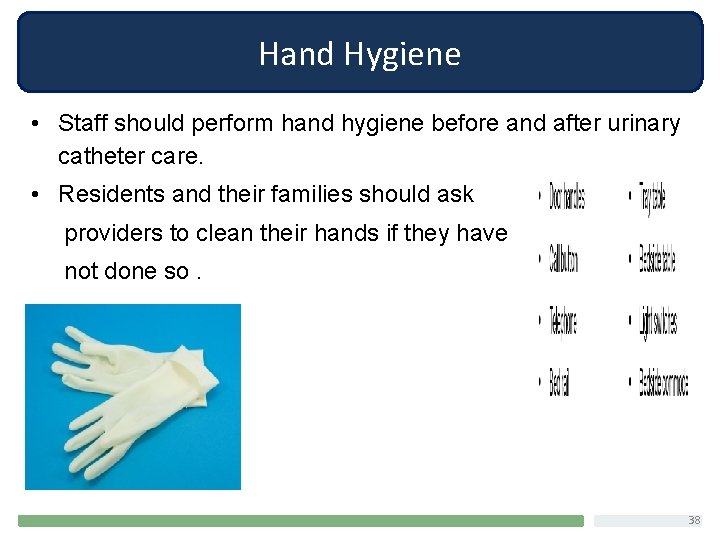
Hand Hygiene • Staff should perform hand hygiene before and after urinary catheter care. • Residents and their families should ask providers to clean their hands if they have not done so. 38
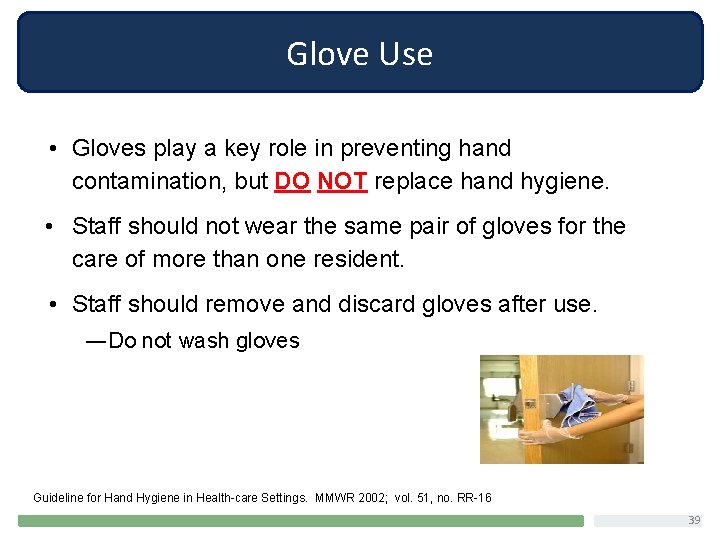
Glove Use • Gloves play a key role in preventing hand contamination, but DO NOT replace hand hygiene. • Staff should not wear the same pair of gloves for the care of more than one resident. • Staff should remove and discard gloves after use. ―Do not wash gloves Guideline for Hand Hygiene in Health-care Settings. MMWR 2002; vol. 51, no. RR-16 39
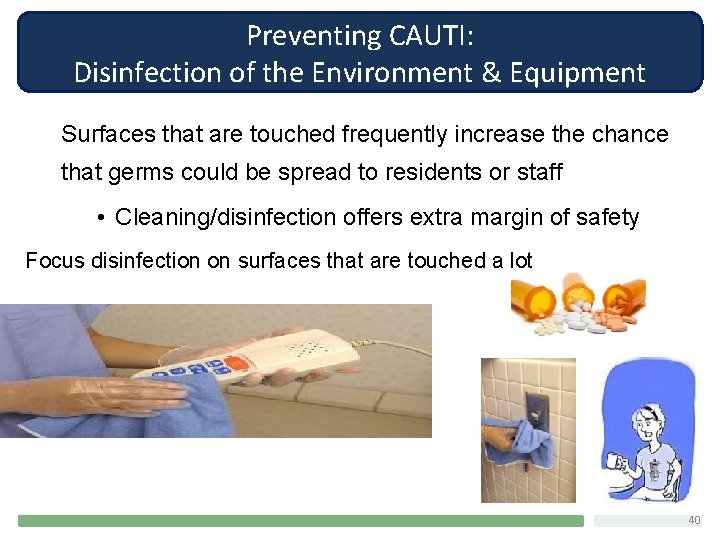
Preventing CAUTI: Disinfection of the Environment & Equipment Surfaces that are touched frequently increase the chance that germs could be spread to residents or staff • Cleaning/disinfection offers extra margin of safety Focus disinfection on surfaces that are touched a lot 40
Prevention of CAUTI: Avoid Overuse of Antibiotics Unnecessary antibiotic use can lead to: • resident harm. • an increase in antibiotic resistant organisms. 41
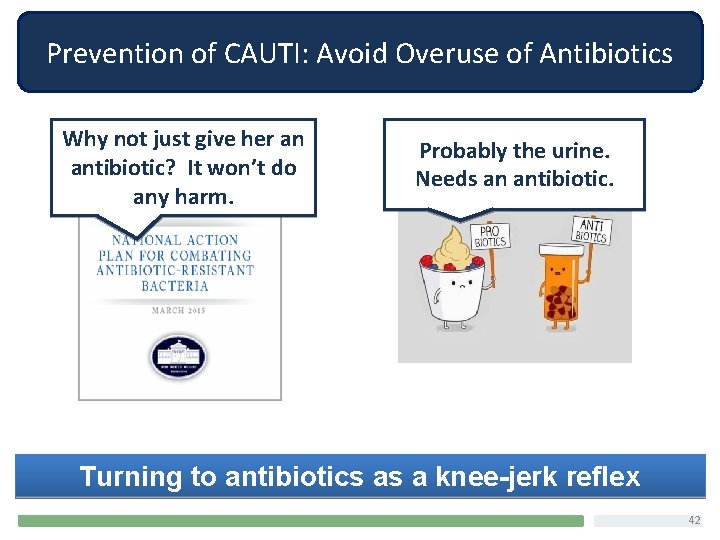
Prevention of CAUTI: Avoid Overuse of Antibiotics Why not just give her an antibiotic? It won’t do any harm. Probably the urine. Needs an antibiotic. Turning to antibiotics as a knee-jerk reflex 42
Why is Knee-Jerk Antibiotic Use Bad? Reason 1 IT’S BAD FOR THE RESIDENT! • Side effects are common • Nausea, diarrhea • Allergic reactions • Antibiotic-related infections • Clostridium difficile (C-diff) • Yeast infections • Wrong diagnosis will delay treatment 43
Why is Knee-Jerk Antibiotic Use Bad? Reason 2 It Leads to Bacterial Resistance! • Antibiotic resistance is a growing problem. • Doctors are often forced to use older antibiotics to deal with resistant organisms. o Many of these drugs are harmful to older persons. The White House Office of the Press Secretary FACT SHEET: Obama Administration Releases National Action Plan to Combat Antibiotic-Resistant Bacteria March 27, 2015 44
Response to Residents or Families Asking for Antibiotics • Find out why they feel antibiotics are needed. The desire for antibiotics may mask another completely different need. • Educate residents and families regarding antibiotic use, including: o Adverse effects – some antibiotics can cause diarrhea. o Antibiotics won’t help if you don’t have a UTI or CAUTI. o Taking antibiotics could cover up the real cause. www. optibacprobiotics. co. uk (Varonen & Sainio, 2004; van Driel et al. , 2006; Braun & Fowles, 2000) 45
Response to Residents or Families Asking for Antibiotics Questions to ask about antibiotics: • Could my symptoms be caused by something other than bacteria (e. g. , a virus or something that is not an infection)? • What signs or symptoms should I look for that could mean I might need an antibiotic? • Can I be monitored to see if my symptoms improve with other remedies, without using antibiotics? o Suggest a care planning meeting be held to discuss antibiotic use. Attend if requested, and help ensure residents’/families’ questions and concerns are addressed. 46
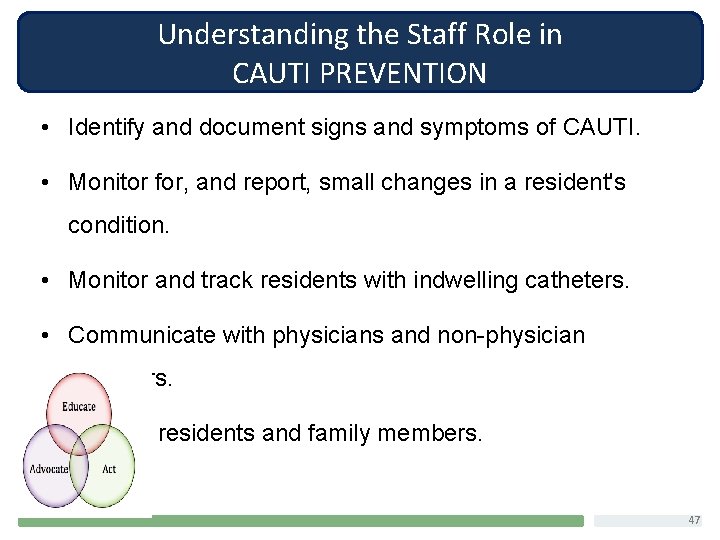
Understanding the Staff Role in CAUTI PREVENTION • Identify and document signs and symptoms of CAUTI. • Monitor for, and report, small changes in a resident's condition. • Monitor and track residents with indwelling catheters. • Communicate with physicians and non-physician providers. • Engage residents and family members. 47
Understanding the Staff Role in CAUTI Prevention • Collect and report infection control data. • Help educate peers/teammates. • Participate in training and in-services. 48
Role of Residents and Family Members • Learn about CAUTI, including the signs and symptoms. • Ask questions to understand why a catheter is being proposed or why it isn’t being removed. Ask about alternatives. • Report any signs/symptoms to staff right away. • Always wash your hands after going to the bathroom. • Remind staff to clean hands before caring for you/your loved one. • Question antibiotic use. • Participate in care planning. • Ask questions. 49
Understanding the Role of the Ombudsman in CAUTI Prevention • Focus on your role as an advocate. • Recognize you are not expected to be a clinical expert. • Understand the information and available resources. • Inform and empower residents and family members. 50
Role of the LTCO: 6 Points 1. Be informed - Learn about CAUTI and other infections. 2. Understand the importance of individualized or personcentered care in reducing or preventing CAUTIs. 3. Investigate complaints or concerns. 4. Speak with, and educate, residents and families. 5. Talk and share information with LTC Providers. 6. Systemic advocacy. 51
No. 1: Be informed - Learn about CAUTI and other Infections • Prevention • Risk factors • Symptoms • Treatment 52
No. 2: Support Individualized or Person-Centered Care in Preventing and Reducing CAUTI • Promote resident and family involvement in care planning. • Support residents and family at care planning meetings. • Help residents/family point out needs and preferences specific to the resident (e. g. , what beverages does the resident like? When is the resident more likely to drink fluids? ). • Educate staff about person-centered care, care planning and CAUTI. 53
No. 3: Investigate Complaints or Concerns • Related to CAUTI or infection prevention or handling resident concerns. • Determining the issues to be investigated. o Facility response to an infection. o Family demand that a catheter be used. o Related issues, such as dehydration. 54
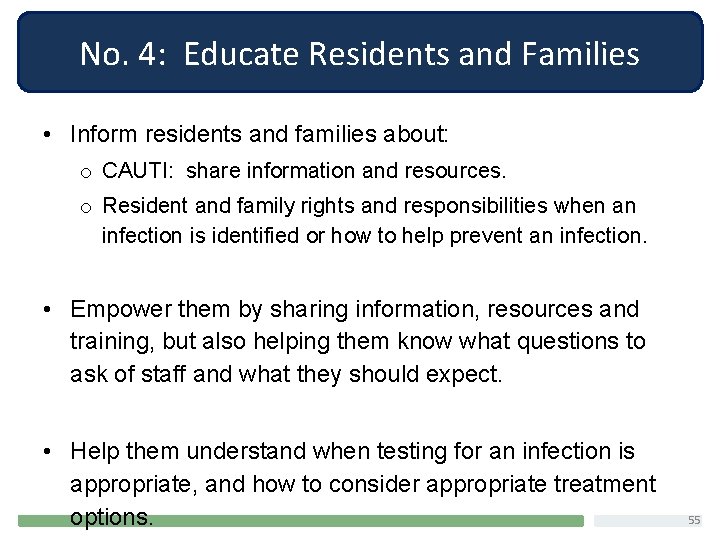
No. 4: Educate Residents and Families • Inform residents and families about: o CAUTI: share information and resources. o Resident and family rights and responsibilities when an infection is identified or how to help prevent an infection. • Empower them by sharing information, resources and training, but also helping them know what questions to ask of staff and what they should expect. • Help them understand when testing for an infection is appropriate, and how to consider appropriate treatment options. 55
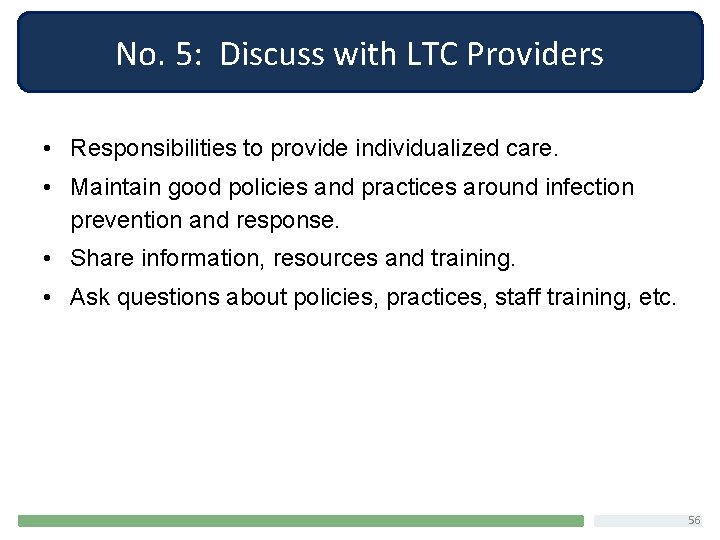
No. 5: Discuss with LTC Providers • Responsibilities to provide individualized care. • Maintain good policies and practices around infection prevention and response. • Share information, resources and training. • Ask questions about policies, practices, staff training, etc. 56
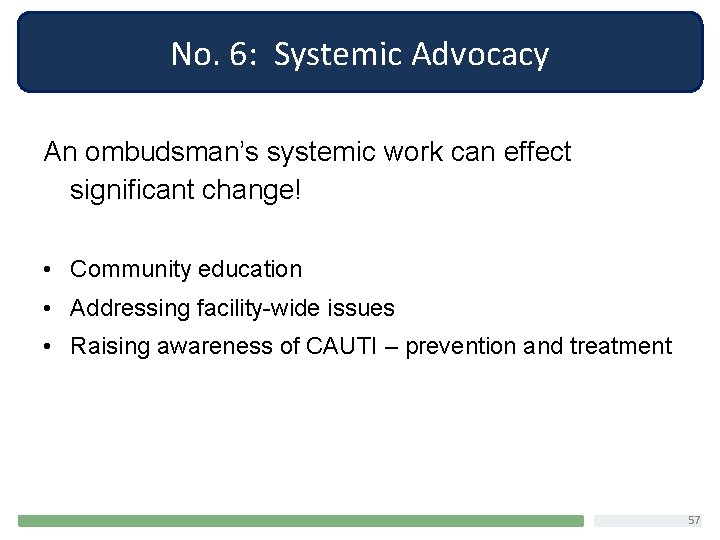
No. 6: Systemic Advocacy An ombudsman’s systemic work can effect significant change! • Community education • Addressing facility-wide issues • Raising awareness of CAUTI – prevention and treatment 57
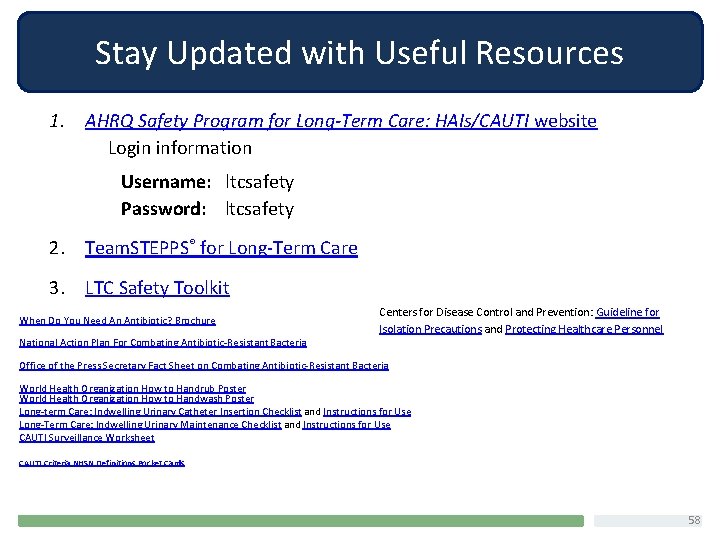
Stay Updated with Useful Resources 1. AHRQ Safety Program for Long-Term Care: HAIs/CAUTI website Login information Username: ltcsafety Password: ltcsafety 2. Team. STEPPS® for Long-Term Care 3. LTC Safety Toolkit When Do You Need An Antibiotic? Brochure National Action Plan For Combating Antibiotic-Resistant Bacteria Centers for Disease Control and Prevention: Guideline for Isolation Precautions and Protecting Healthcare Personnel Office of the Press Secretary Fact Sheet on Combating Antibiotic-Resistant Bacteria World Health Organization How to Handrub Poster World Health Organization How to Handwash Poster Long-term Care: Indwelling Urinary Catheter Insertion Checklist and Instructions for Use Long-Term Care: Indwelling Urinary Maintenance Checklist and Instructions for Use CAUTI Surveillance Worksheet CAUTI Criteria NHSN Definitions Pocket Cards 58