
AHRQ Safety Program for Longterm Care HAIsCAUTI Catheter
- Slides: 14
AHRQ Safety Program for Long-term Care: HAIs/CAUTI Catheter Care and Maintenance National Content Series AHRQ Pub. No. 16(17)-0003 -12 -EF March 2017
Objectives Upon completion of this webinar participants will be able to— • Explain best practices of indwelling urinary catheter care; • Review the do’s and don’ts of catheter care and maintenance; and • Describe the Team. STEPPS strategy of mutual support and how it can be used to improve catheter care and maintenance and prevent healthcare-associated infections and catheter-associated urinary tract infections. AHRQ SAFETY PROGRAM FOR LONG-TERM CARE: HAIs/CAUTI Catheter Care │ 2
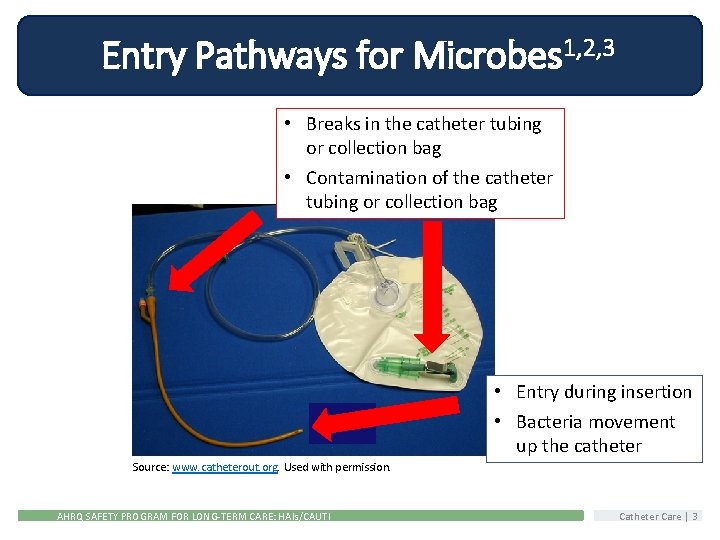
Entry Pathways for Microbes 1, 2, 3 • Breaks in the catheter tubing or collection bag • Contamination of the catheter tubing or collection bag • Entry during insertion • Bacteria movement up the catheter Source: www. catheterout. org. Used with permission. AHRQ SAFETY PROGRAM FOR LONG-TERM CARE: HAIs/CAUTI Catheter Care │ 3
Hand Hygiene and Glove Use 4, 5 Gloves play a key role in preventing hand contamination—but do NOT replace hand hygiene Perform hand hygiene and wear gloves immediately before— • Accessing the drainage system • Emptying the drainage bag • Collecting a urine sample Remove gloves and perform hand hygiene immediately after— • • Handling an indwelling catheter Accessing the drainage system Emptying the drainage bag Collecting a urine sample AHRQ SAFETY PROGRAM FOR LONG-TERM CARE: HAIs/CAUTI Catheter Care │ 4
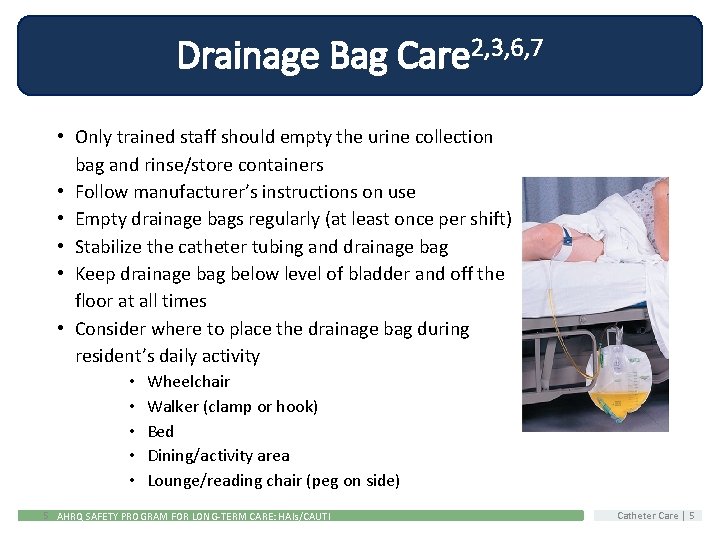
Drainage Bag Care 2, 3, 6, 7 • Only trained staff should empty the urine collection bag and rinse/store containers • Follow manufacturer’s instructions on use • Empty drainage bags regularly (at least once per shift) • Stabilize the catheter tubing and drainage bag • Keep drainage bag below level of bladder and off the floor at all times • Consider where to place the drainage bag during resident’s daily activity • • • Wheelchair Walker (clamp or hook) Bed Dining/activity area Lounge/reading chair (peg on side) 5 AHRQ SAFETY PROGRAM FOR LONG-TERM CARE: HAIs/CAUTI Catheter Care │ 5
Leg Bags and Bath Basins 7 -10* Leg Bags • Residents sometimes prefer leg bags, which can improve mobility and dignity • Leg bag care and changing should be done per your facility’s policy • The outside of the leg bag and the leg straps should be— • Wiped down during routine, daily bathing care • Rinsed and promptly dried • Do not allow prolonged skin-to-skin contact with wet/damp materials Bath Basins • Clean and disinfect basins after each bathing procedure • Keep bath basins clean and dry when not in use, and stored upside down to prevent airborne contamination • Replace basins if damaged • A residentifier should be clearly displayed *Disclaimer: A multidisciplinary team reviewed the literature, and while there is a general lack of research and evidence surrounding leg bag and bath basin care, this team was able to make general recommendations. Please remember to follow your facility’s policy and direct any questions to your supervisor. AHRQ SAFETY PROGRAM FOR LONG-TERM CARE: HAIs/CAUTI Catheter Care │ 6
The DO’s of Indwelling Urinary Catheter Care 2, 3, 6, 7 • Do perform peri-care using only soap and water • Do keep the catheter and tubing from kinking and becoming obstructed • Do keep catheter systems closed when using urine collection bags or leg bags • Do replace catheters and collection bags that become disconnected • Do ensure the resident’s identifier/implementation date is on their urine collection containers • Do make sure to disinfect the sampling port before obtaining a sample AHRQ SAFETY PROGRAM FOR LONG-TERM CARE: HAIs/CAUTI Catheter Care │ 7
The DON’Ts of Indwelling Urinary Catheter Care 2, 3, 6, 7 • Don’t change catheters or drainage bags at routine, fixed intervals • Don’t administer routine antimicrobial prophylaxis • Don’t use antiseptics to cleanse the periurethral area while a catheter is in place • Don’t clean the periurethral area vigorously • Don’t irrigate the bladder with antimicrobials • Don’t instill antiseptic or antimicrobial solutions into drainage bags • Don’t routinely screen for asymptomatic bacteriuria • Don’t contaminate the catheter outlet valve during collection bag emptying Catheter Care │ 8 AHRQ SAFETY PROGRAM FOR LONG-TERM CARE: HAIs/CAUTI
Mutual Support in Teamwork 11 • Assisting each other • Providing and receiving feedback • Exerting assertive and advocacy behaviors when resident safety is threatened AHRQ SAFETY PROGRAM FOR LONG-TERM CARE: HAIs/CAUTI Catheter Care │ 9
What Behaviors Exemplify Mutual Support? • Monitoring other team members’ performance to anticipate assistance requests • Offering or requesting assistance • Filling in for a member who cannot perform a task • Cautioning team members about potentially unsafe situations • Self-correcting and helping others correct their mistakes • Distributing and assigning work thoroughly • Rerouting/delaying work so that an overburdened team member can recover • Regularly providing constructive feedback to team members • Providing encouragement AHRQ SAFETY PROGRAM FOR LONG-TERM CARE: HAIs/CAUTI Catheter Care │ 10
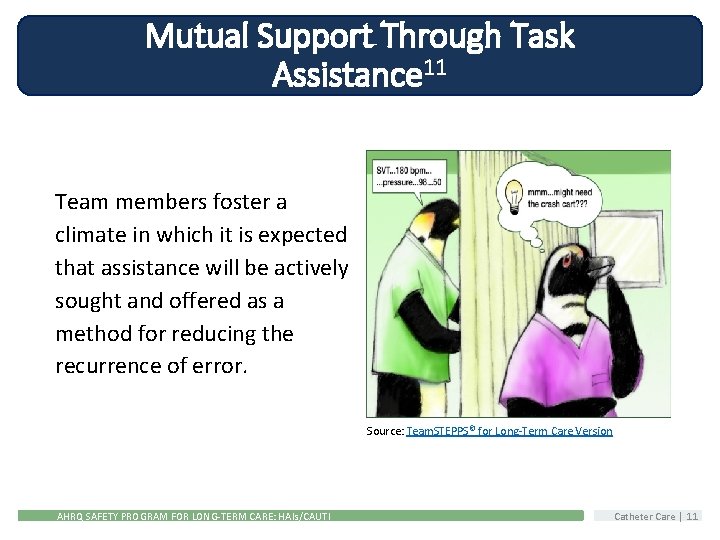
Mutual Support Through Task Assistance 11 Team members foster a climate in which it is expected that assistance will be actively sought and offered as a method for reducing the recurrence of error. Source: Team. STEPPS© for Long-Term Care Version AHRQ SAFETY PROGRAM FOR LONG-TERM CARE: HAIs/CAUTI Catheter Care │ 11
Case Study Joe, a certified nursing assistant (CNA), is busy getting Mr. Rappaport ready for his doctor’s appointment and Mr. Cortez ready for his therapy session. Mr. Rappaport is in a wheelchair with urinary catheter tubing on the floor and a full urine collection bag attached to the chair. How could Sarah and Michael, two CNAs with down time, offer task assistance in this scenario? AHRQ SAFETY PROGRAM FOR LONG-TERM CARE: HAIs/CAUTI Catheter Care │ 12
The Nuts and Bolts of Task Assistance 11 Keep communication clear and explicit; share your specific availability and skills when offering assistance • • Use please and thank you Close the communication loop Account for your coworker’s experience level Foster a supportive climate—pay it forward AHRQ SAFETY PROGRAM FOR LONG-TERM CARE: HAIs/CAUTI Catheter Care │ 13
References 1. catheterout. org. The University of Michigan. http: //www. catheterout. org/. Accessed February 1, 2016. 2. Lo E, Nicolle LE, Coffin SE, et al. Strategies to prevent catheter-associated urinary tract infections in acute care hospitals: 2014 Update. Infect Control Hosp Epidemiol. 2014 May; 35(5): 464 -79. PMID: 25376068. 3. Gould CV, Umscheid CA, Agarwal RK, et al. Guideline for prevention of catheter-associated urinary tract infections 2009. Infect Control Hosp Epidemiol. 2010 April; 31(4): 319 -26. PMID: 20156062. 4. Boyce, JM, Pittet D, Healthcare Infection Control Practices Advisory Committee et al. Guideline for hand hygiene in health-care settings: recommendations of the Healthcare Infection Control Practices Advisory Committee and the HICPAC/SHEA/APIC/IDSA Hand Hygiene Task Force. Infect Control Hosp Epidemiol. 2002 December; 23(S 12): S 3 -40. PMID 12515399. 5. Ellingosn K, Haas JP, Aiello AE, et al. Strategies to prevent healthcare-associated infections through hand hygiene. Infect Control Hosp Epidemiol. 2014 September; 35(S 2): S 155 -78. PMID 25376074. 6. Lynn P. Taylor’s Clinical Nursing Skills: A Nursing Process Approach. Philadelphia: Wolters Kluwer; 2015. 7. Centers for Medicare & Medicaid Services (CMS). Department of Health & Human Services (DHHS). State Operations Manual. Appendix PP –Guidance to Surveyors for Long Term Care Facilities. (Rev. 157, 06 -10 -16). 8. Johnson D, Lineweaver L, Maze LM. Patients’ bath basins as potential sources of infection: a multicenter sampling study. Am J Crit Care. 2009 January; 18(1): 31 -8. PMID 19116402. 9. Marchaim D, Taylor AR, Hayakawa K, et al. Hospital bath basin are frequently contaminated with multidrug-resistant human pathogens. Am J Infect Control. 2012 August; 40(6): 562 -4. PMID 22177667. 10. Rupp ME, Huerta Tm Yu S, et al. Hospital basins used to administer chlorhexidine baths are unlikely microbial reservoirs. Infect Control Hosp Epidemiol. 2013 June; 34(6): 643 -5. PMID 23651900. 11. Team. STEPPS® Long-Term Care Version. Rockville, MD: Agency for Healthcare Research and Quality; content last reviewed September 2015. http: //www. ahrq. gov/professionals/education/curriculumtools/teamstepps/longtermcare/index. html. AHRQ SAFETY PROGRAM FOR LONG-TERM CARE: HAIs/CAUTI Catheter Care │ 14