
AHRQ Safety Program for Improving Antibiotic Use Appropriate
AHRQ Safety Program for Improving Antibiotic Use Appropriate Collection of Microbiologic Specimens Long-Term Care AHRQ Pub. No. 17(21)-0029 Collection of Specimens. June 2021
Objectives 1. Recognize that collecting a good specimen is important to making treatment decisions. 2. Detail procedures for collecting urine and respiratory samples from nursing home residents. 3. Describe strategies that reduce the risk of collecting contaminated microbiologic samples. Goal—to collect high-quality samples, which will lead to better decisions about antibiotic prescriptions for residents Collection of Specimens 2
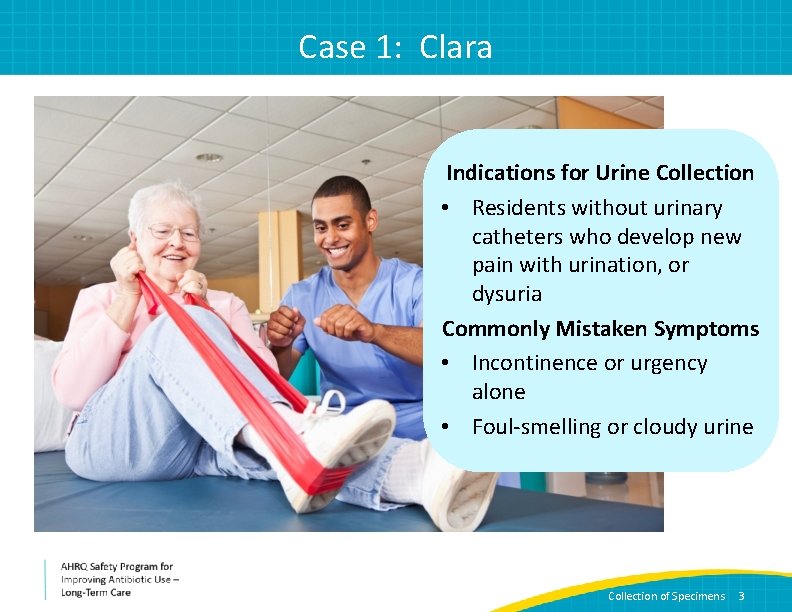
Case 1: Clara Indications for Urine Collection • Residents without urinary catheters who develop new pain with urination, or dysuria Commonly Mistaken Symptoms • Incontinence or urgency alone • Foul-smelling or cloudy urine Collection of Specimens 3
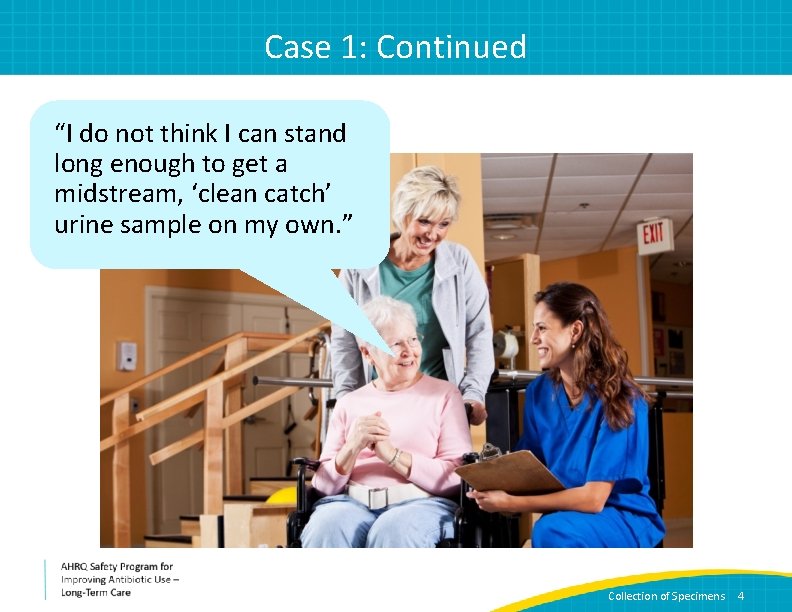
Case 1: Continued “I do not think I can stand long enough to get a midstream, ‘clean catch’ urine sample on my own. ” Collection of Specimens 4
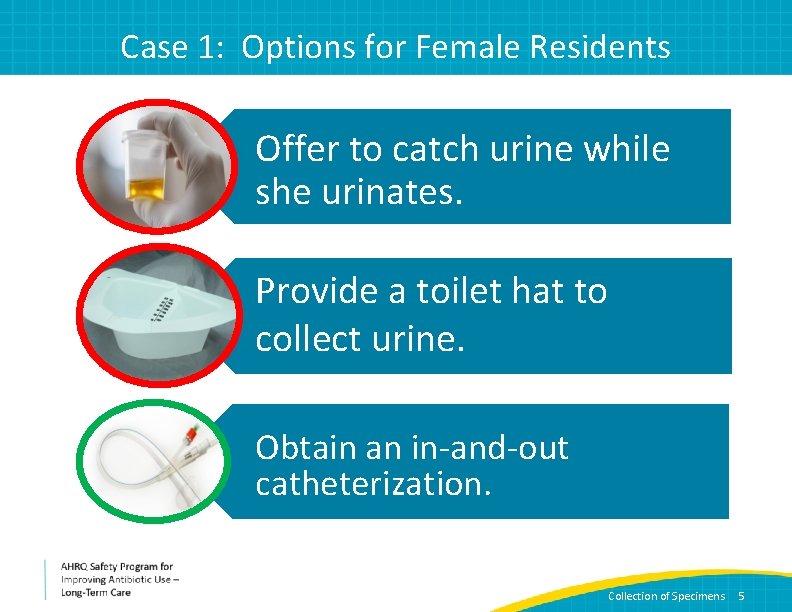
Case 1: Options for Female Residents Offer to catch urine while she urinates. Provide a toilet hat to collect urine. Obtain an in-and-out catheterization. Collection of Specimens 5

Case 1: Options for Male Residents • Catch midstream specimen. • Clean skin around genitals to reduce bacterial contamination. • Help clean the periurethral region and maintain midstream specimen. • Provide condom catheter. Collection of Specimens 6
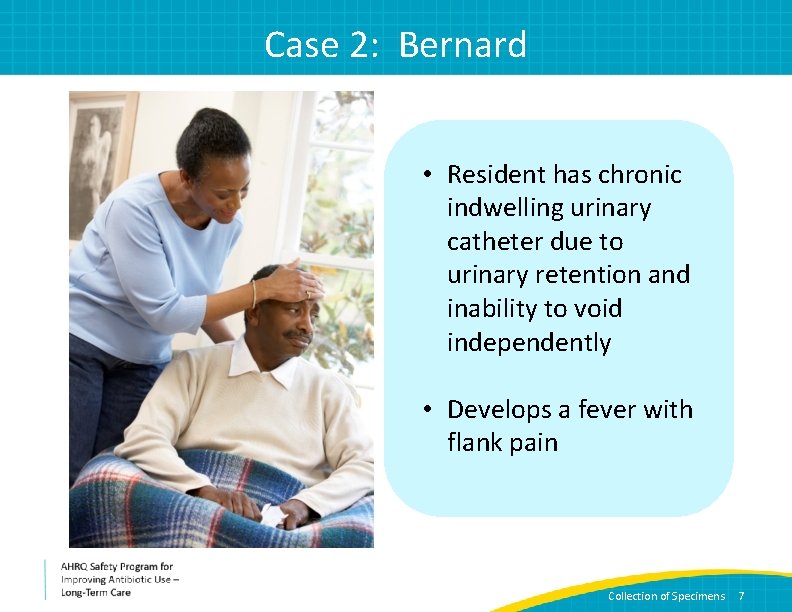
Case 2: Bernard • Resident has chronic indwelling urinary catheter due to urinary retention and inability to void independently • Develops a fever with flank pain Collection of Specimens 7
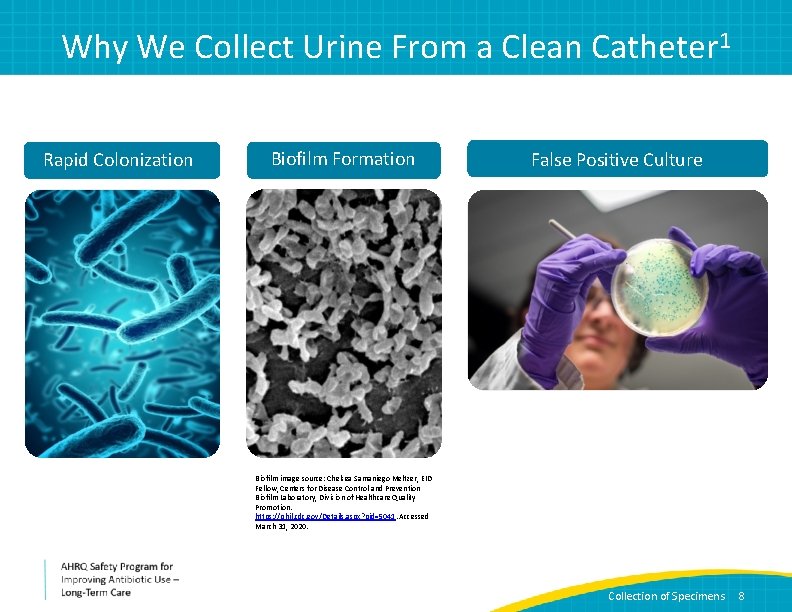
Why We Collect Urine From a Clean Catheter 1 Rapid Colonization Biofilm Formation False Positive Culture Biofilm image source: Chelsea Samaniego Meltzer, EID Fellow, Centers for Disease Control and Prevention Biofilm Laboratory, Division of Healthcare Quality Promotion. https: //phil. cdc. gov/Details. aspx? pid=5041. Accessed March 31, 2020. Collection of Specimens 8
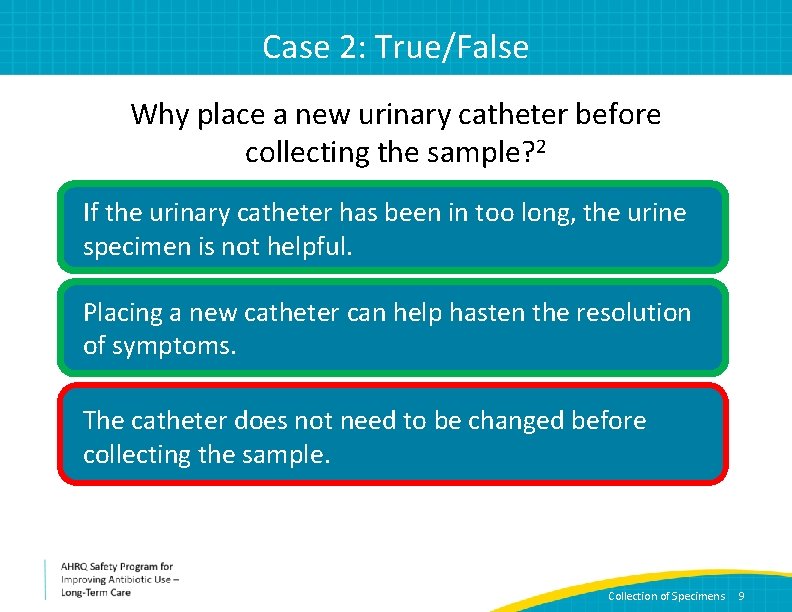
Case 2: True/False Why place a new urinary catheter before collecting the sample? 2 If the urinary catheter has been in too long, the urine specimen is not helpful. Placing a new catheter can help hasten the resolution of symptoms. The catheter does not need to be changed before collecting the sample. Collection of Specimens 9
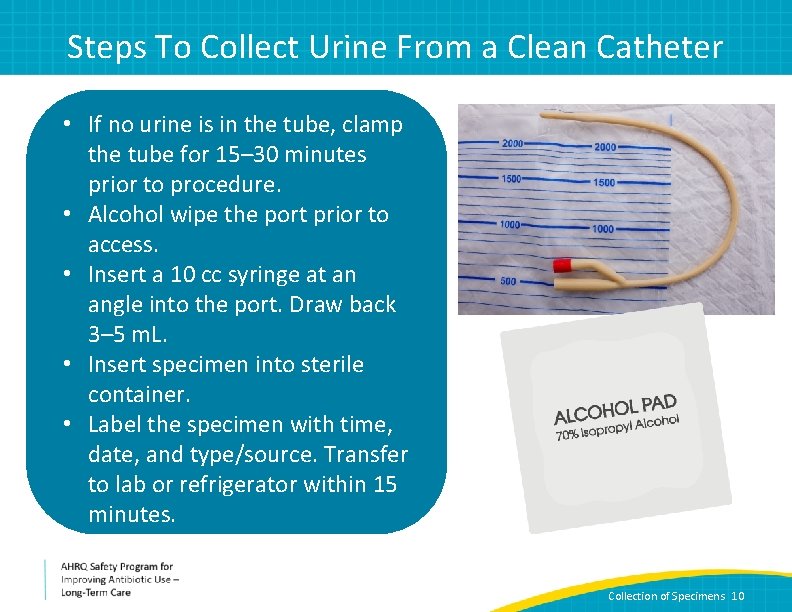
Steps To Collect Urine From a Clean Catheter • If no urine is in the tube, clamp the tube for 15– 30 minutes prior to procedure. • Alcohol wipe the port prior to access. • Insert a 10 cc syringe at an angle into the port. Draw back 3– 5 m. L. • Insert specimen into sterile container. • Label the specimen with time, date, and type/source. Transfer to lab or refrigerator within 15 minutes. Collection of Specimens 10
1 Knowledge Check Why do you need to change gloves before a new catheter is placed? You just removed a contaminated catheter. If you don’t change gloves, you will immediately transfer bacteria to the new catheter and contaminate the urine specimen. Collection of Specimens 11
2 Knowledge Check, continued Why is it important to refrigerate the specimen if it can’t be transported to the lab within 2 hours? Specimens that aren’t handled properly are at risk for bacterial overgrowth and should not be accepted for analysis in the laboratory. All that hard work obtaining the urine sample will be useless if the specimen isn’t stored and transported appropriately. Collection of Specimens 12
Take-Home Messages: Urine Collection • Help residents clean the periurethral region prior to collecting a urine sample. • If midstream clean-catch specimens are not possible, perform an in-and-out catheterization. • For residents with a catheter, urine culture specimens should be obtained from freshly placed catheters, when feasible. • Always wash your hands and obtain the specimen in a sterile container. • Transport urine samples promptly (within 15 minutes) to lab; refrigerate if samples cannot be transported immediately. Collection of Specimens 13
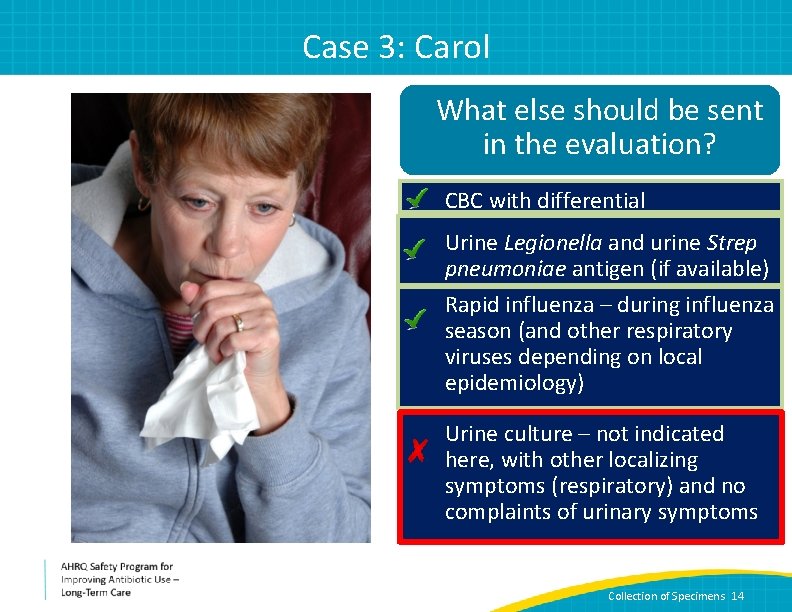
Case 3: Carol What else should be sent in the evaluation? CBC with differential Urine Legionella and urine Strep pneumoniae antigen (if available) Rapid influenza – during influenza season (and other respiratory viruses depending on local epidemiology) Urine culture – not indicated here, with other localizing symptoms (respiratory) and no complaints of urinary symptoms Collection of Specimens 14
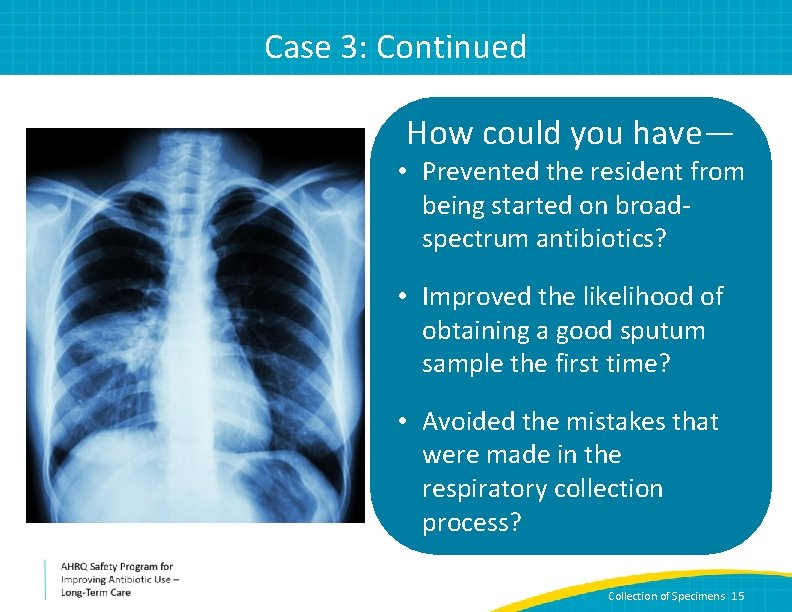
Case 3: Continued How could you have— • Prevented the resident from being started on broadspectrum antibiotics? • Improved the likelihood of obtaining a good sputum sample the first time? • Avoided the mistakes that were made in the respiratory collection process? Collection of Specimens 15
Collecting a Good Respiratory Sample Wash hands and use new gloves for specimen collection. Ask the resident to rinse her mouth with water prior to collection. Obtain an early-morning specimen, ideally before starting antibiotics. Transfer to the lab or refrigerator promptly. Explain to the resident that you need phlegm from her lungs, not just spit from her mouth. Collect the specimen in a sterile, labeled container. Collection of Specimens 16
Remember That Clinical Context Is Important! Sputum cultures should only be sent on residents whom you are concerned have a lower respiratory tract infection (pneumonia). A positive sputum culture does not necessarily mean that organism is responsible for infection. Sputum cultures should NOT be sent on residents with bronchitis or a COPD exacerbation as these are typically caused by viral infections. Collection of Specimens 17
Summary • Bacterial cultures should only be collected from residents with abnormal and concerning clinical symptoms. • Bacterial colonization does not necessarily represent infection. • A good microbiologic specimen can help to make the correct diagnosis and direct treatment—and protect your residents from unnecessary antibiotic use. Collection of Specimens 18
Activities To Complete Activity, Stewardship Team Activity, Frontline Providers Continue to meet monthly as a team Share feedback about the intervention with the Antibiotic Stewardship Team. and review interventions. Review the Collecting Bacterial Cultures and Urine Continue to collect and analyze data Culture Collection posters and display them in common areas, such as break rooms and work stations. using the Monthly Data Collection Review sample collection processes for urine at your Form. facility. Apply the Four Moments of Antibiotic Decision Making Form to 5– 10 residents each month. Supporting Materials • • • Collection of Microbiological Cultures Collecting Bacterial Cultures Poster Urine Culture Collection Poster Four Moments of Antibiotic Decision Making Form Monthly Data Collection Form Collection of Specimens 19
Disclaimer • The findings and recommendations in this presentation are those of the authors, who are responsible for its content, and do not necessarily represent the views of AHRQ. No statement in this presentation should be construed as an official position of AHRQ or of the U. S. Department of Health and Human Services. • Any practice described in this presentation must be applied by health care practitioners in accordance with professional judgment and standards of care in regard to the unique circumstances that may apply in each situation they encounter. These practices are offered as helpful options for consideration by health care practitioners, not as guidelines. Collection of Specimens 20
References 1. Centers for Disease Control and Prevention. Public Health Image Library (PHIL). Office of the Associate Director for Communications, Division of Public Affairs. https: //phil. cdc. gov/phil/details. asp. Accessed July 25, 2017. 2. Hooton TM, Bradley SF, Cardenas DD, et al. Diagnosis, Prevention, and Treatment of Catheter-Associated Urinary Tract Infection in Adults: 2009 International Clinical Practice Guidelines from the Infectious Diseases Society of America. Clin Infect Dis. 2010 Mar 1; 50(5): 625 -63. PMID: 21075247. https: //www. idsociety. org/uploaded. Files/IDSA/Guidelines. Patient_Care/PDF_Library/Comp%20 UTI. pdf Collection of Specimens 21
- Slides: 21