
AHRQ Safety Program for Improving Antibiotic Use Acute
AHRQ Safety Program for Improving Antibiotic Use Acute Care: Onboarding Call #1
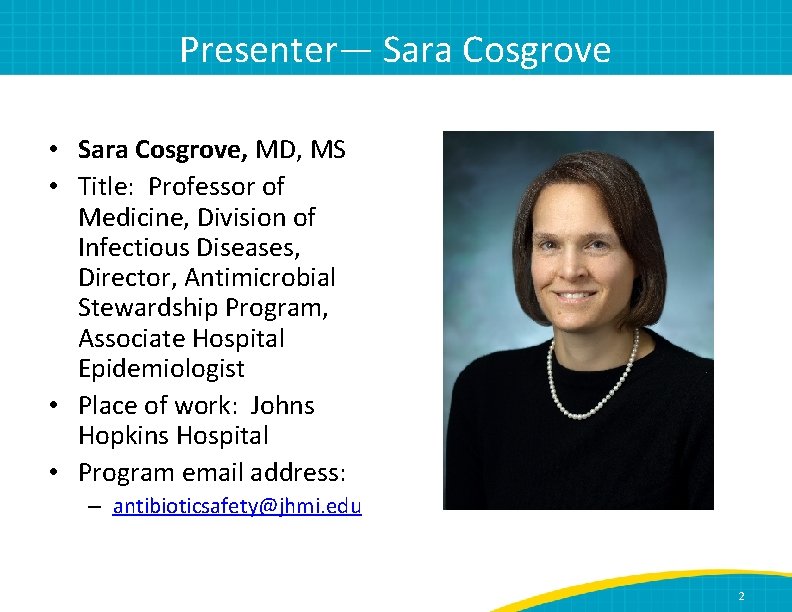
Presenter— Sara Cosgrove • Sara Cosgrove, MD, MS • Title: Professor of Medicine, Division of Infectious Diseases, Director, Antimicrobial Stewardship Program, Associate Hospital Epidemiologist • Place of work: Johns Hopkins Hospital • Program email address: – antibioticsafety@jhmi. edu 2
Housekeeping • Keep phone on mute • Use ‘raise hand’ or ‘chat’ feature in Web. Ex if you need to speak • Hold off most questions until the end during Q&A • Participate when asked 3
Objectives of Onboarding Call #1 1. Understand the goals of the AHRQ Safety Program for Improving Antibiotic Use 2. Understand The Joint Commission Antimicrobial Stewardship Standard and how its goals align with the Safety Program 3. Understand the timeline and components of the acute care educational toolkit 4. Learn the objectives and timeline for the AHRQ Safety Program 4
Goals of the Program 5
About the AHRQ Safety Program for Improving Antibiotic Use • A quality improvement collaborative to improve antibiotic use across healthcare • Program targets 3 settings – Acute Care – Long-term Care – Ambulatory Care • Educational content includes: Clinical (evidence-based approaches) Cultural interventions (CUSP) 6
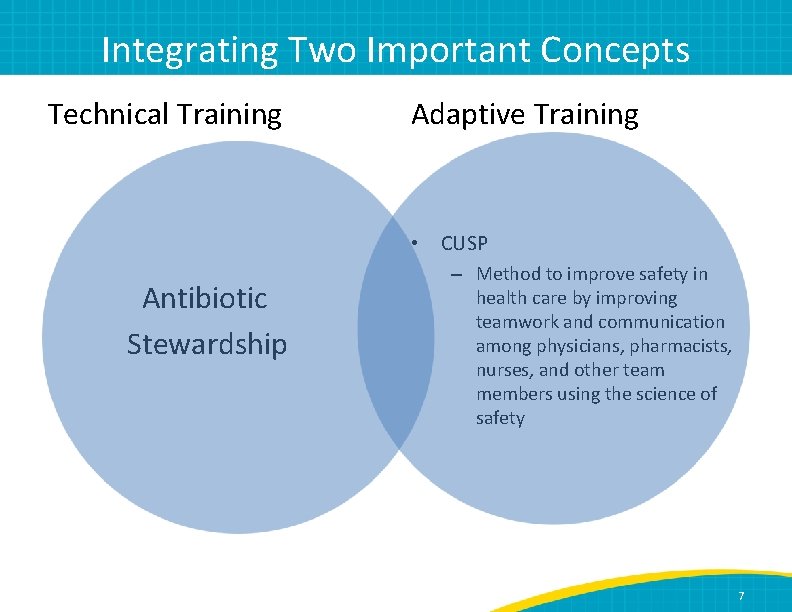
Integrating Two Important Concepts Technical Training Adaptive Training • CUSP Antibiotic Stewardship – Method to improve safety in health care by improving teamwork and communication among physicians, pharmacists, nurses, and other team members using the science of safety 7
Expected Outcomes of Program • Improved safety culture • Enhanced teamwork and communication • Reduction in suboptimal antibiotic usage • Improved antibiotic decisionmaking • Reduction in Clostridium difficile infections • Improved provider, patient, and family satisfaction 8
Benefits to Participants Technical assistance for Antibiotic Stewardship programs Access to CUSP (and teaching/coaching webinars) Networking on regional and national levels Compliance with The Joint Commission Antimicrobial Stewardship Standard • Access to a comprehensive toolkit • • 9
Objective 2 1. Understand the goals of the AHRQ Safety Program for Improving Antibiotic Use 2. Understand The Joint Commission Antimicrobial Stewardship Standard and how its goals align with the Safety Program 3. Understand the timeline and components of the acute care educational toolkit 4. Learn the objectives and timeline for the AHRQ Safety Program 10
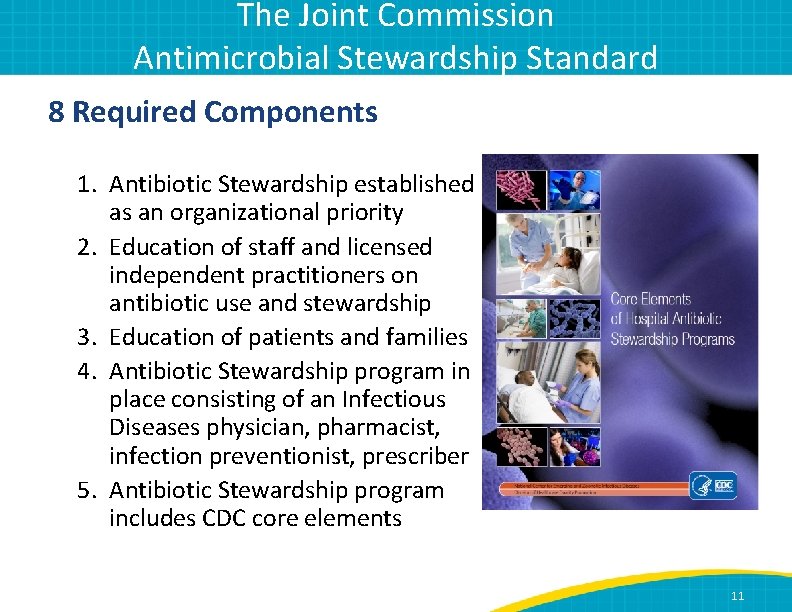
The Joint Commission Antimicrobial Stewardship Standard 8 Required Components 1. Antibiotic Stewardship established as an organizational priority 2. Education of staff and licensed independent practitioners on antibiotic use and stewardship 3. Education of patients and families 4. Antibiotic Stewardship program in place consisting of an Infectious Diseases physician, pharmacist, infection preventionist, prescriber 5. Antibiotic Stewardship program includes CDC core elements 11
The Joint Commission Antimicrobial Stewardship Standard Continiued 8 Required Components 6. AS program uses of organizationapproved multidisciplinary protocols • Guidelines for antibiotic use • Re-evaluation of and feedback to providers regarding antibiotic prescriptions • Antibiotic time out 7. Hospital collects, analyzes, and reports data on its ASP 8. Hospital takes action on improvement opportunities identified by its ASP 12
Objective 3 1. Understand the goals of the AHRQ Safety Program for Improving Antibiotic Use 2. Understand The Joint Commission Antimicrobial Stewardship Standard and how its goals align with the Safety Program 3. Understand the timeline and components of the acute care educational toolkit 4. Learn the objectives and timeline for the AHRQ Safety Program 13
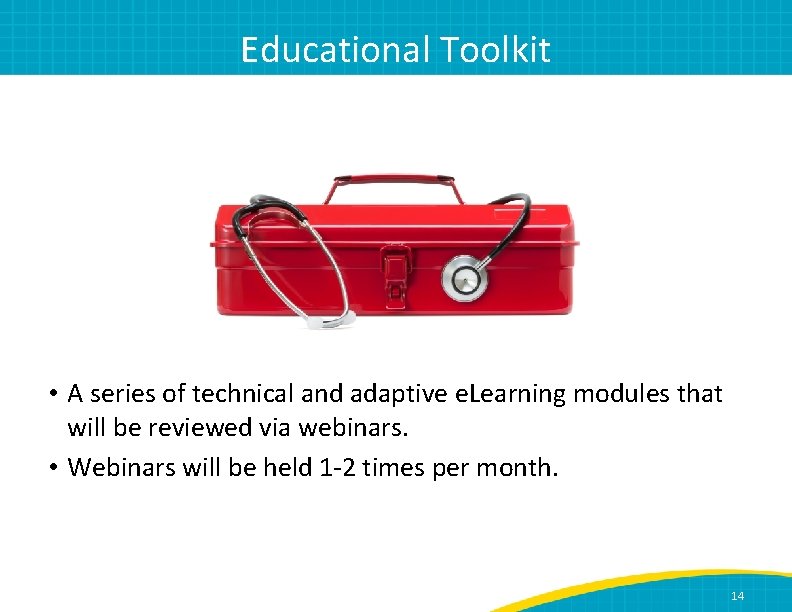
Educational Toolkit • A series of technical and adaptive e. Learning modules that will be reviewed via webinars. • Webinars will be held 1 -2 times per month. 14
Participant Overview • With existing AS programs, there will be 3 levels of participants— • Antibiotic Stewardship team • Unit champions (e. g. , physician, pharmacist, and nurse lead) • Frontline staff • With. OUT existing AS programs, the institution should identify physician and pharmacist leadership to form the backbone of the stewardship team 15
Objective 4 1. Understand the goals of the AHRQ Safety Program for Improving Antibiotic Use 2. Understand The Joint Commission Antimicrobial Stewardship Standard and how its goals align with the Safety Program 3. Understand the timeline and components of the acute care educational toolkit 4. Learn the objectives and timeline for the AHRQ Safety Program 16
Onboarding Call #2 Objectives: 1. Apply the Four Moments of Antibiotic Decision-Making 2. Understand how the CUSP approach can improve safety culture 3. Understand how to use the “Team Antibiotic Review Form” to review antibiotic use with frontline staff 4. Understand how to access data and upload data on the AHRQ Safety Program website Participants: Antibiotic Stewardship Team Month: April 2017 17
Antibiotic Stewardship Program (ASP) Development Objectives: 1. 2. 3. 4. 5. Understand the key personnel for developing an ASP Understand how to work with a senior executive to further program goals Discuss the pros and cons of common ASP interventions Discuss the evaluation metrics for ASPs Understand the steps involved in establishing an ASP Participants: Antibiotic Stewardship Team Month: May 2017 18
Improving Antibiotic Use is a Patient Safety Issue (CUSP 1) Objectives: 1. 2. 3. 4. 5. Discuss the potential harm associated with antibiotic use Understand that patient harm is largely preventable Understand that change efforts often require a focus on systems, not individuals Recognize the principals involved in safe design Understand the importance of diverse input to prevent harm Participants: AS Team, Unit Champions, Frontline staff Month: May 2017 19
Behavior Change Theory for Antibiotic Stewardship Leaders Objectives: 1. 2. 3. Understand what motivates health care providers to prescribe antibiotics Understand basic theories regarding implementation science and organizational change to implement AS interventions and to change prescribing habits Understand successful AS behavior interventions in the acute care setting Participants: AS Team Month: June 2017 20
Identifying Targets for Improving Antibiotic Use (CUSP 2) Objectives: 1. 2. 3. Understand how to identify patient safety risks in their clinical areas Understand how to be proactive in asking staff how the next patient will be harmed Understand how to leverage frontline wisdom to guide safety improvement efforts Participants: AS Team, Unit Champions, Frontline staff Month: June 2017 21
Improving Antibiotic Use by Learning from Defects (CUSP 3) Objectives: 1. 2. 3. Understand how to identify the relevant system factors related to defects in a system Develop interventions to reduce future risk Ensure that interventions are effectively addressing defects related to antibiotic prescribing Participants: AS Team, Unit Champions, Frontline staff Month: July 2017 22
Improving Teamwork and Communication Around Antibiotic Prescribing (CUSP 4) Objectives: 1. 2. 3. Understand the importance of seeking input from all team members when making antibiotic prescribing decisions Understand how to use available AHRQ Safety Tools to improve communication related to The Four Moments of Antibiotic Decision. Making Understand how to effectively communicate potential harm antibiotics can cause with patients and other health care providers Participants: AS Team, Unit Champions, Frontline staff Month: July 2017 23
The Team Approach to Stewardship of Asymptomatic Bacteriuria and Urinary Tract Infections Objectives: 1. 2. 3. 4. 5. Understand how to distinguish asymptomatic bacteriuria, cystitis, and pyelonephritis Develop empiric treatment recommendations for UTIs that are institution specific and minimize adverse events Discuss opportunities for de-escalation of antibiotic therapy for UTIs after additional clinical data are available Discuss reasonable durations of antibiotic therapy for UTIs Discuss challenges and ambiguities in developing and executing a standardized approach to the management of asymptomatic bacteriuria and urinary tract infections Participants: AS Team, Unit Champions, Frontline staff Month: August 2017 24
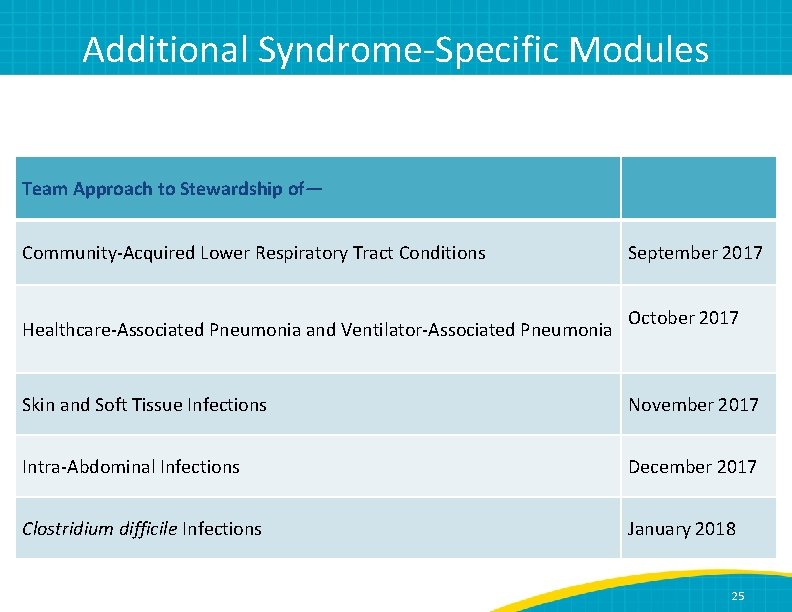
Additional Syndrome-Specific Modules Team Approach to Stewardship of— Community-Acquired Lower Respiratory Tract Conditions Healthcare-Associated Pneumonia and Ventilator-Associated Pneumonia September 2017 October 2017 Skin and Soft Tissue Infections November 2017 Intra-Abdominal Infections December 2017 Clostridium difficile Infections January 2018 25
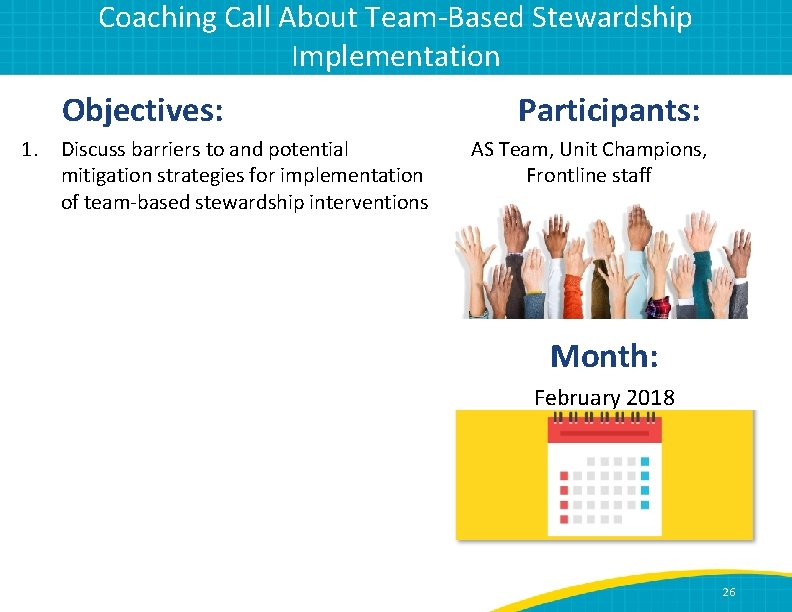
Coaching Call About Team-Based Stewardship Implementation Objectives: 1. Discuss barriers to and potential mitigation strategies for implementation of team-based stewardship interventions Participants: AS Team, Unit Champions, Frontline staff Month: February 2018 26
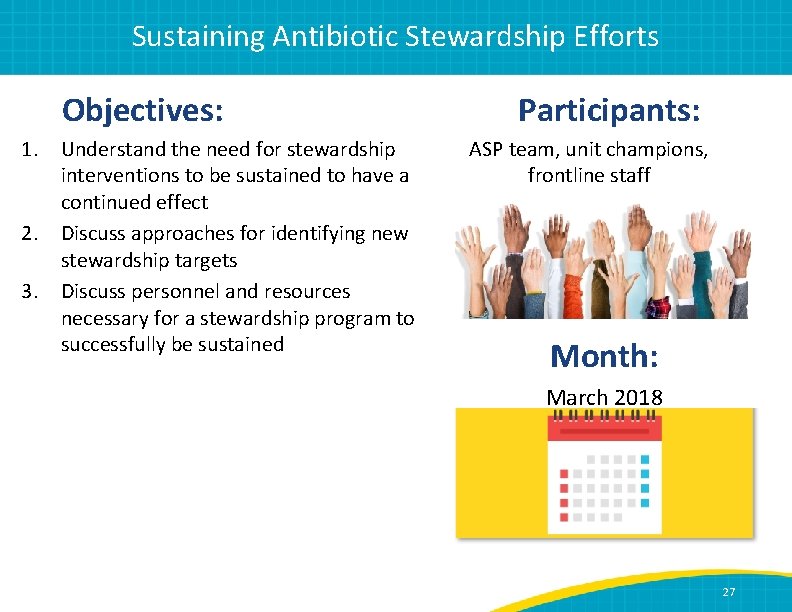
Sustaining Antibiotic Stewardship Efforts Objectives: 1. 2. 3. Understand the need for stewardship interventions to be sustained to have a continued effect Discuss approaches for identifying new stewardship targets Discuss personnel and resources necessary for a stewardship program to successfully be sustained Participants: ASP team, unit champions, frontline staff Month: March 2018 27
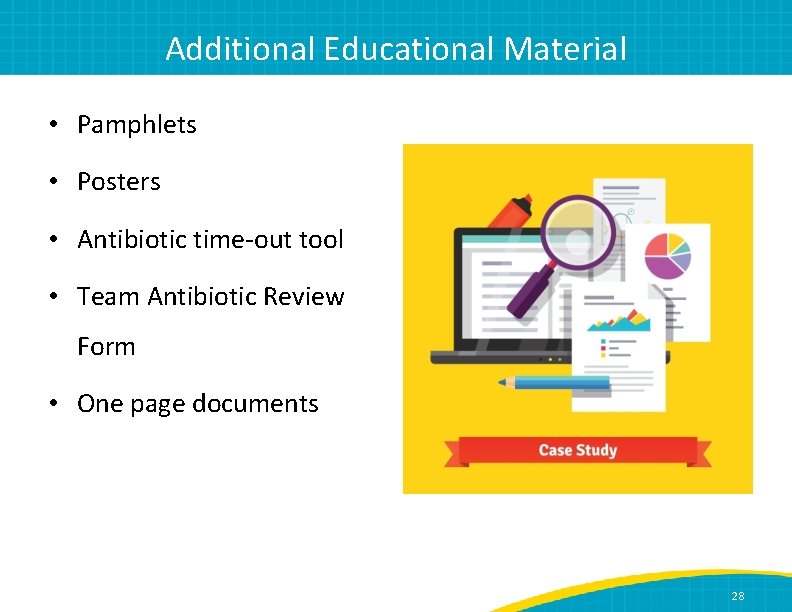
Additional Educational Material • Pamphlets • Posters • Antibiotic time-out tool • Team Antibiotic Review Form • One page documents 28
Benefit Summary • Education for ASPs and frontline providers in approaches to improve antibiotics use • Assistance with addressing the behavior and cultural drivers of antibiotic prescribing • Approaches to improve teamwork related to antibiotic prescribing • Access to experts and peers to enhance learning and collaboration • Access to materials and approaches to ensure compliance with The Joint Commission Antimicrobial Stewardship Standard 29
Questions • Type in your questions using “Chat” 30
Next Steps • Onboarding 1 Web. Ex call • Onboarding 2 Web. Ex call • Questions? antibioticsafety@jhmi. edu 31
- Slides: 31