
AHP Preregistration Workshop Discovering Opportunities in Practice Education
- Slides: 13
AHP Pre-registration Workshop: Discovering Opportunities in Practice Education Supervision in Practice-based Learning (Pr. BL) Dougie Lauchlan Senior Lecturer in Physiotherapy (AHP PE Lead for GCU)
Why is the development of supervision important? • Demonstrate professional commitment to learning & development: • of our professions • of our workforce (nationally & locally) • of ourselves • Demonstrate currency of practice • Informed by evidence-base • Can help support workforce planning • Grow capacity • Grow a sense of belonging 2
Typical Models of AHP Pr. BL Supervision • Traditional model 1: 1 • Is it the traditional model? • Shared model 1: 2, 1: 3 • Typically borne from staffing shortages (unable to resource a 1: 1) • Two/multiple-student model • 2: 1, 3: 1, 4: 1 (typical in NZ/Australia) • Collaborative/Peer-assisted Learning Model • Not just about the numbers! 3
Alternative/Emerging Models • Role-emerging or Contemporary Placements • • • Lack of existing AHP service “New” populations Lone-working Typically do not have registered AHP “Long-arm” supervision http: //www. knowledge. scot. nhs. uk/ahppe/nationalprogramme/student-placements-preregistration/ahpplacement-experiences-(1). aspx 4
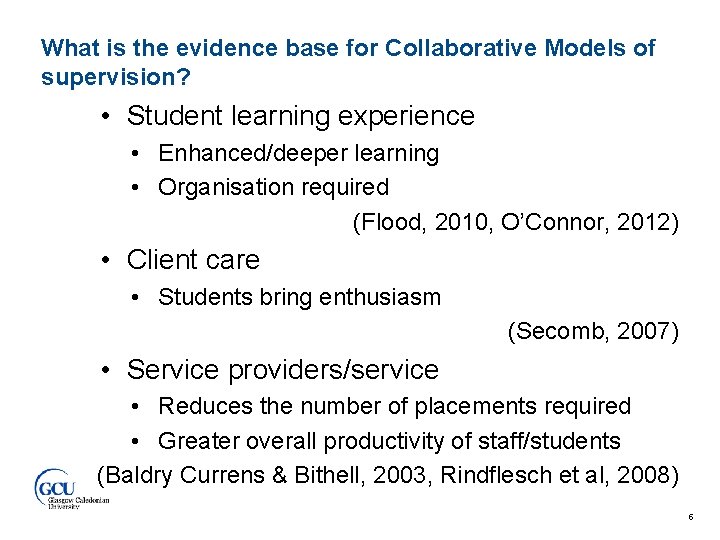
What is the evidence base for Collaborative Models of supervision? • Student learning experience • Enhanced/deeper learning • Organisation required (Flood, 2010, O’Connor, 2012) • Client care • Students bring enthusiasm (Secomb, 2007) • Service providers/service • Reduces the number of placements required • Greater overall productivity of staff/students (Baldry Currens & Bithell, 2003, Rindflesch et al, 2008) 5
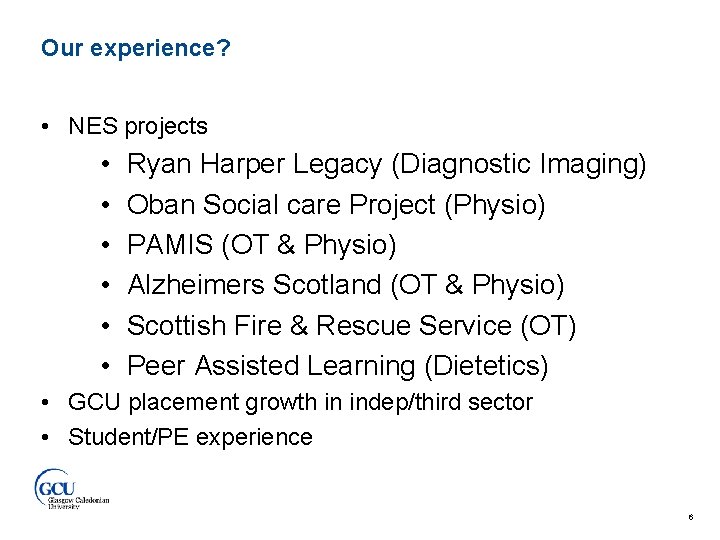
Our experience? • NES projects • • • Ryan Harper Legacy (Diagnostic Imaging) Oban Social care Project (Physio) PAMIS (OT & Physio) Alzheimers Scotland (OT & Physio) Scottish Fire & Rescue Service (OT) Peer Assisted Learning (Dietetics) • GCU placement growth in indep/third sector • Student/PE experience 6
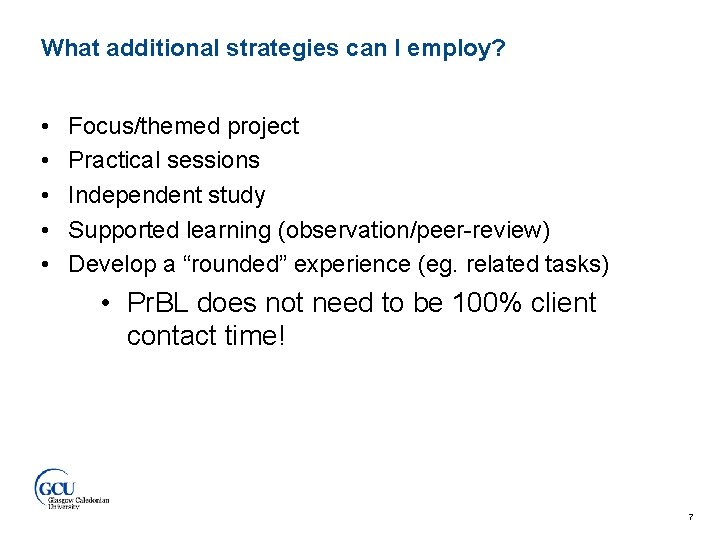
What additional strategies can I employ? • • • Focus/themed project Practical sessions Independent study Supported learning (observation/peer-review) Develop a “rounded” experience (eg. related tasks) • Pr. BL does not need to be 100% client contact time! 7
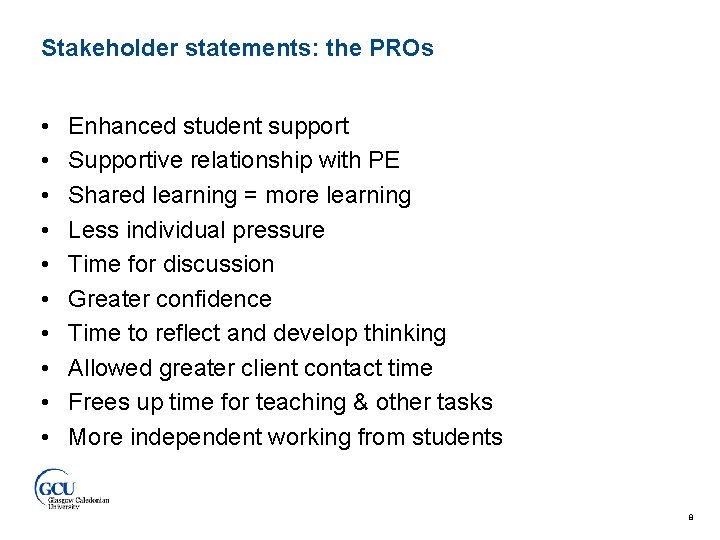
Stakeholder statements: the PROs • • • Enhanced student support Supportive relationship with PE Shared learning = more learning Less individual pressure Time for discussion Greater confidence Time to reflect and develop thinking Allowed greater client contact time Frees up time for teaching & other tasks More independent working from students 8
Stakeholder statements: the CONs • • Enhanced pre-placement preparation Potential of unrealistic expectations Mismatched levels of students does need support Space and practicality of another student 9
“As a P. E you have to do some preparation and organisation beforehand for a 2: 1 placement. But once the placement is underway you’ll find you have more time for clinical teaching and as the students become more independent you’ll have more time for feedback/discussion but also to time to pursue other tasks. ” “It promotes collaborative learning, honesty and helps with their professional growth and development. It gives them peer support and develops communication skills and team working. ” “There is increased direct contact time with each patient if each student takes half of your daily caseload. ” “There are ‘cons’ to the 2: 1 model - such as if one student is clearly stronger/ more outspoken/confident than the other or if there is a personality clash. But if a clear plan is in place before the placement starts to deal with the challenges” Pamela Dougan, Senior Physiotherapist, A&A 10
“It didn't feel as pressurising when it came to these sessions and this atmosphere helped me view the placement less of an assessment and more towards a learning opportunity. ” “It was easier to see some patients together with a fellow student especially those that need the support of two to mobilise. ” Deodatus Quek, Physio student “Having the 2: 1 model this has allowed me to have time to settle in the placement and to find my feet because when having discussions with a group I am able to have time to think as well as contributing to the conversation. ” “I still received a 1: 1 to hear feedback mid-placement, which was good to know what they thought of my personal progress and I was able to talk with them myself. ” Jennifer Hewitt, Physio student 11
Short video testimonial from Kath? 12
Overarching Workshop Aims • Benefits are there to be realised but can we: • Recognise the importance of providing a range of good quality practice education opportunities • We need to develop new ways of working 13