
AHDL Training Class Danny Mok Altera HK FAE

- Slides: 51
AHDL Training Class Danny Mok Altera HK FAE (dmok@altera. com) Copyright © 1997 Altera Corporation
What is AHDL n Altera Hardware Description Language – develop by Altera – integrate into the Altera software Max+Plus II – description the hardware in language instead of graphic • easy to modify • easy to maintane – very good for • complex combinational logic – BCD to 7 Segment converter – address decoding • state machine • more than you want……. . Copyright © 1997 Altera Corporation
continue. . . n As easy as Graphic Entry n As powerful as HDL (Hardware Description Language) – VHDL, Verilog HDL etc. Copyright © 1997 Altera Corporation
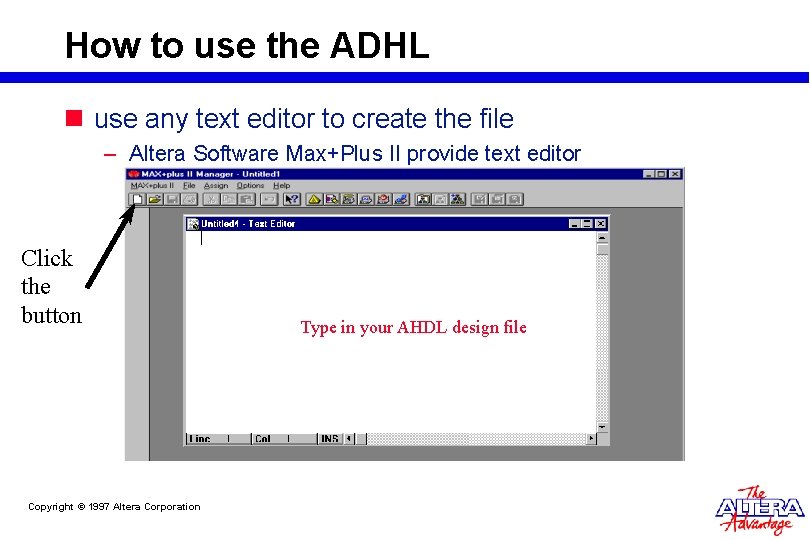
How to use the ADHL n use any text editor to create the file – Altera Software Max+Plus II provide text editor Click the button Copyright © 1997 Altera Corporation Type in your AHDL design file
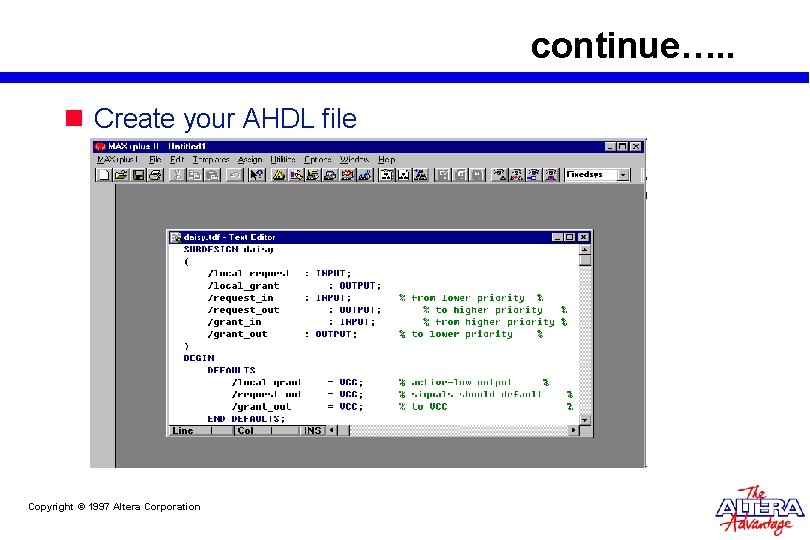
continue…. . n Create your AHDL file Copyright © 1997 Altera Corporation
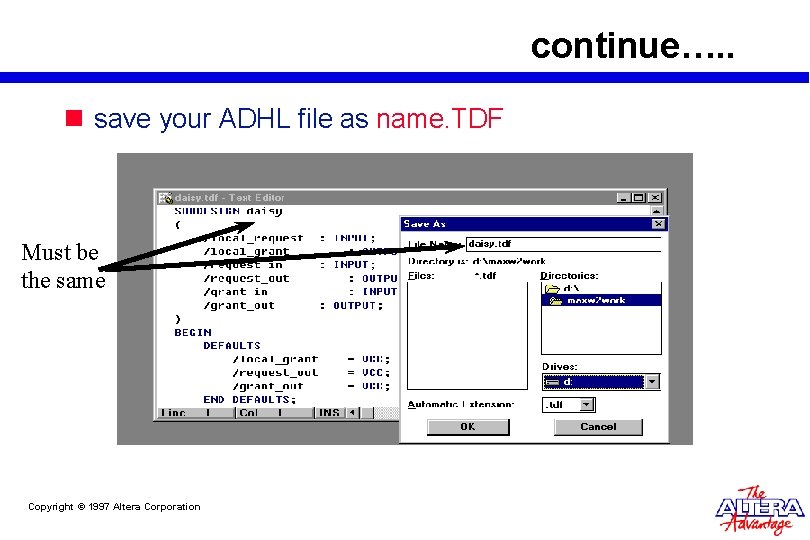
continue…. . n save your ADHL file as name. TDF Must be the same Copyright © 1997 Altera Corporation
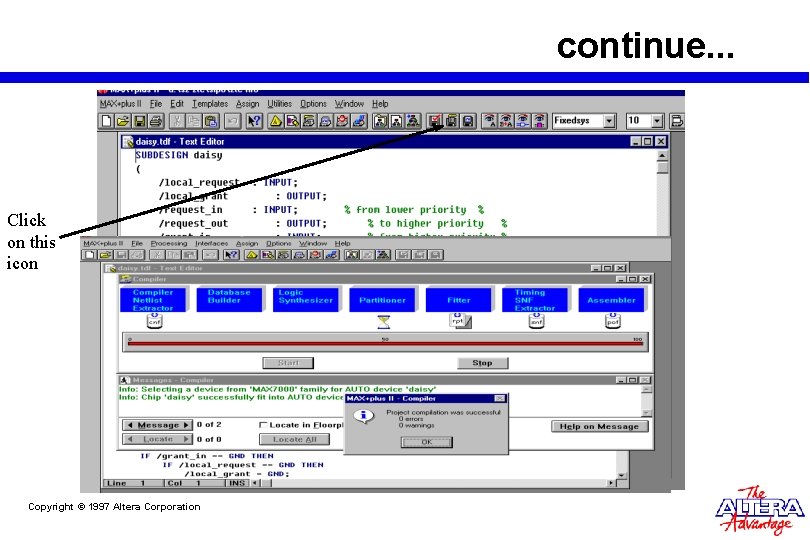
continue. . . Click on this icon Copyright © 1997 Altera Corporation
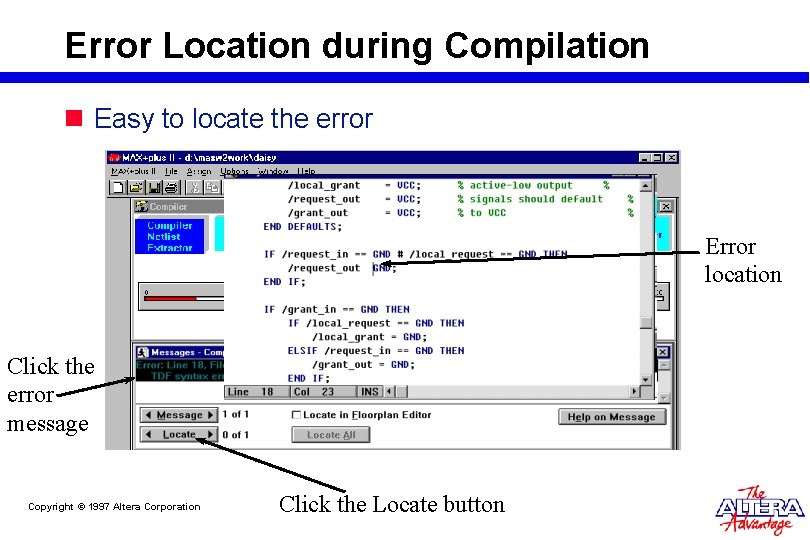
Error Location during Compilation n Easy to locate the error Error location Click the error message Copyright © 1997 Altera Corporation Click the Locate button
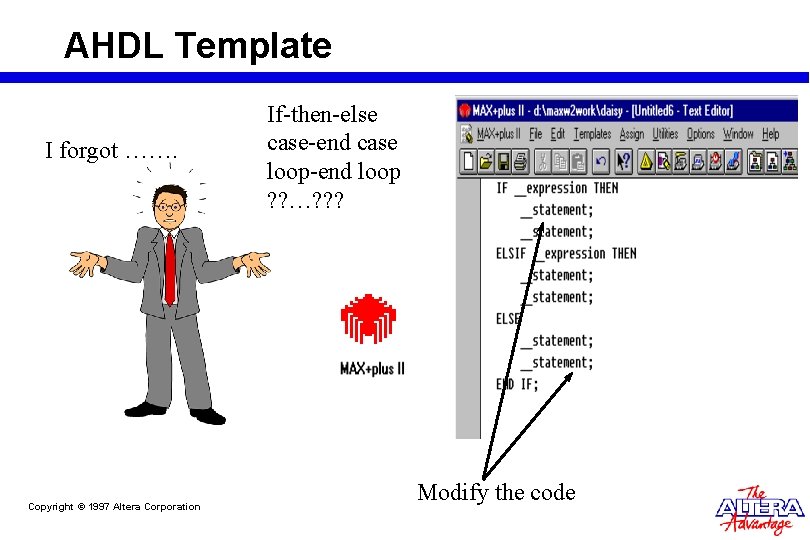
AHDL Template I forgot ……. Copyright © 1997 Altera Corporation If-then-else case-end case loop-end loop ? ? …? ? ? Modify the code
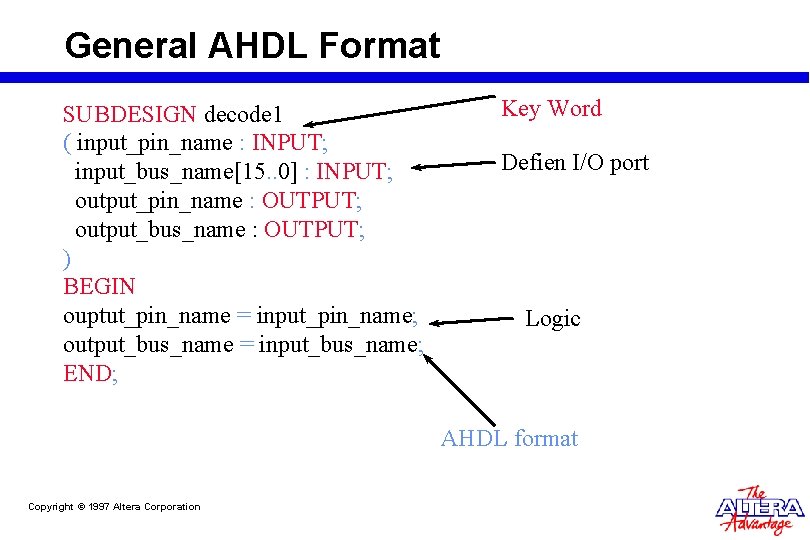
General AHDL Format SUBDESIGN decode 1 ( input_pin_name : INPUT; input_bus_name[15. . 0] : INPUT; output_pin_name : OUTPUT; output_bus_name : OUTPUT; ) BEGIN ouptut_pin_name = input_pin_name; output_bus_name = input_bus_name; END; Key Word Defien I/O port Logic AHDL format Copyright © 1997 Altera Corporation
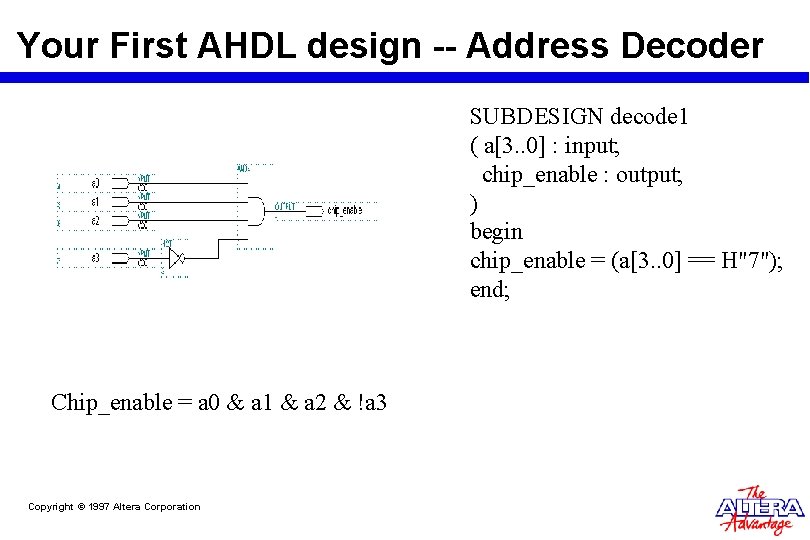
Your First AHDL design -- Address Decoder SUBDESIGN decode 1 ( a[3. . 0] : input; chip_enable : output; ) begin chip_enable = (a[3. . 0] == H"7"); end; Chip_enable = a 0 & a 1 & a 2 & !a 3 Copyright © 1997 Altera Corporation
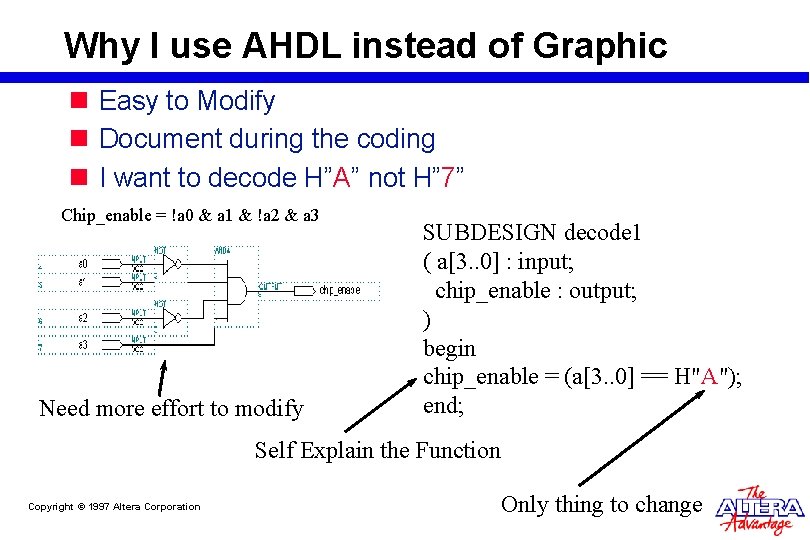
Why I use AHDL instead of Graphic n Easy to Modify n Document during the coding n I want to decode H”A” not H” 7” Chip_enable = !a 0 & a 1 & !a 2 & a 3 Need more effort to modify SUBDESIGN decode 1 ( a[3. . 0] : input; chip_enable : output; ) begin chip_enable = (a[3. . 0] == H"A"); end; Self Explain the Function Copyright © 1997 Altera Corporation Only thing to change
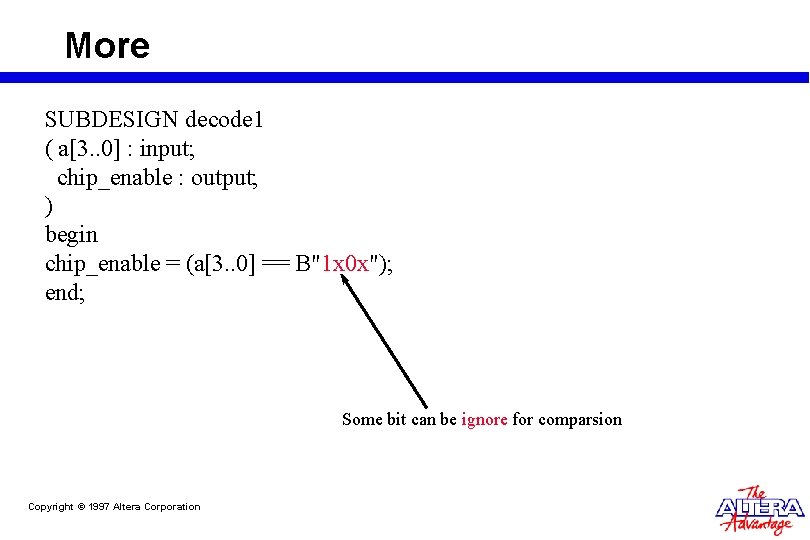
More SUBDESIGN decode 1 ( a[3. . 0] : input; chip_enable : output; ) begin chip_enable = (a[3. . 0] == B"1 x 0 x"); end; Some bit can be ignore for comparsion Copyright © 1997 Altera Corporation
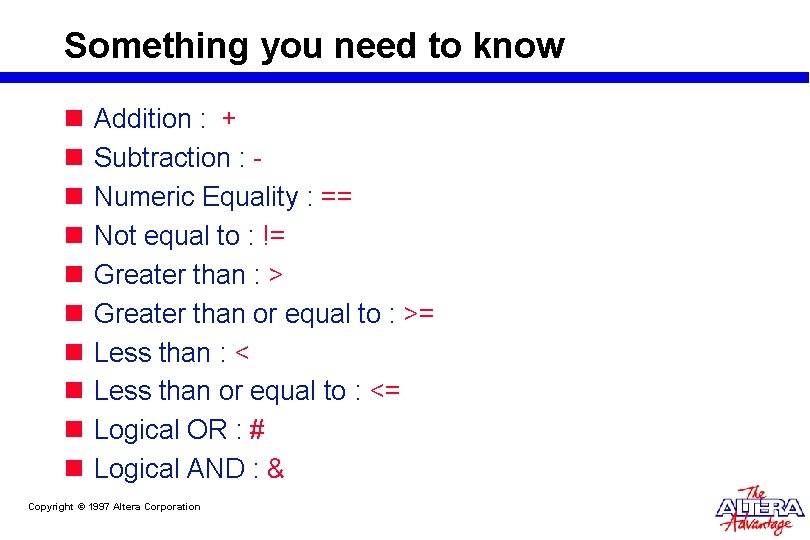
Something you need to know n n n n n Addition : + Subtraction : Numeric Equality : == Not equal to : != Greater than : > Greater than or equal to : >= Less than : < Less than or equal to : <= Logical OR : # Logical AND : & Copyright © 1997 Altera Corporation
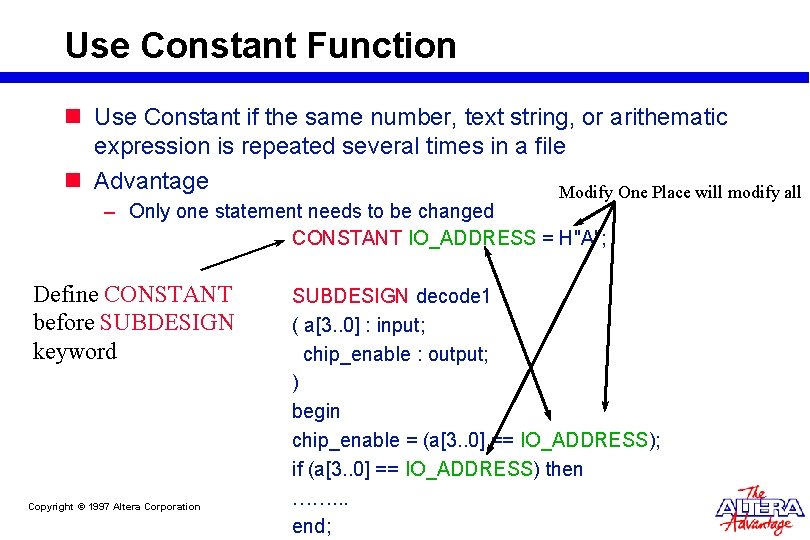
Use Constant Function n Use Constant if the same number, text string, or arithematic expression is repeated several times in a file n Advantage Modify One Place will modify all – Only one statement needs to be changed CONSTANT IO_ADDRESS = H"A"; Define CONSTANT before SUBDESIGN keyword Copyright © 1997 Altera Corporation SUBDESIGN decode 1 ( a[3. . 0] : input; chip_enable : output; ) begin chip_enable = (a[3. . 0] == IO_ADDRESS); if (a[3. . 0] == IO_ADDRESS) then ……. . . end;
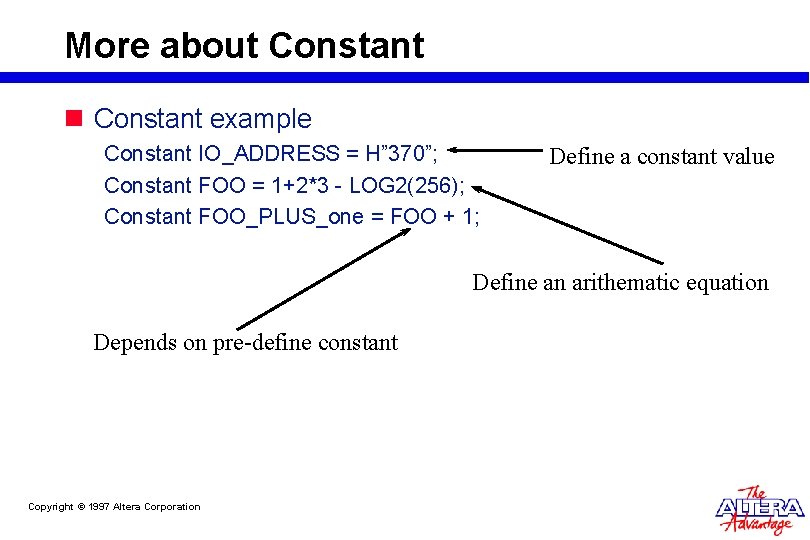
More about Constant n Constant example Constant IO_ADDRESS = H” 370”; Constant FOO = 1+2*3 - LOG 2(256); Constant FOO_PLUS_one = FOO + 1; Define a constant value Define an arithematic equation Depends on pre-define constant Copyright © 1997 Altera Corporation
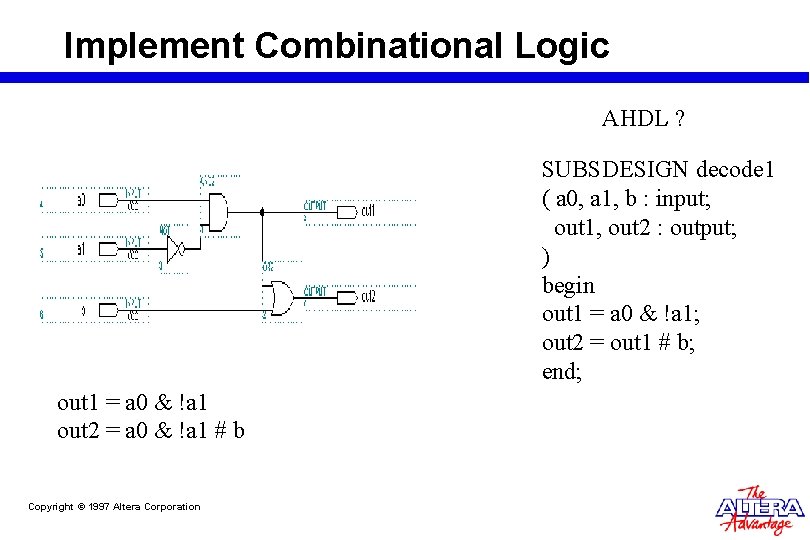
Implement Combinational Logic AHDL ? SUBSDESIGN decode 1 ( a 0, a 1, b : input; out 1, out 2 : output; ) begin out 1 = a 0 & !a 1; out 2 = out 1 # b; end; out 1 = a 0 & !a 1 out 2 = a 0 & !a 1 # b Copyright © 1997 Altera Corporation
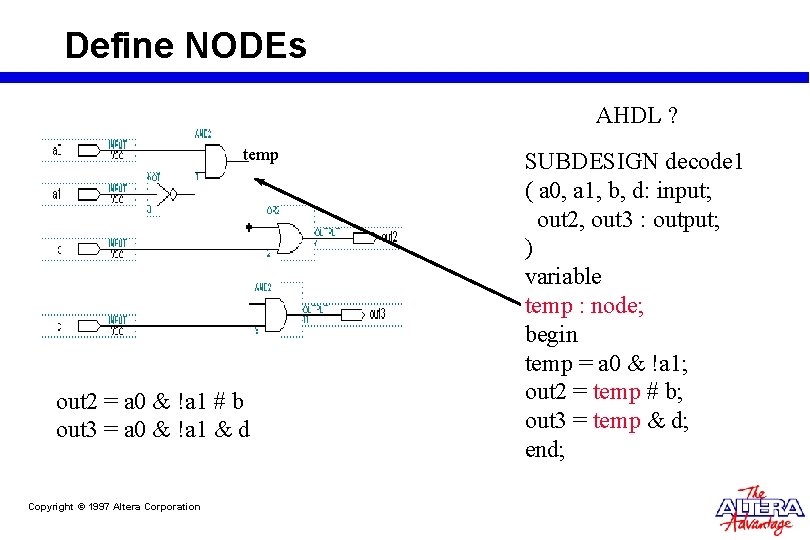
Define NODEs AHDL ? temp out 2 = a 0 & !a 1 # b out 3 = a 0 & !a 1 & d Copyright © 1997 Altera Corporation SUBDESIGN decode 1 ( a 0, a 1, b, d: input; out 2, out 3 : output; ) variable temp : node; begin temp = a 0 & !a 1; out 2 = temp # b; out 3 = temp & d; end;
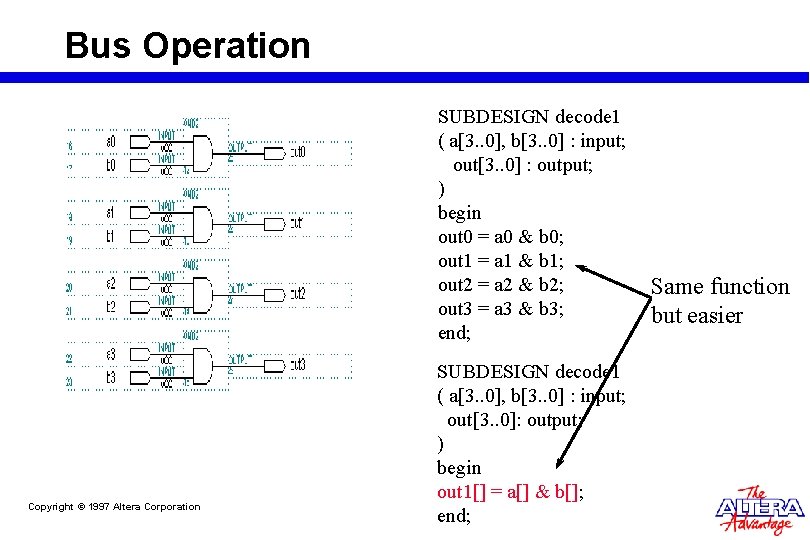
Bus Operation SUBDESIGN decode 1 ( a[3. . 0], b[3. . 0] : input; out[3. . 0] : output; ) begin out 0 = a 0 & b 0; out 1 = a 1 & b 1; out 2 = a 2 & b 2; out 3 = a 3 & b 3; end; Copyright © 1997 Altera Corporation SUBDESIGN decode 1 ( a[3. . 0], b[3. . 0] : input; out[3. . 0]: output; ) begin out 1[] = a[] & b[]; end; Same function but easier
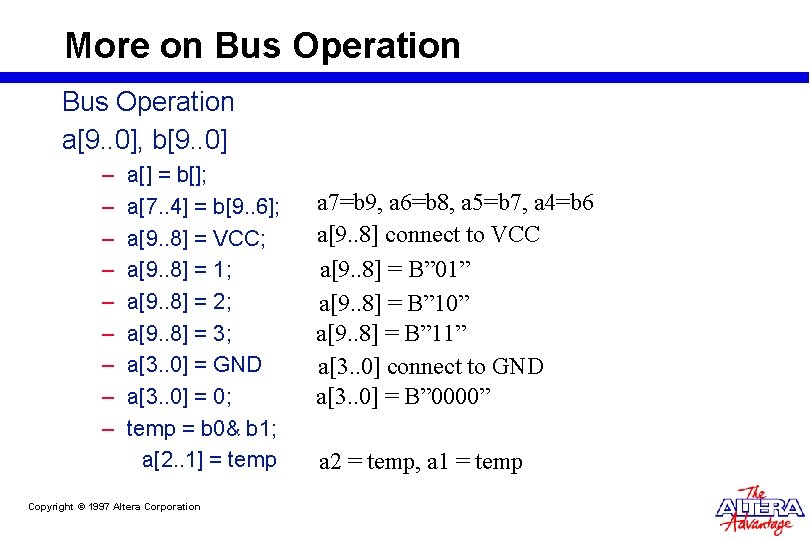
More on Bus Operation a[9. . 0], b[9. . 0] – – – – – a[] = b[]; a[7. . 4] = b[9. . 6]; a[9. . 8] = VCC; a[9. . 8] = 1; a[9. . 8] = 2; a[9. . 8] = 3; a[3. . 0] = GND a[3. . 0] = 0; temp = b 0& b 1; a[2. . 1] = temp Copyright © 1997 Altera Corporation a 7=b 9, a 6=b 8, a 5=b 7, a 4=b 6 a[9. . 8] connect to VCC a[9. . 8] = B” 01” a[9. . 8] = B” 10” a[9. . 8] = B” 11” a[3. . 0] connect to GND a[3. . 0] = B” 0000” a 2 = temp, a 1 = temp
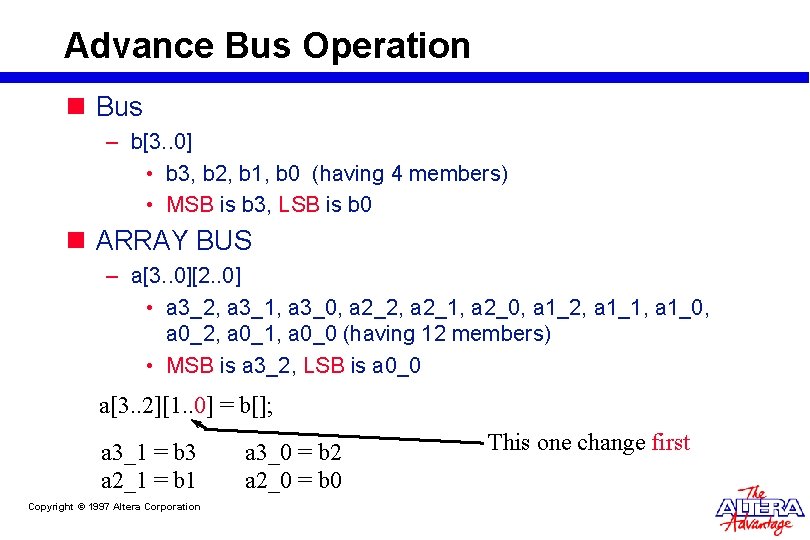
Advance Bus Operation n Bus – b[3. . 0] • b 3, b 2, b 1, b 0 (having 4 members) • MSB is b 3, LSB is b 0 n ARRAY BUS – a[3. . 0][2. . 0] • a 3_2, a 3_1, a 3_0, a 2_2, a 2_1, a 2_0, a 1_2, a 1_1, a 1_0, a 0_2, a 0_1, a 0_0 (having 12 members) • MSB is a 3_2, LSB is a 0_0 a[3. . 2][1. . 0] = b[]; a 3_1 = b 3 a 2_1 = b 1 Copyright © 1997 Altera Corporation a 3_0 = b 2 a 2_0 = b 0 This one change first
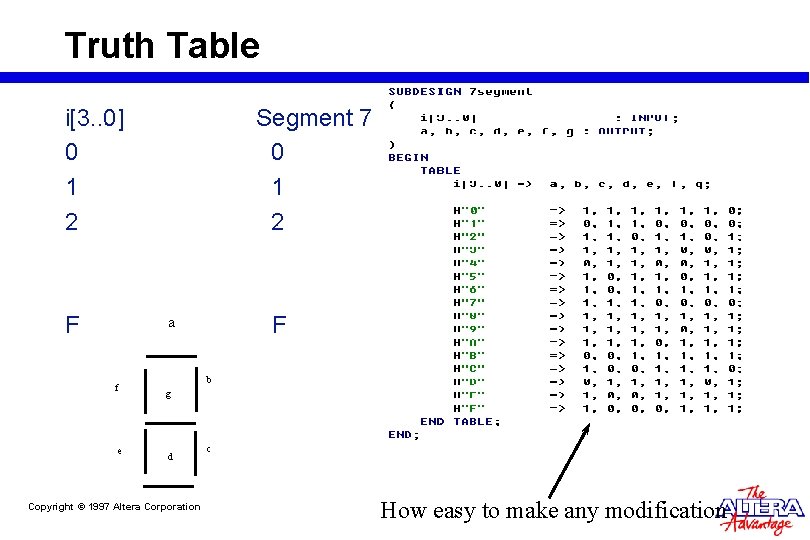
Truth Table i[3. . 0] 0 1 2 F Segment 7 0 1 2 F a f e b g d Copyright © 1997 Altera Corporation c How easy to make any modification
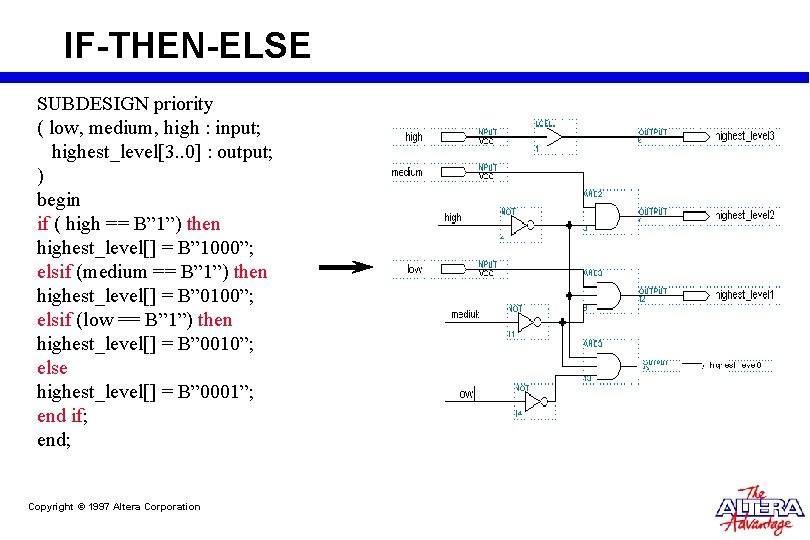
IF-THEN-ELSE SUBDESIGN priority ( low, medium, high : input; highest_level[3. . 0] : output; ) begin if ( high == B” 1”) then highest_level[] = B” 1000”; elsif (medium == B” 1”) then highest_level[] = B” 0100”; elsif (low == B” 1”) then highest_level[] = B” 0010”; else highest_level[] = B” 0001”; end if; end; Copyright © 1997 Altera Corporation
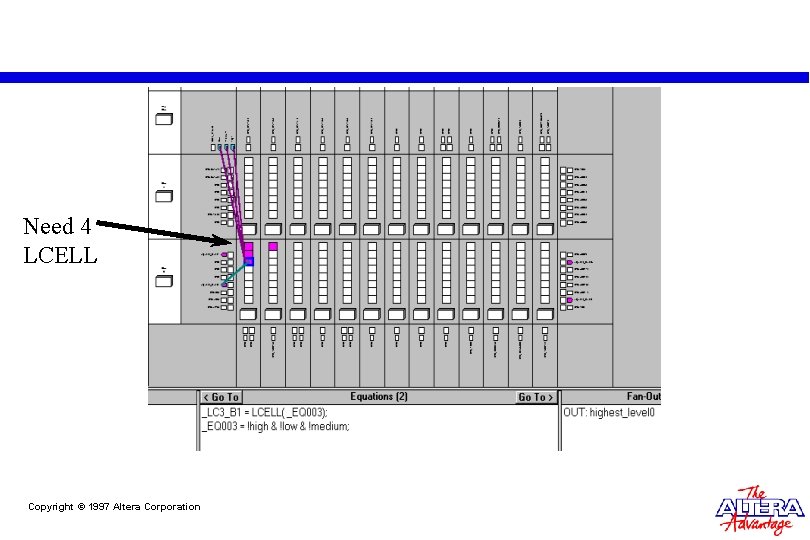
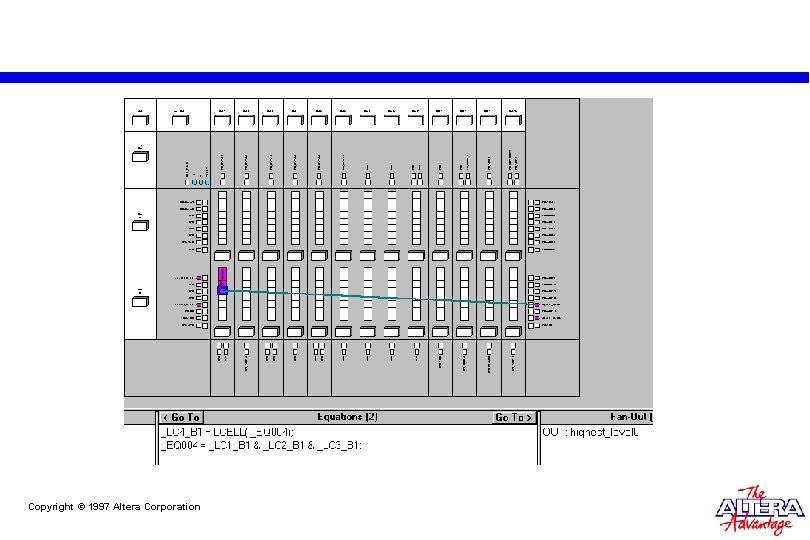
Need 4 LCELL Copyright © 1997 Altera Corporation
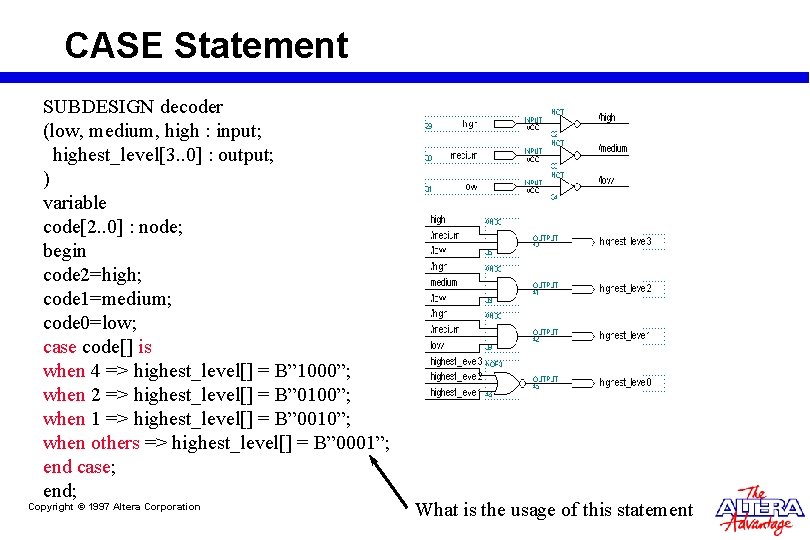
CASE Statement SUBDESIGN decoder (low, medium, high : input; highest_level[3. . 0] : output; ) variable code[2. . 0] : node; begin code 2=high; code 1=medium; code 0=low; case code[] is when 4 => highest_level[] = B” 1000”; when 2 => highest_level[] = B” 0100”; when 1 => highest_level[] = B” 0010”; when others => highest_level[] = B” 0001”; end case; end; Copyright © 1997 Altera Corporation What is the usage of this statement
Copyright © 1997 Altera Corporation
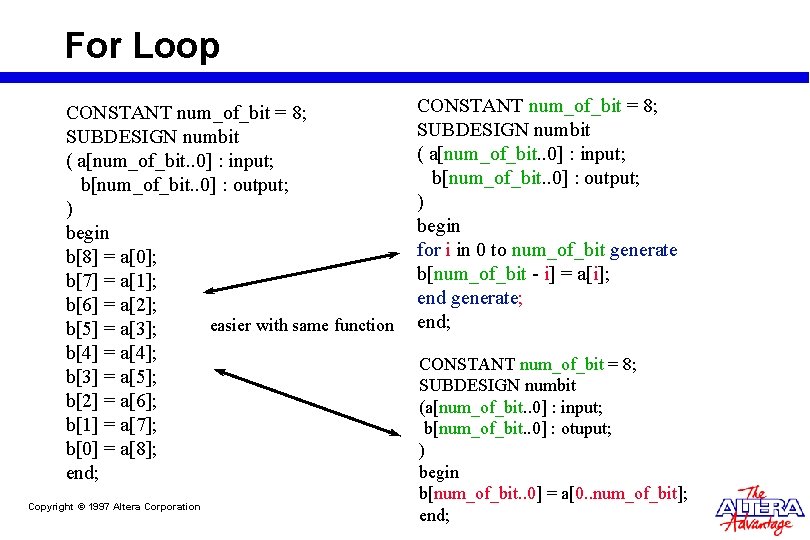
For Loop CONSTANT num_of_bit = 8; SUBDESIGN numbit ( a[num_of_bit. . 0] : input; b[num_of_bit. . 0] : output; ) begin b[8] = a[0]; b[7] = a[1]; b[6] = a[2]; easier with same function b[5] = a[3]; b[4] = a[4]; b[3] = a[5]; b[2] = a[6]; b[1] = a[7]; b[0] = a[8]; end; Copyright © 1997 Altera Corporation CONSTANT num_of_bit = 8; SUBDESIGN numbit ( a[num_of_bit. . 0] : input; b[num_of_bit. . 0] : output; ) begin for i in 0 to num_of_bit generate b[num_of_bit - i] = a[i]; end generate; end; CONSTANT num_of_bit = 8; SUBDESIGN numbit (a[num_of_bit. . 0] : input; b[num_of_bit. . 0] : otuput; ) begin b[num_of_bit. . 0] = a[0. . num_of_bit]; end;
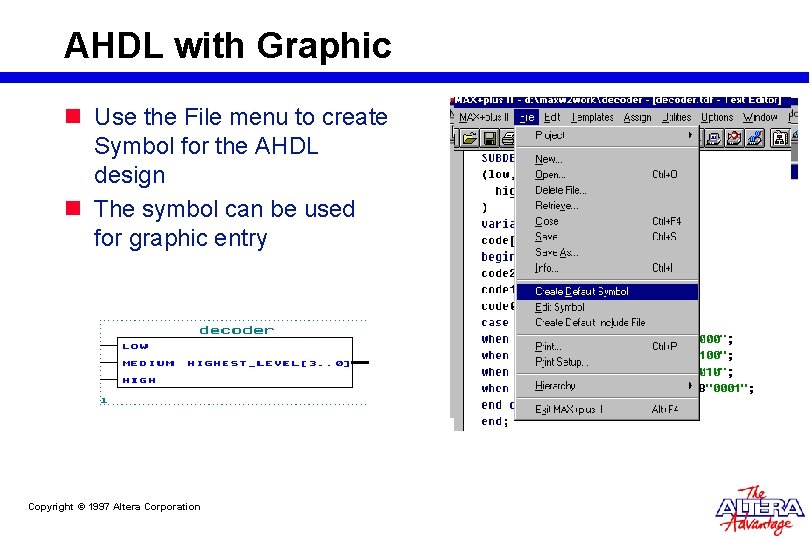
AHDL with Graphic n Use the File menu to create Symbol for the AHDL design n The symbol can be used for graphic entry Copyright © 1997 Altera Corporation
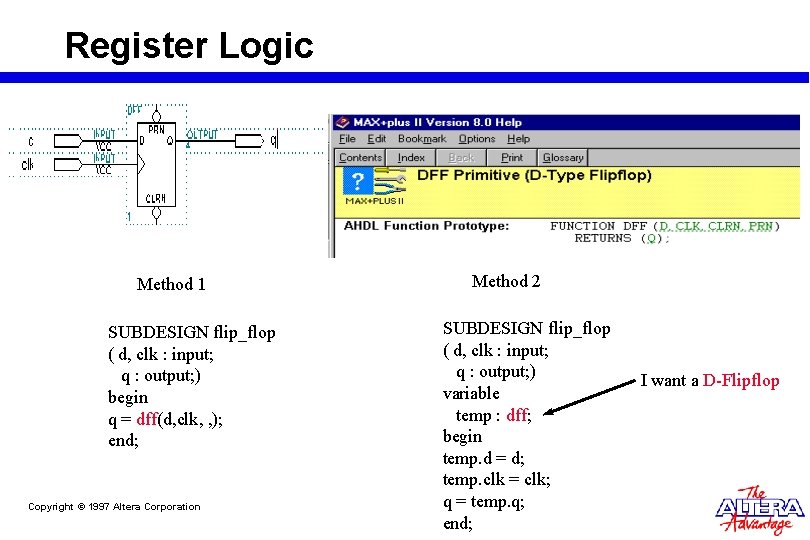
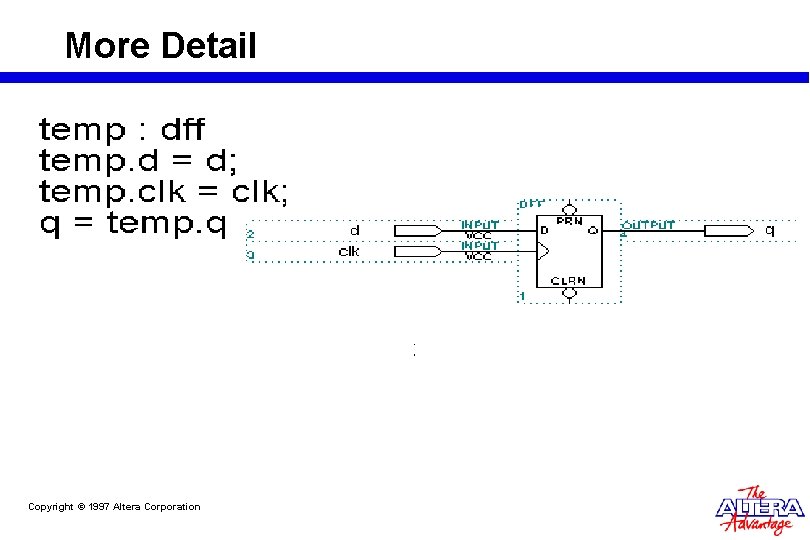
Register Logic Method 1 SUBDESIGN flip_flop ( d, clk : input; q : output; ) begin q = dff(d, clk, , ); end; Copyright © 1997 Altera Corporation Method 2 SUBDESIGN flip_flop ( d, clk : input; q : output; ) variable temp : dff; begin temp. d = d; temp. clk = clk; q = temp. q; end; I want a D-Flipflop
More Detail Copyright © 1997 Altera Corporation
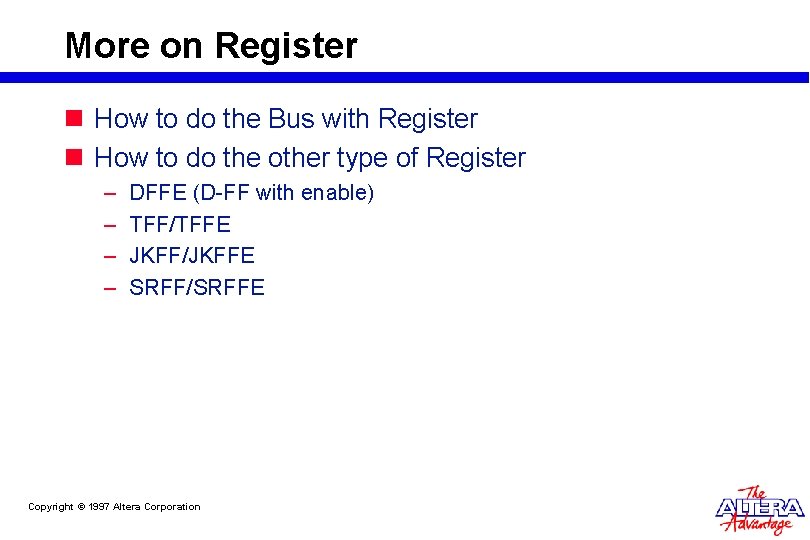
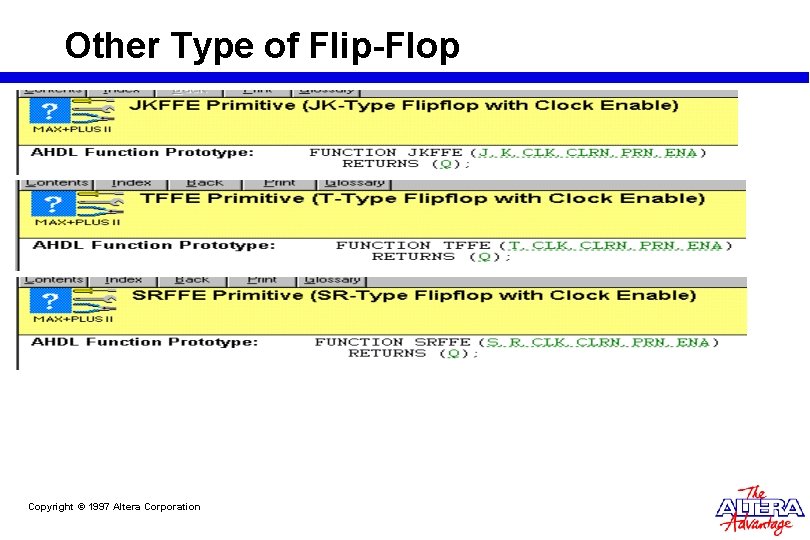
More on Register n How to do the Bus with Register n How to do the other type of Register – – DFFE (D-FF with enable) TFF/TFFE JKFF/JKFFE SRFF/SRFFE Copyright © 1997 Altera Corporation
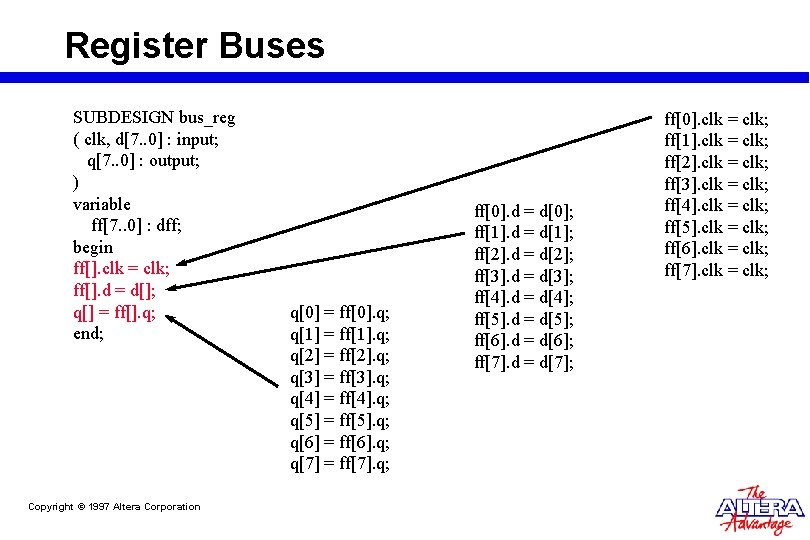
Register Buses SUBDESIGN bus_reg ( clk, d[7. . 0] : input; q[7. . 0] : output; ) variable ff[7. . 0] : dff; begin ff[]. clk = clk; ff[]. d = d[]; q[] = ff[]. q; end; Copyright © 1997 Altera Corporation q[0] = ff[0]. q; q[1] = ff[1]. q; q[2] = ff[2]. q; q[3] = ff[3]. q; q[4] = ff[4]. q; q[5] = ff[5]. q; q[6] = ff[6]. q; q[7] = ff[7]. q; ff[0]. d = d[0]; ff[1]. d = d[1]; ff[2]. d = d[2]; ff[3]. d = d[3]; ff[4]. d = d[4]; ff[5]. d = d[5]; ff[6]. d = d[6]; ff[7]. d = d[7]; ff[0]. clk = clk; ff[1]. clk = clk; ff[2]. clk = clk; ff[3]. clk = clk; ff[4]. clk = clk; ff[5]. clk = clk; ff[6]. clk = clk; ff[7]. clk = clk;
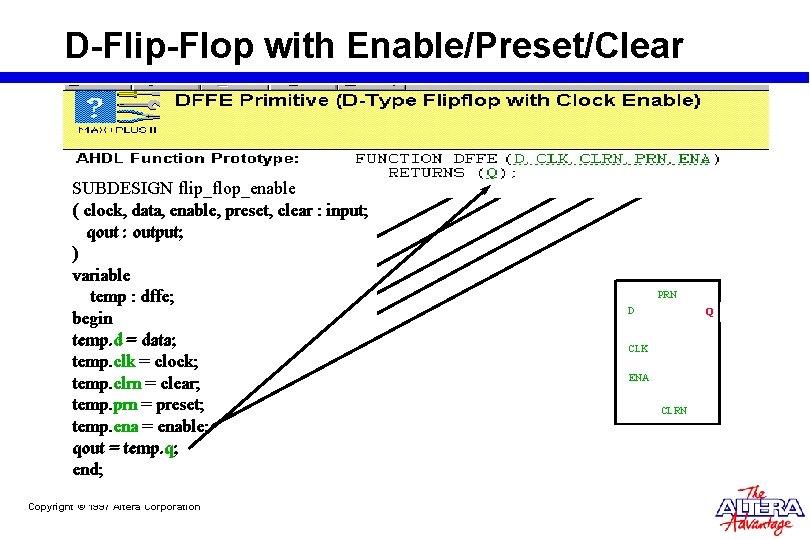
D-Flip-Flop with Enable/Preset/Clear SUBDESIGN flip_flop_enable (( clock, data, enable, preset, clear : : input; qout : : output; )) variable temp : : dffe; begin temp. d == data; temp. clk == clock; temp. clrn = clear; temp. prn == preset; temp. ena == enable; qout == temp. q; end; Copyright © 1997 Altera Corporation PRN PRN Q Q D D CLK CLK ENA ENA CLRN
Other Type of Flip-Flop Copyright © 1997 Altera Corporation
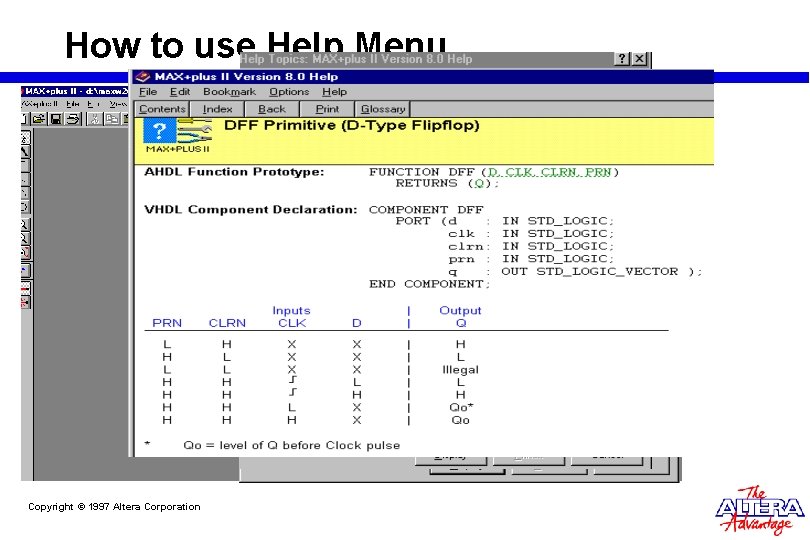
How to use Help Menu Q : I don’t know how to use Altera DFF/JKFFE……, what can I do ? A : Altera Help Menu is a good place to find information Q : How do I use the Help Menu ? A : It is easy………… and Fun DFFE Copyright © 1997 Altera Corporation
How to use Help Menu Copyright © 1997 Altera Corporation
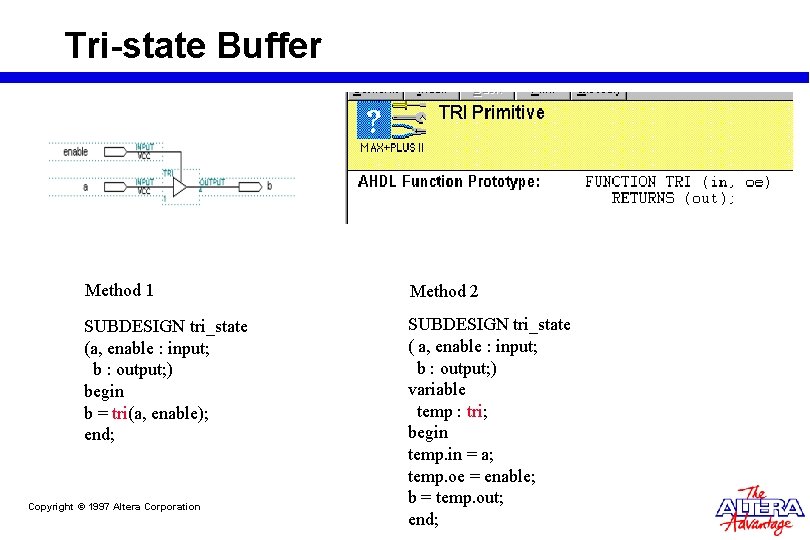
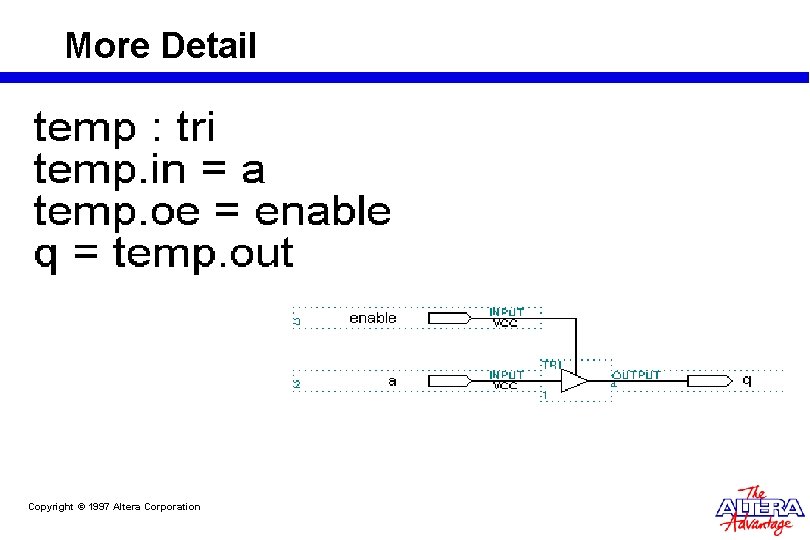
Tri-state Buffer Method 1 Method 2 SUBDESIGN tri_state (a, enable : input; b : output; ) begin b = tri(a, enable); end; SUBDESIGN tri_state ( a, enable : input; b : output; ) variable temp : tri; begin temp. in = a; temp. oe = enable; b = temp. out; end; Copyright © 1997 Altera Corporation
More Detail Copyright © 1997 Altera Corporation
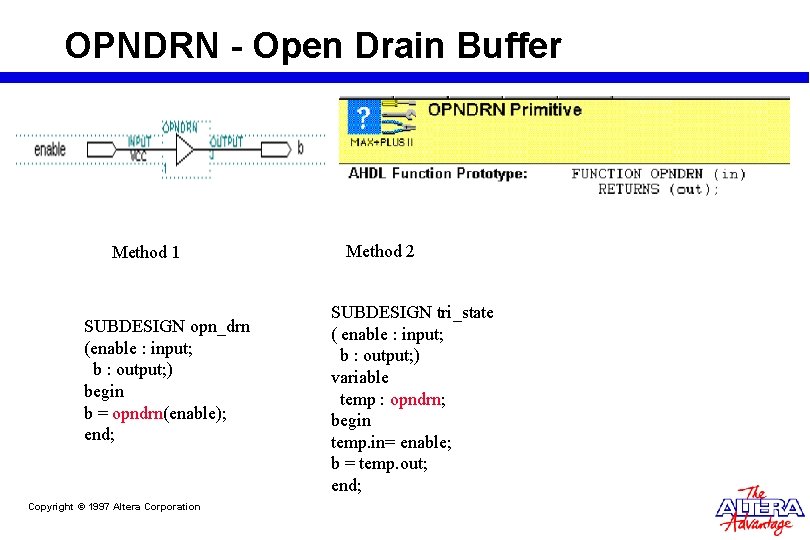
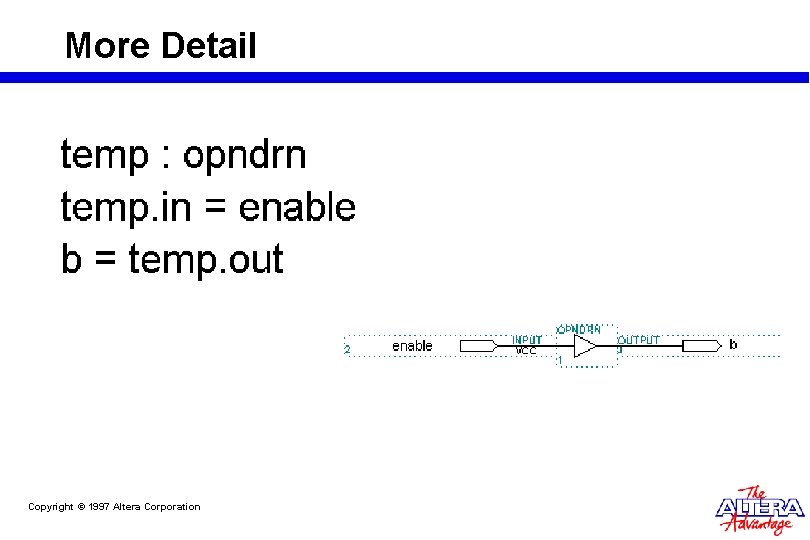
OPNDRN - Open Drain Buffer Method 1 SUBDESIGN opn_drn (enable : input; b : output; ) begin b = opndrn(enable); end; Copyright © 1997 Altera Corporation Method 2 SUBDESIGN tri_state ( enable : input; b : output; ) variable temp : opndrn; begin temp. in= enable; b = temp. out; end;
More Detail Copyright © 1997 Altera Corporation
Using AHDL as EASY as Schematic but Using AHDL is more POWERFUL Copyright © 1997 Altera Corporation
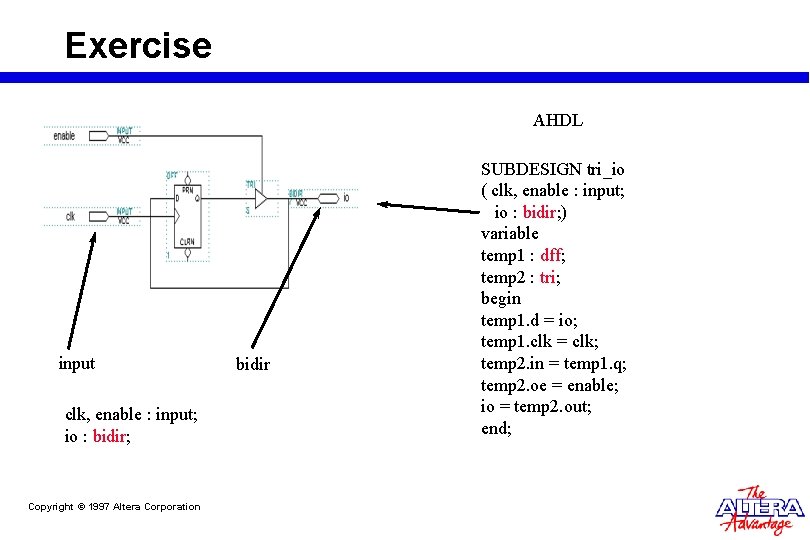
Exercise AHDL input clk, enable : input; io : bidir; Copyright © 1997 Altera Corporation bidir SUBDESIGN tri_io ( clk, enable : input; io : bidir; ) variable temp 1 : dff; temp 2 : tri; begin temp 1. d = io; temp 1. clk = clk; temp 2. in = temp 1. q; temp 2. oe = enable; io = temp 2. out; end;
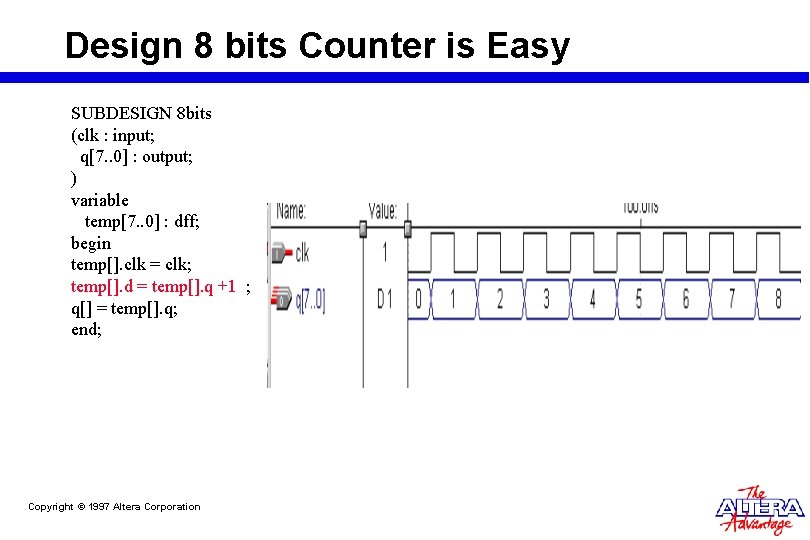
Design 8 bits Counter is Easy SUBDESIGN 8 bits (clk : input; q[7. . 0] : output; ) variable temp[7. . 0] : dff; begin temp[]. clk = clk; temp[]. d = temp[]. q +1 ; q[] = temp[]. q; end; Copyright © 1997 Altera Corporation
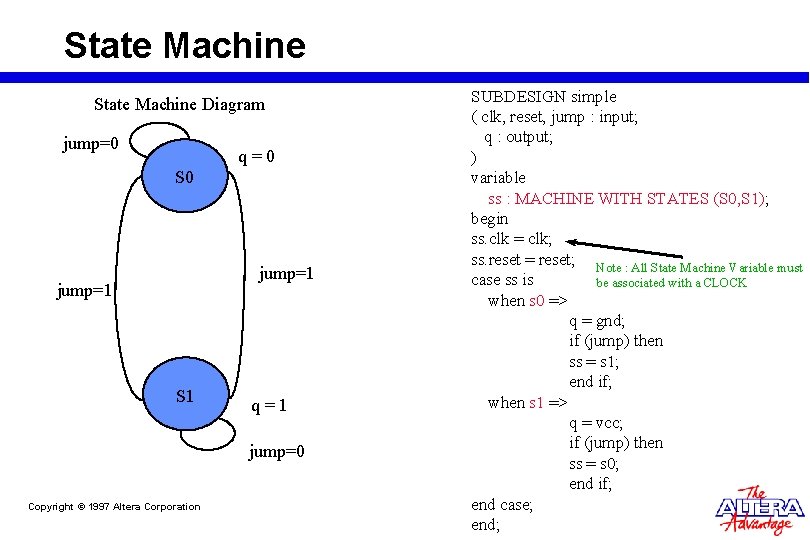
State Machine Diagram jump=0 q=0 S 0 jump=1 S 1 q=1 jump=0 Copyright © 1997 Altera Corporation SUBDESIGN simple ( clk, reset, jump : input; q : output; ) variable ss : MACHINE WITH STATES (S 0, S 1); begin ss. clk = clk; ss. reset = reset; Note : All State Machine Variable must case ss is be associated with a CLOCK when s 0 => q = gnd; if (jump) then ss = s 1; end if; when s 1 => q = vcc; if (jump) then ss = s 0; end if; end case; end;
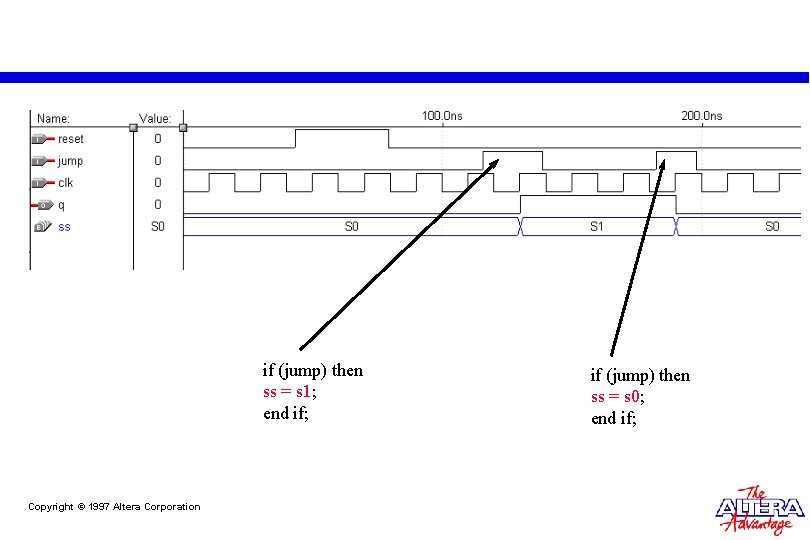
if (jump) then ss = s 1; end if; Copyright © 1997 Altera Corporation if (jump) then ss = s 0; end if;
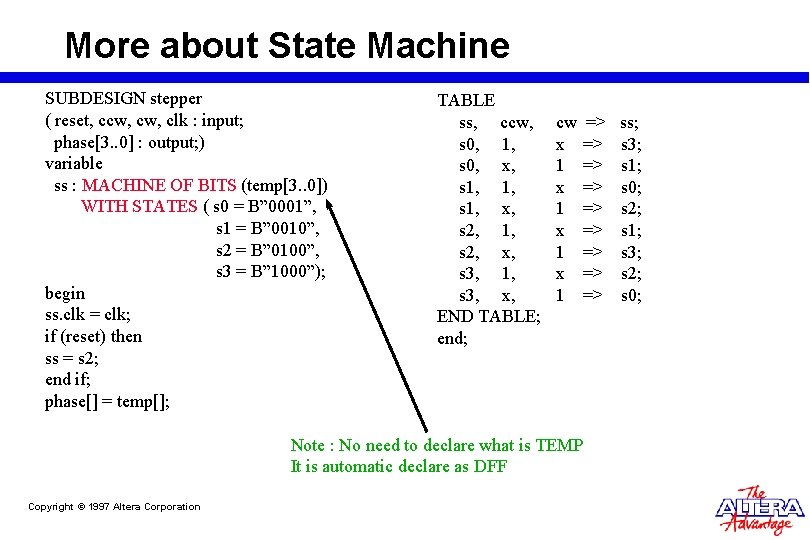
More about State Machine SUBDESIGN stepper ( reset, ccw, clk : input; phase[3. . 0] : output; ) variable ss : MACHINE OF BITS (temp[3. . 0]) WITH STATES ( s 0 = B” 0001”, s 1 = B” 0010”, s 2 = B” 0100”, s 3 = B” 1000”); begin ss. clk = clk; if (reset) then ss = s 2; end if; phase[] = temp[]; TABLE ss, ccw, s 0, 1, s 0, x, s 1, 1, s 1, x, s 2, 1, s 2, x, s 3, 1, s 3, x, END TABLE; end; cw x 1 x 1 => => => Note : No need to declare what is TEMP It is automatic declare as DFF Copyright © 1997 Altera Corporation ss; s 3; s 1; s 0; s 2; s 1; s 3; s 2; s 0;
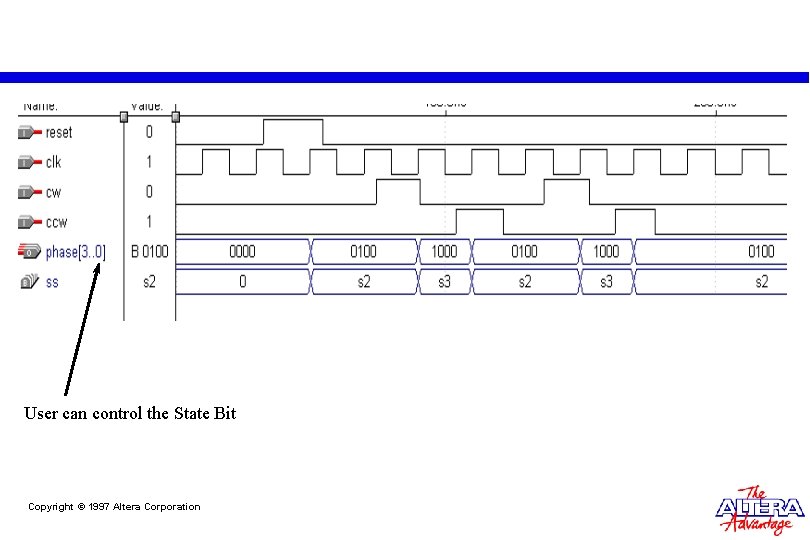
User can control the State Bit Copyright © 1997 Altera Corporation
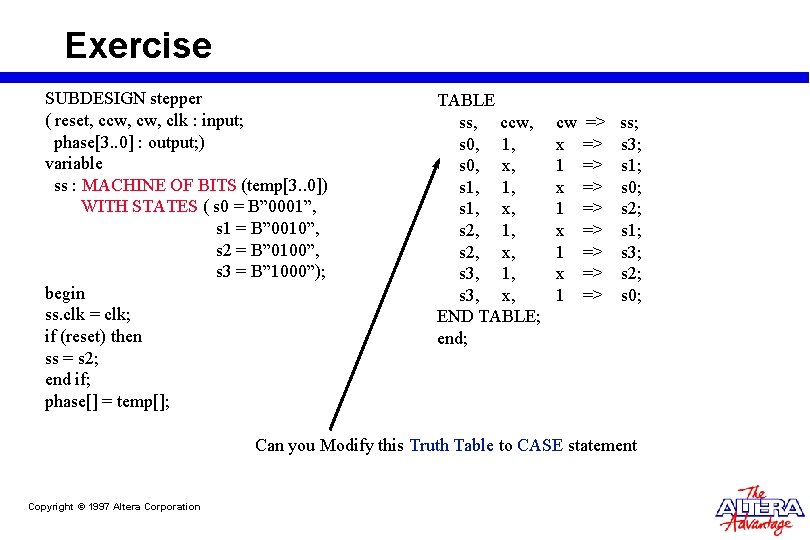
Exercise SUBDESIGN stepper ( reset, ccw, clk : input; phase[3. . 0] : output; ) variable ss : MACHINE OF BITS (temp[3. . 0]) WITH STATES ( s 0 = B” 0001”, s 1 = B” 0010”, s 2 = B” 0100”, s 3 = B” 1000”); begin ss. clk = clk; if (reset) then ss = s 2; end if; phase[] = temp[]; TABLE ss, ccw, s 0, 1, s 0, x, s 1, 1, s 1, x, s 2, 1, s 2, x, s 3, 1, s 3, x, END TABLE; end; cw x 1 x 1 => => => ss; s 3; s 1; s 0; s 2; s 1; s 3; s 2; s 0; Can you Modify this Truth Table to CASE statement Copyright © 1997 Altera Corporation
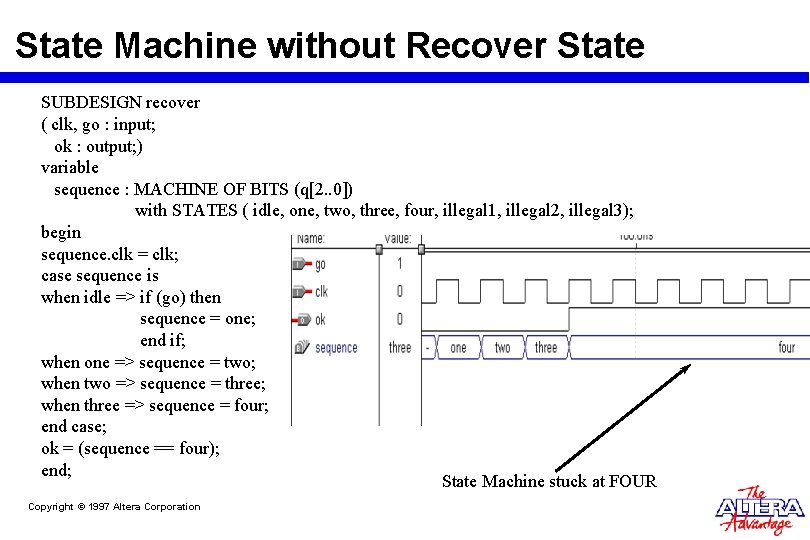
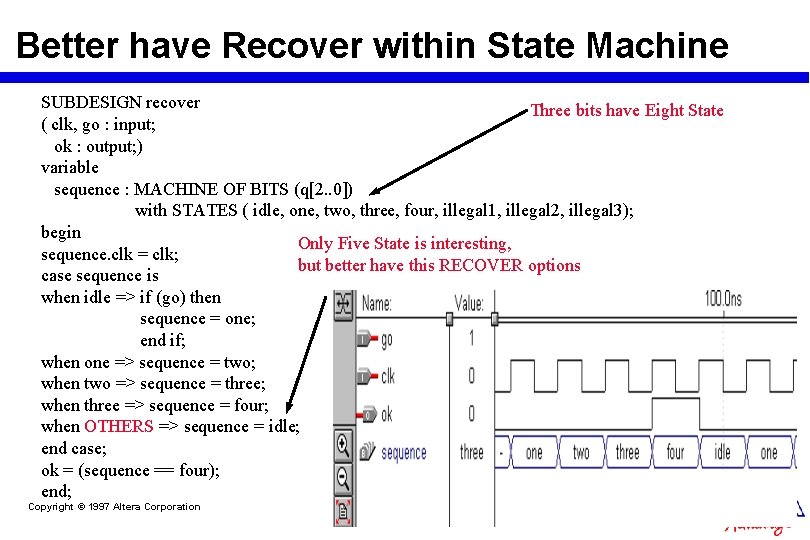
State Machine without Recover State SUBDESIGN recover ( clk, go : input; ok : output; ) variable sequence : MACHINE OF BITS (q[2. . 0]) with STATES ( idle, one, two, three, four, illegal 1, illegal 2, illegal 3); begin sequence. clk = clk; case sequence is when idle => if (go) then sequence = one; end if; when one => sequence = two; when two => sequence = three; when three => sequence = four; end case; ok = (sequence == four); end; State Machine stuck at FOUR Copyright © 1997 Altera Corporation
Better have Recover within State Machine SUBDESIGN recover Three bits have Eight State ( clk, go : input; ok : output; ) variable sequence : MACHINE OF BITS (q[2. . 0]) with STATES ( idle, one, two, three, four, illegal 1, illegal 2, illegal 3); begin Only Five State is interesting, sequence. clk = clk; but better have this RECOVER options case sequence is when idle => if (go) then sequence = one; end if; when one => sequence = two; when two => sequence = three; when three => sequence = four; when OTHERS => sequence = idle; end case; ok = (sequence == four); end; Copyright © 1997 Altera Corporation
Conclusion n When the gate count and design getting for complex – AHDL – VHDL/Verilog n When the design target for high speed and optimize – mixture of AHDL/Graphic/VHDL or Verilog n Engineers is more talent than software Copyright © 1997 Altera Corporation 11/30/2020 P. 51