
AHA QCOR in CVD and Stroke 2010 Controversies

- Slides: 57
AHA QCOR in CVD and Stroke 2010: Controversies in Atrial Fibrillation “Introduction: Contemporary Epidemiology of AF, Stroke Rates, and the Effectiveness of Warfarin” Daniel E. Singer, MD
Presenter Disclosure Information Daniel E. Singer, MD “Introduction: Contemporary Epidemiology of AF, Stroke Rates, and the Effectiveness of Warfarin” FINANCIAL DISCLOSURE: Research Grant: Daiichi Sankyo, significant. Consultant/Advisory Board: Boehringer Ingelheim, significant; Daiichi Sankyo, significant; Johnson and Johnson, modest; Medtronic, significant; Merck and Co. , modest; Sanofi Aventis, modest; St. Jude Medical, modest. Honorarium/Symposium Presentation: Bristol-Myers Squibb, Pfizer, modest. Executive Committee: ROCKET-AF trial of rivaroxaban in AF. UNLABELED/UNAPPROVED USES DISCLOSURE: None
AF: The importance of Stroke AF can cause distressing symptoms and inefficient cardiac function which lead to increased rates of hospitalization. It has been associated with higher mortality rates. But the most important complication of AF is ischemic stroke.
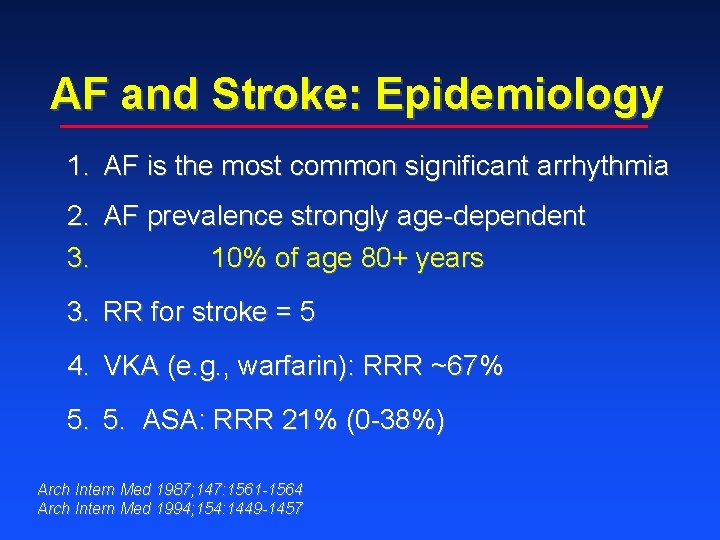
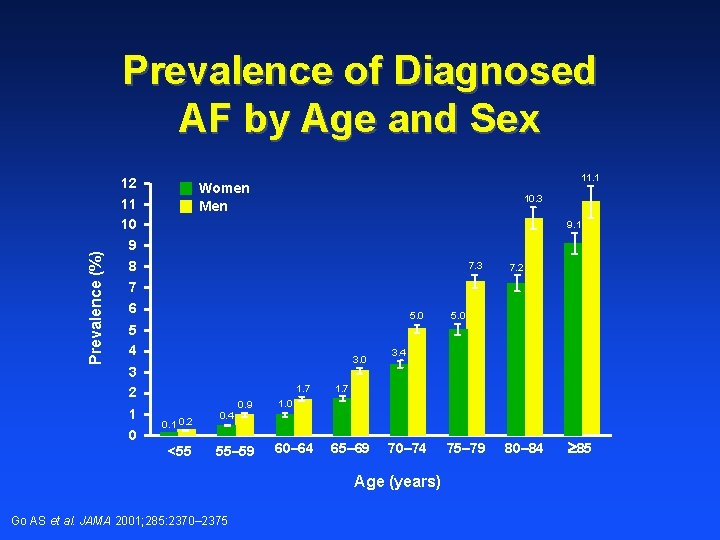
AF and Stroke: Epidemiology 1. AF is the most common significant arrhythmia 2. AF prevalence strongly age-dependent 3. 10% of age 80+ years 3. RR for stroke = 5 4. VKA (e. g. , warfarin): RRR ~67% 5. 5. ASA: RRR 21% (0 -38%) Arch Intern Med 1987; 147: 1561 -1564 Arch Intern Med 1994; 154: 1449 -1457
Prevalence of Diagnosed AF by Age and Sex Prevalence (%) 12 11 10 11. 1 Women Men 10. 3 9. 1 9 8 7 6 7. 3 5. 0 5 4 3. 0 3 2 1 0 1. 7 0. 9 0. 1 0. 2 <55 7. 2 5. 0 3. 4 1. 7 1. 0 0. 4 55– 59 60– 64 65– 69 70– 74 Age (years) Go AS et al. JAMA 2001; 285: 2370– 2375 75– 79 80– 84 85
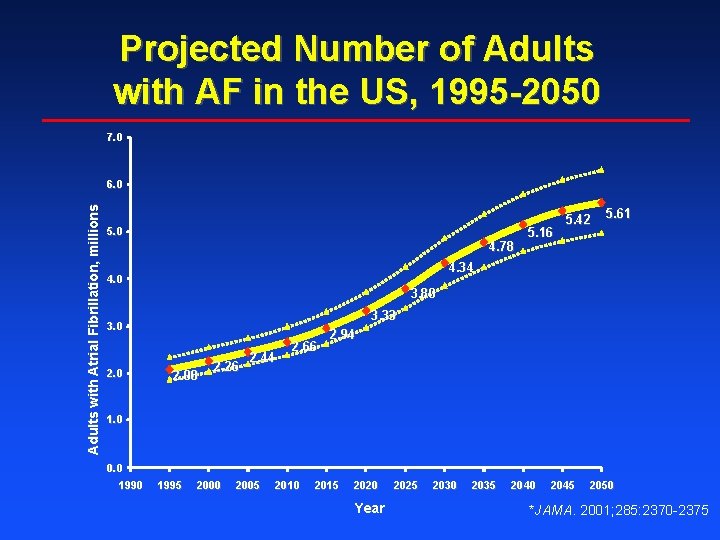
Projected Number of Adults with AF in the US, 1995 -2050 7. 0 Adults with Atrial Fibrillation, millions 6. 0 5. 0 4. 78 5. 16 5. 42 5. 61 4. 34 4. 0 3. 80 3. 33 3. 0 2. 08 2. 26 2. 44 2. 66 2. 94 1. 0 0. 0 1995 2000 2005 2010 2015 2020 Year 2025 2030 2035 2040 2045 2050 *JAMA. 2001; 285: 2370 -2375
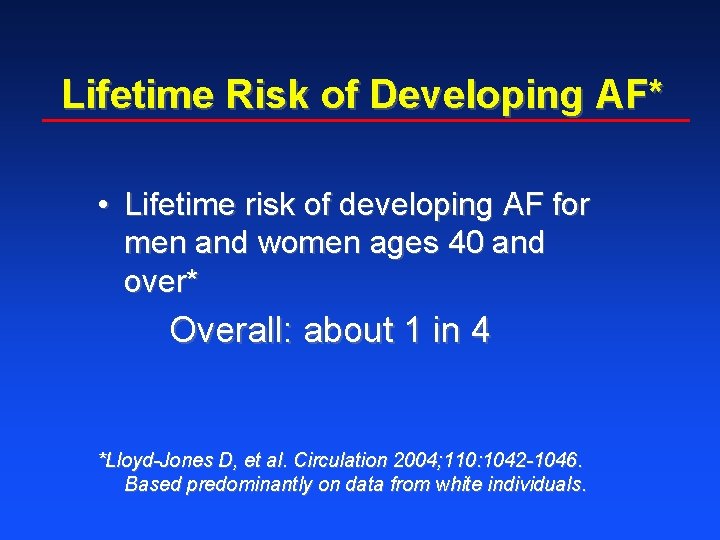
Lifetime Risk of Developing AF* • Lifetime risk of developing AF for men and women ages 40 and over* Overall: about 1 in 4 *Lloyd-Jones D, et al. Circulation 2004; 110: 1042 -1046. Based predominantly on data from white individuals.
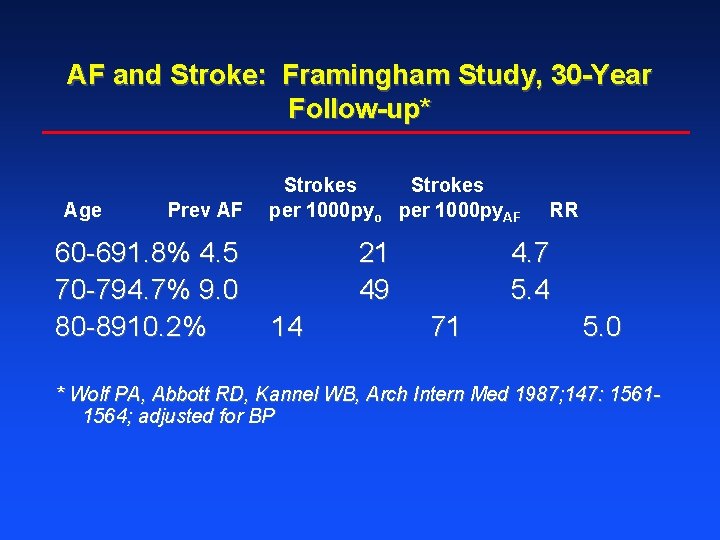
AF and Stroke: Framingham Study, 30 -Year Follow-up* Age Prev AF 60 -691. 8% 4. 5 70 -794. 7% 9. 0 80 -8910. 2% Strokes per 1000 pyo per 1000 py. AF 21 49 14 RR 4. 7 5. 4 71 5. 0 * Wolf PA, Abbott RD, Kannel WB, Arch Intern Med 1987; 147: 15611564; adjusted for BP
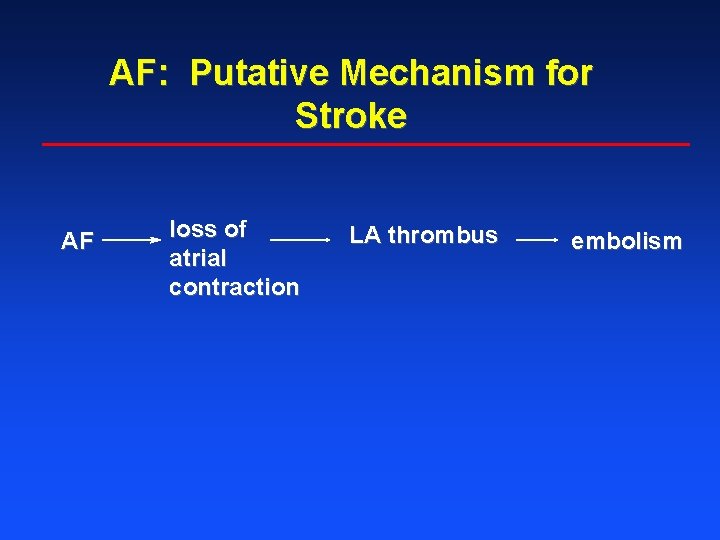
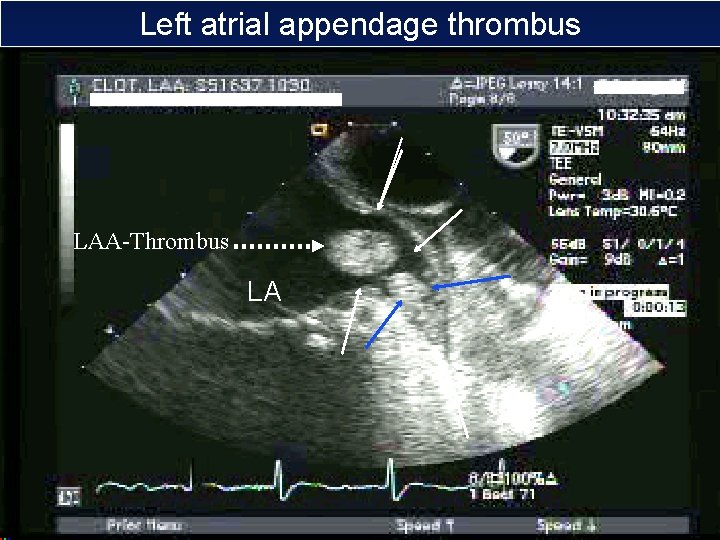
AF: Putative Mechanism for Stroke AF loss of atrial contraction LA thrombus embolism
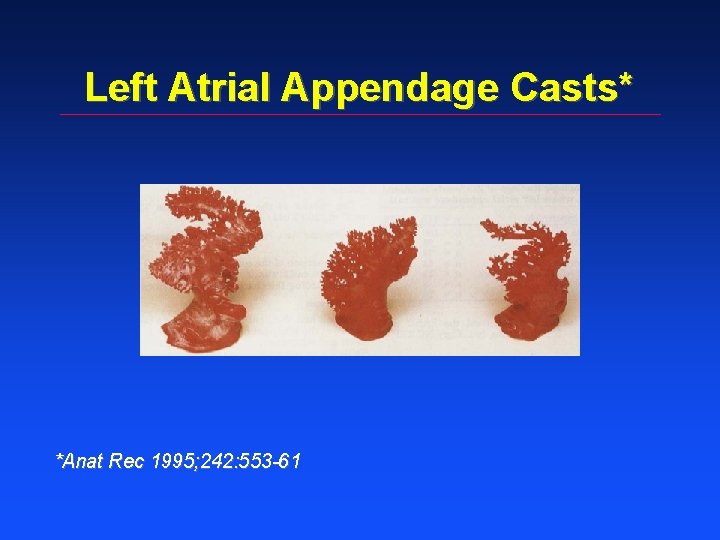
Left atrial appendage thrombus LAA-Thrombus LA
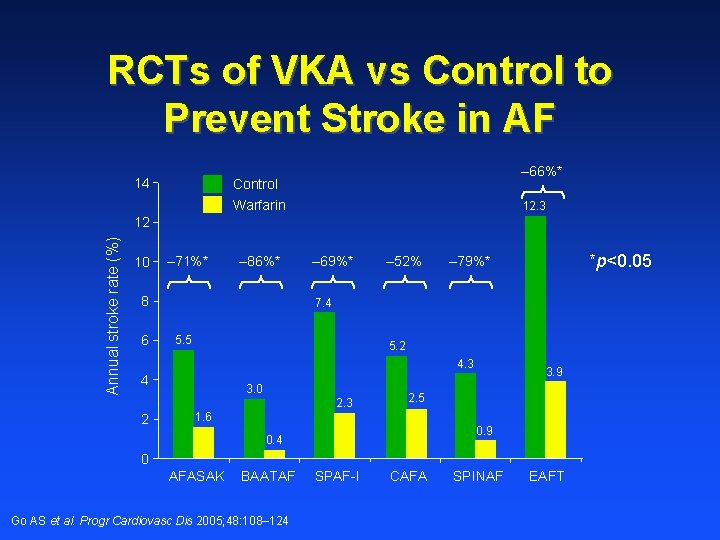
RCTs of VKA vs Control to Prevent Stroke in AF 14 – 66%* Control Warfarin 12. 3 Annual stroke rate (%) 12 10 – 71%* – 86%* 8 6 – 69%* – 52% 7. 4 5. 5 5. 2 4. 3 4 3. 0 2. 3 2 *p<0. 05 – 79%* 3. 9 2. 5 1. 6 0. 9 0. 4 0 AFASAK BAATAF Go AS et al. Progr Cardiovasc Dis 2005; 48: 108– 124 SPAF-I CAFA SPINAF EAFT
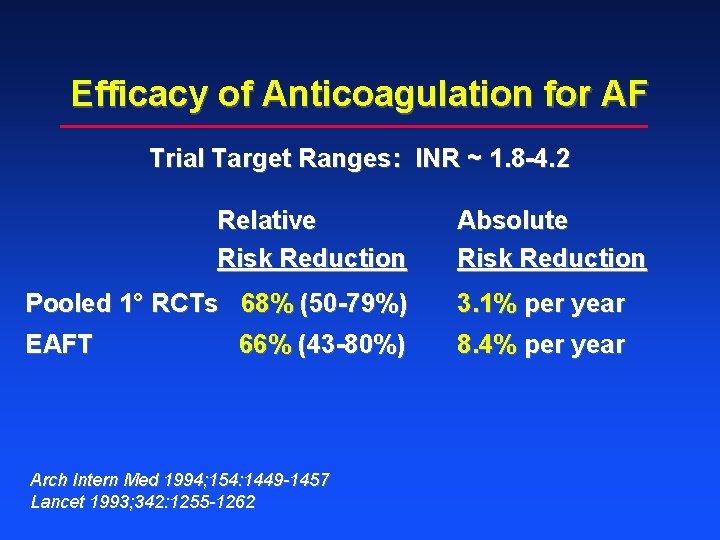
Efficacy of Anticoagulation for AF Trial Target Ranges: INR ~ 1. 8 -4. 2 Relative Risk Reduction Absolute Risk Reduction Pooled 1° RCTs 68% (50 -79%) 3. 1% per year EAFT 8. 4% per year 66% (43 -80%) Arch Intern Med 1994; 154: 1449 -1457 Lancet 1993; 342: 1255 -1262
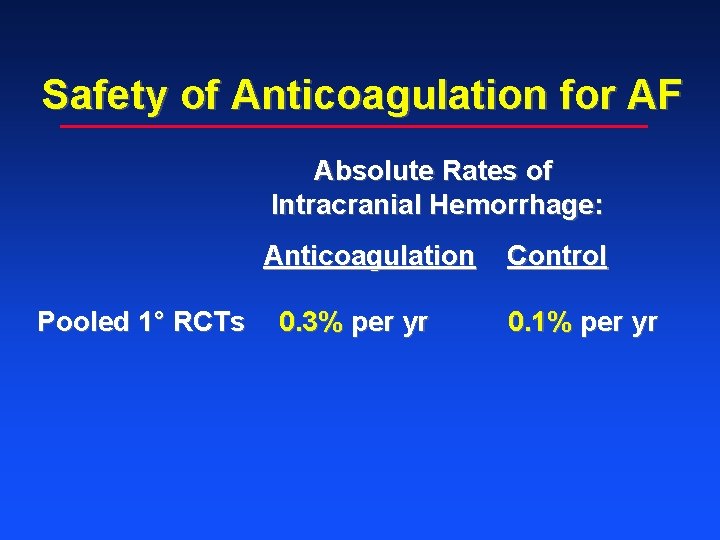
Safety of Anticoagulation for AF Absolute Rates of Intracranial Hemorrhage: Anticoagulation Pooled 1° RCTs 0. 3% per yr Control 0. 1% per yr
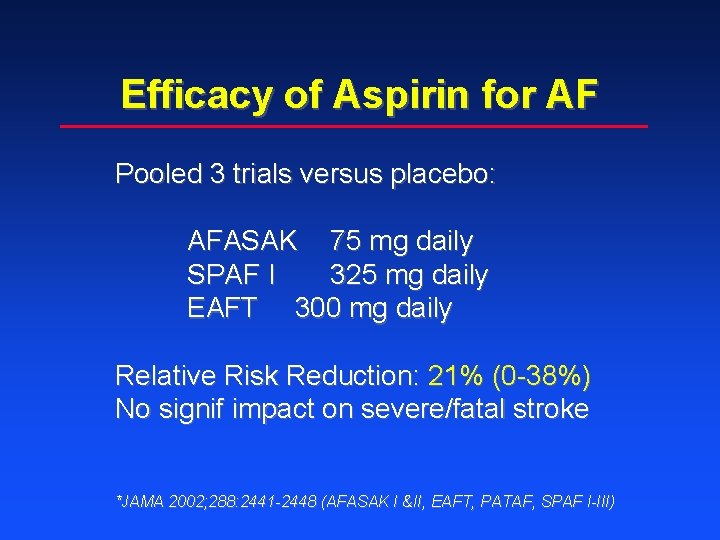
Efficacy of Aspirin for AF Pooled 3 trials versus placebo: AFASAK 75 mg daily SPAF I 325 mg daily EAFT 300 mg daily Relative Risk Reduction: 21% (0 -38%) No signif impact on severe/fatal stroke *JAMA 2002; 288: 2441 -2448 (AFASAK I &II, EAFT, PATAF, SPAF I-III)
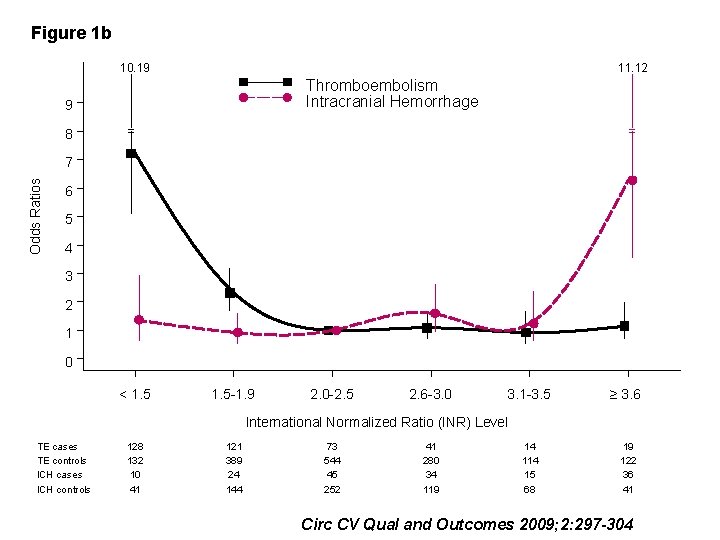
The Optimal INR For an anticoagulant where toxicity results from an exaggeration of the beneficial effect, choosing the right “dose, ” here INR, is crucial.
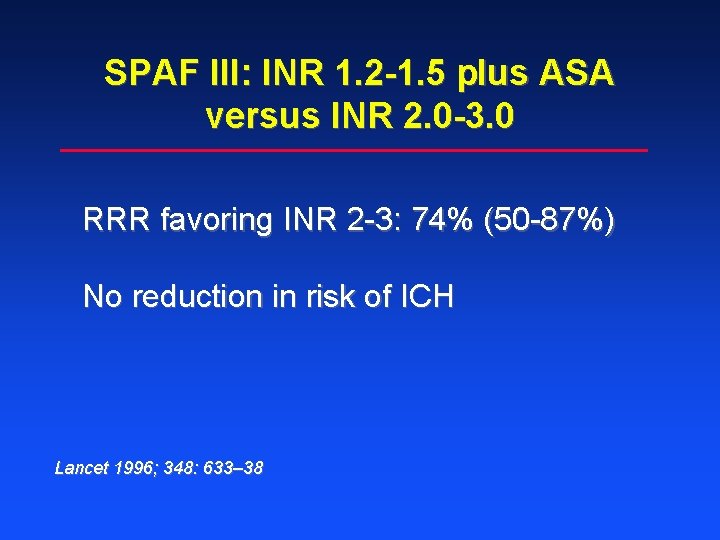
SPAF III: INR 1. 2 -1. 5 plus ASA versus INR 2. 0 -3. 0 RRR favoring INR 2 -3: 74% (50 -87%) No reduction in risk of ICH Lancet 1996; 348: 633– 38
Figure 1 b 10. 19 11. 12 Thromboembolism Intracranial Hemorrhage 9 8 = = Odds Ratios 7 6 5 4 3 2 1 0 < 1. 5 -1. 9 2. 0 -2. 5 2. 6 -3. 0 3. 1 -3. 5 ≥ 3. 6 International Normalized Ratio (INR) Level TE cases TE controls ICH cases ICH controls 128 132 10 41 121 389 24 144 73 544 45 252 41 280 34 119 14 15 68 19 122 36 41 Circ CV Qual and Outcomes 2009; 2: 297 -304
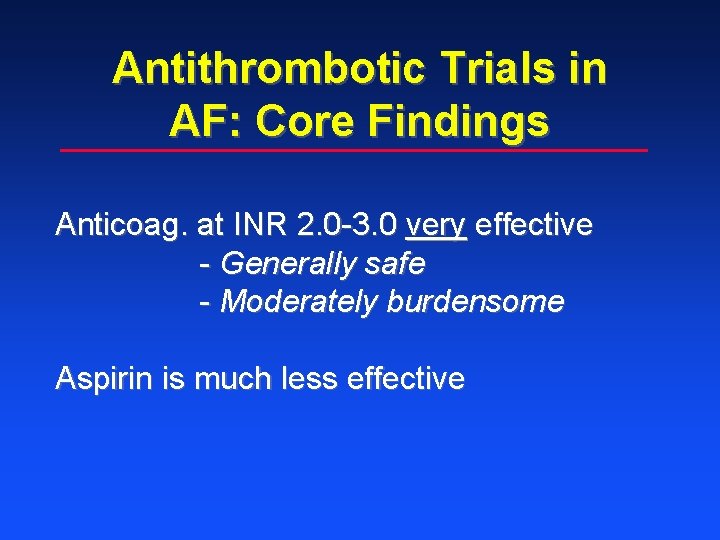
Antithrombotic Trials in AF: Core Findings Anticoag. at INR 2. 0 -3. 0 very effective - Generally safe - Moderately burdensome Aspirin is much less effective
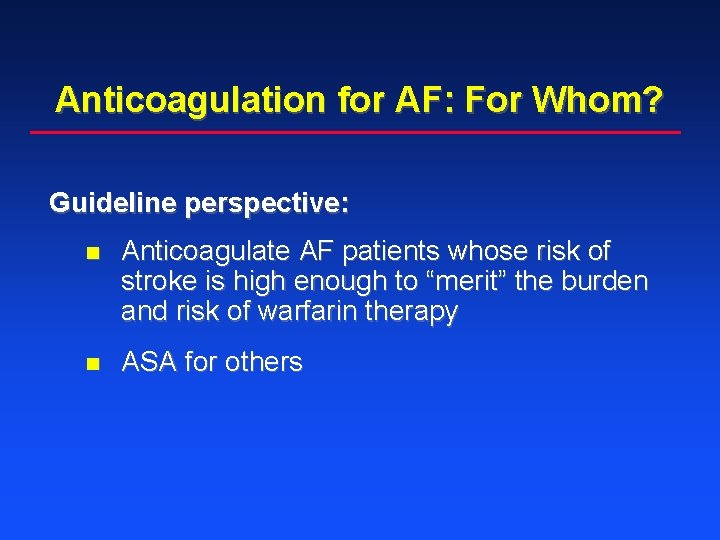
Anticoagulation for AF: For Whom? Guideline perspective: n Anticoagulate AF patients whose risk of stroke is high enough to “merit” the burden and risk of warfarin therapy n ASA for others
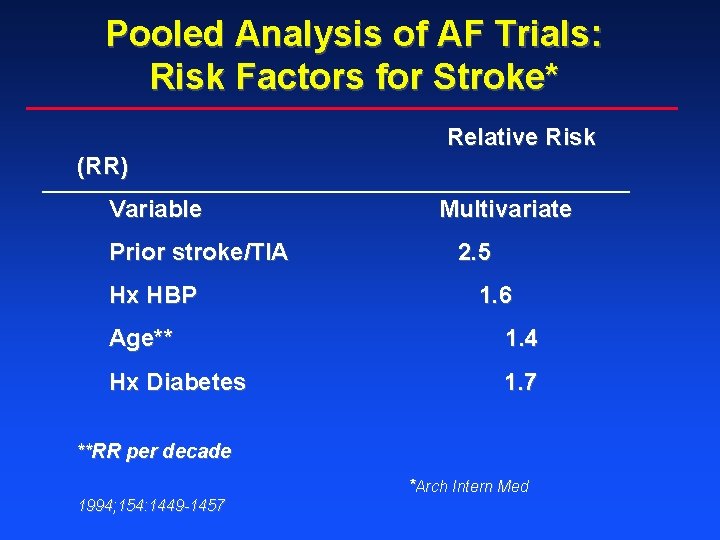
Pooled Analysis of AF Trials: Risk Factors for Stroke* Relative Risk (RR) Variable Prior stroke/TIA Hx HBP Multivariate 2. 5 1. 6 Age** 1. 4 Hx Diabetes 1. 7 **RR per decade *Arch Intern Med 1994; 154: 1449 -1457
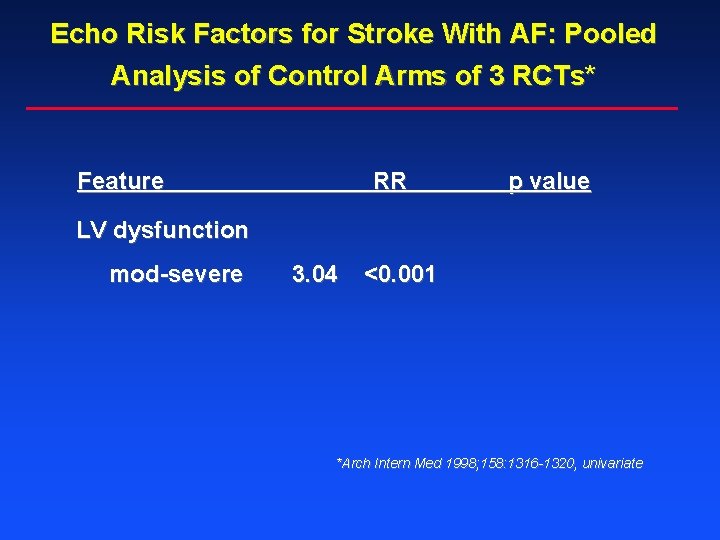
Echo Risk Factors for Stroke With AF: Pooled Analysis of Control Arms of 3 RCTs* Feature RR p value LV dysfunction mod-severe 3. 04 <0. 001 *Arch Intern Med 1998; 158: 1316 -1320, univariate
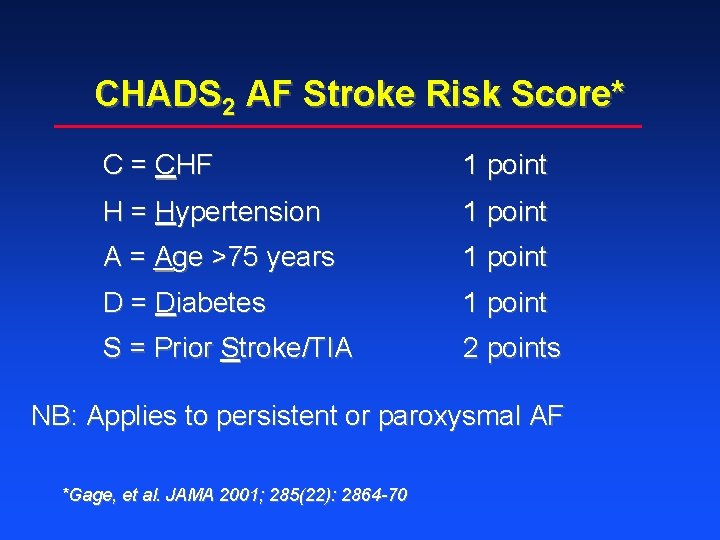
CHADS 2 AF Stroke Risk Score* C = CHF 1 point H = Hypertension 1 point A = Age >75 years 1 point D = Diabetes 1 point S = Prior Stroke/TIA 2 points NB: Applies to persistent or paroxysmal AF *Gage, et al. JAMA 2001; 285(22): 2864 -70
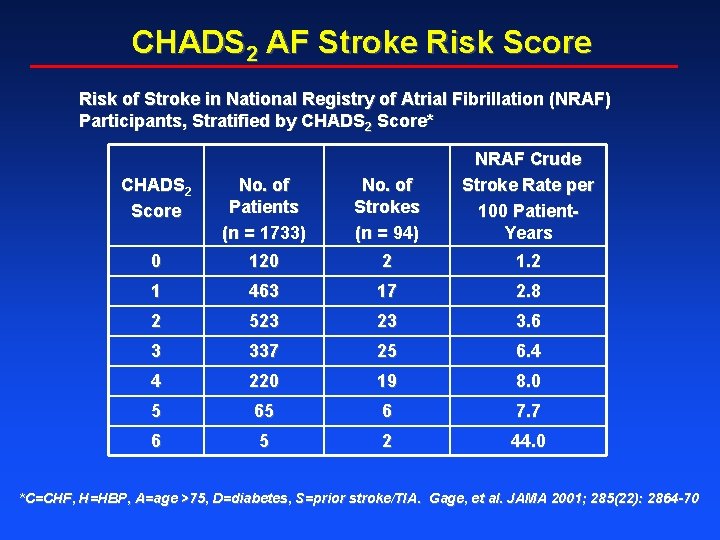
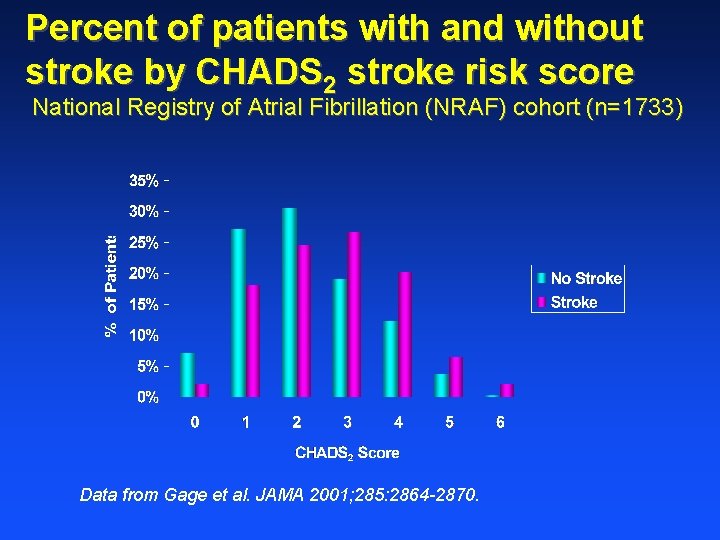
CHADS 2 AF Stroke Risk Score Risk of Stroke in National Registry of Atrial Fibrillation (NRAF) Participants, Stratified by CHADS 2 Score* CHADS 2 Score No. of Patients (n = 1733) No. of Strokes (n = 94) NRAF Crude Stroke Rate per 100 Patient. Years 0 120 2 1 463 17 2. 8 2 523 23 3. 6 3 337 25 6. 4 4 220 19 8. 0 5 65 6 7. 7 6 5 2 44. 0 *C=CHF, H=HBP, A=age >75, D=diabetes, S=prior stroke/TIA. Gage, et al. JAMA 2001; 285(22): 2864 -70
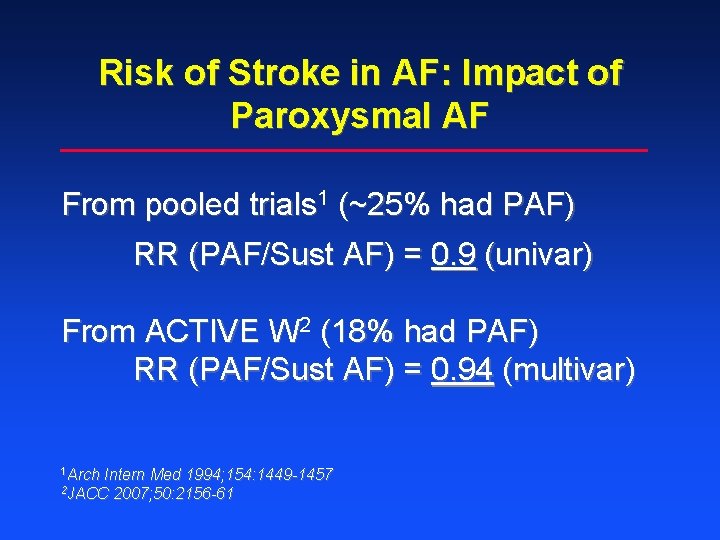
Risk of Stroke in AF: Impact of Paroxysmal AF From pooled trials 1 (~25% had PAF) RR (PAF/Sust AF) = 0. 9 (univar) From ACTIVE W 2 (18% had PAF) RR (PAF/Sust AF) = 0. 94 (multivar) 1 Arch Intern Med 1994; 154: 1449 -1457 2 JACC 2007; 50: 2156 -61
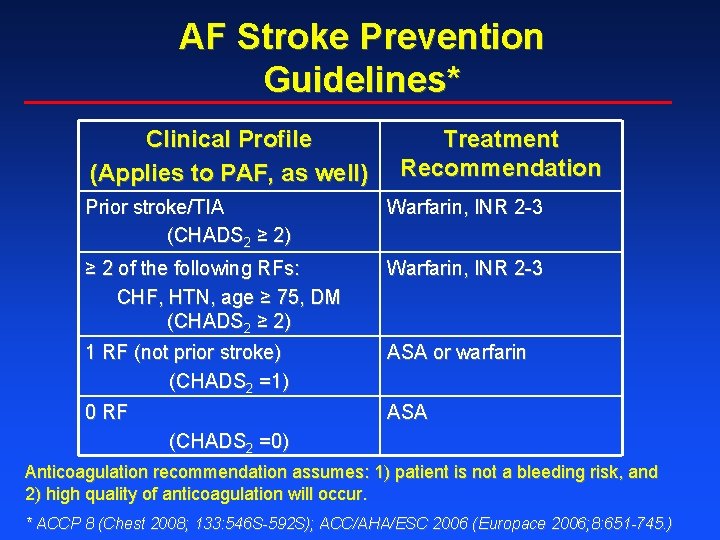
AF Stroke Prevention Guidelines* Clinical Profile (Applies to PAF, as well) Treatment Recommendation Prior stroke/TIA (CHADS 2 ≥ 2) Warfarin, INR 2 -3 ≥ 2 of the following RFs: CHF, HTN, age ≥ 75, DM (CHADS 2 ≥ 2) Warfarin, INR 2 -3 1 RF (not prior stroke) (CHADS 2 =1) ASA or warfarin 0 RF ASA (CHADS 2 =0) Anticoagulation recommendation assumes: 1) patient is not a bleeding risk, and 2) high quality of anticoagulation will occur. * ACCP 8 (Chest 2008; 133: 546 S-592 S); ACC/AHA/ESC 2006 (Europace 2006; 8: 651 -745. )
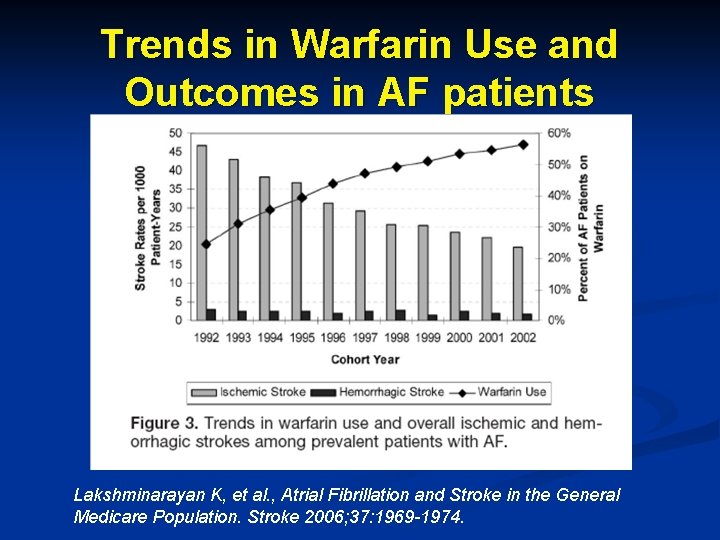
Trends in Warfarin Use and Outcomes in AF patients Lakshminarayan K, et al. , Atrial Fibrillation and Stroke in the General Medicare Population. Stroke 2006; 37: 1969 -1974.
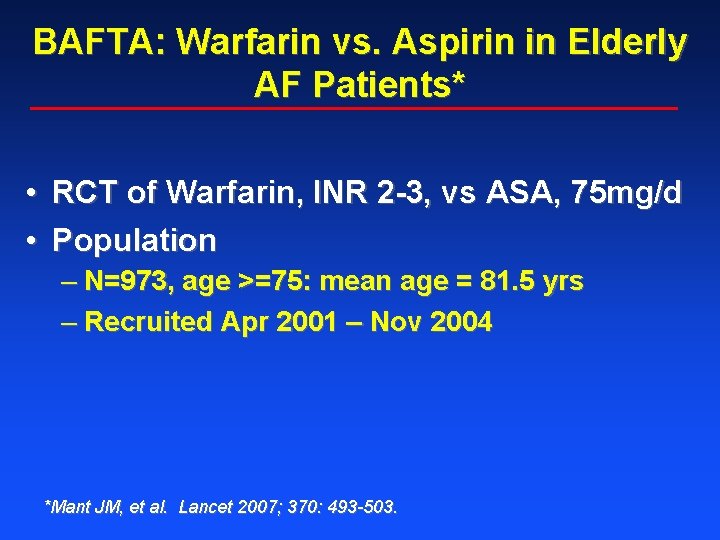
BAFTA: Warfarin vs. Aspirin in Elderly AF Patients* • RCT of Warfarin, INR 2 -3, vs ASA, 75 mg/d • Population – N=973, age >=75: mean age = 81. 5 yrs – Recruited Apr 2001 – Nov 2004 *Mant JM, et al. Lancet 2007; 370: 493 -503.
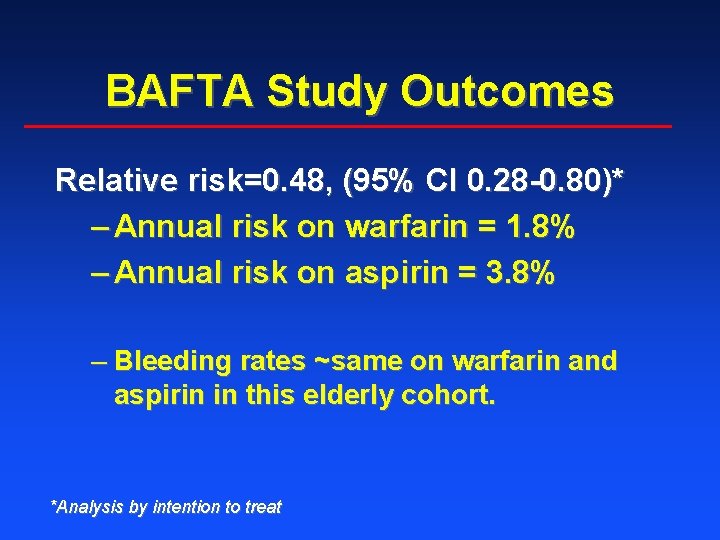
BAFTA Study Outcomes Relative risk=0. 48, (95% CI 0. 28 -0. 80)* – Annual risk on warfarin = 1. 8% – Annual risk on aspirin = 3. 8% – Bleeding rates ~same on warfarin and aspirin in this elderly cohort. *Analysis by intention to treat
Problem: The risk schemes are not very predictive.
Percent of patients with and without stroke by CHADS 2 stroke risk score National Registry of Atrial Fibrillation (NRAF) cohort (n=1733) Data from Gage et al. JAMA 2001; 285: 2864 -2870.
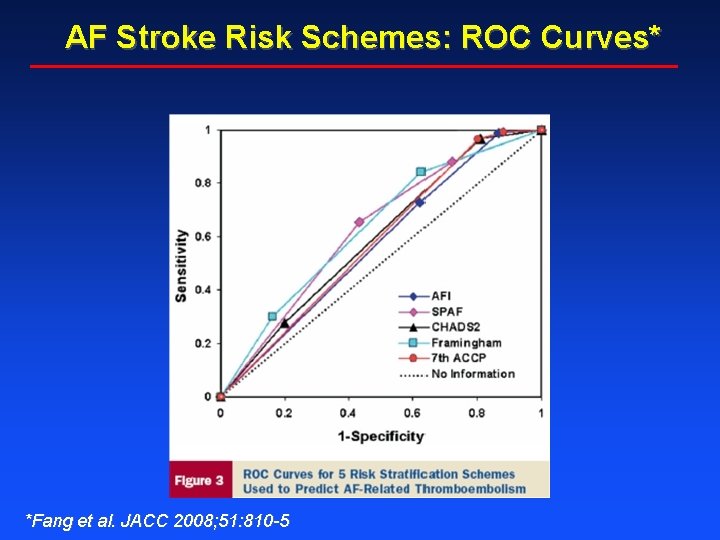
AF Stroke Risk Schemes: ROC Curves* *Fang et al. JACC 2008; 51: 810 -5
Problem (? ): Stroke rates in AF appear to be declining.
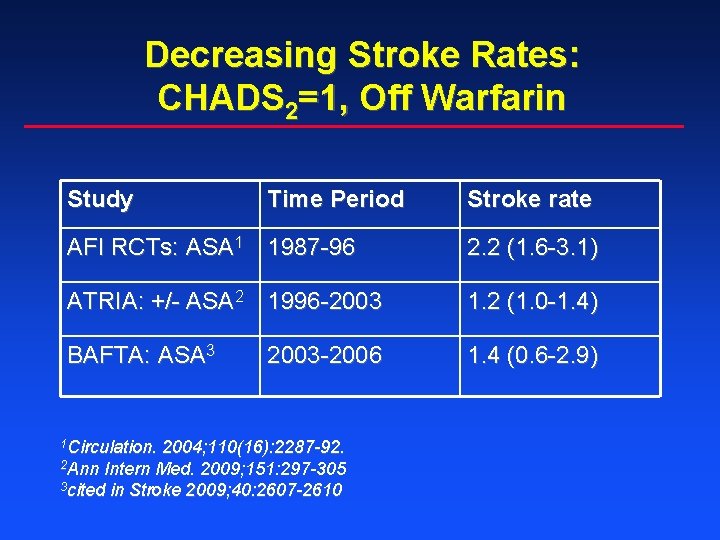
Decreasing Stroke Rates: CHADS 2=1, Off Warfarin Study Time Period Stroke rate AFI RCTs: ASA 1 1987 -96 2. 2 (1. 6 -3. 1) ATRIA: +/- ASA 2 1996 -2003 1. 2 (1. 0 -1. 4) BAFTA: ASA 3 1. 4 (0. 6 -2. 9) 1 Circulation. 2003 -2006 2004; 110(16): 2287 -92. 2 Ann Intern Med. 2009; 151: 297 -305 3 cited in Stroke 2009; 40: 2607 -2610
Anticoagulation for AF in the “Real World”
An. Ticoagulation and Risk Factors In Atrial Fibrillation (ATRIA) Study Massachusetts General Hospital Kaiser Permanente Division of Research
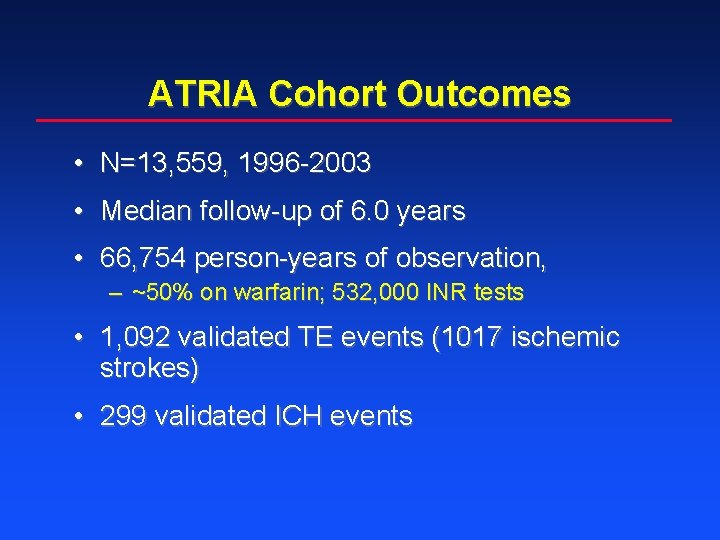
ATRIA Cohort Outcomes • N=13, 559, 1996 -2003 • Median follow-up of 6. 0 years • 66, 754 person-years of observation, – ~50% on warfarin; 532, 000 INR tests • 1, 092 validated TE events (1017 ischemic strokes) • 299 validated ICH events
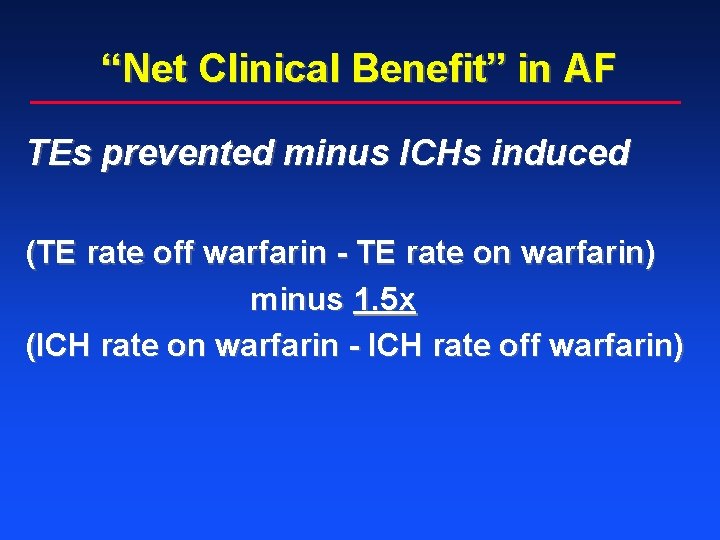
“Net Clinical Benefit” in AF TEs prevented minus ICHs induced (TE rate off warfarin - TE rate on warfarin) minus 1. 5 x (ICH rate on warfarin - ICH rate off warfarin)
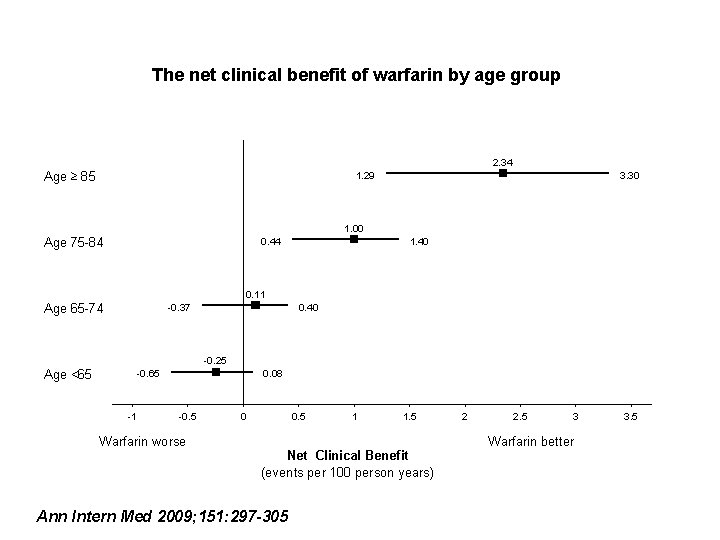
The net clinical benefit of warfarin by age group 2. 34 Age ≥ 85 1. 29 3. 30 1. 00 Age 75 -84 0. 44 1. 40 0. 11 Age 65 -74 -0. 37 0. 40 -0. 25 Age <65 -0. 65 -1 0. 08 -0. 5 0 0. 5 1 1. 5 Warfarin worse 2 2. 5 3 Warfarin better Net Clinical Benefit (events per 100 person years) Ann Intern Med 2009; 151: 297 -305 3. 5
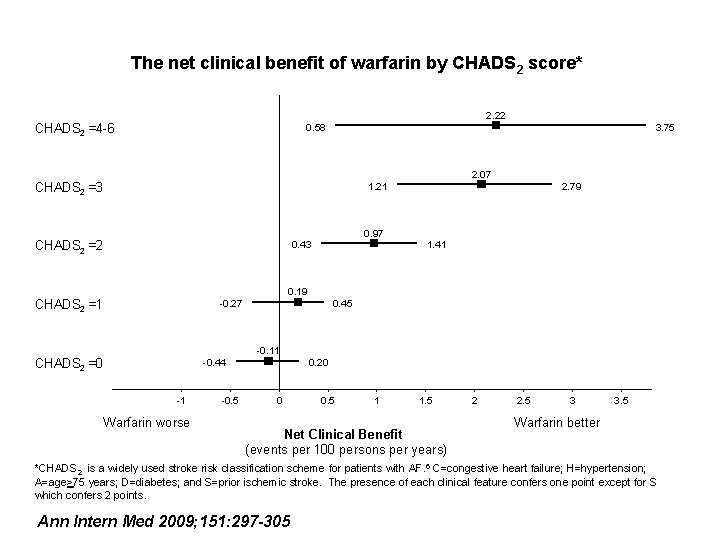
The net clinical benefit of warfarin by CHADS 2 score* 2. 22 CHADS 2 =4 -6 0. 58 3. 75 2. 07 CHADS 2 =3 1. 21 2. 79 0. 97 CHADS 2 =2 0. 43 1. 41 0. 19 CHADS 2 =1 -0. 27 0. 45 -0. 11 CHADS 2 =0 -0. 44 -1 Warfarin worse -0. 5 0. 20 0 0. 5 1 1. 5 Net Clinical Benefit (events per 100 persons per years) 2 2. 5 3 3. 5 Warfarin better *CHADS 2 is a widely used stroke risk classification scheme for patients with AF. 6 C=congestive heart failure; H=hypertension; A=age>75 years; D=diabetes; and S=prior ischemic stroke. The presence of each clinical feature confers one point except for S which confers 2 points. Ann Intern Med 2009; 151: 297 -305
The Importance of “TTR” in Achieving the Net Benefit of Warfarin in AF
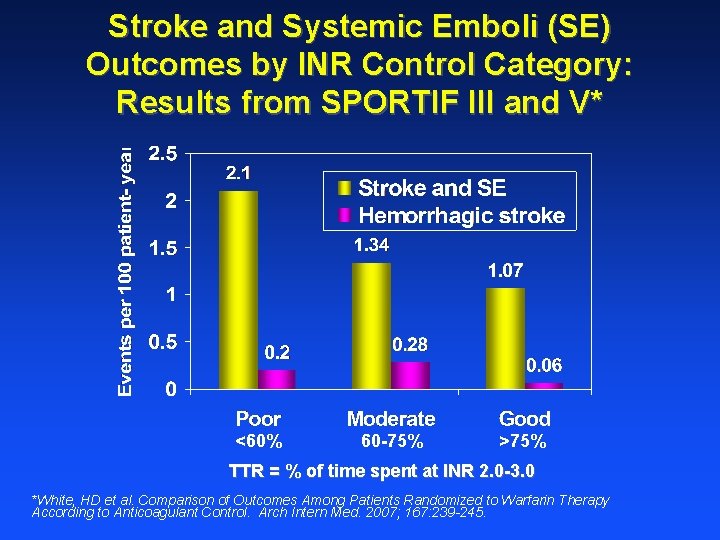
Stroke and Systemic Emboli (SE) Outcomes by INR Control Category: Results from SPORTIF III and V* <60% 60 -75% >75% TTR = % of time spent at INR 2. 0 -3. 0 *White, HD et al. Comparison of Outcomes Among Patients Randomized to Warfarin Therapy According to Anticoagulant Control. Arch Intern Med. 2007; 167: 239 -245.
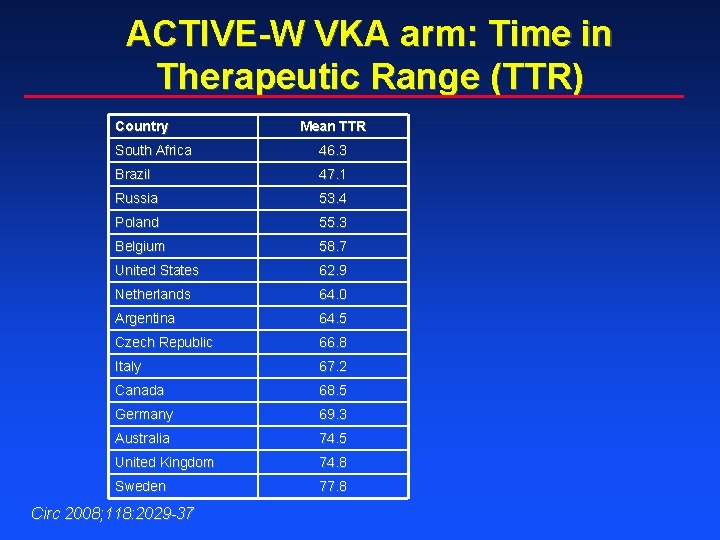
ACTIVE-W VKA arm: Time in Therapeutic Range (TTR) Country Mean TTR South Africa 46. 3 Brazil 47. 1 Russia 53. 4 Poland 55. 3 Belgium 58. 7 United States 62. 9 Netherlands 64. 0 Argentina 64. 5 Czech Republic 66. 8 Italy 67. 2 Canada 68. 5 Germany 69. 3 Australia 74. 5 United Kingdom 74. 8 Sweden 77. 8 Circ 2008; 118: 2029 -37
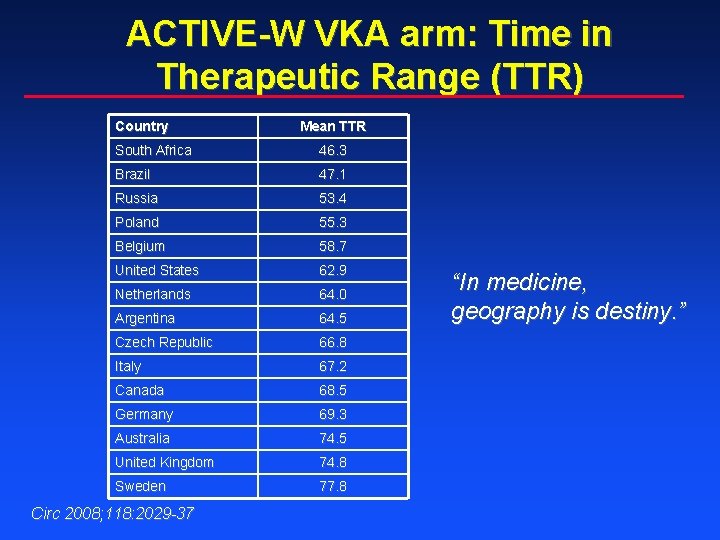
ACTIVE-W VKA arm: Time in Therapeutic Range (TTR) Country Mean TTR South Africa 46. 3 Brazil 47. 1 Russia 53. 4 Poland 55. 3 Belgium 58. 7 United States 62. 9 Netherlands 64. 0 Argentina 64. 5 Czech Republic 66. 8 Italy 67. 2 Canada 68. 5 Germany 69. 3 Australia 74. 5 United Kingdom 74. 8 Sweden 77. 8 Circ 2008; 118: 2029 -37 “In medicine, geography is destiny. ”
The Importance of “TTR” in Achieving the Net Benefit of Warfarin in AF “Do the right thing” “Do the right thing right”
Problems with Warfarin • Much inter- and intra-individual variation in dosing: Monitoring is crucial (17 INRs/yr) • Drug and diet interactions • ~4 day lag in effect, both on and off • Much physician and patient burden; significant discontinuation rates
Response of Industry Increasing prevalence of AF and dissatisfaction with warfarin have prompted extraordinary investment in novel anticoagulants, primarily Xa -I and DTIs. • Multiple non-inferiority megatrials • ~40, 000+ AF patients in RCTs
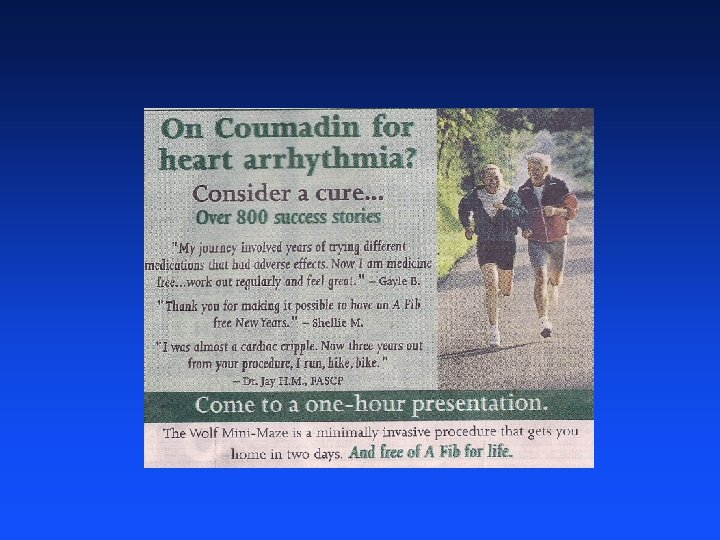
Stroke Prevention in AF: The Future 1. Optimizing warfarin 2. 2. Replacing warfarin – “Breaking the warfarin barrier” 3. True cure for AF: • initiator: ablation/isolation of PV • substrate: “maze” procedure
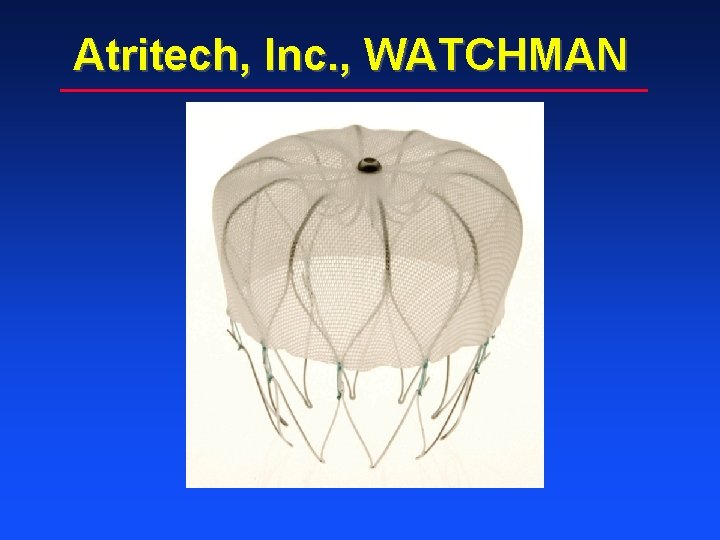
Stroke Prevention in AF: The Future 4. “Rx” of LAA: surgery, Watchman catheter approach 5. **Better risk stratification: stroke, ICH**
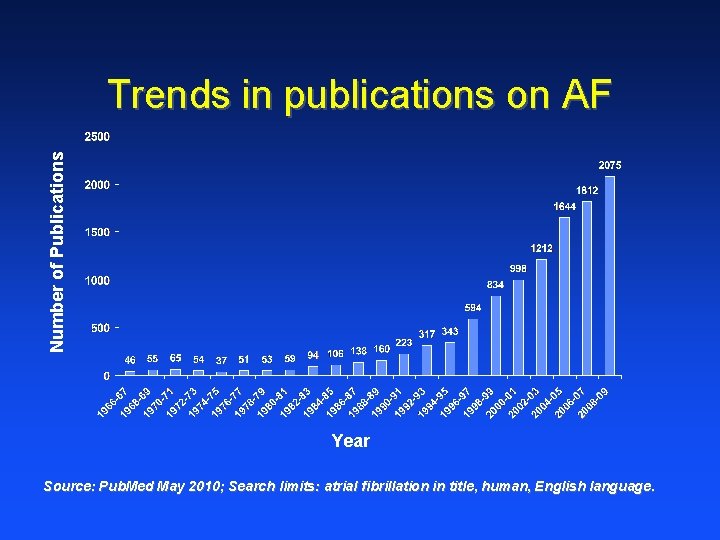
Number of Publications Trends in publications on AF Year Source: Pub. Med May 2010; Search limits: atrial fibrillation in title, human, English language.
END
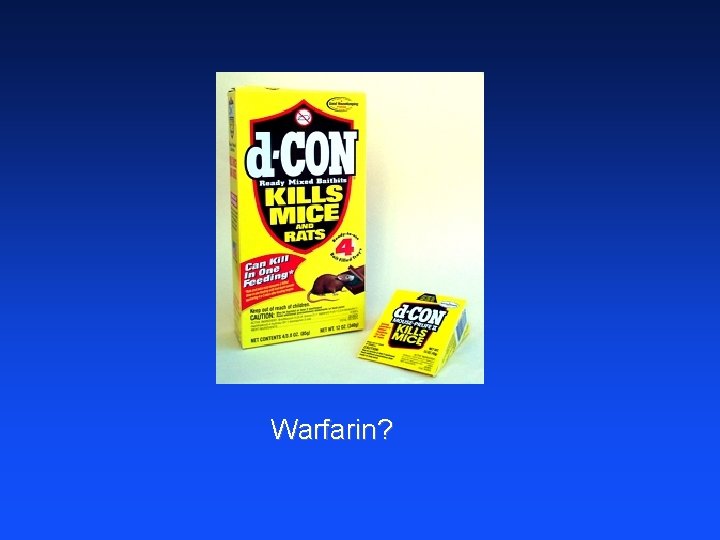
Warfarin?
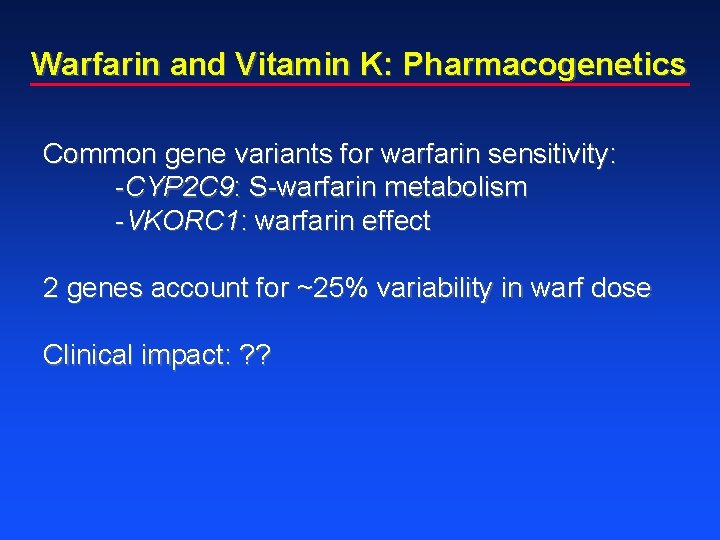
Warfarin and Vitamin K: Pharmacogenetics Common gene variants for warfarin sensitivity: -CYP 2 C 9: S-warfarin metabolism -VKORC 1: warfarin effect 2 genes account for ~25% variability in warf dose Clinical impact: ? ?
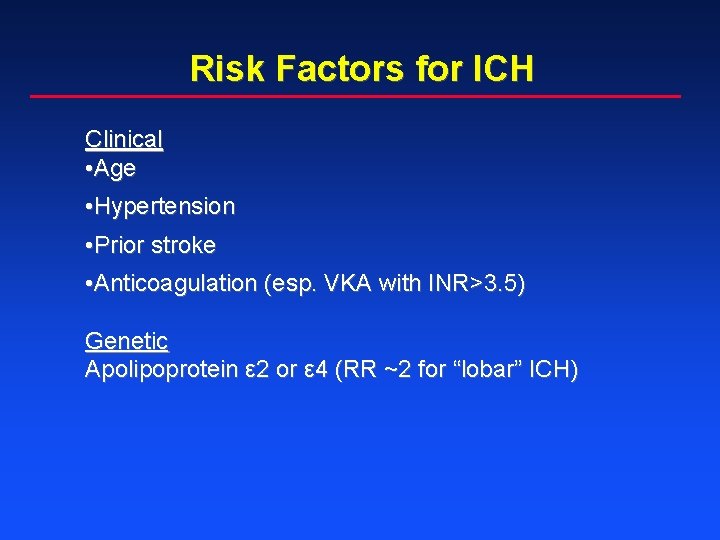
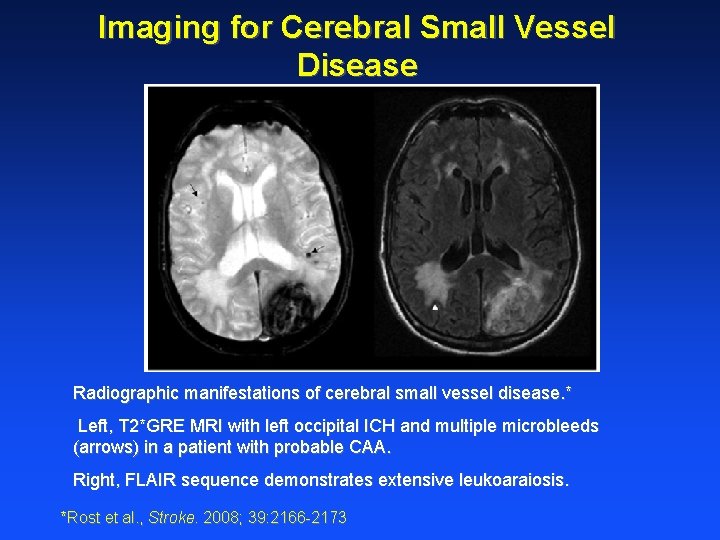
Risk Factors for ICH Clinical • Age • Hypertension • Prior stroke • Anticoagulation (esp. VKA with INR>3. 5) Genetic Apolipoprotein ε 2 or ε 4 (RR ~2 for “lobar” ICH)
Imaging for Cerebral Small Vessel Disease Radiographic manifestations of cerebral small vessel disease. * Left, T 2*GRE MRI with left occipital ICH and multiple microbleeds (arrows) in a patient with probable CAA. Right, FLAIR sequence demonstrates extensive leukoaraiosis. *Rost et al. , Stroke. 2008; 39: 2166 -2173
Atritech, Inc. , WATCHMAN
Left Atrial Appendage Casts* *Anat Rec 1995; 242: 553 -61