
AH Biology Unit 1 Protein Structure Think What
AH Biology: Unit 1 Protein Structure
Think • What are the functions of protein in a cell? • Why is protein structure important? • Why do organisms usually live within a narrow range of temperature and p. H? • If eukaryotic cells are identical in structure relative to their cellular components why do organisms look different? • How can a gecko stick to Perspex? • How do multicellular organisms stay together?
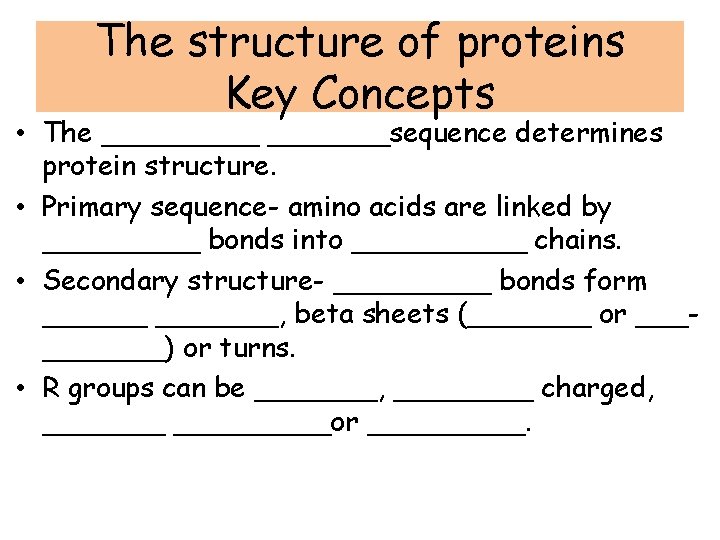
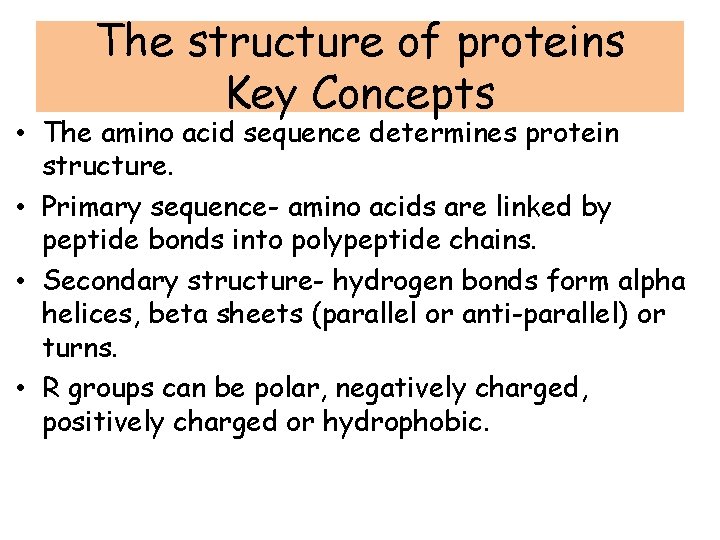
The structure of proteins LOs • The amino acid sequence determines protein structure. • Primary sequence- amino acids are linked by peptide bonds into polypeptide chains. • Secondary structure- hydrogen bonds form alpha helices, beta sheets (parallel or anti-parallel) or turns. • R groups can be polar, negatively charged, positively charged or hydrophobic.
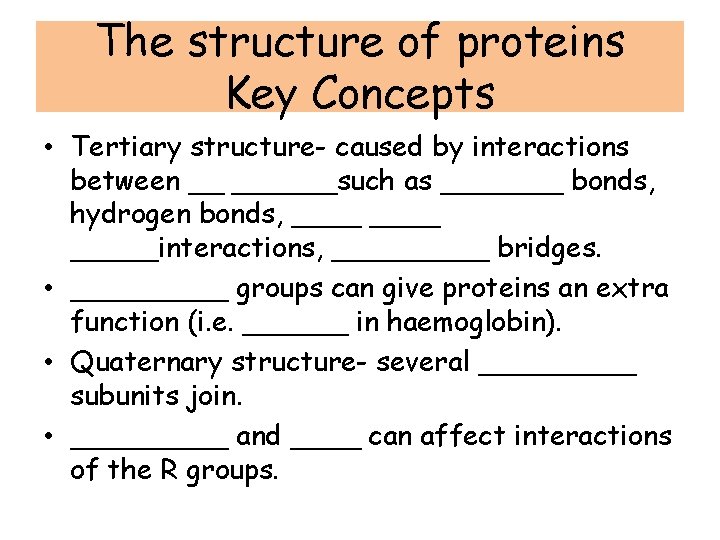
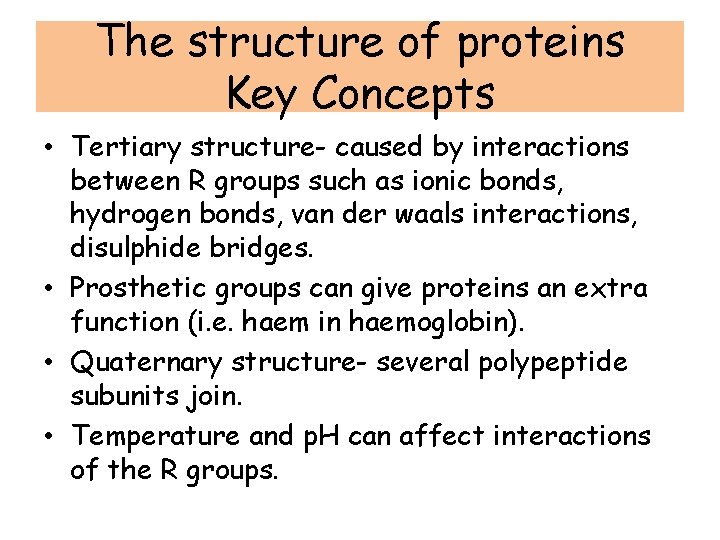
The structure of proteins Los • Tertiary structure- caused by interactions between R groups such as ionic bonds, hydrogen bonds, van der waals interactions, disulphide bridges. • Prosthetic groups can give proteins an extra function (i. e. haem in haemoglobin). • Quaternary structure- several polypeptide subunits join. • Temperature and p. H can affect interactions of the R groups.
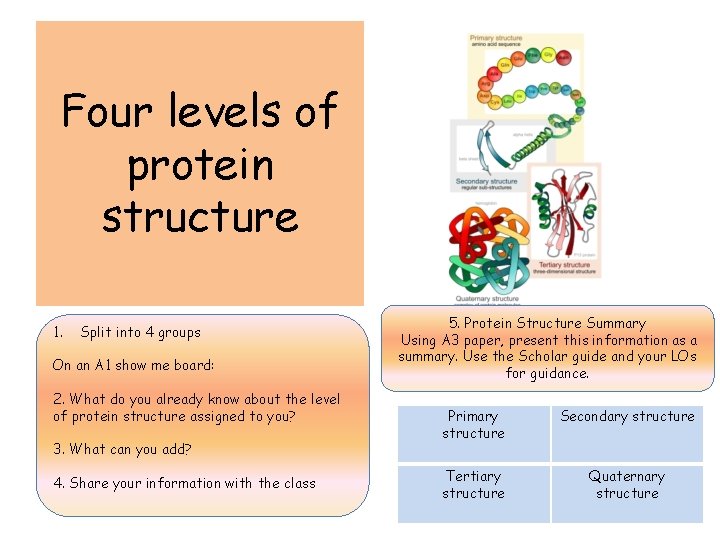
Four levels of protein structure 1. Split into 4 groups On an A 1 show me board: 2. What do you already know about the level of protein structure assigned to you? 3. What can you add? 4. Share your information with the class 5. Protein Structure Summary Using A 3 paper, present this information as a summary. Use the Scholar guide and your LOs for guidance. Primary structure Secondary structure Tertiary structure Quaternary structure
Primary protein structure • Proteins are polymers of amino acid monomers. A monomer is the simplest unit of a polymer. There are 20 amino acids in total. • The primary sequence of a protein is the order in which the amino acids are synthesised by translation into the polypeptide.
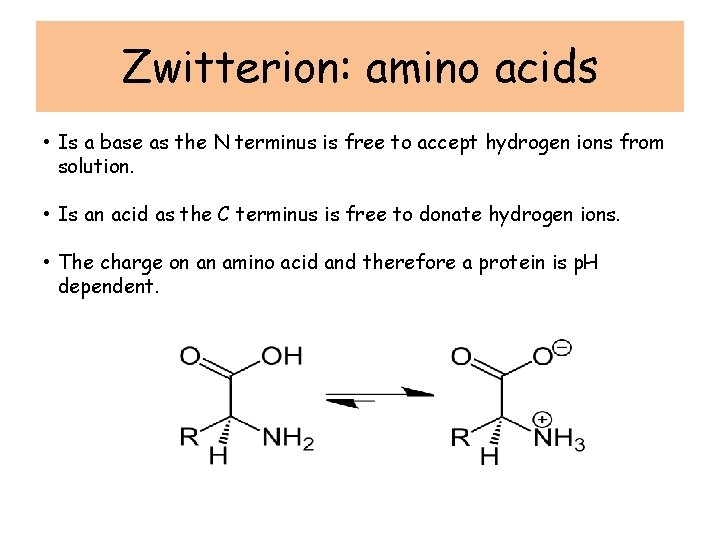
Zwitterion: amino acids • Is a base as the N terminus is free to accept hydrogen ions from solution. • Is an acid as the C terminus is free to donate hydrogen ions. • The charge on an amino acid and therefore a protein is p. H dependent.
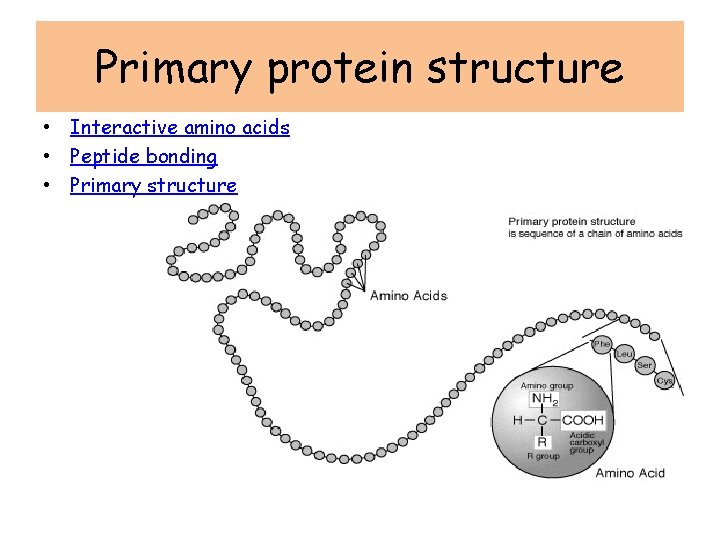
Primary protein structure • Interactive amino acids • Peptide bonding • Primary structure
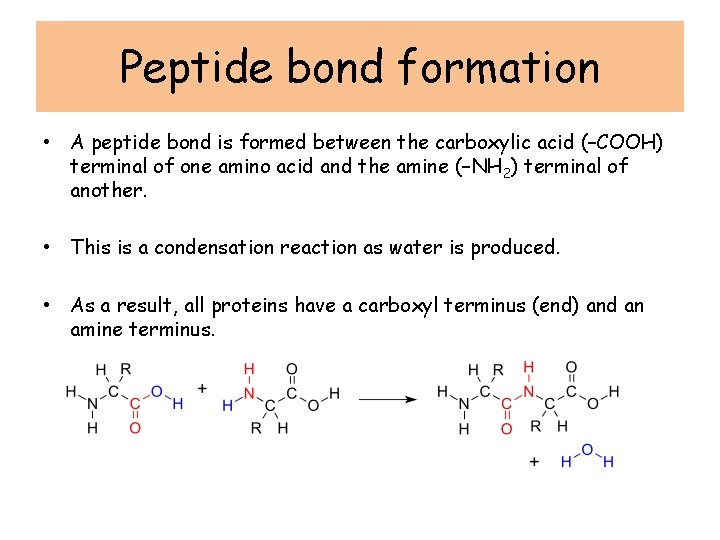
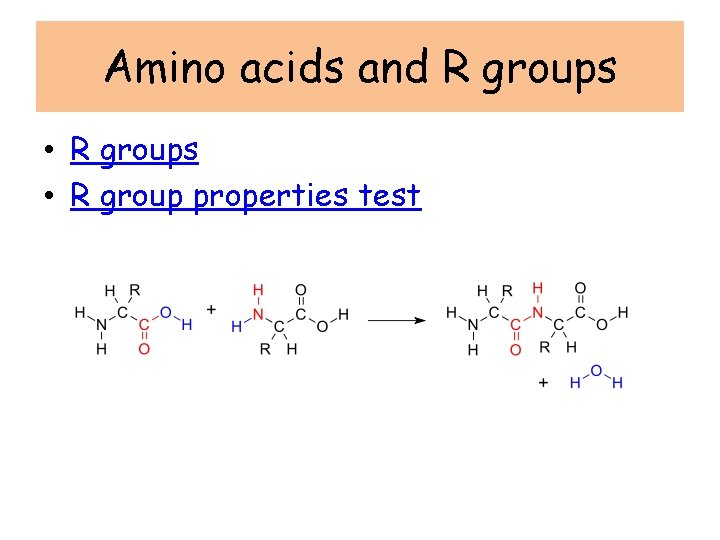
Peptide bond formation • A peptide bond is formed between the carboxylic acid (–COOH) terminal of one amino acid and the amine (–NH 2) terminal of another. • This is a condensation reaction as water is produced. • As a result, all proteins have a carboxyl terminus (end) and an amine terminus.
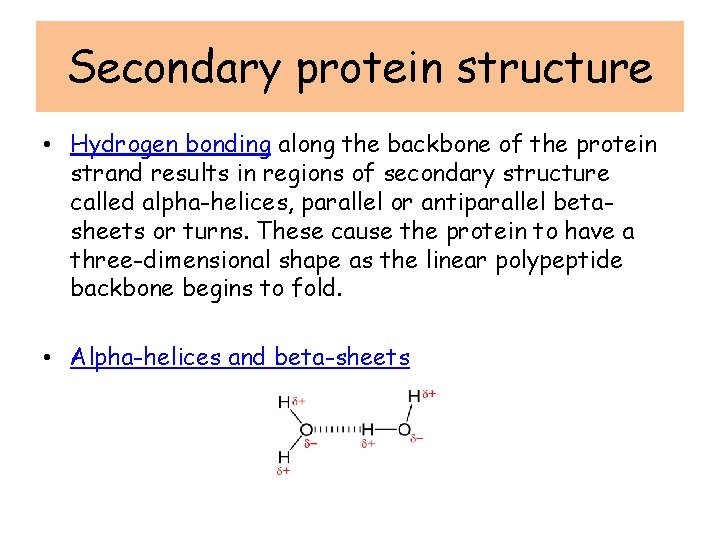
Secondary protein structure • Hydrogen bonding along the backbone of the protein strand results in regions of secondary structure called alpha-helices, parallel or antiparallel betasheets or turns. These cause the protein to have a three-dimensional shape as the linear polypeptide backbone begins to fold. • Alpha-helices and beta-sheets
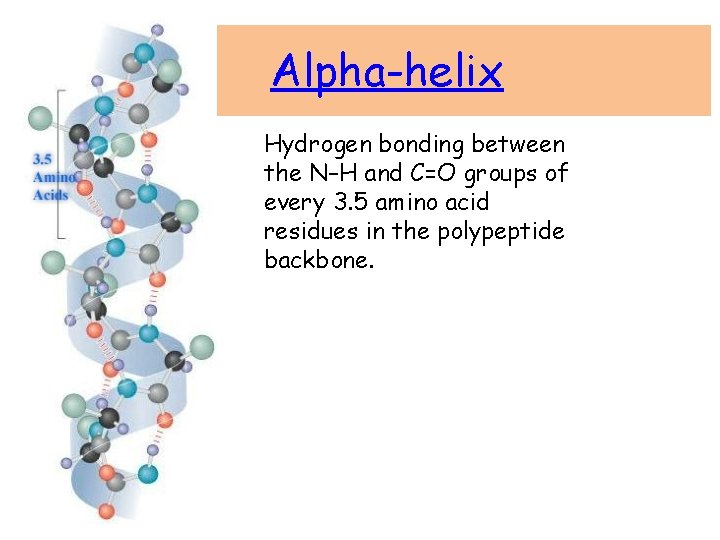
Alpha-helix Hydrogen bonding between the N–H and C=O groups of every 3. 5 amino acid residues in the polypeptide backbone.

Beta-sheet Antiparallel Parallel Hydrogen bonding between the N–H and C=O groups of the amino acid residues in the polypeptide backbone.
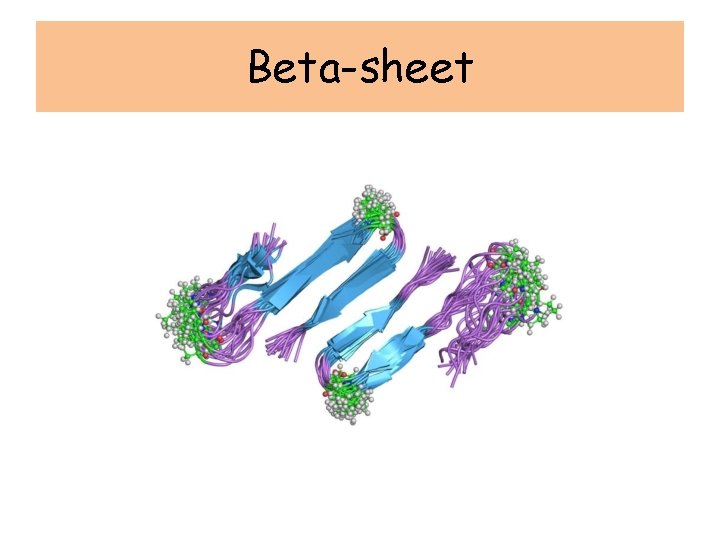
Beta-sheet
Amino acids and R groups • R groups are the residues or side chains of the 20 amino acids, which have different functional groups. 1. 2. 3. 4. 5. Positively charged, basic Negatively charged, acidic Polar Hydrophobic, non-polar Uncharged polar • These functional groups give the protein its function as they interact with each other and with other structures associated with the protein.
Amino acids and R groups • R group properties test
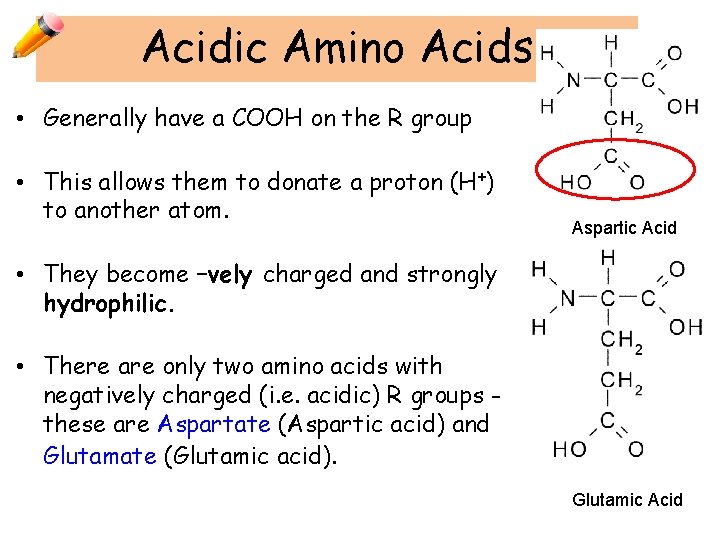
Acidic Amino Acids • Generally have a COOH on the R group • This allows them to donate a proton (H+) to another atom. Aspartic Acid • They become –vely charged and strongly hydrophilic. • There are only two amino acids with negatively charged (i. e. acidic) R groups these are Aspartate (Aspartic acid) and Glutamate (Glutamic acid). Glutamic Acid
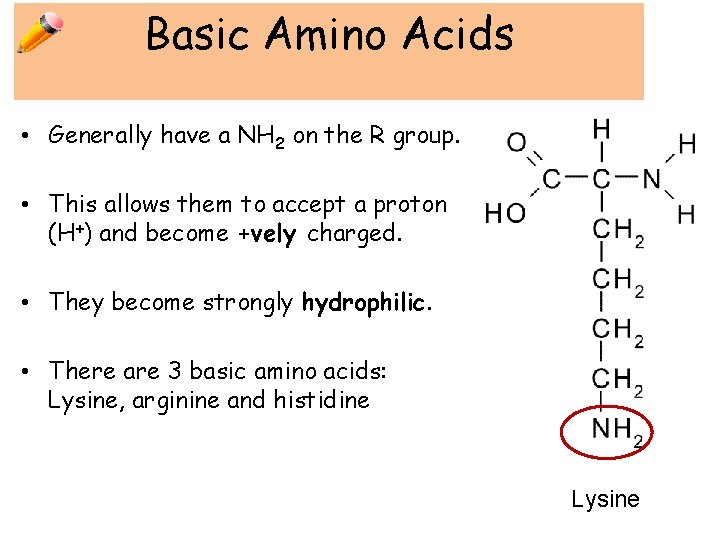
Basic Amino Acids • Generally have a NH 2 on the R group. • This allows them to accept a proton (H+) and become +vely charged. • They become strongly hydrophilic. • There are 3 basic amino acids: Lysine, arginine and histidine Lysine
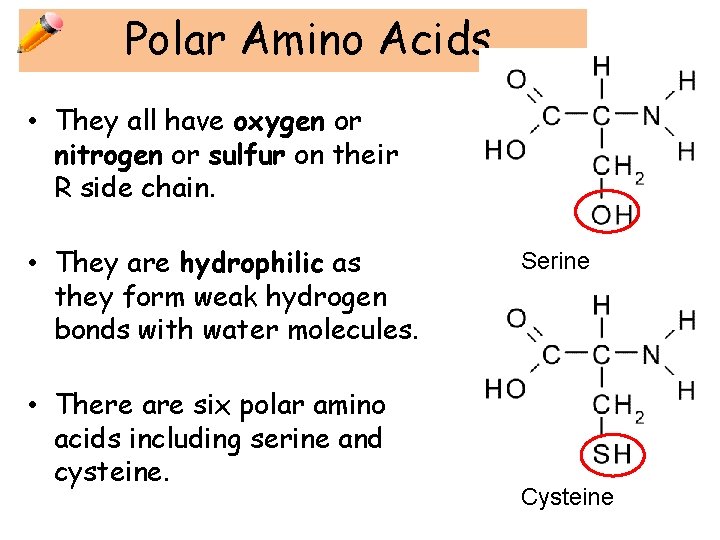
Polar Amino Acids • They all have oxygen or nitrogen or sulfur on their R side chain. • They are hydrophilic as they form weak hydrogen bonds with water molecules. • There are six polar amino acids including serine and cysteine. Serine Cysteine
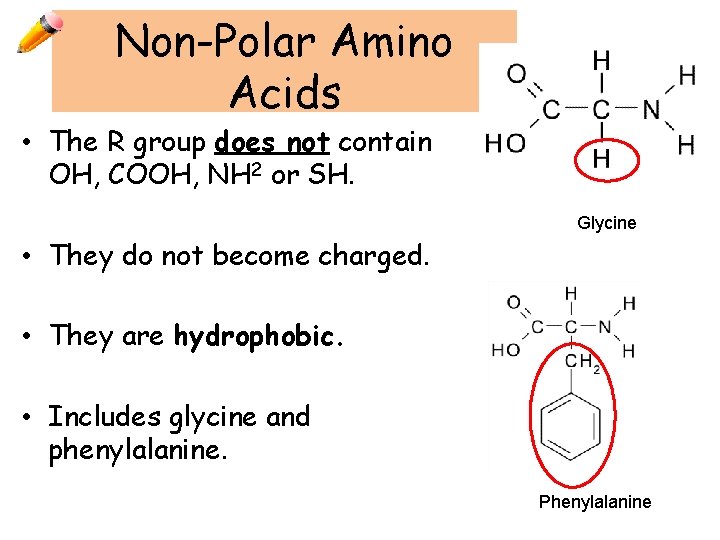
Non-Polar Amino Acids • The R group does not contain OH, COOH, NH 2 or SH. Glycine • They do not become charged. • They are hydrophobic. • Includes glycine and phenylalanine. Phenylalanine
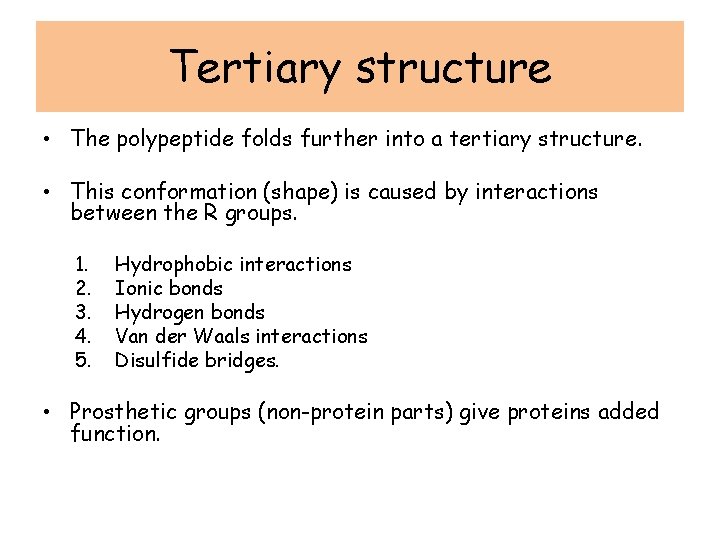
Tertiary structure • The polypeptide folds further into a tertiary structure. • This conformation (shape) is caused by interactions between the R groups. 1. 2. 3. 4. 5. Hydrophobic interactions Ionic bonds Hydrogen bonds Van der Waals interactions Disulfide bridges. • Prosthetic groups (non-protein parts) give proteins added function.
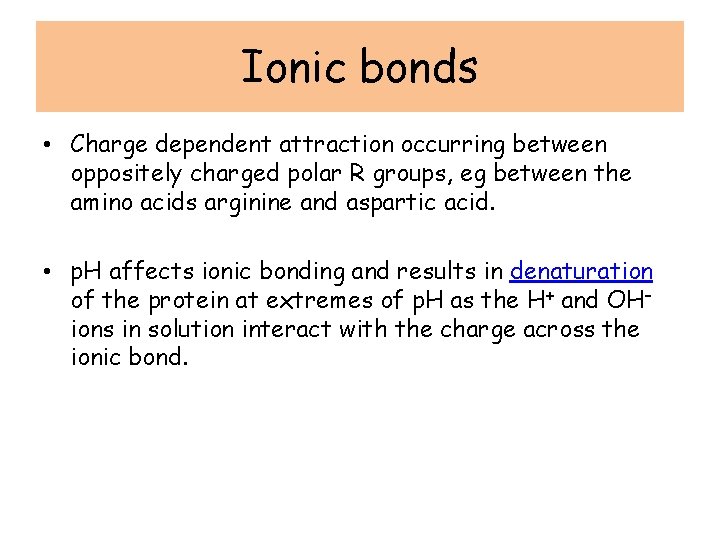
Ionic bonds • Charge dependent attraction occurring between oppositely charged polar R groups, eg between the amino acids arginine and aspartic acid. • p. H affects ionic bonding and results in denaturation of the protein at extremes of p. H as the H+ and OH– ions in solution interact with the charge across the ionic bond.
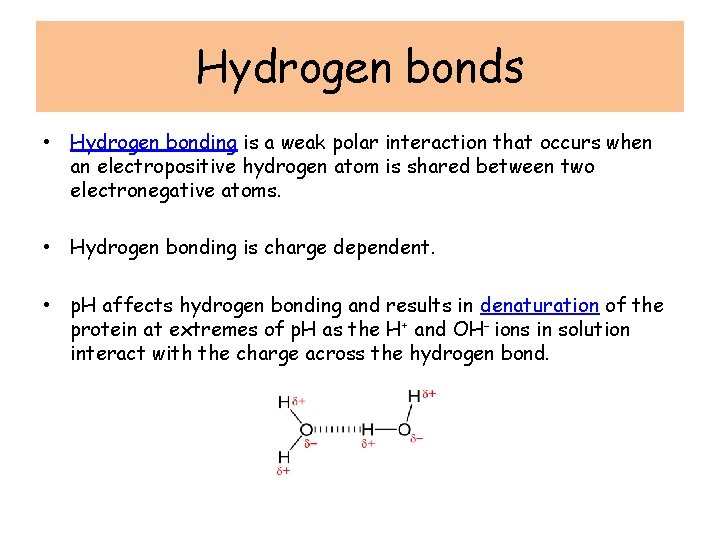
Hydrogen bonds • Hydrogen bonding is a weak polar interaction that occurs when an electropositive hydrogen atom is shared between two electronegative atoms. • Hydrogen bonding is charge dependent. • p. H affects hydrogen bonding and results in denaturation of the protein at extremes of p. H as the H+ and OH– ions in solution interact with the charge across the hydrogen bond.
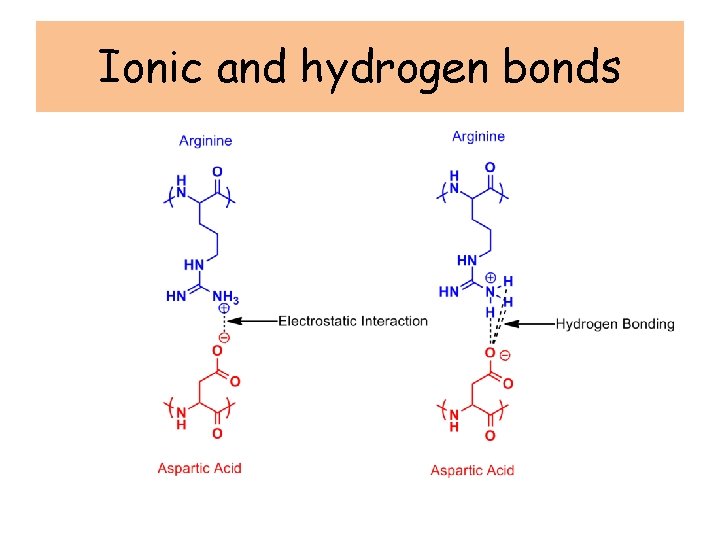
Ionic and hydrogen bonds
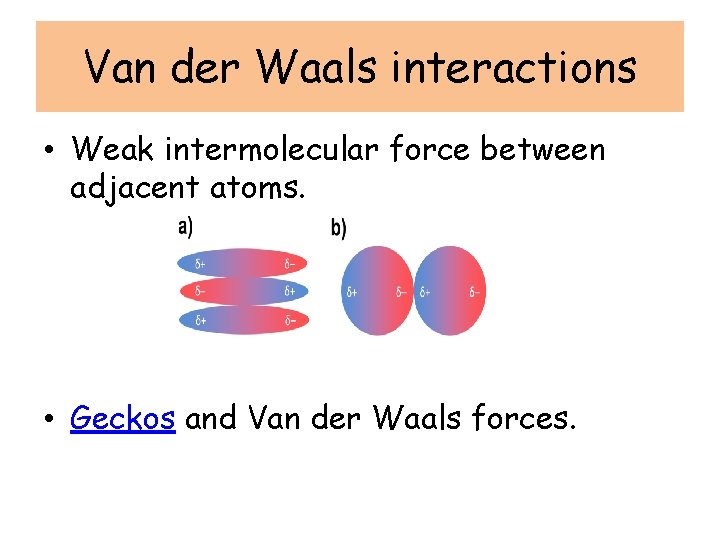
Van der Waals interactions • Weak intermolecular force between adjacent atoms. • Geckos and Van der Waals forces.
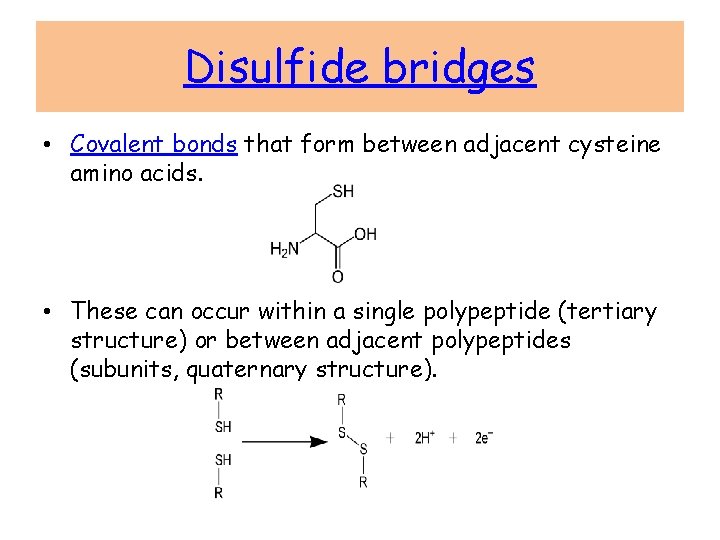
Disulfide bridges • Covalent bonds that form between adjacent cysteine amino acids. • These can occur within a single polypeptide (tertiary structure) or between adjacent polypeptides (subunits, quaternary structure).
Prosthetic groups • These are additional non-protein structures that are associated with the protein molecule and give it its final functionality. • Examples: 1. chlorophyll (magnesium centre), responsible for light capture in photosynthesis 2. haem (iron centre), found in red blood cells in haemoglobin and responsible for oxygen carriage.
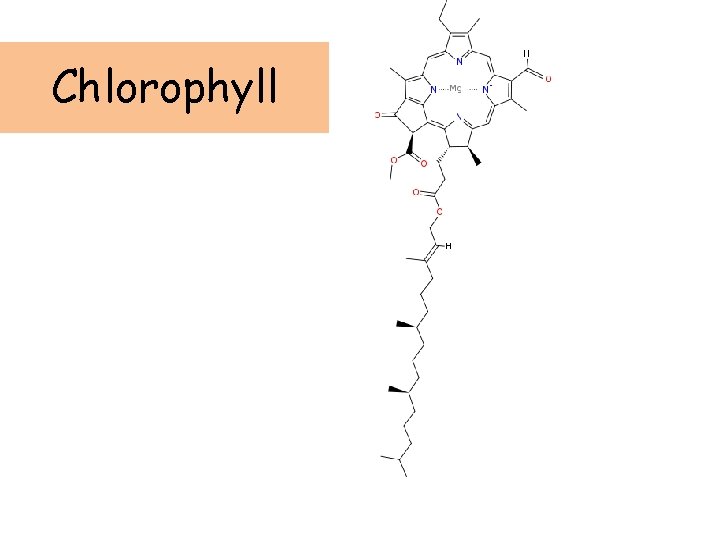
Chlorophyll
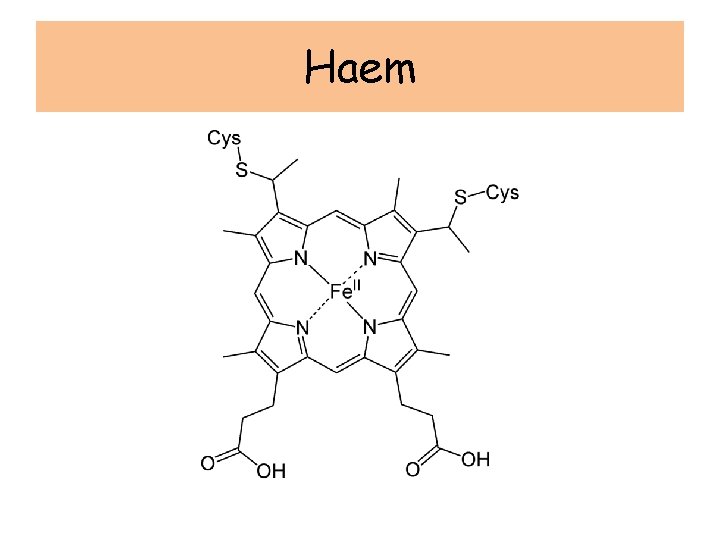
Haem
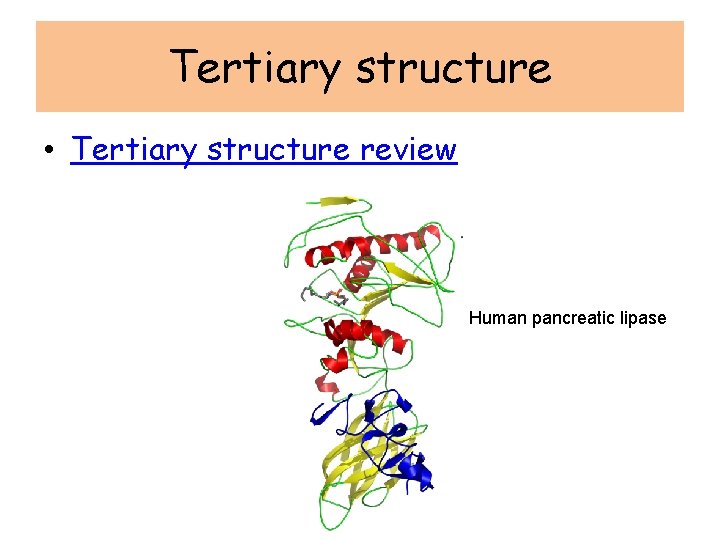
Tertiary structure • Tertiary structure review Human pancreatic lipase
Quaternary structure • Quaternary structure exists in proteins with several connected polypeptide subunits. • These subunits are held together by all of the interactions listed in the tertiary structure. • Quaternary structure review • Immunoglobulins • Keratin
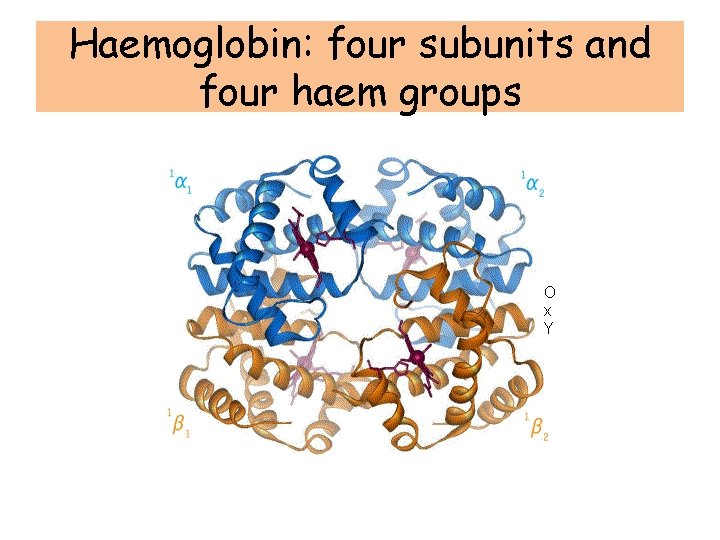
Haemoglobin: four subunits and four haem groups
Effects of temperature and p. H on protein shape • Any factor that changes the interactions of the R groups will change the shape of the protein. • Temperature and p. H can influence the interactions of the R groups. • If the protein has lost its shape (and so its functionality) it has been denatured. • Increasing temperature will first disrupt (melt) weaker bonds and then finally stronger covalent bonds. • p. H can shift the acid/base characters of the R groups on particular amino acids and so change the ionic interactions in the chain. • Denaturation review
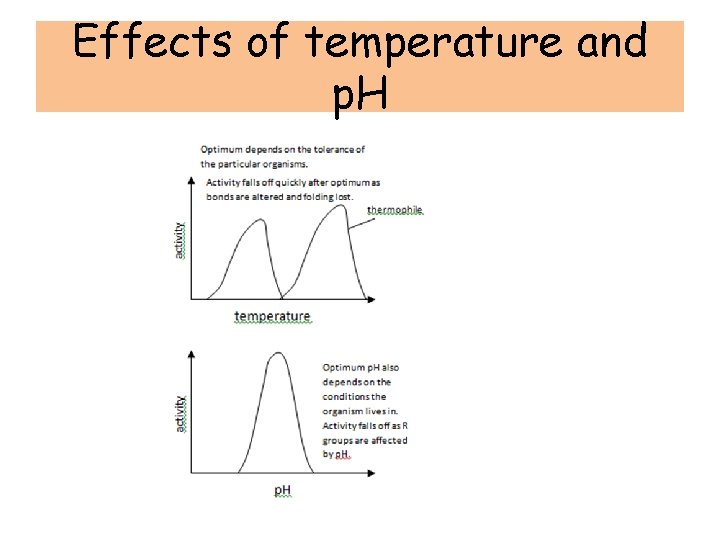
Effects of temperature and p. H
The structure of proteins Key Concepts • The _______sequence determines protein structure. • Primary sequence- amino acids are linked by _____ bonds into _____ chains. • Secondary structure- _____ bonds form _______, beta sheets (_______ or _____) or turns. • R groups can be _______, ____ charged, _________or _____.
The structure of proteins Key Concepts • The amino acid sequence determines protein structure. • Primary sequence- amino acids are linked by peptide bonds into polypeptide chains. • Secondary structure- hydrogen bonds form alpha helices, beta sheets (parallel or anti-parallel) or turns. • R groups can be polar, negatively charged, positively charged or hydrophobic.
The structure of proteins Key Concepts • Tertiary structure- caused by interactions between __ ______such as _______ bonds, hydrogen bonds, _____interactions, _____ bridges. • _____ groups can give proteins an extra function (i. e. ______ in haemoglobin). • Quaternary structure- several _____ subunits join. • _____ and ____ can affect interactions of the R groups.
The structure of proteins Key Concepts • Tertiary structure- caused by interactions between R groups such as ionic bonds, hydrogen bonds, van der waals interactions, disulphide bridges. • Prosthetic groups can give proteins an extra function (i. e. haem in haemoglobin). • Quaternary structure- several polypeptide subunits join. • Temperature and p. H can affect interactions of the R groups.
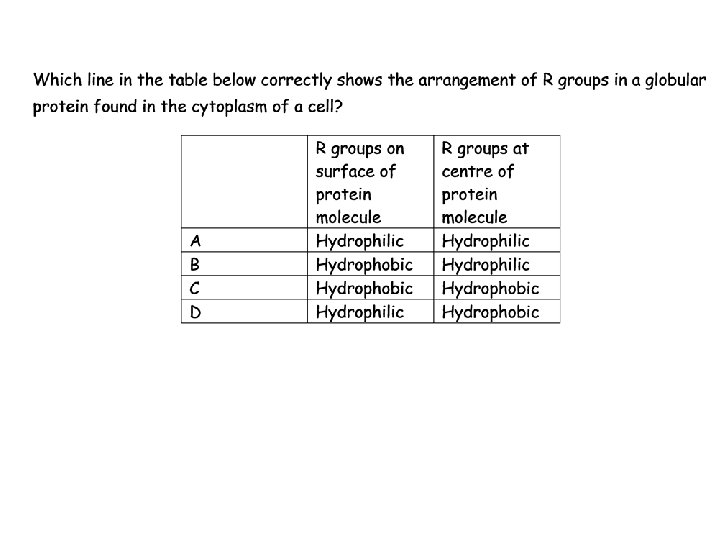
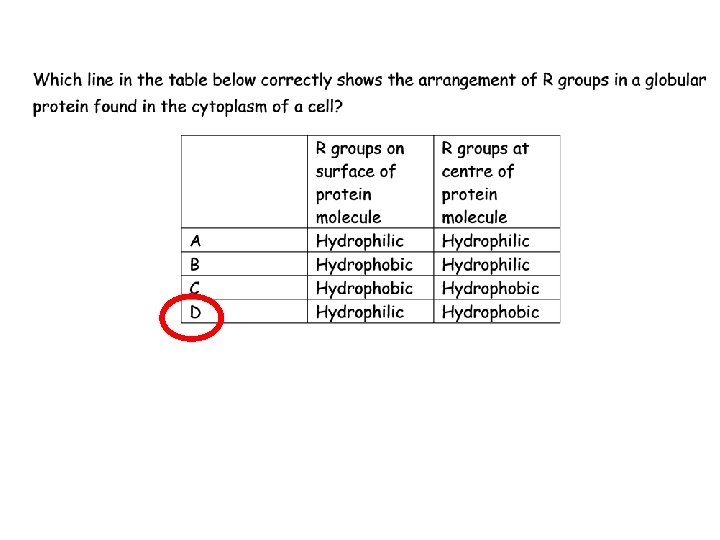
Hydrophobic and hydrophilic interactions LOs • The R groups at the surface of a protein determine its location within a cell. • Hydrophilic (water loving) R groups will predominate at the surface of a soluble protein found in the cytoplasm. • In these proteins, hydrophobic (water hating) R groups may cluster at the centre to form a globular structure. • Regions of hydrophobic R groups allow strong hydrophobic interactions that hold integral proteins within the phospholipid bilayer. Some integral proteins are transmembrane, for example channels, transporters and receptors. • Peripheral proteins have fewer hydrophobic R groups interacting with the phospholipids.
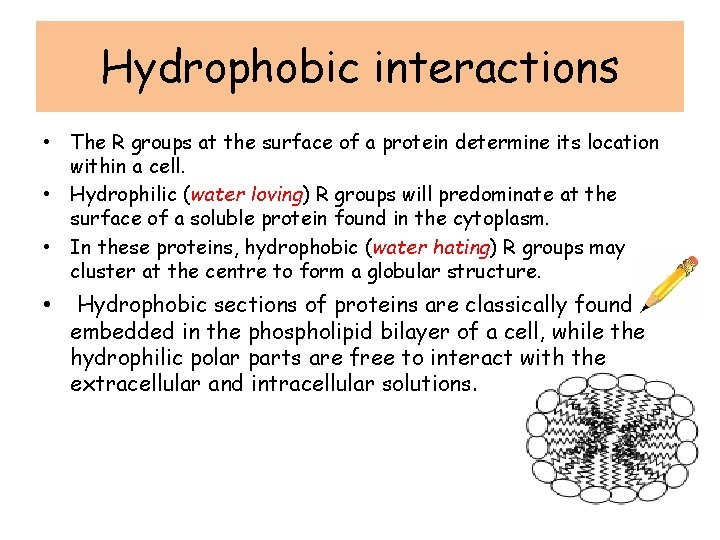
Hydrophobic interactions • The R groups at the surface of a protein determine its location within a cell. • Hydrophilic (water loving) R groups will predominate at the surface of a soluble protein found in the cytoplasm. • In these proteins, hydrophobic (water hating) R groups may cluster at the centre to form a globular structure. • Hydrophobic sections of proteins are classically found embedded in the phospholipid bilayer of a cell, while the hydrophilic polar parts are free to interact with the extracellular and intracellular solutions.
Hydrophobic and hydrophilic interactions • The R groups at the surface of a protein determine its location within a cell. – Protein trafficking animation of Golgi apparatus. – Protein transport animation and the enzymes involved.
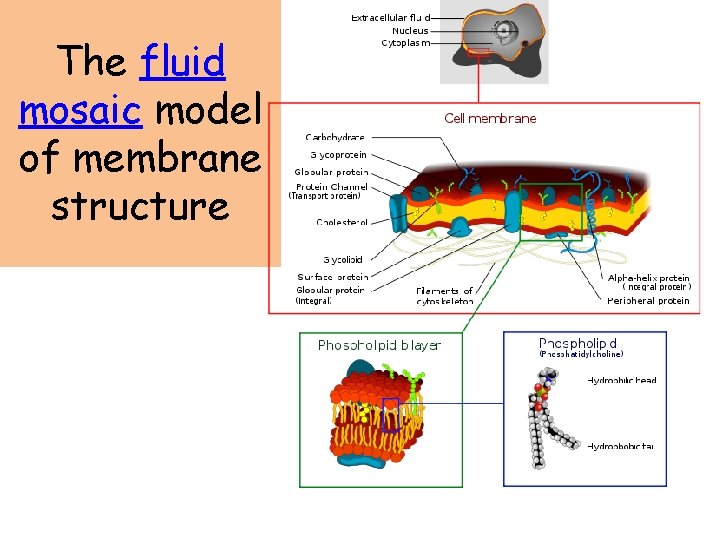
The fluid mosaic model of membrane structure
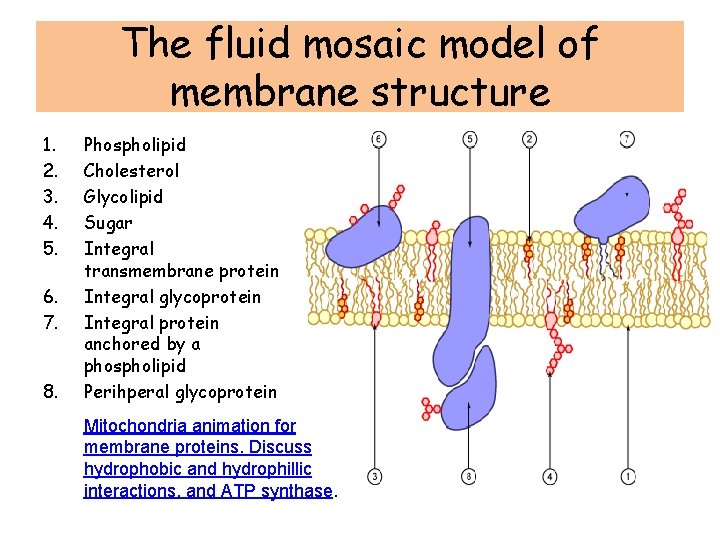
The fluid mosaic model of membrane structure 1. 2. 3. 4. 5. 6. 7. 8. Phospholipid Cholesterol Glycolipid Sugar Integral transmembrane protein Integral glycoprotein Integral protein anchored by a phospholipid Perihperal glycoprotein Mitochondria animation for membrane proteins. Discuss hydrophobic and hydrophillic interactions, and ATP synthase.
The fluid mosaic model of membrane structure • Regions of hydrophobic R groups allow strong hydrophobic interactions that hold integral proteins, those embedded in the membrane, within the phospholipid bilayer as they are free to interact with the hydrophobic tails of the phospholipids. • Some integral proteins are transmembrane and cross the phospholipid bilayer, for example: – channel proteins: facilitated diffusion and active transport – transporters: sodium potassium pump – receptors: G-proteins.
Hydrophobic and Hydrophilic Interactions -Key Concepts • The ____ groups at the surface of a protein determine its _______ within a cell. • _____ (water loving) R groups will predominate at the ______ of a soluble protein found in the cytoplasm. • In these proteins, _______ (water hating) R groups may cluster at the centre to form a _______ structure. • Regions of hydrophobic R groups allow strong hydrophobic interactions that hold _______ proteins within the _____ bilayer. Some integral proteins are transmembrane, for example _______, ____ and _____. • _____ proteins have fewer hydrophobic R groups interacting with the _____.
Hydrophobic and Hydrophilic Interactions -Key Concepts • The R groups at the surface of a protein determine its location within a cell. • Hydrophilic (water loving) R groups will predominate at the surface of a soluble protein found in the cytoplasm. • In these proteins, hydrophobic (water hating) R groups may cluster at the centre to form a globular structure. • Regions of hydrophobic R groups allow strong hydrophobic interactions that hold integral proteins within the phospholipid bilayer. Some integral proteins are transmembrane, for example channels, transporters and receptors. • Peripheral proteins have fewer hydrophobic R groups interacting with the phospholipids.
Think • What are the functions of protein in a cell? • Why is protein structure important? • Why do organisms usually live within a narrow range of temperature and p. H? • If eukaryotic cells are identical in structure relative to their cellular components why do organisms look different? • How can a gecko stick to Perspex? • How do multicellular organisms stay together?

Past Paper Practice Advanced Higher Key Area 1. 2 Protein structure
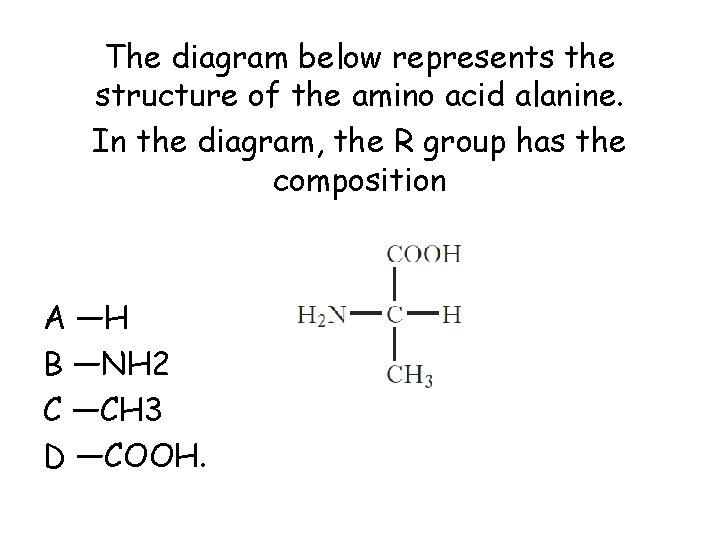
The diagram below represents the structure of the amino acid alanine. In the diagram, the R group has the composition A —H B —NH 2 C —CH 3 D —COOH.
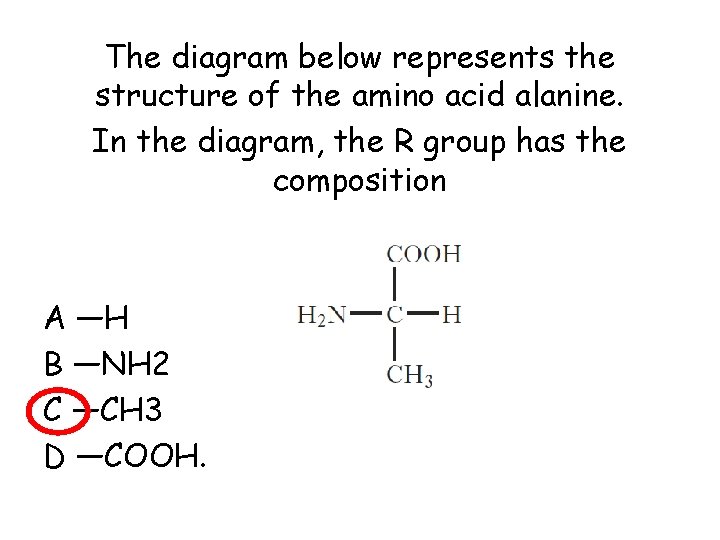
The diagram below represents the structure of the amino acid alanine. In the diagram, the R group has the composition A —H B —NH 2 C —CH 3 D —COOH.
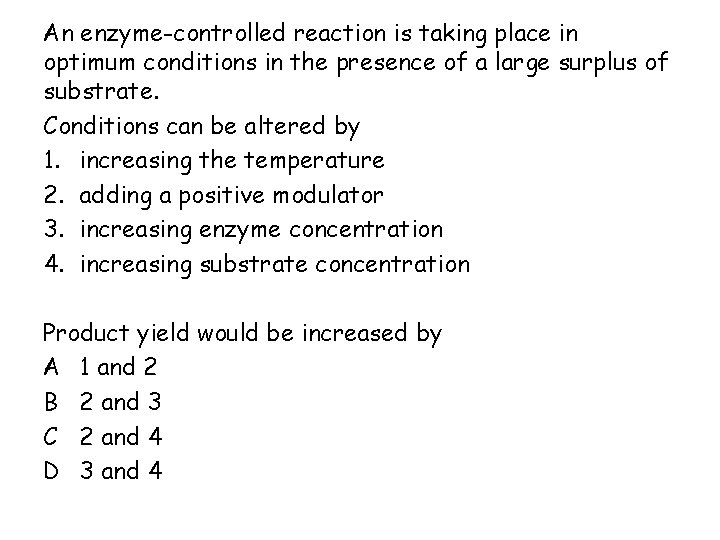
An enzyme-controlled reaction is taking place in optimum conditions in the presence of a large surplus of substrate. Conditions can be altered by 1. increasing the temperature 2. adding a positive modulator 3. increasing enzyme concentration 4. increasing substrate concentration Product yield would be increased by A 1 and 2 B 2 and 3 C 2 and 4 D 3 and 4
An enzyme-controlled reaction is taking place in optimum conditions in the presence of a large surplus of substrate. Conditions can be altered by 1. increasing the temperature 2. adding a positive modulator 3. increasing enzyme concentration 4. increasing substrate concentration Product yield would be increased by A 1 and 2 B 2 and 3 C 2 and 4 D 3 and 4
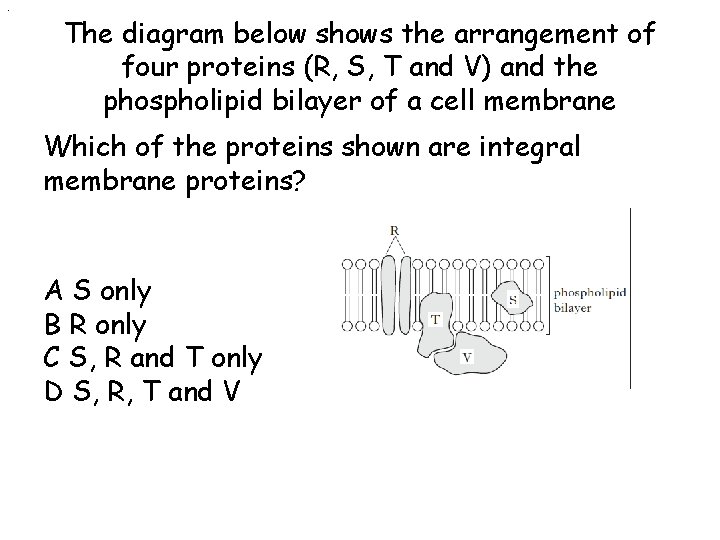
. The diagram below shows the arrangement of four proteins (R, S, T and V) and the phospholipid bilayer of a cell membrane Which of the proteins shown are integral membrane proteins? A S only B R only C S, R and T only D S, R, T and V
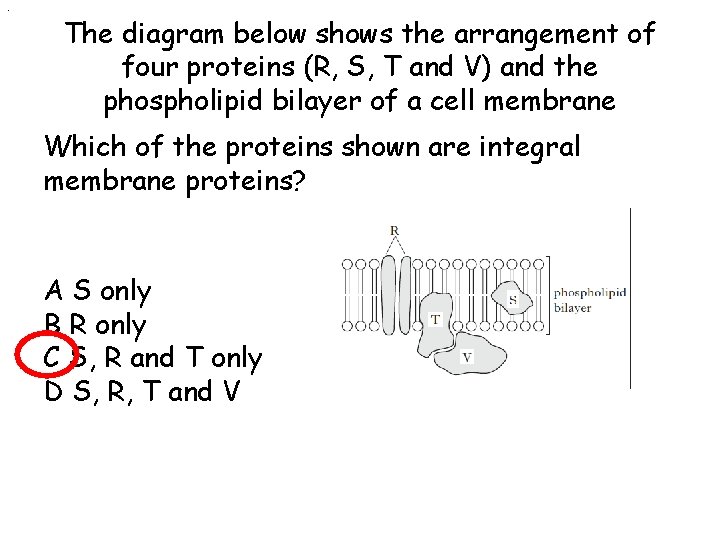
. The diagram below shows the arrangement of four proteins (R, S, T and V) and the phospholipid bilayer of a cell membrane Which of the proteins shown are integral membrane proteins? A S only B R only C S, R and T only D S, R, T and V
• Give details of the structure of proteins including primary, secondary, tertiary and quaternary levels. (10 marks)
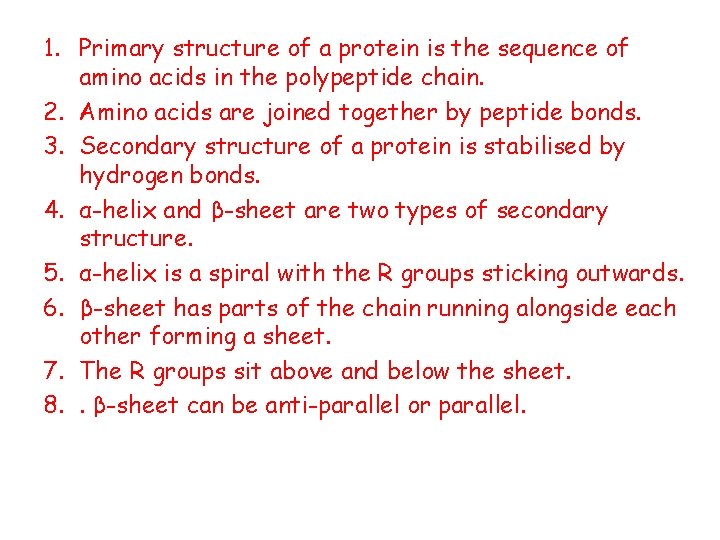
1. Primary structure of a protein is the sequence of amino acids in the polypeptide chain. 2. Amino acids are joined together by peptide bonds. 3. Secondary structure of a protein is stabilised by hydrogen bonds. 4. α-helix and β-sheet are two types of secondary structure. 5. α-helix is a spiral with the R groups sticking outwards. 6. β-sheet has parts of the chain running alongside each other forming a sheet. 7. The R groups sit above and below the sheet. 8. . β-sheet can be anti-parallel or parallel.
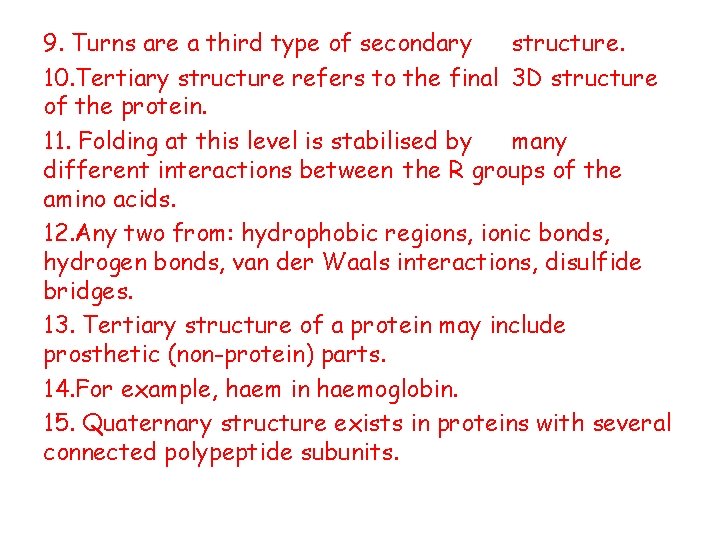
9. Turns are a third type of secondary structure. 10. Tertiary structure refers to the final 3 D structure of the protein. 11. Folding at this level is stabilised by many different interactions between the R groups of the amino acids. 12. Any two from: hydrophobic regions, ionic bonds, hydrogen bonds, van der Waals interactions, disulfide bridges. 13. Tertiary structure of a protein may include prosthetic (non-protein) parts. 14. For example, haem in haemoglobin. 15. Quaternary structure exists in proteins with several connected polypeptide subunits.
- Slides: 58