
AGWA Automated Geospatial Watershed Assessment GISbased Hydrologic Modeling
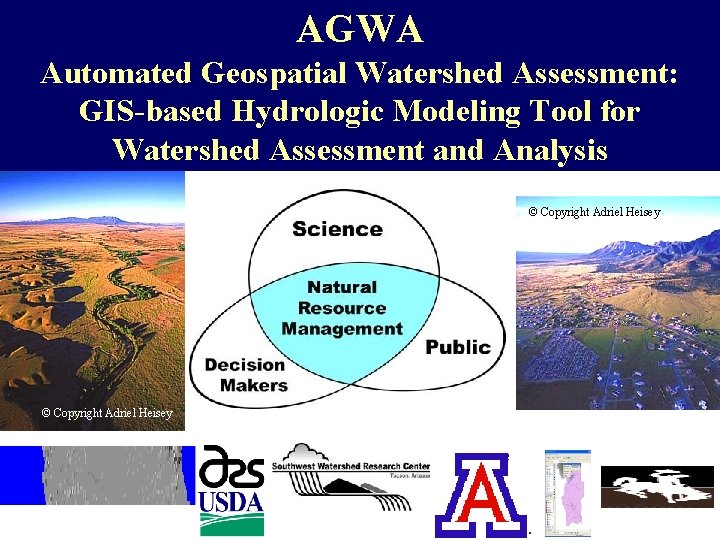
AGWA Automated Geospatial Watershed Assessment: GIS-based Hydrologic Modeling Tool for Watershed Assessment and Analysis © Copyright Adriel Heisey
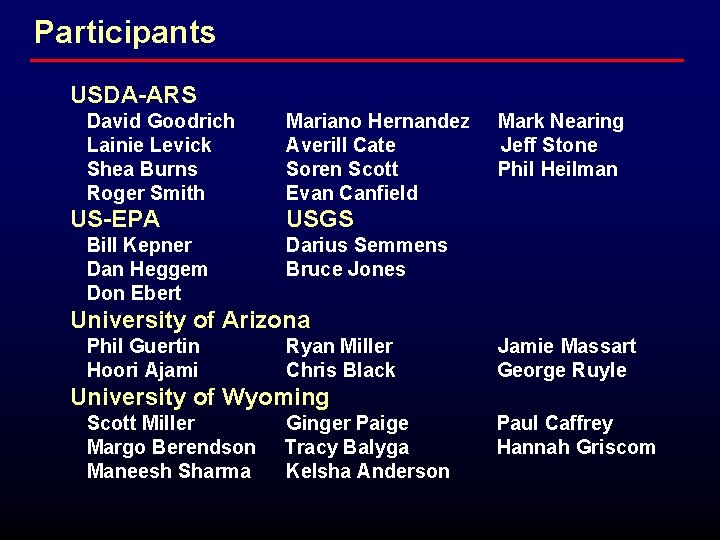
Participants USDA-ARS David Goodrich Lainie Levick Shea Burns Roger Smith US-EPA Bill Kepner Dan Heggem Don Ebert Mariano Hernandez Averill Cate Soren Scott Evan Canfield Mark Nearing Jeff Stone Phil Heilman USGS Darius Semmens Bruce Jones University of Arizona Phil Guertin Hoori Ajami Ryan Miller Chris Black Jamie Massart George Ruyle University of Wyoming Scott Miller Margo Berendson Maneesh Sharma Ginger Paige Tracy Balyga Kelsha Anderson Paul Caffrey Hannah Griscom
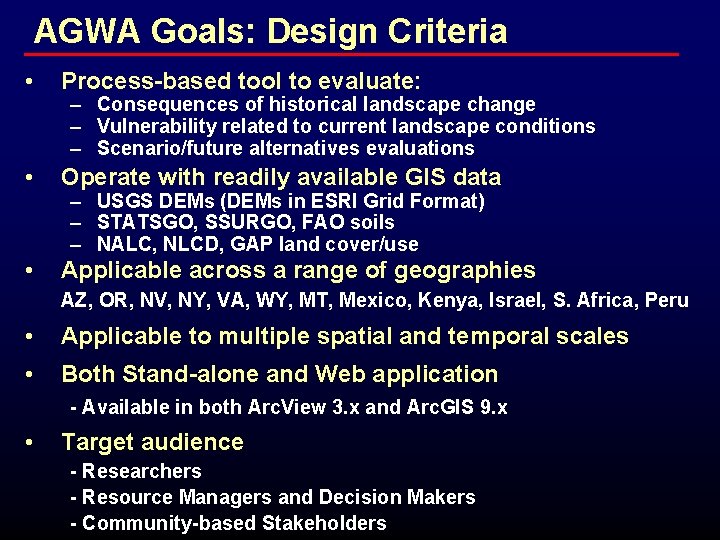
AGWA Goals: Design Criteria • Process-based tool to evaluate: • Operate with readily available GIS data • Applicable across a range of geographies – Consequences of historical landscape change – Vulnerability related to current landscape conditions – Scenario/future alternatives evaluations – USGS DEMs (DEMs in ESRI Grid Format) – STATSGO, SSURGO, FAO soils – NALC, NLCD, GAP land cover/use AZ, OR, NV, NY, VA, WY, MT, Mexico, Kenya, Israel, S. Africa, Peru • Applicable to multiple spatial and temporal scales • Both Stand-alone and Web application - Available in both Arc. View 3. x and Arc. GIS 9. x • Target audience - Researchers - Resource Managers and Decision Makers - Community-based Stakeholders
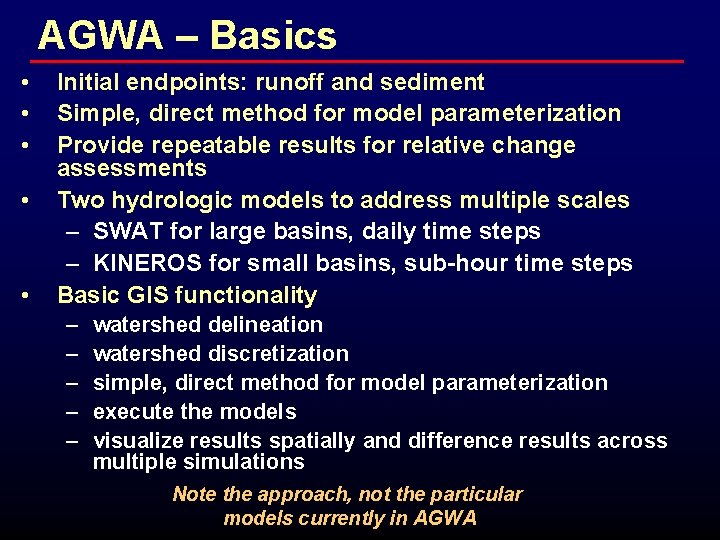
AGWA – Basics • • • Initial endpoints: runoff and sediment Simple, direct method for model parameterization Provide repeatable results for relative change assessments Two hydrologic models to address multiple scales – SWAT for large basins, daily time steps – KINEROS for small basins, sub-hour time steps Basic GIS functionality – – – watershed delineation watershed discretization simple, direct method for model parameterization execute the models visualize results spatially and difference results across multiple simulations Note the approach, not the particular models currently in AGWA
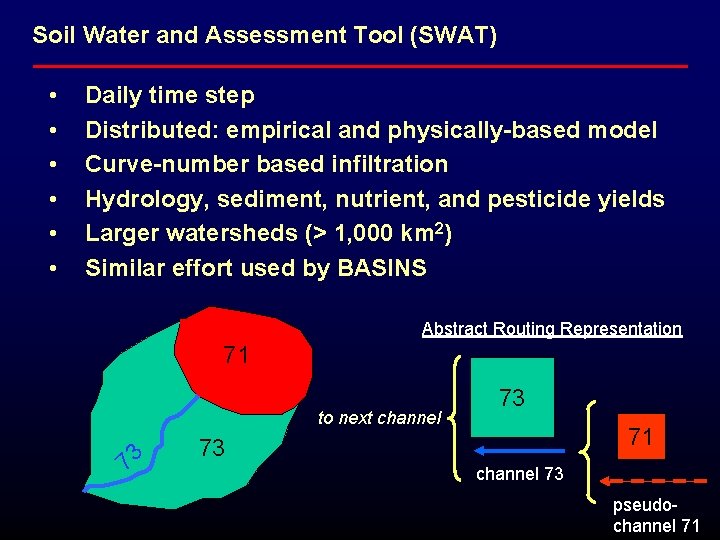
Soil Water and Assessment Tool (SWAT) • • • Daily time step Distributed: empirical and physically-based model Curve-number based infiltration Hydrology, sediment, nutrient, and pesticide yields Larger watersheds (> 1, 000 km 2) Similar effort used by BASINS Abstract Routing Representation 71 to next channel 73 73 71 73 channel 73 pseudochannel 71
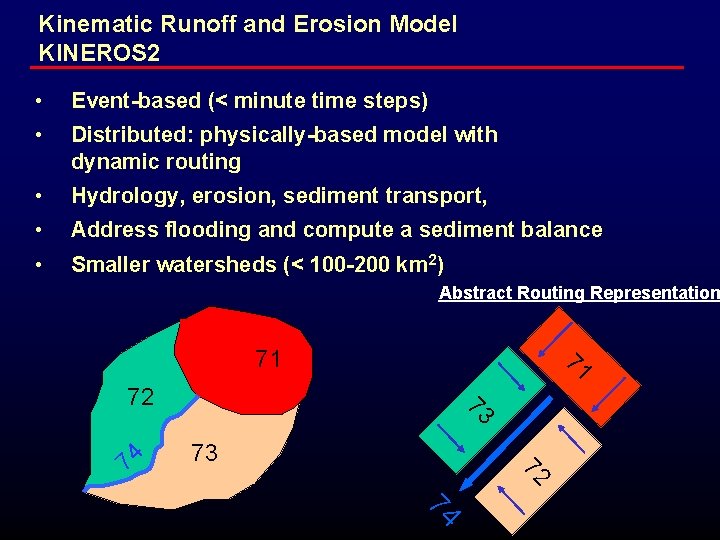
Kinematic Runoff and Erosion Model KINEROS 2 • Event-based (< minute time steps) • Distributed: physically-based model with dynamic routing • Hydrology, erosion, sediment transport, • Address flooding and compute a sediment balance • Smaller watersheds (< 100 -200 km 2) Abstract Routing Representation 71 71 73 72 74
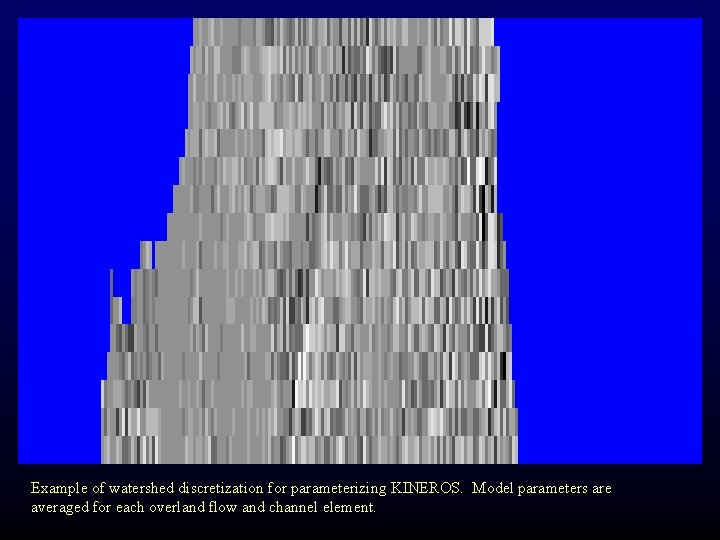
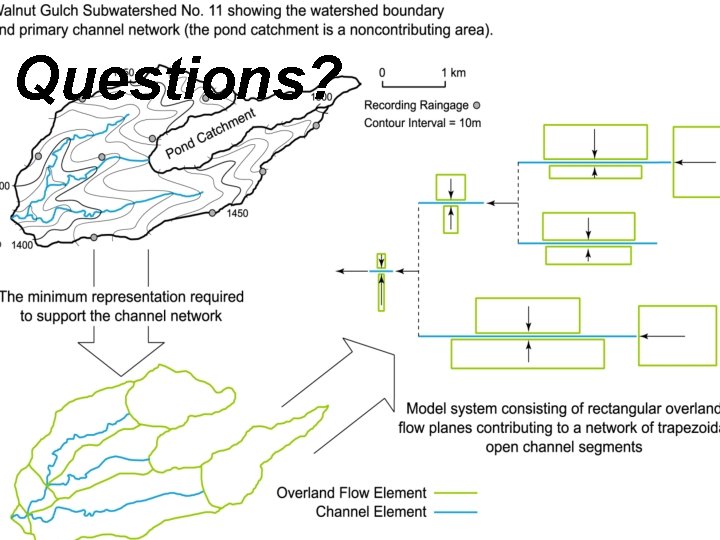
Example of watershed discretization for parameterizing KINEROS. Model parameters are averaged for each overland flow and channel element.
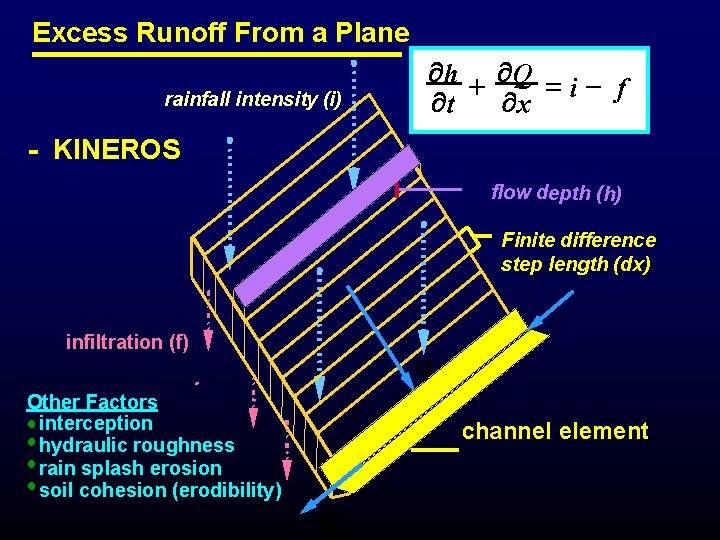
Excess Runoff From a Plane rainfall intensity (i) ¶h + ¶Q = i f ¶t ¶x - KINEROS flow depth (h) Finite difference step length (dx) infiltration (f) q Other Factors interception hydraulic roughness rain splash erosion soil cohesion (erodibility) channel element Q
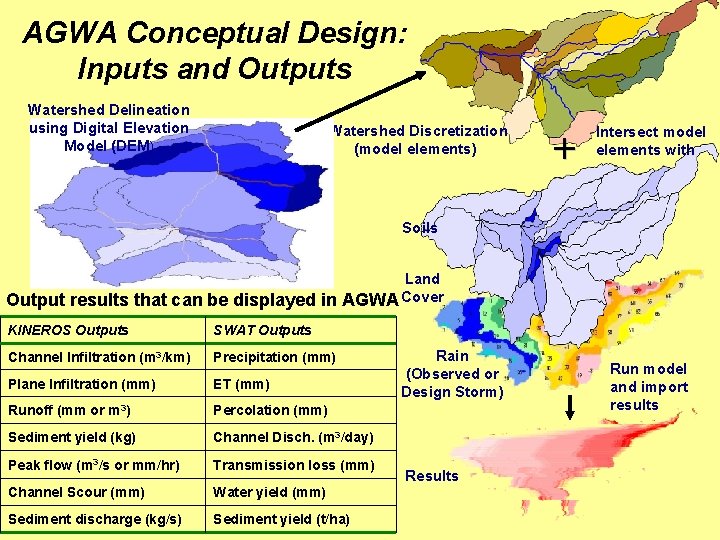
AGWA Conceptual Design: Inputs and Outputs Watershed Delineation using Digital Elevation Model (DEM) Watershed Discretization (model elements) + Intersect model elements with Soils Output results that can be displayed in Land AGWA Cover KINEROS Outputs SWAT Outputs Channel Infiltration (m 3/km) Precipitation (mm) Plane Infiltration (mm) ET (mm) Runoff (mm or m 3) Percolation (mm) Sediment yield (kg) Channel Disch. (m 3/day) Peak flow (m 3/s or mm/hr) Transmission loss (mm) Channel Scour (mm) Water yield (mm) Sediment discharge (kg/s) Sediment yield (t/ha) Rain (Observed or Design Storm) Results Run model and import results
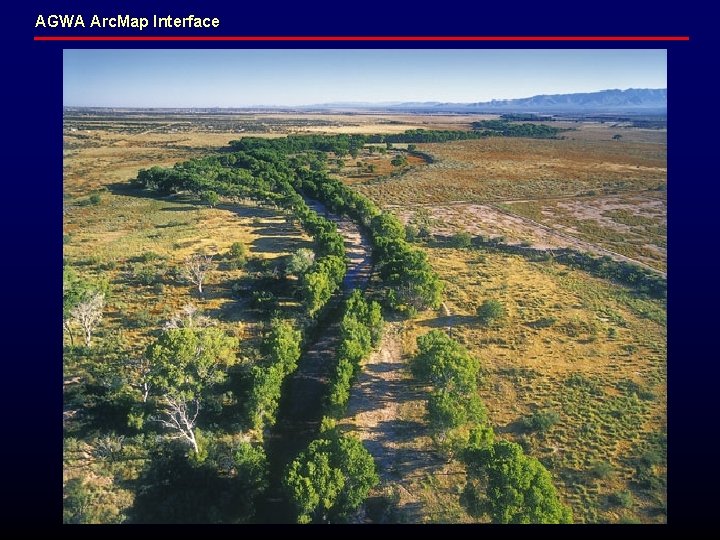
AGWA Arc. Map Interface
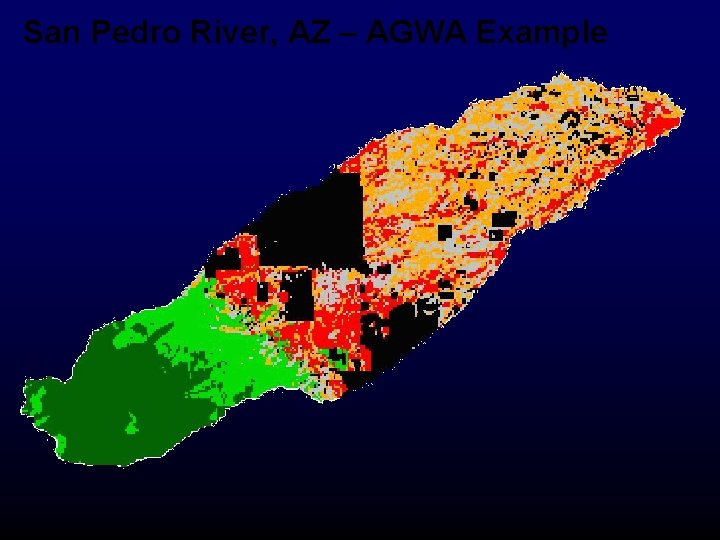
San Pedro River, AZ – AGWA Example
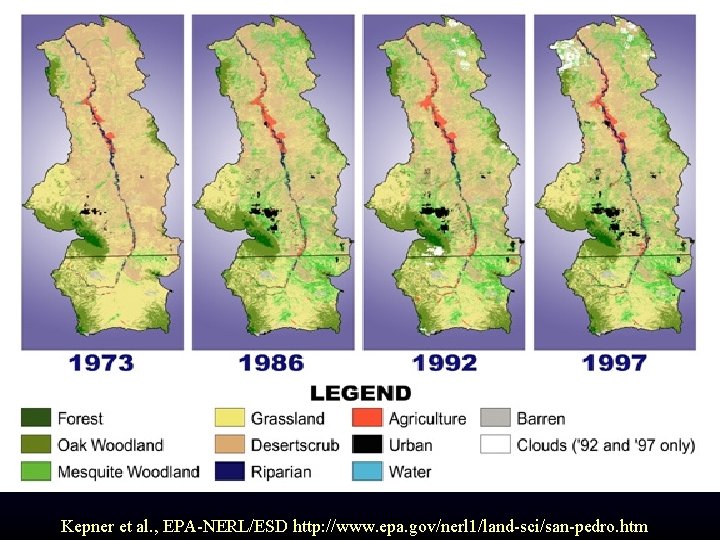
Kepner et al. , EPA-NERL/ESD http: //www. epa. gov/nerl 1/land-sci/san-pedro. htm
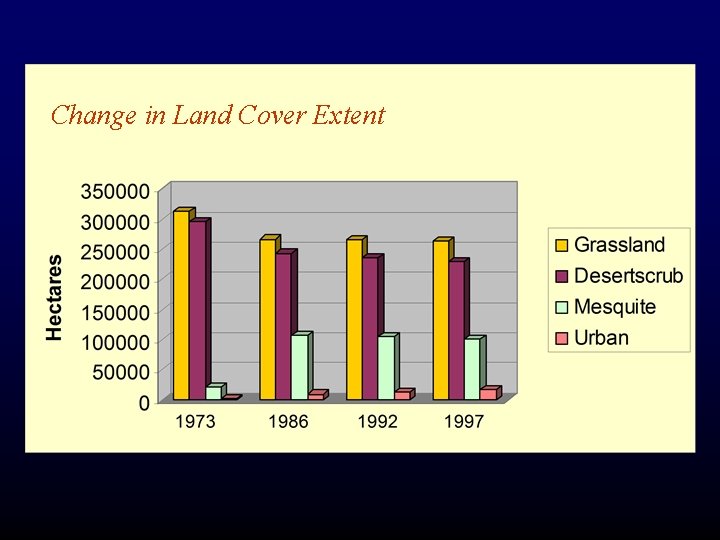
Change in Land Cover Extent
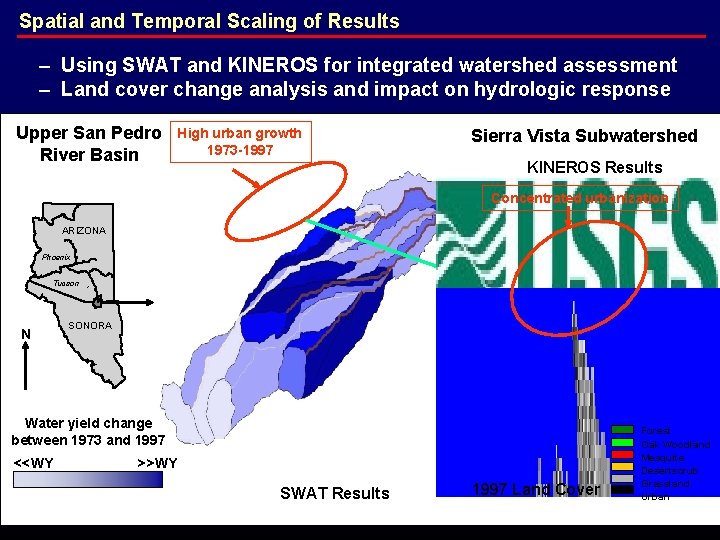
Spatial and Temporal Scaling of Results – Using SWAT and KINEROS for integrated watershed assessment – Land cover change analysis and impact on hydrologic response Upper San Pedro River Basin High urban growth 1973 -1997 Sierra Vista Subwatershed KINEROS Results Concentrated urbanization ARIZONA Phoenix # N # Tucson SONORA Water yield change between 1973 and 1997 <<WY >>WY SWAT Results 1997 Land Cover Forest Oak Woodland Mesquite Desertscrub Grassland Urban
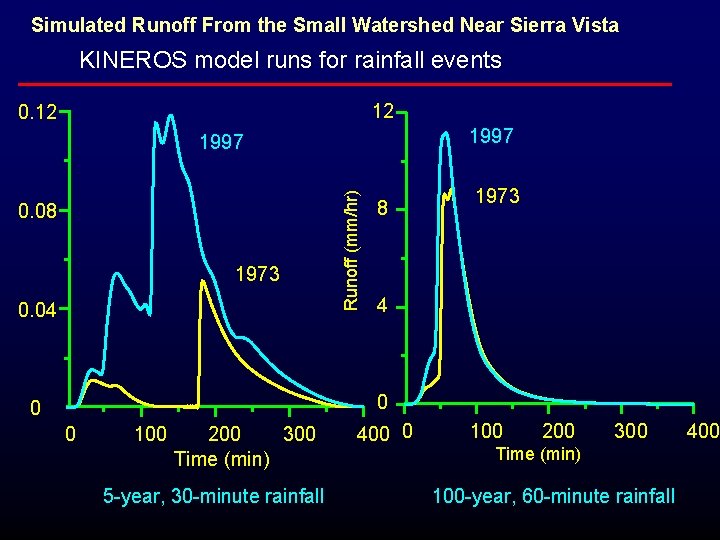
Simulated Runoff From the Small Watershed Near Sierra Vista KINEROS model runs for rainfall events 12 0. 12 1997 0. 08 1973 0. 04 Runoff (mm/hr) 1997 8 1973 4 0 0 0 100 200 300 Time (min) 5 -year, 30 -minute rainfall 400 0 100 200 300 Time (min) 100 -year, 60 -minute rainfall 400
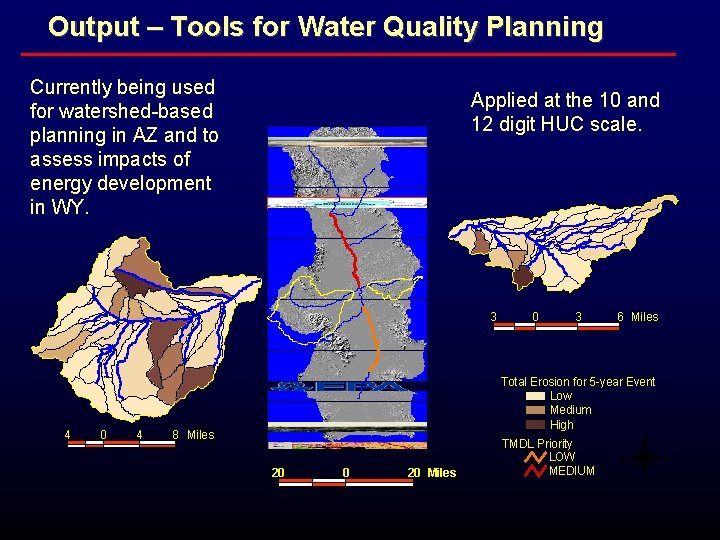
Output – Tools for Water Quality Planning Currently being used for watershed-based planning in AZ and to assess impacts of energy development in WY. Applied at the 10 and 12 digit HUC scale. 3 4 0 3 6 Miles Total Erosion for 5 -year Event Low Medium High 8 Miles 20 0 20 Miles TMDL Priority LOW MEDIUM N W E S
Management Tools • Land use and land cover modification • • – Based on common land use/vegetation types – Vegetation monitoring data (in progress) – NRCS Ecological Site Descriptions (in progress) Buffer strips (KINEROS) Detention and retention ponds/ reservoirs Multi-watershed analysis for political/park boundaries Post-Fire effects
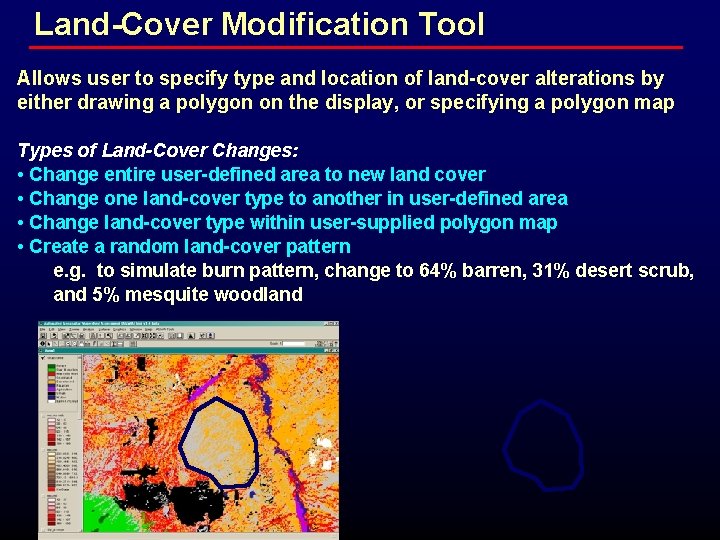
Land-Cover Modification Tool Allows user to specify type and location of land-cover alterations by either drawing a polygon on the display, or specifying a polygon map Types of Land-Cover Changes: • Change entire user-defined area to new land cover • Change one land-cover type to another in user-defined area • Change land-cover type within user-supplied polygon map • Create a random land-cover pattern e. g. to simulate burn pattern, change to 64% barren, 31% desert scrub, and 5% mesquite woodland
New Capabilities - Future Directions • KINEROS 2 -OPUS Coupling − Continuous water balance, subsurface flow, plant growth, snow, nutrients, management (i. e. be more like SWAT but more physicallybased). Will have the same structure as KINEROS. • Development of the Rangeland AGWA (R. AGWA) tool – Supported by a USDA-CSREES Rangeland Science Grant − Include the Rangeland Hydrology and Erosion Model (RHEM) − Incorporation of dynamic WEPP into KINEROS 2 − Improve parameterization based on vegetation characteristics and disturbance − Utilization of Ecological Site Descriptions and monitoring data − Incorporate range management tools (fencing, water, etc. ) • Interface for reservoirs / detention structures in SWAT and KINEROS • Climate change modification tool • Dynamic geomorphic model - erosion / deposition in channels • Sub-discretization based on land-cover, soils, and topography • Develop and validate parameterization methods for different agriculture and natural resource activities.
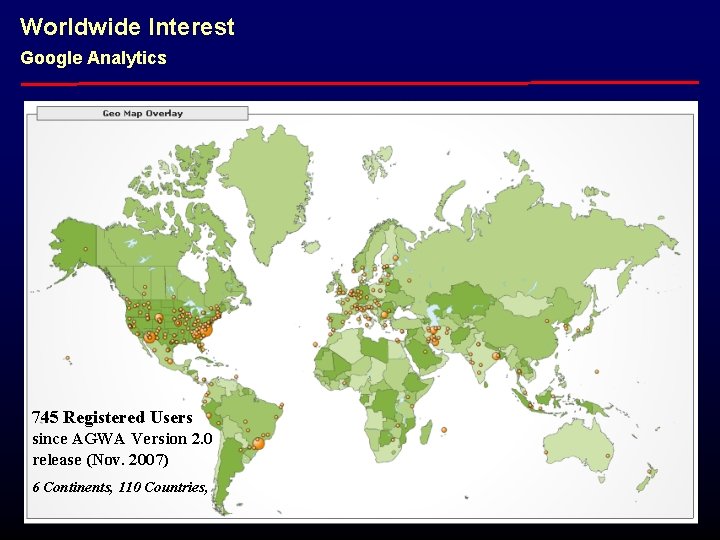
Worldwide Interest Google Analytics 745 Registered Users since AGWA Version 2. 0 release (Nov. 2007) 6 Continents, 110 Countries,
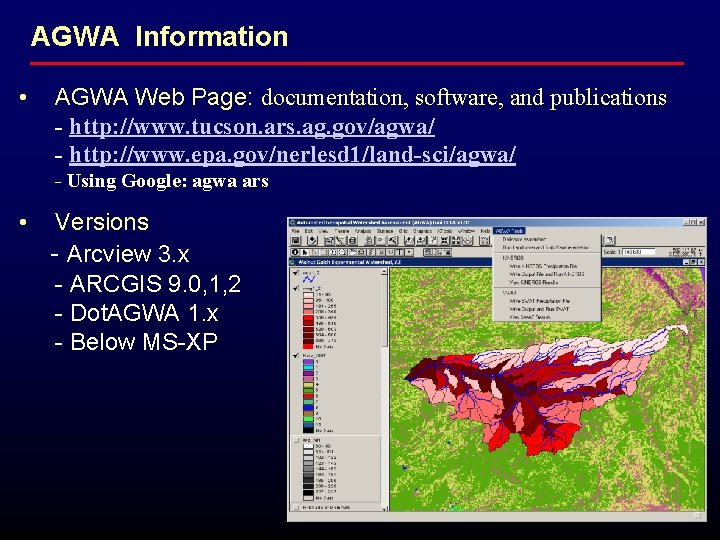
AGWA Information • AGWA Web Page: documentation, software, and publications - http: //www. tucson. ars. ag. gov/agwa/ - http: //www. epa. gov/nerlesd 1/land-sci/agwa/ - Using Google: agwa ars • Versions - Arcview 3. x - ARCGIS 9. 0, 1, 2 - Dot. AGWA 1. x - Below MS-XP
Questions?
- Slides: 22