
Agriculture Engineering 1 Parliamentary Procedure Conducting a Business
Agriculture Engineering 1 Parliamentary Procedure
Conducting a Business Meeting Objective: Analyze the role of Robert’s Rules of Order in conducting a business meeting
Conducting A Business Meeting • Objective: Demonstrate key parliamentary abilities that would be used in a business meeting.
What is Parliamentary Procedure? Parliamentary procedure is using well defined rules to conduct business using a formal, organized approach. Parliamentary procedure is governed by Robert’s Rules of Order.
Parliamentary Law • Robert’s Rule of Order – Rules for conducting a meeting – Assures that all sides are treated fairly and that everyone has the opportunity to discuss and vote
Parliamentary Law • Main Objective: – Focus on one item at a time – Extend courtesy to everyone – Observe the rule of the majority – Ensure the rights of the minority
Methods of Voting • Voice- aye (pronounced “I”) for yes and “no” • Rising- standing or show of hands • Secret Ballot- written vote • Roll Call- secretary asks each member to state vote
Voting • Single majority – one vote more than 50% of the votes cast • Two-thirds majority – 2/3 of the members voting toward one side of the motion – usually used when the rights of the members are limited
Voting • Quorum – number of members required to conduct business
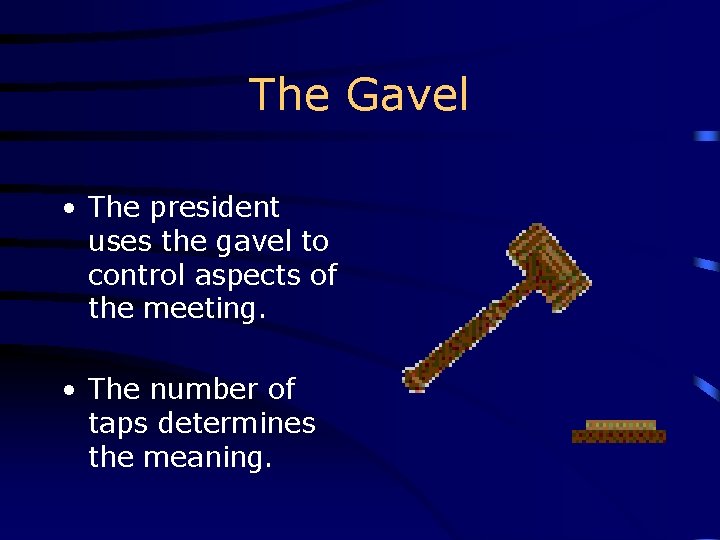
The Gavel • The president uses the gavel to control aspects of the meeting. • The number of taps determines the meaning.
Gavel • Symbol of authority • Meaning of the taps – 1 tap means to be seated – 2 taps means the meeting is called to order – 3 taps means that members should stand – Series of taps • “be quite and orderly”
What to do? • An Agenda is a list of what will be done at the meeting • Also can be called an Order of Business
Presiding Officer • Chapter FFA President • Must be fair and impartial • Must relinquish the chair to the next person in charge to voice their opinion.
Motions
Main Motion • Used to get group approval for a new project or some other course of action • Wording: “I move” NOT “I make a motion” • Can only have ONE main motion on the table at one time
Main Motion • Requires second • Debatable • Amendable • Majority vote required • Can be reconsidered
Main Motion Examples • I move to sell fruit this year. • I move that the chapter attends FFA Camp. • I move that we go to the state fair. • I move to raise pigs.
Second • A second guarantees that more than one person wants to discuss something in a meeting. • Person making a second doesn’t have to be formally recognized.
Amendments • Used to change a main motion • 3 ways to amend: addition, substitution, striking out • Wording: “I move to amend the motion by adding, striking or substituting the words __________ for ___________”
Amendments • Requires second • Debatable • Amendable • Majority vote required • Can be reconsidered
Amendments Examples • Jim moved to sell fruit to raise money for FFA. Michelle wants to sell flowers. How would she change the motion? Answer: “I move to amend the motion by substituting the word FLOWERS for FRUIT”
Adjourn • Used to end a meeting • Wording: “I move to adjourn”
Adjourn • Cannot be debated • Cannot be amended • Cannot be reconsidered • Requires second • Requires majority vote
Point of Order • Used when one believes a parliamentary error has been made • Wording: “I rise to a point of order”
Point of order • Not debatable • Amendable • Does not require second • Cannot be reconsidered • No vote required
Division of the House • Calls for a counted vote • Wording: “I call for a division of the house. ”
Division of the House • Not debatable • Amendable • Does not require second • Cannot be reconsidered • No vote required
Lay on the table • To Postpone a motion to the next meeting • Motion must be taken from the table at the next meeting to be discussed • Wording: “I move to lay this motion on the table until ________”
Lay on the table • • Requires second Not debatable Not amendable Cannot be reconsidered • Majority vote
Previous question • Used to stop debate and vote • Wording: “I move to previous question”
Previous question • Second required • Not debatable • Not amendable • Can be reconsidered before vote • 2/3 vote required
Refer to committee • Used to gain more information on a motion before voting • Wording: “I move to refer this motion to a committee to report at our next meeting. ”
Refer to committee • • Second required Debatable Amendable Can be reconsidered • Majority vote

- Slides: 34