
Agricultural Rural Credit MEANING It is a small
- Slides: 8
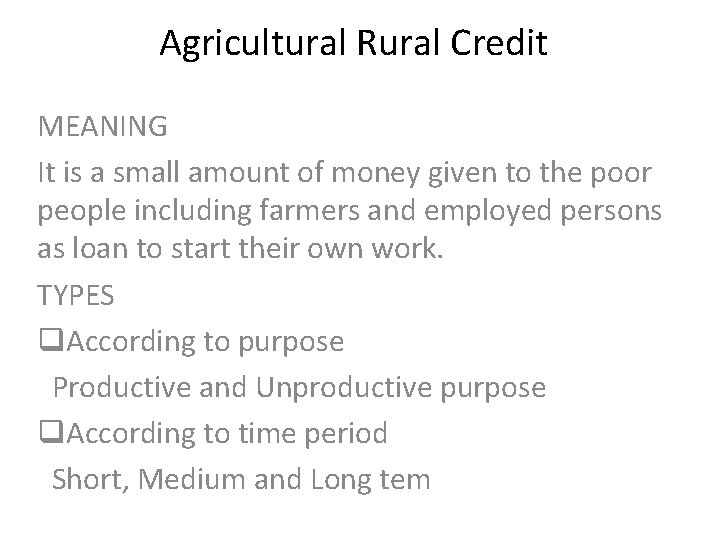
Agricultural Rural Credit MEANING It is a small amount of money given to the poor people including farmers and employed persons as loan to start their own work. TYPES q. According to purpose Productive and Unproductive purpose q. According to time period Short, Medium and Long tem
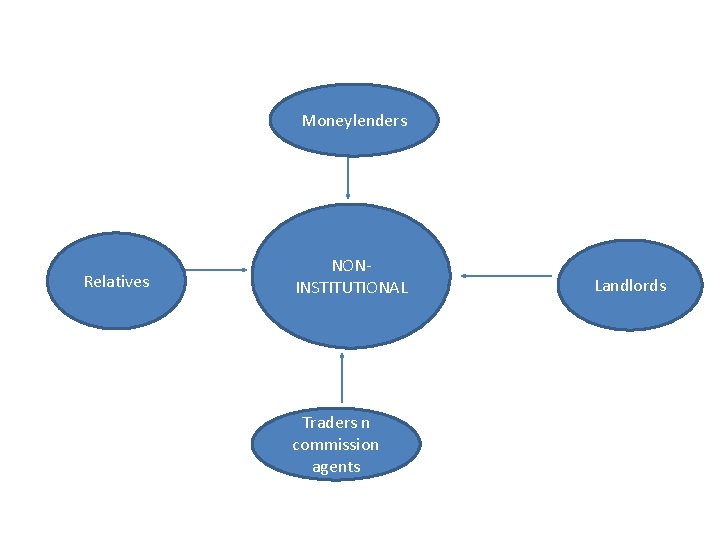
Moneylenders Relatives NONINSTITUTIONAL Traders n commission agents Landlords
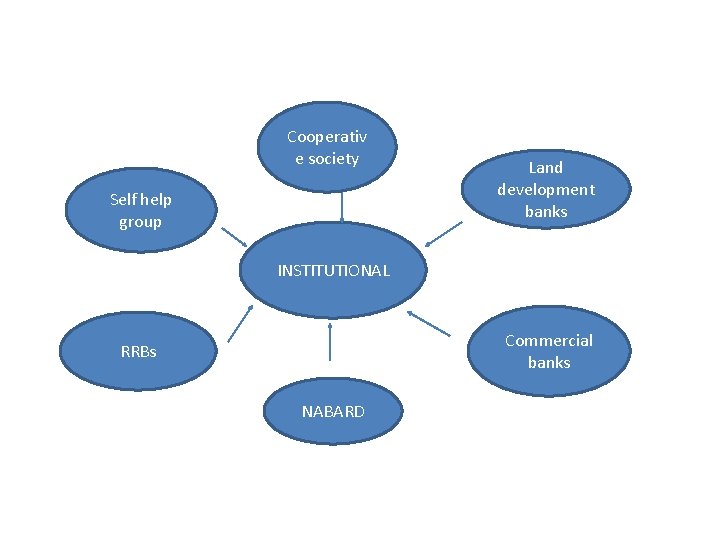
Cooperativ e society Self help group Land development banks INSTITUTIONAL Commercial banks RRBs NABARD
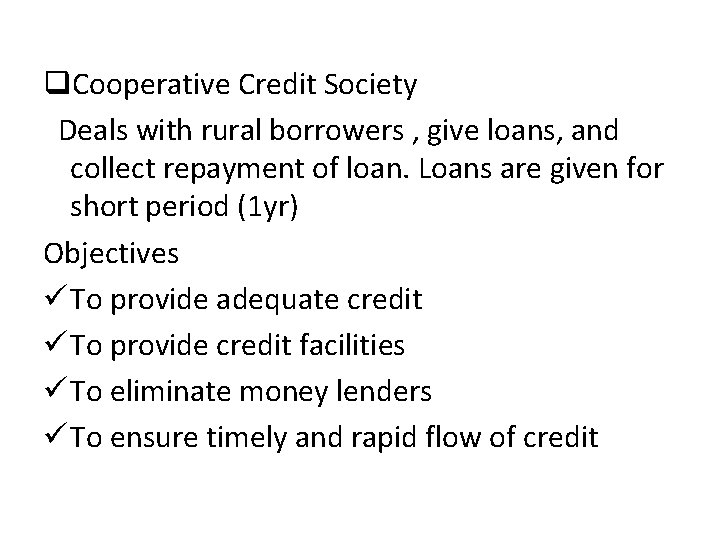
q. Cooperative Credit Society Deals with rural borrowers , give loans, and collect repayment of loan. Loans are given for short period (1 yr) Objectives ü To provide adequate credit ü To provide credit facilities ü To eliminate money lenders ü To ensure timely and rapid flow of credit
q. Land Development Banks Specialized institutions for providing long term credit to agriculturists. Loans are given for longer period for redemption of old debts, improvements of land, purchase of costly agriculture equipments like tractors, construction of wells etc. q. NABARD Coordinates the activity of all institutions involved in the rural financing system. Objective-provide credit for agricultural promotion, small scale industries, cottage and village industries etc.
q RRBs Operate at district level + under control of NABARD + grant direct loans to weaker sections of rural areas + for productive work + reasonable interest rate + mobilize rural savings + also called small man’s bank. q SHGs Self-help groups, also known as mutual help+ mutual aid+ support groups+ are groups of people who provide mutual support for each other + members share a common problem+ from the pooled money + credit is given to needy + at reasonable interest rate + can be repaid in small installments + also called Micro Credit Programmes.
Problems of Rural Credit in India: 1. Insufficiency: • In spite of expansion of rural credit structure, the volume of rural credit in the country is still insufficient as compared to its growing requirement arising out of increase in prices of agricultural inputs. 2. Inadequate Amount of Sanction: • The amount of loan sanctioned to the farmers by the agencies is also very much inadequate for meeting their different aspects of agricultural operations. Considering the amount of loan sanctioned as inadequate and insignificant, the farmers often divert such loan for unproductive purposes and thereby dilute the very purpose of such loan. 3. Lesser Attention of Poor Farmers: • Rural credit agencies and its schemes have failed to meet the needs of the small and marginal farmers. Thus, lesser attention has been given on the credit needs of the needy farmers whereas the comparatively well-to-do farmers are getting more attention from the credit agencies for their better credit worthiness.
4. Growing Over-dues • The problem of over-dues in agricultural credit continues to be an area of concern. The recovery of agricultural advances to various institutions is also not at all satisfactory. In 1997 -98, the recovery of agricultural advances of commercial banks, co-operative banks and regional rural banks were 63 per cent, 66 per cent and 57 per cent respectively. Such growing over-dues has also been resulted from poor repaying capacity of farmers. As a result of that, the credit agencies are becoming wary of granting loan to farmers. 5. Inadequate Institutional Coverage: • In India, the institutional credit arrangement continues to be inadequate as compared to its growing needs. The development of co-operative credit institutions like Primary agricultural credit societies, land development banks, commercial banks and regional rural banks, have failed to cover the entire rural farmers of the country.