
Agricultural Market Access Database AMAD Workshop on Tools
Agricultural Market Access Database (AMAD) Workshop on Tools and Methods for Trade and Trade Policy Analysis 11 -15 September 2006 1
What is AMAD? • AMAD stands for the Agricultural Market Access Database. • It is a publicly available information tool for the analysis of WTO market access issues in agriculture. 2
Who is responsible for AMAD? • Result of a co-operative effort by Agriculture and Agri-Food Canada, European Commission – DG Agriculture, FAO, OECD, UNCTAD, United States Department of Agriculture – Economic Research Service, and the World Bank. 3
How can AMAD be accessed? • Available freely online at www. amad. org. • Based in MS Access/Excel. 4
What information does AMAD contain? • AMAD is the most comprehensive collection of available public data on WTO market access in agriculture. • It contains detailed data on WTO tariffs and TRQ schedules, import data, applied tariffs, production, consumption and trade. • AMAD contains data for all agricultural commodities at the tariff -line level. • AMAD contains data for 126 countries, including all major agricultural trading members. • The data is updated yearly and new information is being added. • The sources of data are WTO tariff and TRQ schedules, WTO notifications of TRQ implementation, UNCTAD TRAINS, UNSD COMTRADE, FAOstat, Eurostat, and various national trade data. 5
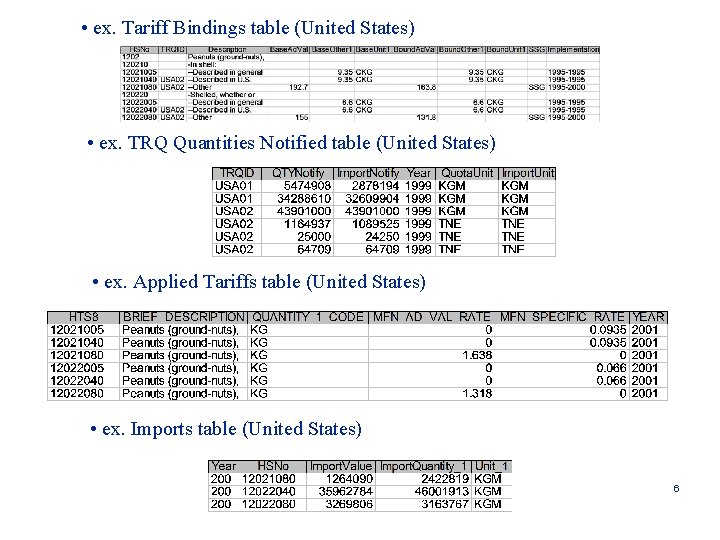
• ex. Tariff Bindings table (United States) • ex. TRQ Quantities Notified table (United States) • ex. Applied Tariffs table (United States) • ex. Imports table (United States) 6
What can AMAD be used for? • Purpose of the database is to provide a common data set on tariffs. • AMAD provides tools for policy makers and researchers to use in analysing levels of tariff protection in agriculture among WTO members. • It can also assist in improving international transparency of agricultural trade as covered by multilateral rules and disciplines. 7
Uses of AMAD • Constructing tariff surfaces. • Analysis of tariff escalation. • Measuring “water in the tariff”. • Identifying differences in tariffs on like products. • Evaluating alternative formulas for reducing agricultural tariffs. 8
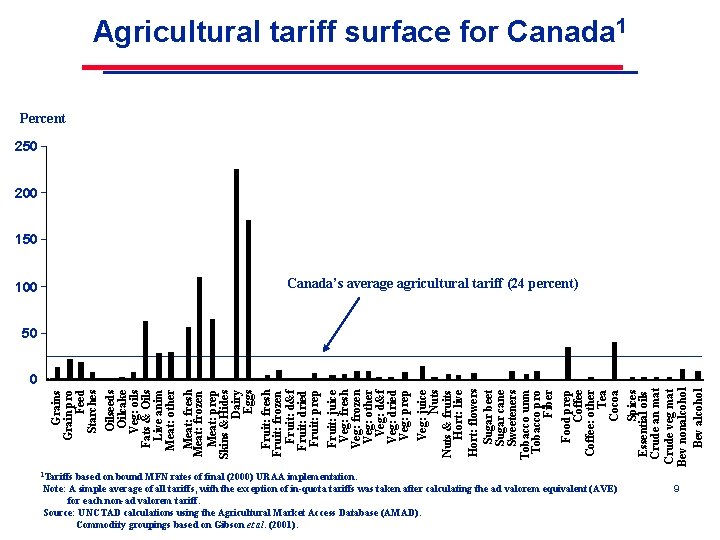
Agricultural tariff surface for Canada 1 Percent 250 200 150 Canada’s average agricultural tariff (24 percent) 100 50 Fruit: fresh Fruit: frozen Fruit: d&f Fruit: dried Fruit: prep Fruit: juice Veg: fresh Veg: frozen Veg: other Veg: d&f Veg: dried Veg: prep Veg: juice Nuts & fruits Hort: live Hort: flowers Sugar beet Sugar cane Sweeteners Tobacco unm Tobacco pro Fiber Food prep Coffee: other Tea Cocoa Spices Essential oils Crude an mat Crude veg mat Bev nonalcohol Bev alcohol Grains Grain pro Feed Starches Oilseeds Oilcake Veg: oils Fats & Oils Live anim Meat: other Meat: fresh Meat: frozen Meat: prep Skins &Hides Dairy Eggs 0 1 Tariffs based on bound MFN rates of final (2000) URAA implementation. Note: A simple average of all tariffs, with the exception of in-quota tariffs was taken after calculating the ad valorem equivalent (AVE) for each non-ad valorem tariff. Source: UNCTAD calculations using the Agricultural Market Access Database (AMAD). Commodity groupings based on Gibson et al. (2001). 9
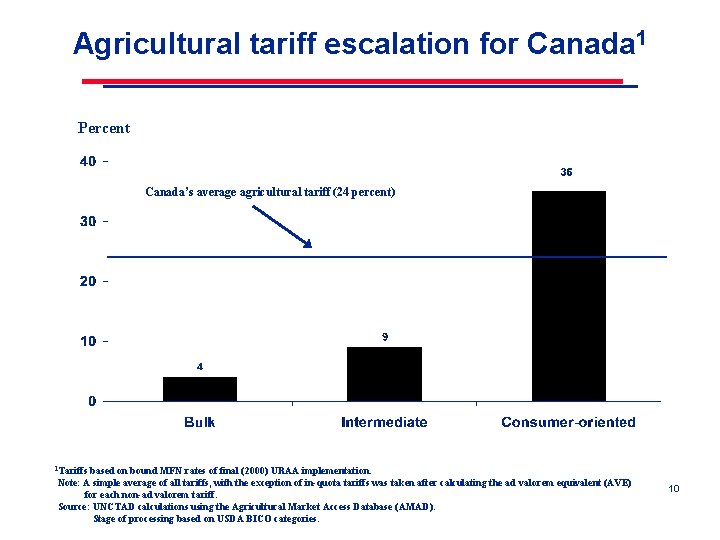
Agricultural tariff escalation for Canada 1 Percent Canada’s average agricultural tariff (24 percent) 1 Tariffs based on bound MFN rates of final (2000) URAA implementation. Note: A simple average of all tariffs, with the exception of in-quota tariffs was taken after calculating the ad valorem equivalent (AVE) for each non-ad valorem tariff. Source: UNCTAD calculations using the Agricultural Market Access Database (AMAD). Stage of processing based on USDA BICO categories. 10
Future direction of AMAD • Incorporate tariff-rate quota (TRQ) administration methods. • Include information on Special Safeguards (SSGs). • Incorporate market access related questions and answers from Summary Reports of the Committee on Agriculture. 11
Other uses of AMAD • Data in AMAD is used in UNCTAD Agricultural Trade Policy Simulation Model (ATPSM) 12
Publications using AMAD • Burfisher, Mary. et al. Agricultural Policy Reform in the WTO: The Road Ahead. Economic Research Service, USDA, Agricultural Economic Report Number 802, May 2001. • Costa Rica. Agricultural Negotiations under the Doha Agenda: Elements to be Taken into Account with Regard to Non-Ad Valorem Tariffs (NAV). Specific Contribution by Costa Rica to the Text. JOB(02)/87. 16 July 2002. • Gibson, Paul. et al. Profiles of Tariffs in Global Agricultural Markets. Economic Research Service, USDA, Agricultural Economic Report Number 796, January 2001. • Shirotori, Miho. WTO Negotiations on Agriculture: Assessment of Non-Ad Valorem Tariffs as a Tariff Barrier. UNCTAD, WEB/CDP/BKGB/8, 2002. 13
- Slides: 13