
AGRICULTURAL INSPECTION AND CERTIFICATION PROCEDURES DIRECTORATE INSPECTION SERVICES

- Slides: 26
AGRICULTURAL INSPECTION AND CERTIFICATION PROCEDURES DIRECTORATE: INSPECTION SERVICES 10 MARCH 2021
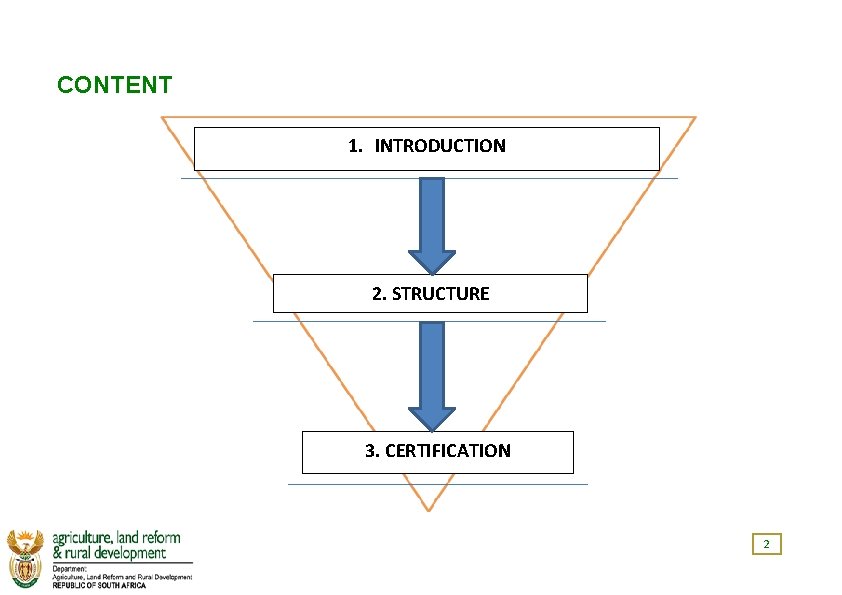
CONTENT 1. INTRODUCTION 2. STRUCTURE 3. CERTIFICATION 2
INTRODUCTION q Responsibilities of Directorate: Inspection Services ü To provide leadership, guidance and support in ensuring compliance with agricultural legislation and regulatory frameworks and overseeing the effective implementation of risk management strategies and plans for regulated agricultural products, with the aim of minimizing pest and diseases entering the territory of South Africa at ports of entry and national by conducting regulatory compliance and monitoring interventions through: • Quarantine ( official isolation areas for imported plants and animals to monitor pests and diseases), • Inspections, • Surveillance and • Testing.
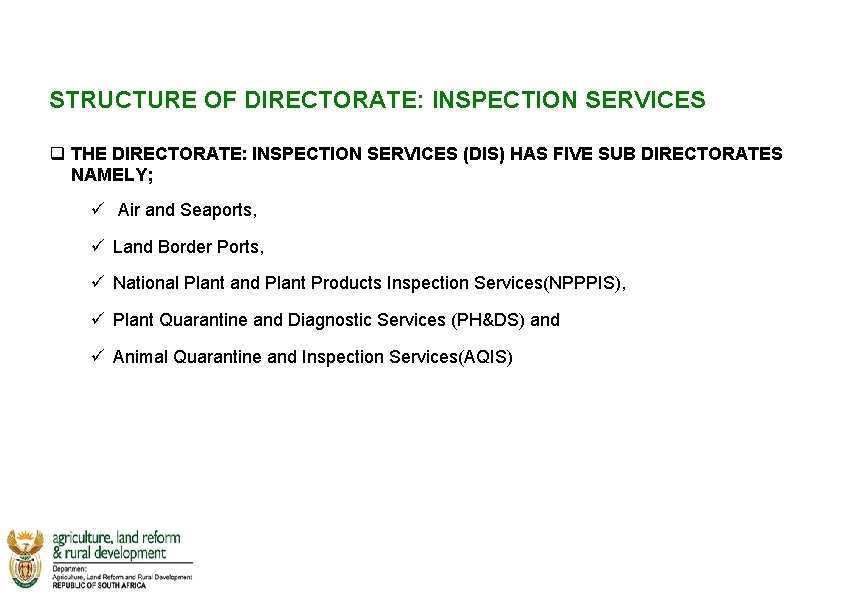
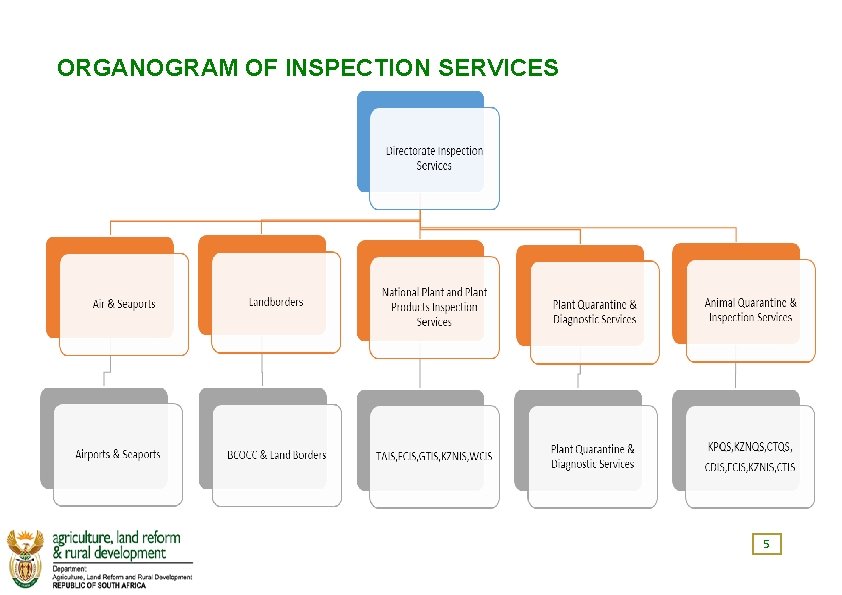
STRUCTURE OF DIRECTORATE: INSPECTION SERVICES q THE DIRECTORATE: INSPECTION SERVICES (DIS) HAS FIVE SUB DIRECTORATES NAMELY; ü Air and Seaports, ü Land Border Ports, ü National Plant and Plant Products Inspection Services(NPPPIS), ü Plant Quarantine and Diagnostic Services (PH&DS) and ü Animal Quarantine and Inspection Services(AQIS)
ORGANOGRAM OF INSPECTION SERVICES 5
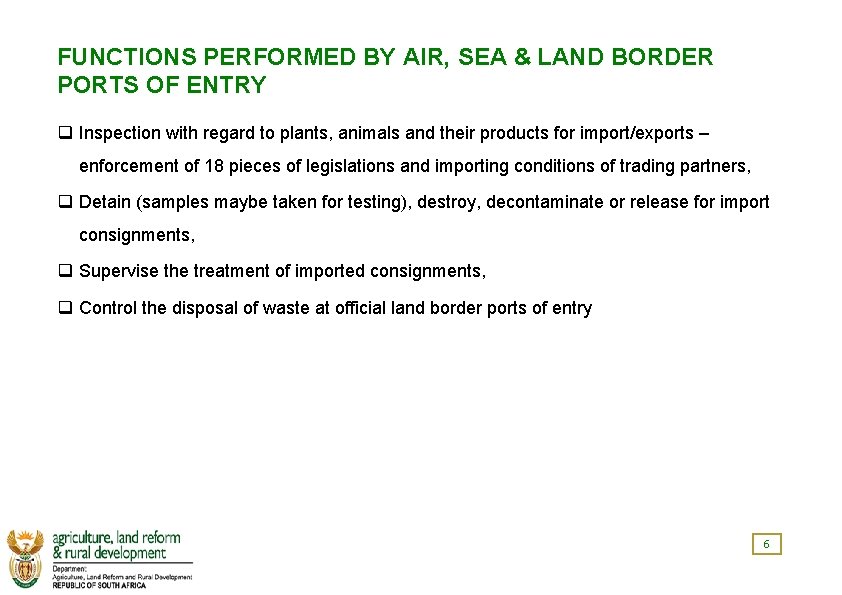
FUNCTIONS PERFORMED BY AIR, SEA & LAND BORDER PORTS OF ENTRY q Inspection with regard to plants, animals and their products for import/exports – enforcement of 18 pieces of legislations and importing conditions of trading partners, q Detain (samples maybe taken for testing), destroy, decontaminate or release for import consignments, q Supervise the treatment of imported consignments, q Control the disposal of waste at official land border ports of entry 6
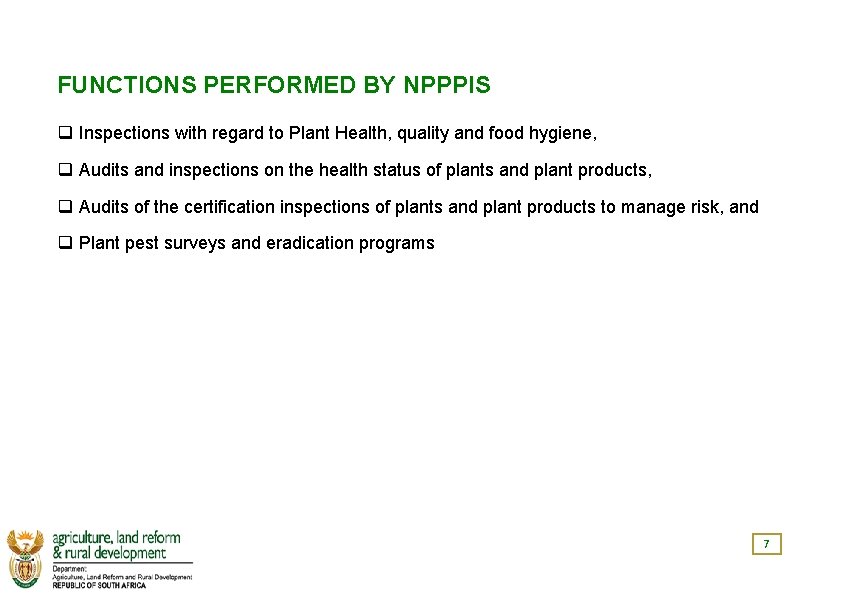
FUNCTIONS PERFORMED BY NPPPIS q Inspections with regard to Plant Health, quality and food hygiene, q Audits and inspections on the health status of plants and plant products, q Audits of the certification inspections of plants and plant products to manage risk, and q Plant pest surveys and eradication programs 7
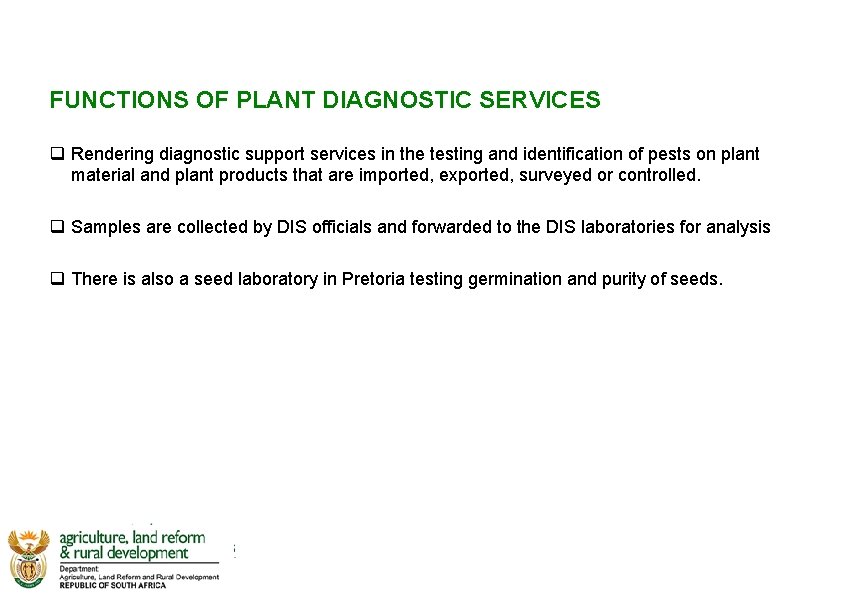
FUNCTIONS OF PLANT DIAGNOSTIC SERVICES q Rendering diagnostic support services in the testing and identification of pests on plant material and plant products that are imported, exported, surveyed or controlled. q Samples are collected by DIS officials and forwarded to the DIS laboratories for analysis q There is also a seed laboratory in Pretoria testing germination and purity of seeds.
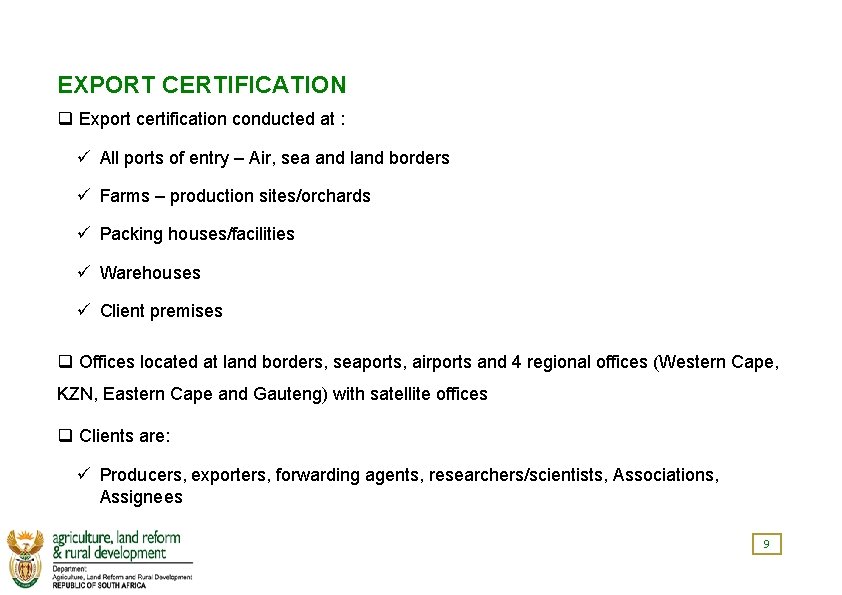
EXPORT CERTIFICATION q Export certification conducted at : ü All ports of entry – Air, sea and land borders ü Farms – production sites/orchards ü Packing houses/facilities ü Warehouses ü Client premises q Offices located at land borders, seaports, airports and 4 regional offices (Western Cape, KZN, Eastern Cape and Gauteng) with satellite offices q Clients are: ü Producers, exporters, forwarding agents, researchers/scientists, Associations, Assignees 9
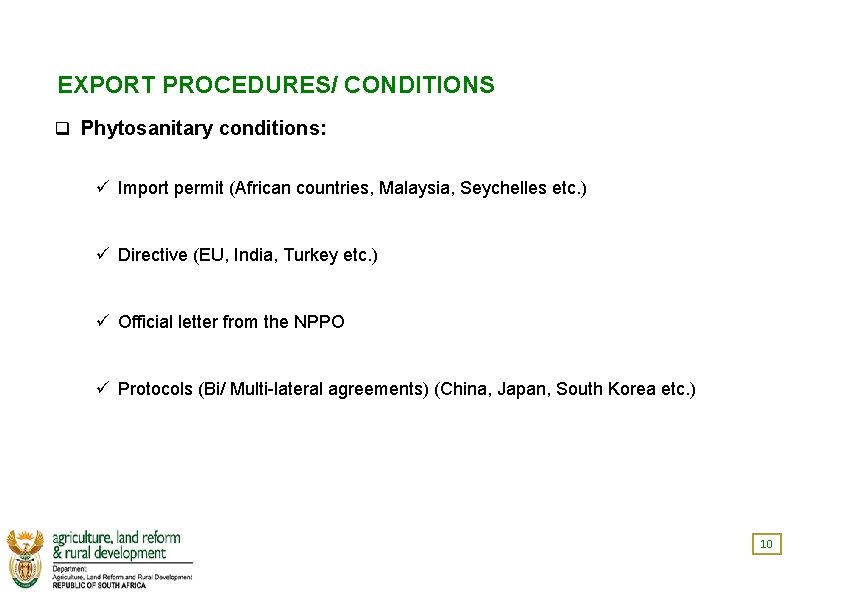
EXPORT PROCEDURES/ CONDITIONS q Phytosanitary conditions: ü Import permit (African countries, Malaysia, Seychelles etc. ) ü Directive (EU, India, Turkey etc. ) ü Official letter from the NPPO ü Protocols (Bi/ Multi-lateral agreements) (China, Japan, South Korea etc. ) 10
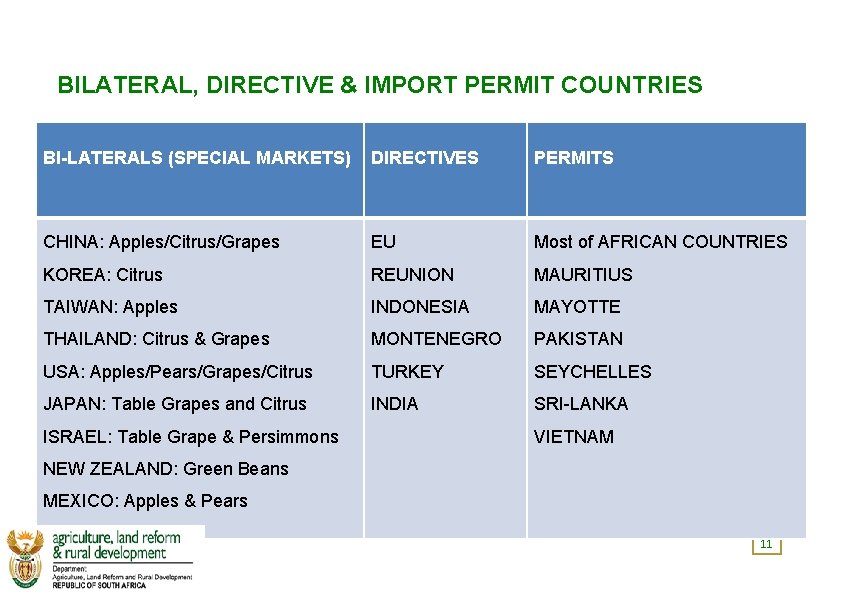
BILATERAL, DIRECTIVE & IMPORT PERMIT COUNTRIES BI-LATERALS (SPECIAL MARKETS) DIRECTIVES PERMITS CHINA: Apples/Citrus/Grapes EU Most of AFRICAN COUNTRIES KOREA: Citrus REUNION MAURITIUS TAIWAN: Apples INDONESIA MAYOTTE THAILAND: Citrus & Grapes MONTENEGRO PAKISTAN USA: Apples/Pears/Grapes/Citrus TURKEY SEYCHELLES JAPAN: Table Grapes and Citrus INDIA SRI-LANKA ISRAEL: Table Grape & Persimmons VIETNAM NEW ZEALAND: Green Beans MEXICO: Apples & Pears 11
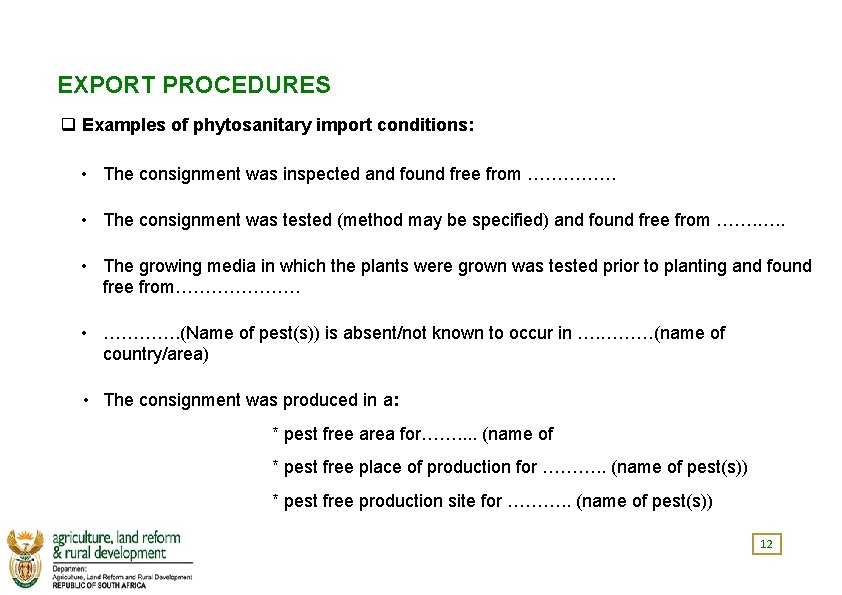
EXPORT PROCEDURES q Examples of phytosanitary import conditions: • The consignment was inspected and found free from …………… • The consignment was tested (method may be specified) and found free from ……. …. . • The growing media in which the plants were grown was tested prior to planting and found free from………………… • …………. (Name of pest(s)) is absent/not known to occur in …. ………(name of country/area) • The consignment was produced in a: * pest free area for……. . (name of * pest free place of production for ………. . (name of pest(s)) * pest free production site for ………. . (name of pest(s)) 12
EXPORT PROCEDURES q IMPORTANT POINTS TO KNOW BEFORE EXPORTING: ü FOR FRESH FRUITS: • FBO CODE (Food Business Operator Code) • PUC ( Producer Unit Code) • PHC (Pack House Code) ü DAFF WEBSITE- www. daff. gov. za: → Branches → Agricultural Production Health & Food Safety → Food Safety & Quality Assurance → Food Business Operator Codes ü The PUC and PHC must be registered before you to export, go to www. daff. gov. za→ Branches → Agricultural Production Health & Food Safety → Plant Health → Exporting from SA → Phytosanitary registration for special markets q Plants and Plant Products (other than fruits): Needs import permit/directive from Importing Country 13
EXPORT PROCEDURES q Export of citrus to the EU markets – pack house managers, exporters and forwarding agents to also register and attend pre-season citrus workshops with Inspection Services. EU CBS and FMS risk management systems in place. Recently EU enforced Fruit Fly control on fresh fruit and vegetables. q To consult the DALRRD website: www. daff. gov. za→ Branches → Agricultural Production Health & Food Safety → Inspection Services or Plant Health q Application forms for the various registrations (pack house managers, exporters and forwarding agents), field inspections and application for phytosanitary certificates together with the contact details for the Inspection Services are available under the link “ Inspection Services” q For protocols on fresh fruit export markets, registrations, databases are available under the link “ Plant Health 14
EXPORT PROCEDURES q Inspection Services to conduct inspections for fresh fruit/vegetables exports at registered production units/ orchards, pack houses and inspections points - confirm with regional or satellite office q Perishable Export Control Board (PPECB) to conduct inspections at pack houses, inspection points, silos and grain facilities for the export of fresh fruit, vegetables and grain for consumption – to issue addendum and export certificate q PPECB also tests for Maximum Residue Limits (MRLs) and other contaminants for certain markets; and ensures the cold chain management by issuing temperature certificates q Removal permits for the movement of fresh fruit and vegetables from Bactrocera dorsalis quarantine areas to non quarantine areas is needed. Inspection Services to conduct inspections on farms. 15
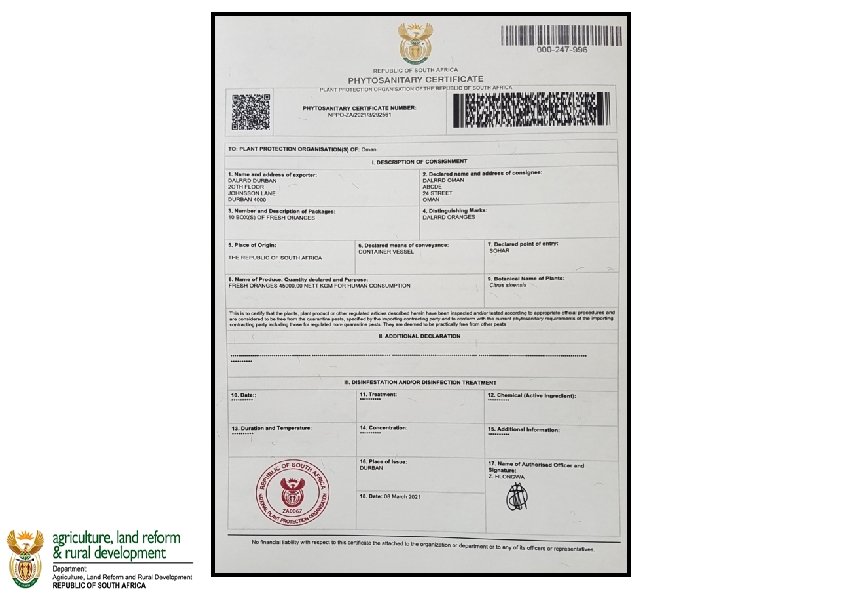
EXPORT PROCEDURES q Export of plants, seeds, flowers may require field inspections and laboratory testing – can take a few days to weeks depending on pest or disease to be tested for q Some fresh fruit may require in transit cold treatment/ chemical treatment and other products before shipping to be chemically treated. q GMO status of commodities may be required depending on import permit conditions q Export of seed may require SANSOR reports and seed potato reports from Potato certification scheme q Application for the issuance of phytosanitary certificates are done on line through Ecertification. Clients are requested to visit the website: www. ecert. co. za for all information on e-cert 16
17
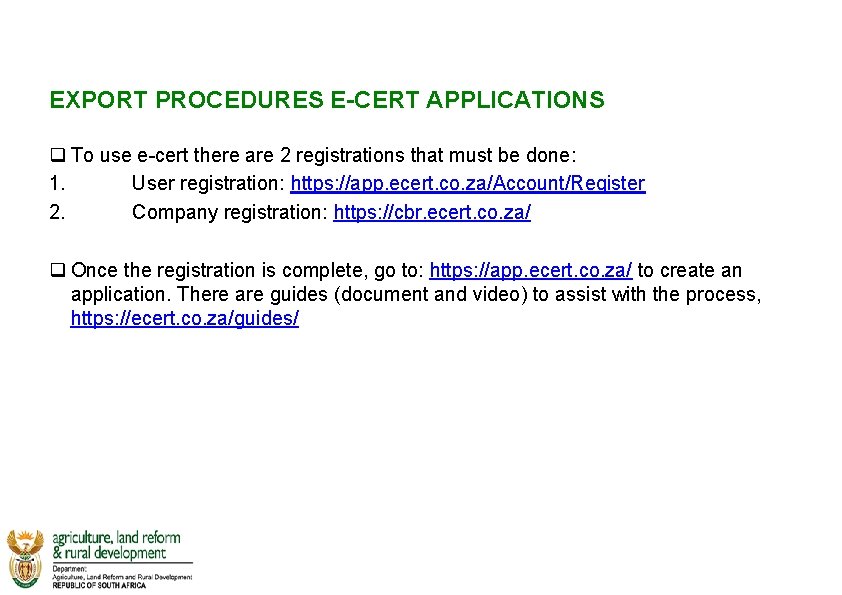
EXPORT PROCEDURES E-CERT APPLICATIONS q To use e-cert there are 2 registrations that must be done: 1. User registration: https: //app. ecert. co. za/Account/Register 2. Company registration: https: //cbr. ecert. co. za/ q Once the registration is complete, go to: https: //app. ecert. co. za/ to create an application. There are guides (document and video) to assist with the process, https: //ecert. co. za/guides/
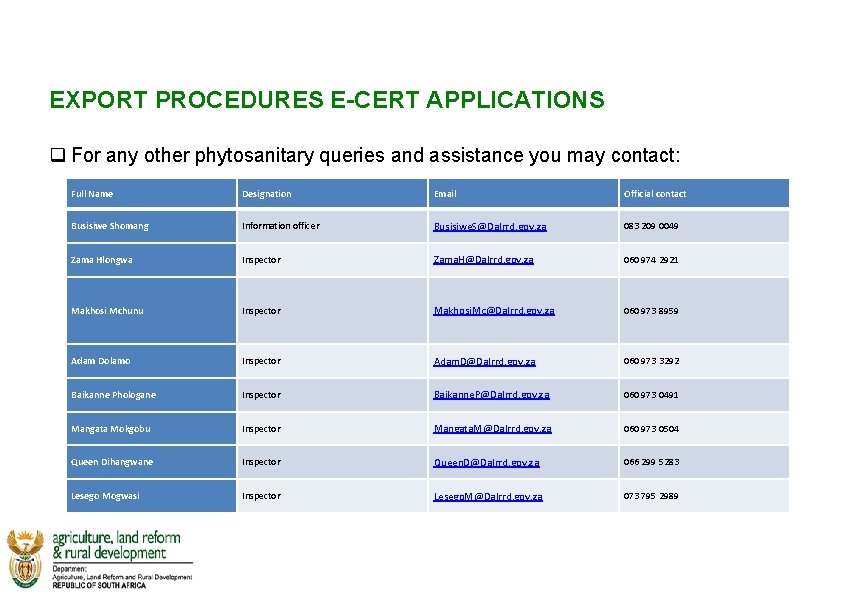
EXPORT PROCEDURES E-CERT APPLICATIONS q For any other phytosanitary queries and assistance you may contact: Full Name Designation Email Official contact Busisiwe Shomang Information officer Busisiwe. S@Dalrrd. gov. za 083 209 0049 Zama Hlongwa Inspector Zama. H@Dalrrd. gov. za 060 974 2921 Makhosi Mchunu Inspector Makhosi. Mc@Dalrrd. gov. za 060 973 8959 Adam Dolamo Inspector Adam. D@Dalrrd. gov. za 060 973 3292 Baikanne Phologane Inspector Baikanne. P@Dalrrd. gov. za 060 973 0491 Mangata Mokgobu Inspector Mangata. M@Dalrrd. gov. za 060 973 0504 Queen Dihangwane Inspector Queen. D@Dalrrd. gov. za 066 299 5283 Lesego Mogwasi Inspector Lesego. M@Dalrrd. gov. za 073 795 2989
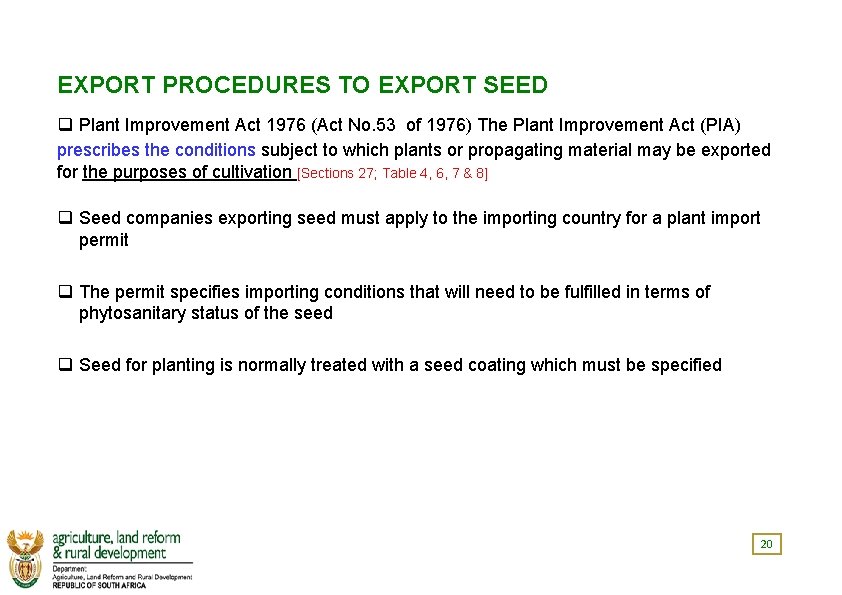
EXPORT PROCEDURES TO EXPORT SEED q Plant Improvement Act 1976 (Act No. 53 of 1976) The Plant Improvement Act (PIA) prescribes the conditions subject to which plants or propagating material may be exported for the purposes of cultivation [Sections 27; Table 4, 6, 7 & 8] q Seed companies exporting seed must apply to the importing country for a plant import permit q The permit specifies importing conditions that will need to be fulfilled in terms of phytosanitary status of the seed q Seed for planting is normally treated with a seed coating which must be specified 20
EXPORT PROCEDURES TO EXPORT SEED q Export certificate: PIA section 27 indicates the following seed to be accompanied by an export certificate v. i. z. White and Yellow Maize, Sorghum, Beans, Soybean and Sunflower q Companies must apply for an export certificate for certain kinds of seed. The application for export certificate must be accompanied by laboratory tests to ascertain the percentage germination and purity (e. g. export certification application) 21
EXPORT PROCEDURES TO EXPORT SEED q OICs: Certain African countries require Orange international certification for certain imported seeds since this scheme specifies a predetermined minimum germ and purity for the given seed varieties. OICs need to be applied for at least 2 months prior to export of the seed. q GMO free certificate: Three kinds of seed (maize, soybean and cotton) need to be declared as GMO free prior to export to certain countries. The exporter will need to apply via D: Biosafety to declare that the seed is free from GMOs. Certain labs are consulted to test as to the status of these consignments q Controlling the export of certain plants and propagating material [Sections 27] q Certified plant propagating material need to comply with much stricter requirements as prescribed by individual scheme regulations 22
EXPORT PROCEDURES TO EXPORT SEEDS 1. 2. 3. 4. 5. Groundnut (Arachis hypogaea L. ) Kidney bean (Phaseolus coccineus L. ) Dry bean (Phaseolus vulgaris L. ) Grain sorghum (Sorghum bicolor (L. ) Moench. ) Cowpea (Vigna unguiculata (L. ) Walp. [Including V. sinensis(L>) Savi ex Hassk. ; Dolichos biflorus L. ]) 6. White and yellow grain maize (Zea mays L. ) If the above mentioned seeds are less than 50 kg, the exporter does not need an export certificate 23
EXPORT PROCEDURES - WOOD PACKAGING ISPM 15 • Registered with DAFF-DIS. • Legible, permanent and not transferable. • Placed in visible location, preferable on at least two opposite sides. • Rectangular or square in shape. • Surrounded by border line with a vertical line separating IPPC logo from country information. • Must not be hand drawn. • No other information shall be contained within the borders of the mark. • Mark should consist of: The symbol, IPPC logo, Country code – ZA, Unique code allocated to service provider, Treatment code – MB /HT www. dalrrd. gov. za→ Branches → Agricultural Production Health & Food Safety → Plant Health → Inspection Services Wood packaging List of registered service providers 24
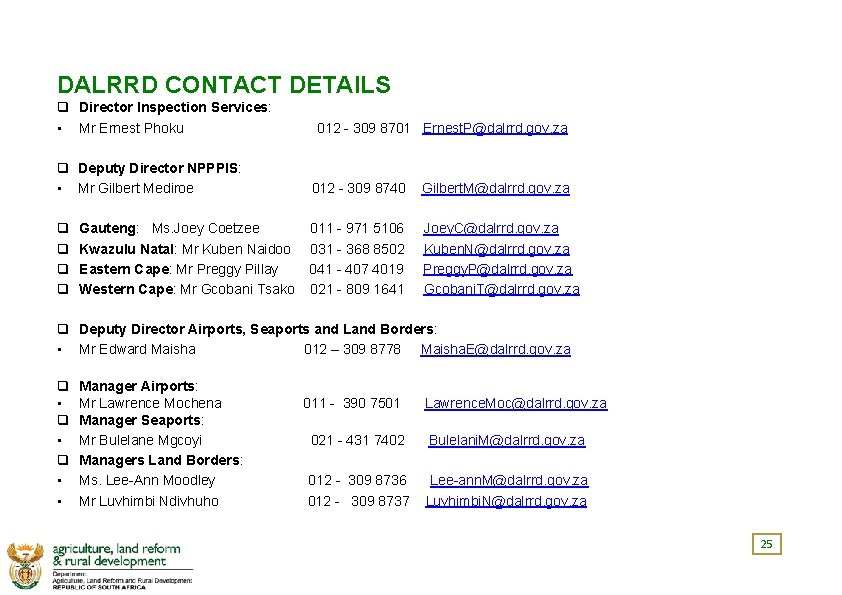
DALRRD CONTACT DETAILS q Director Inspection Services: • Mr Ernest Phoku 012 - 309 8701 Ernest. P@dalrrd. gov. za q Deputy Director NPPPIS: • Mr Gilbert Mediroe 012 - 309 8740 Gilbert. M@dalrrd. gov. za q q 011 - 971 5106 031 - 368 8502 041 - 407 4019 021 - 809 1641 Joey. C@dalrrd. gov. za Kuben. N@dalrrd. gov. za Preggy. P@dalrrd. gov. za Gcobani. T@dalrrd. gov. za Gauteng: Ms. Joey Coetzee Kwazulu Natal: Mr Kuben Naidoo Eastern Cape: Mr Preggy Pillay Western Cape: Mr Gcobani Tsako q Deputy Director Airports, Seaports and Land Borders: • Mr Edward Maisha 012 – 309 8778 Maisha. E@dalrrd. gov. za q • q • • Manager Airports: Mr Lawrence Mochena Manager Seaports: Mr Bulelane Mgcoyi Managers Land Borders: Ms. Lee-Ann Moodley Mr Luvhimbi Ndivhuho 011 - 390 7501 Lawrence. Moc@dalrrd. gov. za 021 - 431 7402 Bulelani. M@dalrrd. gov. za 012 - 309 8736 012 - 309 8737 Lee-ann. M@dalrrd. gov. za Luvhimbi. N@dalrrd. gov. za 25
THANK YOU 26