
AGRICULTURAL EXTENSION PROGRAMMES IN PAKISTAN Village Cooperative movement
- Slides: 35
AGRICULTURAL EXTENSION PROGRAMMES IN PAKISTAN
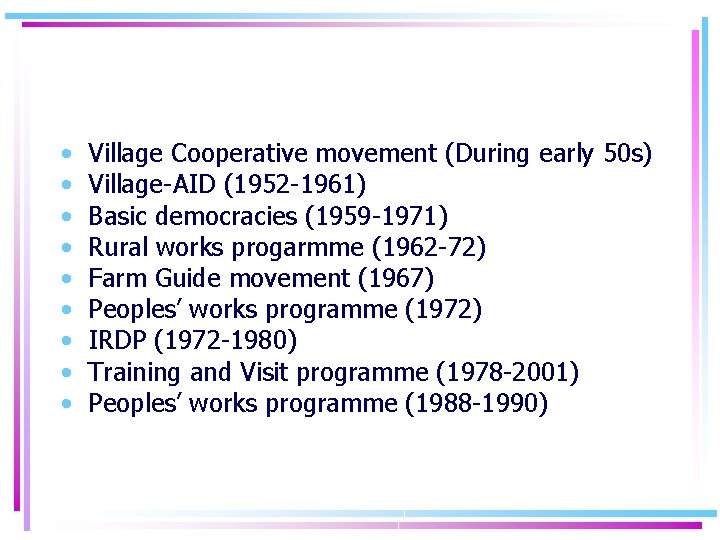
• • • Village Cooperative movement (During early 50 s) Village-AID (1952 -1961) Basic democracies (1959 -1971) Rural works progarmme (1962 -72) Farm Guide movement (1967) Peoples’ works programme (1972) IRDP (1972 -1980) Training and Visit programme (1978 -2001) Peoples’ works programme (1988 -1990)
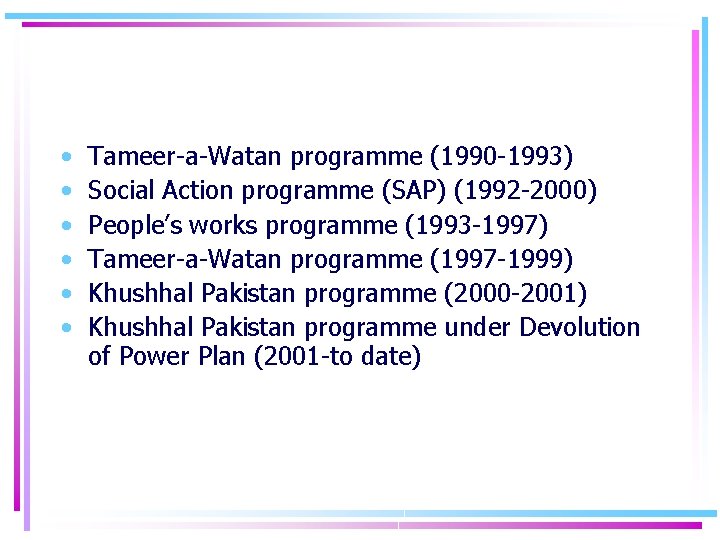
• • • Tameer-a-Watan programme (1990 -1993) Social Action programme (SAP) (1992 -2000) People’s works programme (1993 -1997) Tameer-a-Watan programme (1997 -1999) Khushhal Pakistan programme (2000 -2001) Khushhal Pakistan programme under Devolution of Power Plan (2001 -to date)
Village Agricultural and Industrial Development Programme (V-AID) • Started in 1952 after the recommendations of Sufi Committee • Committee stressed the need for bridging the gulf between Govt. and rural people
V-AID • Funding agencies 1. United States responsible for i. Technical advices ii. Training for Pakistani officials iii. Equipment and commodities 2. Ford Foundation responsible for i. Funds for salaries
V-AID • Democratic approach • People participate on self help basis OBJECTIVES 1. To raise productivity of rural people by modern techniques 2. To multiply existing community services
V-AID 3. To create spirit of self help among villagers 4. To develop coordination among other developmental agencies 5. To improve the condition through social mobilization both to men and women
V-AID Causes of failure • Termination of US mission aid • Departmental revelry • Frequent transfer of officers • Lack of experienced worker, supervisors and instructors Terminated on 1961
Basic Democracies Launched 1959 Terminated 1971 Objectives • To upgrade the living standard of rural people • To decentralize the Govt. administration • To develop a programme which met with the need of people
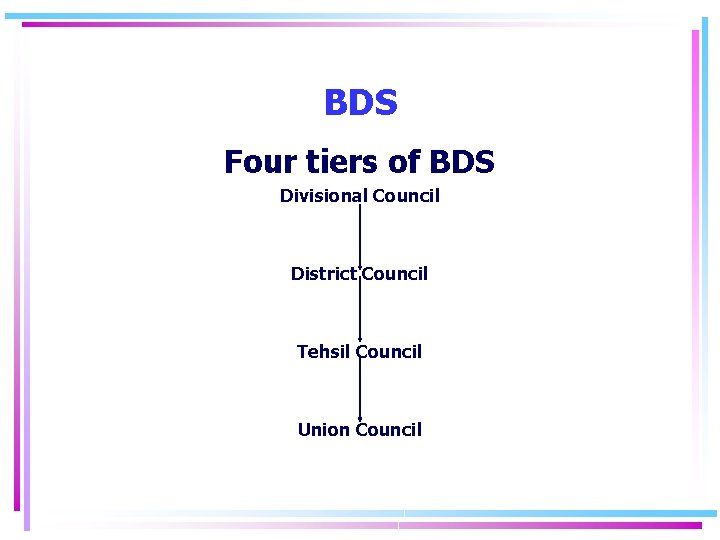
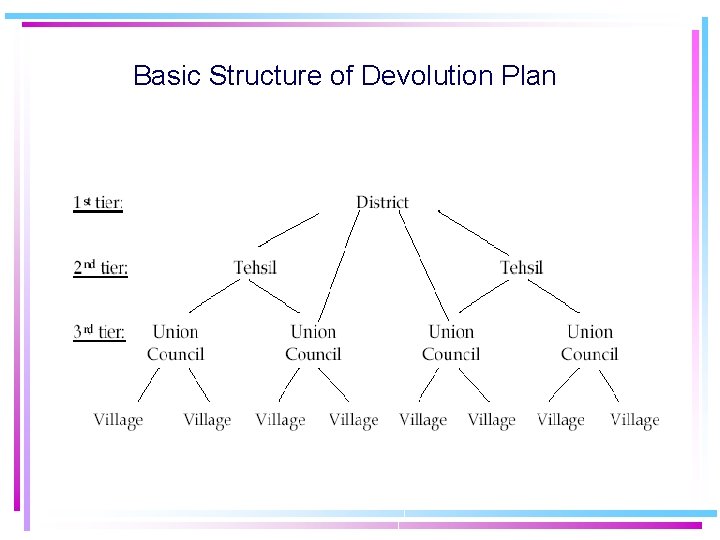
BDS Four tiers of BDS Divisional Council District Council Tehsil Council Union Council
BDS Training Institutes 1. At lala Musa and Tundo Jam 2. PARD, Peshawer Drawbacks • Bureautic approach • Most of the Basic democrats were illiterate
BDS • Revelry between different groups • Condition of poor remain miserable Rural Works Programme (RWP) On experimental basis started at Comilla East Pakistan from 1961 -1962 Launched 1963 Terminated 1972
RWP Main objectives • To provide employments to surplus agricultural labour • To create infrastructure like roads, bridges etc. • To raise additional financial resources through taxation • Training to local councilors in planning
RWP Causes of failure • Vanishing the concept of participatory management • Lack of technical skills • No due importance given to Agricultural Development • No procedure for accounting, reporting and evaluation
Farm Guide Movement West Pakistan Agricultural University, Lyallpur started FGM in 1967 Basic Objectives • To organize the farm and city youth • To disseminate achievements of Science and Technology to the farmer in the filed of Agriculture and industrial development
Peoples’ work programme (PWP) Launched 1972 Terminated 1977 By the recommendation of planning commission of Pakistan • Joint enterprise of Govt. and people • Govt. = Technical, administrative and some financial support
PWP • People= Contribute larger share in form of cash and identify projects Basic objectives • Reduced polarization of rural society by agrarian reforms • Establishment of effective and viable rural institutions • Maximization of agricultural productivity
PWP Causes of failure • Lack of inter and intra agency coordination • Ineffective involvement of people • Absence of rational planning at local level
IRDP Launched 1971 Terminated 1978 Objectives • Bring necessary institutional, structural and attitudinal changes • Packages of economic, industrial and social infrastructure • Improving the quality of life of rural poor and rural weak
IRDP Causes of Failure • Poor implementation of the district organization • Poor technical scrutiny and control • Influence of bureaucracy and feudal lords
Training and Visit programme Launched 1978 Terminated 2001 Main objectives • Exclusive focus on extension • Single and direct line of organizational administration • Transfer of technology through training and visit programme
T&V Causes of failure • Top down oriented • Rigid in terms of fortnightly schedule of visit • Very expensive • No effective use of mass media for communication
Tameer-a-Watan Programme Launched 1990 Terminated 1993 Basic Approach • Participation of elected representatives of public in planning and execution of developmental programmes on the basis of needs of people
Tameer-a-Watan Programme Basic objectives Provision of basic amenities such as drinking water, Health, sanitation, construction of rural roads, Village electrification, education, supply of natural gas and establishment of public call offices
Tameer-a-Watan Programme Coverage= Both rural and urban areas Terminated due to the change of Govt. in the country and again launch in 19971999 Administrative set up By the federal ministery of local Govt. and RD in collaboration with Provincial Govt.
Social Action Programme (SAP) Initially launched for three years Phase I 1993 -96 Key Elements • Primary education • Primary healthcare • Family planning • Rural water supply and sanitation
SAP Achievement All the targets of various components have been achieved fully Govt. initiated a four year SAP Phase-II 1996 -2000
Khushhal Pakistan Programme Launched 2000 -2001 Development schemes approved= 9, 899 Completed= 4, 746 Objective To create employment opportunities as well as to improve the living conditions of poor people
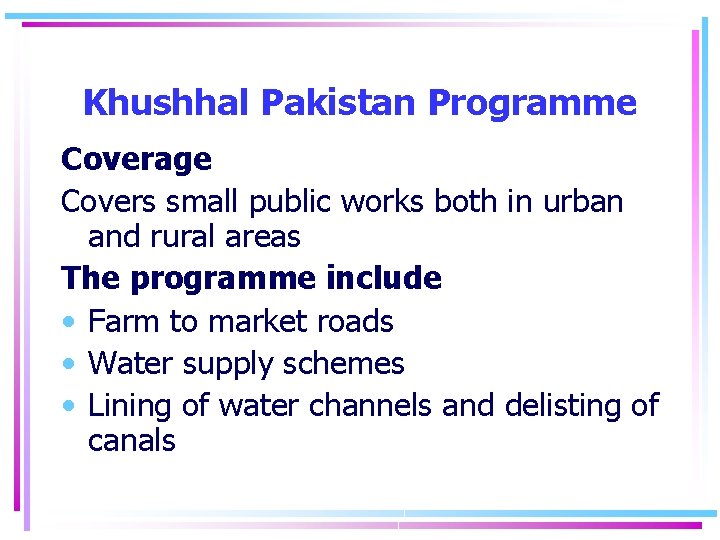
Khushhal Pakistan Programme Coverage Covers small public works both in urban and rural areas The programme include • Farm to market roads • Water supply schemes • Lining of water channels and delisting of canals
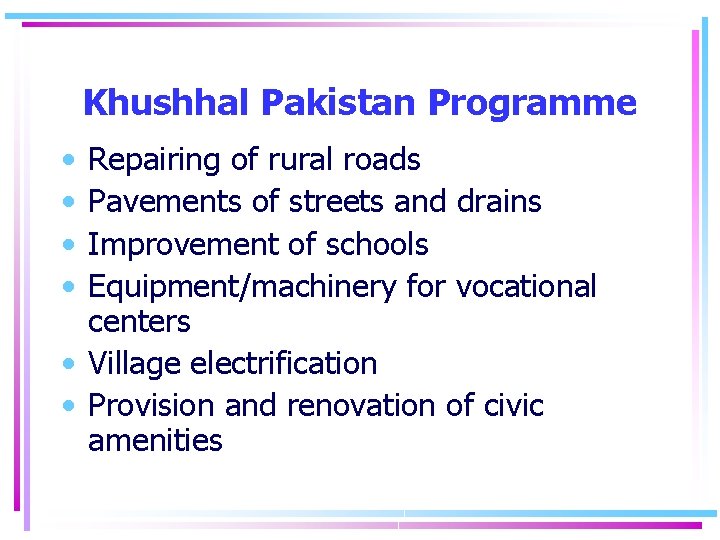
Khushhal Pakistan Programme • • Repairing of rural roads Pavements of streets and drains Improvement of schools Equipment/machinery for vocational centers • Village electrification • Provision and renovation of civic amenities
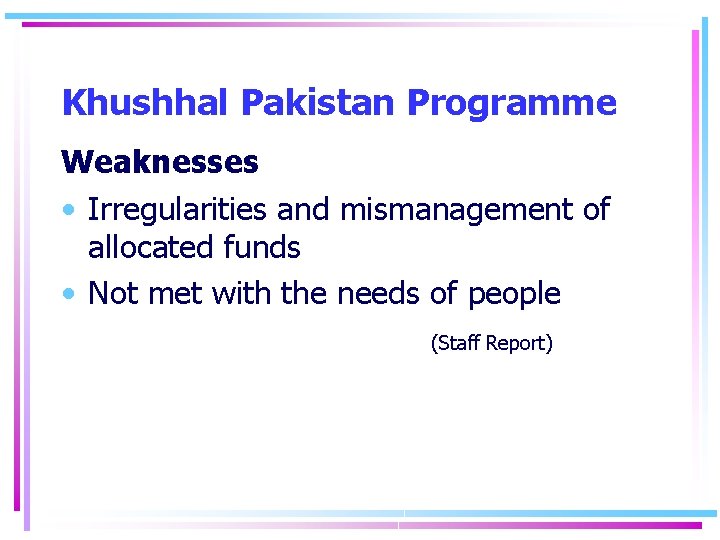
Khushhal Pakistan Programme Weaknesses • Irregularities and mismanagement of allocated funds • Not met with the needs of people (Staff Report)
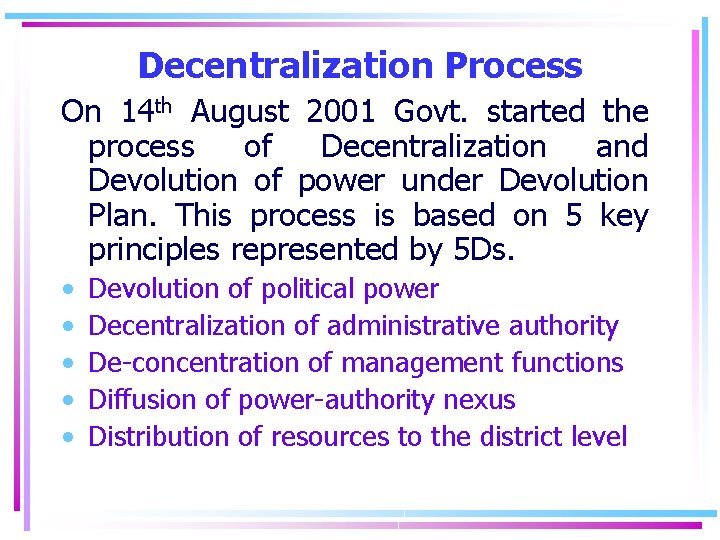
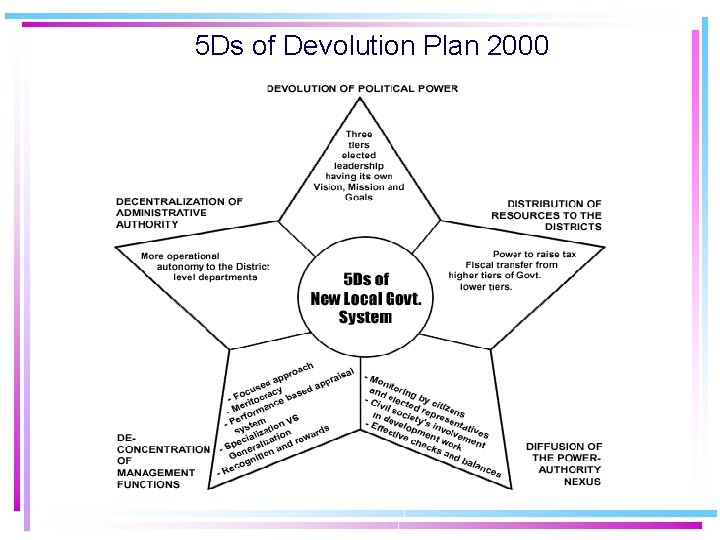
Decentralization Process On 14 th August 2001 Govt. started the process of Decentralization and Devolution of power under Devolution Plan. This process is based on 5 key principles represented by 5 Ds. • • • Devolution of political power Decentralization of administrative authority De-concentration of management functions Diffusion of power-authority nexus Distribution of resources to the district level
5 Ds of Devolution Plan 2000
Basic Structure of Devolution Plan
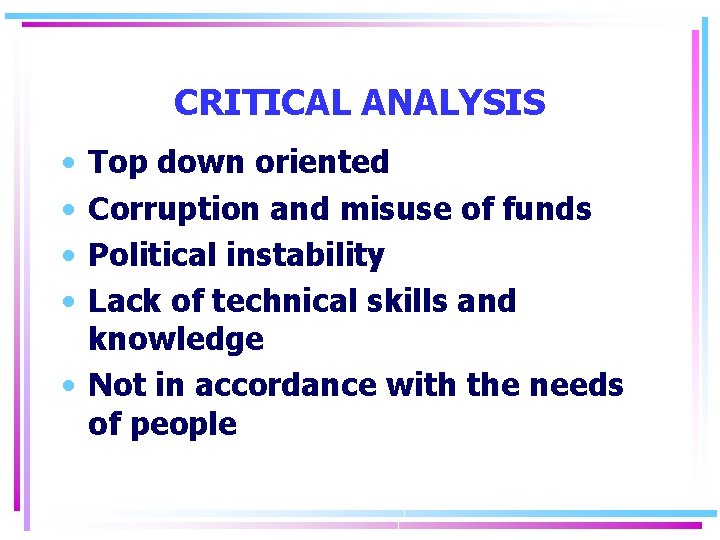
CRITICAL ANALYSIS • • Top down oriented Corruption and misuse of funds Political instability Lack of technical skills and knowledge • Not in accordance with the needs of people